What Is Business Investment? a Practical Guide for 2026

If a company borrows money to buy a bigger building, has it made a good investment, or taken on a bigger bill? The difference depends on what the building helps the company earn, what the financing costs, and what happens if customers don't arrive.
Answering what is business investment takes more than listing assets. Richard Maize's work across real estate and entrepreneurial ventures provides a useful perspective: examine what the business buys, who supplies the money, and whether the expected return justifies the risk.
What Business Investment Means in Plain Terms
An orchard owner plants trees that will produce fruit for years. That's investment: spending today to create something useful tomorrow. Buying apples to resell this week is ordinary trading, even though the owner also hopes to make a profit.
Business investment is spending on assets intended to support production, sales, or future growth. For long-lived fixed assets, the benefit extends beyond the current year rather than ending with the current production cycle.
From an Orchard to an Economy
For an individual company, investment might mean a machine, a commercial building, or software used repeatedly. The purchase can expand what employees can produce without creating anything ready to sell on the purchase date.
At the economy-wide level, gross capital formation includes fixed assets, inventory changes, and valuables. Worldwide gross capital formation equaled approximately 26.29% of global GDP in 2024, according to the World Bank's gross capital formation indicator. That measure includes public-sector and other institutional investment, so it isn't a measure of private-company spending alone.
Inventory explains an apparent contradiction in the orchard example. Buying apples is ordinary trading for the shopkeeper, but an increase in unsold apples held in stock can count as inventory investment in national accounts.
Who Is Doing the Investing?
Readers encounter the term from opposite directions:
Investment by a business: The company buys or develops assets for its operations.
Investment in a business: Owners, investors, or lenders supply capital, expecting an ownership return or repayment.
An investor supplying money hasn't necessarily caused productive capacity to increase. The company still has to use that money well.
Practical rule: Ask whether the proposed spending builds productive capacity or future cash flow beyond the current year.
That question separates a plausible investment from a purchase that merely feels important.
Forms and Goals of Business Investment at a Glance
Different forms of investment solve different problems, so match the asset to the job before comparing price tags.
Form | What it includes | Usual goal | Example |
|---|---|---|---|
Physical equipment | Machinery, vehicles, computers, tools | Raise output or cut cost per unit | A bakery buys a commercial oven |
Property and buildings | Offices, warehouses, factories, land improvements | Secure space that supports production or earns rent | A firm buys a warehouse near its customers |
Intellectual property and software | Software systems, patents, designs, creative works | Repeatable efficiency or protected product rights | A logistics company builds a routing system |
Inventory | Goods held for sale or production | Meet demand or capture price moves | A retailer stocks up before a holiday season |
Acquisitions of other businesses | Stake or full ownership of an existing firm | Gain market share, a capability or customers faster | A software firm buys a smaller competitor |
These categories aren't interchangeable in economic statistics. Buying an existing business transfers ownership; it doesn't automatically create new productive assets. Likewise, inventory serves a different purpose from a machine that remains in use.
Growth and Efficiency
Growth investment helps a business serve additional demand. A bakery might add an oven because it regularly turns away wholesale orders, while a distributor might acquire warehouse space to reach customers it can't currently serve.
The important evidence is unmet demand, not enthusiasm for expansion. Extra capacity without customers can leave the owner paying for unused space and equipment.
Efficiency investment helps employees produce the same output with fewer resources or more output with existing resources. Routing software, for example, might reduce avoidable driving and manual scheduling. Measure the saving after implementation, support, and training costs rather than assuming that automation always pays.
Resilience and Replacement
Resilience investment protects the business against disruption. Backup equipment or a more dependable production system may earn its place by reducing interrupted operations rather than generating new sales.
Replacement investment keeps existing operations viable when assets wear out. Replacing an unreliable oven may preserve current orders while also reducing energy use and adding capacity.
A single purchase can therefore serve several goals. The owner should identify which benefit justifies the decision rather than counting every possible advantage as guaranteed income.
Match the form to the actual problem, then test the expected return. Owning a building, patent, or business isn't enough by itself to make the purchase worthwhile.
How to Tell Investment From Everyday Business Spending
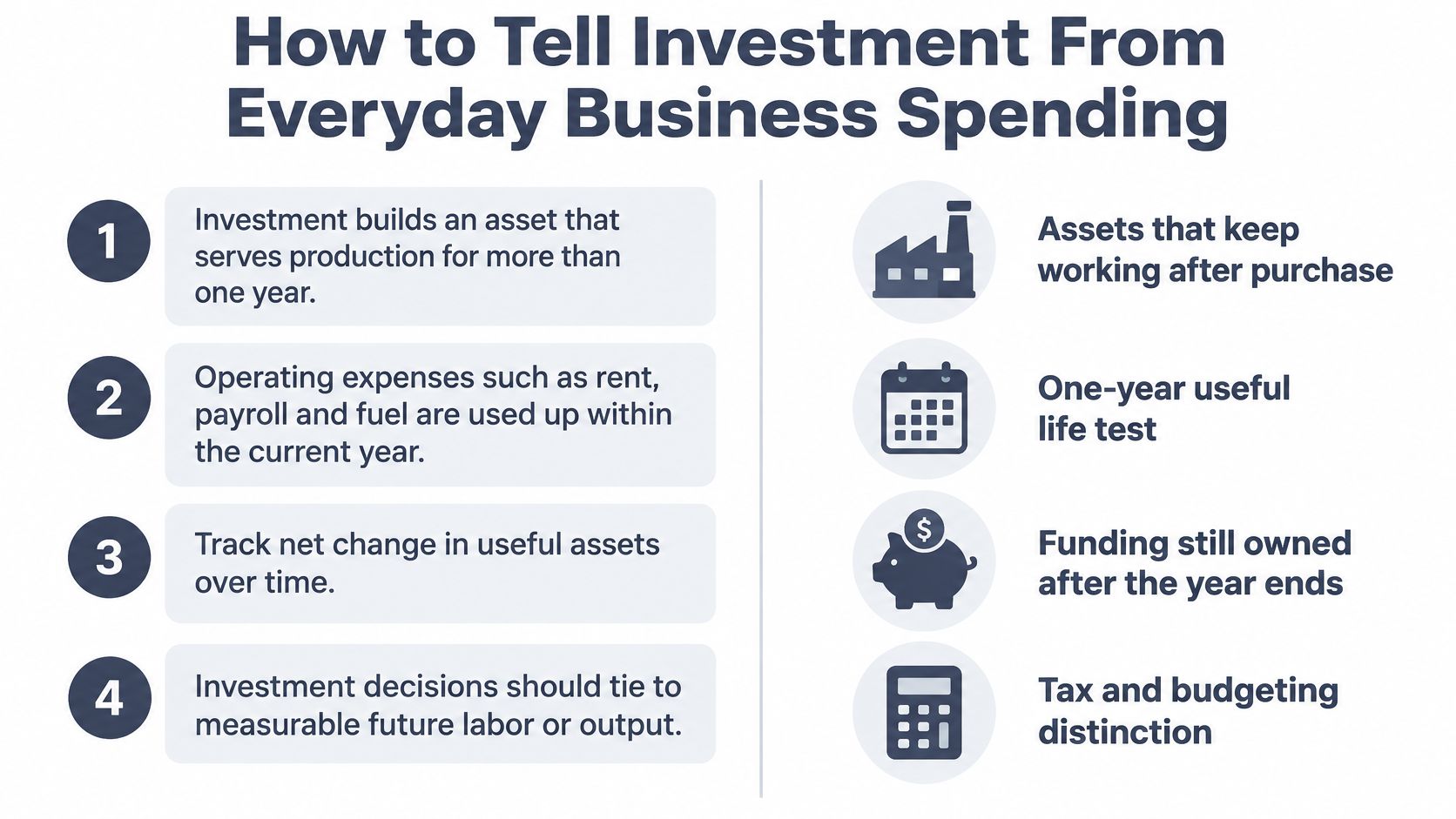
Investment creates an asset that keeps serving production; operating expenses support the current production cycle. Rent, routine payroll, and fuel generally belong to the latter category, even when they're essential to earning revenue.
The U.S. Bureau of Economic Analysis guide to fixed assets describes assets used in production for more than one year and groups them into equipment, structures, and intellectual-property products. A useful asset doesn't need to be something you can touch.
A Purchase Classification Checklist
Check the useful life. Ask whether the item will remain useful beyond the current year, rather than being consumed during ordinary operations.
Identify the future benefit. Name the additional output, recurring saving, or cash flow the purchase should support.
Identify the asset category. Decide whether you're acquiring equipment, a structure, or intellectual property rather than merely paying for an ongoing service.
Account for depreciation. Deduct the loss of value from existing assets when judging whether the useful asset base is growing.
The visual checklist reinforces the distinction between an enduring asset and a current expense.
Similar Purchases, Different Treatment
A delivery van is a lasting asset; its monthly fuel is consumed while making deliveries. A multi-year software licence may provide an enduring right, while a monthly subscription usually purchases continuing access to a service. Contract terms and accounting rules still matter.
A roof replacement that extends a building's useful life differs from routine repainting that maintains its condition. Don't classify spending solely by how expensive or important it feels.
Gross capital expenditure measures new spending without deducting depreciation. Net investment allows for that depreciation, which helps reveal whether substantial purchases are expanding the asset base or mainly replacing what has worn out.
Compare the expected future benefit with acquisition cost, maintenance, financing expense, and economic life. Economic usefulness and tax treatment aren't identical questions, so confirm the accounting classification separately.
How Businesses Pay for Investment
The source of money changes the deal even when the purchased asset stays the same. A founder using retained profits, a lender advancing a loan, and an investor buying shares take different risks and receive different rights.
Access also matters. The World Bank's statement on MSME financing reports that micro, small, and medium-sized enterprises represent 90% of businesses and 75% of employment in emerging-market and developing economies, yet face an estimated $4 trillion financing gap. Lack of conventional funding doesn't necessarily mean a business lacks useful investment opportunities.
What Each Funding Source Costs
Retained earnings: Reinvesting profits avoids scheduled loan repayments and ownership dilution, but uses cash that could support reserves or other opportunities.
Debt: Bank loans and credit lines preserve ownership while adding interest, repayment obligations, and potentially collateral requirements.
Equity: Outside investors provide capital in exchange for ownership, a share of future gains, and sometimes decision-making rights.
Asset-based finance: Leasing provides access to equipment, while factoring converts receivables into earlier cash; the business gives up payments, fees, or part of the receivables' value.
Other contributions and arrangements: Supplier credit, customer prepayments, founder labor, and partnerships can reduce immediate cash needs, but create obligations or consume time, margin, and control.
These last arrangements aren't all nonfinancial contributions. Supplier credit is financing, customer prepayments bring delivery obligations, and founder labor has an opportunity cost even when no salary changes hands.
A Café Without a Bank Loan
Suppose a café acquires an espresso machine on supplier credit. The café invests in equipment while the supplier finances the purchase through delayed payment.
The owner should compare the financed price with the cash price, check late-payment terms, and preserve enough working cash to buy ingredients and pay staff. Alternative finance can cost more than a bank loan, especially when fees obscure the effective cost.
Available funding isn't the same as affordable funding.
For property-related decisions, the guide to financing investment properties offers a related starting point. Whatever the asset, ask: What is the total cost of this money, and can the investment earn more than that?
Real Examples of Business Investment and Their Returns
Richard Maize brings substantial real-estate experience to business-investment discussions. A 2022 Newstrack profile reports that he accumulated approximately 1,000 apartment units before age 30, owned property in 20 U.S. states, and had worked in real-estate investment for more than three decades.
Hypothetical Purchases and Simple Payback
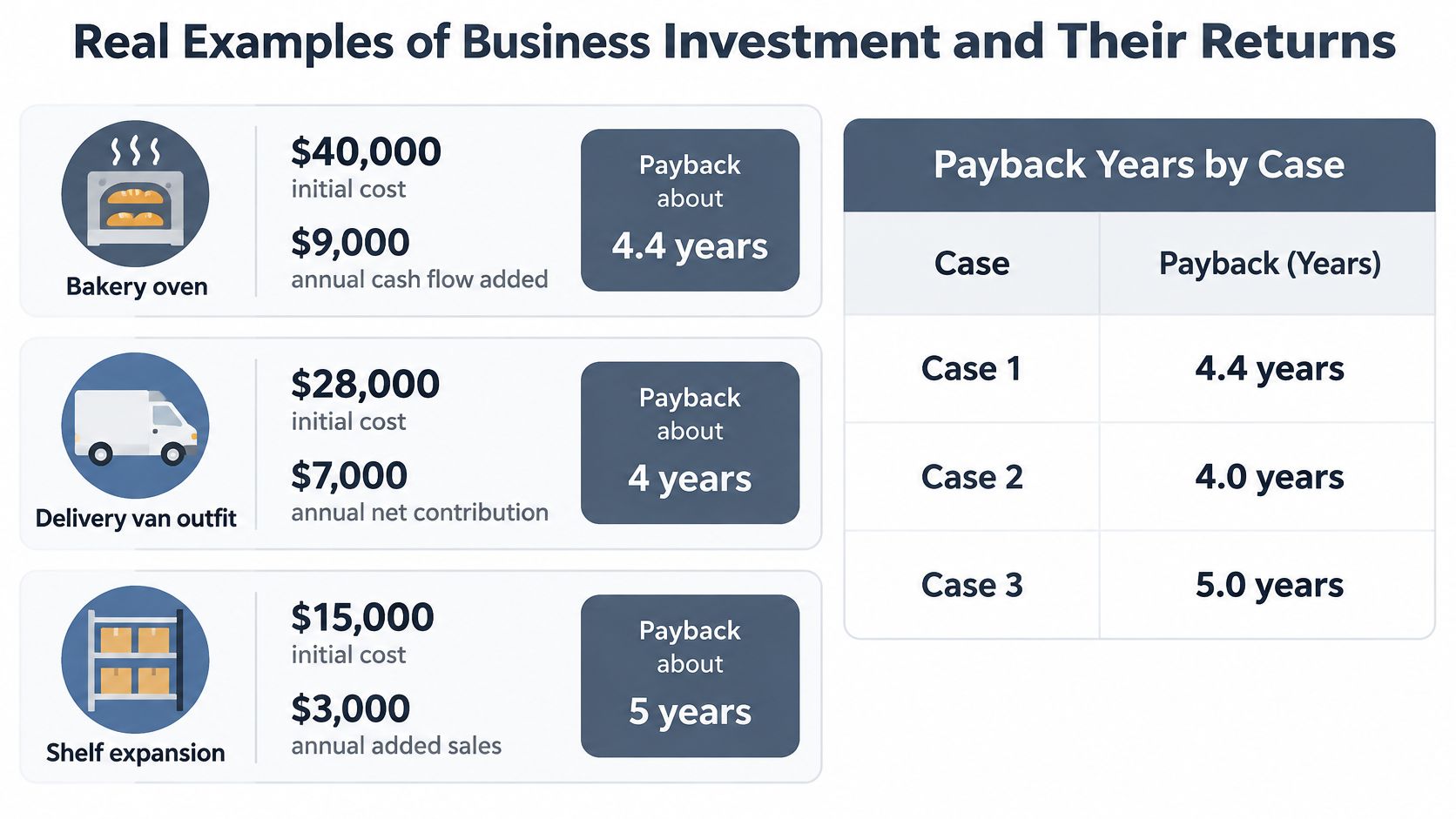
Consider a bakery evaluating an oven, a landlord renovating a rental unit, and a company replacing manual administration with software. The following are hypothetical examples in U.S. dollars, not documented investment results.
Investment | Cost | Expected annual cash benefit | Simple payback |
|---|---|---|---|
Commercial bakery oven | $40,000 | $9,000 additional cash flow | About 4.4 years |
Rental unit renovation | $60,000 | $12,000 additional rent | 5 years |
Operations software system | $25,000 | $10,000 annual savings | 2.5 years |
Simple payback = initial cost ÷ annual cash benefit. The bakery calculation assumes its added cash flow materializes; the software calculation assumes the company eliminates the costs it expects to save.
The renovation needs particular care. Additional rent isn't automatically additional net cash flow, so its displayed payback excludes any extra vacancy, maintenance, or operating costs.
This visual offers additional illustrative comparisons, but added sales must be converted into net cash benefit before calculating a meaningful payback.
The Operator Matters Too
Richeeze Melts, a Los Angeles food truck, was among Maize's first investments outside real estate, and his investment profile describes the founder's motivation, talent, and ability as reasons for the decision. The example illustrates operator assessment, not a documented financial return.
Richard Maize has backed ventures from PR firms and food trucks to fintech. Across those settings, investors must assess whether the person running the business can turn a promising concept into dependable operations.
The food-truck business guide associated with Richard Maize and Richeeze Melts provides related context for this operating-focused example. The accompanying video offers another way to explore the subject.
Payback is a starting point, not a verdict. It doesn't capture the timing of cash receipts, financing costs, asset value at exit, or the possibility that the operator won't achieve the forecast.
Test Whether an Investment Will Pay Off
Not every growth-related expense deserves the same confidence. Productive investment generates measurable cash flow or capacity; defensive spending protects existing income. Speculative expansion depends heavily on uncertain demand, while vanity investment improves appearances without a credible economic benefit.
The categories help identify what evidence a proposal needs.
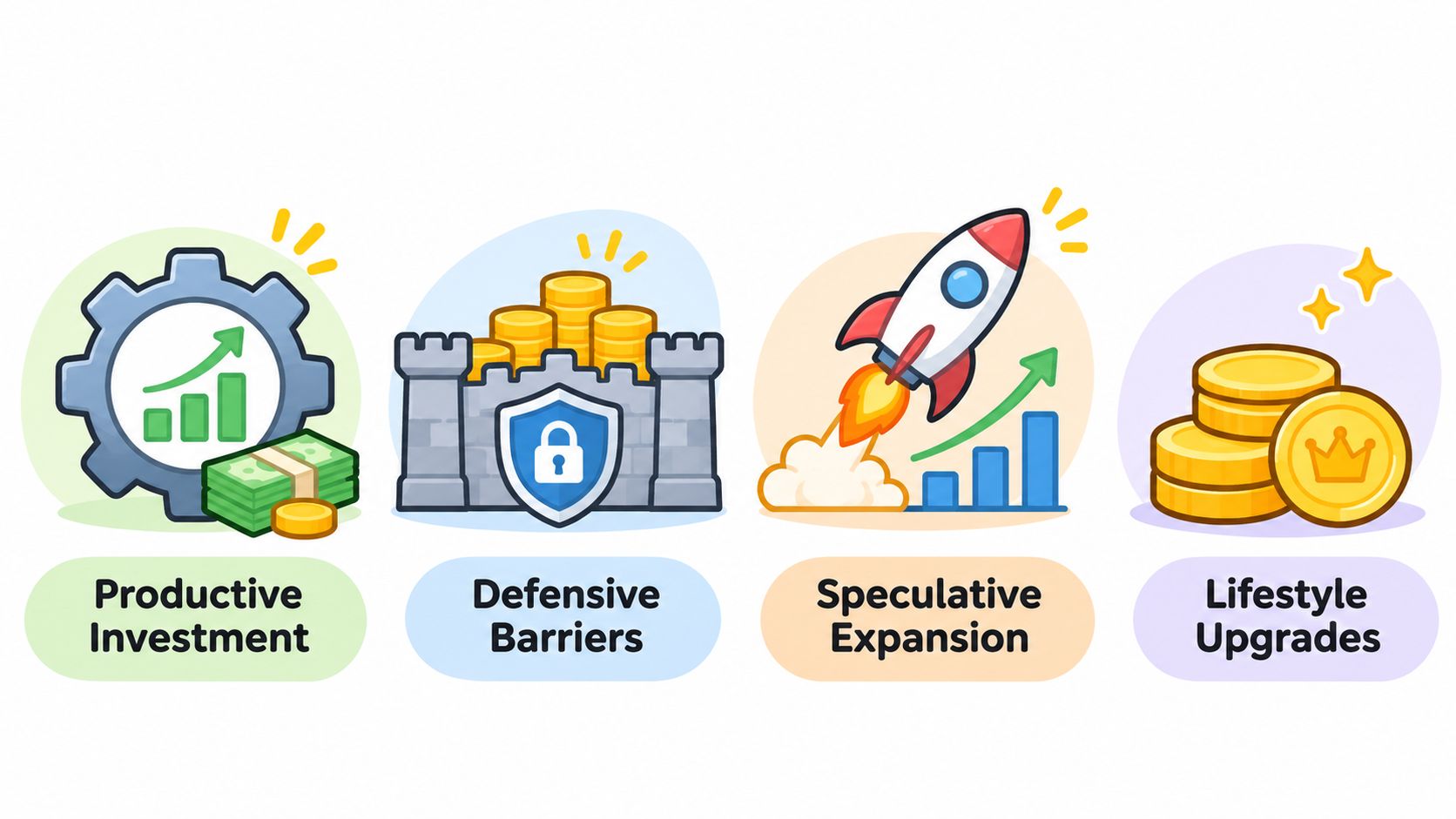
A defensive project isn't necessarily inferior to a growth project. Replacing failing refrigeration may protect the business more effectively than opening another location, even if the replacement doesn't increase sales.
Separate Opportunity From Timing
The OECD's Financing SMEs and Entrepreneurs 2026 report, covering 48 countries, describes recovering new SME lending alongside a broadly stagnant overall stock of SME loans. Better access to some new lending doesn't mean every company has abundant or affordable capital.
A downturn may let an investor negotiate a better purchase price or acquire capacity competitors have abandoned. But an attractive price won't protect a business that runs out of cash before demand recovers.
For acquisitions, the company-evaluation guidance from Richard Maize provides a relevant companion to financial screening. Examine customers, operations, liabilities, and management rather than treating the purchase price as the whole decision.
Put the Proposal Through a Downside Test
Define the useful result and its duration. State what the asset enables and how long that benefit is likely to remain useful. Include implementation delays and the possibility that technology or customer preferences will change.
Translate the benefit into annual dollars. Estimate additional cash receipts or costs avoided. Time saved isn't automatically cash saved unless employees use it productively or the company removes an expense.
Calculate the full commitment. Include acquisition, installation, training, maintenance, financing, and working capital. Recognize the opportunity cost of cash that won't be available elsewhere.
Recalculate under weaker demand. Reduce expected utilization or sales, allow for slower collections, and test higher costs where relevant. Check whether the company can meet repayments and essential expenses while waiting for the project to recover its cost.
Examine the exit. Determine whether the asset can be sold, leased, or redeployed. Specialized equipment and customized software may offer less flexibility than their purchase prices suggest.
The key decision measure is return on incremental invested capital after financing costs, tested against the downside case. In plain language, ask what the additional capital earns after paying for its funding, and whether that result still justifies the risk.
Keep the calculation consistent. Don't subtract financing costs from returns and then charge for the same financing again in the comparison.
A worthwhile investment should fit the business's cash position, not just its optimistic forecast.
Write the answers on a single decision page, compare suitable asset forms, and approve spending only when the benefits, obligations, and fallback plan are clear. Investment by a business and investment in a business both involve costs that someone must earn back.
Questions and opportunities for discussion can be sent to us at richardmaizebusiness@gmail.com.
Richard Maize offers perspectives on real estate, entrepreneurship, and business investing that help readers connect asset choices with operating realities. Visit Richard Maize to explore his ventures and investment commentary, then use the decision-page exercise to prepare a specific opportunity or question for discussion.
Comments