Commercial Real Estate Investment Criteria for Investors

Buying the property with the highest cap rate can mean taking on a financing problem disguised as an attractive yield. Paper income may look strong, while loan maturity, tenant departures and repair obligations leave little room to maneuver.
Sound commercial real estate investment criteria start with a tougher test: can the property meet its obligations if assumptions disappoint? Richard Maize, a Los Angeles-based real estate investor who has built and managed a property portfolio for more than 30 years, makes that downside-first perspective especially relevant. The aim is to identify which risks you can price, finance and manage before committing capital.
The Core Criteria at a Glance
The metrics investors quote most often aren't necessarily the ones that protect their capital. A strong headline cap rate tells you little about the cash needed to replace a departing tenant or the equity required at refinancing.
Start with the following screen. It separates property income, investor returns and financing risk, which shouldn't be treated as interchangeable.
Core commercial real estate investment criteria at a glance
Metric | Formula | Reference point | What it tells you |
|---|---|---|---|
NOI | Rental and other income minus operating expenses | Positive and stabilized | Income measure: what the property earns before financing and income taxes |
Cap rate | NOI divided by purchase price | Compare similar assets in the same market | Return measure: unlevered income yield used to compare assets |
Cash-on-cash return | Annual pre-tax cash flow divided by cash invested | Compare with your target return | Return measure: cash earned on the money you actually contribute |
IRR | Discount rate that sets net present value to zero over the hold | Compare with your hurdle rate | Return measure: annualized return across the hold, including sale proceeds |
DSCR | NOI divided by annual debt service | Applicable lender coverage requirement | Risk measure: income cushion above loan payments |
LTV | Loan divided by property value | Applicable lender ceiling and your own leverage limit | Risk measure: leverage and remaining equity cushion |
NOI belongs at the beginning because every income-based calculation rests on it. But positive NOI doesn't mean positive investor cash flow. Financing costs, capital expenditures and reserves still need funding.
Cap rate helps compare properties without letting different loan structures distort the comparison. Cash-on-cash answers a more personal question: what does your equity earn after the financing costs? IRR extends the calculation across the holding period, but it can look impressive when the projected sale price does most of the work.
Read return and risk together
A buyer seeking income should place more weight on recurring distributions than on an optimistic resale assumption. A buyer pursuing redevelopment may accept limited current distributions, but needs committed funding for construction, carrying costs and delays.
Practical rule: Pair a return measure with coverage and leverage. A high yield with weak debt coverage is a reason to slow down, not accelerate.
This table is a screen, not a verdict. Before comparing opportunities, rebuild the income and cash-flow calculations from the underlying records.
How to Calculate NOI, Cap Rate and Cash-on-Cash
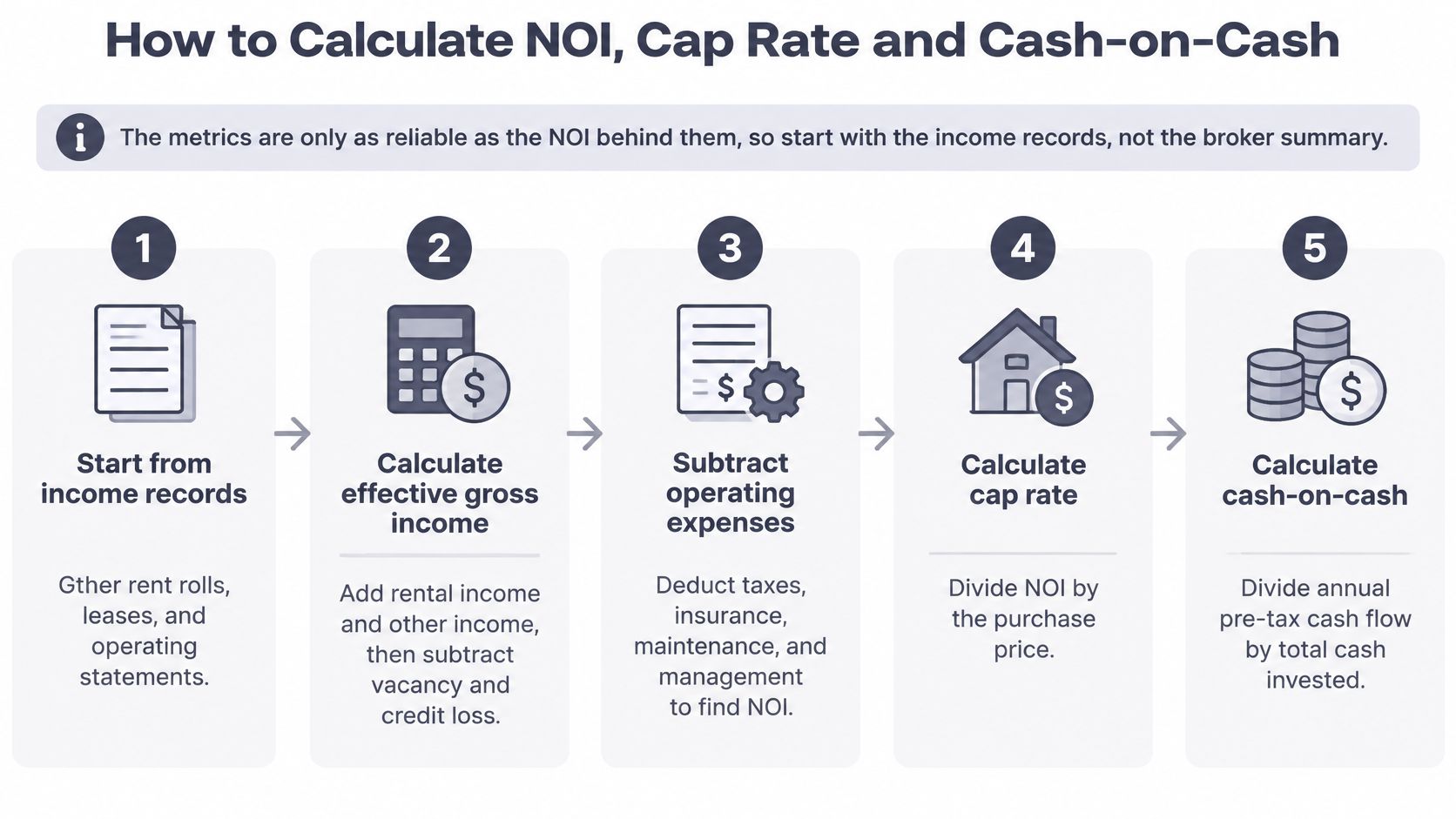
The metrics are only as reliable as the NOI behind them. Start with income records, not the broker's summary, and keep a separate column for every adjustment you make.
Build the income statement
Start with contractual rent. Total a full year of base rent from the rent roll and signed leases. Separate scheduled rent from collections so unpaid balances don't become assumed cash.
Deduct vacancy and credit loss. Use a defensible allowance based on the property's leasing position and competing space. Don't adopt the seller's allowance because it improves the advertised return.
Add other income. Include parking, storage and tenant reimbursements when the records support collection. Match reimbursements to the expenses they recover.
Subtract operating expenses. Include property taxes, insurance, utilities, management and routine repairs. Budget a management fee even if you intend to manage the building yourself.
Separate replacement reserves and capital spending. These reduce spendable cash but aren't deducted in the conventional property-level NOI calculation. Keep them visible rather than hiding them inside an optimistic distribution forecast.
Calculate cap rate. Divide stabilized NOI by the purchase price. Use comparable income definitions when comparing listings.
Calculate cash-on-cash return. Subtract annual debt service and reserves from NOI, then divide by total cash invested. Include closing costs and any initial cash-funded improvements in that denominator.
For a closer look at expense discipline, Richard Maize's guide to operating expense ratio provides a useful companion check.
A hypothetical acquisition calculation
Assume an office building costs $5,000,000, produces $350,000 in NOI, and uses a 65% interest-only loan at 6.5%. These are illustrative assumptions, not a statement of available market financing.
Calculation | Arithmetic | Result |
|---|---|---|
Cap rate | $350,000 ÷ $5,000,000 | 7.0% |
Loan amount | $5,000,000 × 65% | $3,250,000 |
Annual interest-only debt service | $3,250,000 × 6.5% | $211,250 |
Cash flow before reserves | $350,000 − $211,250 | $138,750 |
Total cash invested | $1,750,000 down payment + $100,000 closing costs | $1,850,000 |
Cash-on-cash return | $138,750 ÷ $1,850,000 | 7.5%, rounded |
DSCR | $350,000 ÷ $211,250 | 1.66x, rounded |
The example leaves out reserves for clarity. An actual acquisition model shouldn't.
Rerun this hypothetical with NOI 10% lower. The resulting $315,000 of NOI leaves $103,750 before reserves, reducing cash-on-cash to approximately 5.6% and coverage to 1.49x. The purchase price hasn't changed, but the margin for error has.
Debt Coverage and Leverage Limits Lenders Use
A property that produces exactly its loan payment, a DSCR of 1.00x, has no cushion for vacancy, repairs or a rate increase. That's the practical meaning of dividing recurring income by annual debt service.
The U.S. qualifying CRE underwriting rules specify minimum DSCR benchmarks of 1.50x for qualifying leased commercial property, 1.25x for qualifying multifamily property and 1.70x for other qualifying CRE categories. These are criteria within a specific regulatory framework, not universal approval requirements for every commercial mortgage.
Reference DSCR and LTV thresholds by property case
The interagency real estate lending guidelines set supervisory LTV ceilings of 65% for raw land, 75% for land development, 80% for commercial construction and 85% for improved property.
Metric and property case | Reference threshold | What it means |
|---|---|---|
DSCR, qualifying leased commercial property | 1.50x minimum | Benchmark in U.S. qualifying CRE underwriting rules |
DSCR, qualifying multifamily property | 1.25x minimum | Multifamily benchmark in the same rules |
DSCR, other CRE categories | 1.70x minimum | Higher benchmark for other qualifying categories |
LTV, raw land | 65% ceiling | Supervisory limit; lenders may set tighter limits |
LTV, land development | 75% ceiling | Supervisory limit; lenders may set tighter limits |
LTV, commercial construction | 80% ceiling | Supervisory limit; lenders may set tighter limits |
LTV, improved property | 85% ceiling | Supervisory limit for improved property, not a leverage target |
Build coverage from stabilized income, not gross scheduled rent. Deduct normalized vacancy, management, taxes, insurance and maintenance, then reconcile replacement-reserve treatment with the lender's underwriting definition. Keeping conventional NOI and lender-adjusted income on separate lines prevents accidental double counting.
For floating-rate financing, test debt service at the maximum rate permitted by the interest-rate cap. Also check whether the cap expires before the loan and what replacement protection could cost.
What leverage does to your equity
Consider a hypothetical property bought with 65% debt and 35% equity. If its value falls 10% while debt remains unchanged, equity falls from 35 to 25 units of the original purchase value. The equity loss is 10 ÷ 35, or approximately 28.6%, before selling costs.
Refinancing creates a separate constraint. A replacement lender may offer less because the building's value fell, its income weakened or its underwriting became stricter. An owner can remain current on payments and still face a substantial equity contribution at maturity.
Richard Maize's guide to financing investment properties offers additional context for comparing funding structures. Before touring properties, write down your minimum DSCR and maximum LTV, rather than adopting whichever limits make a listing work.
Tax Effects on Net Returns
Pre-tax returns can overstate what an investor keeps. The cash-on-cash and IRR calculations used here are pre-tax, so the tax analysis needs its own schedule rather than an informal adjustment to the advertised yield.
Taxable income and cash flow aren't the same thing. Depreciation can shelter part of operating income without a matching current cash expense, while reducing the property's tax basis and creating potential recapture exposure at sale.
Separate operating taxes from exit taxes
Loan interest is generally deductible for income-producing property, subject to applicable limitations. That can reduce the net cost of borrowing, but it doesn't make additional debt harmless or eliminate the cash required for payments.
Sale proceeds also aren't the same as taxable gain. Your adviser needs the adjusted basis, selling costs, holding period and depreciation history to estimate the tax consequences, including any applicable recapture.
Property taxes belong in the operating model. Where a purchase triggers reassessment, the seller's bill may understate the buyer's future expense. Obtain a jurisdiction-specific estimate before treating the existing assessment as permanent.
Run an after-tax cash schedule
Take pre-tax cash flow after debt service, reserves and planned capital spending.
Estimate taxable income separately, accounting for allowable interest, depreciation and other applicable deductions. Subtract the resulting estimated tax liability from cash flow.
Divide after-tax cash flow by cash invested to calculate after-tax cash-on-cash return.
Repeat the exercise at exit, deducting estimated sale taxes before calculating the investor's final proceeds and after-tax IRR.
Richard Maize's property investment tax deductions guide provides further context for reviewing deductible expenses.
Don't treat tax savings as a substitute for sound operating performance. Rules vary by jurisdiction, ownership structure and investor circumstances, and they change over time. Have a qualified tax adviser review the acquisition and exit calculations before committing capital.
Market and Lending Conditions That Shape Pricing

A deal that works only with cheap, readily available debt is fragile. Test the financing before setting a bid, because a spreadsheet assumption is not a lender commitment.
The Federal Reserve's financial stability discussion puts outstanding U.S. commercial real estate mortgage debt at approximately $6 trillion at the end of 2024. That total includes owner-occupied and non-owner-occupied property, multifamily mortgages, and acquisition, development and construction loans. Banks held about half, with regional and smaller banks holding less than $100 billion in assets collectively accounting for a larger share of CRE lending than larger banks.
Check the lender as well as the loan
Ask which lenders are actively quoting your property type, rather than advertising commercial mortgages. Confirm whether terms require a deposit relationship, personal guarantees, leasing milestones or additional collateral. Those conditions affect how much equity you need and whether the proposed loan remains workable if leasing slows.
Research cited in the Federal Reserve discussion estimated that the High Volatility Commercial Real Estate capital rule increased affected development loan rates by approximately 40 basis points relative to comparable unaffected loans. On a hypothetical $50 million loan, an additional 0.40 percentage point costs approximately $200,000 annually, before compounding or fees. Build the debt cost into the downside case instead of assuming the difference can be recovered through rent growth.
The July 2025 Federal Reserve lending survey reported that CRE lending standards remained toward the tighter ends of banks' historical ranges. That is a lending signal, not a forecast of property returns. It makes the borrower's plan for higher costs, tenant turnover and refinancing more important.
Turn market observations into price adjustments
Vacancy: Compare the immediate competitive area with the broader metro. A healthy regional average will not fill an obsolete building.
New supply: Identify competing projects, delivery timing and concessions offered to attract tenants.
Rent versus expenses: Compare achievable collected rent with insurance, maintenance and property-tax expectations.
Comparable sales: Check the income definition, physical condition and financing environment behind each reported cap rate.
Refinancing alternatives: Identify more than one plausible lender and check whether its requirements fit the property's future lease profile.
Market conditions should shape the price you can pay using debt you can reasonably expect to keep or replace. A lower headline yield may be safer than a higher one if the first deal depends on a favorable exit cap rate or refinancing terms that lenders may not offer. Don't make an expensive financing structure work on paper by assuming cheaper debt will appear later.
Location, Tenants and Lease Structure Checks
Consider two hypothetical buildings. Building A receives 60% of base rent from one tenant whose lease ends in 24 months; Building B has five tenants with staggered expirations. Building B may provide steadier income despite a lower headline yield, provided those tenants have credible businesses and enforceable obligations.
Location should be evaluated through the tenant's needs. Check access to employers, customers, transportation and labor, then examine population and job trends alongside competing space. Verify that zoning allows the current use and any proposed conversion.
Read the lease before assigning income stability
Lease structures and what each one puts at risk
Lease type | Who pays operating costs | Income stability | Main risk to check |
|---|---|---|---|
Triple net (NNN) | Tenant pays taxes, insurance and maintenance, subject to lease wording | Steady while the tenant performs | Tenant credit, lease term and landlord exclusions |
Modified gross | Landlord and tenant share specified costs | Stronger when recoveries are clearly defined | Which costs can be passed through |
Full-service gross | Landlord pays most operating costs | Expense growth can erode NOI | Expense inflation against fixed rents |
Multi-tenant with staggered leases | Determined separately by each lease | Income spread across several expirations | Leasing workload and turnover costs |
A triple net label doesn't eliminate ownership obligations. Read who pays for structural work, roof replacement, major mechanical systems and expenses above negotiated caps.
Review tenant credit at the entity that signed the lease. A recognizable trading name isn't the same as a parent-company guarantee. As an internal screening choice, you might flag any tenant providing more than roughly 20% of base rent, then decide whether its credit and lease protections justify that concentration.
Map renewal risk and physical obligations
Calculate weighted average remaining lease term, but don't stop at the average. Identify the share of NOI associated with leases expiring within the next three years, and place those expirations beside loan maturity and planned capital work.
Tenant relocation costs can inform renewal probability. Specialized improvements, established customer access and expensive equipment may encourage retention, but an unaffordable rent or unsuitable building can outweigh those advantages.
Request the following before accepting the seller's income narrative:
Rent roll and lease abstracts: Reconcile occupied area, rent steps, concessions, options and security deposits.
Tenant estoppel certificates: Confirm the tenant's understanding of rent, deposits, amendments and disputes.
Roof and HVAC records: Establish age, maintenance history, condition and responsibility for replacement.
Leasing cost estimates: Include commissions, tenant improvements and downtime for realistic replacement tenants.
A long lease is useful only if the tenant can perform and the owner can meet the obligations that remain.
Stress-Testing a Deal Before You Bid
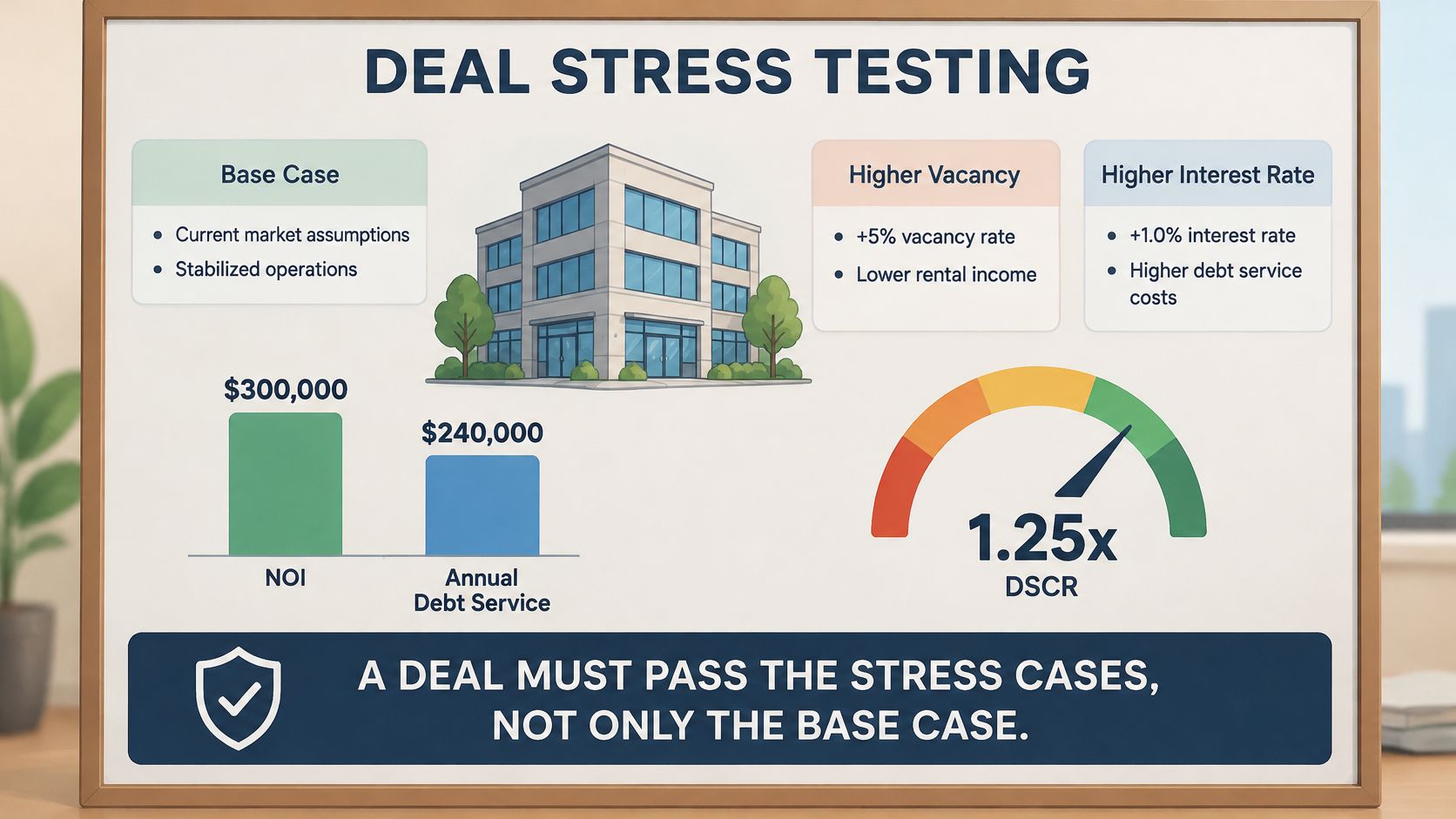
A deal must pass the stress cases, not just the base case. Use a model that changes operating income, financing costs and exit pricing separately, then combines the adverse assumptions.
The CBRE U.S. outlook's midyear 2026 projections anticipate broadly stable capitalization rates and emphasize operating income as a return driver under higher benchmark rates. Treat that as an outlook, not permission to assume favorable resale pricing.
Put the same deal through different conditions
Take a hypothetical property with $300,000 of NOI and $240,000 of annual debt service. Its base coverage is $300,000 ÷ $240,000 = 1.25x.
For this example, assume a $3 million interest-only floating-rate balance, so a one-percentage-point rate increase adds $30,000 to annual debt service. Actual results depend on the loan's balance, amortization and rate protections.
Stress cases for one worked deal
Scenario | Result |
|---|---|
Base case | $300,000 NOI ÷ $240,000 debt service = DSCR 1.25x |
Rate rises 1 point on floating debt | $300,000 ÷ $270,000 = DSCR 1.11x, rounded |
NOI falls 10% | $270,000 ÷ $240,000 = DSCR 1.13x, rounded |
Combined rate rise and NOI fall | $270,000 ÷ $270,000 = DSCR 1.00x |
Exit cap rate rises 50 basis points | At unchanged $300,000 NOI, value falls from $5,000,000 at 6.00% to approximately $4,615,385 at 6.50%, down approximately 7.7% |
The combined operating case leaves nothing before reserves and capital spending. A buyer relying on distributions would need another source of cash, even though the property could still make its scheduled debt payment.
The exit calculation uses value = NOI ÷ cap rate. It isolates pricing risk by holding income constant. A combined decline in income and weaker exit pricing would produce a worse result, before brokerage, legal expenses and loan repayment.
Measure survivability, not just projected profit
A generous acquisition yield doesn't automatically compensate for risk. It may reflect deferred repairs, tenant weakness or the difficulty of finding another buyer.
Add these checks to the acquisition file:
Break-even occupancy: Solve for the occupied, paying space needed to cover operating costs, debt service and planned reserves. Model variable expenses and reimbursement changes rather than assuming every lost rent dollar has the same effect.
Fixed-rate coverage: Remove rate volatility where appropriate, but still test weaker income and major leasing costs.
Near-term income exposure: Identify income associated with upcoming lease expirations and budget replacement costs.
Refinancing equity requirement: Compare the outstanding balance with a replacement loan sized under stressed value and coverage.
Decision standard: If the combined case fails, lower the price, reduce leverage or pass. Don't repair the result by assuming a more generous buyer at exit.
Confirm Your Criteria Before You Commit to a Deal
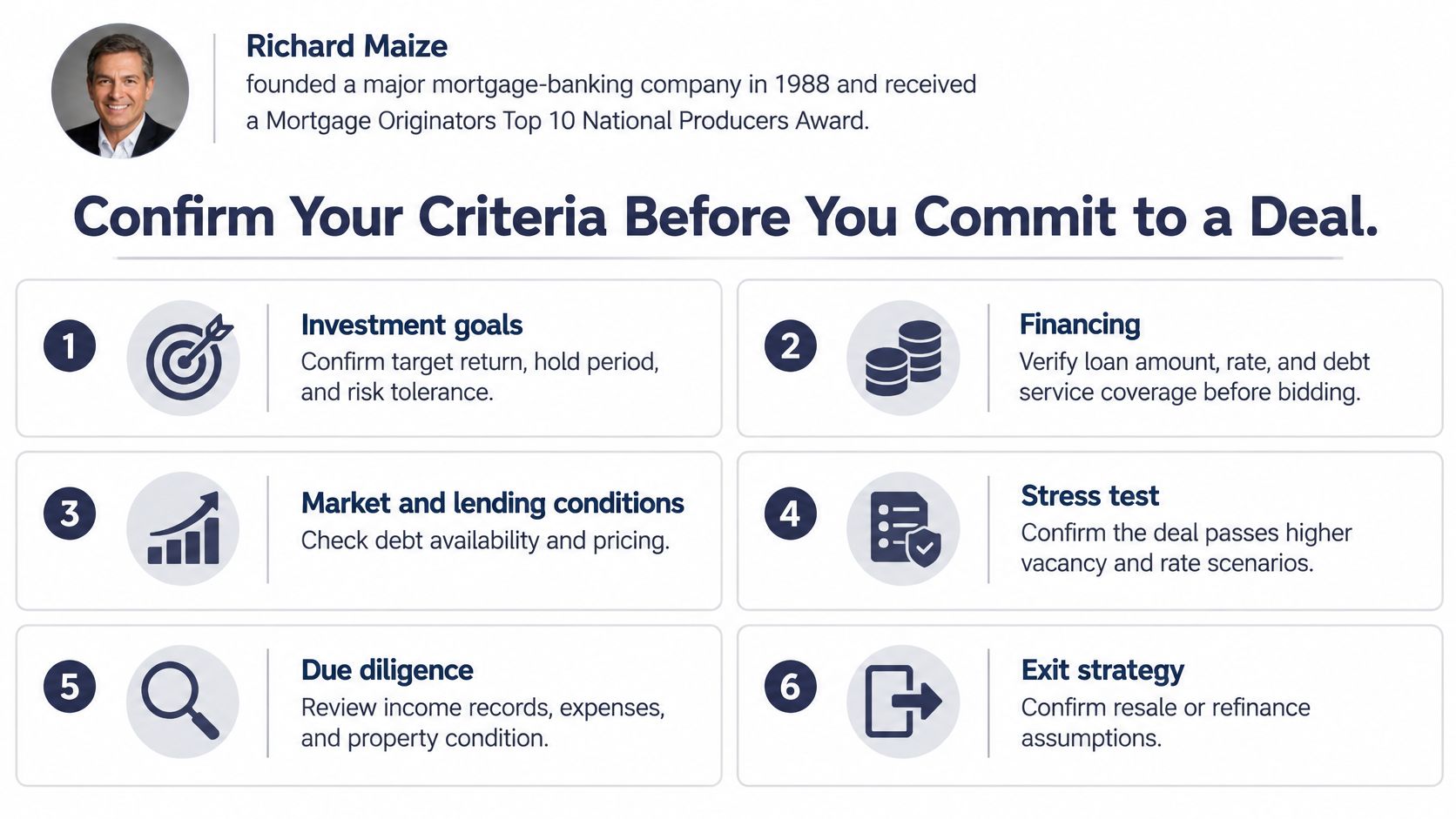
A deal should survive a weaker operating year, not just look attractive on a spreadsheet. Set written decision rules before reviewing listings, then use them to judge the property, financing and cash required under stress.
Richard Maize is a Los Angeles-based real estate investor, entrepreneur and philanthropist who has built and managed a real estate portfolio for more than 30 years. He has backed ventures ranging from PR firms and food trucks to fintech. His public professional profile and published career profile offer background on his work. That breadth reinforces a practical point: underwriting must connect property operations to capital decisions, while recognizing that experience does not remove investment risk.
Put your decision in writing
Set boundaries before reviewing listings. Record your minimum DSCR, maximum LTV, required liquidity and investment objective. Keep them fixed unless new diligence changes the facts.
Confirm stabilized NOI against signed leases, collections and bank statements. List discrepancies separately and identify what evidence would resolve them.
Recalculate returns independently. Build cap rate, cash-on-cash return and debt coverage from reconciled figures. Include an after-tax view, since tax treatment affects the cash retained.
Test a combined downside case: higher debt costs, tenant turnover and a weaker exit. Record the operating shortfall and the cash needed to fund it. A deal that works only through assumed cap-rate compression is not protected by its headline yield.
Review tenant concentration and near-term lease rollover. Include renewal assumptions, downtime, tenant improvements and commissions in the cash budget. Concentrated income can make a single vacancy more consequential.
Verify executable debt terms and plausible refinancing alternatives. Review covenants, guarantees, maturity provisions and extension conditions, then assess whether stressed income and value still support refinancing.
Choose an explicit outcome: proceed, renegotiate price or terms, or pass. Attach unresolved conditions to the decision rather than relying on verbal assurances.
Make the next action concrete
Prepare a short acquisition memo with verified income, proposed financing, stressed cash requirements and unresolved diligence items. Share it with qualified real estate, lending and tax advisers before authorizing the investment.
The criteria should lead to a clear decision, not merely an attractive spreadsheet. A defensible purchase still makes sense after optimistic assumptions are removed. Visit Richard Maize for perspectives on property markets, financing and investment decisions, then use your memo to assess coverage, tenant exposure and downside funding before committing capital.
Comments