Succession Planning for Family Businesses: How to Build One

Only 30% of surveyed family businesses had a formal succession plan, according to PwC's 2021 Global Family Business Survey. That's a governance problem before it's a paperwork problem. A will can say who inherits the shares, but it can't tell employees whose instructions to follow or prove that an heir can manage debt, people, and difficult decisions.
Succession planning for family businesses means separating ownership, management, and family expectations, then making each workable. Richard Maize's perspective as a real estate and business investor is particularly relevant here: protecting assets and choosing who should operate them are different decisions. Families need to settle both without assuming that keeping the business means keeping every relative in management.
Succession Roadmap From First Talk to Handover
Succession roadmap by phase
Phase | Typical timing | Output that proves it is done | Lead |
|---|---|---|---|
1. Define the outcome | Year 1 | One-page statement of ownership and leadership goals | Owners and board |
2. Set successor criteria | Year 1 | Written competency matrix agreed by the board | Board succession committee |
3. Assess candidates | Years 1-2 | Ranked shortlist of family and nonfamily candidates | Independent adviser |
4. Build formal roles | Years 2-5 | Accountable role descriptions and development plans | Successor with mentor |
5. Set communication rules | Ongoing from Year 1 | Written family policy and council calendar | Neutral facilitator |
6. Settle legal and tax matters | Years 2-4 | Ownership map, valuation and updated shareholder agreement | Attorney, tax adviser, valuer |
7. Review annually | Every year | Updated plan with a new review date | Board |
Treat these timings as a suggested working schedule, not a deadline to retire. They assume one or two generations are involved; a runway under two years leaves little room to develop an untested leader.
Approximately 40% of U.S. family-owned businesses transition successfully into the second generation, according to the broad benchmarks summarized by Cornell University. The roadmap is therefore a continuity tool, not an estate document.
Establish the destination before testing people
Define the outcome. Decide whether the family wants majority ownership, management succession without an ownership transfer, or a sale. Record what the owners need financially and what they refuse to compromise.
Set successor criteria. Describe the job the business will need, rather than recreating the founder's personality. A property-heavy company may need stronger financing and asset-management skills than its founder needed during acquisition.
Assess candidates. Invite family members to express interest without promising appointments. Compare them with nonfamily candidates against the same requirements.
Build formal roles. Give finalists responsibility for an operating unit, budget, or investment decision. An impressive title without authority doesn't test readiness.
Run the supporting work in parallel
Set communication rules. Start disclosure while choices remain open. Otherwise, relatives may interpret an announcement as a decision made behind their backs.
Settle legal and tax matters. Have advisers test whether the intended structure is executable while candidates develop. Don't train someone for authority the ownership documents won't permit.
Review annually. Confirm what changed, what remains unfinished, and whether the planned handover is still realistic. Before transferring authority, require a board decision confirming the successor's responsibilities and the founder's remaining role.
Find the phase your business is in today. Start there, not at the stage the family wishes it had reached.
Setting Governance and Objective Successor Criteria
Governance comes before naming anyone. The board should agree on a written competency matrix before evaluating a relative. Otherwise, family members can reshape the requirements around their preferred candidate.
The gap between intention and execution is substantial: Deloitte's family-business succession guidance reports that 82% of family businesses have some form of succession plan, but only about half describe it as thorough and well developed; reported obstacles include insufficiently qualified successors at 35%, difficulty identifying a suitable successor at 33%, and incumbent reluctance to relinquish control at 32%.
Successor criteria and the evidence for each
Criterion | What it measures | Evidence to collect |
|---|---|---|
Technical competence | Ability to run operations, finance and the core assets | Track record in a role with budget or staff responsibility |
Judgment | Decisions under uncertainty, including when to say no | Documented decisions reviewed by an independent adviser |
Values alignment | Commitment to the family's written principles | Written values statement and behaviour in a past dispute |
Stakeholder management | Relationships with lenders, staff, partners and relatives | References from people outside the family |
Accountability | Willingness to accept measurable targets and review | Signed role description with agreed metrics |
Score evidence rather than confidence
Use a scoring sheet with space for the evidence, the reviewer's reasoning, and any development requirement. Don't let a polished presentation compensate for weak financial controls, or let a successful acquisition conceal an inability to retain staff.
For a real estate business, ask the candidate to explain a refinancing proposal, a capital-expenditure budget, and a property's cash requirements. Then ask what would make them reject the transaction. Judgment includes restraint, not just enthusiasm for growth.
Richard Maize's discussion of scaling a business from startup to empire provides a useful companion perspective: assess the leadership demands of the business being built, not just the responsibilities someone has already handled.
Make the assessment independently defensible
An independent board member should be able to explain why the selected candidate ranks above the alternatives. If the explanation depends on birth order, loyalty to the founder, or an undocumented promise, the board hasn't completed its work.
Separate readiness now from potential with development. A candidate may deserve investment without yet deserving control. Give that person specific assignments, a mentor who isn't their parent, and a review that can produce a negative decision.
Selection test: Could a nonfamily director defend the appointment to employees, lenders, and an equally qualified outside candidate?
The founder must accept the same discipline. Approving objective criteria while reserving an unwritten veto leaves the process dependent on personal approval.
Telling the Family What the Plan Says
When should you tell the family, and how much should you share? Begin when owners agree on the principles, not after attorneys finish every document. Share enough for people to understand decisions affecting their roles and expectations, while keeping personal financial details appropriately restricted.
In the 2025 Brown Brothers Harriman Private Business Owner Survey, only 38% said they'd been completely open and transparent with the next generation about wealth and estate plans, while 36% were somewhat transparent and 21% hadn't shared details. Secrecy may feel protective, but it leaves relatives to fill the gaps with assumptions.
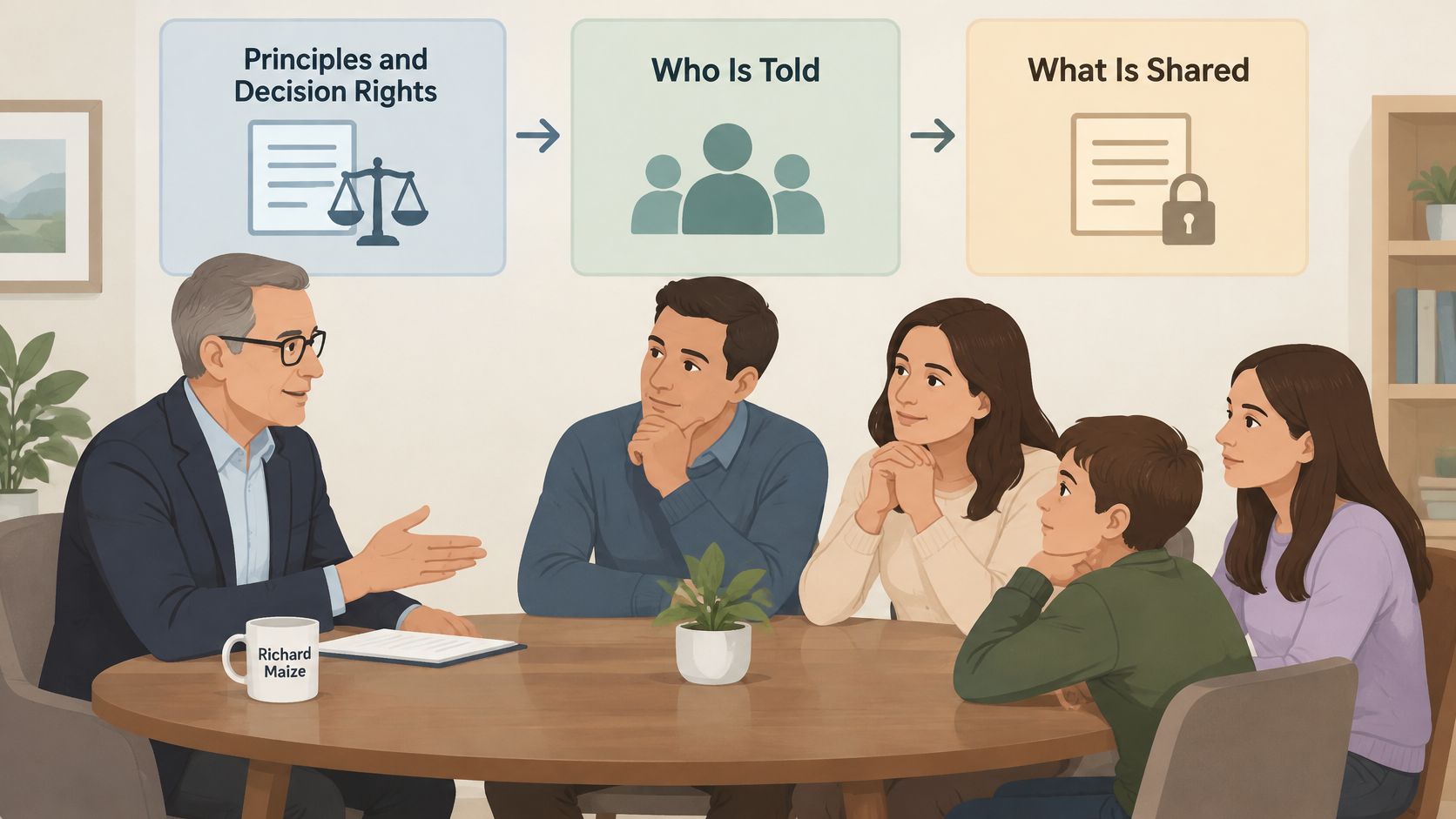
A facilitated meeting gives the family a place to distinguish business decisions from personal expectations.
Disclose in a deliberate sequence
Principles and decision rights. Explain what the family wants to preserve, who recommends decisions, and who approves them.
Ownership and voting structure. Show who owns the economic interest and who can appoint directors or authorize a sale.
Compensation, employment and liquidity. Explain how salaries, dividends, entry requirements, and requests to sell shares will work.
Individual wealth and estate details. Hold private conversations about personal inheritances, trusts, and obligations, then explain shared consequences to everyone affected.
Give recipients a written summary and a way to ask questions afterward. Don't demand immediate agreement during an emotionally loaded meeting.
Explain fairness before announcing differences
Say two children receive equal economic benefit, but only one runs operations. The operating child's salary compensates work; distributions compensate ownership. Managerial authority follows the role, not the size of a sibling's inheritance.
Write that distinction into the family policy. Include employment qualifications, dividend principles, philanthropy decisions, and a documented path for relatives who decline participation. Someone should be able to remain a respected family member without accepting a business job.
Use a family council on a fixed calendar for owner education and shared concerns. Keep personnel reviews and confidential commercial decisions with the board or management team, and bring in a neutral facilitator when the founder can't chair the discussion impartially.
Fairness isn't identical authority. It's a consistent explanation of why different roles carry different rights and obligations.
Prepare communication responsibilities for death, illness, divorce, and a forced sale. Name who contacts relatives, employees, lenders, and advisers so the first substantive conversation doesn't happen during a crisis.
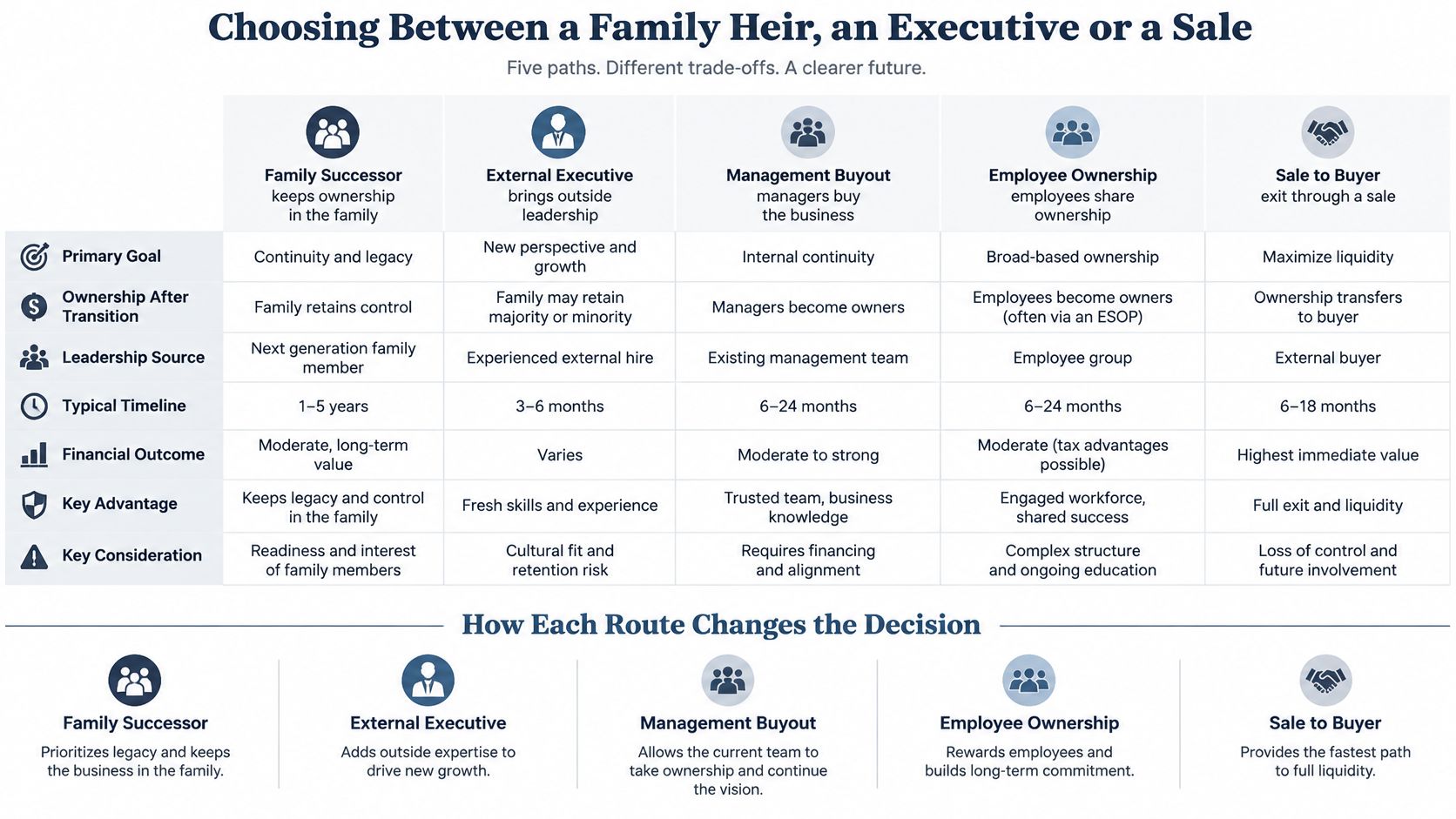
Choosing Between a Family Heir, an Executive or a Sale
Option | Best when | Main risk | Control after handover |
|---|---|---|---|
Family successor | A relative meets the criteria within two to three years | Favouritism claims and unclear authority | Founder keeps high control during transition |
External executive | No family member meets the criteria, or the family wants professional management | Cultural mismatch and higher pay | Founder can keep a board seat |
Management buyout | Managers already run daily operations and can finance a deal | Financing strain and conflicts of interest | Control passes to managers over time |
Employee ownership | Steady cash flow and a culture staff value | Governance complexity and valuation disputes | Shared control through a trust or plan |
Sale to third party | Family wants liquidity or no internal successor exists | Loss of legacy and culture | Control passes at closing |
The table describes planning choices, not automatic legal outcomes. Negotiated documents determine actual control, and the development window shown for a family candidate is a suggested decision horizon.
The visual comparison makes the central trade-off clear: keeping ownership doesn't require keeping management inside the family.
Match the route to the owners' objective
A family successor fits when capability and willingness coincide. If no relative can meet the requirements within the proposed development window, an external executive with family representation on the board may protect the enterprise better than a rushed appointment.
A management buyout fits when managers already operate the company and can support a credible financing proposal. Sellers must examine whether debt service and deferred payments would leave enough cash for maintenance and growth.
Employee ownership deserves consideration when staff value the culture and cash flow can support the structure. It still requires professional leadership, a defensible valuation, and clear governance. Sharing ownership doesn't eliminate difficult management decisions.
A third-party sale prioritizes liquidity and a defined exit. Richard Maize's perspective on evaluating an acquisition also gives sellers a useful question: what would a disciplined buyer need to verify before committing?
Make a fair decision and a clean transition
A fair refusal to appoint a relative needs documented assessments, trial assignments, and independent review. Offer a development path where appropriate, but don't manufacture an executive job to soften disappointment.
Agree on the founder's transition role before announcing the successor. Advisory work or a board chair position needs defined boundaries and an end date; employees shouldn't have to guess whether the former leader can reverse operating decisions.
Richard Maize's business perspective also extends beyond written commentary through multimedia.
For a sale, settle closing control and any continuing founder obligations before committing the family to the transaction. An earn-out or consulting agreement can leave responsibilities behind even after ownership changes.
Decide the route before deciding the person.
Tax, Legal and Valuation Steps to Settle Early
Legal work should implement the family's decisions, not substitute for them. Give the attorney, tax adviser, and independent valuer the same written ownership objective so they aren't solving different problems.
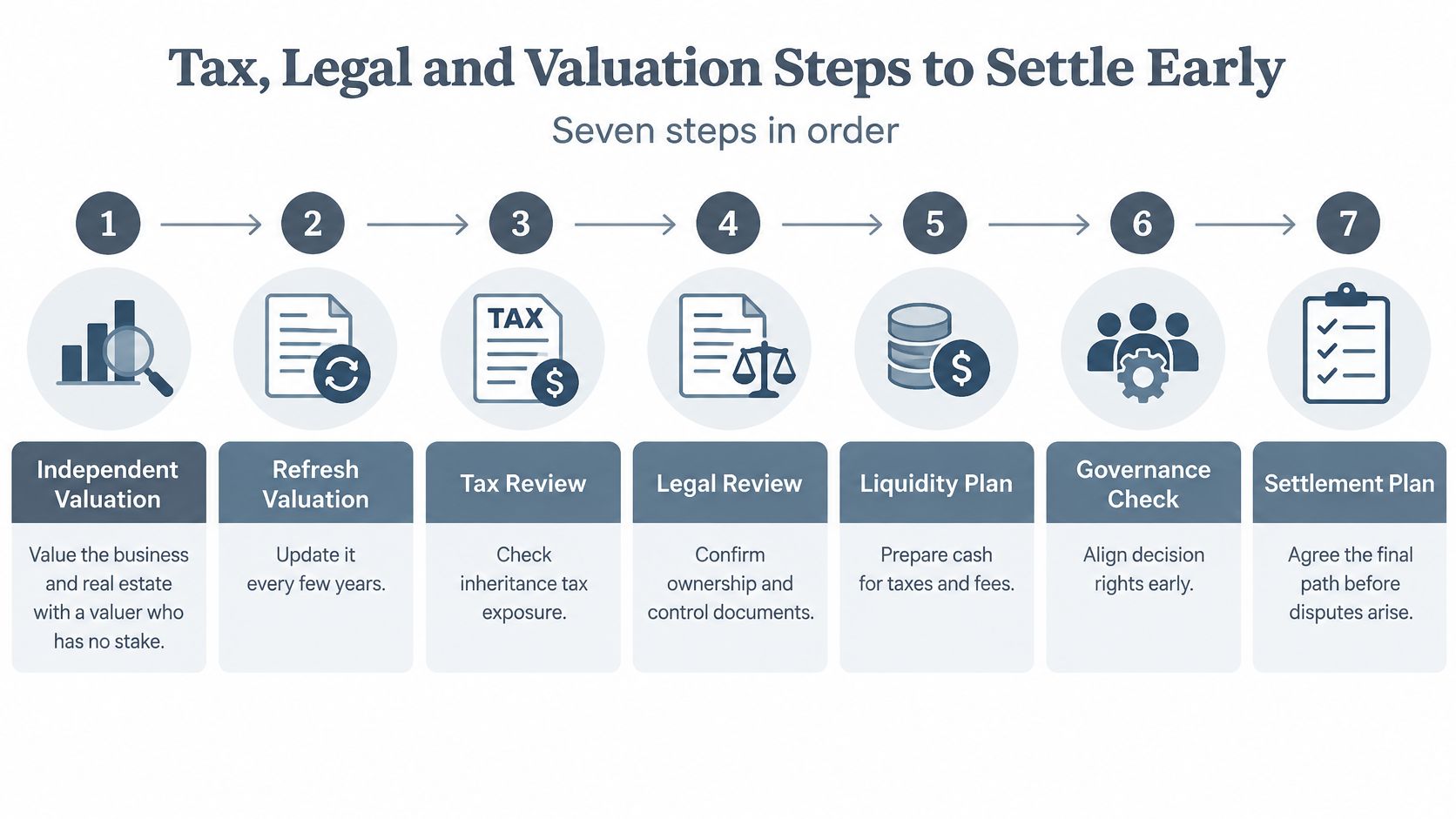
Use the following sequence as a working checklist, with jurisdiction-specific advice before signing or transferring anything.
Assemble the facts before moving assets
Get an independent valuation. Value the operating business and any real estate it holds using a valuer with no stake in the outcome, and adopt a suggested refresh cycle of every two to three years, sooner after a material change. A valuation prepared by the founder's friend without defensible assumptions invites disputes about whether a successor, seller, or sibling received preferential treatment.
Map the current ownership, including voting and non-voting shares, trusts, and family loans, against the intended outcome. The common slip is treating the company register as the entire picture while overlooking beneficial interests, personal guarantees, or loans that affect what an owner receives.
Update the shareholder agreement with buy-sell terms, transfer restrictions, valuation procedures, and a funding method such as suitable life insurance or a reserve. Waiting until the first dispute to sign it leaves owners negotiating under pressure; name the triggering events, payment mechanics, and process for resolving disagreement while interests are still aligned.
Test tax, incapacity and cash requirements
Ask the tax adviser to model lifetime share transfers versus transfers at death under current rules and the family's circumstances. Don't transfer shares solely because a tax result looks attractive without checking the effect on control, income, reporting obligations, and the recipient's ability to hold the asset.
Align wills, trusts, and powers of attorney with the business documents so incapacity is covered as well as death. A trust naming the wrong trustee, or an authority document that doesn't support the necessary business decisions, can undermine a carefully negotiated ownership structure.
Test whether the business can pay a departing owner without selling essential assets or starving operations of working capital. The common mistake is treating a valuable property portfolio as available cash; model debt payments, capital expenditure, owner payments, and potential delays in refinancing or selling an asset.
Record the decisions in a board-approved document with named responsibilities and a review date, while keeping the executed legal instruments in an indexed file. Tax rules and family circumstances change, so an unsigned draft or an outdated adviser's memo shouldn't become the document everyone assumes is authoritative.
For property-owning families, distinguish the operating company from the entities holding land and buildings. Richard Maize's discussion of building generational wealth through real estate investments is relevant to that long-term asset perspective, but the succession file must still identify who controls each entity and how cash moves between them.
A finished legal file should let an authorized person locate one ownership map, one current valuation, and one funding plan without searching through personal emails. Include signed agreements, adviser contacts, access instructions, and the next review date alongside those core records.
Common Mistakes That Stall Succession and Their Fixes
Having no formal plan is the first failure to check: the 2025 Kreischer Miller Family Business Survey found that 45.9% of family-owned companies lacked a formal succession plan, while 39% had a formal development plan for future leaders. A development plan still needs selection criteria attached, or candidates can mistake participation for a promise of promotion.
The following are suggested corrective actions for a 90-day work period, not promises that a complete transition can be finished that quickly.
Common succession mistakes, warning signs and fixes
Mistake | Warning sign | Fix within 90 days |
|---|---|---|
Waiting until the founder's health forces a decision | Succession is discussed only after a health event | Hold an owners' meeting and write the outcome on one page |
Treating family seniority as a qualification | The successor is chosen by birth order | Apply the written competency matrix to every candidate |
Appointing an heir without a trial role | No defined role or measurable targets for the heir | Give the heir a defined role with signed targets and a mentor |
Founder keeps operational control while a successor is announced | The successor must check every decision with the founder | Set decision rights in writing and agree a founder transition role with an end date |
Skipping the valuation until a buyer appears | No valuation is less than three years old | Commission an independent valuation from a valuer with no stake in the outcome |
Writing a will without updating the shareholder agreement | The will and the shareholder agreement name different owners | Map ownership and align the will and the shareholder agreement |
Test what happens when the founder is unavailable
Ask who can authorize payroll, approve urgent repairs, speak to lenders, and access essential records. If every answer is the founder, the business has a dependency problem even if a successor has been announced.
Don't respond by handing over every password without controls. Establish authorized access, approval limits, and an emergency contact sheet, then have the responsible people demonstrate that they can perform their assigned tasks.
Give each correction an owner
The board should record who is responsible, what document or decision will prove completion, and what remains unresolved. Commissioning a valuation, for example, isn't the same as approving a buyout price or securing the money to pay it.
Avoid creating a large succession task force that can discuss everything but approve nothing. Keep operational assignments with management, owner decisions with owners, and independent assessment with someone who can challenge the family without losing their role.
Rate the plan against each warning sign this month. Pick the most serious weakness first, particularly anything that could interrupt operations or leave competing claims to authority, and assign a named person to correct it.
Confirm the First Three Steps Before Next Quarter
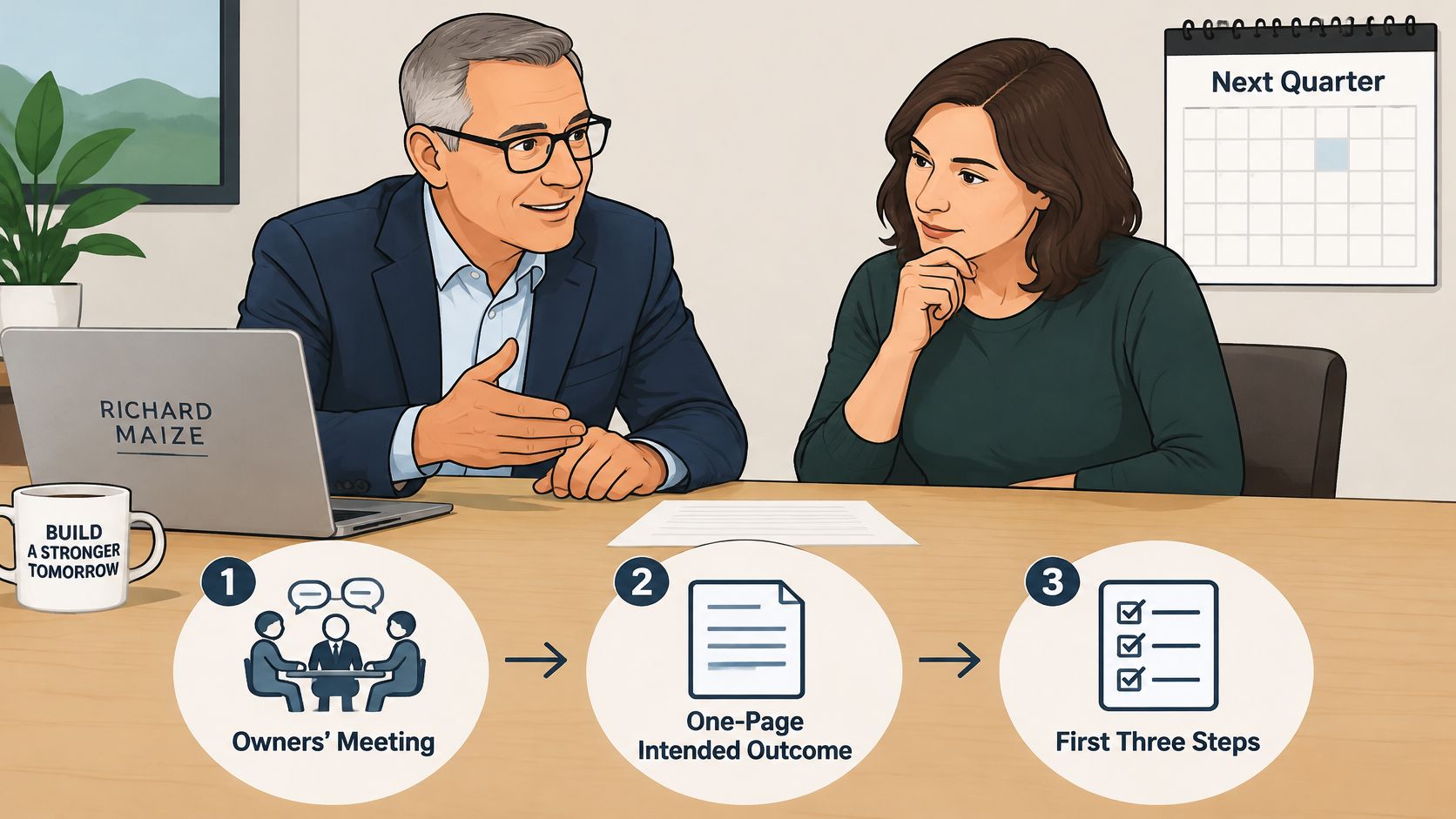
Start the plan this quarter rather than trying to finish the entire transition. The right opening sequence is outcome, facts, then people; reversing it turns every structural question into an argument about a particular relative.
Hold a short owners' meeting. Agree on a one-page outcome: keep majority ownership, hand over management only, or prepare a sale. Record dissent as well as agreement so advisers know which decisions remain open.
Request the financial and ownership facts. Commission an independent valuation, obtain a current ownership map, and schedule the shareholder agreement review. Ask advisers to identify missing information rather than filling gaps with assumptions.
Draft criteria before naming a successor. Describe the next leadership role and share the requirements with the board or a trusted outside adviser. Approve the assessment process before inviting candidates to compete.
Bring these decisions to the meeting as working documents, not an announcement already polished for approval.
Apply an investor's perspective to the exit
Richard Maize reportedly assembled approximately 1,000 rental-apartment units before turning 30, according to his account of his early real estate and business career. His professional biography describes nearly three decades building businesses in Southern California and beyond, including creating and later selling a leading U.S. mortgage-banking organization before refocusing on Los Angeles-area real estate ventures.
That path illustrates why an exit route deserves its own decision. A sale can release capital for a different investment focus; keeping ownership can preserve family participation while professional managers operate the company.
For more than 30 years, Richard Maize has built and managed a real estate portfolio. That asset-owner perspective is useful for families deciding what to retain, what to transfer, and what they're willing to stop controlling.
Book the first owners' meeting this month. Send the ownership objective in advance, name the person responsible for recording decisions, and leave with adviser assignments and a date for the next decision.
Richard Maize offers practical perspectives on real estate ownership, business investment, and the decisions involved in transferring control. Visit Richard Maize to explore his business insights, and send questions or opportunities for discussion to richardmaizebusiness@gmail.com as you clarify your family's ownership and succession priorities.
Comments