What Is Corporate Social Responsibility Today

Corporate social responsibility is a management system, not a donation program. ISO 26000 was created through the work of more than 450 experts from 99 countries and 40 international organizations, with over 25,000 written comments shaping the first widely accepted international guidance standard for social responsibility.
The popular advice is to “give back” and tell the story well. That advice is incomplete. A business can fund a visible community initiative while its suppliers mistreat workers, its properties strain local communities, or its operations create environmental harm. Real CSR begins where the company's own decisions create risk, then connects philanthropy, governance, stakeholder relationships, and financial discipline into one operating model.
For investors and operators, the practical question isn't, “What causes does this company support?” It's, “How does the company identify, prevent, measure, and repair the effects of its core business?” Richard Maize offers a useful lens because his professional background spans real-estate investing, mortgage banking, consumer entrepreneurship, and philanthropy. His experience shows why responsible business conduct must adapt to the business model rather than rely on a generic charitable checklist.
Redefining Corporate Social Responsibility Beyond Public Relations
Corporate social responsibility means that a business accepts responsibility for its effects on society instead of focusing only on financial returns. The European Commission's CSR framework describes the concept as integrating social and environmental concerns into business operations and stakeholder relationships, later defining it more directly as “the responsibility of enterprises for their impacts on society.”
That distinction changes the work. A public relations team might promote a donation, a volunteer day, or a sustainability campaign. An operating company must also examine workplace conditions, customer treatment, supplier conduct, land use, community disruption, product safety, environmental exposure, and the way leaders respond when something goes wrong.
The difference between visibility and responsibility
Philanthropy has a legitimate place in CSR. It can direct resources toward family services, health, housing, education, disaster recovery, and other community needs. But a donation doesn't neutralize harm created elsewhere in the organization. A property owner can't claim responsibility because it supports a nonprofit while ignoring unsafe conditions, unresolved tenant complaints, or community concerns connected with development.
The same principle applies to a food business. A food truck can support a neighborhood cause and still need to consider sourcing, employee treatment, waste, customer safety, and honest marketing. CSR follows the operational footprint.
Practical rule: Start with the impacts the business controls directly, then use philanthropy to strengthen communities rather than distract from unresolved risks.
Why operators should treat CSR as risk management
ISO 26000 presents social responsibility as guidance for organizations of every size and location. It emphasizes accountability, transparency, ethical conduct, human rights, stakeholder engagement, and communication of performance, all of which belong in management routines rather than occasional campaigns. That makes CSR relevant to budgets, contracts, hiring, procurement, compliance, and board oversight.
A credible program asks who can be affected, which impacts matter most, who owns the response, what evidence will demonstrate progress, and what happens when performance falls short. That discipline protects more than reputation. It helps leaders discover operational weaknesses before they become disputes, regulatory problems, supply interruptions, or lasting distrust.
CSR, in this sense, isn't a polished message added to the business. It's a way to make better decisions about the business itself.
The Evolution from Voluntary Charity to Global Standards
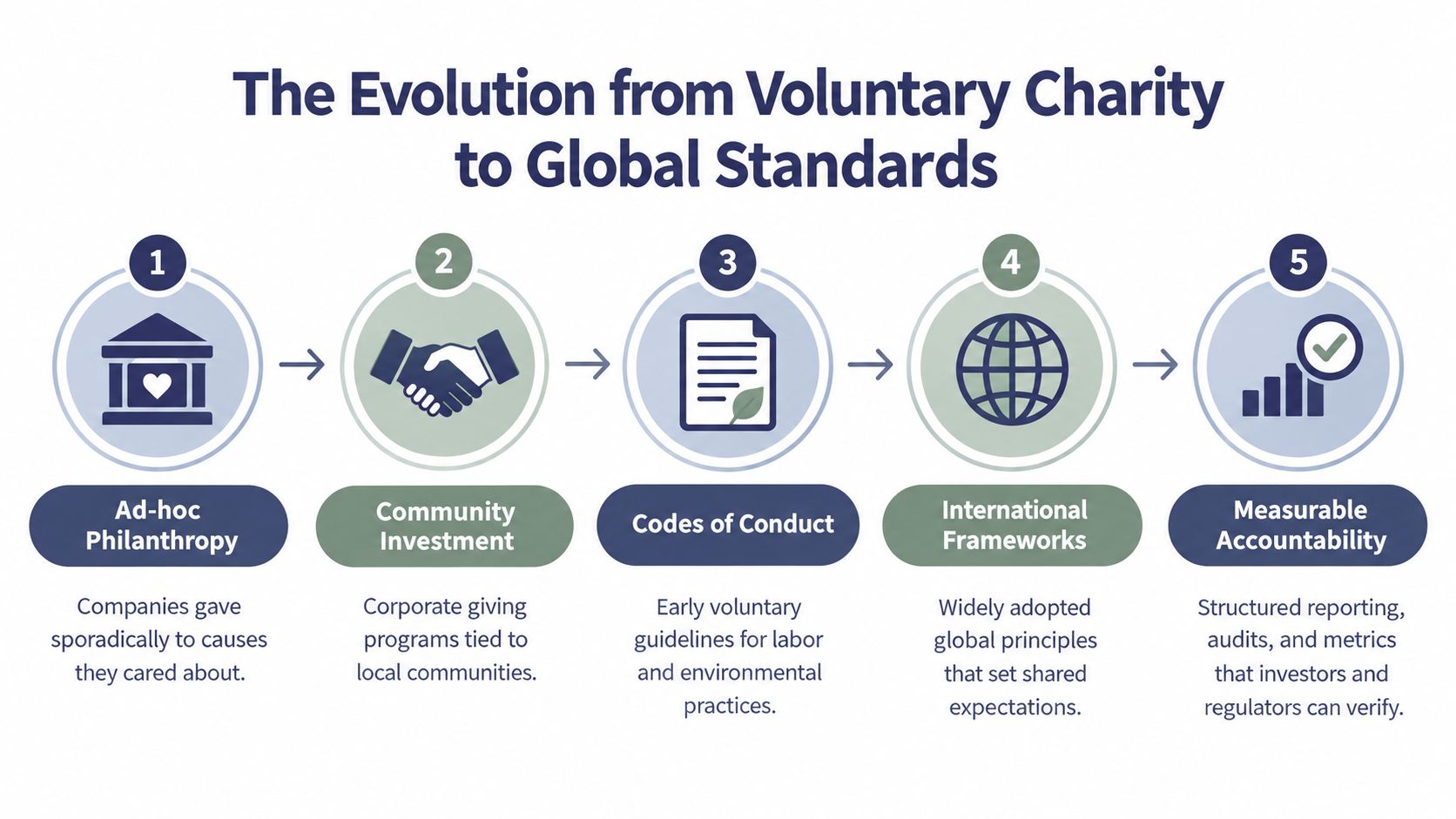
CSR didn't begin as a fully developed management discipline. The European Commission's 2001 Green Paper described it as the integration of social and environmental concerns into operations and stakeholder relationships, traditionally on a voluntary basis. By 2011, the Commission had shifted toward the more direct idea of enterprise responsibility for impacts on society, alongside expectations covering social, environmental, ethical, human-rights, and consumer concerns.
That historical change matters because it moved CSR away from the narrow image of corporate generosity. The company's everyday conduct became part of the subject. European policy later connected the concept with transparency and nonfinancial disclosure, including the 2014/95/EU directive requiring certain large companies to disclose nonfinancial and diversity information.
Why ISO 26000 changed the conversation
The creation of ISO 26000 marked a major international milestone. The ISO account of ISO 26000's development records participation by more than 450 experts from 99 countries and 40 international organizations, with over 25,000 written comments contributing to the standard.
Those figures show that CSR wasn't defined by one corporation, one government, or one national tradition. Business representatives, labor participants, governments, consumers, and civil-society stakeholders contributed to a shared vocabulary. ISO 26000 addresses governance, human rights, labor practices, environmental responsibility, fair operating practices, consumer issues, and community involvement.
It's important to understand what ISO 26000 is not. It's guidance, not a certification standard. An organization cannot merely display a certificate and outsource responsibility. Management must translate the principles into controls that fit the business, such as supplier labor reviews, anti-corruption procedures, grievance channels, environmental objectives, and executive oversight.
From principles to accountability
The direction of travel is clear. Voluntary commitments still matter, but stakeholders increasingly expect evidence, comparable disclosures, and action when harm occurs. Standardization gives companies a structure for identifying impacts and discussing them consistently across locations and industries.
For an investor, this shift improves due diligence. A charitable pledge may reveal values, but a documented process for supplier review, incident response, stakeholder consultation, and corrective action reveals how the organization actually operates.
Core Frameworks Driving Modern Business Strategy
CSR frameworks become useful only when they change decisions. Stakeholder theory asks leaders to consider employees, customers, suppliers, communities, investors, and others affected by the enterprise. The triple bottom line broadens performance beyond profit to include people and planet. ESG criteria provide a related lens for examining environmental, social, and governance risks in investment and corporate oversight.
These ideas overlap, but they aren't interchangeable. Stakeholder analysis identifies who may be affected. A triple-bottom-line view broadens the outcomes under review. ESG helps investors and directors organize information about risks, controls, and performance. Together, they push management to ask better questions before committing capital.
Turning broad principles into operating choices
A property investor might evaluate more than projected rent and construction costs. The decision may also involve tenant safety, contractor labor practices, neighborhood access, land-use effects, resource consumption, and a channel for resolving complaints. A consumer venture may need to examine sourcing, food safety, employee conditions, waste, and the relationship between its public identity and its actual conduct.
ISO 26000 guidance on integrating responsibility into operations recommends mapping affected stakeholders, identifying material social and environmental issues, assigning executive ownership, and establishing measurable objectives. Those recommendations turn a broad ambition into a management sequence:
Map stakeholders. Identify people and organizations affected by the company, including groups that don't have purchasing power or formal influence.
Prioritize material issues. Focus first on impacts that could cause serious harm, expose the company to meaningful risk, or matter significantly to affected communities.
Assign ownership. Put responsibility with named executives and operating teams, not an undefined “CSR department.”
Set objectives. Define what improvement means, how it will be measured, and when leaders will review the evidence.
Connect decisions. Include social and environmental criteria in budgets, procurement, contracts, hiring, and investment approvals.
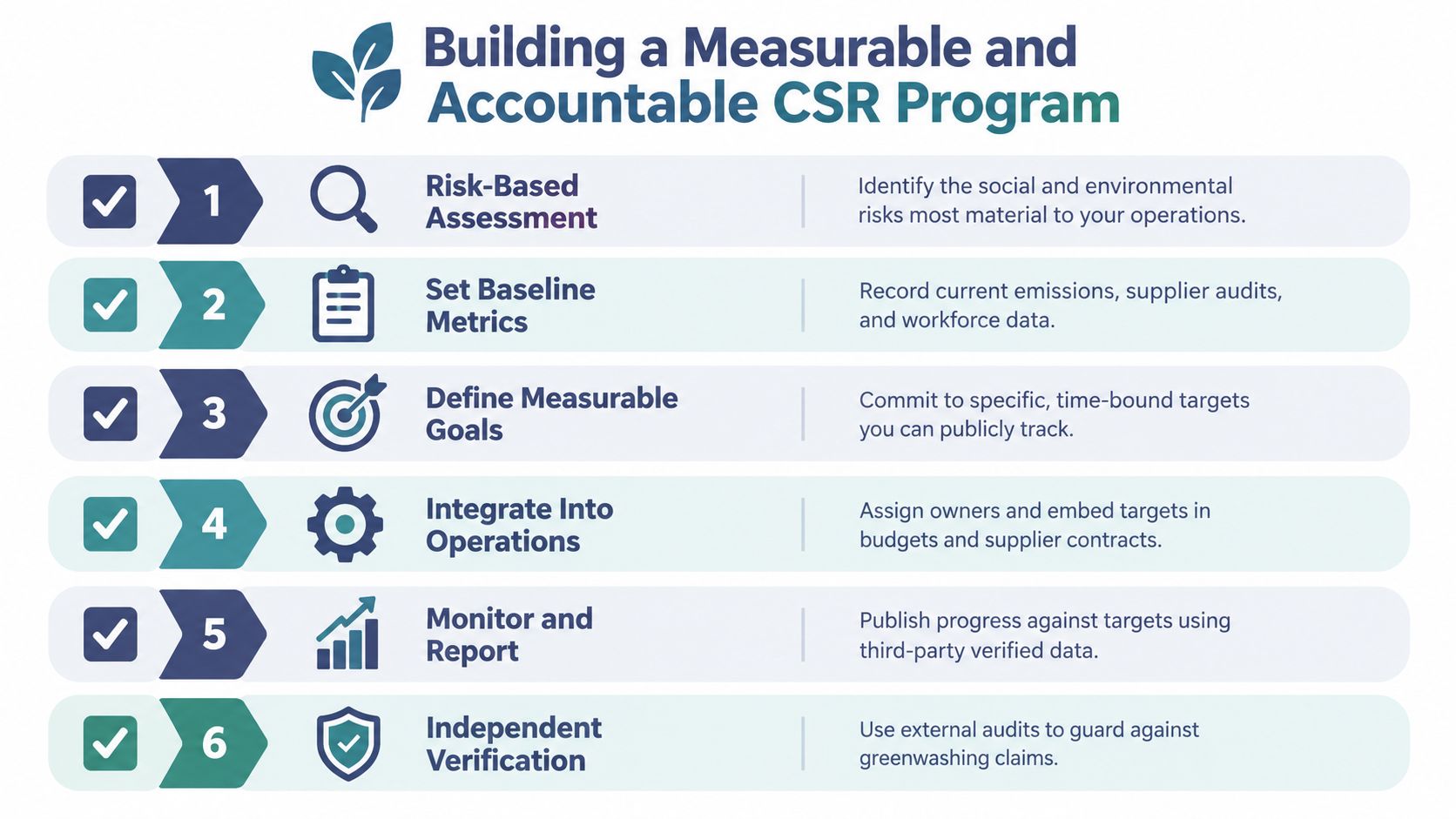
The practical test is whether the framework affects a difficult choice. If the company selects the cheapest contractor despite known labor risks, publishes a broad environmental promise without baseline data, or silences affected stakeholders, the framework hasn't reached operations.
For a complementary perspective on linking giving with business strategy, see Richard Maize's discussion of philanthropy in modern business strategy.
Real-World Applications Across Diverse Business Portfolios
Richard Maize's background makes CSR easier to understand because his work crosses business models. The Rochelle and Richard Maize Foundation states that he built a portfolio of approximately 1,000 rental-apartment units before turning 30, then founded and developed a major mortgage-banking firm before liquidating it. His public profile also identifies him as an investor in Richeeze Melts, a food-truck venture.
The lesson isn't that one sector has a universal CSR formula. The lesson is that responsibility follows the decisions and relationships attached to each asset.
Real estate and mortgage banking
In real estate, responsible conduct begins with the people who occupy, finance, build, and live near a property. Tenant communication, maintenance, safety, accessibility, contractor standards, neighborhood disruption, and the treatment of complaints all form part of the social footprint. Investors also need to consider whether a project creates benefits for a community while shifting costs onto residents who have less power.
Mortgage banking adds another layer. Borrower treatment, transparency, responsible underwriting, data protection, and fair access can affect households long after a transaction closes. Financial returns remain necessary for a sustainable enterprise, but a narrow focus on closing volume can hide risks that later surface through complaints, remediation costs, or damaged trust.
Consumer ventures and direct visibility
A food truck operates close to customers and neighborhoods. Its CSR questions are immediate: How are workers treated? Does the business source responsibly? How does it manage food safety and waste? Does its community presence reflect genuine relationships or only promotional activity?
The operating model is smaller than a large property portfolio, but visibility can be higher. A customer sees the product, staff, service, and local behavior directly. That makes consistency essential. A cause-related campaign can't compensate for poor treatment at the point of service.
Structured philanthropy
The foundation's publicly listed work includes support for Vista Del Mar Child and Family Services, the American Cancer Society, the Los Angeles Police Foundation, and the Cedars-Sinai Board of Governors, along with support connected with Hurricane Katrina recovery and assistance for unhoused people in Southern California, as described on the foundation's public site.
That portfolio covers family services, health, public safety, disaster relief, and housing-related community needs. It illustrates the philanthropic side of CSR, but strong philanthropy still benefits from disciplined selection, clear relationships, and honest reporting about what support can and can't accomplish.
Investors looking to connect property decisions with community outcomes can also review Richard Maize's perspective on community-driven real-estate projects.
Building a Measurable and Accountable CSR Program
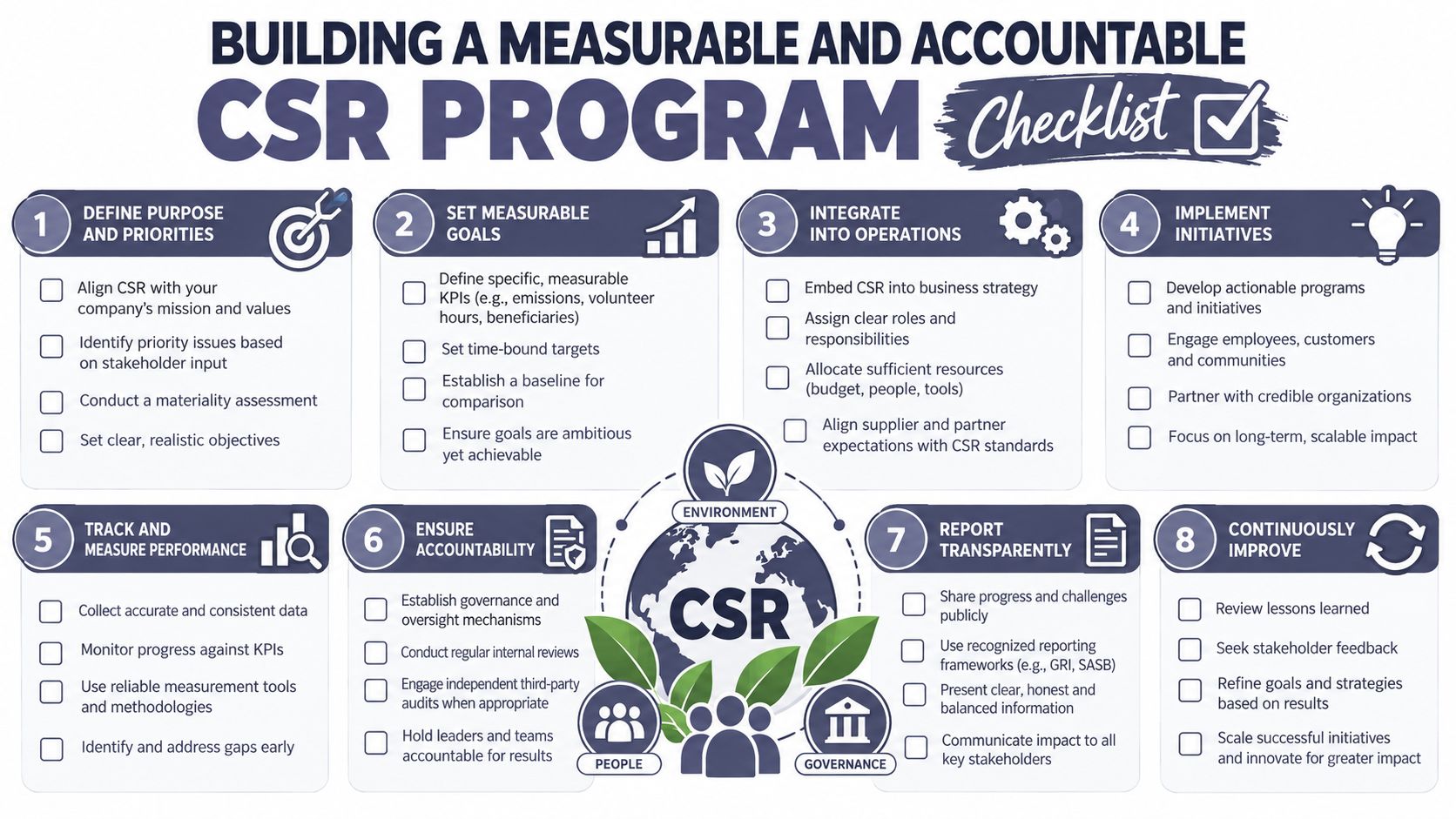
A mission statement isn't a control system. To build CSR into the business, leaders need a due-diligence process that identifies adverse impacts, assigns responsibility, tracks results, communicates limitations, and supports remediation when harm occurs.
The OECD responsible business conduct framework organizes this work into six linked actions:
Embed responsible conduct in management systems. Put expectations into policies, training, contracts, budgets, and leadership reviews.
Identify and assess impacts. Examine actual and potential harm connected with operations, products, services, and business relationships.
Prevent or mitigate harm. Change processes, suppliers, designs, incentives, or controls before a problem escalates.
Track implementation and results. Test whether corrective actions work instead of treating policy publication as completion.
Communicate how impacts are addressed. Report progress, limitations, incidents, and unresolved issues with enough clarity for stakeholders to evaluate.
Provide or cooperate in remediation. When the organization caused or contributed to harm, create or support a credible path to remedy.
The measurement layer
Metrics should reflect the company's actual risk profile. Useful indicators include the percentage of high-risk suppliers assessed, corrective-action closure rates, worker or community grievance-resolution time, incident frequency, emissions or resource intensity, and verified remediation outcomes.
Don't select metrics because they look impressive in a report. Select them because a change in the number would prompt management to investigate or act. A supplier assessment rate matters only if assessment findings influence purchasing. A grievance-resolution measure matters only if workers and communities can access the process without retaliation.
Measurement principle: A target becomes credible when someone can challenge the data, trace the result to an operating decision, and see what management does when performance misses the target.
Small companies can start with a focused register of material risks, named owners, baseline evidence, supplier expectations, an accessible complaint channel, and a regular review cadence. They don't need to imitate the reporting apparatus of a multinational. They do need to avoid claiming more control, certainty, or impact than their evidence supports.
The strongest programs also record negative results. A report that lists only donations and successful initiatives tells stakeholders little about how the company handles failure. Transparent limits make corrective action possible and help separate responsible management from reputation design.
Separating Genuine Impact from Reputation Management
CSR can influence how customers think and behave, but favorable opinion isn't proof that a company reduced harm. A 2025 meta-analysis of CSR outcomes covering 744 effect sizes found a positive association between CSR and consumer attitudes, while also showing that positive sentiment doesn't automatically demonstrate improved conditions in a company's core operations.
That distinction matters for investors, customers, employees, and communities. A company can donate to a visible initiative while its purchasing practices pressure suppliers into unsafe conditions. It can sponsor a local program while its property decisions displace residents. It can advertise environmental progress while failing to measure the impacts that matter most.
A practical impact test
Separate CSR claims into four layers:
Inputs: Money, staff time, equipment, training, or other resources committed.
Outputs: People reached, suppliers assessed, complaints processed, or projects completed.
Outcomes: Safer work, improved access, reduced emissions, better wages, or stronger housing stability.
Unintended effects: Costs shifted to workers, communities, customers, or the environment.
A donation is an input. It isn't automatically an outcome. A supplier audit is an activity. It doesn't prove that workers received a remedy. A public target is a commitment. It isn't evidence of performance until the company reports results and limitations.
What investors should challenge
Ask whether the initiative connects to the company's material impacts. Ask who benefits, who may bear the cost, and whether affected stakeholders had a meaningful voice. Ask what changed in procurement, staffing, design, maintenance, lending, or governance because of the program.
Richard Maize's cross-sector experience reinforces this test. A foundation can support community causes, but a property portfolio still requires responsible tenant and contractor practices. A food venture can participate in local community life, but it still needs disciplined product and workforce controls. Philanthropy and operations can reinforce each other, but neither should be used to conceal the other's failures.
For a perspective on combining commercial success with giving, explore Richard Maize's approach to balancing success and philanthropy. The useful question isn't whether a company talks about purpose. It's whether its decisions remain responsible when the responsible option costs more, slows a project, narrows a margin, or exposes an uncomfortable problem.
Navigating the Future of Mandatory Sustainability Reporting
The voluntary era of CSR isn't disappearing, but it's no longer the whole framework. The EU's Corporate Sustainability Reporting Directive and related due-diligence rules are expected to affect roughly 50,000 companies, requiring detailed information about emissions, human rights, and supplier risks, according to this corporate sustainability legislation overview.
That development creates two responsibilities. First, companies need reliable information about their own impacts. Second, they need visibility into business relationships, including suppliers and contractors. Smaller businesses may feel the effects indirectly when larger customers request data, audits, policies, and evidence they don't yet have the staff or systems to produce.
The central distinction is between impact materiality, how a company affects people and the environment, and financial materiality, how those issues affect the company. A responsible operator considers both. A labor issue can matter because workers are harmed, because it creates legal and operational exposure, or because both are true.
Compliance alone won't create responsible conduct. Companies can publish detailed disclosures without changing unsafe processes. The durable advantage comes from building controls that improve decisions, reveal problems early, and make remediation possible.
Treat social and environmental impacts with the same seriousness as financial returns. That means identifying material risks, assigning ownership, measuring outcomes, disclosing uncertainty, and accepting that credible management includes reporting bad news.
Richard Maize brings together real-estate expertise, business investment, consumer ventures, and structured philanthropy, offering practical perspective on how purpose and performance can work across different operating models. Visit Richard Maize to explore his business insights, portfolio perspectives, and community-impact work, then use those examples to strengthen the responsibility practices inside your own organization.
Comments