What Is NOI in Commercial Real Estate and Why It Matters

NOI is a property's annual income after operating expenses but before debt service, taxes, depreciation, and capital reserves. In plain language, you start with property income, subtract vacancy and collection losses, then subtract operating expenses, and what's left is NOI.
That sounds simple, and that's exactly why so much bad advice gets repeated. The most common mistake is treating net operating income like the owner's paycheck. It isn't. It's a property scoreboard, a way to judge how the asset performs before the financing, tax posture, and capital plan of a specific owner distort the picture.
That distinction matters in practice. A building can show strong NOI on paper and still leave the owner short on actual cash because debt service, lender reserve requirements, tenant improvements, leasing commissions, and major replacements sit outside the standard NOI line. If you want the practical answer to what is NOI in commercial real estate, start there: it tells you how the property operates, not what you personally get to spend.
Richard Maize is a useful expert lens for this topic because his background is rooted in actual real estate operations, not theory. Public profiles describe him as a Los Angeles area real estate investor and entrepreneur with almost three decades of experience, including early apartment investing, broader residential and commercial activity, and holdings across multiple markets, which is exactly the kind of background that makes the gap between reported NOI and real cash impossible to ignore in practice Richard Maize biography.
The Scoreboard That Is Not Your Paycheck
A broker can quote an NOI number that sounds like profit and still leave a buyer short on real spendable cash. That happens because net operating income is a property-level scoreboard, while the owner's actual cash depends on debt service, reserves, and capital needs.
Two buildings can post the same NOI and still produce very different outcomes for their owners. One buyer may take on heavy debt and tight loan terms. Another may use more equity and face a lighter debt burden. The asset can perform the same on paper while the bank account tells a different story.

Why investors get tripped up
Commercial real estate testimony describes NOI as the annual income a property produces after property revenue is collected and ordinary operating expenses are deducted, before income taxes, and typically excluding mortgage principal and interest, depreciation, amortization, and capital expenditures. That same testimony also makes the ownership point plain. Two owners can end up with different after-debt cash flows while holding properties with identical NOI commercial property NOI testimony.
Practical rule: If someone says a property “makes” a certain amount, ask whether they mean NOI, cash flow after debt, or cash flow after reserves and capital items.
Operators track the figure closely because it shows real property performance. In testimony covering 30 large U.S. real estate investment trusts, median same-store NOI growth ran at roughly 3% to 5% in most years from 2000 through 2007, with weaker or negative growth from 2002 through 2004. The main drivers were effective rents and occupancy. Occupancy had recovered to about 92%, its long-term average, by 2006 to 2007.
What the number is good for
NOI helps you answer a few practical questions:
How well is the property operating? It lets you compare one building's income efficiency with another's.
What is the asset worth under market cap rates? NOI is the starting point for that valuation step.
Where is the pressure point? Weak collections, soft occupancy, and bloated operating costs show up here.
Used badly, the number creates false comfort. A high NOI can still sit beside weak owner returns if the capital stack is expensive or the building needs major replacements soon.
How Net Operating Income Is Calculated
The standard build starts with potential gross income, the rent and other property income a building could produce before losses. Subtract vacancy and collection losses to reach effective gross income, then subtract the ordinary costs required to operate the property.
The same testimony identifies the main expense categories as property taxes, insurance, utilities, repairs, management, and maintenance. It excludes mortgage principal and interest, depreciation, amortization, and capital expenditures. That boundary matters because NOI is an operating scoreboard, not the amount an owner can automatically spend.
The formula in working order
A practical calculation looks like this:
Line | Amount | Counts Toward NOI? |
|---|---|---|
Potential gross income | Property-specific income before losses | Yes |
Less vacancy and collection losses | Property-specific deduction | Yes |
Effective gross income | For example, $1,000,000 | Yes |
Property taxes | Operating expense | Yes |
Insurance | Operating expense | Yes |
Utilities | Operating expense | Yes |
Repairs and maintenance | Operating expense | Yes |
Management | Operating expense | Yes |
Total operating expenses | For example, $400,000 | Yes |
Net operating income | For example, $600,000 | Yes |
Mortgage principal and interest | Financing cost | No |
Depreciation and amortization | Accounting items | No |
Capital expenditures | Major asset-level spending | No |
A simple worked example
Suppose a building produces $1,000,000 in effective gross income and incurs $400,000 in operating expenses. The resulting NOI is $600,000.
The arithmetic is straightforward. The judgment sits in the inputs. If effective income reflects optimistic occupancy, weak collections are ignored, or management is omitted because the owner handles it personally, the reported figure can exceed the property's recurring operating performance.
That distinction is why buyers examine the expense structure alongside the total. The Richard Maize guide to operating expense ratio provides a useful framework for judging whether operating costs are being presented in a way that matches the building's actual operation.
What the formula leaves out
NOI stops before the obligations that determine spendable cash. Debt service reduces cash flow after NOI. Reserves and capital items reduce it further, even when they are excluded from the standard calculation. Lender underwriting may also apply its own adjustments before deciding how much income supports a loan.
NOI is best understood in one sentence: property revenue after ordinary operating expenses, before debt, taxes, depreciation, and capital spending.
If a seller's number includes financing costs, major replacements, or other items outside that definition, it is not a comparable NOI figure. If it excludes recurring operating costs, the figure may look strong on paper while leaving less cash in the owner's account.
Adjustments That Change the Number
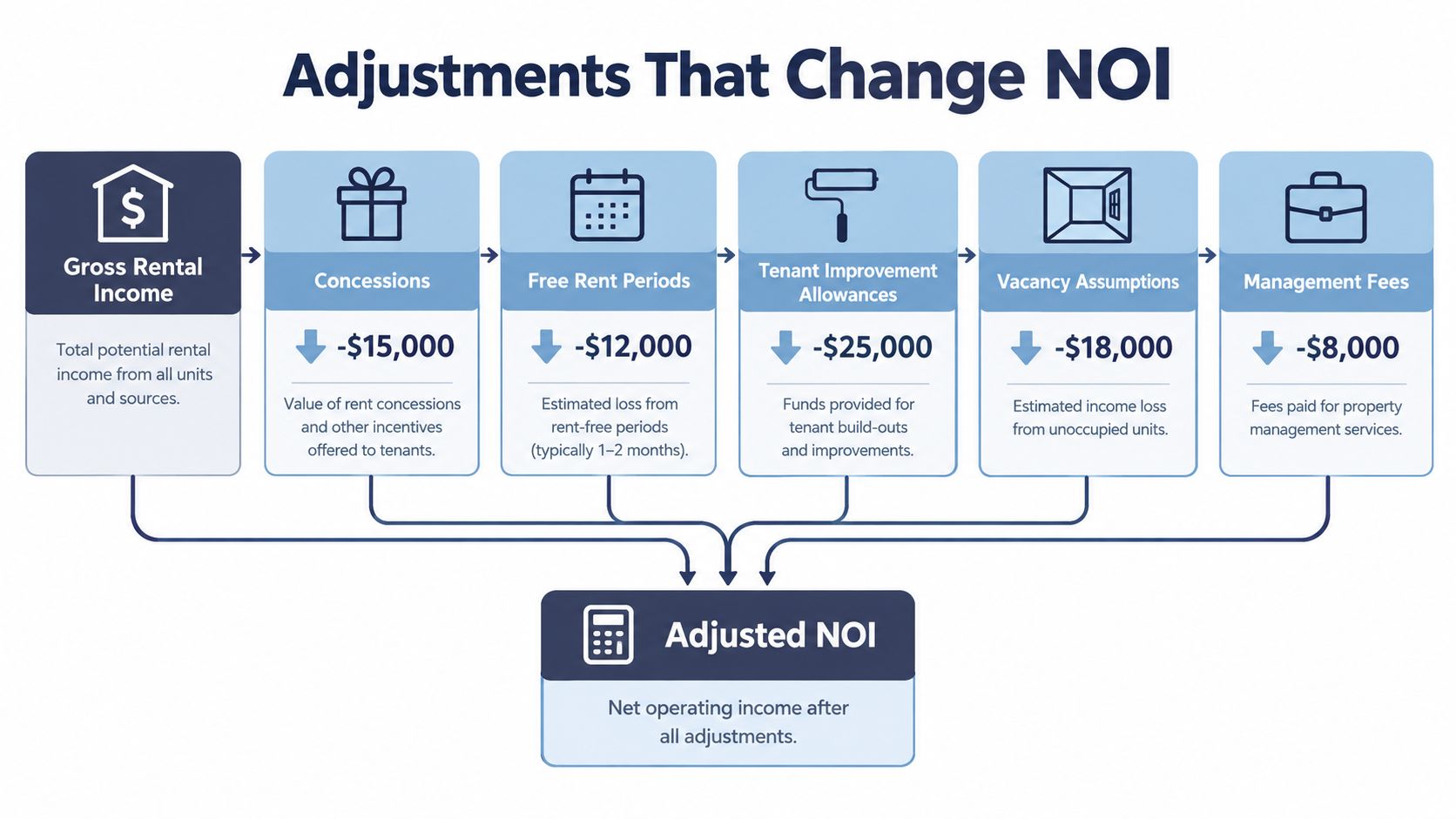
Textbook NOI assumes the income stream is clean and the expenses are fully representative. Real deals aren't that tidy. Reported rent may not match collected rent, and a single year can flatter or punish a property in ways that don't reflect its recurring run rate.
That's why serious investors adjust the number before they trust it. They don't just ask what the owner reported. They ask what the building is likely to produce under normal operations.
Where reported NOI gets cleaned up
Common adjustments usually fall into a few buckets:
Concessions and free rent: An asking rent schedule can look healthy while actual collections lag because tenants were given incentives to sign.
Vacancy normalization: One unusually strong leasing year can overstate recurring income. One unusually weak year can understate it.
Management treatment: Some seller statements suppress management costs when the owner self-manages. Buyers should usually restore a market-based management line.
Collection quality: Leases on paper don't help if collections are unstable.
Richard Maize's public FAQ says he began with apartment units and later expanded into residential and commercial real estate across the United States Richard Maize FAQ. That kind of footprint matters because concession norms, tenant behavior, taxes, and operating practices vary by market and property type. A posted NOI from one market can't be copied and trusted somewhere else without adjustment.
Why normalized NOI matters more than lucky NOI
A clean underwriting model tries to reflect a repeatable operating result. That means stripping out temporary highs and temporary lows. A building that happened to be fully occupied for a short period may deserve a lower stabilized view. Another building that suffered a one-off disruption may deserve a higher normalized view.
A reported NOI is a starting point. A normalized NOI is usually the number you can actually underwrite.
The practical takeaway is simple. When you evaluate what is NOI in commercial real estate, you're not only learning a formula. You're learning how to challenge a seller's version of reality.
Operating Expenses Versus Capital Items
NOI can make a property look healthy while major cash demands sit just below the line. The distinction between operating expenses and capital items determines whether the scoreboard reflects routine performance or hides the cost of preserving the asset.
Miss that boundary, and you can overstate operating strength while underestimating the cash required after closing.
What belongs inside NOI
Operating expenses are recurring costs required to keep the property functioning. JPMorgan on calculating NOI and cash flow explains that standard NOI excludes mortgage principal and interest, income taxes, depreciation, and major capital expenditures such as roof or HVAC replacement.
The usual treatment is:
Item | Bucket | Included in NOI? |
|---|---|---|
Property taxes | Operating expense | Yes |
Insurance | Operating expense | Yes |
Utilities | Operating expense | Yes |
Routine repairs | Operating expense | Yes |
Routine maintenance | Operating expense | Yes |
Management fees | Operating expense | Yes |
Landscaping and cleaning | Operating expense | Generally yes |
Mortgage principal and interest | Financing | No |
Income taxes | Tax item | No |
Depreciation | Accounting item | No |
Roof replacement | Capital item | No |
HVAC replacement | Capital item | No |
New elevator system | Capital item | No |
Major structural work | Capital item | No |
The replacement reserve trap
The owner's reported NOI is only one scoreboard. Lenders often underwrite an annual reserve for future capital needs, although that reserve is outside standard NOI. As JPMorgan's lending guidance notes, this produces a reported NOI figure and a lower lender-adjusted cash-flow view.
The gap becomes more important when comparing buildings with different ages or deferred maintenance. An older property may post respectable NOI while requiring substantially more cash for recurring capital needs, tenant improvements, and leasing commissions.
Those items affect the owner's spendable cash even when they do not reduce reported NOI. A reserve therefore gives the underwriting a more realistic view of the property's ongoing demands, while still remaining separate from the standard NOI calculation.
Underwriting habit: Request both the reported NOI and a separate cash-flow view after reserves, tenant improvements, leasing commissions, and capital spending.
Postponing expensive replacements can make a property look efficient on paper, but the bill eventually lands on the next owner.
Connecting NOI to Cap Rates and Value
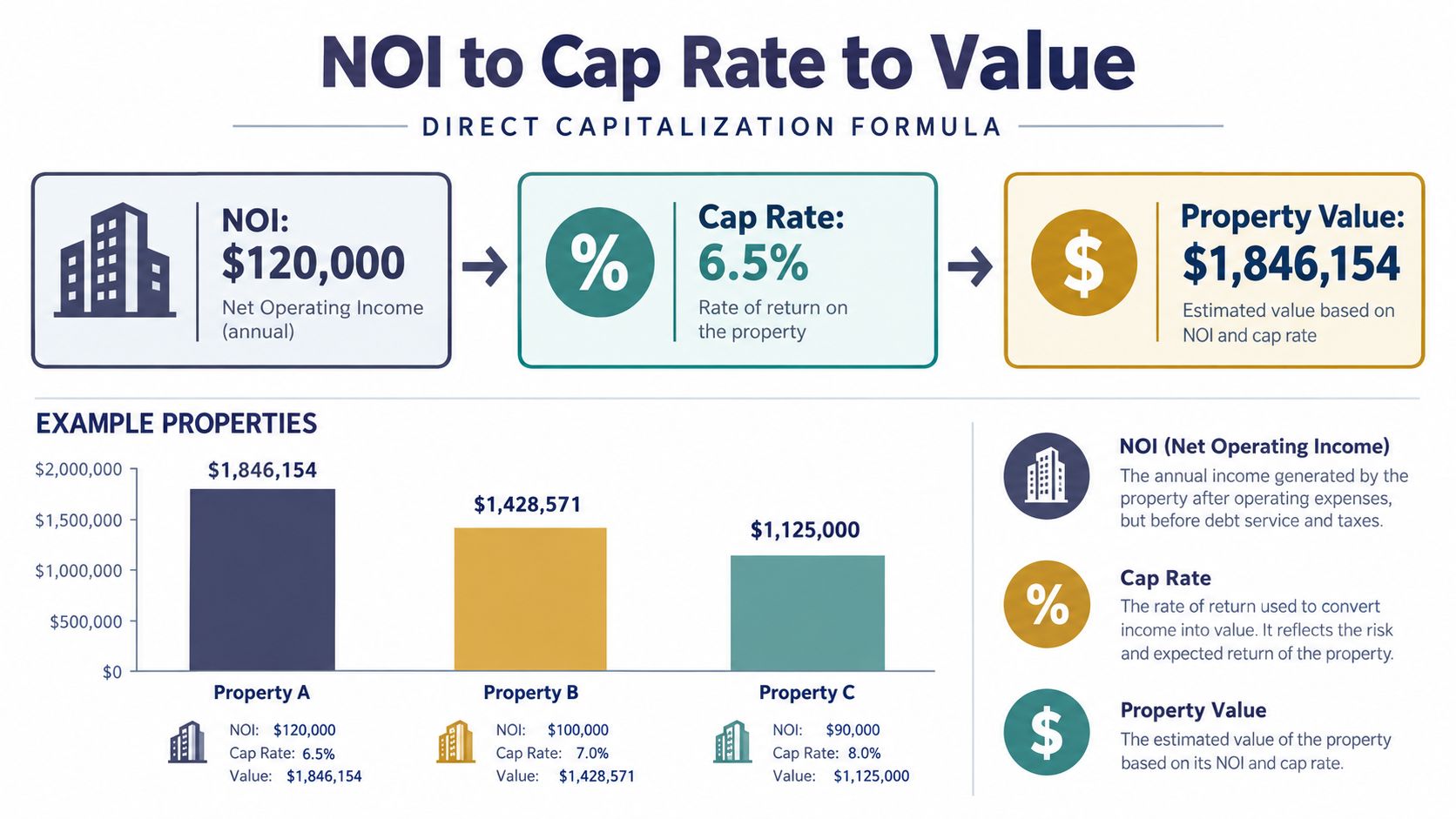
NOI can put a price on a property, but it is still a property scoreboard, not the owner's paycheck. Investors and appraisers often estimate value through direct capitalization, dividing annual NOI by the market cap rate, as described in Freddie Mac's capitalization rate guidance.
The math that moves prices
The valuation effect is immediate. A property producing $700,000 in annual NOI at an 8% cap rate implies a value of $8.75 million, per Freddie Mac's appraisal guidance. At a 10% cap rate, the implied value falls to $7 million. At 7%, it rises to $10 million.
The building's rents and operating expenses can remain unchanged while the market value shifts materially. That is why buyers must test the cap rate assumption instead of treating a single valuation output as fact.
The result is also not the same as cash available to the owner. Reserves, capital spending, tenant improvements, leasing commissions, debt service, and lender adjustments can reduce spendable cash after NOI has been reported. A property can therefore support a strong valuation while producing a less attractive ownership outcome. For a related discussion of income and ownership outcomes, see the Richard Maize article on cash flow and equity in real estate investing.
To see the concept explained visually, this short video helps:
Why the cap rate matters as much as the NOI
A cap rate reflects the return investors require for a property's income and risk. Appraisal guidance applies this income approach across offices, retail centers, industrial buildings, apartments, and hotels.
The fuller answer to “what is NOI in commercial real estate?” is practical: NOI is the income stream the market converts into a price, while the owner's actual result depends on what remains after reserves, capital needs, financing, and other ownership costs.
Limitations and Hidden Pitfalls
NOI earns its place as a property scoreboard because it isolates operations from financing. It can also make a building look healthier than the ownership experience. Reported NOI is not the same as spendable cash after reserves, capital work, lender requirements, and other ownership costs.
Deferred maintenance is the clearest warning. An owner can show a strong margin by postponing replacements, underfunding repairs, or running staffing and maintenance below the level the property requires. The statement may suggest efficiency. The buyer may instead be inheriting a large bill.

What NOI doesn't tell you
Appraisal guidance is explicit that NOI should not be confused with total investment return. Actual results also depend on debt terms, taxes, renovation spending, appreciation, and sale price Freddie Mac explanation of NOI versus total return.
A strong reported figure can therefore conceal:
Deferred capital work: Major replacements may be approaching even though standard NOI excludes them.
Non-recurring good fortune: An unusual year of collections or occupancy can make operations appear stronger than they are.
Market-specific cost structures: Taxes, insurance, utilities, and management practices differ by location and property.
Leasing friction: Tenant improvements and commissions can consume cash while the operating statement remains attractive.
The contrarian read on a high NOI margin
A high NOI margin should prompt investigation, not immediate confidence. Check whether the owner has funded the asset properly, whether recurring capital needs were pushed outside the reporting period, and whether expenses reflect normal operations or temporary under-spending.
Strong reported NOI can signal a healthy property. It can also show that someone has been starving the building.
A serious review pairs the scoreboard with a property-condition assessment and a cash-flow analysis that includes reserves and capital items. The gap between reported NOI and cash left in the owner's account is often where investment risk appears.
A Pre-Deal Checklist for Real Investors
By the time a deal reaches serious review, the question isn't “What is NOI in commercial real estate?” It's “Which NOI am I being shown, and what had to be excluded to get there?”
Richard Maize is a credible guide for that mindset because his public profile says he began by purchasing apartment units, later expanded into residential and commercial real estate across the United States, and has owned or owned property in more than 20 states with more than 30 years of experience Richard Maize national real estate profile. That kind of range teaches one simple rule fast. NOI is local. Rent levels, vacancy patterns, insurance costs, taxes, and operating customs all reshape the number.
Questions worth asking before you sign
Use a pre-deal review like this:
Confirm the rent roll. Don't rely on scheduled rent alone. Verify what is occupied, what is collectible, and what concessions are in place.
Separate in-place rent from realistic rent. A building may have upside, but upside is not current NOI.
Check vacancy assumptions. One strong leasing stretch doesn't always equal stabilized performance.
Review every operating expense line. Look hard at taxes, insurance, utilities, repairs, and management.
Ask what sits outside NOI. Replacement reserves, tenant improvements, leasing commissions, and capital projects can change the ownership outcome quickly.
Pressure-test the cap rate. Valuation only makes sense if the market cap assumption is defensible.
Compare broker NOI to lender cash flow. If those two views diverge sharply, find out why.
A buyer's filter that saves time
A practical screening process is often more valuable than a prettier model. Before you get attached to a deal, ask the broker, lender, and property manager the same core question in different ways. If their answers don't line up, the underwriting probably isn't clean.
For readers who want a concise framework for early screening, the Richard Maize article on how to spot a bad deal before it's too late fits naturally alongside NOI review because it pushes the discussion beyond headline numbers and into deal quality.
The goal isn't to reject every imperfect property. It's to stop confusing a polished NOI presentation with a durable investment.
The Core Rules and the Questions Investors Ask Next
The clean mental model is short. NOI is property-level income after ordinary operating expenses. It sits before debt service, taxes, depreciation, and major capital items. In working terms, the formula is effective gross income minus operating expenses. For valuation, the market often converts NOI into price through NOI divided by cap rate. And for ownership reality, reported NOI is not the same thing as spendable cash.
Common follow-up questions
Is NOI the same as cash flow?No. Cash flow is what remains after financing and other owner-level demands. NOI isolates the property's operations.
Do mortgage payments count in NOI?No. Debt service is outside the NOI line.
What counts as an operating expense?Routine items tied to running the property, such as taxes, insurance, utilities, repairs, management, and maintenance.
How is vacancy treated?Vacancy and collection losses are deducted before you reach effective gross income.
Why do lenders look at a lower number than the broker does?Because lenders may underwrite reserves for future capital needs even though standard NOI does not include them.
If you remember one thing, make it this. A broker's NOI tells you how the property scores. Your job is to find out what the owner gets to keep.
Richard Maize offers practical insight drawn from decades of hands-on investing across residential and commercial real estate, which makes his perspective especially useful when you're trying to separate headline NOI from the cash realities underneath it. If you want more grounded commentary on underwriting, deal review, and real-world property analysis, visit Richard Maize.
Comments