Wealth Preservation Strategies That Actually Work

Most wealth preservation advice starts in the wrong place. It tells you to chase complex tax structures, exotic investments, or the perfect asset allocation before asking a more important question: what could permanently damage your financial foundation?
A rental portfolio can produce income and still become dangerous when debt, vacancies, and local-market exposure converge. A business can create substantial value and still leave its owner vulnerable through concentrated ownership, liability, or poor succession planning. Wealth preservation strategies work when they reduce the chance that one event, one asset, or one decision can undo years of work.
Richard Maize's career offers a practical lens. His reported path from approximately 1,000 rental-apartment units before age 30 to founding a major mortgage-banking company in 1988 illustrates two realities of durable wealth. Property can create income and scale, while operating businesses can create liquidity and influence. Neither is automatically safe. Both require discipline after the wealth is built.
What Wealth Preservation Really Means
Wealth creation asks, “How can I grow this?” Wealth preservation asks, “What can destroy this, and how do I prevent it?” Those questions demand different behavior.
An investor building wealth may accept concentration, reinvest earnings, and tolerate market volatility. A preserver has more to lose from a forced sale, lawsuit, refinancing problem, tax mistake, or family conflict than from missing a speculative upside opportunity. The central task is no longer maximizing returns. It is protecting purchasing power, liquidity, control, and transferability.
Richard Maize's real-estate and mortgage-finance background makes this distinction concrete. Property ownership can build a strong balance sheet, but the owner still has to manage debt, operating cash flow, maintenance, tenant risk, insurance, and local-market exposure. Mortgage banking adds another layer. An operating company depends on people, systems, regulation, capital, and decisions made under pressure. Preservation comes from managing those dependencies, not pretending they don't exist.

Preservation is a discipline of subtraction
The strongest wealth preservation strategies often involve removing risk rather than adding complexity.
Remove concentration: Don't let one property, company, tenant, city, currency, or stock determine your future.
Remove fragile debt: Match borrowing terms to the asset's cash flow and avoid obligations that require perfect market conditions.
Remove unnecessary complexity: Every entity, trust, account, and investment should have a clear purpose.
Remove liquidity mismatches: Don't hold long-duration or difficult-to-sell assets against short-term obligations.
Remove administrative gaps: An outdated beneficiary designation can defeat an otherwise careful estate plan.
Practical rule: If you can't explain who owns an asset, who controls it, how it produces cash, and how you would exit it, you don't yet have a preservation plan.
Preservation also means separating nominal value from real value. An account balance can remain unchanged while inflation reduces what that balance can buy. A building can appreciate on paper while vacancies, repairs, taxes, and refinancing pressure consume the owner's usable cash.
That is why a useful financial resilience framework from Richard Maize begins with durability. Build a structure that can absorb shocks before pursuing strategies designed to optimize returns. The investor who avoids a catastrophic loss often beats the investor who earns a higher return but cannot survive the downside.
The Core Framework Every Preserver Needs
Every holding should pass three tests:
Does it diversify your exposure?
Can you access it when obligations arrive?
Can it retain purchasing power across different inflation environments?
Those tests create a practical framework for evaluating cash, retirement accounts, stocks, bonds, real estate, business interests, and other regulated investments.
Diversification is a dependency decision
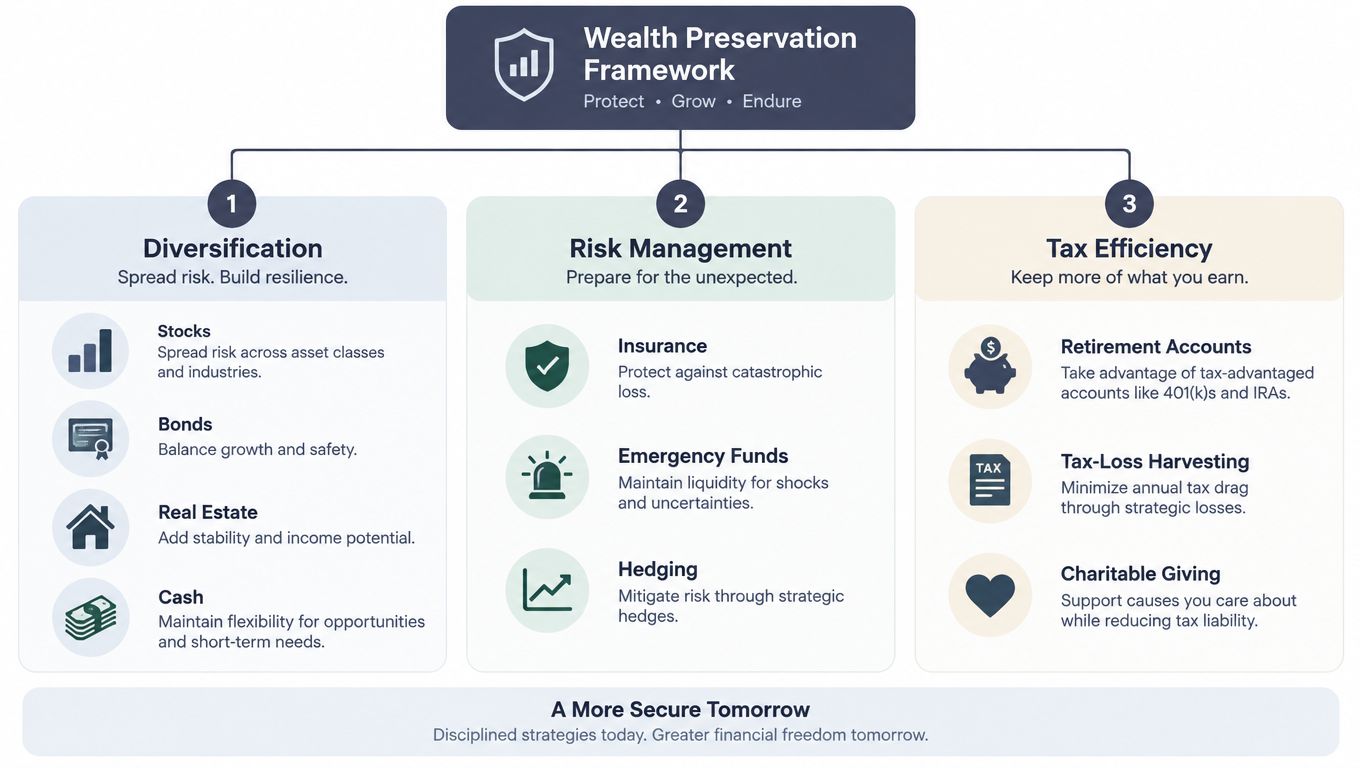
Diversification isn't just owning many things. It means avoiding dependence on the same economic driver. A rental property and a property-focused business may look like separate holdings, but both can suffer when local real-estate values fall or financing becomes expensive.
The Federal Reserve's 2022 Survey of Consumer Finances shows why one account type isn't enough. 54.3% of U.S. households held retirement-account assets, but only 4.6% held more than $1 million in those accounts according to the Congressional Research Service summary of the survey. Retirement accounts can be valuable, but they don't automatically provide near-term liquidity, real-estate exposure, business capital, or a complete transfer plan.
A durable balance sheet usually combines different functions:
Cash and short-duration reserves for immediate obligations and unexpected shocks.
Retirement accounts for tax-advantaged long-term savings.
Marketable securities for liquidity and broad economic participation.
Income-producing property for operating cash flow and real-asset exposure.
Business interests only when the owner understands the concentration and control risk.
Liquidity must match the liability
Don't use an illiquid building to fund a near-term tax bill. Don't assume retirement assets can solve an early cash-flow problem without tax or access costs. Keep reserves where you can reach them without selling under pressure.
The third test is purchasing power. Inflation doesn't affect every asset in the same way. Research covering eight major asset classes from 1963 through 2019 found that an equivalent one-standard-deviation increase in headline inflation corresponded with an average 3.1% decline in U.S. common-stock returns, while the comparable core-inflation response was an 8.1% stock-market decline after energy effects were separated, as reported by the National Bureau of Economic Research Digest. The same research found negative responses from Treasury, corporate, and agency bonds across the inflation measures examined.
The lesson is not to abandon stocks, bonds, or property. It is to match tools to liabilities. Use accessible, appropriately selected assets for near-term spending, growth assets for long-term purchasing power, and carefully sized real-asset exposure for energy or supply shocks. No single “inflation hedge” works in every regime.
Why Real Estate Earns a Spot in Your Plan
Richard Maize reportedly built a residential real-estate portfolio of approximately 1,000 rental-apartment units before turning 30, according to his foundation biography. The useful lesson isn't the size of the reported portfolio by itself. It is the structure: income-producing housing can distribute exposure across multiple units rather than placing every dollar in one residence.
That distinction matters. A rental portfolio can generate recurring cash flow, provide a real-asset position, and support long-term ownership. A single property bought for appreciation offers a narrower thesis. If the market stalls, the building needs major repairs, or the owner must refinance at an unfavorable moment, the entire plan may depend on one asset.
Cash flow beats a story
Preservation-oriented property ownership starts with operating reality. Review rent collection, vacancy assumptions, repairs, insurance, property taxes, management costs, debt service, and required capital improvements. Treat appreciation as a possible benefit, not the source of solvency.
Debt deserves special attention. Borrowing can improve equity efficiency when income covers obligations and maturities are manageable. It can also force a sale when rents weaken, lenders tighten terms, or a property requires capital at the wrong time. The debt structure matters as much as the building.
Geographic and property-type diversification can reduce dependence on one local economy, but it introduces management complexity. A larger portfolio requires systems, competent operators, clean accounting, and clear decision rights. More properties don't automatically mean less risk if they all rely on the same lender, market, tenant group, or operating team.
Real estate preservation trade-offs
Structure | Preservation Strength | Primary Risk |
|---|---|---|
Income-producing rental portfolio | Spreads operating income across multiple units | Vacancy, maintenance, management, and financing pressure |
Single rental property | Simple ownership and direct control | Concentration in one asset and local market |
Owner-occupied property | Provides housing utility and potential real-asset exposure | Illiquidity, upkeep, and limited income production |
Highly leveraged property | Can increase capital efficiency | Refinancing risk and forced-sale exposure |
Property held through an entity | May clarify ownership and governance | Administrative, legal, tax, and compliance complexity |
Real estate also fails as a universal inflation solution. The analysis of real estate as an inflation hedge should be read alongside the asset's financing, operating income, valuation, and location. Property may retain nominal value while leaving the owner short of usable cash.
The right allocation is the one that supports your obligations without making your entire financial life dependent on one neighborhood, one building type, or one refinancing window.
Estate Planning and Tax-Aware Transfers
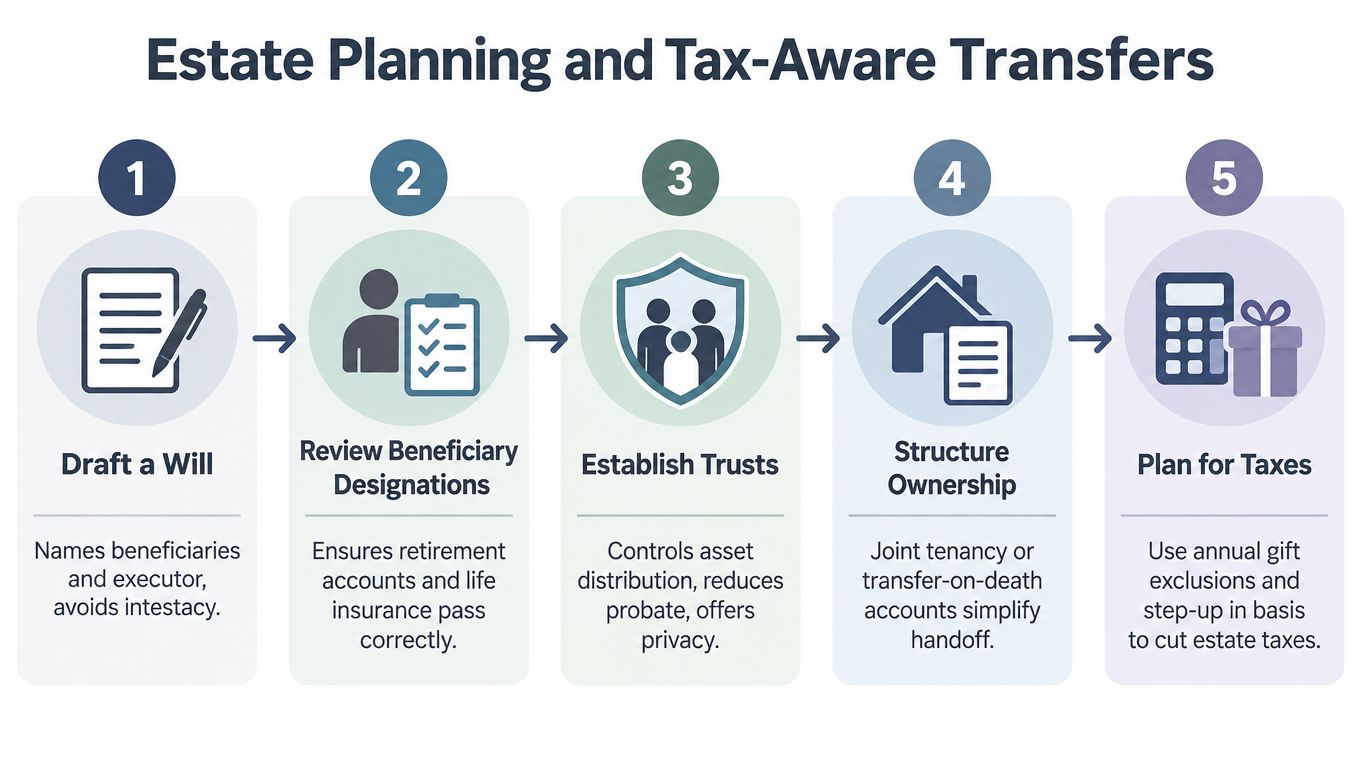
A balance sheet isn't preserved if the family can't transfer it cleanly. Wills, beneficiary designations, trusts, ownership records, and liquidity planning determine what happens when the owner dies, becomes incapacitated, or wants to transfer control during life.
Start with the basic documents, then coordinate them. A will names an executor and directs assets that pass through probate. Beneficiary designations control many retirement accounts and insurance policies, and they can override instructions in a will. A trust may help manage distribution, privacy, control, or continuity, but it only works when assets and instructions are properly aligned.
Current thresholds still require judgment
For U.S. taxpayers, the 2026 annual gift-tax exclusion is $19,000 per recipient, and the 2026 basic estate-and-gift-tax exclusion amount is $15 million, according to the Internal Revenue Service. These figures aren't a reason to give assets away blindly. They are planning parameters that should be coordinated with spending needs, control objectives, basis consequences, and reporting requirements.
Maintain a transfer ledger by recipient and year. Separate straightforward present-interest gifts from more complex future-interest transfers. Document who owns each property, business interest, account, insurance policy, and digital record. Then review whether the intended recipient should receive the asset, its income, its voting control, or its sale proceeds.
Tax rules change. Historical U.S. estate-tax milestones show how sharply thresholds and rates can move. The exemption was $1 million in 2002, $1.5 million in 2004 and 2005, and $2 million in 2006, while the highest marginal rate fell from 50% in 2002 to 46% in 2006, according to the U.S. Department of Agriculture Economic Research Service overview. A plan that worked under an earlier rule set may become inefficient or incomplete after a legislative change.
Transfer planning is more than estate tax
Basis, liquidity, governance, and family capability matter alongside tax. An heir who receives a valuable building without cash for taxes, repairs, or debt may be forced to sell. A family business can lose value when ownership transfers without a clear operating successor. A property portfolio can become unmanageable when no one knows which entity owns which asset.
Cross-border families face additional complications involving tax residence, forced-heirship rules, marital-property regimes, probate, currency, and local reporting. Use qualified legal and tax professionals in each relevant jurisdiction. Do not treat a U.S. structure as a universal answer.
Insurance and the Case for Reducing Fragility First
Many households want advanced wealth preservation strategies before they have protected their income, property, or ability to meet obligations. That order is backwards.
A 2026 survey across Australia, Brazil, France, Germany, Indonesia, Italy, Spain, Switzerland, Türkiye, and the United Kingdom found that nearly one in three respondents couldn't save regularly, while only 18% demonstrated advanced financial knowledge, according to Cerulli's survey summary. For households with unstable cash flow, the first preservation strategy is reducing fragility, not adding complexity.
Build a tiered defense
Keep immediate cash for ordinary disruptions, a broader reserve for serious interruptions, and separate liquidity for known obligations. The exact amount depends on income stability, dependents, debt, property costs, and business exposure. The principle is simple: don't make a long-term investment do a short-term job.
Then compare high-cost debt with expected investment returns. Paying down expensive, variable, or fragile debt can provide a more dependable improvement to resilience than pursuing an uncertain gain. This is especially important when a property or business already creates substantial exposure to one economic cycle.
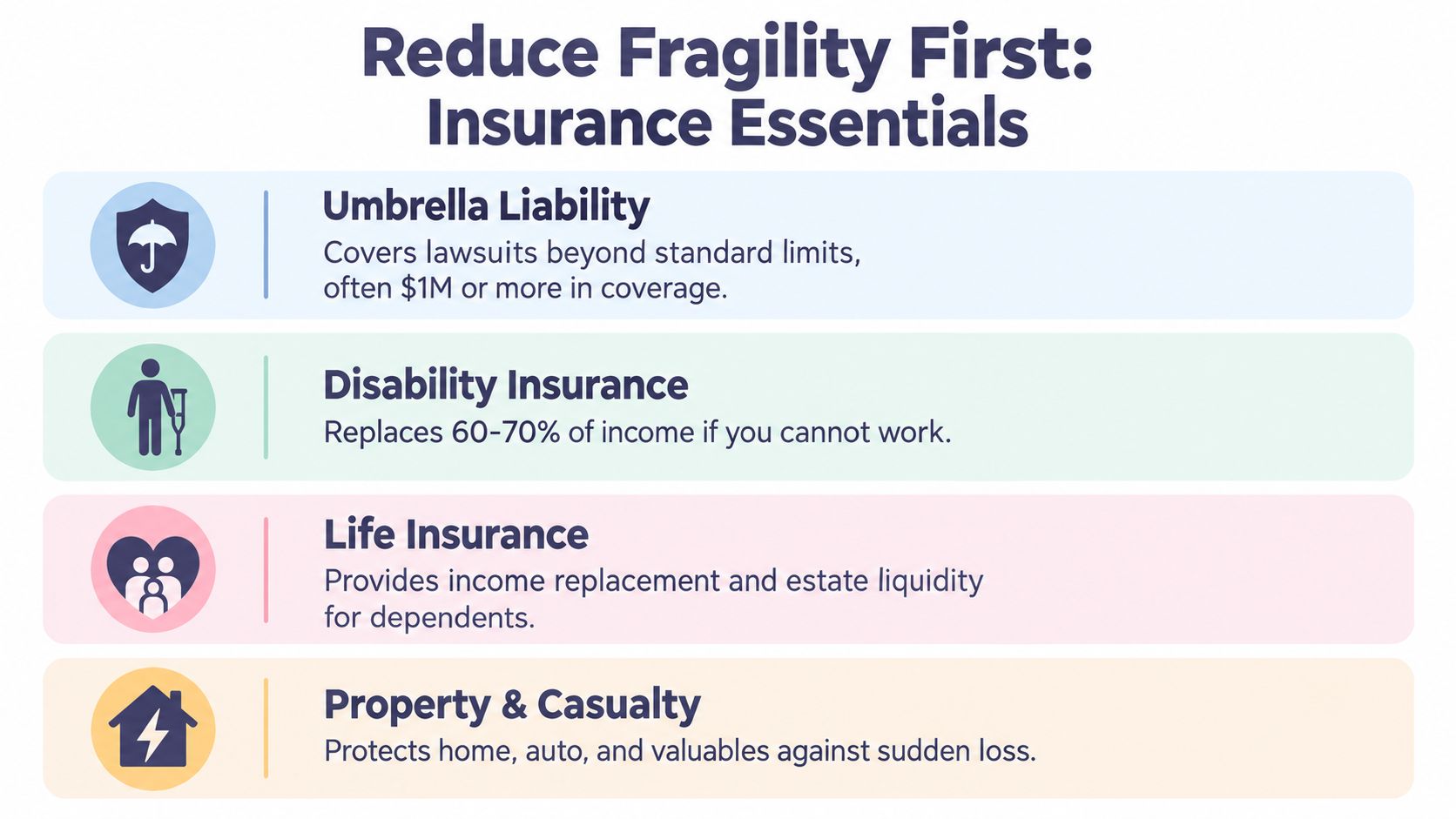
Insurance should address the events that could permanently change your balance sheet:
Umbrella liability: Extends protection beyond standard liability limits when property ownership or public exposure creates lawsuit risk.
Disability coverage: Protects earning capacity when work is the household's most valuable asset.
Life insurance: Creates income replacement or estate liquidity for dependents.
Property and casualty coverage: Protects buildings, vehicles, equipment, and valuables against sudden loss.
Review exclusions, deductibles, policy limits, ownership, and beneficiaries. A policy that doesn't respond to the risk you face is not protection.
The best insurance decision is not the policy with the longest feature list. It's the policy that prevents one identifiable event from forcing a destructive sale.
Stress-test the household against job loss, medical costs, property vacancies, business interruption, liability claims, and currency pressure where relevant. The objective isn't to predict the next crisis. It is to make sure the family has choices when conditions deteriorate.
Philanthropy as a Preservation Strategy
Philanthropy belongs in wealth planning before an estate transfer becomes urgent. Structured giving can move capital with purpose, establish family decision-making habits, and support causes without leaving every transfer choice to a rushed inheritance process. For owners whose wealth sits in rental property or operating companies, giving also forces a clear decision about control, liquidity, and succession.
A family does not need a foundation to give seriously. A donor-advised fund, direct charitable gift, foundation, charitable trust, or board role can serve different objectives. The right vehicle depends on the donor's assets, timing, desired control, administrative tolerance, and tax situation, as explained in this role of philanthropy in modern business strategy. Qualified advisors should coordinate charitable decisions with the wider estate plan.
Richard Maize's philanthropic work includes formal governance. He serves on the Cedars-Sinai Board of Trustees, the American Cancer Society board, and the Vista Del Mar Child and Family Services board, as described in his biographical profile. His foundation's stated focus includes youth development, education and mentoring, cultural and arts programs, health initiatives, environmental stewardship, and family services.
Giving can reinforce governance
Board service demands judgment, oversight, accountability, and sustained commitment. Those habits also strengthen business and family wealth management. A family that decides why it gives, who approves gifts, and how results are reviewed is practicing governance, not just distributing money.
Philanthropy can transfer values alongside assets. Younger relatives may join grant decisions, serve on committees, or assess organizations. That experience prepares them to manage a family foundation, operating company, property portfolio, or trust with greater responsibility.
Tax efficiency matters, but it should support a defined charitable purpose rather than dictate one. For example, contributing appreciated rental interests or business equity through a donor-advised fund instead of retaining those assets for operating cash flow changes control, liquidity, and basis outcomes. Coordinate that choice with the estate plan before transferring title. An unsuitable structure can create administration without meaningful impact.
A practical charitable policy answers four questions:
Purpose: Which needs or communities should receive support?
Authority: Who can approve gifts and change priorities?
Continuity: What happens when the original donor is no longer involved?
Evidence: How will the family evaluate stewardship and outcomes?
Wealth lasts longer when the family learns to deploy capital deliberately, not merely accumulate it.
Philanthropy is part of preservation architecture. It can reduce future confusion, build durable relationships, and give the next generation a structured way to exercise judgment over capital.
Your 12-Month Wealth Preservation Action Plan
Preservation becomes real when it enters the calendar. Use the next year to move from an informal collection of assets to a coordinated structure.
The first 30 days
Create a complete inventory of properties, businesses, securities, retirement accounts, cash, insurance, debts, guarantees, digital records, and beneficiary designations. Record the owner, custodian, decision-maker, estimated value, income, obligations, and liquidity constraints for each item.
Then identify concentration. Ask what would happen if one property lost income, one business stopped distributing cash, one lender changed terms, or one market became difficult to sell. Don't wait for a crisis to discover that several “different” assets depend on the same economic driver.
Months two through three
Build a reserve structure matched to personal and operating obligations. Review high-cost debt, refinancing dates, property vacancies, tax payments, and planned capital expenditures. Obtain independent insurance reviews for liability, disability, life, property, and business exposures.
Use a written policy for investment decisions. It should define acceptable concentration, liquidity needs, rebalancing authority, borrowing limits, and the purpose of each asset. A written rule is more valuable than a confident reaction during a volatile week.
Months four through six
Update wills, powers of attorney, trusts, ownership records, and beneficiary designations together. Confirm that the person named on each account matches the broader plan. For business owners, document succession, voting control, buyout terms, key relationships, and access to essential records.
Tax-aware transfers should be reviewed with qualified professionals. Keep a transfer ledger and assess basis, liquidity, reporting, and jurisdictional issues before moving property or business interests.
Months seven through twelve
Evaluate whether charitable giving belongs in the structure. Decide whether direct gifts, a donor-advised fund, a foundation, or another vehicle fits the family's purpose and administrative capacity. Invite the next generation into appropriate conversations about stewardship and responsibility.
Finally, schedule a recurring annual review. Real estate values, debt terms, tax rules, family circumstances, business risks, and insurance needs change. Richard Maize's career arc, from rental housing to mortgage banking and organized philanthropy, demonstrates that preservation is not one allocation decision. It is the ongoing management of property, operating risk, liquidity, control, and purpose.
Start with the balance sheet you have, not the one you hope to build. Remove the most dangerous concentration, close the most consequential planning gap, and protect the cash flow that gives you time to make good decisions.
Richard Maize offers perspectives on real estate, business investing, entrepreneurship, and purpose-driven giving through his platform. Visit Richard Maize to explore his insights and connect wealth preservation decisions with practical experience in property, operating businesses, and philanthropy.
Comments