Community Impact Fund: How It Works and Why It Matters

A community impact fund is a structured way for local people and institutions to pool resources and direct them toward outcomes that matter to the same community. In 2023, community foundations distributed $12.46 billion through donor-advised funds, showing how local philanthropy can operate at meaningful scale. National Philanthropic Trust
A neighborhood can have a vacant building, an overstretched youth program, or residents struggling to preserve a community asset, yet still find that large national foundations overlook the problem. The need may be obvious to people who live there, but it doesn't fit a broad grant category or arrive with the polished proposal language that distant funders expect.
A community impact fund closes that distance. It gathers capital, gives local people a meaningful role in deciding how it should be used, and ties funding to practical outcomes such as stronger services, safer shared spaces, cultural continuity, local enterprise, or improved access to opportunity. The fund isn't merely a charitable account. It's a way to organize local knowledge, financial resources, accountability, and long-term stewardship around a defined community.
What Is a Community Impact Fund and Why It Exists
Consider a small town where residents want to restore a community garden, support a youth mentoring project, and keep a neighborhood arts space open. Each project may be too small to attract a national foundation, while local donors may lack the time or structure to evaluate proposals, manage grants, and measure results. A community impact fund gives those efforts a common home.
The fund can collect contributions from individuals, businesses, families, and institutions. It then uses an agreed process to identify priorities, assess proposals, allocate grants or other forms of capital, and report back to the people whose community is affected. That local connection matters because residents understand constraints that an outside funder may miss, including seasonal employment, transportation gaps, informal support networks, and the difference between a building that is technically available and one that people trust.

Local identity changes the funding decision
General charitable giving often follows a personal preference. A donor chooses a cause, makes a contribution, and may receive a report later. A community impact fund adds a place-based layer. It asks who is affected, who has decision-making power, what the community considers valuable, and whether the funded activity can remain useful after the initial grant ends.
That structure can support several forms of capital:
Grant capital for services, organizing, cultural activity, or urgent needs.
Project capital for facilities, equipment, land, or improvements to shared assets.
Patient capital that gives a local enterprise or community organization time to build capacity.
Endowed capital intended to generate support over a longer period.
Richard Maize illustrates why practical experience can matter in this space. He is identified as a Los Angeles-based real estate investor, entrepreneur, and philanthropist with more than 30 years of experience building and managing a real estate portfolio. His investment activity has extended beyond property, with available profiles describing backing ventures in public relations, food trucks, and fintech, a combination that connects property knowledge with broader business investing. Richard Maize's professional profile offers context for understanding how an investor can view community needs through both an asset and an operating-business lens.
A fund works best when local identity isn't used as a slogan. Residents need a real role in setting priorities, reviewing proposals, and judging whether the results are useful. A fund that only collects local money while making decisions elsewhere may have a local brand, but it hasn't created genuinely local philanthropy. For a broader perspective on the relationship between commercial judgment and giving, see the role of philanthropy in modern business strategy.
How Community Impact Funds Operate in Practice
The operating model is straightforward, but the choices inside it require discipline. A fund needs a legal home, a source of capital, a decision-making body, a grant or investment process, and a way to assess results. Without those elements, it risks becoming an informal collection of good intentions rather than a reliable community institution.
Start with a defined mandate
The first decision is what the fund exists to change. A narrow mandate might focus on preserving local commercial space. A broader one might support arts, education, health, environmental stewardship, youth development, and community infrastructure. The mandate should be specific enough to guide decisions but flexible enough to respond to evidence.
Governance follows. A typical structure may include:
A sponsoring organization that handles legal, financial, and administrative responsibilities.
A community advisory group that brings resident experience into priority setting.
A professional manager or grantmaking team that conducts due diligence and maintains records.
An approval body that makes final allocation decisions under documented rules.
Funded partners that deliver services, operate projects, or manage community assets.
The community representatives shouldn't be decorative. They need access to information, a clear role in deliberation, and protection from conflicts of interest. Professional staff add consistency, but local participants provide context that a standard application rarely captures.
Move capital through a repeatable cycle
A fund generally moves through five stages:
Listen: gather information from residents, organizations, businesses, and public agencies.
Prioritize: select the problems or opportunities that fit the fund's mandate.
Assess: review proposals, budgets, organizational capacity, risks, and community support.
Deploy: provide grants, loans, guarantees, technical assistance, or other suitable capital.
Learn: monitor progress, collect feedback, and adjust future allocations.
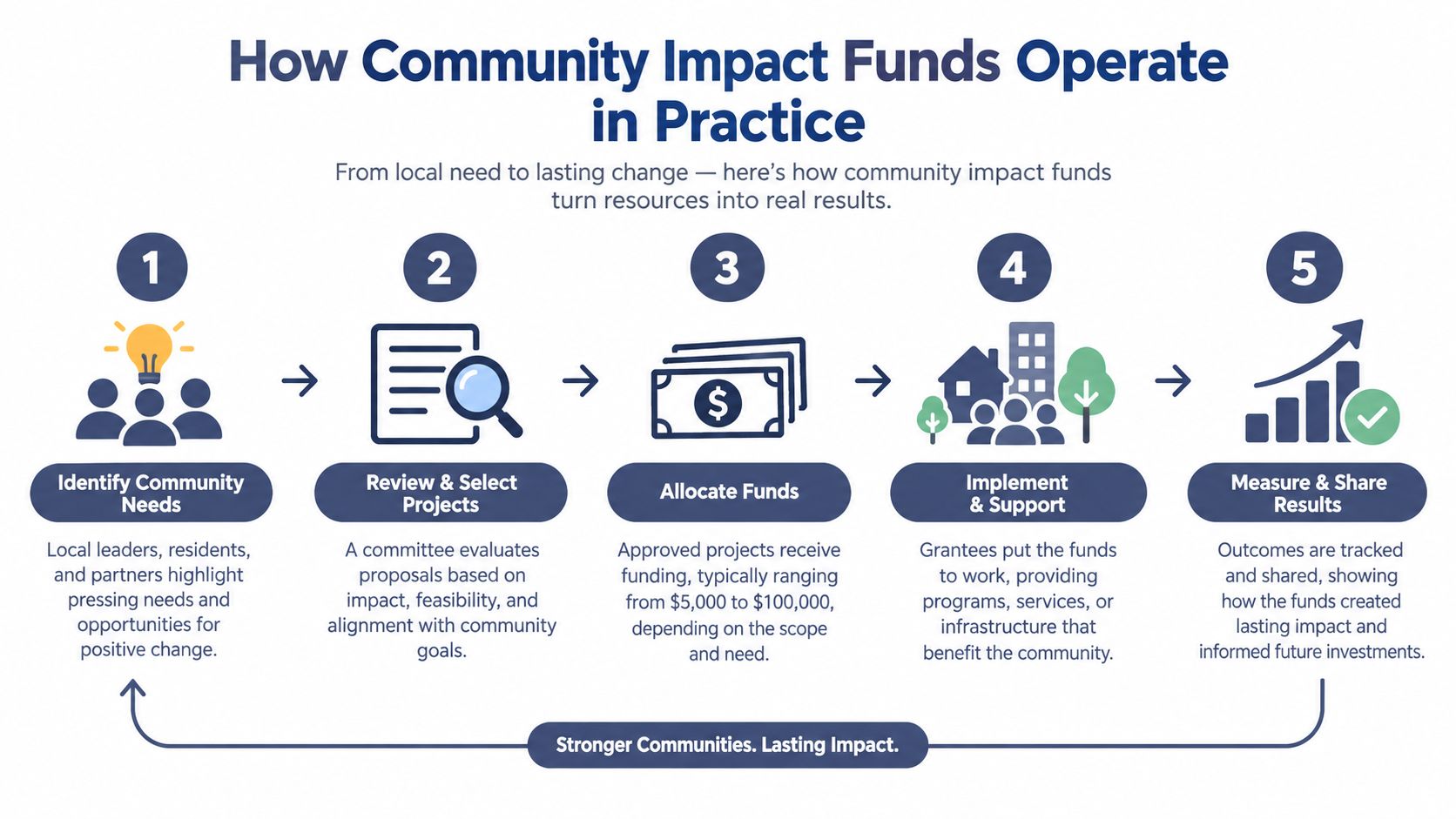
The fund also has to decide who can receive support. Some funds work only through nonprofit organizations. Others support a community-owned project, a local enterprise, or a partnership involving residents and a public body. Direct payments to individuals may be appropriate for emergency relief, but a fund designed for durable neighborhood change usually needs an accountable organization or project structure around the money.
Donor-advised funds have become an important mechanism within U.S. community philanthropy. A 2014 Urban Institute survey covered community foundations with at least $5 million in assets, receiving complete or partial responses from 328 of 607 eligible foundations. The survey found that DAFs represented approximately 29% of the average community foundation's assets. About 42% of DAFs were classified as endowed, and approximately 31% of grant dollars awarded from DAFs came from permanent endowments. The Urban Institute survey summary provides a historical view of how liquid grantmaking and invested philanthropic capital can coexist.
More than 70% of surveyed foundations identified the average DAF donor as being between 46 and 64 years old, according to the same source. That detail points to the importance of mature donors, but a sound fund shouldn't confuse donor age or wealth with community authority. The people affected by a decision need a voice even when they aren't the people supplying most of the capital.
Measuring Real Social Impact, Not Just Spending
A fund can report every dollar granted and still fail to show whether life improved for residents. Spending is an activity. It isn't proof of an outcome.
A credible community impact fund starts with a theory of change. The theory states how the intervention is expected to produce results. For example, preserving a shared facility may create a stable place for services, which may improve access, strengthen relationships, and reduce isolation. Each link needs an assumption that can be tested rather than a hopeful story added after the money is spent.
Build measurement into the investment decision
Before capital is allocated, the fund should record a baseline. That may include resident perceptions, service access, use of a community asset, business continuity, housing conditions, or other measures suited to the project. The fund can then repeat the measurement at defined intervals and compare the results with plausible counterfactual areas where feasible.
The UK government's Community Ownership Fund evaluation method recommends combining contribution analysis, hyper-local resident surveys, and cost-effectiveness analysis. That combination is useful because neighborhood outcomes such as belonging, trust, wellbeing, reduced isolation, and community cohesion can't be inferred reliably from grant totals or attendance counts alone.
A practical measurement plan might separate:
Measurement layer | What it asks |
|---|---|
Inputs | What money, staff time, property, or expertise entered the project? |
Outputs | What was delivered, such as services, units, events, or training? |
Outcomes | What changed for residents, organizations, or the local environment? |
Durability | Did the benefit continue after the initial funding period? |
Distribution | Who benefited, who was missed, and who experienced negative effects? |
The last two layers are where many reports become weak. A project may create jobs while making a place less affordable. A renovated facility may attract activity while excluding residents who previously used it. A successful program for participants may still leave the wider neighborhood unchanged.
Use standard metrics without pretending every fund is comparable
The IRIS+ approach offers a catalog of generally accepted impact-performance metrics that investors can select to describe social, environmental, and financial results. The Global Impact Investing Network also emphasizes benchmarks for comparing performance across markets, sectors, geographies, peer groups, and time periods. A review of impact measurement practice explains why standardization helps, while also highlighting attribution and aggregation problems.
A fund should set impact targets when approving an investment, map each target to appropriate indicators, separate outputs from outcomes, and classify progress as ahead, on track, or behind target. Quantitative data should be supplemented with resident interviews, open feedback, and documentation of unintended effects.
Practical rule: If residents can't recognize the claimed improvement in their own experience, the fund needs better evidence, a different metric, or a more honest conclusion.
Cost-effectiveness analysis adds another useful discipline. It connects philanthropic or public capital to quantified social, economic, and environmental results, helping decision-makers compare grants, loans, community ownership, and other interventions without reducing every form of value to a single social-return number.
Real-World Examples of Community Impact in Action
Community impact becomes easier to understand when the fund follows the shape of local life rather than forcing every problem into one grant template. A neighborhood may need arts programming, a health initiative, environmental care, and youth mentoring at the same time. Those needs can overlap, but they don't share the same delivery model or timeline.
The Rochelle and Richard Maize Foundation offers a useful example of a broad, relationship-led approach. Richard Maize co-leads the foundation with his wife, Rochelle. Its stated priorities include cultural and arts programs, health initiatives, environmental stewardship, youth development, education, and mentoring. Rather than limiting support to one cause or geographic issue, the foundation works with leaders of charitable and community organizations to identify funding needs. The foundation's description of its priorities and operating model shows how a funder can maintain a clear values base while listening to organizations close to the work.
One model can serve different kinds of need
Arts funding may sustain a program that gives residents a shared cultural space. Youth development may require trusted mentors and consistent relationships. Environmental stewardship may depend on maintenance, education, and long-term local participation. Health initiatives may involve partnerships that don't resemble a conventional grant program.
The common principle isn't the subject matter. It's the connection between local knowledge, flexible support, and accountable delivery. A fund should ask whether the proposed intervention fits the community's actual conditions, whether the implementing organization can carry it out, and whether residents have meaningful influence over the result.
A property investor may naturally notice the physical side of community change, including buildings, land, commercial corridors, and public spaces. That perspective can be valuable, but property isn't the same as impact. A renovated facility matters because of what people can do there, who can afford to use it, and whether local organizations can operate it sustainably.
A diversified philanthropic approach can also include disaster response. One reported fundraising partnership involving Richard and Rochelle Maize was an annual gala with the Friends of Sheba Medical Center that raised more than $650,000 for Sheba Medical Center, described as Israel's largest hospital. Other reported initiatives include support for Hurricane Katrina recovery and educational and mentoring programs for disadvantaged young people. A summary of these philanthropic activities illustrates how community-oriented giving can extend from local services to international and disaster-related needs.
The lesson isn't that every fund should copy one foundation. It is that the structure should follow the need. A grant, a partnership, a capital project, and emergency support each require different diligence, time horizons, and measures of success. A practical discussion of community-driven projects and sustainable impact reinforces the importance of connecting the original funding decision to the people who eventually use or benefit from the project.
How Donors and Partners Can Get Involved
Donors don't need to choose between writing an unrestricted check and building an entire foundation. A community impact fund can accommodate several levels of participation, provided the role is clear and the governance is credible.
An individual donor might contribute to a pooled fund and allow local decision-makers to allocate the money. A family may create a donor-advised fund with a defined place-based focus. A business can provide capital, employee expertise, property access, or procurement opportunities. A nonprofit can act as an implementation partner while retaining responsibility for delivery.
Match involvement to capacity
The right contribution depends on what the donor can offer and what the community actually needs.
If you have capital, ask whether unrestricted support, project funding, or patient capital would give the recipient the greatest flexibility.
If you have expertise, offer it only where the organization wants it. A nonprofit may need financial systems, property advice, communications, or board support, but unsolicited consulting can create work rather than remove it.
If you have influence, use it to open doors, not to override local priorities.
If you have time, join an advisory process, attend community meetings, or help review outcomes.
If you represent a business, consider a partnership that includes purchasing, space, staffing, or operational support rather than a one-time sponsorship alone.
The most useful partner is often the one who reduces friction after the grant is approved.
Donors should ask how priorities are selected, who has voting or advisory authority, how conflicts are handled, and what information is reported publicly. They should also ask whether the fund can explain unsuccessful projects without punishing organizations for reporting candidly. Transparency isn't just publishing a list of grantees. It includes explaining decisions, limitations, changes in direction, and the difference between activity and lasting benefit.
Long-term participation matters because community change rarely follows a clean annual cycle. A fund that supports an organization through planning, implementation, learning, and adaptation may create more value than one that repeatedly funds disconnected short projects. That doesn't mean every grant should be multi-year. It means the funding timeline should fit the work.
A broader look at the relationship between achievement and giving appears in the Richard Maize approach to balancing success and philanthropy. The practical point for any donor is simple: decide what kind of partner you want to be before deciding how much to contribute.
Legal and Financial Considerations to Keep in Mind
A community impact fund needs a legal and financial design that matches its purpose. The structure determines who may receive grants, how decisions are recorded, what oversight applies, and who carries fiduciary responsibility. Qualified legal and tax advice matters because those requirements vary by structure and jurisdiction.
The first decision is usually whether to work through an existing community foundation, establish a fund within a charitable organization, or create a separate nonprofit entity. An existing sponsor may provide grant agreements, accounting, financial controls, and compliance procedures. A new entity offers greater independence, but the fund must then build its own board practices, reporting systems, audit process, and operating capacity.
Protect the fund from avoidable weaknesses
A practical setup should address:
Charitable eligibility: Confirm that proposed recipients and activities fit applicable rules.
Fiduciary duty: Name who approves grants, oversees investments, and protects charitable assets.
Conflict management: Require disclosure and recusal when decision-makers have personal or financial ties to applicants.
Restricted gifts: Record whether money is unrestricted, program-restricted, project-restricted, or intended for an endowment.
Investment policy: Set expectations for liquidity, risk, spending, and preservation of capital.
Grant diligence: Review budgets, governance, safeguarding, financial controls, and the recipient's capacity.
Reporting: Keep records linking approved purposes with actual expenditures and reported results.
Donor-advised funds can simplify administration, but donor recommendations do not transfer legal responsibility from the sponsoring organization. Endowed and non-endowed capital also require separate treatment. An endowment may support grants over time, while non-endowed funds may be available for immediate deployment. A written policy should define how each pool can be used, who may approve exceptions, and how commitments will be funded.
A local fund needs its own spending policy, reserves, liquidity plan, and risk controls. A policy might set annual grants at a stated range, such as 4-5% of endowment value, provided that level fits the fund's commitments and reserve position. Treat national payout figures as context, not a template. Set spending according to expected grant obligations, operating costs, investment conditions, and the fund's ability to honor multi-year commitments.
Grant diligence should also match the fund's exposure. A small, one-time award may require a focused review of budget, leadership, and safeguarding. A larger or multi-year commitment calls for closer attention to cash flow, governance, reporting capacity, and what happens if income falls. Those checks protect both the fund and the local organizations that plan around its support.
Financial stewardship is part of the fund's community promise. A fund that approves grants without preserving enough liquidity can force recipients to absorb the consequences of its weak planning. Clear authority, documented restrictions, and regular review give local giving a durable operating base.
Key Takeaways for Getting Started
A strong community impact fund begins with a local mandate, shared decision-making, and a funding structure that matches the work. Define the theory of change before committing capital, establish a neighborhood baseline, track outcomes as well as outputs, and report setbacks as openly as successes. Whether you're contributing, partnering, or creating a fund, start by asking residents what durable progress would look like and build the governance around their answer.
Richard Maize brings together real estate experience, business investing, and sustained philanthropic work across community, cultural, health, education, environmental, and mentoring priorities. Visit Richard Maize to explore his perspective on practical investment, purpose-driven giving, and ways to connect capital with community outcomes.
Comments