Real Estate Exit Strategies That Actually Work

The most popular advice about real estate exits is also the least complete: decide whether to sell, hold, or refinance, then choose the option with the best projected return. Those choices aren't interchangeable when a loan is coming due, coverage is becoming difficult to obtain, or a tax deadline is already running. In practice, the property and its financing can dictate the timing unless the owner has planned for those pressures.
Richard Maize's approach puts exit criteria into the underwriting, not the cleanup phase. That means setting conditions for a sale, refinance, capital call, renovation pause, or management change before market conditions force a rushed decision. The central question isn't just what the property might sell for. It's whether the owner can preserve control and equity when debt, insurance, and taxes narrow the available choices.
Why Most Exit Decisions Get Made for You
A property can still look attractive on paper when its financing leaves the owner with no affordable way to keep it. The practical question is how much time remains to arrange an exit before a maturity date, insurance renewal, or tax deadline limits the choices.
Debt maturity sets a firm deadline. In 2025, roughly 20% of outstanding U.S. commercial and multifamily mortgage balances, about $957 billion, were scheduled to mature, including 24% of office loans and 35% of hotel and motel loans, according to the Mortgage Bankers Association's maturity analysis. Refinancing may require fresh equity or tighter terms. Selling may mean accepting less than the owner expected. A loan modification requires lender agreement, so it should never be the only fallback.
Holding requires financing that can carry the property.
Insurance deserves the same scrutiny. Comparable sales offer little comfort if a buyer cannot obtain acceptable coverage or a lender will not close without it. Obtain current coverage terms for the property before relying on a projected sale price. Otherwise, an insurance problem can surface during negotiations, when the owner has less room to absorb a discount or delay.
Practical rule: Define the triggers for a sale, refinance, capital call, renovation pause, or management change before underwriting. Richard Maize recommends this approach in his real estate market analysis framework. Written criteria give owners a basis for acting before emotion or short-term market movements take over.
The financing pressure extends across commercial property. The U.S. market was valued at about $22.5 trillion in late 2023, with roughly $5.9 trillion in debt and approximately $1.7 trillion, nearly 30% of that balance, projected to mature between 2024 and 2026, according to the Federal Reserve Bank of St. Louis. For an individual owner, the useful response is to test replacement financing and required equity while there is still time to sell, negotiate, or change course without a deadline dictating the terms.
The Major Exit Strategies at a Glance
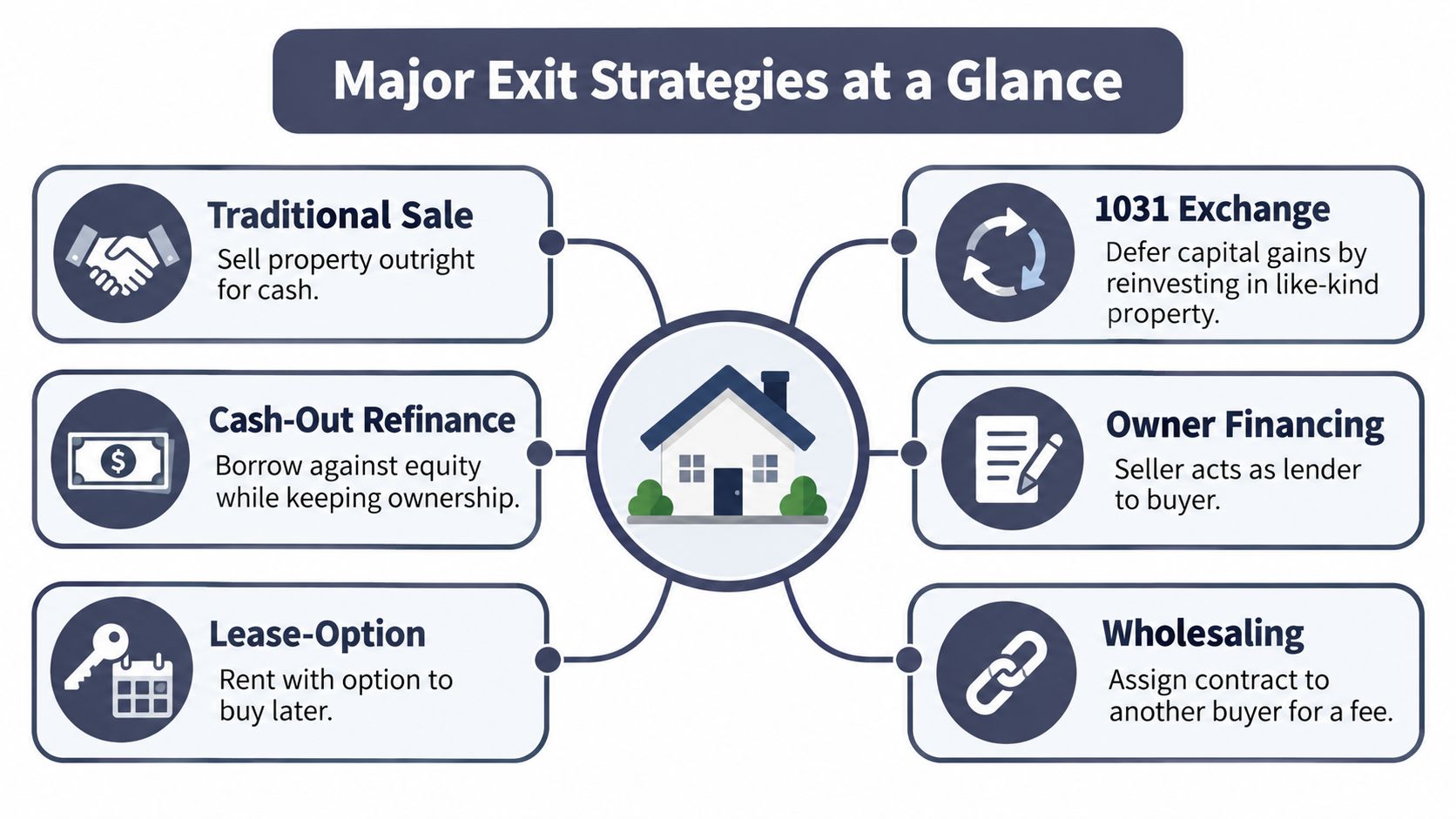
An exit strategy is the route an owner uses to realize value, reduce exposure, or change how capital is invested. The right route depends on whether the priority is liquidity, continued ownership, tax deferral, reduced management demands, or a faster transfer of risk.
Start with the outcome you need
A traditional sale transfers the property to a buyer in exchange for proceeds at closing. It suits an owner who wants a clean break, but the final amount depends on transaction costs, debt payoff, taxes, and what buyers will pay.
A 1031 exchange sells an investment or business property and redirects the proceeds into qualifying replacement real estate. It can defer recognition of gain, but it doesn't deliver unrestricted cash for personal use, and strict execution rules apply.
A cash-out refinance lets an owner borrow against equity without giving up ownership. It can provide capital for another investment or property work, but it also increases debt and can become unattractive when new loan terms strain cash flow.
Owner financing makes the seller the lender. The buyer pays over time under agreed terms, which can make a sale possible when conventional financing is a barrier. In exchange, the seller carries repayment and default risk instead of receiving all proceeds at closing.
A lease-option or rent-to-own arrangement gives a tenant the right to buy later under agreed terms. It may suit an owner who wants ongoing income before a sale, but it postpones a full exit and requires clear contract terms.
Wholesaling transfers a purchase contract to another buyer for a fee, rather than completing a conventional property sale. It can suit someone exiting a deal before taking ownership, but it depends on contract rights and a ready buyer. A fix-and-flip instead involves improving a property and selling it, with renovation execution and costs directly affecting the outcome.
Consider structures that change ownership gradually
A joint-venture buyout lets one partner purchase another's interest, keeping the asset under shared ownership's remaining partner rather than selling the whole property. A partial or portfolio sale can reduce exposure or raise capital while leaving other assets or ownership interests in place.
A REIT sale, contribution, or recapitalization can shift an owner's exposure from direct property ownership toward a larger platform or a different ownership structure. The REIT model created an important liquid route for real estate investment: REIT assets grew from roughly $1 billion in the early expansion era to more than $21 billion, while REIT ownership of institutional-quality commercial real estate rose from 8.9% in 2009 to 19.6% by mid-2020, according to this history of REIT growth.
Each path answers a different question. Do you need cash now, want to keep the property, need to shift into a different asset, or want to reduce management responsibility? The tax treatment and timing rules determine how much of the apparent value you can retain.
Tax and Legal Mechanics That Shape Every Exit
The sale price doesn't tell you what you'll keep. Tax treatment, transaction structure, and whether the seller can access proceeds before reinvesting can change the economics of an exit. Owners should settle those mechanics before agreeing to terms, not after the closing date is fixed.
A 1031 exchange defers gain, it doesn't erase it
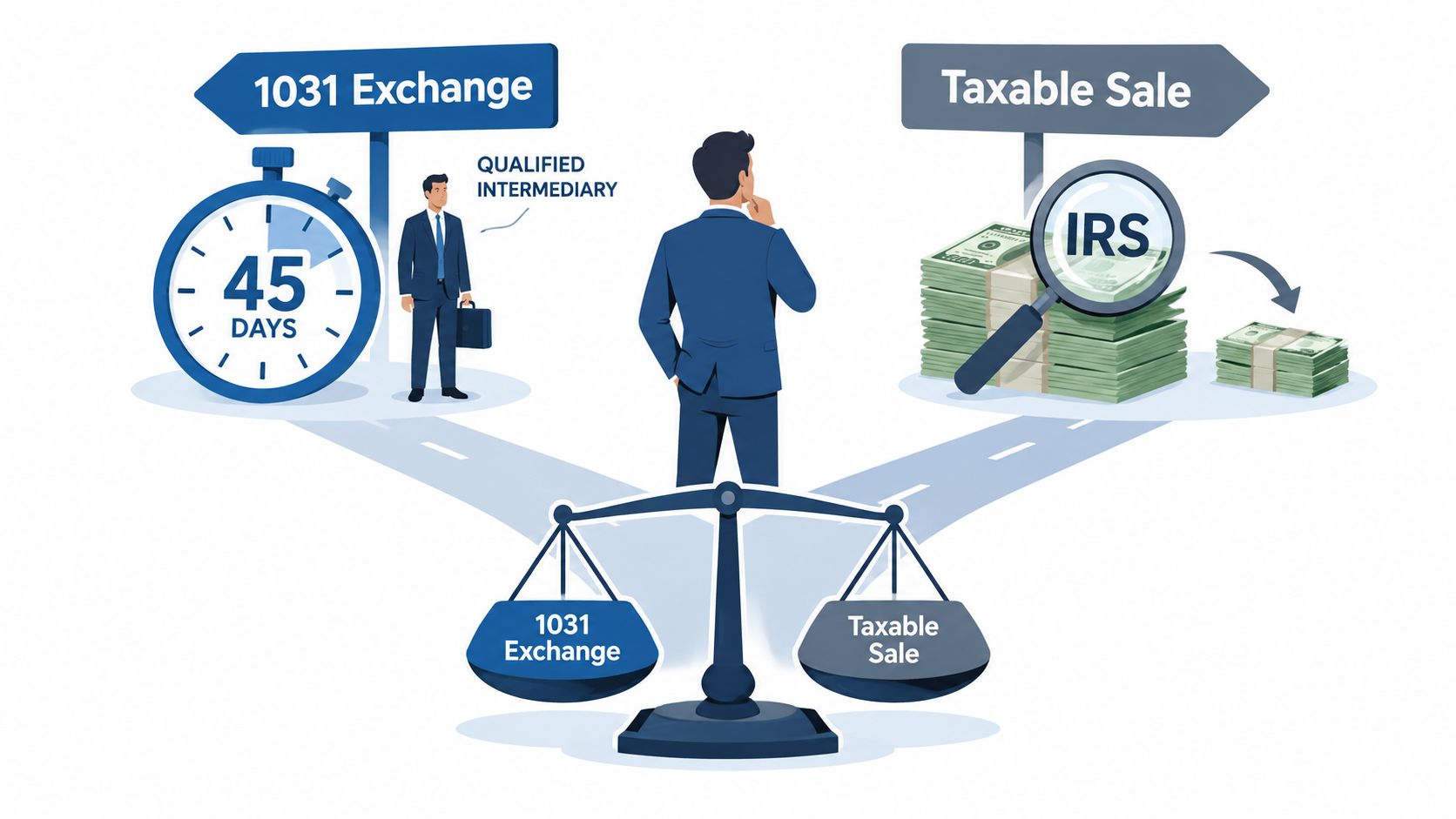
Under Section 1031, qualifying real property held for investment or business use may be exchanged for like-kind real property without immediately recognizing the gain. The rule is about tax deferral, not tax elimination. The replacement property generally carries forward the transferred property's basis, so the deferred gain can remain embedded in the investment.
Execution is unforgiving. The seller generally can't take actual or constructive receipt of the sale proceeds, so a qualified intermediary or another permitted safe harbor needs to hold them. Replacement property must generally be identified within 45 days and acquired within 180 days, subject to the applicable tax-return deadline if earlier, as explained in the IRS guidance on real estate like-kind exchanges. Missing a deadline or receiving non-like-kind cash can create taxable gain.
For a broader discussion of tax planning in property investing, Maize's guide to minimizing real estate investment taxes can help frame the questions to take to qualified tax counsel.
A sale without an exchange may be simpler, but the owner still needs to account for tax consequences. Property held for more than a year may generally qualify for long-term capital-gains treatment, subject to the relevant rules. Converting qualifying investment property into a residence may also raise the Section 121 home-sale exclusion, with possible exclusions of up to $250,000 for an eligible single filer or $500,000 for an eligible married couple filing jointly, subject to ownership, use, and other requirements.
Keep the deal mechanics connected
Cash or other non-like-kind property received in an exchange, often called boot, may trigger recognized gain to the extent received. That makes the settlement statement and the flow of funds part of the tax plan, not merely closing paperwork.
Owners comparing a taxable sale with an exchange should ask their tax and legal advisers to confirm eligibility, basis, timing, and how proceeds will be handled before signing. The following video offers additional context on exchange mechanics:
How to Choose the Right Exit for Your Situation
Start with the event that would make you act. Richard Maize's practitioner framework is to define exit triggers before underwriting, then test whether the investment still works if those triggers arrive sooner than expected. A trigger might be a refinancing constraint, a change in operations, a capital call, or an insurance renewal that materially changes the property's economics.
Test value, cash flow, and financing together
Exit value is sensitive to the capitalization rate. A simplified terminal value divides next-period net operating income by the exit cap rate. Holding NOI constant at $1,000,000, a 5.0% exit cap implies about $20.0 million in gross value, while a 6.0% cap implies roughly $16.7 million, a decline of about 16.7% before selling costs and debt repayment, as illustrated in the IRS sale and exchange FAQ.
That's why a refinance plan and a sale plan can't be underwritten in isolation. A lower valuation can reduce equity proceeds and make refinancing harder, particularly when a loan is nearing maturity. Run early-sale, base-date, and delayed-sale cases with separate assumptions for NOI, vacancy, capital expenditures, transaction costs, and payoff. Compare levered net proceeds and risk-adjusted return, not the headline sale price.
Insurance belongs in the same model. Property insurance premiums rose 33% nominally from 2020 to 2023, including a 13% real increase, and a reinsurance shock reduced average home values by about $8,400, according to research summarized by the National Bureau of Economic Research. Those figures describe broader patterns, not a forecast for any individual asset. Obtain renewal terms and coverage details for the property's location, and test whether deductibles, exclusions, or reduced availability would change buyer demand or lender conditions.
A strong comp set can't substitute for confirming that a buyer can insure the property and finance the purchase.
For investors reviewing operating assumptions alongside equity decisions, Maize's discussion of cash flow and equity in real estate investing provides a related lens.
Exit Path | Best For | Tax Treatment | Typical Timeline |
|---|---|---|---|
Traditional sale | Owner seeking a full transfer and liquidity | Taxable sale, subject to individual circumstances | Depends on preparation, marketing, and closing |
1031 exchange | Owner reinvesting into qualifying property | Defers gain if requirements are met | Identification and acquisition windows apply |
Cash-out refinance | Owner retaining the asset while accessing equity | Not a sale, but creates or increases debt | Depends on lender underwriting and loan terms |
Owner financing | Seller willing to receive payments over time | Depends on transaction structure and tax rules | Payments extend beyond closing |
Lease-option | Owner delaying a sale while offering a purchase option | Depends on contract and eventual disposition | Sale may occur later, if option is exercised |
REIT or recapitalization | Owner changing exposure or ownership structure | Depends on transaction design | Requires negotiation and structuring |
Lessons From Real Portfolio Decisions
A sound property can still require a sale. Debt maturity and insurance availability can close off an exit even when operations remain healthy. Richard Maize's market analysis guidance recommends defining sale, refinance, capital-call, renovation-pause, and management-change triggers before underwriting. Those triggers give owners a basis for acting before a lender's deadline controls the decision.
The following worked examples illustrate portfolio decisions, rather than documented transactions.
The maturity-driven rental: refinance only if ownership remains workable
For a rental approaching loan maturity, the decision starts with the income available to service replacement debt. Sound operations support keeping the property only if the new loan also leaves room for operating needs and insurance costs.
Compare replacement debt service with property income, then test the shortfall if the lender offers fewer proceeds than expected. Identify where the additional equity would come from before committing to the refinance. An equity withdrawal that leaves the property struggling to carry its debt postpones the same problem.
Set the fallback before negotiations become urgent.
If refinancing fails the owner's underwriting threshold, an early sale, equity contribution, or negotiated modification belongs on the table. An extension remains a possibility until agreed, not a funding plan.
The management-heavy holding: exchange toward a defined objective
For an owner selling a demanding property, the replacement objective should describe the workload they are willing to retain. Buying another management-intensive asset may preserve the very burden that prompted the sale.
A 1031 exchange fits when suitable replacement property can be identified within the required schedule and supports that objective. Before the relinquished property closes, establish selection criteria, assemble the exchange team, and assess replacement cash flow. Receiving proceeds directly can jeopardize the intended exchange treatment.
The trade-off is accepting execution constraints to pursue a better-fitting holding. Tax deferral alone does not establish that fit.
The weakening exit window: sell while buyers can still close
When projected value, insurance availability, or refinancing terms weaken, the relevant deadline may arrive before contractual maturity. A buyer still needs insurable collateral and workable financing; waiting can narrow that buyer pool.
An earlier sale may fall short of the original valuation target while preserving more control over closing and debt repayment. Compare its likely net proceeds with the equity required for a pressured refinance, including transaction costs and debt payoff.
Act on the trigger established before underwriting. The purchase price cannot determine whether today's exit is executable.
Risks, Misconceptions, and Common Mistakes
Exit mistakes often come from measuring the wrong thing or waiting until the decision has become urgent. The strategies can look straightforward on paper, but each has a distinct cost in time, flexibility, financing, or tax treatment.
Compare what each route gives up
Exit Route | When It Can Work | What It Costs or Risks | Common Failure |
|---|---|---|---|
Sale | Owner needs a full transfer or wants to reduce exposure | Taxes, selling expenses, and debt payoff affect proceeds | Treating gross price as the return |
Refinance | Owner wants to retain the asset and financing remains workable | New debt and lender conditions can limit flexibility | Assuming future proceeds without stress-testing terms |
1031 exchange | Owner wants to reinvest in qualifying property | Strict execution and replacement-property constraints | Treating deferral as tax elimination or mishandling proceeds |
Owner financing | Buyer needs seller-provided terms and seller accepts installment risk | Seller waits for payments and carries repayment risk | Failing to assess buyer credit and remedies |
Lease-option | Owner can wait and wants to provide a future purchase path | A full exit may be delayed or never completed | Unclear option and lease terms |
Wholesaling | Contract rights and a ready buyer support a transfer | The seller may not complete a direct property sale | Assuming an assignment is always permitted or executable |
REIT or recapitalization | Owner wants a different ownership or liquidity structure | Negotiation and transaction design can be complex | Underestimating control and structuring trade-offs |
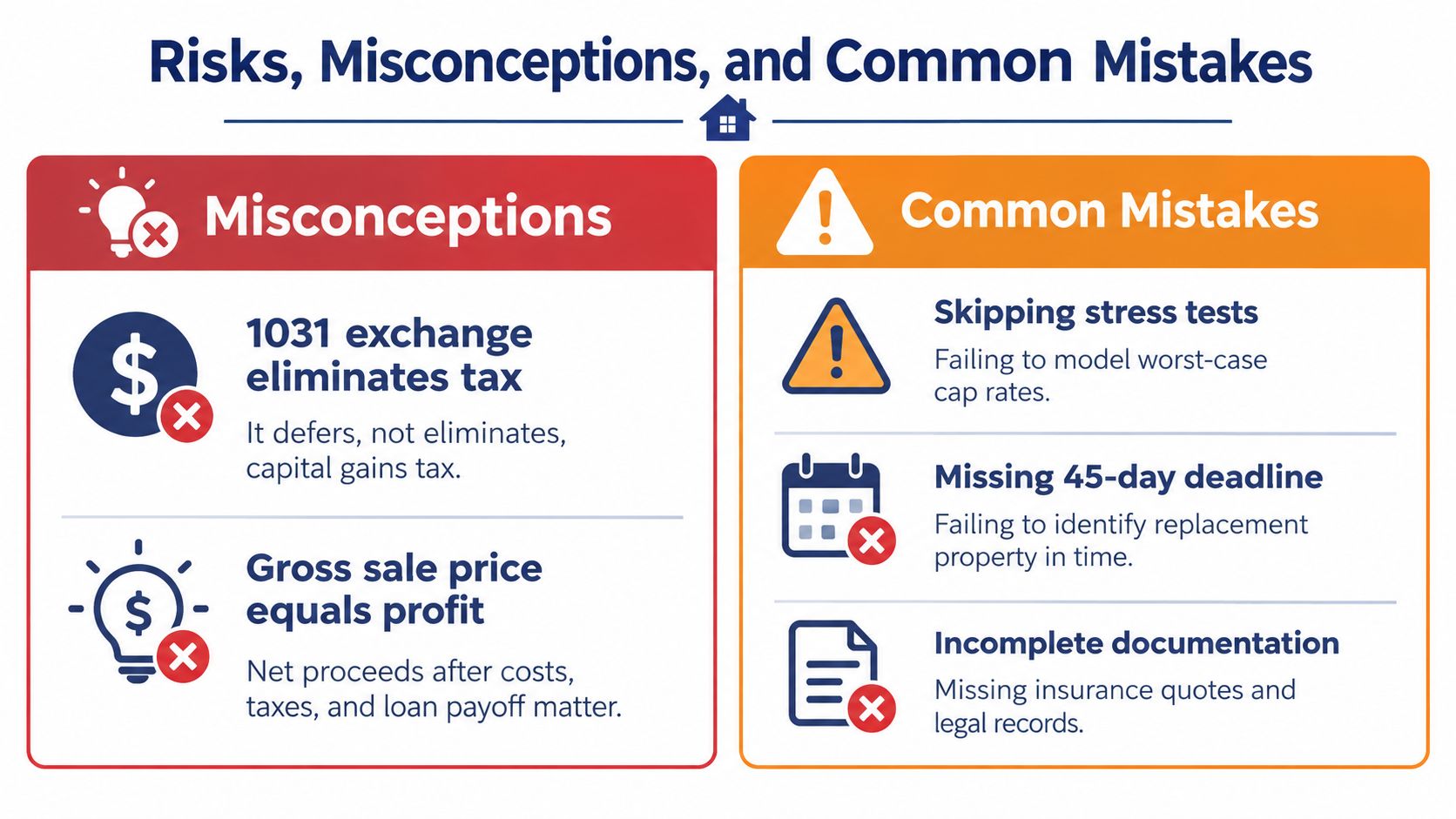
A 1031 exchange defers gain. It doesn't erase the obligation or make every sale-and-repurchase combination eligible. Another common error is treating gross sale price as success. The decision should account for loan repayment, selling costs, taxes, and the cash that reaches the owner.
Waiting until a loan approaches maturity also shrinks the time available to compare refinancing with selling or restructuring. Owners should track debt-service coverage, lender requirements, extension terms, prepayment conditions, and potential equity needs well before a decision becomes urgent.
Treat insurance as a saleability issue
Insurance can affect the price a buyer can finance and the terms a lender will accept. The broader premium and value effects cited earlier don't predict a particular property's outcome, but they make it unwise to rely on general market comparisons alone. Get property-specific renewal quotes, review deductibles and exclusions, and document mitigation work that may help demonstrate risk management.
Practical guardrails are straightforward:
Renew coverage early: Check terms before listing or refinancing.
Stress-test value: Model how a higher exit cap rate changes proceeds.
Check debt capacity: Revisit property income and debt-service coverage.
Document improvements: Keep clear records of mitigation, repairs, and insurance communications.
Protect exchange execution: Treat boot, proceeds handling, and deadlines as matters to confirm with qualified advisers.
Your Pre-Deal Exit Checklist and Action Plan
An exit assumption belongs in underwriting before you commit capital. Holding, selling, and refinancing require different conditions to work. Put debt maturity, insurance availability, and decision triggers beside the purchase assumptions so the preferred exit has a workable timetable.
Before you buy
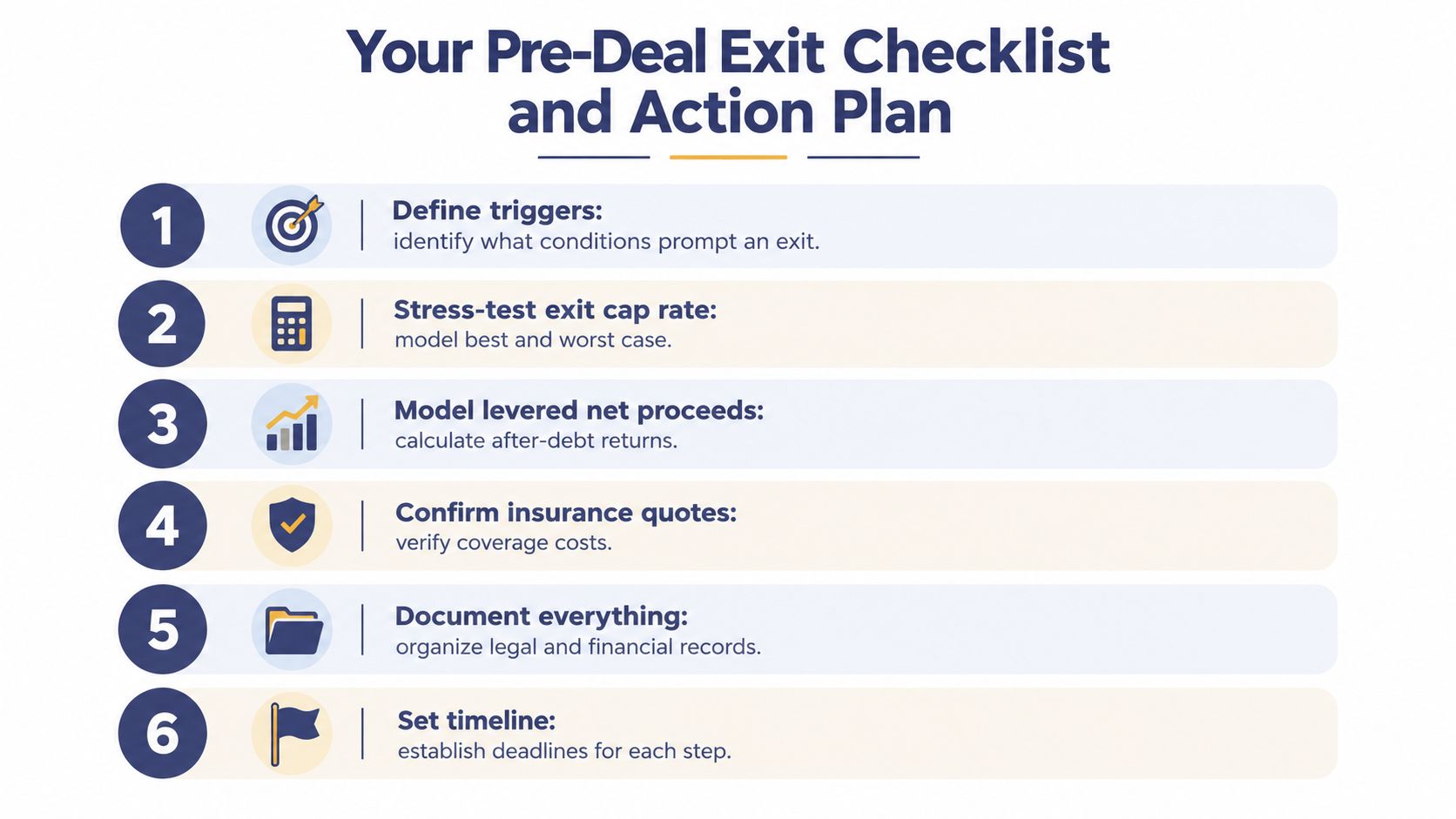
Define exit triggers: Specify what prompts a sale, refinance, capital call, renovation pause, or management change. Assign responsibility for acting.
Stress-test the exit cap rate: Compare valuation cases and identify where a lower sale value would require additional equity.
Model levered net proceeds: Include debt payoff, transaction costs, taxes, and cash retained. Compare that outcome with the capital required to keep holding.
Confirm insurance terms: Obtain property-specific quotes, review deductibles and exclusions, and check whether coverage supports the intended financing.
Document the property: Assemble legal, financial, operating, and mitigation records before a buyer or lender requests them.
Set the decision calendar: Work backward from maturity and renewal dates. Allow time to pursue an alternative if the preferred exit fails.
If you already own the property
Start with the loan documents. Pull maturity dates, extension-fee terms, and extension requirements into the decision calendar this week. Assign someone to confirm refinance feasibility and coordinate insurance renewal with any sale or loan application. If an exchange is possible, involve tax and legal advisers before closing and before proceeds are received.
Use the Federal Reserve Bank of St. Louis analysis as market context; base the action calendar on the property's actual obligations.
For an acquisition, Richard Maize's commercial real estate due diligence checklist can help organize unresolved questions before closing. Record each open item, its owner, and the condition that would change the purchase decision. A checklist becomes usable when unresolved assumptions have deadlines and consequences.
Discipline Is the Exit Strategy
Real estate wealth depends on keeping choices available before deadlines narrow them. Define exit triggers before underwriting, measure proceeds after debt and transaction costs, and keep enough liquidity to act.
Holding, selling, and refinancing serve different purposes. Holding requires financing and insurance that remain workable. Refinancing preserves ownership only when the property supports the debt. Selling early may sacrifice potential upside while preserving capital and flexibility before maturity forces a rushed decision.
Review one property this week against the checklist, testing its loan timeline, insurance availability, and realistic net proceeds against your predefined triggers.
Richard Maize shares real estate market perspectives and practical investing insights through his website and blog. Visit Richard Maize to explore his work and consider how exit assumptions and predefined decision criteria can inform your next property review.
Comments