Impact Events That Build Lasting Community Value

The most popular advice for impact events is to attract a bigger crowd, secure prominent sponsors, and maximize the fundraising total. That advice confuses a successful production with a successful community investment. A full room can still leave local organizations without the relationships, resources, or authority they need to make progress.
A better approach borrows from disciplined investing and philanthropy: define the asset you want to strengthen, understand who will benefit, and decide how you'll verify that value remains after the event. The gathering is an investment, not the finished result.
Redefining Success Beyond Attendance Numbers
Attendance tells you how many people arrived. It doesn't tell you whether a community organization gained a capable board member, a researcher found a collaborator, or residents influenced a decision affecting their neighborhood. Fundraising totals matter, but they don't establish whether the money supported work that beneficiaries needed.
A three-year study of 15 Canadian business events argues that delegate counts and sponsorship value miss policy influence, talent development, innovation, community strengthening, and sector competitiveness. Its framework examines social, intellectual, policy, financial, human, cultural, natural, and built capital, using interviews, documentary evidence, and longitudinal tracking.
Distinguish activity from value
For planning purposes, separate the event's performance from the community's progress:
Activity includes registrations, sessions delivered, introductions made, and funds collected.
Immediate results include agreed next steps, qualified applications, or commitments to collaborate.
Durable outcomes include implemented programs, sustained partnerships, and improved access to resources.
Those categories shouldn't compete. Organizers still need operational measures to control costs and deliver a good experience. The mistake is presenting those measures as proof of lasting change.
Investment test: If the event disappeared next year, what useful capacity would the community still retain?
A smaller gathering may be the stronger investment when participants can resolve a specific obstacle and have the authority to act afterward. A larger event may be appropriate when broad participation is itself necessary, such as gathering diverse public input. Neither format deserves an automatic advantage.
Before approving the venue or sponsorship package, write a plain-language outcome statement: who should be better positioned, what they should be able to do, and what evidence would demonstrate that improvement. Specificity makes accountability possible. It also gives sponsors something more meaningful to support than visibility alone.
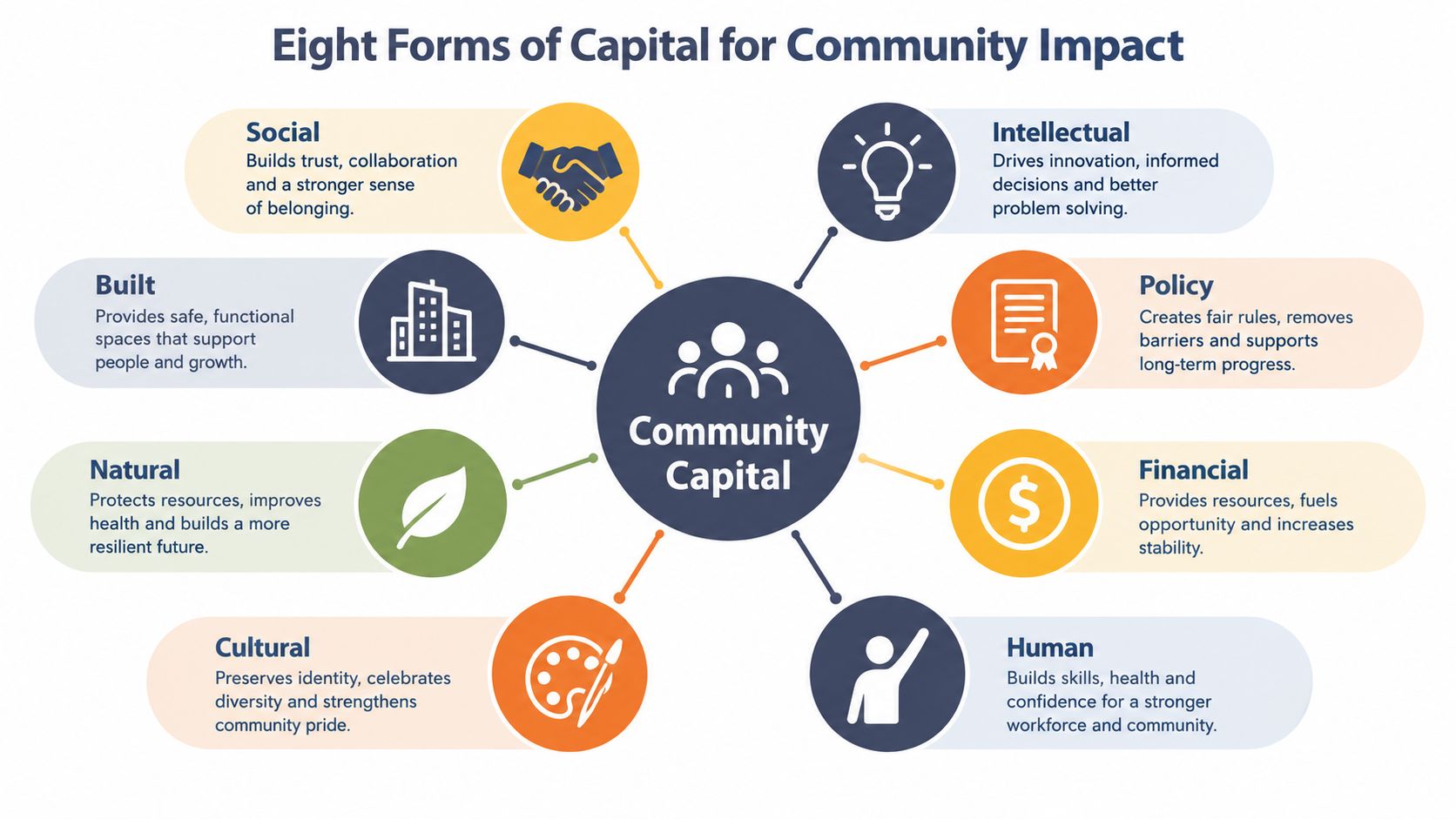
Eight Forms of Capital for Community Impact
Community capital becomes useful when organizers connect each category to a design decision. The framework introduced above provides a broader planning vocabulary than awareness or engagement, but it shouldn't become another checklist completed without judgment.
Use this map to distinguish the assets an event might strengthen.
Translate capital into design choices
Social capital means useful relationships and trust. Facilitated introductions around a shared problem are more purposeful than an unstructured reception.
Intellectual capital includes knowledge participants can reuse. Ask speakers to contribute working templates, research questions, or practical guidance rather than presentation slides alone.
Policy capital concerns the ability to inform public decisions. A working session should identify the responsible institution and the actual decision process.
Financial capital includes resources available for community priorities. Distinguish a funding announcement from money beneficiaries can access under workable conditions.
Human capital means skills, experience, and leadership capacity. Pair a training activity with an opportunity to apply the learning.
Cultural capital includes creative expression, identity, and shared heritage. Give community contributors influence over programming and appropriate recognition.
Natural capital concerns environmental assets. Connect environmental programming to defined stewardship responsibilities rather than decorative messaging.
Built capital includes facilities and physical infrastructure. Use discussions about shared space to address access, maintenance, and responsibility for ongoing costs.
Not every event should pursue every category. A narrowly focused gathering can be valuable if its organizers understand the intended benefit and avoid creating burdens elsewhere.
The property-investment parallel is useful: a building's appeal at opening doesn't resolve its operating needs. The same question applies to community programs: who maintains the asset after the launch? A community-driven approach to sustainable real-estate impact offers a useful lens for connecting initial investment with continuing beneficiary needs.
Planning for Relationship Quality Over Scale
A guest list is a resource-allocation decision. Every additional participant requires attention, accommodation, and a credible reason to be there. Increasing capacity without redesigning interaction can make meaningful participation harder.
Start with the people who understand the problem, those affected by it, and those who can help remove the obstacle. Seniority and donor status aren't substitutes for those roles. Equally, inviting residents without giving them influence turns participation into stage dressing.
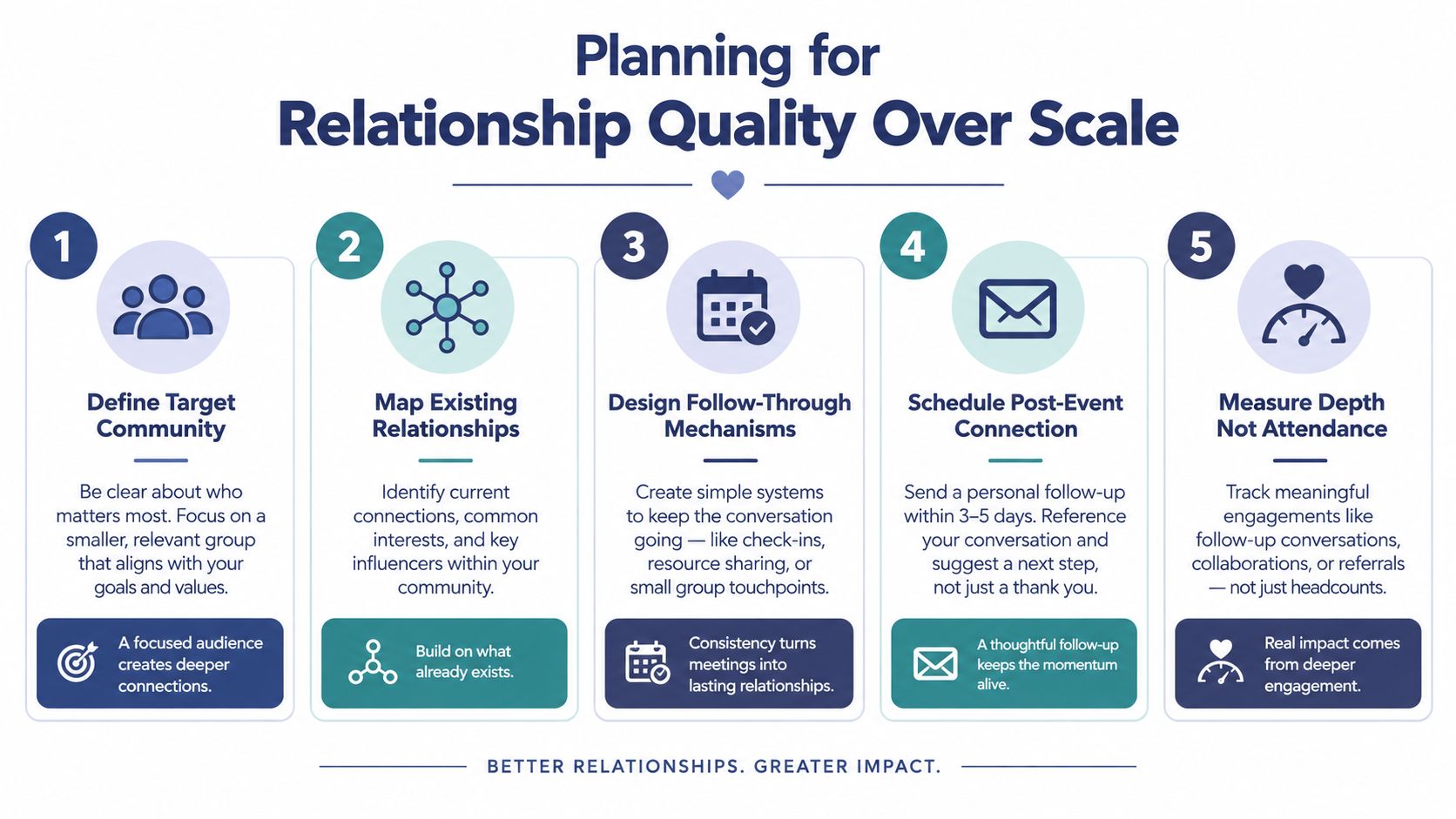
Use the following sequence to connect invitations with continuing work.
Design the handoff before the gathering
Define the target community and map existing relationships. Ask prospective participants where cooperation already exists, where it has stalled, and whose perspective is missing. Don't spend the event introducing people who already work together while leaving an essential delivery partner outside the room.
Choose a format around the decision. A facilitated working table suits a practical problem requiring negotiation. A public session suits an issue requiring broad scrutiny. A keynote may establish context, but it shouldn't consume the time participants need to work.
Assign responsibility before people leave. Capture the next action, its owner, relevant constraints, and permission to reconnect. A contact list without consent or context isn't a collaboration system.
Spend on the person who can help participants resolve a difficult conversation before spending on another production feature.
Budget trade-offs should be explicit. Capping attendance may disappoint sponsors seeking exposure; investing in facilitation may mean simplifying staging. Explain those choices through the intended outcome rather than pretending there's no sacrifice.
Schedule reconnection around a real milestone, such as a proposal review or partner decision. A generic thank-you email can close an administrative loop, but it doesn't advance unfinished work. Give someone responsibility for identifying stalled commitments and helping participants decide whether to continue, revise, or stop.
Making Honest Sustainability and Format Decisions
An event shouldn't receive an environmental pass because its catering and signage look responsible. Organizers need to account for what they include, what they exclude, and why participants must travel.
The University of Birmingham's 2025 conference pilot reported average operational emissions of 13.7 kg CO2e per delegate, rising to 627 kg CO2e per delegate when international travel was included; the reported figures form the accounting comparison below.
Event Format Emissions Comparison
Format | Operational Emissions (kg CO2e) | Travel Emissions (kg CO2e) | Total Per Delegate |
|---|---|---|---|
Conference pilot, operations-only boundary | 13.7 per delegate | Excluded | 13.7 kg CO2e |
Same pilot, international travel included | Included in combined total | Not separately stated here | 627 kg CO2e |
Regional, hybrid, or virtual alternative | Requires scenario-specific assessment | Requires scenario-specific assessment | Not established by these figures |
These aren't separate measurements of competing formats. They illustrate how the accounting boundary changes the reported result. Don't treat missing travel data as negligible travel impact, and don't assign virtual or hybrid formats invented emissions estimates.
Choose the format by examining the work participants must accomplish. Physical attendance may be justified for site inspection, hands-on activity, or sensitive relationship-building. A remote briefing may be more appropriate when participants mainly need information or a routine decision.
Participation equity belongs in that assessment. Ask who faces travel costs, caring responsibilities, accessibility barriers, or unreliable connectivity. Hybrid delivery deserves its own facilitation plan so remote participants can contribute rather than merely watch.
Disclosure standard: State the emissions boundary and the reason for gathering physically before describing an event as sustainable.
Compare plausible locations and participation options before committing contracts. Then consider emissions per meaningful outcome, while reporting absolute emissions too. That approach supports judgment without turning a worthwhile social goal into an excuse to ignore environmental costs.
Real World Examples From POPPOP FEST and Beyond
POPPOP FEST provides a concrete reference point for discussing community-facing events. It shouldn't, however, be presented as proof of sustained community change without documented follow-up. A festival experience and a verified outcome are different kinds of evidence.
The community-festival image below captures the kind of personal participation organizers may want to encourage.

Follow the participant beyond the activation
Consider a hypothetical art activity at a festival. Participants create something together, meet a local organization, and learn about an opportunity to contribute. The activity becomes a stronger community investment if the organization can offer an appropriate next step and has capacity to welcome interested participants.
That sequence is a design example, not a claim about documented POPPOP FEST results. Without records of subsequent participation, an organizer can credibly describe the activity and its intended purpose, but not claim that it produced an enduring partnership.
The same discipline applies across different settings:
Consumer ventures can support a community activation, but branding should remain distinguishable from beneficiary value. Ask what the partner organization receives beyond exposure.
Charitable gatherings can generate interest in a cause. Before soliciting volunteer commitments, confirm that the beneficiary has suitable roles and supervision.
Neighborhood events can surface concerns about shared spaces. Tell participants who will review their input and how decisions will be communicated.
The practical failure to avoid is promising more engagement than a partner can absorb. A busy activity may produce goodwill while creating an administrative burden for the organization expected to follow up.
Keep the invitation proportionate to delivery capacity. An honest, manageable opportunity is preferable to an ambitious promise that nobody owns after the festival closes.
Measuring What Changed Months Later
An exit survey can tell you whether participants enjoyed the experience. It can't establish whether a partnership survived difficult negotiations or whether a proposed program reached its intended beneficiaries.
The harder question is what changed months later and how much the event contributed. Treat measurement as part of delivery, with permission to contact participants, a named record owner, and a manageable evidence standard.
Build an evidence chain
Use a simple record that connects intention to verification:
Record | What to capture | Evidence to seek |
|---|---|---|
Starting position | Existing relationships, resources, and obstacles | Baseline interview or planning document |
Event contribution | Relevant discussion, introduction, or agreement | Session notes or participant confirmation |
Subsequent action | What participants actually did afterward | Correspondence, applications, or signed agreements |
Community outcome | What changed for the intended beneficiaries | Delivery records and beneficiary feedback |
Alternative explanation | Other influences on the result | Timeline and corroborating accounts |
For example, a research introduction might later become a funded collaboration. A local speaker might receive an invitation that expands their professional reach. A policy discussion might contribute to a government program. These are possible outcome pathways, not results to claim without evidence.
Ask interviewees what they were already planning, what specifically changed after attending, and what probably would've happened without the event. Request supporting documents where appropriate, while protecting confidential information.
Distinguish contribution from sole causation. If an event accelerated an existing relationship, say so. If participants disagree about its importance, preserve that uncertainty rather than choosing the most flattering account.
Negative findings deserve attention too. A stalled partnership may reveal an unsuitable funding condition, missing authority, or unrealistic workload. Publishing those limitations gives future organizers a practical basis for improvement and gives supporters a more credible account of their investment.
Your Action Plan for Durable Community Impact
Make the next planning meeting a decision meeting, not another discussion about reach. Use this summary to turn the framework into responsibilities.
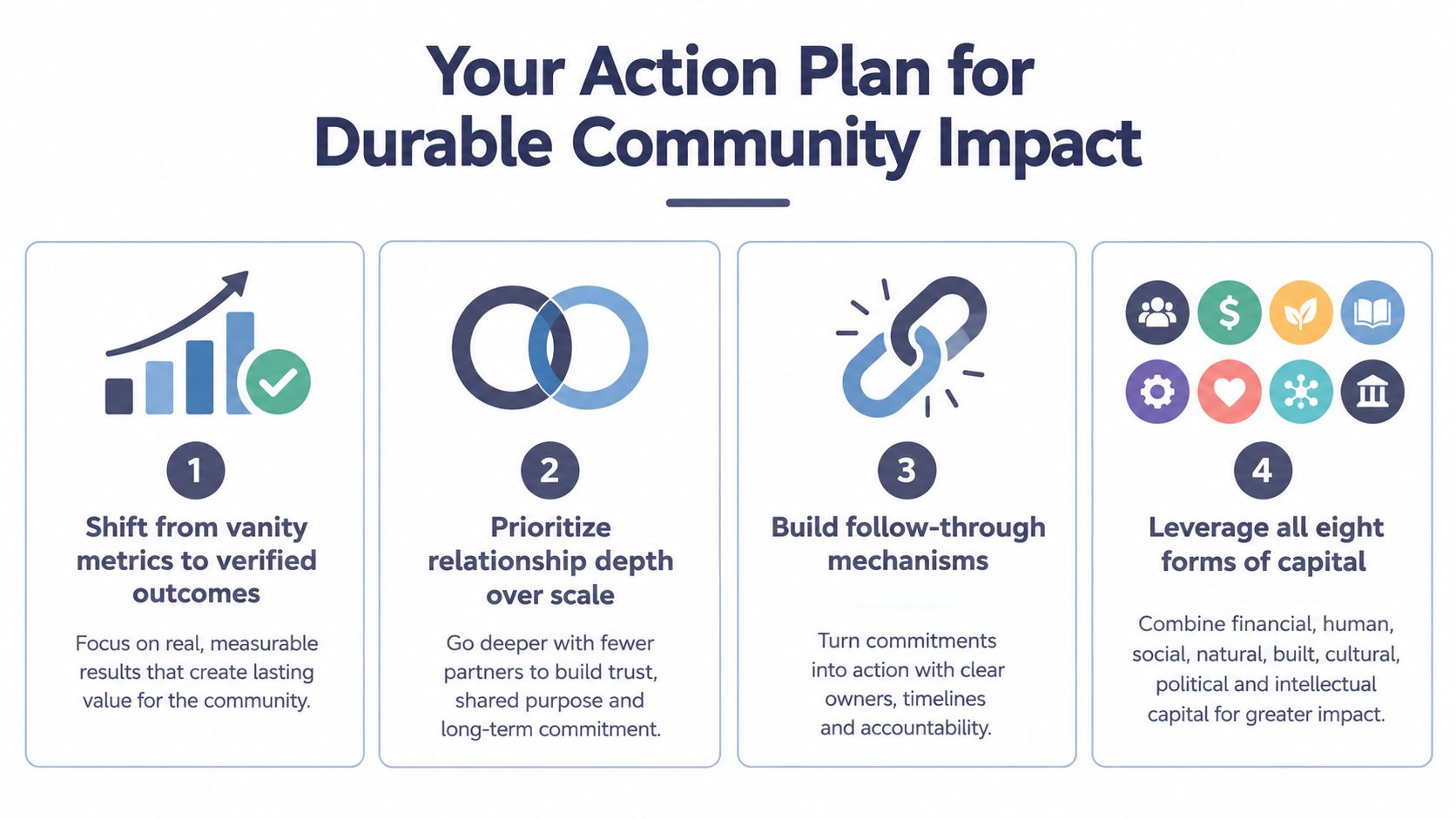
Approve an outcome statement. Name the intended beneficiaries and the change you'll test.
Protect delivery capacity. Match invitations and commitments to the people available to support them.
Make costs visible. Include follow-up work and environmental assessment in the budget.
Assign an evidence owner. Use a shared spreadsheet and organized document folder before purchasing a complex platform.
If stakeholders resist, retain familiar attendance and fundraising reports while adding a concise outcome record. Limited budgets call for a narrower promise, not unsupported claims.
A business strategy that incorporates philanthropy should make room for beneficiary needs, operating responsibilities, and honest evaluation. Those considerations belong in approval decisions, not just closing reports.
Use the accompanying video as a prompt for your team's discussion about purpose and accountability.
Before committing to another event, agree on what evidence would justify doing it again. Repeat the investment because it serves the community, not because it has become a tradition.
Richard Maize offers perspectives grounded in real-estate investing, business-building, and philanthropy, a useful lens for evaluating community initiatives beyond launch-day excitement. Visit Richard Maize to explore his investment insights and philanthropic work, and use those perspectives to sharpen the outcomes, partnerships, and accountability behind your next impact event.
Comments