7 Los Angeles Real Estate Investment Firms to Know

Choosing the biggest name is often the wrong way to compare Los Angeles real estate investment firms. The right firm depends on the strategy, not the name: an institutional lending platform, a neighborhood apartment operator, and an urban developer solve different investment problems. A polished portfolio doesn't tell you whether you can invest, how you'll recover your capital, or who handles an operating shortfall.
Los Angeles remains a substantial investment market, but context matters. Metropolitan commercial real estate sales totaled $37.3 billion in 2025, compared with $51.4 billion in 2019, according to Bisnow's Los Angeles capital-markets coverage. That's a reason to examine financing and acquisition discipline, not assume a recognizable sponsor makes every deal attractive.
The firms below represent distinct approaches to creating or preserving value. Institutional investment access and owner-operator partnerships aren't interchangeable. Richard Maize's combination of property-investment and mortgage-banking experience provides a useful perspective: evaluate the asset, financing, and execution plan together, rather than treating any firm's reputation as the investment thesis.
1. CIM Group
CIM Group fits research into institutional-scale ownership, development, and lending, rather than a search for a small apartment-management partner. Founded in 1994, the Los Angeles-based firm combines real estate equity, credit, infrastructure, and operating capabilities, and reports $31.8 billion in assets owned and operated as of March 31, 2026, on the CIM Group website.
Its breadth is the main attraction. A platform that invests, develops, operates, and lends can approach a property from different positions in the capital structure. CIM also describes Opportunity Zone experience, including Los Angeles projects, but investors should separate the underlying property economics from any potential tax considerations.
Where the breadth helps
Capabilities: In-house investment, development, operations, and lending resources support strategies across sectors and risk profiles.
Research visibility: Public project information and investment disclosures give prospective investors material to examine.
Trade-off: Its scale and varied businesses make direct comparisons with local multifamily specialists difficult.
The practical question isn't whether CIM has a large portfolio. It's which specific vehicle or transaction you can access, what it owns, and where your capital sits relative to lenders and other investors. Eligibility, fees, and liquidity depend on the offering, and opportunities may not be open to every individual.
Richard Maize's perspective on navigating Los Angeles real estate offers a local-market lens alongside institutional research. Use that lens to assess acquisition assumptions and neighborhood demand, not to infer an endorsement of CIM or any particular investment. Portfolio scale and past results don't establish the outcome of a new deal.
2. Kennedy Wilson
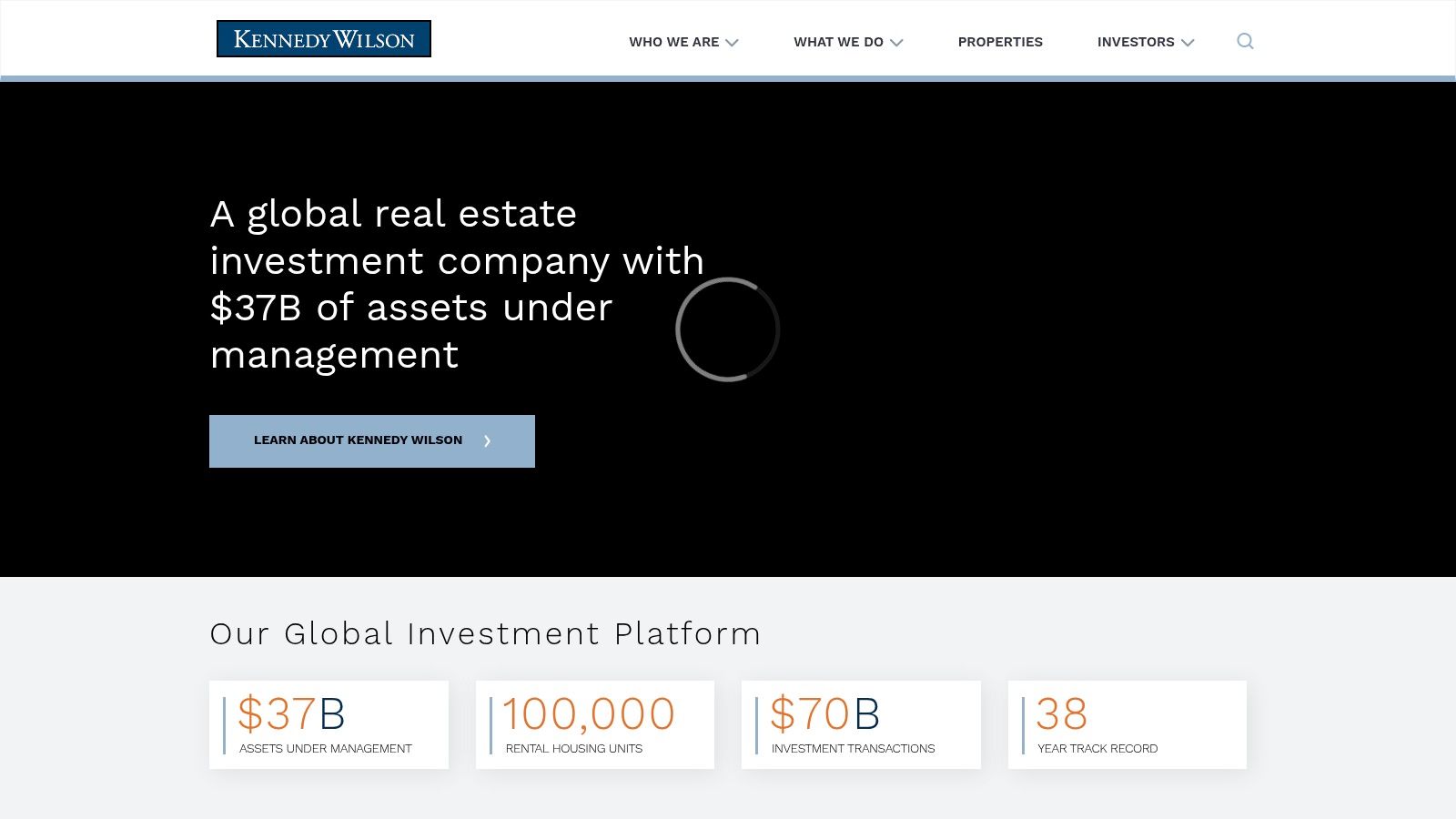
An investor seeking rental-housing exposure alongside commercial property and lending has a different research task from someone seeking a local renovation partner. Beverly Hills-headquartered Kennedy Wilson is a global real estate investment and management firm with Southern California activity and a large, multimarket portfolio.
Its housing strategies can include rehabilitation, repositioning, development, and recapitalization. The firm also participates through equity investments and real estate loan commitments, making it important to identify whether a proposed opportunity depends on property operations, development execution, or borrower repayment.
A local headquarters doesn't make every investment a local strategy. Review the actual geographic allocation before treating a platform as Los Angeles exposure.
Compare the investment, not just the platform
Kennedy Wilson's established operating platform and multiple investment approaches are useful strengths. They also create a comparison problem: a rental-housing investment and a real estate loan have different downside protections, cash-flow patterns, and exit constraints.
Ask how much discretion the manager has to change markets or property types. Then determine whether the opportunity provides the concentration you want or broader exposure you didn't intend to buy.
Access is the limiting question. Individual investors may not have direct access to every fund or strategy, and the firm's size may not suit someone seeking a small, hands-on partnership. Richard Maize's guide to diversification, risk management, and long-term portfolio growth provides a framework for deciding whether broader exposure serves your objectives or merely adds complexity.
3. TruAmerica Multifamily
Apartment specialization makes TruAmerica Multifamily a more focused comparison than a diversified real-asset manager. The Los Angeles-headquartered TruAmerica platform describes market-rate apartment, workforce-housing, affordable-housing, residential-development, and structured-finance activities, alongside property and investment management capabilities.
Its value-add, core, and core-plus strategies shouldn't be treated as interchangeable. Ask how each proposed investment earns its return: existing income, renovation execution, development, or a combination. A workforce-housing label alone doesn't establish tenant affordability or protect an acquisition from financing risk.
Put operating assumptions ahead of renovation renderings
Los Angeles multifamily vacancy reached 5.7% in Q4 2025, while annual asking-rent growth was -0.1%, according to the Matthews Los Angeles multifamily market report. Those conditions support conservative rent assumptions rather than an automatic renovation premium.
For a proposed apartment investment, examine:
Collections: Separate scheduled rent from cash collected, concessions, and bad debt.
Renovations: Request the unit-level scope, completion assumptions, and evidence supporting projected rents.
Financing: Test whether the property can cover debt service if improvements take longer and rent growth stalls.
TruAmerica's housing specialization is a strength for investors who want a dedicated apartment manager. It's a limitation for those seeking office, retail, or industrial diversification, and direct individual access may be limited.
Richard Maize's lessons for aspiring real estate investors provide a complementary starting point for reviewing the fundamentals. Professional management doesn't eliminate property, market, financing, or liquidity risk; it changes who is responsible for managing those risks.
4. Cityview

Cityview's distinguishing feature is the connection between investment management and urban housing execution. The Los Angeles-based manager and developer describes acquisitions, development, asset management, and property management capabilities, with offices elsewhere in the United States. It reports approximately $7 billion invested across more than 150 projects on the Cityview website.
Its stated approaches include repositioning under-managed properties, portfolio aggregation, infill redevelopment, and multifamily value-add investment. These approaches create value differently: improving an existing operation requires different controls from assembling a portfolio or delivering new apartments.
Separate operational upside from development upside
For an existing property, request evidence that weak performance reflects fixable management problems rather than weak demand. For redevelopment, examine entitlement status, construction scope, financing conditions, and the leasing plan separately.
Strength: Broad in-house capabilities can support continuity from acquisition through ongoing property operations.
Fit: Apartment and urban-housing specialization is relevant to investors seeking that exposure.
Limitation: Multifamily concentration won't satisfy investors seeking diversification across property types.
Local supply analysis belongs in that review. Approximately 32,000 apartment units delivered since 2022, while vacancy increased by only about 100 basis points, according to Northmarq's Los Angeles multifamily analysis. That supports examining competing deliveries and asset positioning rather than assuming new construction has the same effect everywhere.
Access is likely to depend on a specific fund or partnership rather than an always-open public product. Company-reported investment and project totals establish activity, not future performance or the suitability of an available offering.
5. LWK Partners

Renovating apartments and adding housing require different underwriting. Southern California private-equity firm LWK Partners focuses on acquiring and operating value-add multifamily properties, with a concentration in Los Angeles. Its stated approach combines renovations, operational improvements, and additional units where feasible, while considering workforce affordability and housing supply.
This is a more locally concentrated proposition than a broad national platform. It may fit investors researching property-level improvements, but the investment case should distinguish work within existing buildings from projects requiring additional approvals and construction.
Practical rule: Underwrite added units as a separate execution case until feasibility, approvals, costs, and financing are sufficiently established.
Ask what works without expansion
A useful diligence exercise is to evaluate the property without assuming additional units will be approved. If the existing apartments can't support the purchase and financing on reasonable assumptions, the investment depends more heavily on development than its renovation description might suggest.
LWK's clear property-improvement approach and local concentration make it relevant to investors interested in hands-on multifamily value creation. The corresponding drawback is narrower exposure than a diversified manager, plus dependence on contractor execution, approvals, leasing, and market conditions.
Public information doesn't provide a standard fee schedule or retail investment terms. Prospective partners should request the ownership structure, sponsor contribution, reporting obligations, and decision rights rather than assume that a local focus means an informal arrangement.
For renovation plans involving occupied apartments, also examine tenant communication, deferred maintenance, and applicable rent-regulation constraints. A credible budget should explain both the improvement work and the operational disruption, not just the projected rent after completion.
6. Winstar Properties
For a property owner, the most valuable conversation may concern ongoing apartment operations rather than fund access. Los Angeles-based Winstar Properties describes an investment and management approach centered primarily on multifamily properties in Los Angeles and nearby areas, with long-term ownership, renovation, and property improvements.
Its website includes rental and owner-portal functions. Those features are relevant to residents and owners, but they shouldn't be mistaken for evidence of an available passive-investment product.
Evaluate the operating relationship
Winstar's local emphasis and combination of investing with property management make it worth exploring for an operations-oriented partnership. The key distinction is what relationship the firm is offering you.
For owners: Clarify maintenance authorization, vendor selection, collections reporting, and responsibility for major capital work.
For potential partners: Establish who contributes capital, approves refinancing, and decides when to sell.
For passive investors: Request the legal offering structure before discussing projected distributions.
Public information about fund structures, investor eligibility, and performance is limited, and no standard public pricing or investment minimum is listed. That doesn't establish whether a proposal is attractive or unattractive; it means the website alone isn't enough to evaluate it.
Long-term ownership also deserves scrutiny rather than automatic praise. Ask how reserves are maintained, how recurring maintenance differs from capital improvements, and what happens if an investor needs liquidity before the owner intends to sell.
Best fit is a local operating relationship, subject to the services and terms available. Investors seeking a clearly documented public fund should avoid assuming that a property-management platform offers equivalent access.
7. Urban Stearns

Development investors should begin with execution risk, not projected returns. Privately held Urban Stearns describes real estate investment opportunities for accredited investors, with a focus on Los Angeles multifamily and mixed-use development, ground-up construction, and property ownership.
Project examples in San Pedro and Westlake provide a view of its stated geographic activity. They don't establish that another project will receive comparable approvals, financing, construction pricing, or leasing demand.
Treat the development schedule as an investment assumption
The appeal is a focused Los Angeles strategy that includes creating housing rather than only purchasing existing income. The trade-off is exposure to entitlement, construction, financing, and lease-up risks before a property reaches stable operations.
A development investment isn't the same as buying an occupied apartment building. Ask what protects your capital before the project produces dependable operating income.
Request documentation of site control, entitlement status, construction responsibilities, financing conditions, and contingency funding. Clarify whether investors could face additional capital requests, what happens if they decline, and how delays affect the distribution structure.
The accredited-investor focus excludes many members of the general public. Eligibility also isn't a substitute for suitability: an investor may qualify yet still need liquidity sooner than a development project can reasonably provide.
Urban Stearns is most relevant to investors deliberately seeking development exposure. Treat website return figures as firm-reported targets or claims, not assured outcomes. Request completed-project results and explanations of deviations from original budgets and schedules, rather than comparing opportunities solely by their advertised upside.
Los Angeles Real Estate Investment Firms: 7-Company Comparison
Firm | Focus and strategy | 🔄 Implementation complexity | ⚡ Scale and access | 📊 Potential outcomes | 💡 Ideal use and key advantage |
|---|---|---|---|---|---|
CIM Group | Multi-sector real estate equity and credit, plus infrastructure and lending | High: combines investment, development, operations, and lending | Institutional-scale; reports $31.8B in assets owned and operated as of March 31, 2026; access depends on offering | Exposure to varied real estate strategies; results depend on the specific investment | Researching a diversified institutional platform with broad in-house capabilities |
Kennedy Wilson | Rental housing, commercial property, and real estate lending | High: strategies include repositioning, development, recapitalization, and lending | Large global platform with documented Southern California activity; access varies by strategy | Potential exposure to property equity and loans across markets | Comparing a large, multi-strategy firm with a Beverly Hills base |
TruAmerica Multifamily | Apartments, workforce and affordable housing, and residential development | Moderate to high: property management, development, and multiple investment strategies | National platform headquartered in Los Angeles; individual access may be limited | Multifamily investment exposure across value-add, core, and core-plus strategies | Researching a specialist in apartments and housing |
Cityview | Multifamily acquisitions, development, redevelopment, and property management | High: capabilities span investment through property operations | Reports about $7B invested across 150+ projects; access generally tied to specific offerings | Exposure to urban apartment projects and value-add strategies; outcomes are not assured | Exploring a Los Angeles-rooted multifamily developer with in-house operations |
LWK Partners | Southern California value-add multifamily, concentrated in Los Angeles | Moderate to high: renovations, operational improvements, and possible unit additions | Local-focused private-equity firm; public investment terms are limited | Potential value creation through property improvements, subject to execution and approvals | Researching a focused local apartment strategy |
Winstar Properties | Los Angeles-area multifamily ownership, renovation, and management | Moderate: emphasizes hands-on property improvements and ongoing management | Local firm; public fund terms and investor access details are limited | Long-term apartment ownership and operational improvement; performance details are not publicly specified | Seeking a local, operations-oriented perspective on apartment properties |
Urban Stearns | Los Angeles multifamily and mixed-use development, including ground-up projects | High: development involves construction, approvals, financing, and leasing | Privately held; opportunities are aimed at accredited investors | Potential development exposure; firm-reported targets are not assured outcomes | Accredited investors researching LA-focused development and property ownership |
Match the Firm to Your Capital and Your Time
Write down your liquidity date before you write down your target return. Say you have $250,000 you may need back within three years; that capital belongs in a different vehicle than money committed to a ground-up project with a five-year lease-up horizon. Mismatching the two is how investors end up in structures that penalize early exit.
Once the timeline is clear, confirm whether the firm accepts your type of capital, and request the offering documents, fee structure, liquidity terms, and past-project results before committing.
Then examine a comparable Los Angeles acquisition in detail. Review actual operating costs, renovation assumptions, financing terms, exit constraints, and the firm's responsibilities from acquisition through asset management. Ask to see original underwriting alongside completed results, including explanations for missed assumptions rather than only successful outcomes.
Questions that apply to every structure
Who controls the decisions that most affect your return, and what approval rights do you hold?
What happens to your capital if the business plan runs a year late?
How are fees calculated when a project underperforms its projections?
What did the firm's weakest completed deal look like, and why?
Richard Maize's background offers a useful lens on evaluating property and financing together. His career biography describes building and later selling a mortgage-banking organization before moving into multifamily ownership.
Use that background as an analytical frame; it does not replace diligence on any firm named above. Stress-test the deal in front of you: does it still work with slower leasing, higher operating costs, or a weaker exit? If the answer depends entirely on optimistic rent growth or refinancing, the investment deserves closer scrutiny.
Choose the relationship you can evaluate and sustain. Your available capital, need for liquidity, tolerance for uncertainty, and willingness to participate should set the shortlist. Marketing can introduce a firm; documents, property-level evidence, and clear responsibilities decide whether you proceed.
Richard Maize shares perspectives on property markets, entrepreneurship, and hands-on investing that can help you assess how an investment firm intends to create value. Visit Richard Maize to explore his investment background and commentary, then use those resources to sharpen your questions about financing, operations, and partnership fit.
Comments