Commercial Real Estate Financing Options Worth Considering

You're at your desk in Los Angeles with competing term sheets, a purchase agreement moving toward closing, and a property you still want to own. The rates look close enough. Then your attorney flags the differences: one lender controls any extension, another wants a broader guaranty, and neither commitment works quite the way the broker described it.
That's where evaluating commercial real estate financing options becomes an ownership decision, not just a borrowing decision. You need capital that supports the business plan without forcing you to sell, refinance, or contribute fresh equity at the wrong moment.
Why the Right Financing Choice Is About More Than the Rate
Consider a hypothetical acquisition of an apartment property that needs renovations and fresh leasing. The lower-rate proposal looks attractive in the acquisition spreadsheet. But its maturity arrives before you've allowed enough time for construction delays, tenant turnover, and a lender to recognize the improved income.
The competing proposal costs more initially but gives you clearly defined extension rights. Neither is automatically better. The question is whether the savings justify the risk you'll have to replace the loan before the property is ready.
Read the obligations before comparing the savings
Begin with the provisions that can change your position after closing:
Extension conditions: Identify whether an extension is contractual or discretionary, and what financial tests you must satisfy.
Recourse: Ask counsel to explain personal exposure, completion obligations, and the circumstances that can expand a guaranty.
Prepayment restrictions: Check whether your intended sale or refinancing would trigger an expense that changes the investment return.
Cash controls: Understand when the lender can restrict distributions or require property income to remain in a controlled account.
These aren't secondary details. They determine how much freedom you retain when the business plan needs adjustment.
The Federal Reserve's July 2024 lending survey reported continued tightening of commercial real estate lending standards following tightening in the preceding quarter. Banks adjusted spreads, maximum loan sizes, loan-to-value limits, coverage requirements, and interest-only periods. A borrower therefore needs to evaluate the complete structure, not assume a quoted rate describes the lender's willingness to fund the deal.
Practical rule: Compare what each lender requires when the property underperforms, not just what each lender charges when everything goes according to plan.
Match the debt to the work ahead
A renovation strategy needs room for execution. A long-term hold needs predictable carrying costs and an acceptable exit mechanism. A development project needs funding obligations that remain workable through completion.
My judgment is straightforward: paying somewhat more for a structure you can live with can be sensible. Paying more for vague promises of flexibility isn't. Ask the lender to translate every important assurance into a provision your attorney can locate in the documents.
The Three Numbers That Move Every CRE Deal
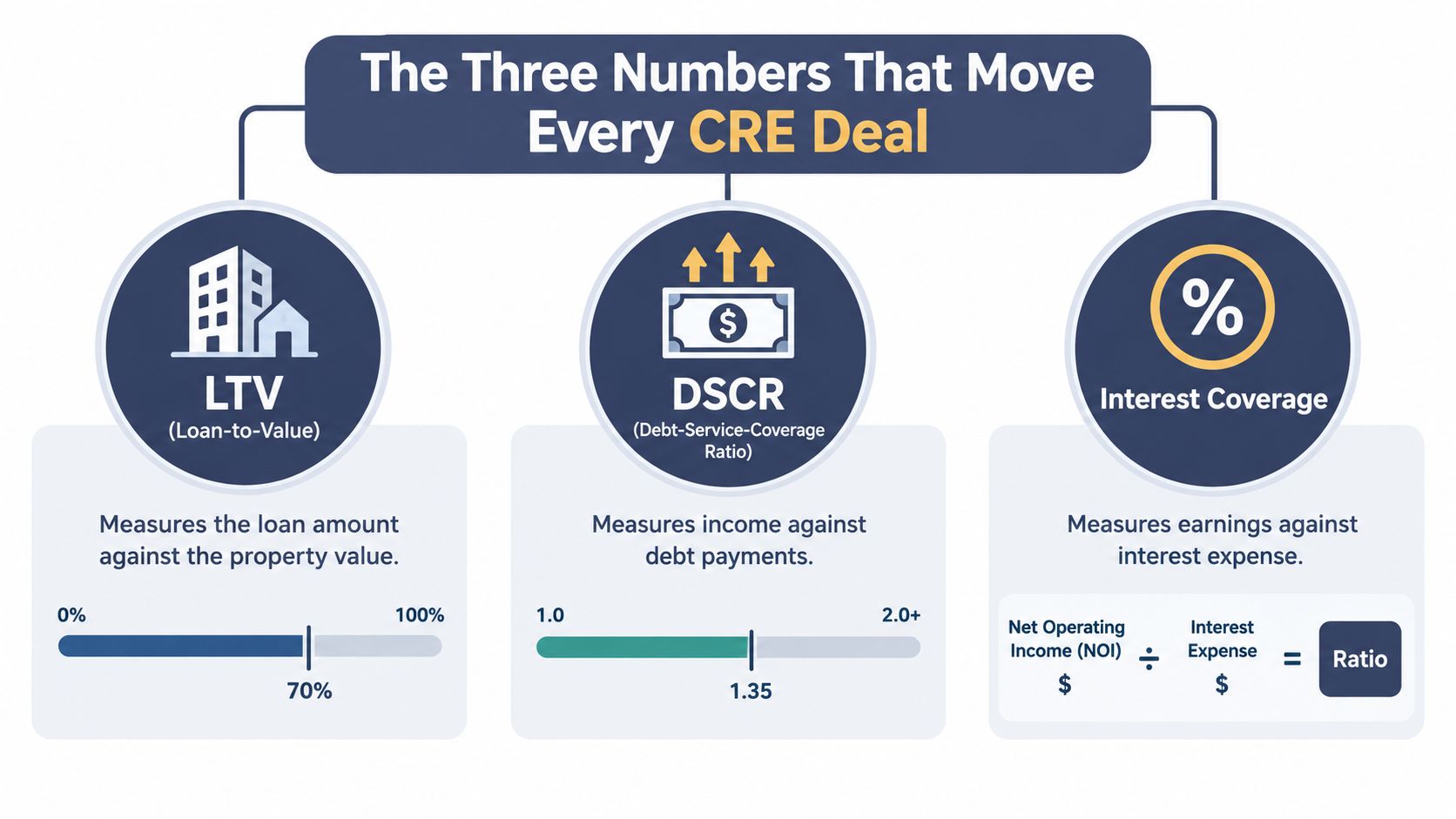
Before comparing lenders, establish what the property can support. Loan-to-value, debt-service coverage, and interest coverage answer different questions. A strong result on one doesn't erase a weakness in another.
The relationships are easier to see together.
Separate collateral support from payment capacity
Loan-to-value, or LTV, compares the requested loan with the property's value. Think of it as the size of the mortgage relative to the appraisal. It tells you how much collateral cushion stands behind the debt, not whether the building produces enough cash to pay it.
Debt-service-coverage ratio, or DSCR, compares net operating income with scheduled principal and interest. It's the rent-check test after operating expenses, rather than a comparison with gross rent. Review what NOI means in commercial real estate before accepting a coverage calculation that relies on optimistic income or incomplete expenses.
Metric | Calculation | Question to ask |
|---|---|---|
LTV | Loan amount divided by property value | How much debt rests on the collateral? |
DSCR | Net operating income divided by scheduled debt service | Can recurring operations cover principal and interest? |
ICR | Operating earnings divided by interest expense | Can earnings cover the interest obligation? |
Interest-coverage ratio, or ICR, isolates interest expense. It isn't a substitute for DSCR because it doesn't test the same principal-repayment burden. Confirm which earnings measure the lender uses rather than assuming every coverage calculation is comparable.
Underwrite the interaction
The European Systemic Risk Board's systemic-risk guidance identifies DSCR/ICR, firm-level indebtedness, and facility-level LTV as relevant borrower-based measures for limiting CRE vulnerability. The practical lesson is to examine collateral, payment capacity, and sponsor indebtedness together.
Start with supportable income, calculate coverage under the proposed payment schedule, and then check debt against a defensible valuation. Don't begin with the loan proceeds you want and work backward until the assumptions produce them.
A property can have substantial equity and still lack payment capacity. Conversely, strong current income doesn't make an aggressive valuation harmless. For floating-rate debt, check how changing interest expense affects coverage and whether a cap, swap, or funded reserve addresses the exposure.
A Practical Map of Commercial Real Estate Financing Options
The financing label should describe the job the capital needs to perform. Buying a stabilized building, completing renovations, and funding construction aren't interchangeable assignments. Treat the following as a screening map, then confirm the actual lender's requirements.
Commercial Real Estate Financing Channels at a Glance
Financing Channel | Typical Use Case | Underwriting Posture |
|---|---|---|
Traditional bank mortgage | Acquisition or refinancing of an operating property | Prepare documented income, collateral support, and sponsor financials. |
SBA 504 | Eligible owner-occupied fixed-asset projects | Confirm business and project eligibility with the participating lender and Certified Development Company. |
CMBS conduit loan | Financing a stabilized income property | Examine property cash flow, servicing provisions, reserves, and exit restrictions. |
Bridge loan | Renovation, repositioning, or lease-up | Present an executable improvement plan and a credible permanent-financing exit. |
Mezzanine capital | Filling a capital gap behind senior debt | Scrutinize combined obligations, lender coordination, and enforcement rights. |
Construction and land-development loan | Ground-up development or substantial building work | Prepare a funded budget, completion plan, and repayment strategy. |
Hard money | Short-duration transactions requiring specialized execution | Test the cost, collateral requirements, and exit before prioritizing speed. |
Equity or joint venture | Sharing project funding and ownership risk | Negotiate control, distributions, additional contributions, and exit decisions. |
Seller financing | Negotiating financing directly with a willing seller | Resolve security, payment terms, existing debt, and maturity obligations. |
REIT investment | Passive real estate exposure | Evaluate the investment vehicle rather than treating it as financing for your own acquisition. |
Opportunity-zone or 1031 structure | Tax-sensitive investment planning | Obtain transaction-specific tax and legal advice separately from the debt decision. |
Distinguish financing from ownership and tax planning
The SBA 504 program provides a concrete owner-occupied alternative: its typical structure allocates 50% to a private lender, 40% to a Certified Development Company, and 10% to the business owner, with listed loan amounts from $25,000 to $5.5 million and real-estate maturities of up to 25 years, according to the SBA's lender resources. Confirm how those parameters apply to your project before treating them as a financing commitment.
Don't lump every item in the table into a loan comparison. Equity changes ownership economics. A REIT offers an investment route, not a mortgage for a building you're purchasing directly. Opportunity-zone planning and a 1031 exchange belong in the tax-structure discussion; neither replaces a funded capital plan.
More available capital isn't automatically a stronger capital structure. Each additional participant can introduce another approval right, payment obligation, or competing exit preference.
For bridge and hard-money proposals, demand a concrete explanation of the takeout. For mezzanine and joint-venture proposals, spend as much attention on control as on price. For permanent debt, consider whether restrictions fit the likely holding period.
The useful comparison is total cost, operating freedom, and a workable exit. Product names alone won't tell you which proposal delivers those things.
How Lender Segmentation Shapes Who Actually Closes Your Deal
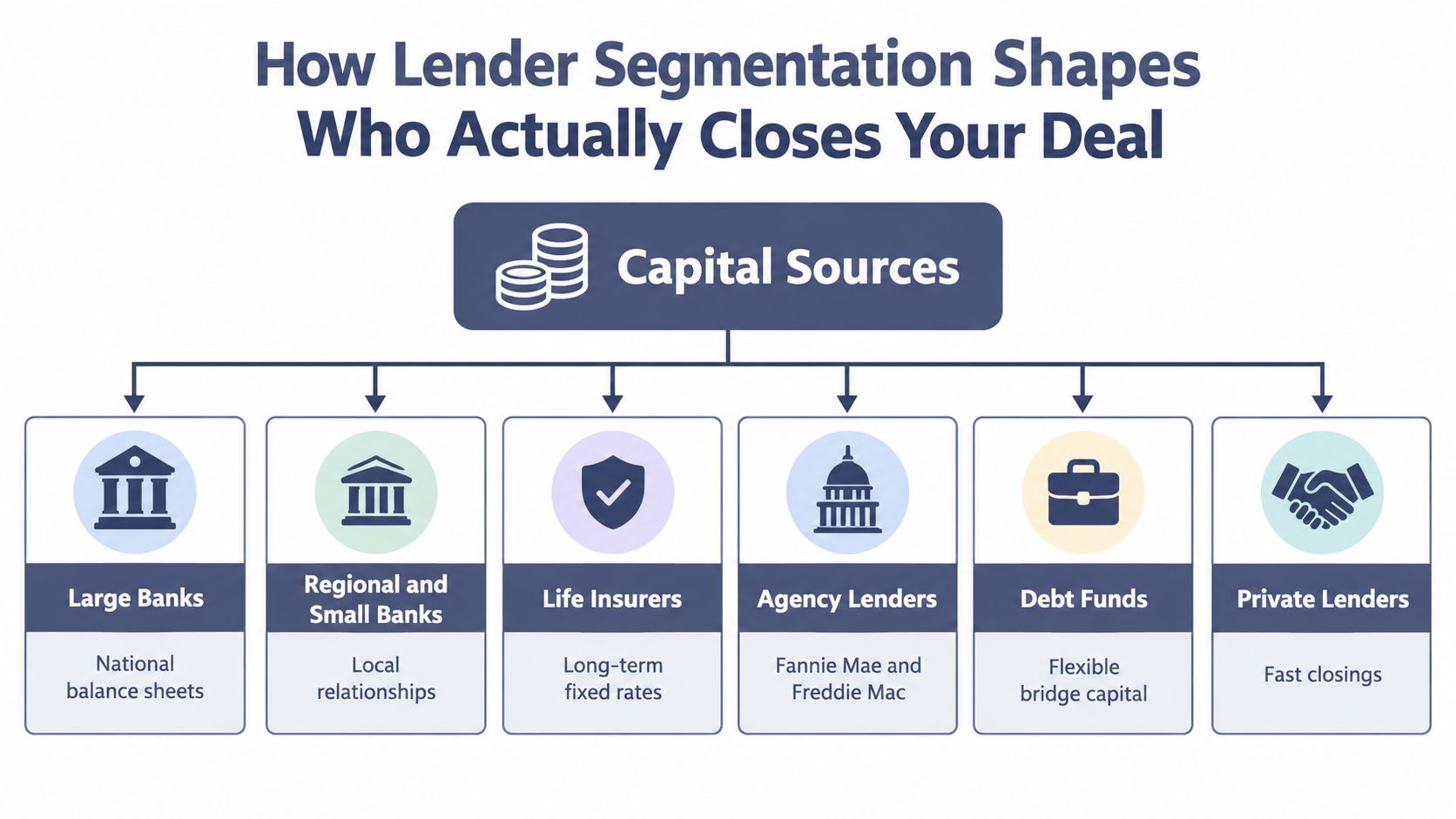
A lender declining your property doesn't mean every lender has stopped lending. It may mean that institution doesn't want your asset type, project phase, market exposure, or sponsor profile. Sending the same package indiscriminately to more lenders can produce more conversations without improving execution.
The Federal Reserve's July 2025 Senior Loan Officer Opinion Survey illustrates the distinction: banks reported tighter standards for nonfarm nonresidential and construction loans, broadly unchanged multifamily standards, and weaker demand for construction and nonresidential credit. Those findings describe a differentiated market, not a universal lending posture.
Use the lender categories as an outreach filter, not a promise of approval.
Choose the desk before negotiating the terms
For a stabilized property, consider conversations with banks and long-term institutional lenders. For qualifying multifamily, include agency-focused lenders in the screening process. For transitional property, ask debt funds and specialist lenders whether the business plan fits their mandate.
Institution size matters, but don't reduce it to a slogan. A regional bank relationship may help you establish credibility locally; a large bank may offer a different balance-sheet fit. Neither substitutes for confirming the institution's current appetite.
Large banks: Ask about transaction fit, sponsor expectations, exposure limits, and the approval process.
Regional and small banks: Determine whether local familiarity translates into actual lending capacity for this property.
Life insurers and agency lenders: Screen for property eligibility, stabilization requirements, and compatibility with your holding strategy.
Debt funds and private lenders: Establish how they assess execution risk, future funding, and the proposed exit.
Qualify the relationship before paying for diligence
Ask who approves the credit, what could change between indication and commitment, and which third-party reports the lender requires. Get a direct answer about whether its concerns involve the property, your sponsorship, or its own portfolio constraints.
A commercial finance partnership is most useful when each participant's role is explicit. Know who is advising, who is arranging capital, who is funding, and who has authority to approve changes.
Don't confuse an enthusiastic originator with an approved credit. Sequence outreach around fit, then compare proposals from lenders that can explain how your deal gets through their process.
The Documentation Package That Gets a Term Sheet Faster
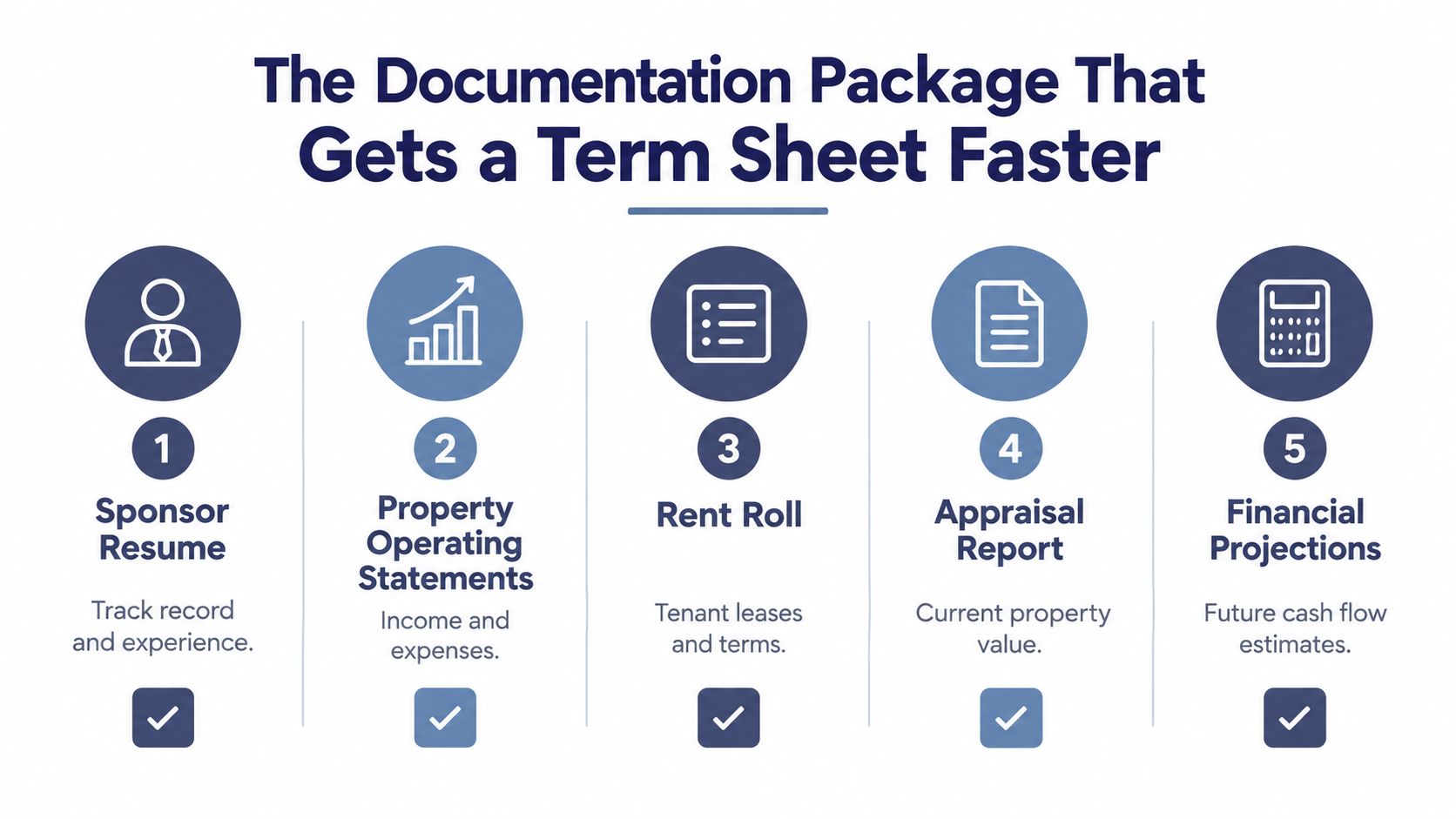
A polished presentation can't rescue unsupported income. Prepare a package that lets the lender trace the investment case from historical operations to the requested debt, without having to reconcile conflicting versions of the story.
Organize the core materials before distributing the opportunity.
Build a file the credit officer can verify
Sponsor résumé and track record: Identify relevant acquisitions, operating responsibilities, completed projects, and unresolved problems. Distinguish your own role from the broader team's work.
Operating statements: Assemble the trailing two to three years, together with current results and a forward-looking pro forma. Reconcile unusual expenses and explain adjustments rather than omitting them.
Rent roll and tenant rollover: Include lease terms, concessions, delinquencies, expiration dates, and anticipated downtime. Reconcile collections with reported revenue.
Stabilized NOI forecast: Show the assumptions behind rent growth, occupancy, operating costs, and the timing of improvements.
Rate sensitivity and capital budget: Present changing debt costs alongside a completion or capex budget, sources and uses, and the source of any additional equity.
Valuation and property diligence: Provide available appraisal materials and relevant property reports, while confirming which reports the lender must commission itself.
The point isn't to overwhelm the lender with attachments. Use clear filenames, a consistent financial model, and a short explanation of any discrepancy that would otherwise generate a follow-up request.
Prepare for questions beyond the building
The Federal Reserve's commercial real estate workout guidance defines global debt-service coverage to include borrower and guarantor cash flows and financial obligations, including contingent obligations. That guidance concerns accommodations and workouts, but it gives borrowers a clear reason to prepare a complete picture of guarantor exposure.
Preparation standard: A guarantor's headline net worth isn't the same thing as cash available to support this property.
Prepare liquidity information, other debt commitments, and contingent liabilities before those questions become urgent. Explain where completion money comes from and whether another project already depends on the same resources.
Good documentation doesn't guarantee approval or pricing. It removes avoidable uncertainty and gives the lender a more reliable basis for making a decision.
Stress-Testing Refinancing Risk Before You Sign
A balloon payment isn't a repayment strategy. Before committing, establish what happens if the property reaches maturity with less income, a lower valuation, or a more expensive replacement loan than you expected.
Keep the maturity date visible alongside the projected operating milestones.

The Deloitte 2026 commercial real estate outlook reports commercial mortgage exposure exceeding $1.7 trillion and that more than half of surveyed companies face a property-loan maturity within the coming year. Those figures make maturity planning a practical financing concern, not an optional appendix to the acquisition model.
Model the replacement loan, not just today's payment
Start with the current underwriting baseline, then change the conditions a takeout lender would examine.
Reduce the valuation: Recalculate proceeds under the replacement lender's borrowing limit constraint.
Increase the refinance rate: Determine how much debt stressed income can service.
Lower occupancy: Include downtime, concessions, and leasing costs rather than adjusting rent alone.
Delay the exit: Test a six- to twelve-month extension, including carrying costs and any required paydown, as part of the maturity-stress framework described in the Deloitte outlook cited above.
Identify the cash gap: Compare available replacement proceeds with the payoff, transaction expenses, and required reserves.
Review the debt-to-equity relationship alongside that gap. Decide whether additional equity would be available, who would provide it, and whether existing agreements permit the proposed solution.
This companion video provides another format for considering the financing discussion.
Test the fallback in the documents
Bridge debt needs a credible route into replacement financing. Permanent bank, insurer, or CMBS proposals deserve a different examination: whether their longer-term payment structure and restrictions remain compatible with your intended ownership.
Ask counsel to identify every extension condition and every circumstance requiring fresh cash. Don't assume a lender will extend because an extension would make economic sense to you.
The cheapest initial capital can become the most difficult capital to repay.
The useful output is a written response to each adverse scenario: refinance, extend, contribute equity, or sell. If none is credible under reasonable stress, change the structure before signing.
Choosing the Right Financing Option for Your Situation
Richard Maize describes purchasing his first apartment building in his mid-20s, owning more than 1,000 apartment units by age 30, and holding property in 20 states in his account of his investing experience. That ownership background provides a useful practitioner perspective alongside lender underwriting and professional advice: evaluate capital in relation to the property you must operate, not merely the transaction you want to close.
A practical decision begins with the asset's condition, the sponsor's resources, and the work remaining before income is dependable. Timing and recourse preferences then narrow the acceptable choices.
Match the situation to the next conversation
Borrower Situation | Financing Conversations to Prioritize | Decision That Needs Resolution |
|---|---|---|
Stabilized multifamily owner | Banks, agency-focused lenders, and suitable long-term lenders | Whether payment predictability and exit provisions fit the holding plan |
Owner-occupant buying a small industrial building | Conventional business-property lenders and SBA 504 participants | Whether eligibility, cash contribution, and business finances support the structure |
Ground-up development sponsor | Construction lenders, specialist debt providers, and equity partners | Whether completion funding and the eventual takeout remain credible under delay |
For the multifamily owner, don't accept transitional financing merely because it offers convenient proceeds. Investigate whether permanent capital fits the property without creating restrictions that conflict with a likely sale.
For the owner-occupant, keep business working capital in the discussion. Buying the building shouldn't leave the operating company without a defensible liquidity cushion.
For the developer, prioritize certainty of future funding and responsibility for overruns. A financing proposal is incomplete if it pays for acquisition but leaves the completion plan dependent on unidentified capital.
Make the final decision against your constraints
Choose the proposal whose conditions you can satisfy without relying on perfect execution. Local relationships matter when they produce clear communication and a realistic approval path, not when they encourage you to overlook weak terms.
Before authorizing closing, reconcile the final documents with the approved model. Prepare the documentation, approach lenders in a deliberate sequence, and resolve the maturity shortfall before it becomes a deadline.
Richard Maize offers practical real estate commentary informed by hands-on property ownership across multiple markets. Visit Richard Maize to explore his investing perspectives, then use your operating statements, lender questions, and maturity model to prepare your next financing conversation.
Comments