Real Estate Investment Terms Every Investor Should Know

You're looking at a listing sheet late in the evening. The rent looks solid, the photos look clean, and then the acronyms start. NOI, cap rate, DSCR, LTV. You don't need another sales pitch. You need to know what those words do to your money before you sign, wire, or waive anything.
Why These Investment Terms Matter Before You Sign Anything
Most beginners don't lose money because they picked a terrible building. They lose money because they misread one term and built every later assumption on that mistake. A seller's net operating income isn't your cash flow. A lender's rate isn't your return. A dividend yield isn't a promise.
That's why real estate investment terms aren't trivia. They're the controls on the deal. Some terms change the math, some change who bears the risk, and some change how easily you can get out.
Three Jobs Language Does in a Deal
Math terms set the price: NOI, cap rate, and cash-on-cash return tell you what income you're buying and what you're paying for it.
Structure terms set control and taxes: An LLC, a syndication, and a REIT can hold similar buildings and still leave you with very different liability, liquidity, and tax reporting.
Risk terms set the downside: Vacancy, refinancing risk, and reserves describe what happens when rent is late, a roof fails, or a loan comes due in a worse market.
Learn to separate those jobs and an offering memorandum gets easier to challenge. You stop asking whether a deal sounds good and start asking which assumption is doing the heavy lifting.
Practical rule: If you can't explain a term in plain English and say what happens when it moves against you, you're not ready to price the deal.
Experience teaches that sequence. Richard Maize reportedly created a portfolio of approximately 1,000 rental apartment units before turning 30 and later founded and developed a major U.S. mortgage-banking firm. That path, from owning apartments to financing them, is a useful reminder for new investors. Learn the language before the strategy, because strategy built on a misunderstood word is just a faster way to make an expensive mistake.
Use this glossary as a working reference. Keep it open next to the rent roll, the loan quote, and the seller's expense sheet, and translate each claim into cash in, cash out, and risk retained.
How This Glossary Is Organized
A broker's offering memorandum lands in your inbox. The pro forma quotes a cap rate, three units sit below market rent, and the lender wants a debt service number you haven't run yet. Where do you start?
Start with the question in front of you. Each group of terms answers a different one, and alphabetical order won't tell you which.
Five Buckets to Work From
Question on your desk | Group that answers it |
|---|---|
What is this income actually worth? | Deal math and valuation |
What will the lender allow, and at what cost? | Financing and debt |
Who holds the asset and carries the liability? | Ownership and entities |
Does rent survive vacancy, repairs, and reserves? | Property operations |
What breaks this deal in a worse market? | Risk, stress tests, and resilience |
The last row earns its place. Insurance repricing, refinancing exposure, and climate risk sit beside vacancy and borrowing power because all of them land the same way: smaller distributions than the pro forma promised.
Bold marks every term defined elsewhere in the glossary, so you can jump between connected ideas. That linking matters. Cap rate means little without stabilized NOI, cash-on-cash return means little without debt service, and a REIT dividend means little without funds from operations.
Read straight through once if this vocabulary is new to you. After that, pull the three or four terms that control the deal on your desk and pressure-test those. The rest can wait.
Deal Math and Valuation Terms
The map below shows how the core valuation terms connect to one property and its income.
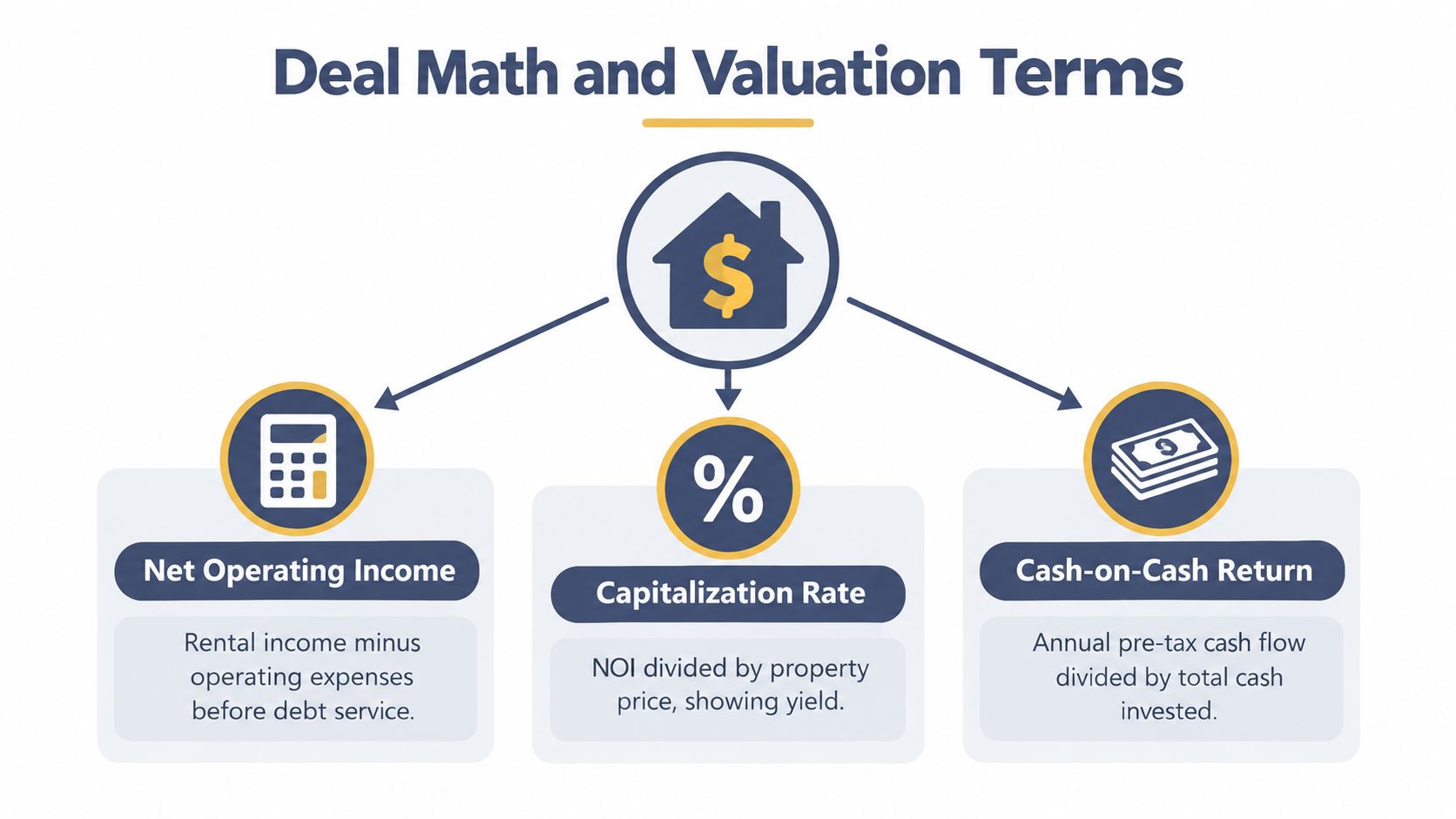
Start with net operating income, or NOI. It's property-level recurring income after operating expenses, but before financing costs, income taxes, depreciation, and owner-specific capital decisions. Stabilized NOI goes one step further. You normalize temporary vacancy, concessions, nonrecurring repairs, abnormal utility costs, and rents that sit above or below market before you trust the number.
Cap Rate and Value
Underwriting treats cap rate as NOI divided by value, with NOI representing stabilized property-level income before financing, taxes, depreciation, and owner-specific capital structure. Flip the formula and you get value. Value equals NOI divided by cap rate.
A lower cap rate produces a higher value for the same NOI. Buyers usually accept that lower yield when they believe income is durable, the location is liquid, or growth prospects are stronger. A higher cap rate produces a lower value and usually signals the buyer demands more return for more uncertainty.
Don't call cap rate your return on investment. It ignores holding-period cash flow growth, capital expenditures, sale proceeds, transaction costs, and changes in value. It's a snapshot of unlevered income against price, not a full holding-period answer. Test it anyway, because a 50-basis-point change in the rate you apply can materially alter value, especially your exit value.
Leveraged and Multi-Year Measures
Cash-on-cash return: Annual pre-tax cash flow after debt service, divided by the total cash you put in. It answers what your equity earns this year, not what the property earns before the loan.
Gross rent multiplier: Price divided by gross rent. It's a fast screening tool and a weak valuation tool because it ignores expenses entirely.
Internal rate of return: The annualized rate that ties together your initial cash out, periodic cash flows, and eventual sale proceeds over time.
Equity multiple: Total distributions back to you divided by total equity in. It shows how many times your money came back, without adjusting for how long it took.
The clip below is useful to watch with a rent roll in hand, pausing wherever a formula depends on an assumption you haven't verified.
Compare cap rates only across comparable assets, markets, lease structures, and income quality. Two buildings can show the same headline yield and carry completely different durability once you inspect who's paying, for how long, and at what expense load.
Financing and Debt Terms
Two buyers can close on the same duplex the same week. One finances 60% of the price at a fixed rate and shrugs off a vacancy. The other borrows 80% on a floating rate and starts feeding the building cash within two years. Same asset, same rents, different debt terms.
Loan-to-value, or LTV, is the loan amount divided by the property value. It tells you how much of the purchase the lender funds and how much of your own equity absorbs a price drop before the bank feels it. Higher LTV raises your potential equity return in a good year and deepens your loss in a bad one. It isn't automatically better, and lenders price it accordingly.
Debt service coverage ratio, or DSCR, compares NOI with required debt payments. Lenders use it to judge whether property income covers the loan with room to spare. Run it yourself under stressed rent and expense assumptions rather than the seller's best year. As an example, a property covering its payment 1.4 times on paper can slide below 1.0 the moment one anchor tenant leaves, and that's the moment the loan stops being a tool and starts being a landlord.
Rate, Cost, and Paydown Are Different Things
Amortization is the schedule that splits each payment between interest and principal over the loan term. Early payments go mostly toward interest, so equity builds slowly at first even when you pay on time. Points are prepaid interest you hand over upfront to buy down the rate, and they only pay off if you hold the loan long enough to recoup them.
Your interest rate is the cost of borrowed money on the balance. The annual percentage rate folds in certain lender fees, which makes it the honest comparison when two quotes show similar rates with different charges. A fixed-rate mortgage locks the rate for the term. An adjustable-rate mortgage resets it on a schedule, so your cash flow forecast has to survive a payment you haven't seen yet.
That range is not academic. Freddie Mac has tracked the average U.S. 30-year fixed mortgage rate since April 1971, with a historical high near 18.63% in October 1981 and a record weekly low of 2.65% in January 2021. Inside that spread sits the difference between a property that pays you and a property you pay for. The mortgage rate prices your debt. The cap rate estimates operating income relative to value before any debt is considered.
When your borrowing cost sits above the property's debt-free yield, borrowed money works against your equity instead of for it, even if the rent checks arrive on time.
Before you accept any quote, work through a structured guide to financing investment properties and funding choices and rerun your DSCR at a rate above the one you were offered. If the deal only works at today's payment, you've bought a refinancing hope, not a durable investment.
Ownership and Entity Terms
How you own real estate decides who controls decisions, who reports the tax, who absorbs liability, and how fast you can exit. The building can stay identical while your experience as an owner changes completely.
Sole ownership puts title and control in one name, along with the exposure. Tenancy in common lets multiple owners hold undivided interests they can generally transfer separately. A joint venture is usually a negotiated partnership for a specific deal, where the operating agreement, not the label, decides who manages, who funds shortfalls, and who can force a sale.
Pooled and Passive Structures
A limited partnership separates a general partner who manages from limited partners who contribute capital. A syndication pools investors behind a sponsor who sources and runs the deal, so your diligence shifts toward the sponsor's fees, promote, reporting, and track record. A limited liability company is a flexible holding vehicle many direct owners use, but it doesn't erase personal guarantees a lender requires. A Delaware Statutory Trust lets beneficiaries hold fractional interests under a trustee structure, with limited control in exchange for passivity.
A real estate investment trust, or REIT, owns or finances income-producing real estate and lets you buy exposure without buying a building. A U.S. REIT is generally required to distribute at least 90% of its taxable income to shareholders annually, which is why REIT cash yields tend to be higher than typical diversified equity dividends. Publicly traded REITs generally avoid entity-level tax on distributed income, while shareholders typically report distributions as taxable income.
That structure separates income yield from rents and capital appreciation from rising value. Listed shares can generally be bought or sold during market hours, unlike a physical property that may take months to transact. You gain liquidity and lose control.
Judge REITs with funds from operations, or FFO, not just GAAP net income. FFO adds back real estate depreciation and removes gains or losses from property sales, because historical-cost depreciation doesn't necessarily track market value. It still isn't operating cash flow or distributable cash. Check the reconciliation, plus debt load, occupancy, property type, and dividend sustainability, because the distribution rule isn't a guarantee of returns.
Property Operations and Income Terms
A twelve-unit building can advertise healthy rent on paper and still deliver little of it by month end. Operations vocabulary is what separates the advertised number from spendable income, so learn it as a waterfall: income shrinks in stages, and each stage has a name and a typical spot where sellers hide optimism.
Start at the top. Gross potential rent assumes every unit occupied at market rent with perfect collection. Nobody collects it. Subtract vacancy and credit loss for empty units, concessions, and tenants who do not pay, then add recurring income such as parking, laundry, or storage, and you arrive at effective gross income. Below that line sit the cost categories, and each one carries its own underwriting trap:
Term | What it covers | Where pro formas cheat |
|---|---|---|
Operating expenses | Taxes, insurance, utilities you pay, repairs, and day-to-day running costs | A recurring cost misclassified as one-time inflates NOI instantly |
Property management fees | What a manager charges, or the rate you should charge the deal even if you self-manage | Free management in a pro forma is a subsidy from your own unpaid labor |
Reserves for replacement | Money set aside for roofs, systems, and interiors that wear out | Skipping reserves borrows cash flow from next year's capital bill |
Repairs and maintenance | Recurring work that keeps units rentable, distinct from capital improvements | Blurring it with capex understates the true operating load |
Once every line has a name, test the stack as a whole. Working through how the operating expense ratio exposes bloated cost structures against comparable properties tells you whether a lean expense load reflects efficiency or a cost that is missing, deferred, or buried below the NOI line.
Underwrite NOI on stabilized assumptions rather than today's vacancy snapshot. A fully leased building with below-market rents and deferred repairs can be a weaker asset than a partly vacant one with market rents and clean systems. Ask which expenses the seller normalized, which they ignored, and which reset the day you take title. Your monthly distribution lives in those answers.
Return, Risk, and Stress-Test Vocabulary
The illustration below frames the return terms that cut both ways once debt and time enter the deal.
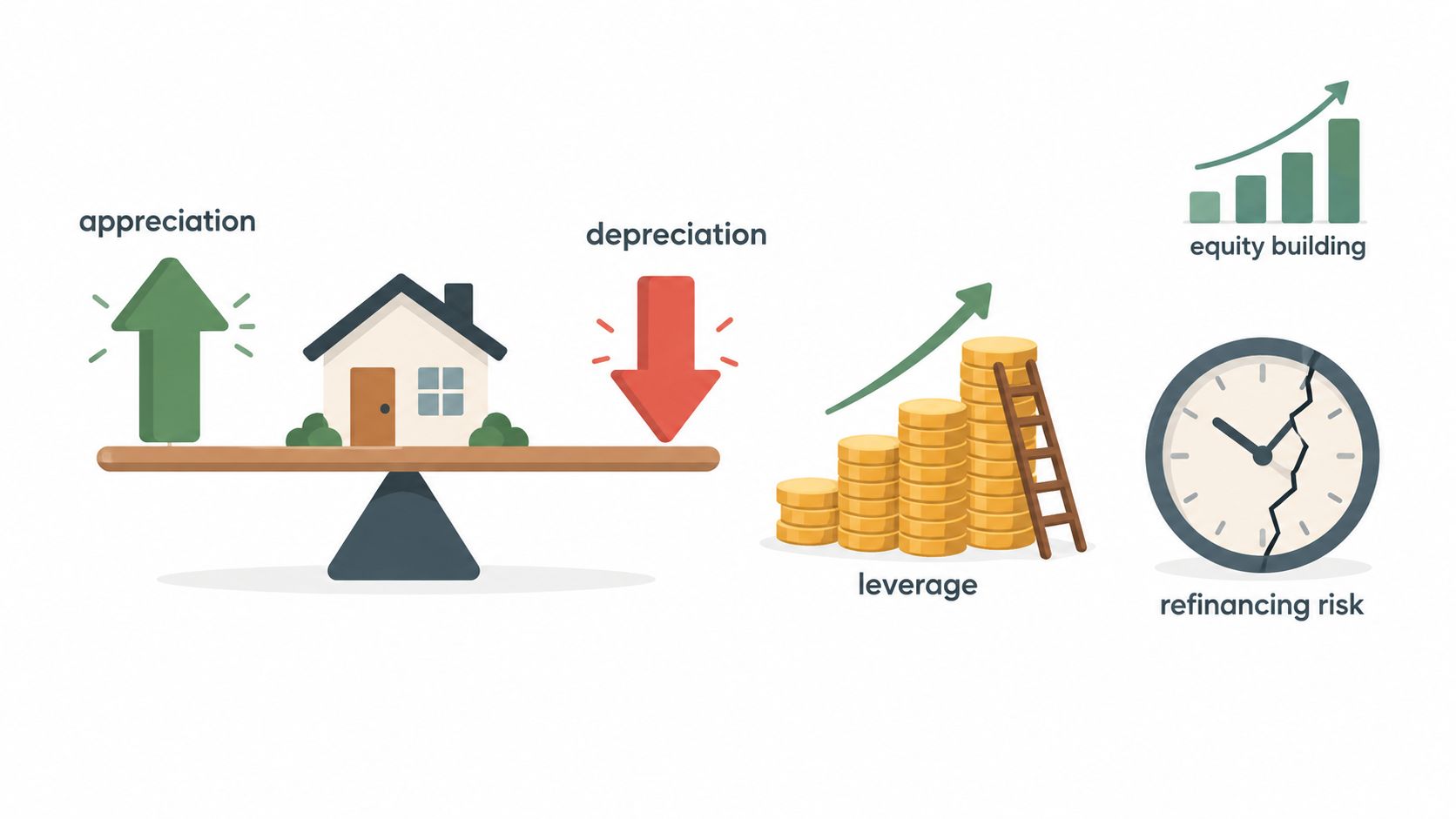
Appreciation is value rising over time, from market demand, income growth, or improvements you make. Depreciation has two meanings you must keep apart. In tax accounting, it's a deduction that spreads cost over useful life. In market terms, it means value falling. Confusing the two leads beginners to treat a tax benefit as proof the asset is losing worth, or the reverse.
Equity buildup happens as tenants' rent covers debt payments that reduce principal, and as value rises above the loan balance. Borrowed money makes that buildup faster. It also makes a value decline hit your equity first and hardest.
When a High Cap Rate Is a Warning
Stop treating a high cap rate as an automatic bargain. It can signal weak tenant demand, short leases, heavy deferred maintenance, rising insurance, or a market buyers are leaving. Price adjusts for risk before it rewards you for finding it.
Stress test first: Run occupancy, rent growth, interest rate, and exit cap rate scenarios together. A deal that survives only one friendly assumption at a time doesn't survive reality, where they move together.
Refinancing risk is the chance that when your loan matures, rates, values, or lender appetite won't let you replace it on workable terms. Current affordability shows how tight conditions can get. Buying a median-priced home requires about 43% of median household income, well above the traditional 30% affordability threshold, while mortgage rates remain above 6%.
Separate cash-on-cash return from total return in your own reporting. Cash-on-cash counts annual cash against cash invested. Total return also counts principal paydown, appreciation, and eventual sale proceeds. Mixing them lets a deal with thin monthly cash look healthy on paper while it strains your reserves.
Climate, Insurance, and Resilience Terms
Last year's premium on the seller's expense sheet is a stale number. Quote it yourself during diligence, because U.S. commercial-property insurance costs across multifamily, office, industrial, and retail rose 154% from 2017 to 2024, and insurance consumed 4.1% of property NOI in 2024 versus 1.9% in 2017. Multifamily costs rose 207.5% over that period in the same data, and high-risk-market properties traded at a 25% discount to low-risk-market properties.
Three terms decide whether your quote kills the deal. Insurability asks whether coverage exists at all, on terms a lender accepts, at a price the property can carry. A deductible is the loss amount you absorb before coverage responds; a large one is risk you chose to keep in exchange for a cheaper bill. Catastrophe exposure describes vulnerability to severe events tied to location and construction, and it follows the building no matter who owns it.
Watch a premium move through the math. Say a building earns $100,000 of NOI and insurance climbs $15,000 a year at renewal. NOI drops to $85,000, and at a 7% cap rate the property supports roughly $215,000 less value than it did before the bill arrived. One line item repriced the whole asset.
The Terms Buyers Use Against You at Exit
Resilience capex is spending that reduces physical vulnerability, hardening roofs, drainage, or mechanical systems, judged by whether it protects insurability and uptime. Stranded-asset risk is the chance that rising premiums, lender requirements, or buyer resistance make a property hard to finance, sell, or operate profitably well before its physical life ends. Climate-adjusted NOI is stabilized income after you underwrite realistic forward insurance costs, deductibles, and resilience spending rather than copying last year's figure.
A lower purchase price compensates for physical risk only temporarily when premiums keep rising, exclusions widen, and lenders tighten terms, because each renewal clips distributable cash again. Ask what coverage structure your lender will require at renewal before you close, and underwrite to that answer.
A Quick-Reference Checklist for Any Deal
Run every offering memorandum through gates, in this order, and make the document earn a pass.
Gate | Pass condition |
|---|---|
Price | NOI is stabilized, expenses are normalized, and the cap rate is supported by comparable sales rather than the seller's story. |
Debt | LTV, amortization, maturity, and DSCR still work after a higher-rate refinance and a wider exit cap. |
Control | The entity, reporting duties, and exit rights are clear enough that you know who can say no. |
Operations | Vacancy, management, repairs, and reserves are loaded before you celebrate yield. |
Break point | Insurance, taxes, resets, and climate exposure are tested together against real cash flow. |
If a row stays blank, mark it assumed or missing and price that risk. A package that survives this screen can then go line by line through a due diligence checklist for commercial deals; a package that fails usually needs no clever structure, only a lower offer or a walk-away.
Questions Smart Investors Ask Once They Know the Basics
When is a high cap rate a warning? When it reflects weak demand, short leases, deferred capital needs, or insurance and tax loads the seller understated. Cheap yield often prices in trouble you haven't found yet.
Why can insurance change my cap rate? Because higher recurring premiums permanently reduce NOI, and buyers pay for NOI.
Would this cash flow survive refinancing? Rerun DSCR at maturity using higher rates and a wider exit cap rate. If coverage collapses, today's cash flow is rented from cheap debt.
Why do two REITs with similar yields carry different risk? Compare borrowed capital, occupancy, property type, FFO quality, and dividend sustainability, not the headline payout.
If you're building your vocabulary before your next purchase, refinance, or syndication review, use these terms as a checklist and keep testing each deal against financing, operations, and insurance reality. For more practitioner guidance on property markets, underwriting, and long-term investing, visit Richard Maize and bring your next deal sheet with sharper questions.
Comments