Community Development Programs: Your Actionable Guide

Popular advice about community development programs often starts with a grant application and ends with a ribbon-cutting ceremony. That sequence is backwards. The hard work is deciding which local problem deserves capital, who can execute the response, how regulations will affect delivery, and which outcomes will still matter after the funding cycle ends.
From a Los Angeles investment and philanthropy perspective, community development is neither a purely charitable exercise nor a guaranteed path to financial gain. It is a disciplined way to improve places, strengthen local institutions, and create conditions in which responsible businesses and long-term investments can function. The programs that last usually combine resident knowledge, operational control, realistic funding, and measurement that distinguishes a completed project from a genuinely useful one.
Why Community Development Programs Matter to Investors
The assumption that community development is only charity limits the people who participate in it. A housing investor may see a neighborhood initiative as separate from portfolio strategy. An entrepreneur may treat local services as someone else's responsibility. A philanthropist may focus on the size of a grant rather than the capacity of the organization receiving it. Each view misses the connection between community conditions and economic performance.
A stable neighborhood can support stronger commercial activity, better property use, and more dependable partnerships. That doesn't mean every community investment produces a financial return, or that appreciation should be promised. It means investors who understand local needs can make better decisions about where capital, services, and relationships are likely to be useful.

The strategic case
The practical question isn't, “Can this project be described as impact?” It's, “What local constraint does it remove, and how will we know?” A small-business corridor may need safer pedestrian access, dependable maintenance, or technical support for owners. A housing project may need more than construction. It may require tenant services, transportation access, or a management plan that protects the intended community benefit.
For investors, that creates several decision points:
Asset quality: Does the program protect or improve the physical environment around an investment?
Execution risk: Does a credible local organization have responsibility for delivery?
Demand fit: Does the intervention address a problem residents and businesses actually experience?
Time horizon: Can the benefit remain useful after the initial grant or investment ends?
Entrepreneurs can apply the same filter. A workforce service, food business, childcare provider, or technology company may become more durable when it solves a clearly defined local need and builds relationships with institutions already serving residents. Philanthropists can use their capital to support the capacity that public or private funding often overlooks, including planning, staff development, and evaluation.
Practical rule: Treat community development as place-based operating strategy, not as a branding exercise attached to a project.
The strongest opportunity is often not the most visible program. It's the one with clear ownership, a realistic maintenance plan, and a direct connection between resources and local use. That is where Richard Maize's perspective as a Los Angeles investor, entrepreneur, and philanthropist is relevant. His work sits across real estate, business activity, and charitable support, a combination that encourages investors to look at community outcomes alongside financial and operational realities.
How Community Development Programs Evolved
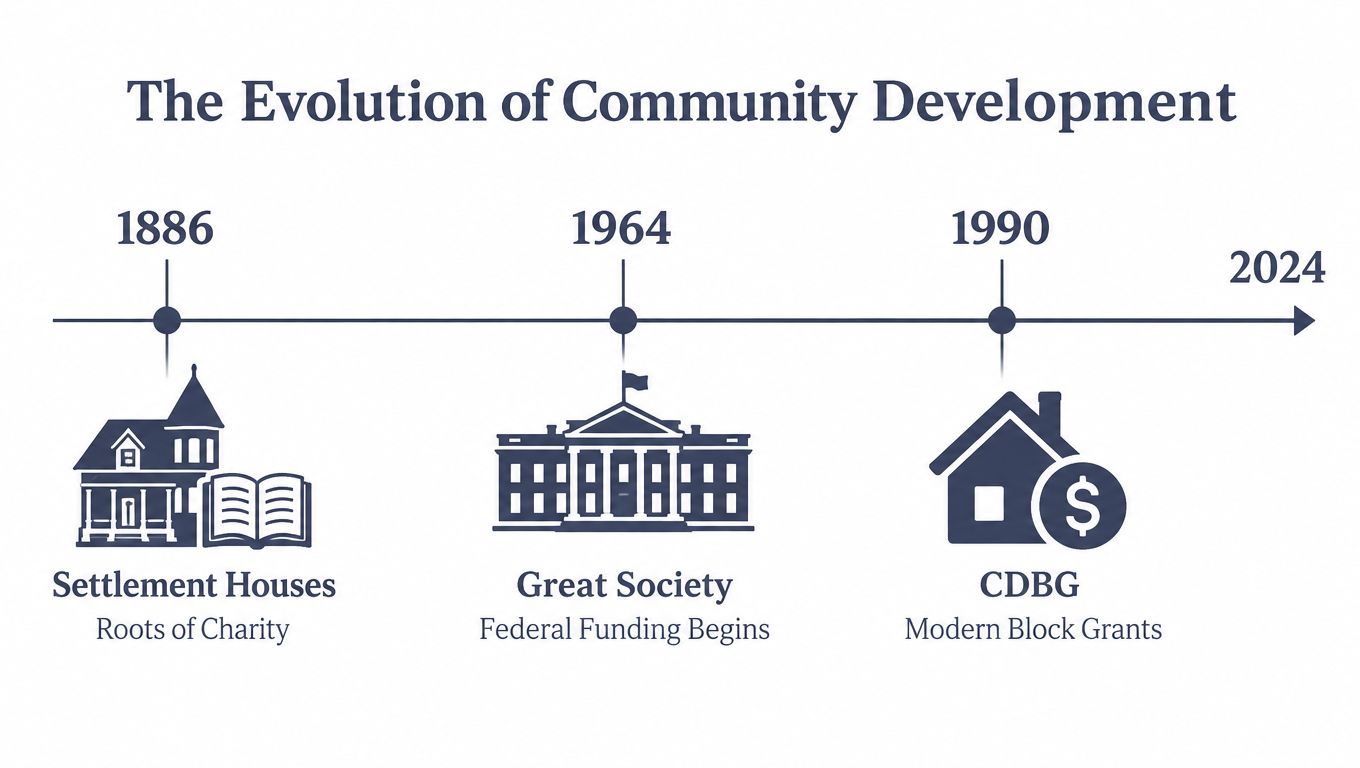
Community development programs didn't begin as a modern grant category. Their roots reach back to the late nineteenth and early twentieth centuries, when settlement house leaders in major cities organized residents and created practical neighborhood institutions. These included playgrounds, day care, literacy classes, skills training, and housing improvements for immigrant and low-income families. The approach was direct: identify a local problem, bring people and resources together, and build a service that residents could use.
That history matters because it places participation before process. Early settlement houses were not merely distributing aid from a distance. They were creating relationships, learning what families needed, and building institutions that connected social support with education, work, health, and housing. Modern community development programs still face the same basic challenge, even though the funding structures are more formal.
From fragmented support to place-based finance
A major U.S. milestone came in 1974, when the Housing and Community Development Act consolidated funding tied to eight separate programs into the Community Development Block Grant system. The result was a single annual block grant that still underpins local community development finance today, as documented in this history of the Community Development Block Grant system.
The shift changed the operating environment for local governments. Instead of managing several disconnected funding streams, communities received a more durable, place-based mechanism that could support housing, infrastructure, and neighborhood services. The model also introduced a continuing tension. Central authorities could provide funding and broad rules, but local governments still had to decide which needs were urgent, which projects were feasible, and who would manage them.
That tension explains why historical knowledge is useful to today's investors and entrepreneurs. A program can have a legitimate public purpose and still fail because the funding is too fragmented, the responsible organization lacks capacity, or the project doesn't match local demand.
What the history teaches practitioners
The settlement house tradition emphasized proximity and practical service. The block grant tradition added scale, administrative structure, and recurring public finance. Neither approach is sufficient on its own.
Local knowledge helps teams select interventions residents will use.
Stable funding makes planning and maintenance more realistic.
Clear authority prevents responsibility from being divided among partners.
Adaptation allows a program to respond when conditions change.
The durable lesson is simple. Community development works best when broad public resources are connected to specific local decisions. Investors should look for that connection before committing capital. Entrepreneurs should understand the rules that govern the funding environment. Philanthropists should ask whether their support strengthens the local institution responsible for carrying the work forward.
The Three Main Models and What Works
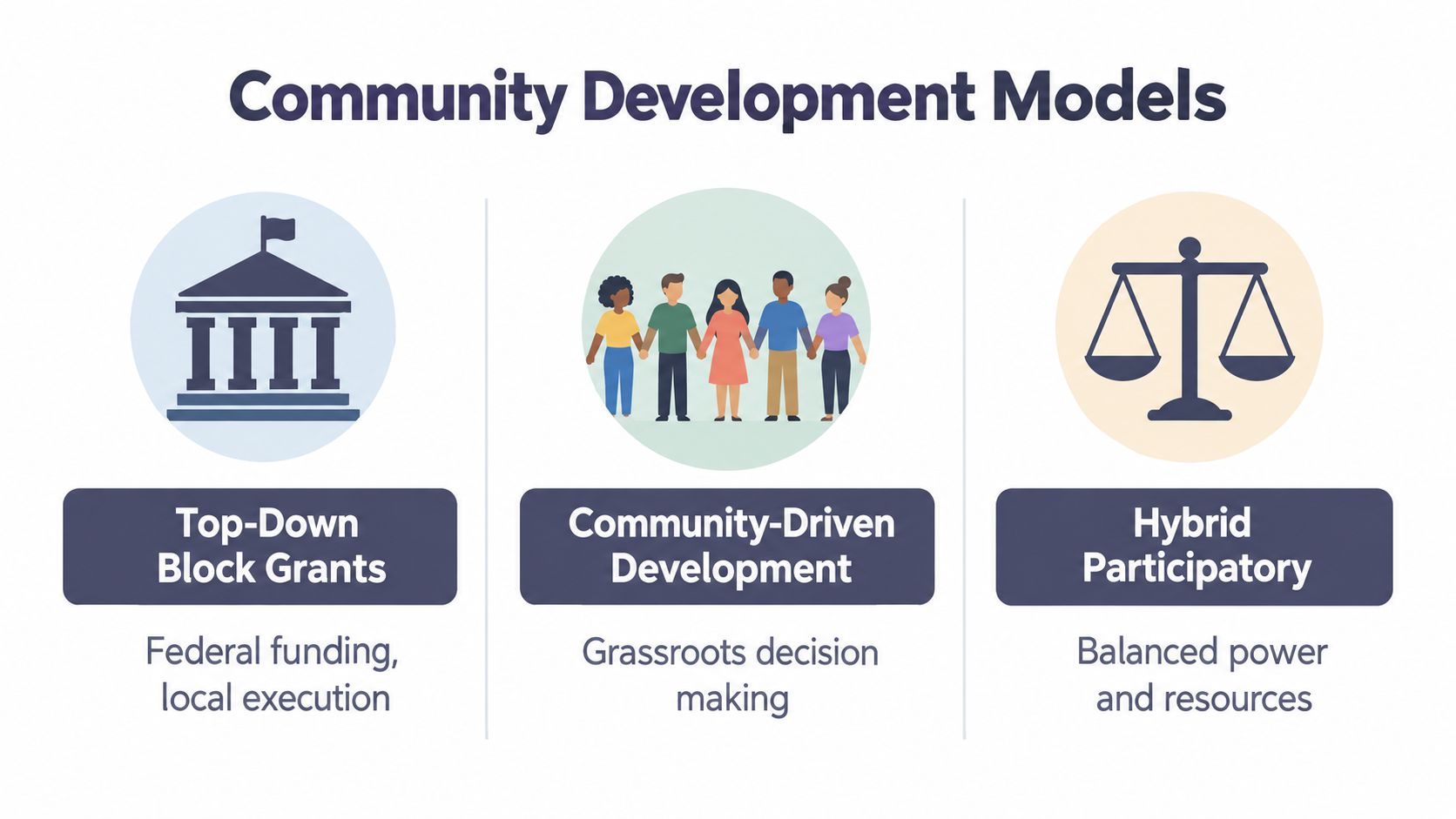
Three models appear repeatedly in community development: top-down block grants, community-driven development, and hybrid participatory approaches. They differ less in their stated values than in who controls decisions, how funds reach projects, and what success looks like.
Model | Decision pattern | Strongest use | Main risk |
|---|---|---|---|
Top-down block grants | Public authority sets eligibility and broad priorities, local actors execute | Large-scale housing, infrastructure, and coordinated services | Local priorities may be poorly matched to program design |
Community-driven development | Residents and local groups help choose and manage projects | Basic services and infrastructure in remote or fragile settings | Participation can be uneven without technical and administrative support |
Hybrid participatory approaches | Institutions share resources and decision power with residents | Complex places that need both compliance and local judgment | Shared authority can slow decisions if roles aren't defined |
Match the model to the outcome
Top-down block grants are useful when a project requires public accountability, formal procurement, or coordination across a large service area. Their weakness appears when administrators select projects without enough resident input. A technically eligible project can still miss the problem people experience every day.
Community-driven development gives residents more influence over micro-planning and allocation. Evidence is strongest when the objective is local infrastructure and basic services, particularly in remote, fragile, or conflict-affected areas. A World Bank evidence review of community-driven development reports improvements in access to all-weather roads, clean water, sanitation, education, and health services. Its meta-analysis found statistically significant gains in household consumption and living standards in 7 of 9 projects.
Hybrid models are often the most practical choice for investors and civic partners. Residents can identify the problem and test whether a solution fits local conditions, while public agencies or experienced nonprofits handle compliance, contracting, and reporting. The arrangement is not automatically successful. It needs a written decision structure, defined escalation routes, and a budget that supports participation rather than treating it as unpaid labor.
Measure what the program actually controls
Community development teams often promise broad outcomes such as capacity building, cohesion, or governance improvement. Those goals may matter, but they're difficult to attribute to a single intervention and may take longer to appear than a completed road, functioning water system, or maintained facility.
Start with output and service-delivery measures:
Is infrastructure completed to specification?
Can residents access the service consistently?
Who maintains the asset, and with what resources?
Has service quality improved for the intended users?
Does the project remain operational after the initial implementation period?
Evidence indicates that community-driven programs produce more reliable results for infrastructure delivery and basic services than for broad social cohesion or broad agency. That doesn't make governance irrelevant. It means program managers should treat governance outcomes as hypotheses to evaluate, not benefits to assume.
Where the Money Comes From and How Partnerships Work
Community development finance comes from several layers, and each layer carries different requirements. Local governments may use block grants for eligible housing, infrastructure, or neighborhood services. Nonprofits may combine public awards with foundation grants and earned revenue. Investors may contribute property, debt, equity, technical expertise, or operating partnerships. International development institutions can finance large portfolios across multiple countries.
The global scale is substantial. As of June 2025, the World Bank supported 341 active Community and Local Development projects in 95 countries, with a total value of US$48.7 billion, including US$40.1 billion in World Bank financing and US$8.6 billion from borrowers and donors, according to the World Bank's Community and Local Development portfolio. Those figures show that community development is not confined to small local grants. It's also a major financing channel for jobs, resilience, inclusion, and essential services.
Capital has to match capacity
The right partnership depends on what each participant can contribute and what the project actually needs.
A real estate investor may provide a site, predevelopment capital, construction knowledge, or a long-term management commitment. An entrepreneur may bring a service model, local hiring plan, or technology that makes delivery more accessible. A philanthropic funder may cover planning, early staffing, resident engagement, or evaluation before larger capital becomes available.
A practical partnership review should answer five questions:
Who controls the funds?
Who signs contracts and carries legal responsibility?
Who owns the asset or program after completion?
What happens when grant funding ends?
Which partner has authority to change course?
Avoid partnerships built around a vague promise to “work together.” Assign deliverables, reporting duties, approval rights, and maintenance responsibilities before money moves.
Fragmentation is an operating problem
Funding can be available and still fail to meet local need when several small programs use different eligibility rules, deadlines, reporting systems, and geographic boundaries. That fragmentation creates administrative costs and pushes organizations to chase awards instead of building a coherent local strategy.
A philanthropist can help by funding coordination rather than another disconnected activity. An investor can ask whether the project complements existing public work or duplicates it. An entrepreneur should determine whether the business can survive without a grant, even if the grant helps with launch costs.
For a broader perspective on aligning purpose with commercial decision-making, see Richard Maize's analysis of philanthropy in modern business strategy. The useful principle is not that every investment must become charitable. It's that capital performs better when the partner understands the community, the obligations, and the route to lasting operation.
Building Programs That Deliver Measurable Results
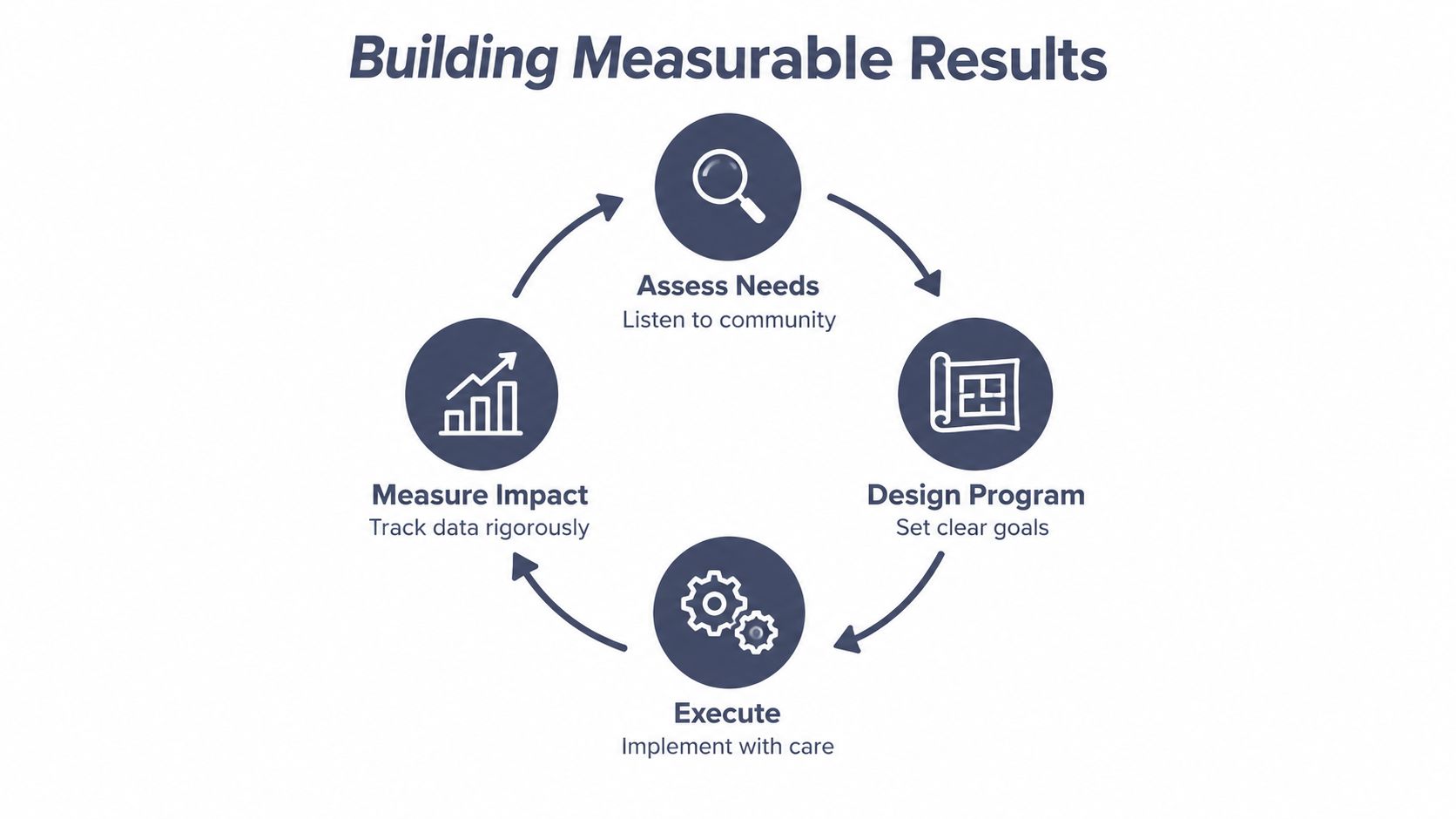
A program should begin with a local need, not with a preferred funding category. Before selecting a site or announcing a partnership, speak with residents, service providers, property owners, and the agency responsible for approvals. Compare what each group reports with available administrative data and direct observation. A needs assessment should identify both the problem and the conditions that could prevent a solution from working.
Four steps from need to evidence
Assess needs. Define the service gap in operational terms. “The neighborhood needs investment” is too broad. “Residents lack dependable access to clean water” or “a facility cannot remain open because maintenance responsibility is unclear” gives the team something to solve.
Design the program. Set a small number of measurable objectives. For infrastructure, track completion, condition, usage, maintenance response, and service quality. For education or workforce initiatives, define participation, completion, placement, or continued engagement without assuming that attendance alone proves impact.
Execute with discipline. Assign one accountable operator. Create a schedule for procurement, permits, inspections, resident communication, and reporting. Build contingencies into the budget and document who can authorize changes.
Measure and adjust. Review results at agreed intervals. Separate outputs, such as a completed facility, from outcomes, such as reliable access or improved service. If the program misses its target, change the design rather than hiding the variance.
Measurement principle: Count what residents can use, not only what the project team can announce.
Evidence syntheses indicate that community development programs produce more dependable effects in infrastructure stock, maintenance, and service quality than in broad governance outcomes. Community-built infrastructure can also persist better than top-down projects, as described in this evidence synthesis on community-driven development outcomes.
Regulatory checkpoints protect the mission
A strong social objective doesn't exempt a project from zoning, building, accessibility, environmental, procurement, labor, or grant-reporting requirements. Confirm the approval path before public commitments are made. Review land control, permitted use, utility capacity, construction standards, insurance, contractor qualifications, and the reporting terms attached to each funding source.
For investors and entrepreneurs, compliance is part of feasibility, not paperwork added at the end. For philanthropists, due diligence should include financial controls, board oversight, safeguarding policies, and the organization's ability to manage restricted funds.
A useful implementation framework can support that work, while Richard Maize's guide to building sustainable impact through community-driven real estate projects offers a relevant lens for connecting property decisions with community outcomes.
The final test is durability. Who pays for maintenance, who receives complaints, and who can repair the program when circumstances change? If those answers aren't clear, the project isn't ready for launch.
Los Angeles in Action and Local Lessons
Los Angeles makes the trade-offs visible. The city's communities differ sharply in housing conditions, transportation access, business patterns, cultural institutions, and exposure to environmental pressures. A program that works in one neighborhood may be poorly suited to another, even when both qualify under the same funding category.
That's why local relationships matter. Richard Maize is described as a Los Angeles-based investor, entrepreneur, and philanthropist who co-leads the Rochelle and Richard Maize Foundation with his wife. The foundation identifies cultural and arts programs, health initiatives, environmental stewardship, youth development, education, and mentoring among its focus areas, as outlined in the Rochelle and Richard Maize Foundation's overview.
Philanthropy with an institutional view
The foundation has operated since 2003 and supports education, mentorship, healthcare, youth development, family services, social welfare, and the arts, according to this profile of the Maize Foundation's community work. Its stated support includes organizations such as the American Cancer Society, Los Angeles Police Foundation, Vista Del Mar Child and Family Services, Children's Hospital Los Angeles, and Cedars-Sinai Board of Governors.
The lesson for local funders isn't to copy a list of beneficiaries. It's to build a portfolio that reflects how community needs overlap. Youth development can connect to education and mentoring. Health initiatives can connect to family services. Arts and cultural programs can create places where residents build relationships and young people develop confidence.
For an investor, that portfolio perspective helps prevent a narrow focus on a single building or transaction. For an entrepreneur, it highlights the value of partnerships with institutions that already understand local trust and service delivery. For a philanthropist, it raises a practical question: does the grant support direct service, organizational capacity, or both?
Resident participation needs structure
Participatory budgeting is another local-government signal. Recent reporting cited in the Urban Institute's federal place-based programs analysis says similar models were adopted by over 50 municipalities in 2025, compared with 30 in 2023. The numbers indicate growing interest, but participation alone doesn't guarantee a useful result.
Los Angeles organizations should make participation accessible, especially for residents who work irregular hours, lack reliable internet access, or need language and childcare support. They should also publish how proposals are screened, how budgets are constrained, and what happens after residents select a priority.
Richard Maize's community work offers one example of combining philanthropy with broader engagement, as discussed in how Richard Maize gives back to the Los Angeles community. The transferable lesson is practical: fund relationships and operating capacity, not only visible projects.
Your Next Steps as an Investor, Entrepreneur, or Philanthropist
Investors should select a place, define the local constraint, and test whether a proposed project can operate after launch. Entrepreneurs should build around a real service gap and identify public, nonprofit, and private partners before scaling. Philanthropists should fund measurable delivery while reserving capacity for coordination, resident participation, and evaluation.
Start with one clearly defined intervention, document the baseline, confirm regulatory requirements, and assign maintenance responsibility. Community development programs create durable value when every partner knows what success means and who remains accountable when the opening ceremony is over.
Richard Maize offers a practical perspective on the connection between real estate, entrepreneurship, investment, and purpose-driven giving. Visit Richard Maize to explore his portfolio insights, community impact, philanthropic work, and potential starting points for building a more durable local initiative.
Comments