Customer Value Proposition: Build One That Converts

Most customer value propositions fail for a simple reason: they sound polished but don't help a buyer decide. They describe the seller's ambition, list attractive features, or promise broad transformation without showing what changes for a specific customer and how the business will deliver it.
A useful customer value proposition is more demanding. It identifies the customer, names the trade-off that customer faces, defines the outcome worth paying for, and supplies enough proof to make the promise credible. In real estate, food service, events, partnerships, and philanthropy, the same discipline applies. Buyers, tenants, sponsors, guests, and donors all want to know what they'll receive, what risk is reduced, and whether the operator can follow through.
What a Customer Value Proposition Actually Does
The popular advice says a customer value proposition should be short, memorable, and benefit-led. That's incomplete. A short sentence can still convert poorly if it says nothing specific about the buyer's situation.
A customer value proposition performs a commercial job. It connects a defined customer need with a particular outcome and explains why this business can deliver that outcome better, more reliably, or with less friction than the available alternatives. Academic scholarship traces the formal marketing and strategy concept to the 1980s, with Michael Lanning and colleagues at McKinsey commonly credited with introducing the term in a 1988 staff paper. Later work further formalized the idea in Lanning's 1998 book, Delivering Customer Value (academic review of customer value propositions).
That history matters because the concept moved firms away from product-first language. The customer value proposition starts with the customer's perspective, even though businesses still disagree about one universal definition. The practical agreement is stronger: the proposition must show how distinct capabilities match the needs of a target segment.
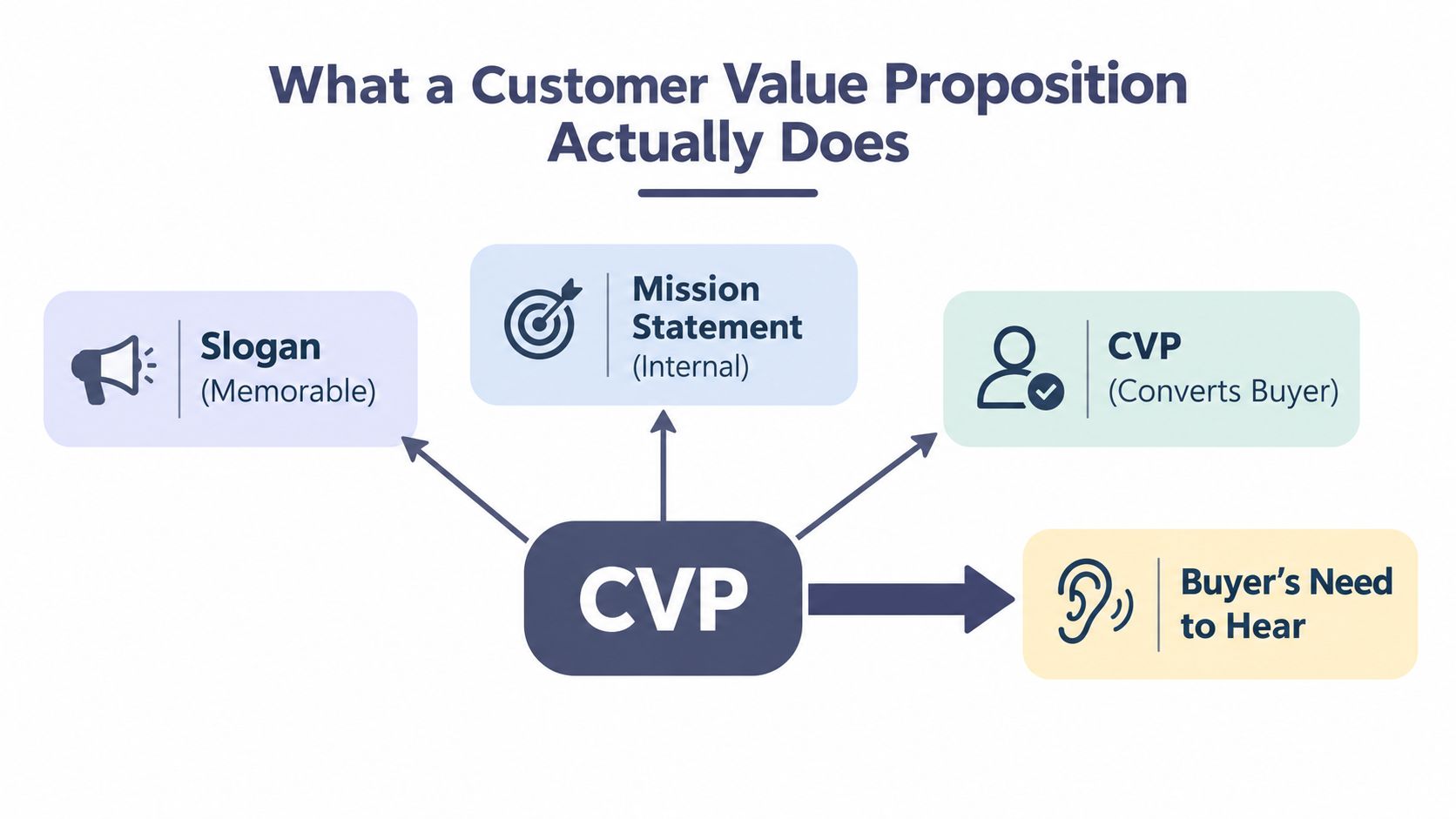
What it isn't
A slogan creates recall. A mission statement guides the organization internally. A customer value proposition helps a buyer evaluate a choice.
That difference changes the writing. “We bring people together” might fit a mission. “We provide a reliable community experience for families, sponsors, and local vendors” starts to identify an offer, an audience, and a reason to participate. The second statement still needs proof, but it gives the operator something concrete to deliver.
A strong proposition also acts as a pre-qualification filter. It tells poor-fit customers to keep looking and gives the right customers a reason to continue. That may reduce broad appeal, but broad appeal isn't the same as commercial strength. If the proposition tries to serve every tenant, investor, guest, or sponsor, it usually becomes too vague for anyone to believe.
Practical rule: If a buyer can't repeat the promise in plain language, the proposition isn't finished.
The Core Components That Make a CVP Work
A lease package offers a useful analogy. A serious landlord doesn't present a property with a single attractive sentence. The package identifies the tenant, describes the premises, explains the operating terms, establishes the economics, and supplies evidence that the arrangement can work. A credible customer value proposition needs the same completeness.
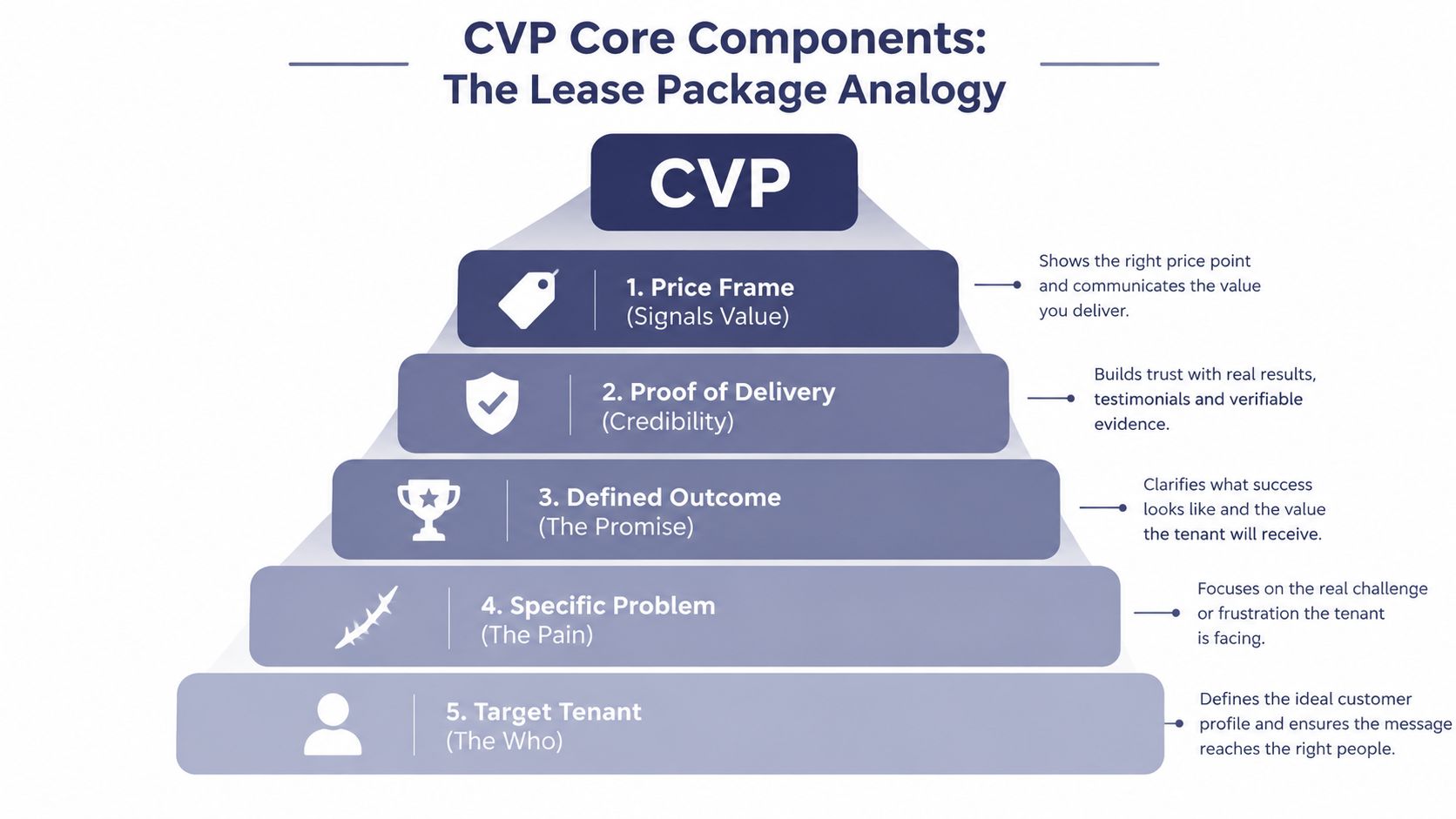
Start with the target tenant
Define the person or organization you're serving. In a property context, that might be a small landlord seeking dependable management, an investor assessing a multifamily acquisition, or a resident looking for a particular living arrangement. In a food business, it might be an event organizer who needs an appealing service that can work in a busy venue.
A target customer isn't just a demographic label. It includes the customer's decision authority, operating conditions, constraints, and use case. A proposition aimed at a sponsor shouldn't sound like one aimed at a festival attendee.
Name the specific problem
The problem must be serious enough to influence a decision. “People want better service” is weak. “Small landlords need responsive management that protects cash flow and reduces avoidable operational surprises” gives the operator a usable direction.
Customer value research in business markets emphasizes that buyers respond to measurable outcomes and to the few attributes that matter most, rather than to an undifferentiated list of benefits (Harvard Business Review framework for business-market value propositions). The problem statement therefore has to reflect the customer's priorities, not the seller's internal vocabulary.
Define the outcome
State what improves after the purchase, lease, booking, or partnership. The outcome may involve more reliable operations, a clearer transaction, a stronger experience, or reduced uncertainty. Don't confuse the outcome with the feature. A food truck is an asset. A convenient, satisfying event meal is the customer-facing result.
Provide proof of delivery
Proof turns a claim into a commercial argument. It can include observed buying behavior, renewals, expansions, price acceptance, testimonials, operating records, or a transparent description of what the team does. Business-market research stresses that differentiated value is strongest when it is supported by commercial evidence rather than copy alone (proof of value proposition in commercial data).
Frame the price
Price signals positioning. A premium frame requires proof of quality, reliability, durability, trust, or experience. A value frame requires operational efficiency and clear limits. If your price appears detached from the outcome and proof, buyers hear aspiration instead of value.
These parts interlock. A vague target creates a vague problem. A vague problem produces a generic outcome. An unproven outcome makes the price difficult to defend. Write the copy only after all five pieces can stand on their own.
A Practical Framework for Building Your CVP
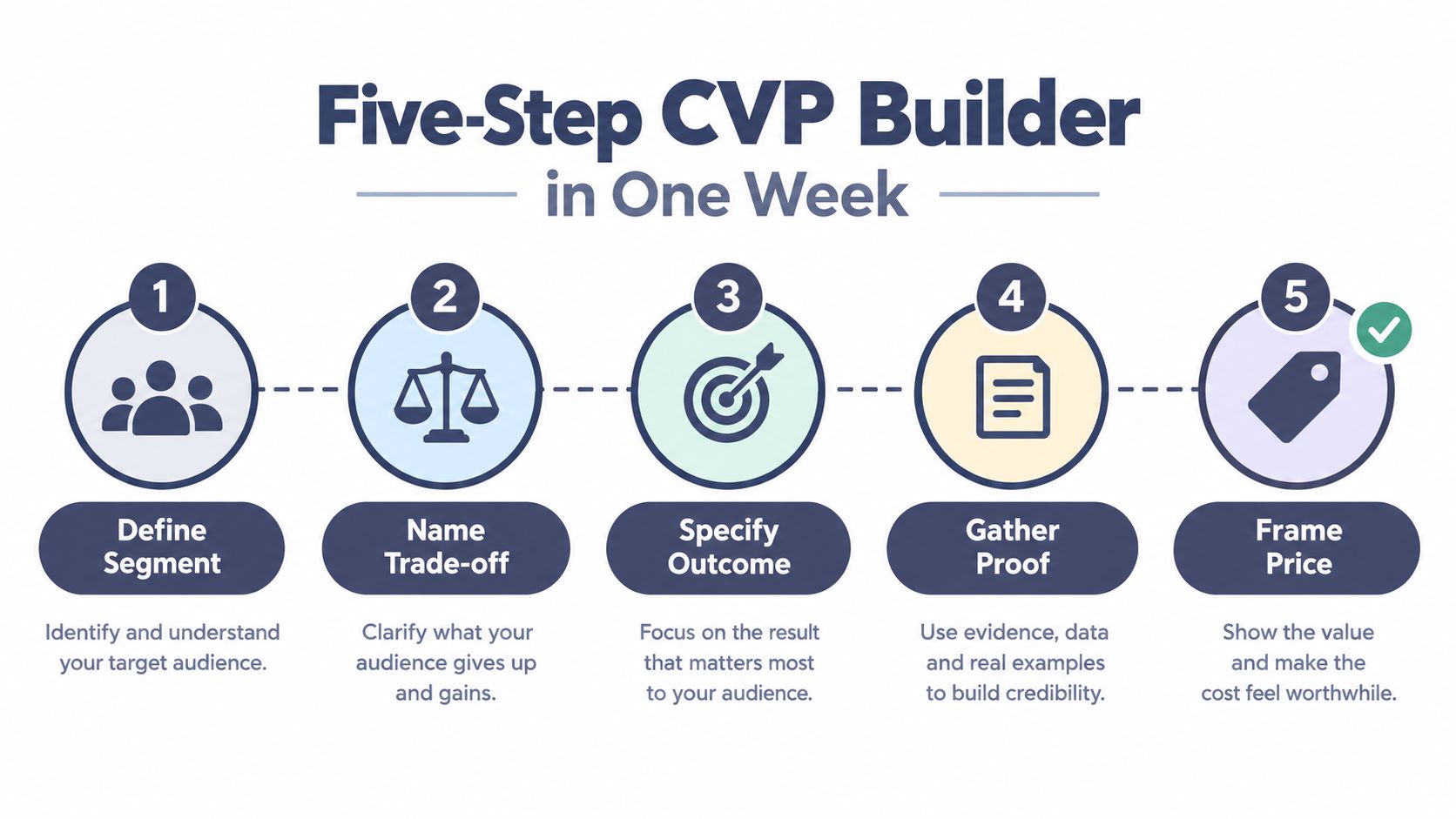
Treat the customer value proposition as a working sequence, not a brainstorming exercise. Each step should produce an artifact that another person can inspect.
Define the segment
Choose one buyer group first. Write down who makes the decision, what situation triggers the search, and what alternatives are already available. Don't combine investors, tenants, sponsors, and consumers just because they encounter the same brand.
The output is a one-page buyer profile. Keep it practical. Include the job the buyer needs done, the risk they want to avoid, and the evidence they need before committing.
Name the trade-off
Every purchase involves a trade. A buyer gives up money, time, flexibility, attention, or an existing alternative in exchange for a gain. Your job is to identify the uncomfortable choice the customer is already making.
A small landlord might trade higher management fees for responsiveness and control. An event organizer might trade menu flexibility for dependable service and easier guest coordination. If you can't identify the trade-off, you're probably still describing the offer from the seller's perspective.
Specify the outcome
Write the result as an observable change. Avoid inflated language such as “revolutionize” or “achieve limitless growth.” A defined outcome might be a smoother acquisition process, clearer transaction expectations, a more enjoyable event meal, or stronger alignment between a sponsor and a community audience.
Gather proof
Build a proof log before writing the headline. Record what the operation has delivered, which customers accepted the offer, what they repeated, and where the service held up under pressure.
For pricing and feature decisions, structured research methods such as conjoint analysis, Van Westendorp pricing, and feature-level simulations can test willingness to pay and acceptable price bands across segments (research on operationalizing customer value propositions). Those tools don't replace customer conversations or operating evidence, but they can expose assumptions before you invest heavily in the wrong position.
Pressure-test the price frame
Compare the offer with substitutes, not just direct competitors. A property may compete with another building, but it may also compete with self-management, delaying an acquisition, or investing capital elsewhere. A food service brand may compete with another vendor, home preparation, or guests going without.
The common failure point is writing elegant copy before proof exists. Stop at that point. Rewrite the promise to match what the operation can repeat, then collect evidence through real transactions and customer feedback.
How Real Operators Put the CVP to Work
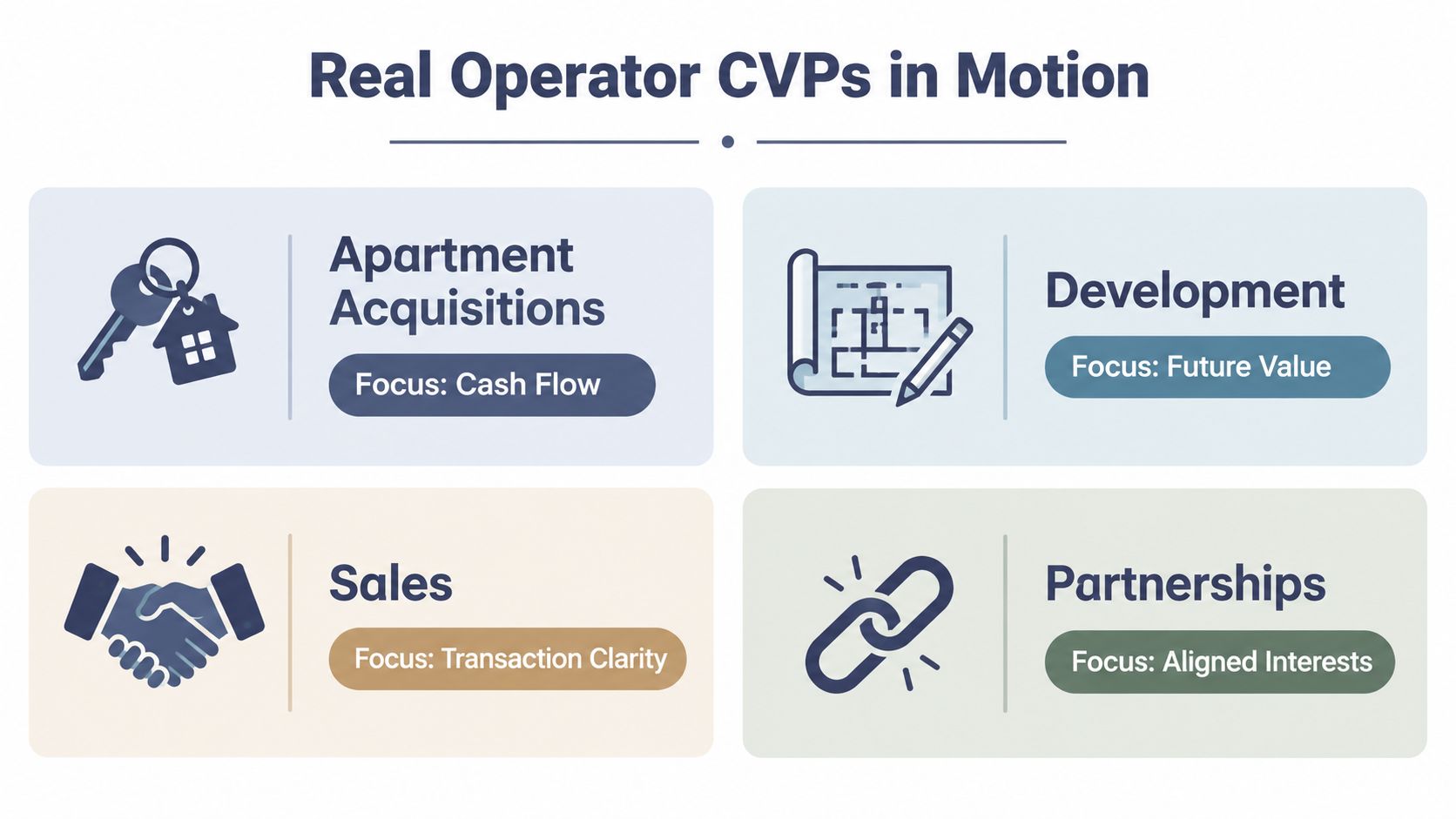
The fastest way to understand a customer value proposition is to watch it operate across different businesses. Richard Maize's portfolio provides useful examples because the buyers and desired outcomes change from one venture to the next.
Apartment acquisitions
Maize is described as a Los Angeles-based real estate investor and entrepreneur with more than 30 years of experience in real estate and finance, and his site identifies him as based in Beverly Hills, California (Richard Maize FAQ). Multiple sources state that he had accumulated about 1,000 apartment units before age 30, while one account says he began purchasing apartment units while attending California State University, Northridge (Richard Maize real estate profile).
The useful lesson isn't the unit count as a slogan. The proposition for a small landlord or acquisition partner would need to center on what the relationship delivers, such as attention to cash flow reliability, management responsiveness, disciplined evaluation, or clearer execution. The heavy-lifting component is proof of delivery. Experience only matters when it translates into decisions, operating systems, and follow-through that the buyer can recognize.
Richeeze Melts Food Truck
Richeeze Melts works from a narrower promise. The appeal is indulgent comfort food, a focused menu, and an event-friendly experience that can be understood quickly. The proposition has to appear in the menu design, truck presentation, service pace, and event partnerships. If the food, pricing, and guest experience don't reinforce the same expectation, the brand promise breaks at the point of purchase.
Here, defined outcome does the most work. Guests aren't buying a list of ingredients. They're buying a satisfying moment that fits the setting and the occasion.
POPPOP FEST
POPPOP FEST operates at the level of shared community experience rather than a single transaction. Attendees want an enjoyable event, vendors need a workable platform, and sponsors need alignment with the audience and purpose. One broad message can't satisfy all three groups, so the core proposition must remain consistent while the proof changes for each stakeholder.
Aligned interests become the differentiator. Sponsors, vendors, and attendees should understand what they contribute and what they receive. The messaging fails when the event promises community but gives each participant an unrelated commercial story.
A broader view of entrepreneurial execution appears in Richard Maize's analysis of scaling a business.
This video offers another way to see the operator lens applied across ventures:
Foundation and advisory work
The Rochelle and Richard Maize Foundation is described as supporting education, mentorship, healthcare, youth development, family services, social welfare, and the arts. Sources say Maize co-leads the foundation with his wife Rochelle, and one profile says it has operated since 2003, supporting efforts that include feeding and housing people experiencing homelessness and assisting students (Rochelle and Richard Maize Foundation profile).
In philanthropic and advisory work, the proposition is reputation-based. Consistency, discretion, and follow-through carry more weight than a clever statement. Donors, partners, and organizations need confidence that the stated purpose will be respected after the introduction, not merely repeated during outreach.
Template Language for Pitches, Listings, and Brand Pages
A template helps only if it preserves the buyer's decision logic. Use this five-line structure, then replace every bracket with language your buyer already understands:
Audience cue: “For [specific buyer] who needs [specific job done]...”
Core promise: “We provide [offer] so you can [defined outcome].”
Proof line: “That promise is supported by [verifiable operating evidence].”
Differentiation line: “Unlike [substitute], we [specific execution difference].”
Call to action: “Review [next decision step] to determine whether it fits.”
For an investor pitch
“For multifamily investors seeking disciplined acquisition decisions, we evaluate [property type] around [cash flow or operating priority]. The opportunity includes [verifiable property facts]. Unlike a broad market pitch, the case is built around [specific advantage]. Review the assumptions and determine whether the asset fits your criteria.”
The proof line should contain actual records, assumptions, or documents. Don't substitute adjectives for diligence. A pitch deck should make the investor's next question easier to answer, not bury it under brand language. For more guidance on investor presentation structure, see this investor pitch deck breakdown.
For a property listing
“For [named renter or buyer] seeking [specific living or investment outcome], [property] offers [defined benefit] through [relevant feature or operating choice]. The property includes [renovation scope, rent comparisons, or neighborhood demand evidence]. Compared with [relevant substitute], it provides [clear distinction]. Schedule [tour, underwriting review, or conversation].”
Don't claim strong demand without supporting neighborhood information. Don't call a renovation “high-end” unless the materials, workmanship, and comparison set justify that description.
For a brand page
“For [customer group] who wants [occasion or outcome], [brand] delivers [specific experience] through [how the operation works]. Customers can verify the promise through [menu anchors, service process, testimonials, or operating record]. Choose [brand] for [specific reason], then [book, visit, or inquire].”
For cold outreach, lead with the buyer's situation and keep the proof concise. For a warm investor update, lead with what changed, what evidence supports it, and what decision you need. Trim repetition, not the proposition. If a sentence doesn't identify the buyer, outcome, proof, distinction, or next step, question whether it belongs.
Measuring Whether the CVP Is Converting
Attention isn't proof. A page view, impression, or enthusiastic internal reaction may indicate exposure, but it doesn't establish that buyers believe the proposition or act on it.
Commercial evidence sits further down the path. In business markets, useful signals include win-loss outcomes, price premiums, renewals, and expansion rates, because these behaviors show whether buyers convert perceived value into willingness to pay (commercial proof of differentiated value). For other ventures, use the closest equivalent behavior: qualified inquiries, serious property responses, completed bookings, repeat purchases, sponsor renewals, or post-sale feedback tied directly to the original promise.
Tag the claim before launch
Create a simple claim register. For every landing page, listing, pitch, sales conversation, and onboarding touchpoint, record which part of the proposition it reinforces. Then connect that claim to the downstream action you expect.
A property listing may emphasize transaction clarity, so track whether inquiries contain relevant financial questions and move toward substantive review. A food brand may emphasize an event-friendly experience, so track booking quality and repeat requests rather than social engagement alone.
Metric Category | What It Tracks | Why It Matters | Weak Signal |
|---|---|---|---|
Lead quality | Fit between inquiries and the named segment | Shows whether the proposition is filtering demand | Raw inquiry volume |
Response behavior | Whether prospects take the requested next step | Tests clarity and relevance | Impressions alone |
Conversion movement | Progress from inquiry to decision | Connects the promise to commercial action | General engagement |
Repeat behavior | Renewals, repeat purchases, or expansions | Indicates realized value after delivery | One-time interest |
Experience evidence | Satisfaction linked to the promised outcome | Tests whether delivery matches messaging | Unrelated praise |
Diagnose belief failure
If buyers hear the proposition but don't act, check three areas. The proof may be too weak, the operation may deliver inconsistently, or the advertised segment may not match the people responding. Price can also expose the problem. Structured willingness-to-pay methods, including conjoint analysis and Van Westendorp pricing, help test how attributes affect purchase probability and acceptable price ranges across segments (customer value proposition quantification research).
Review the evidence on a regular operating cadence, and revisit the proposition when the same objection appears across qualified conversations, when repeat behavior weakens, or when customers describe the delivered experience differently from the advertised promise. Rewrite the proposition when the mismatch is structural. Tweak wording only when the underlying offer is already sound and the evidence shows confusion rather than disbelief.
Common Mistakes That Weaken a CVP
Weak propositions usually fail in one of three ways. The operator promises an outcome the operation can't reproduce, publishes copy without proof, or targets a segment whose priorities don't fit the offer.
Over-promising
Broad claims create a delivery obligation. If the team can't maintain the service, quality, speed, or attention implied by the language, the proposition creates dissatisfaction before the customer has a chance to appreciate the offer.
Narrow the promise to what the operation can repeat. A property operator shouldn't promise perfect management. A food brand shouldn't imply unlimited customization if the menu and service model depend on focus. A sponsor partnership shouldn't promise universal reach when its strength is local community alignment.
Copy without proof
A sentence such as “we deliver exceptional results” asks the buyer to do all the believing. Attach a verifiable signal instead: an operating record, a documented process, an actual unit history, a customer testimonial, or a clear description of what happens after purchase.
The evidence must support the exact claim. Don't use experience in one category as automatic proof of performance in another.
Poor segment fit
A proposition can be clear and still attract the wrong people. Test it with one specific buyer before broad distribution. Ask what they think the offer does, what they believe they would receive, and what makes them hesitate.
Operator's correction: When a CVP underperforms, inspect the promise, proof, and audience fit before increasing the marketing budget.
The underlying entrepreneurial discipline is discussed in Richard Maize's perspective on the mindset of a successful entrepreneur. Effort isn't usually the missing ingredient. The gap is more often a promise the team can't substantiate, evidence the buyer can't verify, or an audience that doesn't value the outcome enough to act.
A Short Operator's Checklist You Can Use Today
Use this checklist in one working session, then revisit it as the business changes.
Write for one named buyer. A specific audience forces useful choices and prevents a general statement from becoming empty.
Lead with the outcome. Buyers need to know what improves before they care about the feature or process behind it.
Attach one proof point. One relevant, verifiable signal is more useful than a paragraph of unsupported superlatives.
Test the line with a real prospect. Ask the prospect to explain what they think you're offering. Their interpretation exposes unclear language quickly.
Measure behavior, not vanity metrics. Track qualified responses, decisions, repeat behavior, renewals, and satisfaction connected to the promise.
Review the proposition quarterly. Customer priorities, substitutes, pricing, and delivery capacity change. The CVP should reflect the business that exists, not the one you intended to build.
A customer value proposition is therefore a recurring operating discipline. The wording matters, but delivery matters more. Buyers remember whether the property process was clear, the event experience worked, the meal met expectations, or the partnership honored its commitments. Durable value comes from that record, not from the polish of the sentence describing it.
Richard Maize offers practical perspectives on real estate investing, entrepreneurship, business ventures, and purpose-driven community work. Visit Richard Maize to explore his portfolio, articles, media, and opportunities to connect around creating and delivering real customer value.
Comments