Risk Assessment Framework Explained with Real Examples

You're looking at a deal that feels promising. The rent roll looks stable, the neighborhood seems to be improving, or the owner of a small business says demand is strong and growth is right around the corner. On paper, everything appears workable.
Then the surprises show up.
A property has deferred maintenance that didn't make it into the seller's glossy package. A tenant concentration issue turns one vacancy into a cash flow problem. A small business depends too heavily on one supplier, one manager, or one marketing channel. None of these problems are exotic. They're ordinary. That's exactly why they're expensive.
Investors rarely lose sleep over obvious risk. They lose sleep over the risk they didn't slow down enough to see.
That's where a risk assessment framework earns its keep. It's not paperwork for the sake of paperwork. It's a disciplined way to pressure-test a decision before the market, a contractor, a regulator, or a customer does it for you. In plain terms, it's a safety net for judgment.
Richard Maize's career offers a useful lens here. He's described as a real estate investor, entrepreneur, and philanthropist with more than 30 years of experience in real estate and finance, based in Beverly Hills, California, according to Richard Maize's FAQ page. That kind of longevity usually doesn't come from guessing right every time. It comes from building habits that reduce avoidable mistakes.
A strong framework won't remove uncertainty. Nothing will. What it does is make uncertainty visible, comparable, and manageable. It gives you a repeatable process for asking better questions, weighing trade-offs, and deciding where to be cautious, where to negotiate, and where to walk away.
Introduction Why Every Investment Needs a Safety Net
A good deal can make you impatient. That's often the first risk.
In real estate, the pressure usually sounds familiar. Another buyer is circling. The broker says interest is high. The numbers look acceptable at a glance, so it's tempting to move from excitement to action without pausing long enough to test assumptions. Small business investing creates the same trap. The owner tells a strong story, and the story starts doing too much of the work.
Why enthusiasm creates blind spots
Most losses don't begin with recklessness. They begin with confidence that hasn't been examined.
Consider two investors looking at the same mixed-use property. One studies rent trends, lease rollover timing, local rules, repair history, and liquidity if the hold period changes. The other focuses mostly on purchase price and projected upside. Both may call that “due diligence,” but only one is using a real framework.
Practical rule: If a deal only works when nothing goes wrong, the risk assessment is incomplete.
That's the difference between a checklist and a safety net. A checklist reminds you to look. A framework helps you judge what matters, what interacts with what, and what deserves a response before money is committed.
What experienced investors know
Seasoned investors tend to sound less dramatic than new ones. That's not because they see fewer risks. It's because they've learned that boring fundamentals protect wealth.
A roof problem, zoning issue, weak operator, poor lease structure, or fragile vendor relationship doesn't become dangerous because it's complicated. It becomes dangerous because no one put it in context early enough. A formal process forces that context. It turns scattered concerns into a decision record.
Here's the practical value of that approach:
It slows rushed decisions: You stop reacting to deal momentum and start judging the actual exposure.
It exposes hidden dependencies: A good framework shows how one weakness can trigger another.
It improves conversations: Partners, lenders, and managers can debate facts, not gut feelings.
It supports consistency: You evaluate your tenth deal with the same discipline as your first.
A risk assessment framework is useful precisely because it's repeatable. You don't need a dramatic market event to justify one. You need one because ordinary deals contain ordinary hazards, and ordinary hazards are where many avoidable losses begin.
What a Risk Assessment Framework Really Is
A risk assessment framework is the structure you use to identify what could go wrong, judge how much it matters, decide what to do about it, and keep watching after the decision is made. It's less like a note on your desk and more like the blueprint behind a building.
If a simple checklist says, “inspect the property,” a framework asks wider questions. What are you inspecting for. How serious is each issue. Which problem affects financing, operations, legal exposure, or exit options. Who owns the response. When will it be reviewed again.
Blueprint versus to-do list
That distinction matters because investors often confuse activity with discipline. Looking at several risks is not the same as managing them in a coherent way.
A checklist is helpful for memory. A framework is helpful for judgment.
A framework gives risk a home inside decision-making. It keeps risk from becoming an afterthought once enthusiasm takes over.
With a true framework, the same core process can work across property investing, operating businesses, vendor decisions, financing plans, and even new ventures. The categories change, but the discipline stays the same.
Why the concept became formal
Modern risk frameworks didn't appear by accident. They became more standardized over time.
ISO 31000, one of the best-known global risk management frameworks, was first published on 13 November 2009 and updated in February 2018. The 2018 edition reduced the guiding principles from 11 to 8 and placed stronger emphasis on integration with governance and leadership. It was confirmed again in 2023, which means ISO 31000:2018 remains the current valid version for at least another five years, as summarized in the ISO 31000 overview.
A related milestone came when NIST published SP 800-30 Rev. 1 in September 2012, replacing the earlier 2002 version. ISO also expanded the toolkit with IEC 31010:2019, a standard focused on risk assessment techniques, noted on the ISO project page for IEC 31010.
Those dates matter because they show a shift. Risk assessment moved from being a loose management habit to a more codified process that organizations can repeat, document, and improve.
The plain-language definition
If you want a simple working definition, use this:
Working definition: A risk assessment framework is a repeatable method for finding risks, judging them, prioritizing them, responding to them, and reviewing them over time.
That's why it beats an informal list. The framework doesn't just ask, “Did we think about risk?” It asks, “Did we evaluate the right risks, in the right order, with an actual response plan?”
Core Components That Make the Framework Work
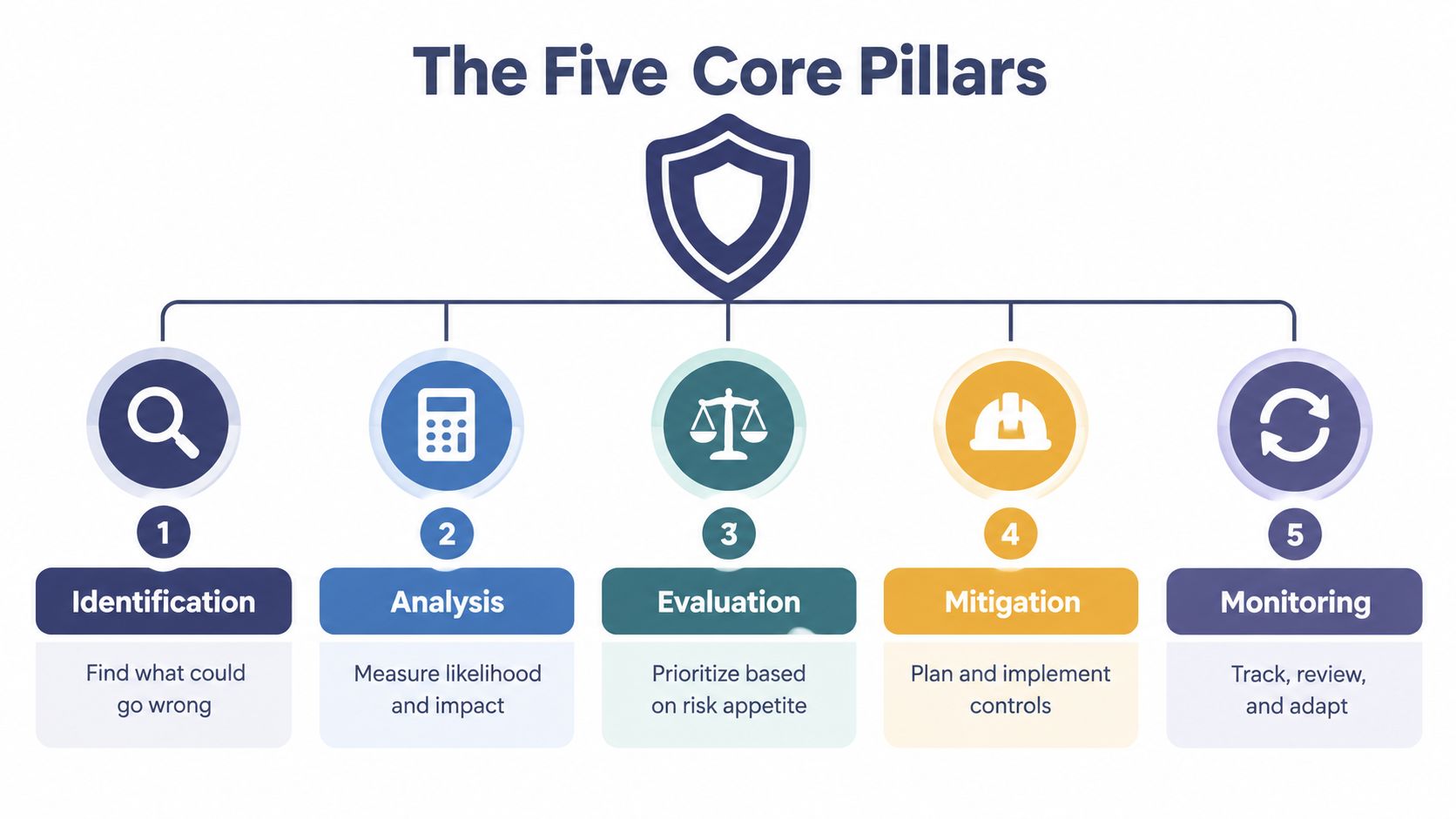
The framework becomes useful when you break it into working parts. Everyone understands the idea of “assessing risk,” but confusion starts when they try to turn that idea into an operating habit. The cleanest way to do that is to follow the core flow from discovery to review.
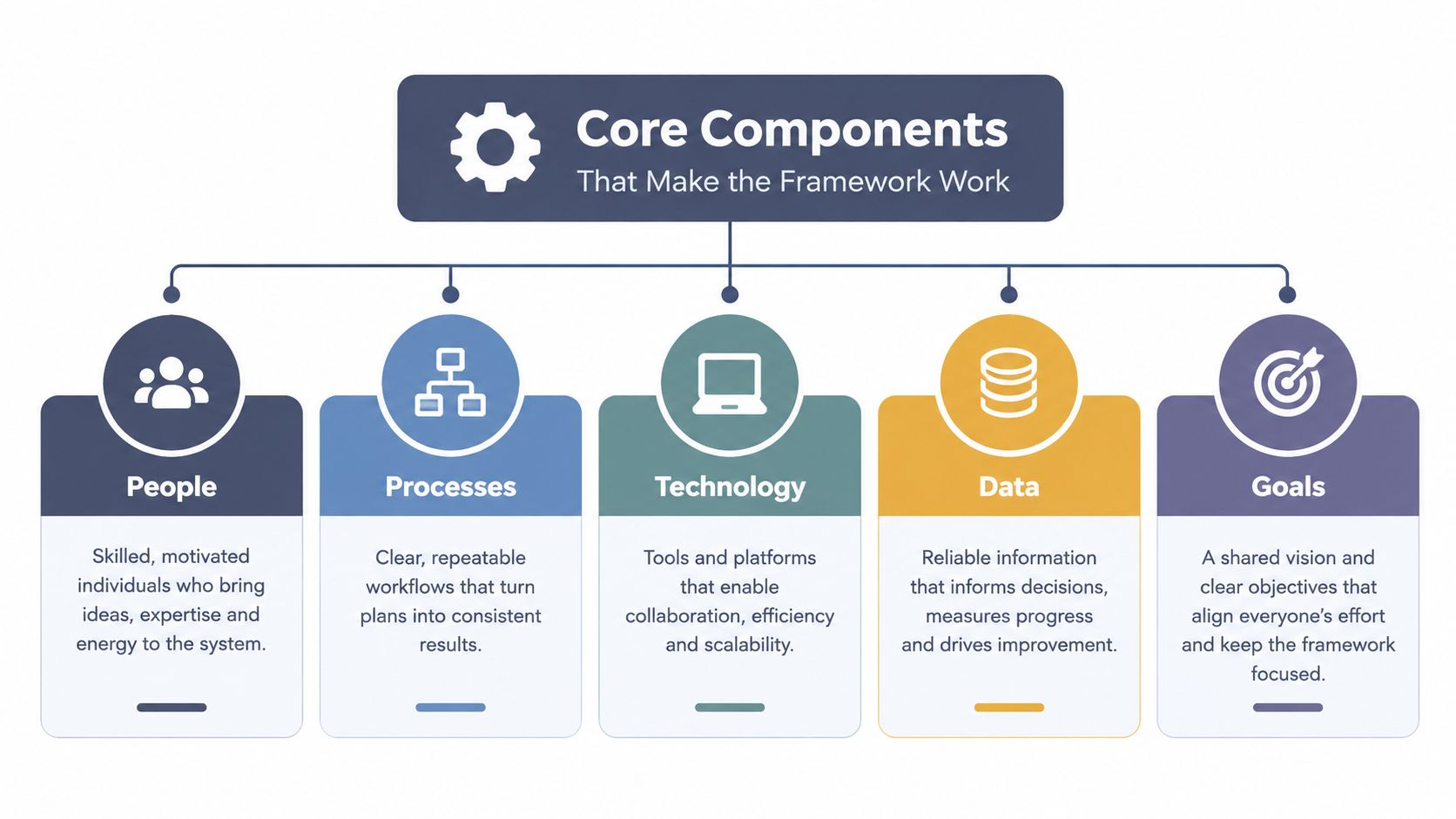
Identification
Start by naming what could go wrong. Be concrete.
In a property deal, that might include vacancy exposure, repair surprises, lease rollover concentration, insurance gaps, title issues, local rule changes, or refinancing pressure. In a small business, it could mean customer concentration, supplier fragility, weak controls, dependence on one operator, or reputation risk.
A common mistake happens here. People list only obvious, single-point risks. They miss interacting risks.
Recent policy analysis on multi-hazard governance argues that many implementation gaps now sit in data governance, fragmented coordination, and weak cascading-risk modeling. It also notes that data gaps can materially hamper quantitative risk assessment, according to this multi-hazard governance review. That matters far beyond public policy. In investing, a risk often doesn't arrive alone. A permitting delay can affect financing timing. A local infrastructure issue can affect occupancy. A weather event can expose maintenance, tenant, and liquidity problems all at once.
Analysis
Once you've listed risks, study them. Ask two questions. How likely is the problem to occur, and how hard would it hit if it does?
This step doesn't require false precision. What it does require is disciplined reasoning. Why is this risk more than theoretical. What evidence supports the concern. What assumptions make it worse or better.
Useful prompts include:
Trigger check: What event would cause this risk to become real?
Exposure check: Which part of the investment gets hit first, cash flow, value, operations, financing, or reputation?
Dependency check: Does this risk depend on another weak point already on the list?
Evaluation
Now you rank the risks against your own tolerance. Not every risk deserves the same attention.
Some are acceptable because the upside justifies them and the downside is manageable. Others belong in the “fix before closing” bucket. A few may sit in the “walk away” category.
A simple way to evaluate is to separate risks into three practical groups:
Decision Group | What It Means | Typical Response |
|---|---|---|
Accept | The risk is real but manageable | Monitor it and proceed |
Reduce | The risk is too exposed in current form | Add controls, terms, reserves, or contingencies |
Avoid | The downside is out of proportion to the reward | Decline the deal or restructure it |
Mitigation and treatment
Many frameworks fail at this point. Teams identify and rank risks, then stop.
A risk without a treatment plan is just a well-described problem.
Your treatment might be a lower purchase price, a reserve for repairs, stronger lease terms, diversification, operational controls, insurance changes, or staged capital deployment. Good mitigation is specific. It names the action, the owner, the timing, and the threshold for follow-up.
Investor's test: If you can't explain who will manage the risk after closing, you haven't really managed it.
Monitoring and review
Risk is not a one-time memo. It moves.
This is especially important because compliance-style frameworks can look polished while missing operational reality. A 2026 systematic review found sector-specific blind spots in cyber risk assessment, especially in healthcare, finance, and SMEs, and reported no major methodological breakthrough in the 2024 to 2026 update window. In related AI-focused analysis, one framework left 69.23% of identified risks unaddressed and another showed an 80.00% unresolved high-risk gap. A 2025 FCA review also found many firms still relied on generic, poorly documented, and non-quantitative assessments rather than business-specific evidence, as discussed in this review of cyber and AI risk framework limitations.
The lesson is simple. A framework must stay tied to evidence. If the facts change, the assessment changes.
How the Framework Adapts to Real Estate and Small Business Investing
An investor can review two deals on the same afternoon and need two different risk lenses. A small apartment building may look plain but hide expensive roof, plumbing, or rent-rule exposure. A neighborhood service business may show strong monthly sales while depending too heavily on one owner, one supplier, or one local reputation. The framework stays the same. The pressure points do not.
That lesson shows up clearly through Richard Maize's long career in real estate and finance, as noted earlier. After enough cycles, you stop looking for a one-size-fits-all checklist. You build a process that bends to the asset, the way a good contractor uses different tools for concrete, wood, and wiring instead of forcing one tool onto every job.
Here's a quick visual walk-through before the comparison.
Real estate focuses on asset durability and market exposure
With real estate, you usually start with the property and then widen the circle. First, ask whether the asset can keep producing income. Then test what could weaken that income over time.
A useful way to frame it is simple. Real estate risk often sits in four places at once. The building, the tenant base, the financing, and the local market.
Questions tend to sound like this:
Physical risk: What is likely to fail, age poorly, or require more capital than the seller's numbers suggest?
Income risk: How stable are the tenants, lease terms, and occupancy assumptions?
Location risk: Is the submarket gaining strength, losing demand, or shifting in a way that changes tenant appeal?
Regulatory risk: Could zoning, permitting, rent rules, or local compliance costs alter returns?
Liquidity risk: If the hold period changes, how hard will it be to refinance, carry, or sell?
That last point gets missed often. A property can look strong on paper and still become awkward if credit tightens or buyer demand cools. For a practical view of diversification and risk control across holdings, Richard Maize's guide to building a strong real estate portfolio connects portfolio structure to long-term durability.
Small business investing focuses on operating fragility
A small business asks different questions because the weak spot is often not the asset. It is the operation itself.
If real estate is often a question of asset endurance, small business investing is often a question of daily execution. Can the business still perform if one manager quits, a vendor raises prices, a bad review spreads, or customer demand softens for a quarter?
Look closely at these areas:
Cash flow risk: Are margins wide enough to absorb slower sales, wage pressure, or rising input costs?
Operational risk: Does the business depend too much on one person, one supplier, or one undocumented process?
Brand risk: Can one service failure or customer complaint reduce demand quickly?
Competitive risk: Can a nearby operator copy the model without much effort?
Execution risk: Can the team deliver the growth story used to justify the price?
Maize's cross-asset perspective helps here. In real estate, a tenant can leave and the building remains. In a small business, the wrong manager can leave and take relationships, know-how, and momentum with them. The framework has to catch that difference before capital goes out the door.
Risk assessment focus by investment type
Risk Dimension | Real Estate Application | Small Business Investing Application |
|---|---|---|
Cash flow | Rent collection, lease quality, vacancy exposure | Sales consistency, margin pressure, expense control |
Operations | Maintenance systems, vendor reliability, property management | Staff dependency, process discipline, inventory or service delivery |
Regulation | Zoning, permits, local rules, compliance obligations | Licensing, labor practices, customer-facing compliance |
Market position | Neighborhood demand, competing inventory, absorption trends | Brand strength, customer loyalty, differentiation |
Liquidity | Refinance options, hold flexibility, resale market | Exit options, buyer appeal, sustainability of earnings |
A disciplined framework does not flatten these differences. It highlights them. That is how investors avoid blind spots that look small during underwriting and become expensive after closing.
Inside a Portfolio Project How the Framework Works in Practice
Frameworks become real when you watch one guide a live decision. A representative consumer venture helps here because it shows how risk isn't only about buildings or balance sheets. It's also about execution.
Before age 30, Maize had accumulated about 1,000 apartment units, according to this Richard Maize profile. That kind of early scale suggests a habit that matters in every asset class. Don't confuse speed with haste. You can move quickly and still evaluate risk in layers.

A simple portfolio case
Take a food-truck-style consumer venture. The first version of the story sounds attractive. Lower overhead than a full restaurant. Strong visual branding. Flexible location strategy. Clear menu concept.
The risk assessment framework changes the conversation from “Do people like the idea?” to “What can interrupt the economics?”
The initial risk list might include permit delays, equipment breakdown, weak location selection, inconsistent staffing, vendor reliability, weather disruption, and uneven daily demand. None of those risks means the project is bad. They mean the project needs structure.
How the decision improves
The analysis phase compares impact across categories. A branding issue may be recoverable. A refrigeration failure during service hours may be more urgent. A poor event calendar may damage revenue consistency. Once those risks are ranked, the venture can respond with practical controls.
That can include backup vendor options, preventive maintenance schedules, location approval criteria, tighter cash handling, narrower menu complexity, and a review rhythm after launch. The point isn't to eliminate every problem. It's to prevent one ordinary problem from spreading into several.
Good investors don't just ask whether a venture can grow. They ask whether it can take a hit without losing its footing.
That same discipline is behind any strong deal review. If you want a sharper lens for spotting weak opportunities early, how to spot a bad deal before it's too late aligns closely with this framework mindset.
What the case teaches
The portfolio lesson is straightforward:
Early risk naming beats late repair: It's cheaper to identify fragility before launch than after losses start.
Controls should match the actual exposure: Don't overbuild low-priority responses and underbuild high-priority ones.
Review matters as much as setup: The first assessment is only the starting point. Operations reveal what the memo missed.
A framework doesn't make a project exciting. It makes it investable.
Your Practical Toolkit Templates and Checklists to Get Started
A small set of practical tools is often the right starting point. A workable risk assessment framework starts with three documents: a risk register, a simple scoring matrix, and a review checklist.
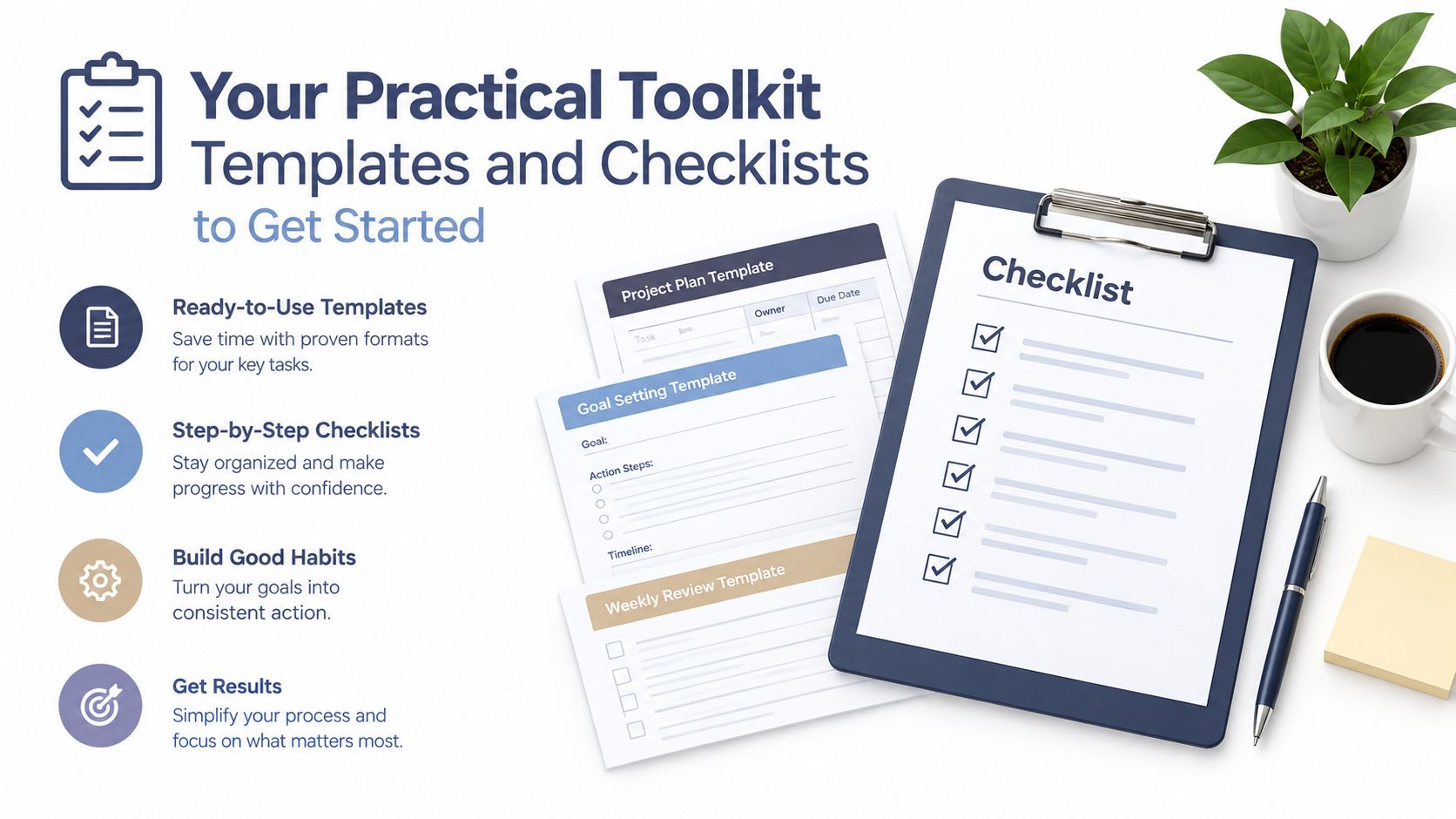
Template one for the risk register
Use a spreadsheet if that's easiest. The format matters less than consistency.
A basic risk register should include:
Risk item: Write the issue in plain language.
Why it matters: Note the likely consequence if it happens.
Current evidence: Record what you know today, not what you assume.
Priority level: Mark whether it deserves immediate action, added review, or simple monitoring.
Response plan: State the action you'll take to reduce or control the risk.
Owner: Assign one person responsibility.
Review date: Decide when the issue gets revisited.
Template two for the matrix
Keep the matrix simple. You don't need complicated math to make better decisions.
Use a grid with likelihood on one side and impact on the other. Then place each risk into one of three practical zones:
Matrix Zone | Meaning | Action |
|---|---|---|
Low | Limited concern | Track it |
Medium | Needs attention | Add controls and monitor |
High | Material threat | Act before proceeding |
The value comes from the discussion behind the placement. Why is this risk medium and not high. What evidence supports that call. What would move it into a different category.
Field note: A neat matrix can create false comfort if the underlying facts are thin.
That caution matters because many frameworks look mature on paper while failing in live conditions. As noted earlier in the article, current analysis points to gaps in data quality, coordination, and the ability to model interacting risks. A clean template helps, but only if the team updates it with real operating evidence.
For deal-specific preparation, Richard Maize's commercial real estate due diligence checklist is a practical companion because it helps convert broad caution into actual review items.
Template three for the pre-investment checklist
Before you commit capital, ask:
Have I identified the main risks, not just the obvious ones?
Which assumptions are carrying the deal?
What evidence supports those assumptions?
Which risks interact with each other?
What is my mitigation plan for the top concerns?
Who will monitor those concerns after closing or launch?
What would make me pause, renegotiate, or walk away?
If you answer those questions, your framework is already doing its job.
Building Confidence Through Smarter Risk Decisions
A risk assessment framework isn't about becoming pessimistic. It's about becoming clear-eyed.
The strongest investors don't try to predict every disruption. They build a process that catches weak assumptions early, ranks what matters, and keeps decisions tied to evidence. That's what makes the framework useful in real estate, small business investing, and any venture where one overlooked detail can change the outcome.
Three ideas are worth keeping close:
Consistency beats intensity: A steady process protects you better than occasional bursts of deep analysis.
Flexibility matters: Good frameworks adjust to the asset, the operator, and the environment.
Monitoring is part of the investment: A risk review that stops at closing isn't finished.
Confidence doesn't come from pretending a deal is safe. It comes from knowing you've looked at it from enough angles to make a disciplined choice.
Start small. Build one risk register. Use one simple matrix. Review it on a regular rhythm and update it when new facts appear. Over time, that habit becomes one of the most practical forms of downside protection an investor can own.
Richard Maize offers practical insight drawn from decades of hands-on investing across real estate, business ventures, and community-focused work. If you want more perspective on disciplined deal review, portfolio judgment, and the habits that help investors avoid costly blind spots, visit Richard Maize.
Comments