Off Market Real Estate Deals: A Practical Playbook

You've found a duplex that never appeared on the MLS. The owner is willing to talk, the price sounds attractive, and there's no competing offer pushing you higher. That combination is exactly why off-market real estate deals attract investors, and exactly why disciplined underwriting matters. Private access can solve a seller's problem, but it can also hide weak rents, title complications, unpermitted work, and a price that only looks like a bargain.
Richard Maize approaches these transactions as a Los Angeles portfolio operator, not as a collector of cold-call tricks. His own site describes more than 30 years of building and managing a substantial real estate portfolio (Richard Maize's investor profile), while a separate biography describes more than 30 years in mortgage and real estate and direct experience with financing and deal execution (Maize's professional biography). That perspective leads to a simple rule: private deal flow is a pipeline discipline, and every opportunity still has to survive rigorous underwriting.
What Off Market Real Estate Deals Actually Look Like
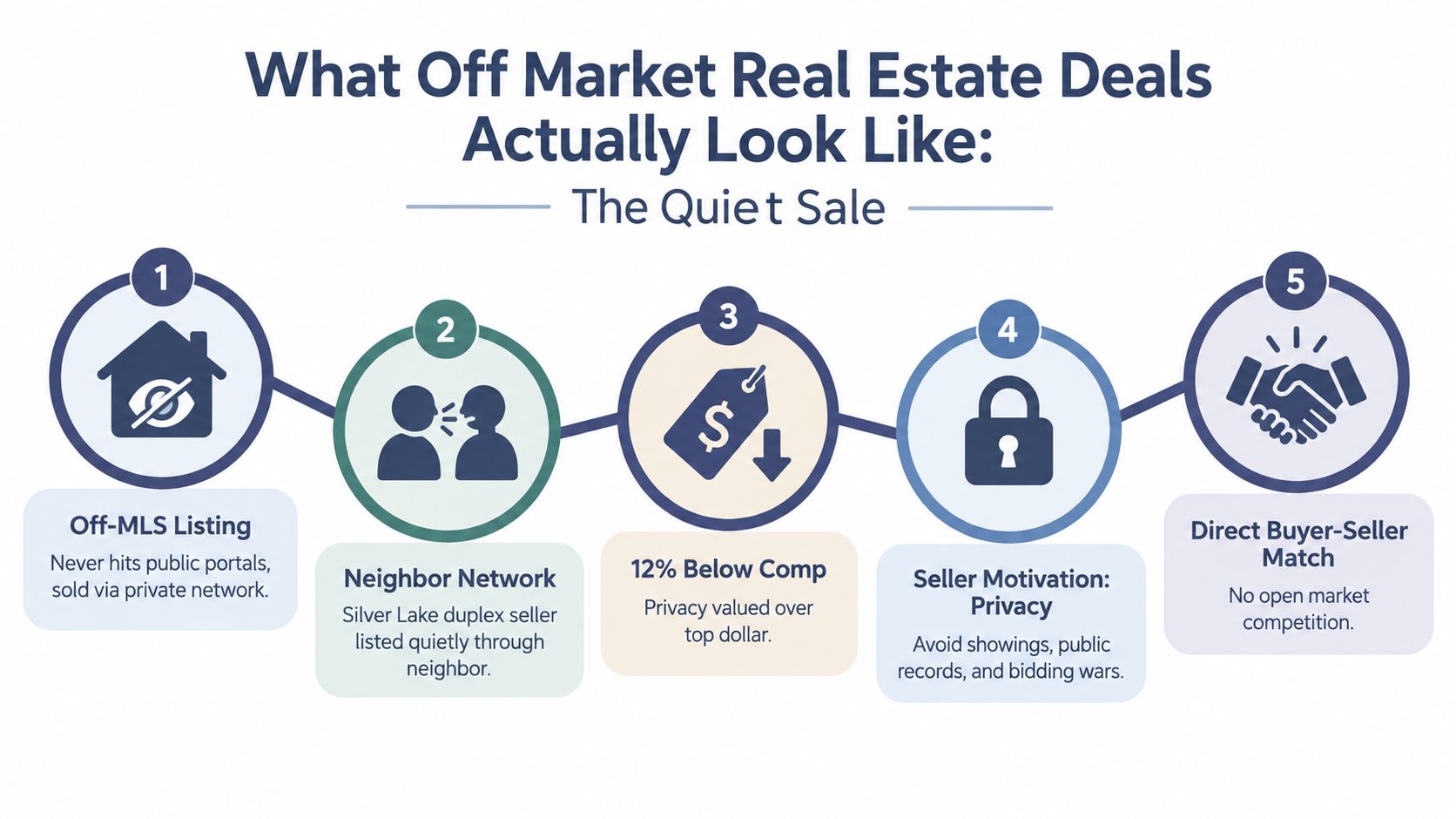
A Silver Lake duplex once reached a seller through a neighbor rather than a listing portal. The owner wanted a quiet transaction, didn't want showings, and accepted a number 12% below the last comparable sale because privacy mattered more than reaching the highest possible price. That wasn't a giveaway. The buyer solved a real problem, and the seller knowingly exchanged some price discovery for discretion.
An off-market real estate deal is a property transfer completed without public marketing through the MLS. A pocket listing is usually handled privately by an agent, while a whisper listing may circulate through a small network of buyers or brokers. A coming-soon property can be visible through a brokerage or MLS status before a full public launch, so it isn't automatically the same as a completely private sale.
The seller problem matters more than the label
The Los Angeles opportunities worth pursuing usually fall into a few recognizable categories:
Tired landlord exits: An owner has dealt with maintenance, vacancies, tenant friction, or management fatigue long enough to value certainty.
Probate and inherited houses: Heirs may prioritize a clean process, especially when several family members need to agree.
Divorce-driven sales: Privacy and a defined timeline can matter as much as the final price.
Absentee-owner mispricings: An out-of-state owner may not understand the value-add potential, deferred maintenance, or local buyer demand.
The common thread isn't ignorance. Motivated sellers often care about speed, certainty, confidentiality, or carrying-cost relief more than squeezing out the last dollar. An investor who leads with an unrealistic discount usually gets ignored because the owner can still list publicly, refinance, hold, or wait.
Off-market activity is much larger than a niche strategy. A 2024 analysis estimated about 1.2 million U.S. homes sold off-market, including 175,363 in Texas, 123,637 in Florida, and 62,923 in Georgia (RESIClub Analytics coverage). In California's higher-end market, agents estimated that about 40% of homes above $2 million traded outside the MLS, according to the same coverage. In institutional real estate, a German study reported more than €40 billion in off-market transaction volume in 2018 and estimated commercial-property volume at roughly €40 billion to €70 billion (German off-market study).
Practical rule: The discount comes from solving a seller's problem, not from locating an uninformed owner.
Where Off Market Deals Actually Come From
Reliable private deal flow in Los Angeles comes from repeated contact with people who see ownership problems before the broader market does. Volume alone isn't a strategy. I'd rank the main channels by the quality of conversations they produce, the seller's likely motivation, and the amount of cleanup required before a contract can close.
Channel | Typical Seller Motivation | Realistic Close Rate | Top Risk to Watch |
|---|---|---|---|
Direct mail to absentee and out-of-state owners | Management fatigue, vacancy, distance, deferred maintenance | Usually low from first contact, stronger after repeated permission-based follow-up | Bad skip-trace data, overbroad targeting, compliance failures |
Probate records and LA County Superior Court filings | Inherited property, family coordination, liquidation | Low until the decision-maker is identified | Stale filings, wrong heir, premature contact |
Divorce and estate attorneys | Privacy, court deadlines, asset division, orderly disposition | Referral-driven and highly variable | Contacting a represented party or misunderstanding authority |
CPA and financial-planner partnerships | Tax planning, liquidity, portfolio restructuring | Relationship-dependent, generally slower to develop | Asking for confidential client information |
Screened boutique wholesalers | Speed, assignment opportunity, distressed ownership | Variable, based on contract quality and seller access | Contract-juggling, inflated repairs, unclear assignment rights |
Coming-soon and restricted MLS channels | Seller testing demand while limiting exposure | Dependent on agent access and buyer fit | Misreading status rules or creating agency conflicts |
Agent-to-agent quiet inventory | Privacy, convenience, pre-market testing | Strongest when the buyer is credible and local | Dual-agency pitfalls and unclear representation |
For data, PropStream and DealMachine can support ownership research and targeted outreach. Reonomy is useful for commercial ownership intelligence, while county recorder portals help verify vesting, liens, and recorded transfers. None of these tools replaces a conversation with the owner or a title review.
The human network usually compounds more effectively than another software subscription. Local REI clubs, Builders Industry Association meetings, title-representative lunches, property managers, contractors, and attorneys can surface owners who will never respond to a generic campaign. The most valuable referral often arrives after you've handled a prior transaction cleanly.
Choose two channels, not seven. For a part-time investor, direct mail plus one professional referral channel is a workable combination. For a commercial buyer, Reonomy plus broker and title relationships may be more productive. Go deep enough that people learn what you buy, how quickly you can perform, and how you treat sellers.
Outreach Scripts That Open Doors Without Burning Them
Good outreach lowers uncertainty. It doesn't disguise your identity, manufacture urgency, or force a seller into a decision before they understand the conversation.
Three messages that earn a response
Direct mail to an absentee owner
Hello [Name], I'm [Name], a Los Angeles investor interested in properties near [address or neighborhood]. I'm not sure whether you're considering a sale, and there's no pressure if you're not. If the property has become difficult to manage or you'd simply like to understand your options, I'd be glad to have a brief conversation and work around your timeline. You can reach me at [number].Regards, [Name]
The opener identifies the property and location. The empathy statement gives the owner permission to say no. The question is indirect but useful because it uncovers management fatigue without assuming distress.
Cold-call voicemail
Hi [Name], this is [Name]. I'm calling about the property you own on [street]. I buy in the area and wanted to ask whether a private sale is something you'd consider, now or later. I'm not calling with a deadline or a low-pressure tactic. If you're open to a conversation, call me at [number]. Again, that's [number].
A short voicemail works better than a speech. State who you are, why you called, and one value proposition, then leave a clear callback number.
Warm text to a probate heir
Hi [Name], this is [Name. I left a brief voicemail about the [property address] property. I'm sorry your family is dealing with an estate matter. If a sale becomes part of the plan, I can discuss a private purchase and work around the estate's process. No need to respond if the timing isn't right.
The text acknowledges the situation without prying. It offers a path forward while respecting the heir's control.
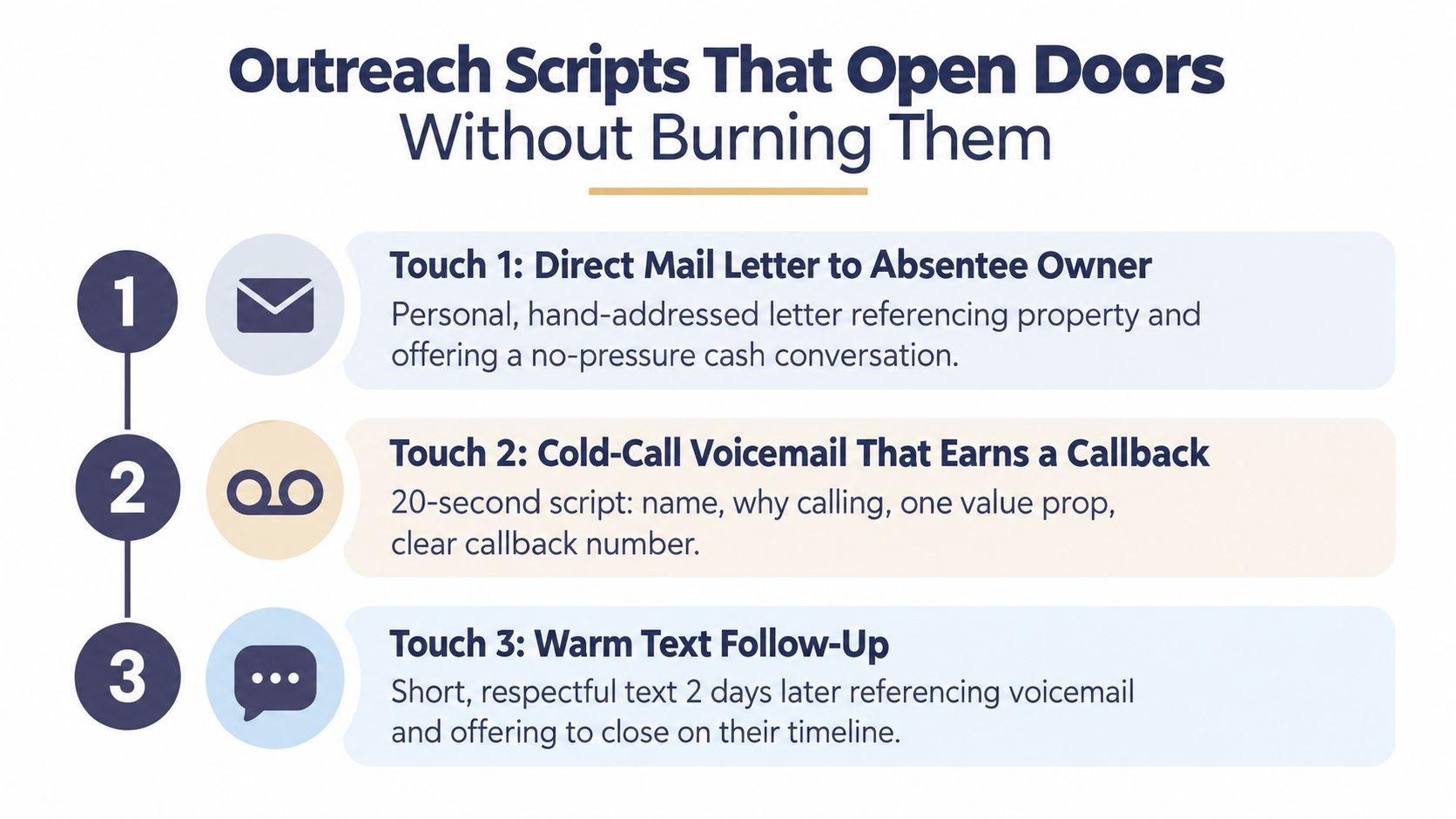
A 21-day follow-up cadence
Use one initial letter, a call or ringless voicemail after delivery, and a respectful SMS only where you have a lawful basis to contact the person. Follow up again during the second week, then send a final handwritten note around day 21. Record every contact, response, opt-out, and source in your CRM.
Don't misrepresent yourself as the buyer if you're acting as an agent. Don't create fake urgency, use TCPA-violating autodialing on cell numbers, or contact someone represented by an agent without that agent's consent. Weekly follow-up can look professional during the first month when the owner hasn't opted out. The same pattern in month nine can become harassment.
The purpose of persistence is to make a legitimate offer available, not to wear down a reluctant owner.
Underwriting an Off Market Deal the Right Way
An off-market price is not a verified discount. It's an unverified starting bid, and the property must clear the same underwriting standard as a marketed deal. Private access removes some competition, but it also removes useful public signals about pricing, condition, and buyer objections.
Four variables that break assumptions
Comps: Pull at least six closed sales within a quarter mile from the last 90 days when the submarket provides enough activity. Weight location, gross living area, condition, concessions, and seller credits. Don't use a single attractive sale to justify a price.
Rent roll reality: Verify collections through bank statements, ledgers, leases, and deposits. Pro forma rent is not income. In Los Angeles rent-stabilized units, vacancy and replacement rules can materially change the expected yield, so confirm the legal and operational path before valuing upside.
Hidden diligence drag: Order a Phase I early when the asset type warrants it, not after the LOI has created emotional commitment. Scope seismic concerns, soft-story retrofit requirements, roof and sewer conditions, and unpermitted conversions, especially in older bungalow courts and small multifamily properties.
Exit liquidity: Model resale using the comp set's gross living area and actual buyer demand. Aspirational per-unit pricing creates a paper profit that may disappear when an appraiser or lender reviews the file.
A Silver Lake duplex offered at $1.05 million appeared underpriced against the initial comp set. Further diligence identified $80,000 in seismic and unpermitted-conversion issues, which changed the projected yield by 200 basis points. The lesson isn't that every private deal contains a hidden defect. The lesson is that an apparent discount has no value until the costs, permits, rents, and exit assumptions are verified.
Diligence Line Item | Off-Market Standard | Marketed Standard |
|---|---|---|
Comparable sales | Build an independent comp set and challenge the seller's anchor | Review the listing agent's analysis and verify the strongest sales |
Income | Confirm actual collections and lease terms | Reconcile marketing materials with leases and operating records |
Physical condition | Inspect before treating the price as a bargain | Use disclosures, inspections, and known listing history as starting points |
Permits and zoning | Search records and investigate every conversion or addition | Review public records alongside the seller's disclosure package |
Environmental and seismic issues | Scope early when asset type or location warrants it | Review available reports, then order targeted follow-up |
Exit value | Use conservative, evidence-based resale assumptions | Compare current marketing data with independent valuation |
For a second pass before issuing an offer, use this guide to spotting a bad deal before it's too late. The strongest private buyers stay emotionally detached until the property earns its valuation.
Negotiation Tactics When the Other Side Has Options
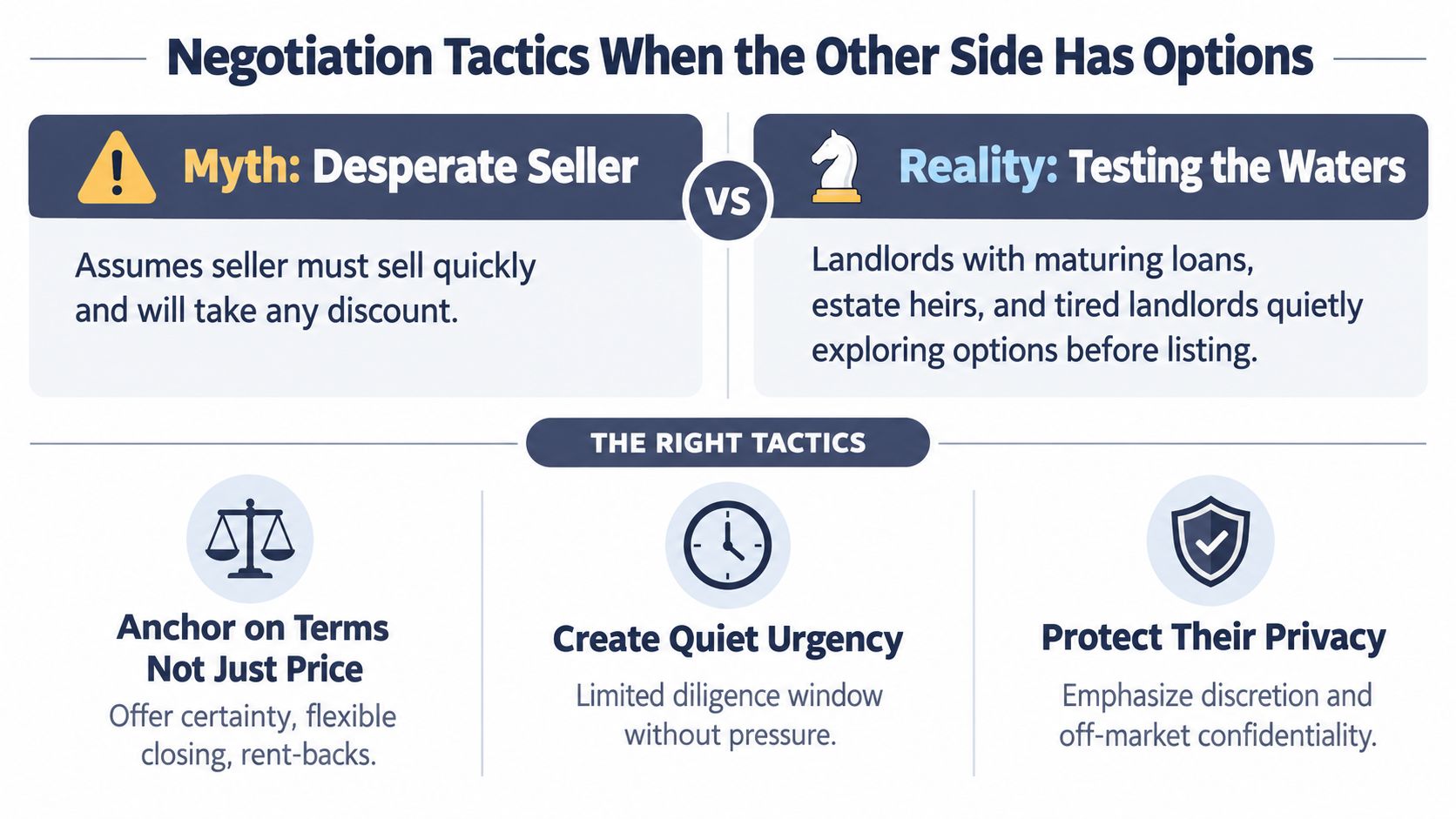
The seller who avoids the MLS isn't necessarily desperate. A landlord with a maturing loan may be testing the market. An heir may be comparing private offers before authorizing an agent. A tired owner may be willing to hold for another year if the number doesn't reflect the inconvenience being removed.
Private negotiation works when both sides exchange certainty for something measurable.
Three principles for a balanced offer
Anchor on verified comps. If the seller floats a price based on a neighbor's renovated sale, separate the renovation premium from the subject property. A clear comp schedule gives the conversation a factual center.
Trade strengths for unknowns. Suppose collections haven't been verified. You can underwrite conservatively and offer a faster close at the supported number rather than cutting the headline price. Certainty, timing, and a clean execution plan can be more persuasive than another argument over value.
Use time ethically. A defined diligence window creates structure. A fabricated competing buyer or fake deadline destroys trust and can damage your reputation with brokers, attorneys, and title professionals across Los Angeles.
A useful exchange with an estate attorney might sound like this:
Investor: “I'm not assuming the estate needs a quick sale. What decision has to happen first, and what timeline would make the process easier for the beneficiaries?”Attorney: “The siblings want clarity, but they disagree about whether to hold or sell.”Investor: “Would a private offer help them compare a defined net result, including timing and expenses, against waiting for a public listing?”Attorney: “Possibly, if the offer accounts for court and title requirements.”Investor: “Then I'll provide a supported price, proof of funds, and a diligence plan. We can identify the tax and authority questions before anyone commits.”
The investor isn't prying into family conflict. The questions uncover timeline, tax exposure, decision authority, and sibling disagreement because those facts affect execution.
The privacy premium can work for either side. A seller may accept less for discretion, while a luxury seller may demand more because access is limited. In England and Wales, TwentyEA found that 15.8% of residential sales between 2022 and 2024 were off-market, with yearly rates of 17.8% in 2022, 17.2% in 2023, and 11.4% in 2024 (TwentyEA data summary). The variation reinforces the point. Private channels don't produce one universal pricing outcome.
Closing, Diligence, and Legal Checkpoints
A private transaction still needs a normal closing process. The absence of an MLS listing doesn't eliminate title defects, disclosure obligations, lender requirements, probate authority, or escrow controls.
From signed LOI to escrow
Start with an LOI that clearly states the price, earnest-money deposit, diligence window, contingencies, closing target, and assignment rights. In Los Angeles, parties often discuss a 21 to 30-day diligence window, but the actual period belongs in the negotiated document, not in an assumption.
Move promptly to a California Residential Purchase Agreement or the appropriate CAR commercial form. Clarify whether the buyer will close all-cash, use financing, or ask the seller to carry paper. Open escrow on day one, request the preliminary title report within five business days, and review CCRs for HOA restrictions, use limits, and rent-control overlays.
Documents that protect the transaction
Inspection reports should cover the structure, roof, sewer, electrical, plumbing, and known environmental issues. Residential files also need the natural hazard disclosure and TDS, while multifamily underwriting requires lease verification, a rent-roll audit, permit history, and evidence of actual collections.
Ask directly about unpermitted work. A visual inspection can identify a converted garage or added unit, but it won't establish legality, final permits, or future enforcement exposure. Confirm seller authority through probate court orders, trust certification, corporate resolutions, or a divorce decree when applicable.
Title is not a formality. It is the transaction. If the documents don't establish who can sell, stop before money moves.
Use this commercial real estate due diligence checklist as a second review, then have California counsel and the escrow team confirm the requirements for the specific asset.
Before wiring, verify the final settlement statement, vesting, payoff figures, lender instructions, prorations, repair credits, and recording conditions. Call escrow using a trusted number, confirm wiring instructions through an independent channel, and make sure the deed and transfer documents match the approved vesting. Keep proof of funds, insurance, entity documents, and identification ready so the final days don't turn into a preventable scramble.
The strongest ethical checkpoint is simple: if title authority is unclear, don't close. Private sellers deserve a clean process, and buyers need documentation that will withstand later scrutiny.
Your 90-Day Off Market Plan and Final Answers
A part-time investor can build a credible pipeline without treating it like a second full-time job. The work needs a calendar, a focused geography, and a rule that no opportunity reaches negotiation before the data is clean.
The operating calendar
Weeks 1 and 2: Set up a CRM, choose a target neighborhood and property profile, select list sources, and vet a skip-trace vendor. Build separate fields for ownership, property condition, contact history, motivation, representation, and opt-out status.
Weeks 3 through 6: Work two sourcing channels. Reserve a short daily block for research and calls, then use one weekly block for letters, CRM cleanup, and conversations with attorneys, agents, managers, or title representatives. Consistency matters more than a burst of activity you can't maintain.
Weeks 7 through 10: Vet responses. Request leases, operating records, title information, permits, and access before you spend time negotiating a price. Underwrite every serious lead with a conservative comp set and a written list of unknowns.
Weeks 11 through 13: Submit LOIs only when the decision-maker and property facts are clear. Move accepted terms into a purchase agreement, open escrow, complete diligence, and keep a dated checklist through the wire.
Five questions that deserve direct answers
How should you evaluate a wholesaler's contract? Confirm the wholesaler has a signed, assignable agreement, authority to market the interest, a defined inspection period, and no undisclosed competing assignments. Verify the seller directly and have counsel review the documents.
What if the seller ghosts during diligence? Send one concise notice listing the missing items, the contractual deadline, and the consequence of no response. Call the escrow and title teams, document every attempt, and don't waive contingencies solely to preserve momentum.
How do you avoid probate-filing scams? Verify the case through the LA County Superior Court, identify the personal representative, compare names against title, and confirm authority with the estate attorney. Never rely on a mailing list as proof that someone can sell.
Should you disclose cash-buyer status? Yes. State whether you're buying directly, using an entity, assigning the contract, or representing another party. Transparency prevents a credibility problem when the seller reviews proof of funds or the contract structure.
What is the realistic probability of closing a first off-market deal within 90 days? No responsible practitioner can promise a probability from a general plan. It depends on the asset, decision-maker, channel, follow-up quality, financing, title, and whether the seller's motivation is real. Treat 90 days as a testing period for your process, not a guaranteed closing deadline.
Two useful actions this week are to create a focused owner list in PropStream or DealMachine and schedule a conversation with a local title representative. If private capital becomes the constraint, review this quick playbook for finding private money lenders before you make an offer that depends on uncommitted funds.
Richard Maize offers a practical real estate perspective grounded in long-term investing, portfolio management, financing, and deal execution, which can help investors think more clearly about off-market opportunities and their risks. Visit Richard Maize to explore his real estate insights, business ventures, and current resources, then use this playbook to build a cleaner pipeline and underwrite your next private deal with discipline.
Comments