Real Estate Tax Strategy: How to Keep More Profit

The biggest tax decision in real estate often isn't about a flashy deduction. It's about managing the most durable tax burden attached to the asset itself.
That sounds backward to people who were taught to think about real estate taxes only at sale time. But long-hold investors know the opposite is usually true. A sound real estate tax strategy starts with recurring exposure, then moves to depreciation, then to deferral, and only after that to optimization around the edges.
Richard Maize's career is a useful lens for this topic because he didn't build his reputation around one-off deals. Public profiles describe him as a Los Angeles and Beverly Hills real estate investor and entrepreneur with more than 30 years in mortgage and real estate, and one profile says he owned nearly 1,000 apartment units before age 30 and later owned property in 20 states (Richard Maize FAQs). That kind of scale changes how you think. You stop chasing tax tricks and start building systems that protect cash flow, preserve basis where it matters, and keep capital moving.
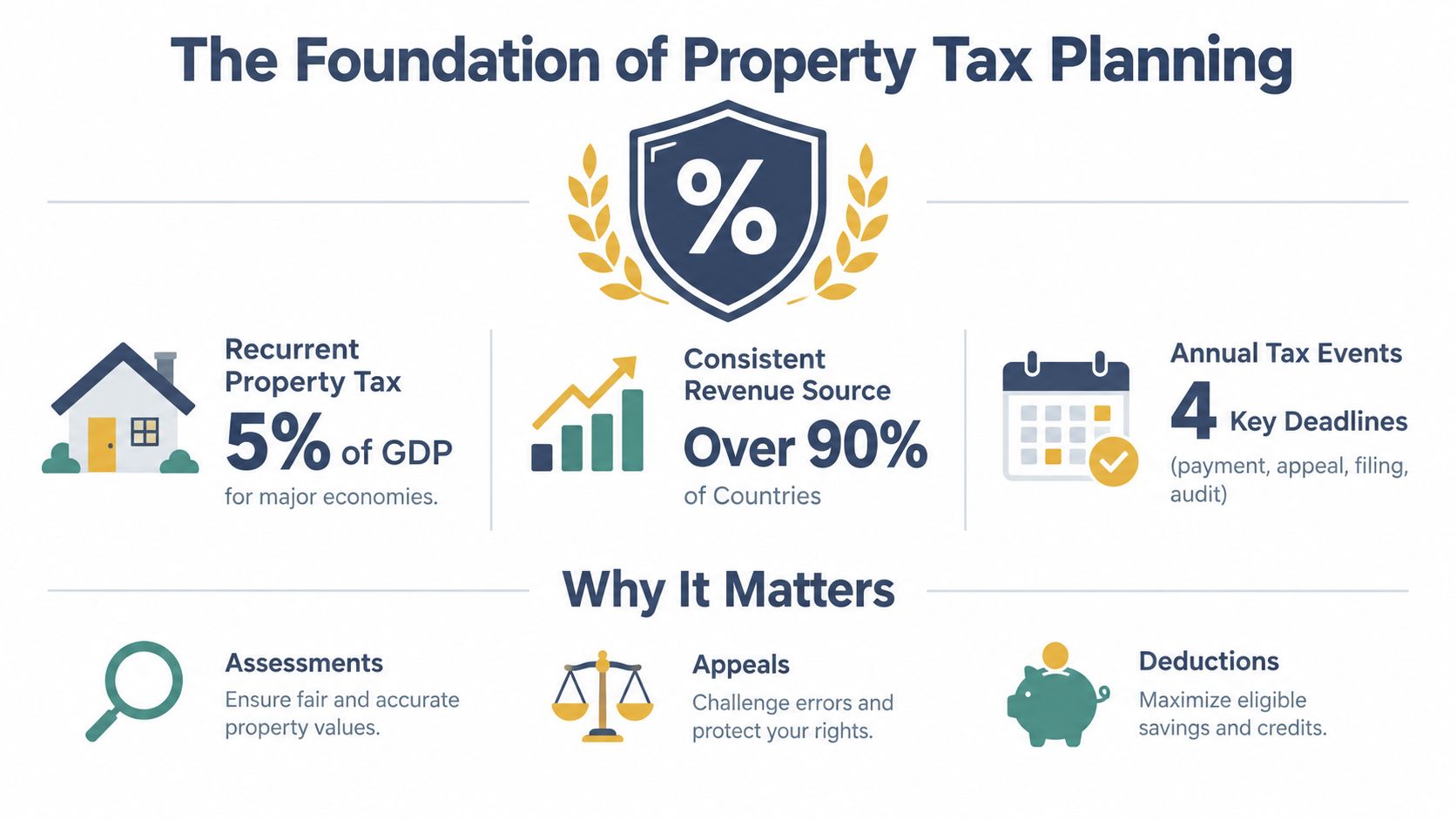
The Foundation of Property Tax Planning
Recurring property tax is often the first tax line that weakens a deal, and investors who treat it as background noise usually pay for that mistake for years.
Across OECD countries, recurrent taxes on immovable property account for about 62% of total property-tax revenues on average, while total property-tax revenues have remained roughly 1.5% to 1.9% of GDP over the past six decades (OECD housing taxation report). That kind of stability matters. It shows why disciplined investors underwrite property tax as a continuing claim on cash flow, not as a line item to revisit only at closing or sale.
Why recurring taxes deserve top billing
Property tax does not care whether the rent roll is ahead of plan, whether a unit is dark, or whether a refinance took longer than expected. The bill keeps coming. On large portfolios, that makes recurring tax one of the most reliable drags on annual return, which is exactly why it deserves more attention than many investors give it.
The practical issue is control. An owner cannot control the tax code as a whole, but an owner can control how aggressively assessments are reviewed, how purchase pricing is underwritten against future reassessment risk, and how the ownership structure supports long-term tax goals. Those decisions shape after-tax returns long before a sale creates a headline gain.
I have found that strong operators treat this as an asset-management function, not a year-end accounting exercise.
Practical rule: If recurring tax exposure is not stress-tested in underwriting, the projected return is incomplete.
What actually works
A sound property-tax process is usually simple, but it has to be consistent:
Track assessments early and continuously. Review notices, local valuation methods, comparable properties, and appeal deadlines before a problem turns into a multi-year overpayment.
Challenge bad assessments. Many owners ignore appeals because the process feels administrative. That is expensive when the assessed value no longer reflects actual income, condition, or market reality.
Choose the ownership structure with the hold strategy in mind. A property held for cash flow, a property intended for a family transfer, and a property positioned for future exchange do not belong in the same tax box by default.
Tie tax planning to financing decisions. Reserves, debt service, reassessment risk, and payment timing should be reviewed together. Richard Maize's guide to smart funding for investment properties is consistent with that approach.
Protect optionality. Good tax planning at the property level supports bigger moves later, especially when depreciation strategy, entity structure, and gain deferral come into play across a portfolio.
Weak investors treat property tax as fixed overhead. Experienced investors treat it as a controllable expense with compounding consequences. That mindset protects cash flow now and preserves more capital for the tax strategies that drive long-term wealth.
Depreciation and the Shield It Creates
Depreciation is one of the strongest wealth-protection tools in real estate because it lets owners keep more cash in the deal while the asset is still producing income. Across larger portfolios, that tax shield often matters as much as a rent increase or a small cap rate improvement. Investors who understand that tend to underwrite with more discipline, preserve liquidity, and avoid paying tax earlier than necessary.
Property tax follows the asset regardless of market optimism. Depreciation works differently. It is a federal income tax tool tied to basis, asset class, and timing. Used well, it reduces current taxable income without requiring a refinance or sale, which is why experienced owners treat it as part of acquisition planning rather than year-end cleanup.
Why the rules matter so much
Depreciation schedules shape investor behavior because timing shapes returns. The Economic Recovery Tax Act of 1981 accelerated write-offs for real estate, and the Tax Reform Act of 1986 tightened those benefits and reset how owners recovered basis over time, as described in this Freddie Mac report on tax law changes.
That shift changed more than tax filings. It changed pricing, hold periods, and acceptable debt levels. Faster recovery leaves more capital in the investor's control during the early years of a hold. Slower recovery puts more pressure on basis allocation, entity design, and exit planning.
In large portfolios, those differences compound across properties and tax years.
How to use depreciation well
The owners who get the most from depreciation usually handle four points early:
Separate land from depreciable basis. Land stays out of the calculation. The building and qualifying improvements drive the deduction.
Classify the asset correctly. Residential rentals, commercial property, site improvements, and personal-property components recover on different schedules.
Match the deduction to the taxpayer. The value of depreciation depends on whether the owner can use the loss now, carry it forward, or pair it with other income.
Plan for recapture before closing. A larger deduction today can improve after-tax cash flow, but it also reduces basis and affects the tax bill when the property is sold.
That last point gets ignored too often.
I have seen investors celebrate early tax savings, then give back flexibility later because they never modeled the exit. Good tax strategy does both. It protects current cash flow and keeps future options open.
Depreciation changes the timing of tax. That timing difference keeps more capital available for reserves, debt service, improvements, and the next acquisition.
What works
Sound operators start with the deal, then fit the tax strategy to the business plan. A stabilized apartment hold, a heavy-value-add project, and a short- to medium-term industrial hold can all produce depreciation, but the best structure depends on who owns the asset, how long they plan to hold it, and what kind of income they need to offset.
The common mistake is chasing paper losses while ignoring weak operations. A property with poor location, fragile tenancy, or thin debt coverage does not become a good investment because the depreciation schedule looks attractive. Tax benefits improve a durable asset. They do not fix a bad one.
Another avoidable mistake is waiting until after closing to involve tax counsel and the CPA. By then, key decisions may already be locked in. Purchase-price allocation, placed-in-service timing, partner economics, and entity structure can all affect how much of the shield the owner can use and when. Investors who manage sizeable portfolios know the tax strategy starts in diligence, because that is where returns are protected.
Accelerating Benefits Through Cost Segregation
Cost segregation is where a standard depreciation schedule becomes a timing strategy. Instead of treating large portions of a property as one long-life asset, the investor identifies components that can be recovered faster. That doesn't create a new deduction out of thin air. It pulls forward deductions that would otherwise arrive later.
For investors who need liquidity early in the hold, that timing difference can matter more than a modest rent bump.

Standard depreciation versus cost segregation
Approach | How it behaves | Best use case |
|---|---|---|
Standard depreciation | Spreads recovery over longer schedules tied to the building category | Investors who want simplicity and have limited need for front-loaded deductions |
Cost segregation | Reclassifies certain components into shorter-lived categories to accelerate deductions | Investors who can use early deductions and want stronger early-year cash flow |
The appeal is obvious. Flooring, lighting, landscaping, and similar components may not need to sit inside the same long recovery bucket as the building shell. When those items move into shorter categories, the tax shield arrives sooner.
Where the trade-off lives
Cost segregation isn't automatically smart. It works best when the investor can use the accelerated deductions and when the hold strategy justifies the effort, complexity, and future tracking.
Compare two owners:
Owner A holds without segregation. Taxes are smoother over time, but early-year deductions are lighter.
Owner B uses segregation and coordinates it with other planning. Early taxable income may fall more sharply, leaving more capital available for reserves, debt service, or reinvestment.
That second path can be powerful, but only if the broader tax picture supports it. If losses are trapped, the headline benefit looks better on paper than on the return.
A lot of investors also miss the connection to jurisdiction. Tax Foundation's 2026 update shows real terms capital cost recovery ranging from 100% in Estonia and Latvia to 48.4% in Chile and 49.1% in New Zealand (Tax Foundation capital allowances update). Cross-border investors can't assume that depreciation timing creates the same after-tax result everywhere.
Deferring Gains with 1031 Exchanges
A well-executed 1031 exchange preserves equity by postponing tax recognition and keeping more sale proceeds in the estate cycle.
That matters because the tax bill on sale is often larger than investors model at acquisition. The gain does not vanish. The basis carries into the replacement property, so the deferred liability stays with the new asset until a later taxable exit.
The hidden drag of a taxable sale
In a taxable U.S. disposition, straight-line depreciation is recaptured as unrecaptured Section 1250 gain and taxed at a federal rate capped at 25%. A properly executed Section 1031 exchange defers both that recapture and the capital gain by carrying the old tax basis into the replacement property (1031 exchange treatment of depreciation recapture).
On larger portfolios, that difference changes what an owner can buy next. I look at every sale through a capital preservation lens first. Gross proceeds matter less than net equity available for the next acquisition, reserve funding, debt reduction, or a better-quality asset.
A simple comparison helps:
Taxable sale: part of the equity leaves the portfolio immediately to cover capital gains tax and depreciation recapture
1031 exchange: more equity stays invested, which can support a larger replacement property or lower loan-to-value on the next deal
That retained capital compounds. Over multiple transactions, deferral often does more for long-term wealth than squeezing for an extra bit of headline appreciation on a weak hold.
Why disciplined investors use it selectively
The investors who benefit most from 1031 exchanges use them to improve the portfolio, not just postpone a tax payment. A stronger market, a property with better management economics, a cleaner tenant mix, or a better fit for the hold period are all valid reasons to exchange. Tax deferral should support the investment decision, not cover up a mediocre one.
Execution is where deals fail. Deadlines are rigid, replacement options can get thin fast, and a rushed identification usually leads to overpaying or accepting operational problems that were obvious before the clock started. I would rather pay tax on a sale than force capital into a bad replacement.
Tax law also made this tool more important. Earlier rules gave investors broader room to use real-estate losses against other income. The Tax Reform Act of 1986 narrowed that sheltering benefit, which pushed serious owners to rely more on timing, basis management, and deferral during disposition, as noted earlier in the Freddie Mac analysis.
Navigating Passive Loss Rules and Entity Choices
Most investors first meet passive loss rules when they discover that a paper loss doesn't always reduce the tax bill they expected. That lesson usually arrives after acquisition, not before. By then, the structure is already in place, the debt is signed, and the return isn't behaving the way the pro forma suggested.
That's why entity choice matters more than people think.
A common portfolio mistake
An investor buys rental property in an LLC for liability protection, assumes depreciation and other deductions will offset income broadly, then learns the loss treatment doesn't line up with the rest of the tax picture. The LLC may still be the right legal vehicle, but the investor treated formation as strategy when it was only one part of strategy.
The same problem appears with debt. Under current U.S. rules, the mortgage interest deduction generally allows deduction only up to $750,000 of mortgage debt for newer loans, while loans taken out on or before October 13, 1987 fall under a grandfather rule (Freddie Mac report on mortgage interest rules). If someone is already close to the line between itemizing and not itemizing, or if a property sits inside a broader household or investment structure, that cap changes the value of using borrowed money.
How seasoned investors think about entity selection
Richard Maize's public background helps here. Entrepreneur's author page says he accumulated 1,000 apartment units before age 30 and now owns property in 20 states (Entrepreneur profile for Richard Maize). Investors operating at that scale don't pick entities because a template said LLCs are good. They align legal structure with control, risk isolation, financing needs, recordkeeping, and tax treatment.
A practical framework looks like this:
Use entities for liability boundaries. That's the first job.
Check how income and losses flow. The legal shell and the tax result aren't always the same thing.
Model debt placement before closing. Interest treatment, ownership splits, and future refinancing all matter.
Keep state exposure in view. A structure that looks clean in one state can create friction in another.
What usually works better
The investors who keep more profit usually do two things well. They separate legal protection from tax assumptions, and they review entity structure as the portfolio changes.
An LLC formed for one duplex often isn't the ideal structure for a broader family portfolio, a multi-state hold, or a refinance-driven acquisition plan. Entity decisions should evolve with the business, not freeze at the first closing.
Insights from a Seasoned Investor
Richard Maize's record stands out because it reflects duration and repetition, not just a headline deal. A separate public profile states that before founding one of the country's largest mortgage banking companies, he had already amassed almost 1,000 apartment units at age 28, then moved into additional ventures after selling the firm (IdeaMensch profile of Richard Maize). That chronology matters because tax discipline becomes more valuable as the portfolio gets larger and the margin for avoidable error gets smaller.

Large-scale investors rarely talk about taxes as a side issue. They treat tax planning as part of capital protection. That means keeping enough liquidity to survive weak leasing periods, avoiding structures that create unnecessary friction, and favoring decisions that preserve optionality.
Why the legal structure matters
The right entity structure amplifies the value of a real estate tax strategy because it affects how assets are held, refinanced, transferred, and defended. It also determines how cleanly a portfolio can expand across markets without turning compliance into a drag on operations.
That's one reason cash flow keeps coming back into the conversation. Maize's perspective on cash flow and equity in real estate investing fits the practical reality. Tax savings are useful only if they support a property that remains financeable, resilient, and liquid enough to withstand pressure.
A short interview clip adds context to that long-view approach:
“The investors who last are usually the ones who leave themselves room to adapt.”
That's the core lesson. Good tax planning doesn't force a portfolio into brittle decisions. It creates room to hold, refinance, exchange, restructure, or wait.
Building Your Actionable Tax Plan
Most tax mistakes in real estate don't come from ignorance of one deduction. They come from failing to coordinate timing, structure, and usable losses.
A workable plan should be simple enough to run every year and detailed enough to catch real money. It should also account for the fact that tax law changes, while your portfolio keeps moving.
A practical yearly checklist
Start with the properties you already own before you chase new acquisitions. Review basis allocation, recent improvements, financing changes, and whether any asset now justifies a cost segregation study or a 1031 exchange analysis.
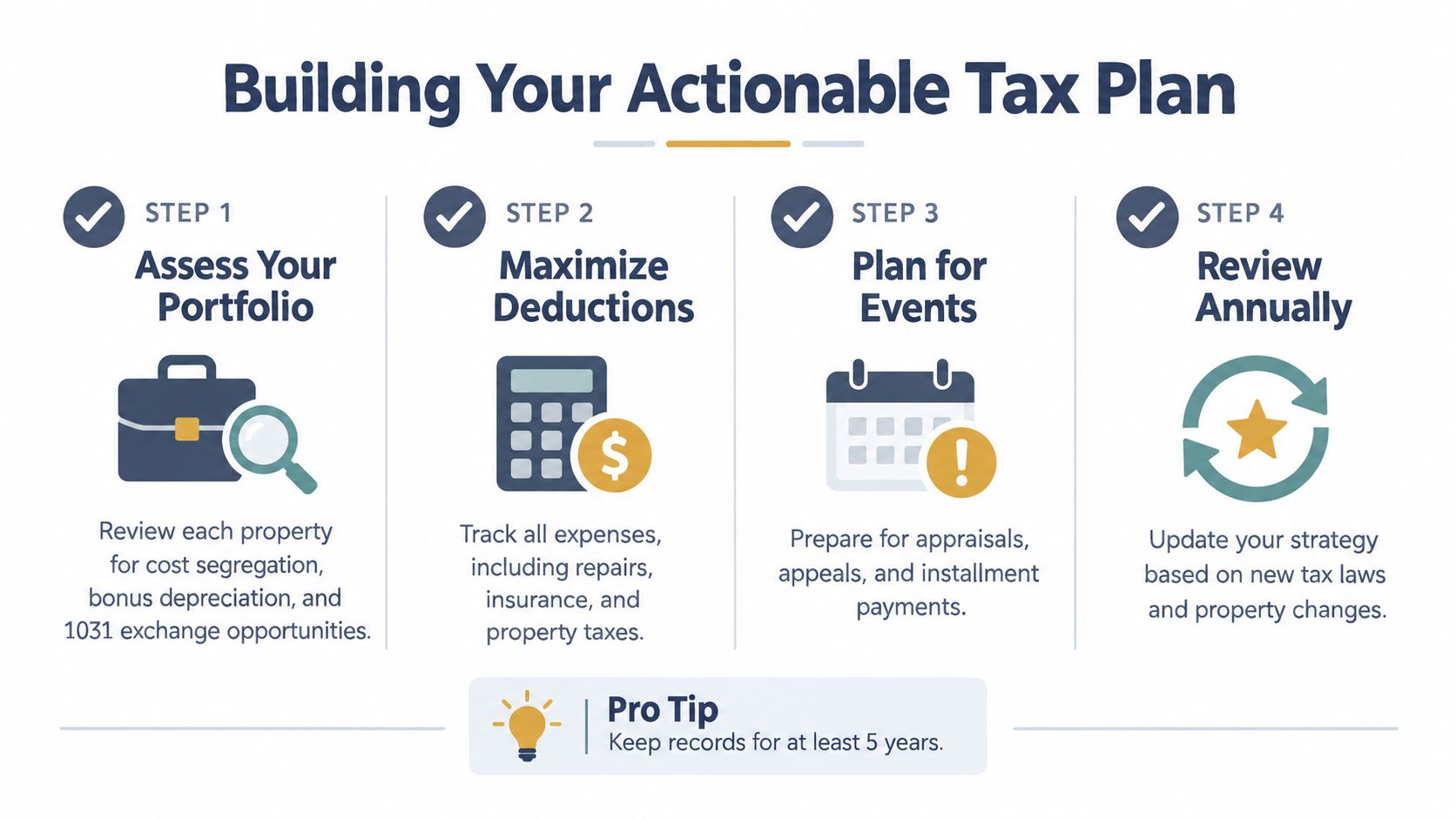
Then pressure-test these issues:
Itemization reality: The temporary SALT cap expansion is relevant, but only in context. Coverage of the change notes the cap is set to rise to $40,400 for 2026 and then is scheduled to revert to $10,000 in 2030 unless extended, and the benefit depends on the full itemization stack, including mortgage interest and charitable giving (analysis of the temporary SALT cap expansion).
Placed-in-service timing: Recent guidance highlights the permanent return of 100% bonus depreciation for qualifying property placed in service after January 19, 2025, alongside higher Section 179 limits, but those benefits only help when the losses are usable and the timing is right (real estate tax and accounting issues for 2026).
Debt modeling: That same guidance notes the permanent extension of the modified Section 163(j) EBITDA-based interest limitation, which can materially change acquisition underwriting in debt-financed deals (real estate tax and accounting issues for 2026).
What to put into motion now
A real estate tax strategy becomes useful when it turns into a repeatable operating process:
Review each property's depreciation profile and improvement history.
Match current deductions against your ability to use them.
Revisit entity structure after refinancing, expansion into a new state, or ownership changes.
Model sale scenarios before listing, especially if an exchange might preserve deployable capital.
Keep records organized enough that you can defend timing, classification, and business purpose.
If you want a plain-language resource on deductions that belongs in that annual review, Richard Maize also has a post on property investment tax deductions and ROI.
The investors who protect wealth best usually aren't the ones finding exotic loopholes. They're the ones who treat taxes as part of operations, revisit the plan before year-end, and make fewer irreversible mistakes.
Richard Maize offers a practical perspective shaped by decades in mortgage, real estate, and multi-market investing, which makes his platform useful for investors who want grounded thinking on tax efficiency, cash flow, and portfolio structure. If you want more of that long-view approach to real estate decision-making, visit Richard Maize.
Comments