Why Is Philanthropy Important for Investors

Most advice about philanthropy starts with generosity and ends with a donation receipt. That view misses the practical question investors should ask: what does the money make possible after the check is deposited? A contribution can address an urgent need, but strategic giving can also strengthen the schools, health services, local businesses, and social networks that keep a community stable.
For real estate investors, this distinction matters. Property value doesn't exist in isolation from the people, services, and institutions around it. A building may be well managed, but its long-term prospects still depend on whether families can remain secure, businesses can operate, and residents trust the neighborhood enough to invest their own time and money.
That's why the answer to why is philanthropy important extends beyond moral obligation. Giving can be a disciplined form of community investment, provided donors understand the need, select capable partners, measure meaningful outcomes, and stay engaged long enough to see whether the work lasts. Richard Maize's career across real estate, business, and philanthropy offers a useful lens for examining that approach.
Rethinking Charity as Strategic Community Investment
The traditional model treats charity as a one-way transaction. A donor writes a check, a nonprofit receives it, and the relationship ends. That model can provide immediate relief, but it often leaves the donor with little understanding of what changed and leaves the organization with funding that may be too restricted, too short-term, or disconnected from the underlying problem.
Investors think differently about capital. They ask what an asset needs to perform, which risks could impair it, and whether the plan creates durable value. Philanthropy deserves the same seriousness. A grant to a youth program, health initiative, or neighborhood service provider can support the human infrastructure that makes a community safer, more capable, and more economically active.
The World Giving Report found that in 2025, 62% of people globally said charities had a fairly or very positive impact in their local community, while people gave an average of 1% of their income to good causes, according to its 2025 donor insights. The report also identified regional variation, with Africans donating an average of 1.6% of income, compared with 0.6% in Europe. Those figures point to more than personal virtue. They show that giving represents a measurable flow of support into local institutions and community relationships.
The investor's change in mindset
Strategic philanthropy doesn't mean reducing every human need to a financial return. It means respecting the complexity of the work. Donors should listen to community leaders, understand operating constraints, and fund the capabilities that allow effective organizations to serve people consistently.
A contribution to a food program, for example, may help a family through a difficult period. Flexible support for the organization may also help it retain staff, coordinate volunteers, and respond when demand changes. The immediate service and the organizational capacity are both valuable, but they require different funding decisions.
Practical rule: Treat a charitable contribution as an investment in people and systems, not as a transaction that ends when funds leave your account.
This perspective is central to Richard Maize's view of philanthropy in modern business strategy. The strongest giving aligns resources with a clear community need while applying the discipline investors already use in business. The objective isn't publicity. It's a stronger foundation for local quality of life and long-term resilience.
The Macroeconomic Scale of Global Giving
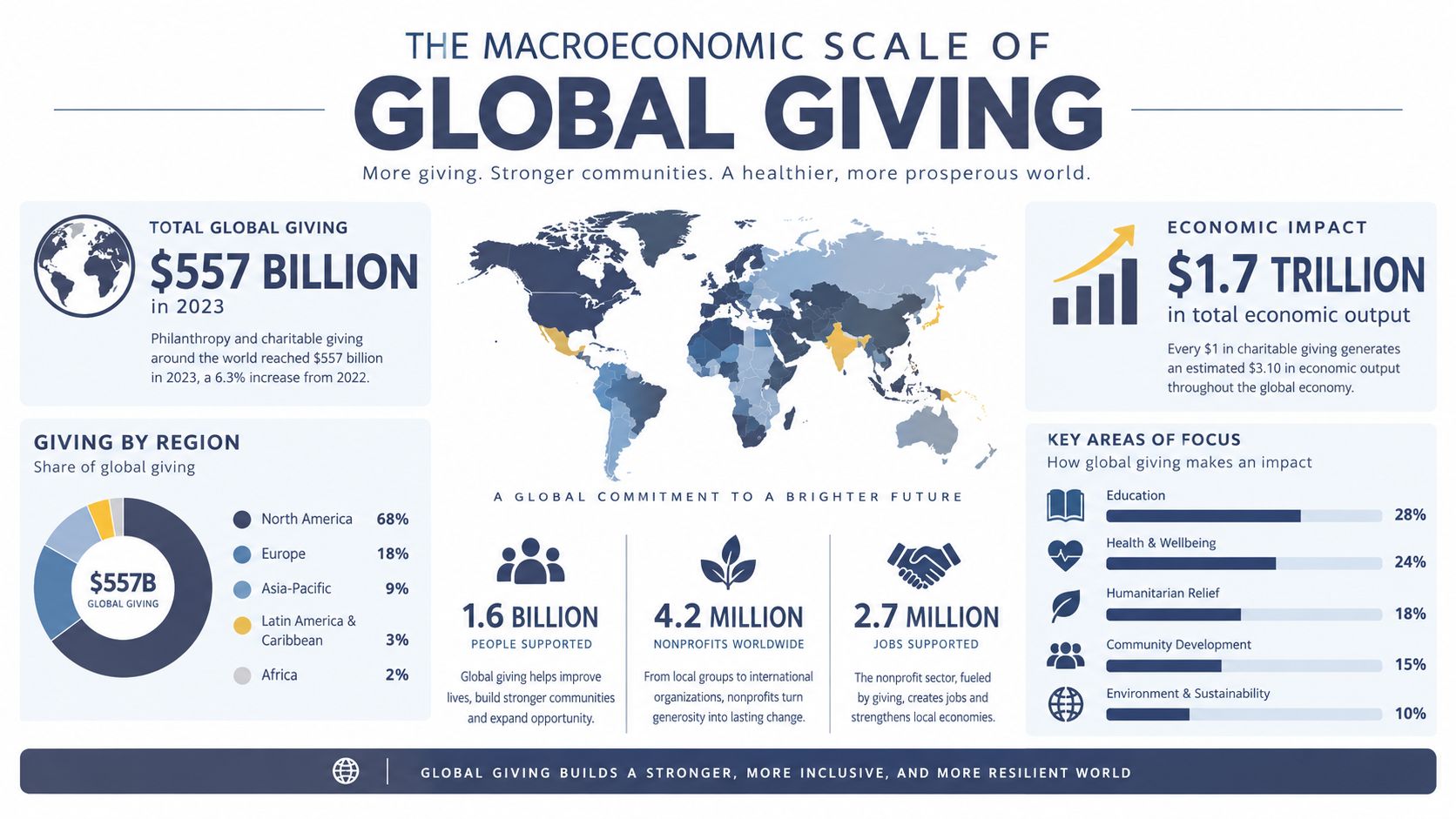
Philanthropy operates at a scale that individual donors can easily underestimate. It isn't a collection of isolated acts. It's a recurring network of donations, volunteer hours, nonprofit jobs, supplier relationships, and services that reach people public systems or commercial markets may not reach quickly enough.
CAF's World Giving Index reported that around 4.3 billion people worldwide helped a stranger, volunteered, or donated money in 2024, equal to roughly 72% of the world's adult population, as reported in CAF's record levels of global generosity. The same measure recorded around 4.2 billion people taking one of those actions in 2022. That participation makes philanthropy one of the largest recurring forms of civic activity across countries.
Where charitable capital travels
Money donated to a nonprofit rarely stays in one place. Organizations hire employees, pay rent, purchase supplies, contract local professionals, maintain facilities, and deliver services. A housing nonprofit may work with contractors. A healthcare organization may buy equipment and employ clinical staff. A youth program may pay instructors and use local venues.
One cited estimate found that $100 in giving stimulated more than $1,800 in increased GDP, while another source noted that U.S. charitable gifts represent roughly 2% of GDP, according to an economic analysis of how giving can support economic activity. These figures shouldn't be treated as a guaranteed return for every donation. They illustrate the broader mechanism, charitable money circulates through labor, procurement, and service delivery.
The same analysis reported that a 10% increase in income has been associated with about a 7% increase in giving. That relationship helps explain why philanthropy often expands alongside economic health, while also highlighting a vulnerability. If household finances weaken, organizations that depend on broad individual participation can face pressure even when need is rising.
Why scale changes the investor's view
At this level, philanthropy supplements public services and responds to needs that markets may not price properly. Donations can reach a crisis quickly, support specialized expertise, and maintain relationships that commercial transactions don't create. They can also provide early funding for approaches that later attract public, institutional, or earned revenue.
For an investor, the practical lesson is straightforward. A well-targeted contribution isn't merely leaving the economic system. It may help sustain a service network, preserve local employment, and stabilize demand in the areas where the donor owns or operates assets. The quality of the allocation still matters. Scale magnifies both effective decisions and poorly designed ones.
How Community Resilience Drives Real Estate Value
A property's value reflects more than its structure, location, and financial statements. It also reflects whether the surrounding area can support stable households, functioning businesses, and reliable public life. Philanthropy can help fund the parts of that environment that markets routinely underprovide.
Education access, social services, medical research, and community programs create benefits that extend beyond the person who receives them. A landlord may not capture the full value of a stronger school or a more effective support organization, yet those improvements can influence whether families stay, whether employers recruit, and whether residents maintain the neighborhood.
Economic analysis identifies philanthropy's role in funding public-goods-like outcomes that markets underprovide. It also finds that tax incentives can efficiently increase philanthropic donations and substitute for public grants, directing more private capital toward social outcomes, as discussed in this economic review of charitable giving.
The connection isn't a promise of appreciation
Strategic giving doesn't guarantee that a property will rise in value. That would be an irresponsible way to present philanthropy. Community investment works through indirect pathways, and results depend on local conditions, execution, and the time required for institutions and residents to build trust.
The more defensible argument is that resilient communities tend to offer a better operating environment. Businesses face fewer disruptions when residents have access to support. Families make longer-term decisions when essential services are dependable. Owners can plan with greater confidence when the neighborhood has institutions capable of responding to pressure.
Fund the missing layer
Real estate investors often understand physical infrastructure. They budget for roofs, plumbing, access, security, and maintenance. Philanthropy can address the less visible infrastructure that supports those assets, including mentorship, family services, health access, and local leadership.
Good grant design begins with a funding gap. What can't the market fund on its own? What does the nonprofit need to deliver consistently? Is the contribution paying for a short-term activity, building organizational capacity, or testing a model that could attract additional support?
Tax planning matters, but it should follow the purpose rather than replace it. Matching structures, multi-year commitments, and outcome tracking can improve the usefulness of a grant. Investors looking to connect development decisions with community priorities can also examine how real estate investors can build sustainable impact through community-driven projects. The strongest approach respects both sides of the equation, the nonprofit's mission and the investor's need for disciplined allocation.
The Shifting Landscape of Modern Philanthropic Funding
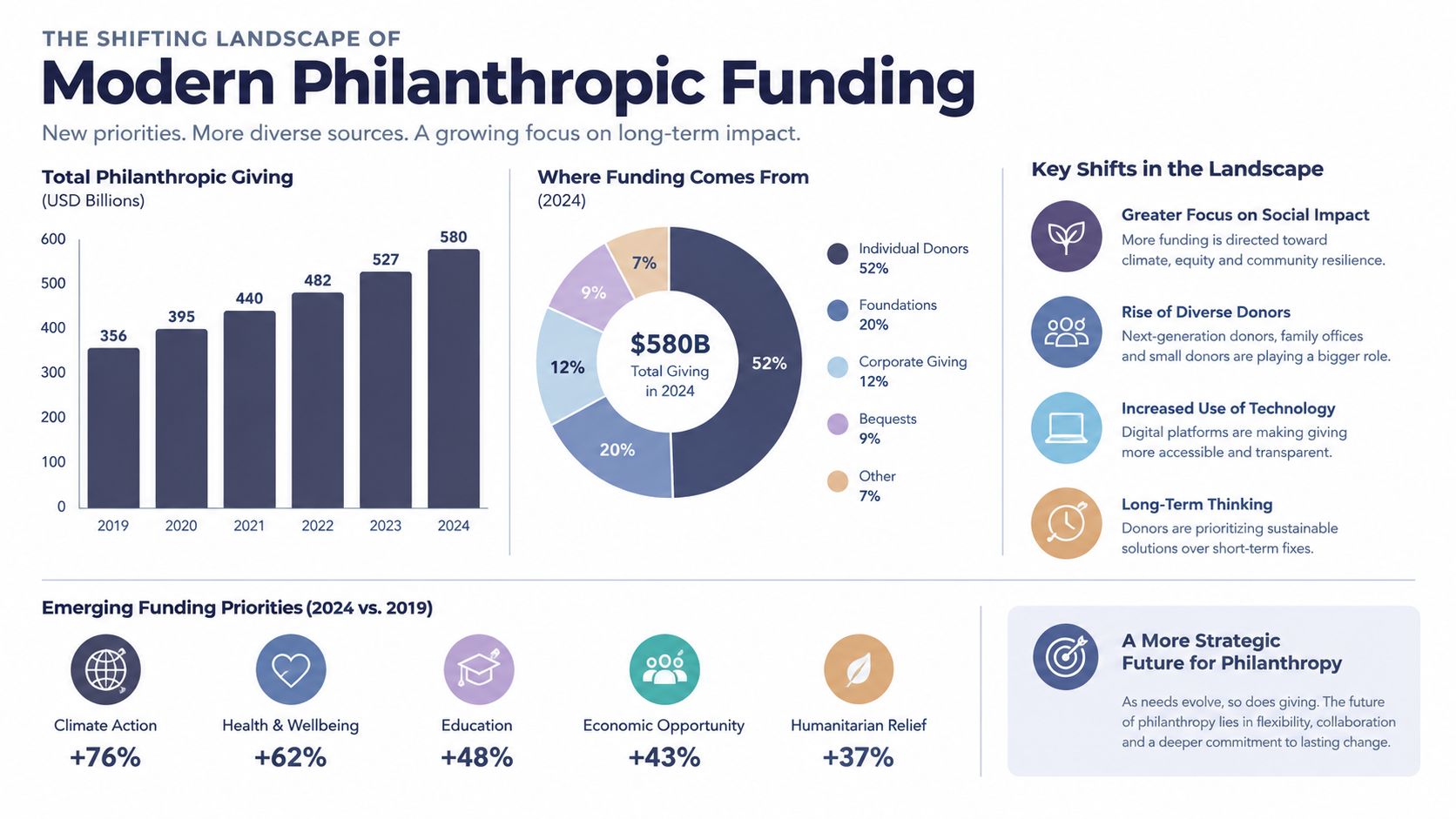
Headline totals can conceal a structural change. U.S. charitable giving reached a record $617.2 billion in 2025, but the share from individuals fell from 67% in 2023 to 64% in 2025, according to Associated Press coverage of the Giving USA report. Foundations and bequests have grown as a share of the funding mix, which means philanthropy is becoming more institutional even as total giving reaches new levels.
Why the funding mix matters
Institutional capital can provide scale and professional grantmaking. It can support larger programs, fund research, and make longer-term commitments. That strength comes with a risk, though. When fewer households participate directly, local nonprofits may lose a broad base of supporters who provide unrestricted money, introductions, volunteer time, and public legitimacy.
A nonprofit funded by a small number of major institutions may have significant resources, but it can also become exposed to decisions made far from the community. A foundation may change priorities. An estate may distribute funds according to a schedule that doesn't match operating needs. A donor may favor a visible project while the organization needs general support to retain staff and keep its doors open.
Recent coverage has also raised concerns about a potential tax cliff, aging populations, and the growth of spend-down strategies. Those pressures could reshape the timing and concentration of philanthropic resources. Investors don't need to predict every shift, but they should understand how dependent a local organization is on one grant, one donor, or one funding cycle.
The role of blended support
Resilient nonprofits usually need more than a large restricted gift. They need operating support, recurring individual donors, volunteers, partnerships, and leaders who can adapt. Strategic investors can strengthen that mix by making flexible contributions, encouraging collaboration, and supporting capacity rather than only funding highly visible outputs.
Smaller, locally informed donors can add value here. They may be able to respond quickly, understand neighborhood conditions, and help organizations bridge gaps between institutional grants. The goal isn't to replace foundations or government. It's to prevent community infrastructure from depending on a single source of capital.
Applying Investment Rigor to Charitable Portfolios
Good intentions alone do not build a dependable philanthropic portfolio. Donors need a process that connects values to decisions, then tests those decisions against results. Investment discipline can help, provided it supports community judgment rather than reducing nonprofit work to a spreadsheet.
Recent research found that 81% of affluent donors made charitable contributions in 2024, while 68% said personal values drive their giving. The Bank of America study of philanthropy also identified growing interest in measurable results, collaboration, and digital transparency. Donors increasingly want a working relationship with the organizations they support, not only a receipt after sending money.
Start with a clear investment thesis
Define the issue, geography, and type of change you want to support. A donor might concentrate on youth mentorship in Los Angeles, healthcare access, family services, environmental work, or support for local entrepreneurs. A focused thesis creates a useful basis for comparing opportunities and reduces scattered contributions.
Evaluate each organization against that thesis. Review its mission, leadership, financial reporting, governance, funding concentration, and evidence of activity. Speak with its leaders and, when appropriate, community partners. Ask what flexible funding would make possible, what the organization cannot measure yet, and which risks could interrupt delivery.
A strong charitable portfolio also reflects the trade-off between focus and flexibility. Concentrating funds can deepen impact, while spreading them across several organizations can reduce dependence on one approach or operating model.
Measure outcomes without distorting the mission
A practical measurement plan separates activity from change. The number of workshops delivered may matter, but it does not show whether participants gained skills, stayed engaged, or reached better opportunities. Measures should reflect the organization's theory of change, not just the information that is easiest to count.
A useful portfolio can include:
Operating health: Review whether the organization can retain staff, manage cash flow, and maintain services.
Program outcomes: Agree on a limited set of meaningful indicators and review them consistently instead of demanding constant reporting.
Community voice: Check whether residents help define the problem and assess the response.
Durability: Look for capabilities, partnerships, or systems that can continue after a grant ends.
Learning value: Record what failed, what changed, and where the next contribution should go.
A grant should buy learning as well as activity. If evidence never changes a donor's decisions, measurement becomes paperwork.
Matching grants can broaden participation, but they work best when the match does not create barriers for smaller donors. Collaboration can increase impact when partners share information and avoid financing the same narrow output while leaving operating needs unsupported. Digital transparency provides useful signals, but a polished website does not establish effectiveness. Conversations, documentation, and follow-up still matter.
Readers assessing a public resource that connects business, investing, and philanthropy can review Richard Maize for those related perspectives. The same diligence used for a property partnership can guide charitable commitments, with greater attention to community voice and less dependence on one headline metric.
Local Impact Through the Rochelle and Richard Maize Foundation
Strategic giving becomes easier to understand when it is tied to a place. Los Angeles contains complex needs across education, healthcare, family services, youth mentorship, culture, fundraising, and community development. A donor who lives and operates in the region can bring more than money. They can bring local relationships, business judgment, and the ability to recognize where a modest intervention may remove a larger obstacle.
The Rochelle and Richard Maize Foundation reflects that place-based approach. Its work supports local and broader causes through charitable organizations and initiatives connected to art, culture, family services, youth mentorship, healthcare, education, disaster relief, and community development, as described through the Rochelle and Richard Maize Foundation.
Expertise can improve charitable decisions
A real estate investor sees how land use, services, employment, and neighborhood confidence interact. That perspective can help identify whether a charitable project addresses a root constraint or merely adds another temporary program. It can also help a donor evaluate practical questions, such as whether an organization has a suitable facility, whether its operating model can grow, and whether its partnerships are strong enough to endure pressure.
That doesn't mean business expertise should override nonprofit leadership. Community organizations understand needs that may not appear in a financial model. The investor's role is to contribute useful skills while allowing experienced practitioners and residents to define success.
From support to stronger networks
A contribution to a local organization can do more than fund a single service. It can connect residents with mentors, help entrepreneurs access resources, support families before a crisis becomes more severe, or give a healthcare initiative the capacity to reach people who otherwise remain outside the system.
The measurable impact may appear in program records, participation, partnerships, and organizational stability. The wider value appears in stronger networks and more capable local institutions. Neither outcome should be exaggerated, and neither should be ignored.
A foundation can also provide continuity. Instead of making disconnected gifts based on visibility or urgency, it can build relationships with organizations, learn from results, and align future support with demonstrated needs. That patient approach is particularly relevant to investors, who already understand that durable value usually requires consistent attention rather than a single transaction.
Your Action Plan for Strategic and Purpose-Driven Giving
Philanthropy becomes useful when it changes how you direct money, time, and expertise. Treat giving as a capital-allocation decision, then build a simple system you can review each year.
Six decisions for a stronger giving practice
Review your existing commitments. List donations, sponsorships, volunteer work, and informal support. Record the cause, location, recipient, restrictions, timing, and reason for each commitment. Look for duplicated efforts, relationships that have gone quiet, and organizations that have never received useful feedback.
Choose a practical focus. Select issues that fit your values, knowledge, and connection to a place. An investor with property experience may contribute through facilities, housing access, neighborhood development, or operational planning. Another donor may create more value through healthcare, education, or mentorship.
Investigate the organization before funding it. Read financial statements and program reports, then speak with its leaders. Ask how they define success, what residents and participants say, which costs are hardest to fund, and what would make the organization better prepared for disruption.
Decide what kind of capital is needed. A restricted project gift can fit a defined activity. Flexible operating support may matter more when staff, technology, insurance, or administration are limiting delivery. A recoverable grant, matching arrangement, or multi-year commitment may suit another situation.
Set an evidence plan. Agree on a few outcomes before funding begins. Review progress at a sensible interval, using those conversations to solve problems rather than punish honest reporting. Track both service quality and the organization's ability to operate more effectively over time.
Build a durable relationship. Introduce useful partners, attend community meetings, share professional expertise, and ask what the nonprofit needs next. Donor involvement should reduce barriers, not force staff to spend more time managing the relationship than delivering services.
Make tax efficiency serve the purpose
Tax treatment can shape the timing and structure of a contribution, and professional advice can help identify an appropriate giving vehicle. The mission should set the direction. A tax-efficient donation that supports the wrong activity remains poor capital allocation.
Investors should distinguish output metrics from social return. A completed building, event, or distribution is an output. The more important assessment is whether people gained access, stability, capability, or opportunity, and whether the organization can maintain that progress.
The most valuable question may be what remains when the grant ends. Stronger leadership, reliable systems, lasting partnerships, and community ownership can matter more than a short burst of activity.
Review the portfolio periodically. Continue supporting organizations that learn and deliver. Change course when evidence shows a mismatch, and exit respectfully when another donor or funding model fits better. Strategic philanthropy does not require controlling a community's future. It requires directing resources with humility, clear expectations, and enough discipline to make them useful.
Richard Maize offers a practical perspective shaped by real estate investing, business development, and community-focused philanthropy. His work illustrates how purpose-driven capital can strengthen local systems while supporting long-term community value.
Comments