Why Are Case Studies Important: Key Benefits

Case studies matter because they reveal how and why success happened, not just the outcome. Richard Maize assembled approximately 1,000 rental apartment units before turning 30, but that number becomes useful only when you understand the decisions, conditions, and risks behind it.
You may be reviewing a potential partner, investor, acquisition, or marketing strategy right now. Someone hands you a polished list of completed projects and impressive outcomes. It looks credible, but it doesn't answer the question that matters most: Could the same mechanism work in your situation?
A case study closes that gap. It connects results to timing, resources, leadership, constraints, market conditions, and stakeholder behavior. The strongest examples don't present success as magic. They show the chain of decisions that produced it, the obstacles that shaped it, and the limits of applying the lesson elsewhere.
Richard Maize offers a useful lens because his career spans property ownership, mortgage finance, entrepreneurship, consumer businesses, and philanthropy. His portfolio evolution demonstrates why a résumé can establish credibility while a case study creates understanding.
The Difference Between A Resume And A Story
Suppose you're evaluating a real-estate partner. Their résumé lists acquisitions, developments, businesses launched, and companies sold. Those achievements may justify a meeting, but they don't tell you how the person evaluates risk, responds to weak demand, manages financing, or adapts when the original plan fails.
A story gives you that operating detail. It explains the starting conditions, the decision that changed the trajectory, the resources available, and the trade-offs the decision-maker accepted. Without that context, an achievement is a data point. With it, the achievement becomes evidence you can examine.

What Maize's career arc makes visible
The Rochelle and Richard Maize Foundation states that Richard Maize assembled a portfolio of approximately 1,000 rental apartment units before turning 30 according to the foundation's biography. That fact establishes an early scale milestone. It doesn't, by itself, explain how he selected properties, handled operations, financed growth, or judged when to move into another part of the industry.
The next stage matters because it reveals a change in operating context. The same source says Maize later founded and developed a highly successful U.S. mortgage-banking firm before liquidating it. The relevant lesson isn't just that he owned apartments and later ran a mortgage business. It's that experience expanded from owning assets to understanding a financial system connected to those assets.
That distinction is exactly why case studies matter. A résumé says, “This happened.” A case study asks:
What was the starting position?
Which decisions created the next opportunity?
What capabilities transferred from one venture to another?
Which conditions would make the same move unsuitable elsewhere?
Credentials open the door, evidence informs the decision
A successful outcome can attract attention, but the surrounding explanation determines whether it deserves confidence. Investors need to know whether a result came from repeatable judgment, unusual timing, privileged access, exceptional capital, or a combination of factors that won't exist in their own market.
Practical rule: Treat every impressive credential as an invitation to investigate, not as proof that the same playbook will work for you.
A well-built case study preserves the sequence. It shows what changed, why the decision-maker acted, and what happened afterward. That makes the material useful for partnership decisions, investment review, and strategic planning rather than merely promotional.
Four Pillars That Make Case Studies Indispensable
Case studies earn their place in business communication when they do four jobs at once: build credibility, make complexity understandable, create audience connection, and connect effort to outcomes. Remove any one of these functions and the document becomes weaker. A list of metrics lacks meaning, while a personal story without evidence lacks discipline.
Richard Maize's background illustrates the value of combining both. His documented activity spans real estate, mortgage finance, consumer ventures, public relations, and cultural initiatives. His LinkedIn profile identifies ownership of properties in more than 20 states and investment interests that include a food-truck business, a public-relations agency, and a K-Pop festival as described on his LinkedIn profile. An independent industry listing identifies Severin Stone and Richard Maize as owners of Richeeze, providing a separate reference for that consumer venture.
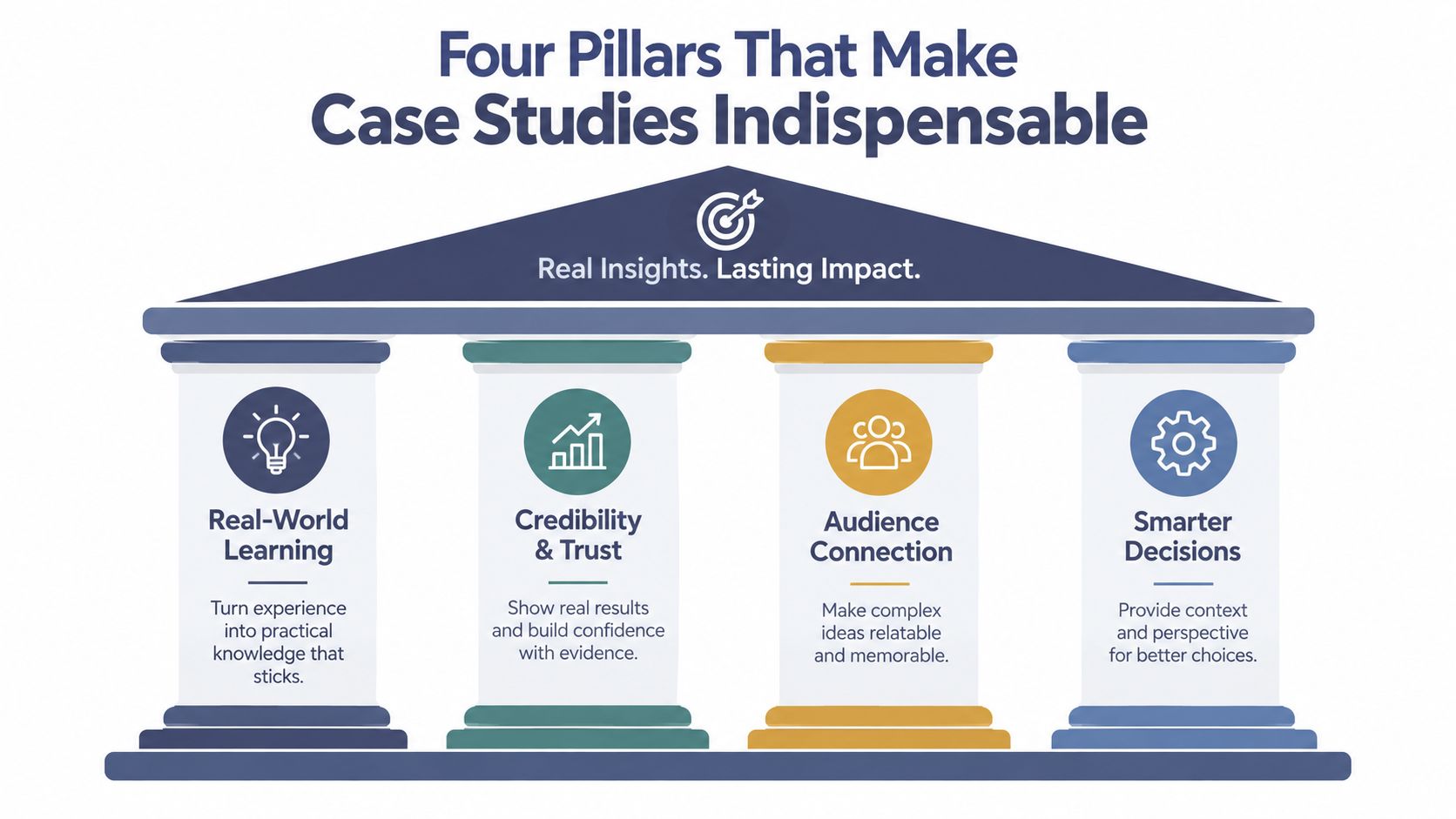
Credibility comes from a documented chain
A case study is more convincing when readers can follow the path from starting conditions to intervention to result. Maize's movement from rental apartments into mortgage banking creates a clear subject for that analysis. The value isn't the résumé alone. It lies in examining which property experience informed the next business and which new constraints appeared after the transition.
Credibility also requires honest boundaries. A case study should distinguish verified outcomes from interpretation, identify the evidence used, and avoid implying that one example represents an entire market.
Storytelling makes complex decisions memorable
Real-estate and business outcomes rarely come from a single action. Financing, regulation, customer demand, staffing, timing, and execution can interact. A chronological account helps readers understand those interactions without flattening them into a single headline.
That makes a case study easier to remember and easier to challenge. Readers can ask whether the decision made sense at the time, whether alternatives were available, and whether the same conditions exist in their own organization.
Relatability turns attention into useful engagement
Lead generation works better when potential customers recognize their own problem in the example. A business owner may not identify with a large property portfolio, but they may recognize the challenge of entering a new sector, building operational confidence, or managing several ventures with different audiences.
The story should therefore focus on decisions and constraints, not celebrity. A reader needs a practical point of contact, such as how a team evaluated risk, handled a transition, or measured progress.
ROI requires more than a success label
A useful return-on-investment discussion connects resources to outcomes. It can include financial results when those records are available, but it should also identify operational improvements, avoided costs, adoption, delivery, or stakeholder benefit. Without a baseline and a clear outcome, “successful” tells the reader very little.
The same standard applies to foundation and community work. A responsible case study should explain what resources were deployed, who benefited, what changed, and what limitations remain. That turns a charitable account into a transparent explanation of impact rather than a list of activities.
How Academic Methodology Transforms Business Evidence
Business leaders often use the term “case study” for any customer story. Rigorous case-study research is more demanding. A 2011 methodological review of case-study research describes it as an in-depth, multi-faceted examination of a complex issue in its real-life context. It combines interviews, focus groups, observations, questionnaires, audits, and routinely collected data rather than relying on one measurement.
That definition has direct commercial value. A property investment, business turnaround, or community initiative rarely has one isolated cause. Timing, financing, leadership, market conditions, institutional rules, and stakeholder behavior can all affect the outcome. A case study preserves those connections so readers can assess the mechanism rather than merely admire the result.
The five stages behind reliable documentation
The same review identifies five core stages:
Define the case. Specify the project, decision, organization, or intervention being examined.
Select the case. Explain why this example is relevant and what it can illuminate.
Collect and analyze data. Bring together records, observations, interviews, audits, and other evidence.
Interpret findings. Separate what the evidence shows from what the author infers.
Report results. Present the process, outcomes, limitations, and implications clearly.
This structure would improve almost any business narrative. If you document Maize's career from early rental ownership through mortgage banking and later investments, you shouldn't treat the stages as disconnected trophies. You should ask what capabilities, relationships, or insights carried forward, and where the operating environment changed.
Analytical learning is not statistical proof
A single case can't predict how often an outcome will occur across a population. It can, however, help test a theory or identify a mechanism. That distinction is known as analytical generalization. The reader applies the underlying principle cautiously, then checks whether the necessary conditions exist in the new setting.
For practical guidance on separating human judgment from automated assistance while documenting decisions, see when to use ChatGPT and when to rely on yourself. The same discipline applies to case-study writing. Tools can organize evidence, but people still need to decide what the evidence means, which alternatives matter, and where uncertainty remains.
Building Transferable Case Studies That Drive Decisions
Not every success story deserves the label case study. A promotional anecdote highlights the favorable result. A decision-grade case study gives readers enough context to determine whether the lesson travels.
Oxford research describes case-study analysis as an examination of how and why real-life processes work or fail. It also emphasizes evidence discipline, including independently verifiable success metrics and a combination of quantitative outcomes with qualitative context in its research guidance. That standard is demanding, but it protects investors and operators from making decisions based on a polished narrative.
Start with the baseline
State what conditions looked like before the intervention. For a property, that may include the asset's operating position, financing structure, tenant demand, regulatory environment, or management constraints. For a consumer venture such as Richeeze, the relevant baseline may involve the target customer, operating model, location, offer, and available capabilities.
Without a baseline, readers can't judge change. “We improved performance” is an opinion until the document explains what performance looked like before the decision.
Document the intervention and its alternatives
Describe what changed and why. Identify the decision-maker, resources committed, timing, and alternatives considered. A strong account also explains what the team chose not to do.
A diversified career becomes analytically useful here. Maize's documented experience across real estate, finance, consumer businesses, and cultural initiatives offers several different operating contexts. The point isn't to claim that diversification automatically creates success. The point is to examine which skills transferred, which assumptions changed, and which ventures required entirely different capabilities.
Show outcomes, costs, and constraints
Use verifiable results wherever records permit, then pair them with qualitative context. Include costs, delays, failed approaches, unintended effects, and stakeholder reactions. Readers need to know what the intervention demanded, not only what it produced.
A practical audit can ask:
Baseline: What was true before the decision?
Action: What exactly changed?
Evidence: Which records or observations support the result?
Cost: What money, time, people, or attention did the work require?
Constraints: Which market, regulatory, financial, or organizational conditions shaped it?
Transfer: Which conditions must exist before another operator copies the approach?
The final question matters most. A case study becomes transferable when it identifies the principle and the limits together.
Why Some Case Studies Mislead Even When They Inspire
A compelling narrative can still be weak evidence. The danger appears when a writer selects only a favorable outcome, hides the alternatives, and presents a complex result as if one action caused everything.
Richard Maize's documented portfolio evolution provides a useful contrast. His activities include real estate across multiple states, mortgage banking, a food-truck venture, public-relations interests, and a K-Pop festival. That range can illustrate strategic adaptation, but it doesn't prove that diversification is right for every investor. A rigorous reader would ask what each venture required, what risks differed, and which lessons apply only under specific conditions.
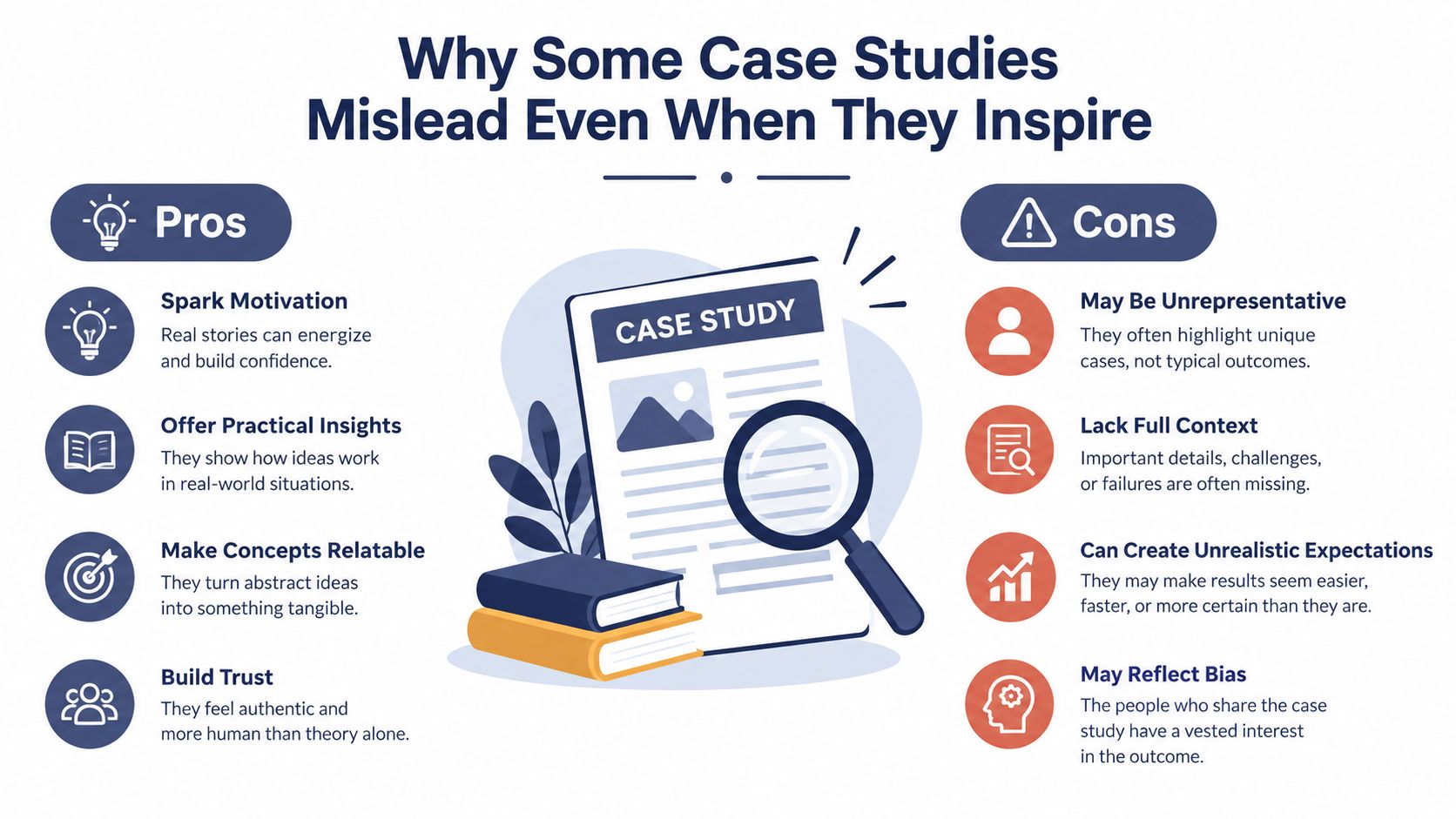
Inspiration versus evidence
A glossy success story | A rigorous case study |
|---|---|
Starts with the outcome | Establishes the baseline |
Highlights favorable decisions | Explains alternatives and trade-offs |
Uses broad success language | Shows independently verifiable evidence |
Omits friction and failure | Includes constraints and unintended effects |
Implies broad applicability | States where the lesson may not transfer |
A methodological discussion of analytical and statistical generalization explains that a single case usually can't establish how frequently an outcome will occur across markets. It can generate or test a mechanism, and that mechanism becomes more credible through comparison and replication. External validity improves when authors justify case selection and describe the institutional and market context.
Use a skeptical reader's checklist
Before relying on any case study for an investment, partnership, or marketing decision, ask:
Selection: Why was this case chosen, and what comparable examples were excluded?
Causality: What evidence connects the intervention to the result?
Alternatives: What else could have produced the outcome?
Negative evidence: Which setbacks, costs, or omitted results appear in the account?
Context: What capital, timing, regulation, market demand, or capabilities were necessary?
Replication: Has the mechanism appeared in another setting, or is it still a hypothesis?
This is also the discipline behind how to spot a bad deal before it's too late. A persuasive presentation should trigger better questions, not suspend judgment.
A case study reduces risk by making assumptions visible. It doesn't remove uncertainty.
From Portfolio Projects To Actionable Intelligence
Many people treat case studies as marketing assets. That view is too narrow. A well-documented case study is also a risk-reduction instrument because it exposes the context that a headline or portfolio page leaves out.
Richard Maize's public platform brings together real-estate perspectives, business investments, multimedia, press coverage, philanthropic activity, and examples such as the Richeeze Melts Food Truck and POPPOP FEST. Presented responsibly, that range can become more than a collection of accomplishments. It can form a body of evidence about how decisions vary across property, consumer, cultural, and community settings.
Documentation turns experience into a shared resource
The useful unit isn't the project name. It's the decision record around the project. For each initiative, document the problem, starting position, chosen intervention, evidence of change, costs, constraints, and unresolved questions.
That record helps three audiences. Internal teams can learn without relying on memory. Partners can evaluate whether expectations match operating reality. External readers can separate transferable principles from context-specific tactics.
A case-study portfolio also becomes more valuable when entries use consistent language and structure. Readers should be able to find the challenge, approach, outcome, and limitations quickly, then explore the detail that supports the conclusion. The format should serve the decision, not the ego of the person presenting it.
Make the next decision better
The most useful case study doesn't promise that readers will reproduce the original success. It helps them decide whether to proceed, adapt the method, gather more evidence, or walk away.
For acquisition decisions, readers can pair this approach with what to look for when seeking to acquire a new company. The point is not to copy a personality or a portfolio. It's to inspect the mechanism, test the assumptions, and match the opportunity to available resources and conditions.
Case studies are important because they convert isolated experience into shared understanding. They answer the questions a résumé can't: How did this happen, why did it work, what did it cost, and where might it fail?
Richard Maize offers a public platform featuring real-estate insights, investment perspectives, venture examples, multimedia content, and philanthropic work that readers can evaluate through a practical lens. Visit Richard Maize to explore those projects and use the documented decisions, constraints, and outcomes as a starting point for your own case-study research.
Comments