What Is Wholesale Real Estate Investing

The popular advice is to find a cheap house and build a buyers list. That skips the difficult part.
Wholesale real estate investing means putting a property under contract and assigning the right to buy it to an end buyer for a fee. A contract at $180,000 assigned at $195,000 produces a $15,000 gross spread, which is not the same as profit.
Skill lies in securing terms a genuine buyer can close on within the contract deadline, using a structure allowed by your jurisdiction. Wholesaling is a jurisdiction-specific liquidity business, and the legal mechanics matter more than the discount.
Richard Maize's more than 30 years of building and managing a real estate portfolio offers a useful lens: evaluate the buyer's financing and the property's economics before getting attached to the advertised fee.
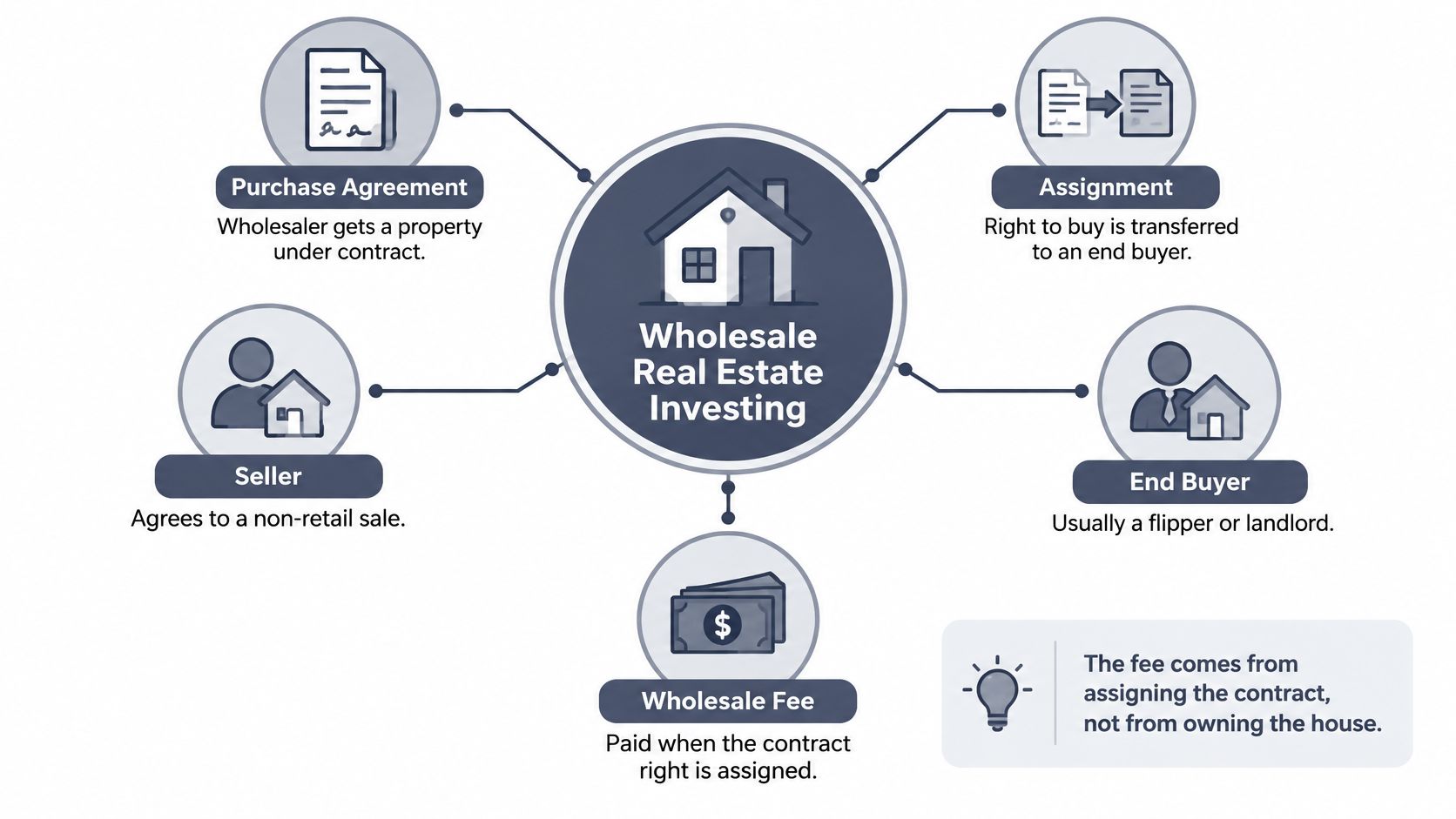
What Wholesale Investing Is and Where the Fee Comes From
The wholesaler's product is a contractual right to purchase. A seller agrees to a price and closing terms, and an end buyer decides whether those terms leave enough room for repairs, financing costs, and profit. The keys change hands only if that math works for the buyer who funds the deal.
A low purchase price alone does not make a transaction work. The seller might value an as-is sale, a particular closing date, or relief from managing an occupied property, and the wholesaler's fee comes from matching those terms to a buyer whose numbers still clear.
Each party holds something different: the seller holds the property, the wholesaler holds contract rights, and the end buyer holds the cash that closes.
Richard Maize is a Los Angeles based real estate investor, entrepreneur, and philanthropist. His business biography and an independent profile describe more than 30 years spent building and managing a real estate portfolio. That ownership record is the relevant credential here: a wholesaler has to think like the investor on the other side of the contract, because that investor's math decides whether the deal closes.
Separate the spread from the earnings
Gross assignment spread isn't net income. Subtract every cost you incur: marketing, legal review, title work, inspections, and any deposit that becomes nonrefundable or is forfeited. A deposit that comes back to you is capital returned, and counting it as a cost understates what the deal paid.
The worked example below pairs the assignment figures with NAR's real-estate market comparison: a $180,000 contract assigned at $195,000 produces a $15,000 gross spread, while the national comparison shows a $407,500 median existing-home price in 2024 versus $114,600 in 1995, with sales of 4.06 million and 3.85 million, respectively.
Assignment spread and the market behind it
Line | Figure | What it means |
|---|---|---|
Seller contract price | $180,000 | Price the wholesaler agreed to pay; an illustration |
End-buyer assignment price | $195,000 | Total effective price for taking the contract and completing the purchase |
Gross assignment spread | $15,000 | Fee before deal costs come out; one example, one deal |
Costs to subtract | Marketing, legal, title, inspection, earnest money | Subtract incurred expenses and any forfeited deposit |
2024 median existing-home price | $407,500 | National price context that shows the example is a small deal |
2024 existing-home sales | 4.06 million | Near the lowest annual level since 1995 |
1995 comparison | 3.85 million sales; $114,600 median | Prices rose far faster than sales volume |
National totals, like those in the HUD national housing summary, describe how much product moves across the country. They say nothing about whether one local contract has a buyer.
Use Richard Maize's real-estate market analysis template to organize comparable sales and local conditions, then test your price against actual investor interest before you sign the contract.
The fee is never automatic. If the end buyer can't close, you may have to renegotiate, locate another buyer, or lose earnest money and contractual rights.
Common Terms Every Beginner Needs
Terms used in wholesale deals
Term | Plain meaning |
|---|---|
Assignment | Transfer of the buyer's contract rights to an end buyer, usually for a fee |
Assignment fee | Payment the wholesaler receives for passing the contract on |
Double closing | Back-to-back sales, with the wholesaler briefly on title |
Earnest money | Contract deposit that may be at risk if the deal fails, subject to the agreement |
End buyer | Flipper or landlord who closes the purchase |
Comps | Recent comparable sales used to estimate resale value |
Equitable interest | Position held under a purchase contract rather than legal title |
Motivated seller | Owner who wants a fast, non-retail sale |
Disclosure | Written statement of the wholesaler's role required by some states, including in advertising |
These terms appear in different places, and mixing them up can change what you promise. Assignment belongs in the purchase agreement and assignment documents; double closing belongs in the closing and funding plan. They aren't interchangeable labels for the same paperwork.
Earnest money appears in the purchase contract and escrow instructions. Check who holds it, when it must arrive, and what conditions permit its return. A deposit isn't automatically forfeited whenever a transaction fails, but neither is it automatically protected because you haven't found a buyer.
Know which terms describe ownership
Equitable interest isn't legal title. A signed purchase agreement may give you enforceable contractual rights, but it doesn't make you the recorded owner or give you unrestricted authority to advertise the property.
Disclosure language should describe the position you hold. Avoid an advertisement that makes a prospective buyer believe you own the house when you're offering an interest in a contract.
Describe what you control, not what you hope to own.
Comps belong in the underwriting file. Select closed sales with similar location, size, condition, and property characteristics, then explain adjustments rather than choosing the highest nearby sale.
A motivated seller belongs in the conversation, not in a pressure script. Ask what the owner needs from the transaction and whether a conventional listing would serve them better. Wanting convenience doesn't mean the owner understands the trade-off between a fast sale and maximum exposure.
Confirm the contractual meaning
Everyday definitions are only a starting point. State law and the actual agreement determine the rights, duties, and remedies attached to these terms.
Have a local real-estate attorney confirm the language before it appears in a contract or advertisement. In particular, ask whether an assignment transfers only rights or also delegates obligations, and whether the original buyer remains liable after signing it.
That distinction matters when choosing between assignment and double closing, and when deciding how much earnest money you can put at risk.
State Rules That Decide If You Can Wholesale
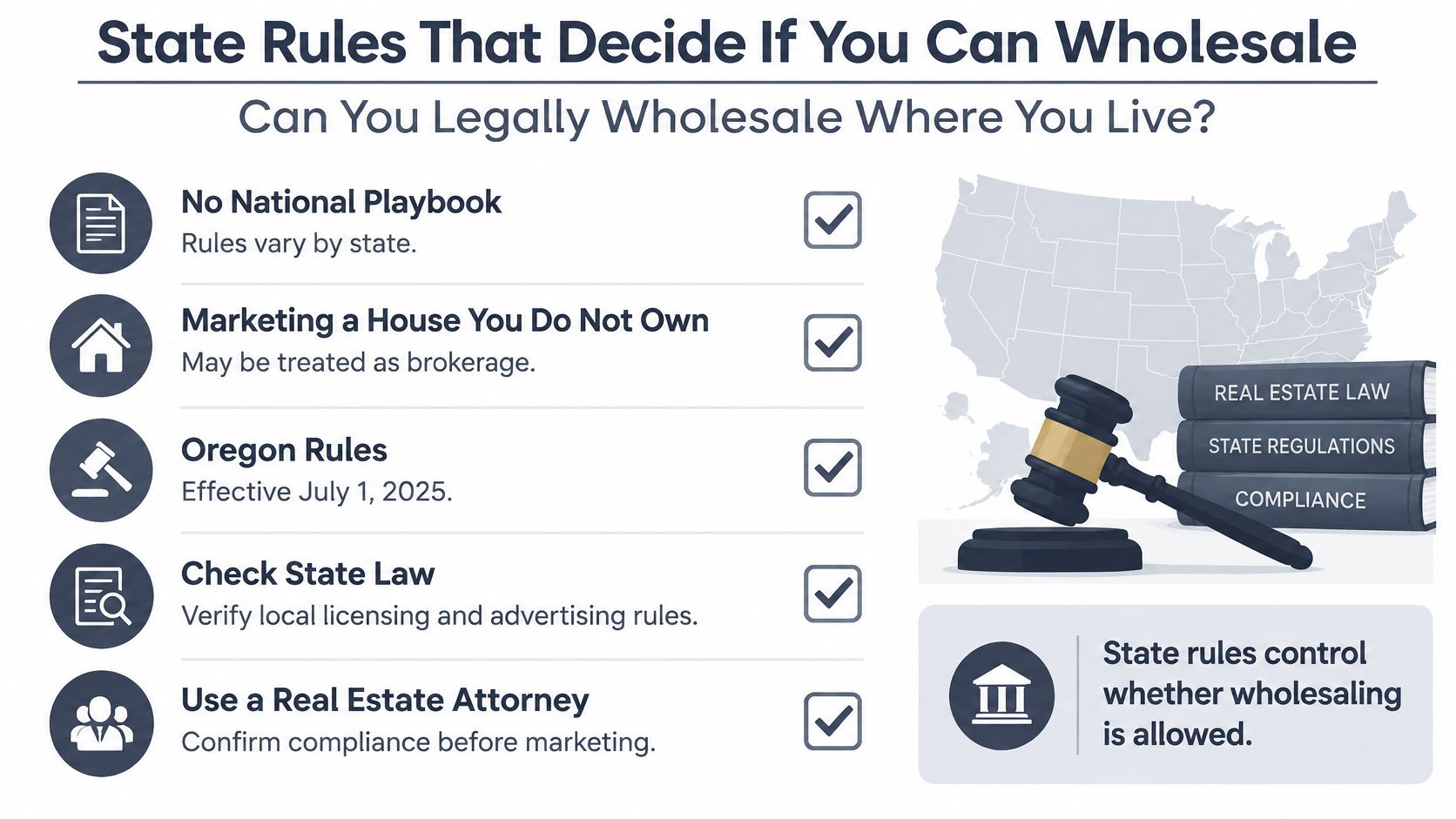
Wholesaling is a liquidity business run under local law. The skill is getting a contract a real buyer can close, legally, in the state where the property sits, rather than finding a cheap house. Marketing a house you don't own can be treated differently from offering an assignable contractual interest, and your conduct can raise brokerage questions whatever label you put on the business.
Start with the regulator and a local real-estate attorney, not a downloadable contract. Run the issues below past both before you spend anything on marketing.
Different states draw different lines
The Oregon Real Estate Agency's wholesaling FAQs describe rules effective July 1, 2025, requiring residential wholesalers to register or hold a broker or principal-broker license, with a $300 registration fee for registrants and written disclosures to parties and in advertising. Oregon's coverage reaches marketing while holding only an equitable interest or purchase option for fewer than 90 days, with less than $10,000 invested in improvements. That describes a short-hold assignment deal closely enough that I'd treat registration as the default assumption there.
Two state approaches and the check everywhere else
Place | What the rule requires | What it changes |
|---|---|---|
Oregon, from July 1, 2025 | Register or hold a broker or principal-broker license; $300 registration fee for registration; written disclosures | Covers marketing while holding only an equitable interest or option under 90 days and under $10,000 of improvements |
Connecticut | Sets its own licensing and closing-timeline rules | Confirm current requirements with the state regulator before any contract is signed |
Any other U.S. state | No single national playbook | Confirm license, ad language, assignment clause, cancellation, and disclosures locally |
When a state writes its own licensing and closing-timeline rules, scheduling becomes a compliance question, not only an operational one. A seller's informal flexibility on timing doesn't substitute for whatever the applicable rule requires in writing.
No single row tells you whether your transaction is lawful in your city. Verify the current requirements and how they apply to your specific activities before soliciting sellers or buyers.
For an additional discussion of the topic, watch the following video.
Take the whole transaction to counsel
Ask your attorney to review more than the assignment clause:
Authority to operate: Identify the license or registration your activities require.
Advertising: Confirm permitted wording and whether you may market the property, your contractual interest, or neither.
Contract protections: Review assignability, cancellation rights, deadlines, and continuing liability.
Disclosures: Establish who receives them, when they're delivered, and how receipt is documented.
Closing structure: Determine whether the proposed conduct is an assignment, double closing, or regulated brokerage activity.
Ethics belong in that review. Tell the seller in writing that an assignee or subsequent buyer may complete the transaction, keep earnest-money handling transparent, and don't promise a price you can't support.
Ask whether a seller comparing your offer with market value would find your advertising misleading. Compliance is part of the transaction's value, not paperwork to repair after finding a buyer.
From Contract to Assignment or Double Closing
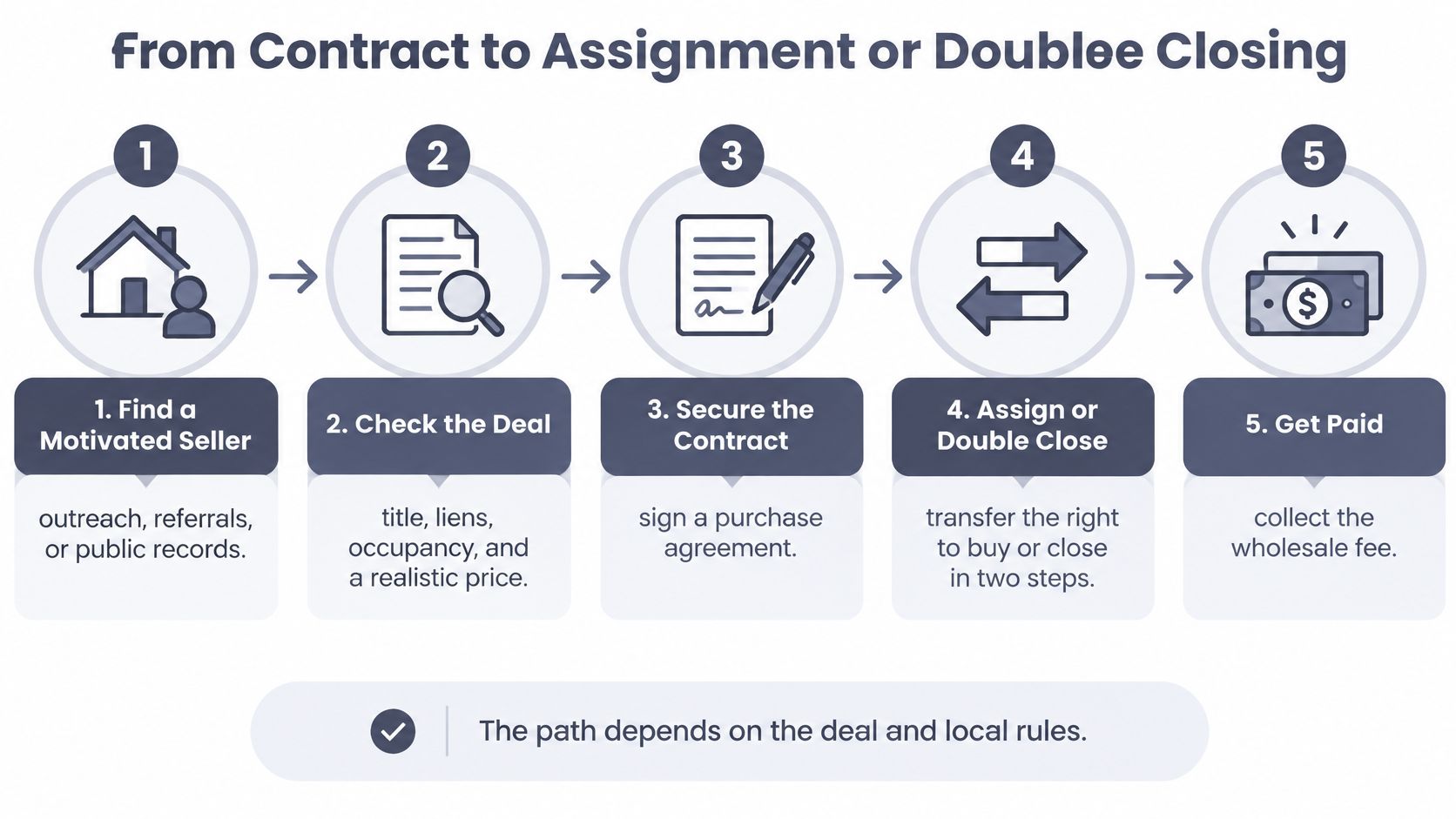
A workable process starts with the seller's circumstances and ends with cleared funds. Advertising a projected fee before checking the title, access, and closing structure reverses that order.
Follow the transaction in sequence
Find a motivated seller. Use lawful outreach, referrals, or public records, and ask why the owner wants a non-retail sale. Confirm who has authority to sign and what timing or occupancy needs the sale must accommodate.
Check the property and ownership. Have the title company or attorney investigate ownership, liens, and potential title defects. Establish occupancy, access, and a realistic repair range. An exterior photograph isn't enough to underwrite interior damage.
Secure the appropriate contract. Use an attorney-reviewed purchase agreement with assignment rights if that's the intended structure. Otherwise, determine whether a funded double closing is permissible and practical. Deliver the agreed earnest money through the designated holder and retain the receipt.
Work backward from the buyer's economics. Start with defensible comparable sales, then account for repairs, financing, carrying costs, selling expenses, and the buyer's required profit. Your fee must fit inside what remains, not sit on top of an already marginal deal.
Qualify the end buyer. Ask about recent closings, available funds, lender requirements, and decision-making authority. Arrange inspection access early enough for the buyer to evaluate the property before the deadline becomes urgent.
Choose the executable closing path. Assign when the agreement and local law permit it. Use a double closing only after the closing professional confirms the documents, funding, sequencing, and disbursement requirements.
Complete disclosures and closing instructions. Make required disclosures at the correct stage, describe your interest accurately, and reconcile the settlement statement. Don't claim the house is yours merely because you have a signed contract.
The broad path is simple; the work sits inside those checks.
An assignment that works on paper
Consider a hypothetical seller who agrees to $240,000 for a house needing approximately $40,000 of work. After checking comps and inspecting the property, a flipper agrees to pay a $12,000 assignment fee to step into the contract.
Those are scenario assumptions, not typical prices or earnings. The wholesaler transfers the contractual interest without taking title, while the flipper brings the purchase funds and pays the agreed fee through the documented closing process.
The useful question isn't whether the spread looks attractive. It's whether the flipper has accepted the property's actual condition, can satisfy financing requirements, and can deliver funds on schedule.
If that buyer walks away, the wholesaler must act within the original agreement. Depending on its terms and any valid contingencies, the earnest money may be exposed and other contractual liability may remain.
Practical rule: A buyer's enthusiasm isn't a closing commitment. Verify the money, the conditions attached to it, and the deadline.
A double closing with a funding problem
Now suppose the purchase agreement prohibits assignment. The wholesaler proposes buying from the seller and then selling to an investor at a higher price, either the same day or the next.
That requires an actual acquisition, not merely different labels on assignment paperwork. The wholesaler needs available cash or approved transactional funding, along with the additional title and closing expenses associated with separate transfers.
Use Richard Maize's private-money lender playbook to prepare financing questions, but obtain written terms for the specific transaction. Ask whether the lender requires the resale buyer's funds to be deposited, what happens if the resale stalls, and who bears the financing expense.
If the investor's money is a condition of the acquisition funding and doesn't arrive, neither sale may close. If the wholesaler funds the acquisition independently but the resale fails, the wholesaler may instead be left owning the property.
A double closing isn't a workaround for prohibited conduct. Choose assignment when the contract and law allow it; choose a double closing only when the purchase, resale, and funding are independently executable.
Benefits and Risks When Inventory Rises
Wholesaling can require less cash than buying a rental, avoid renovation management, keep the intended holding period short, and compensate you for connecting a seller with a capable buyer. Each advantage has a condition attached.
Lower capital doesn't mean no capital, and avoiding construction doesn't remove construction risk from your pricing. The end buyer still needs enough margin to absorb problems.
What wholesaling offers and where it breaks
Claimed advantage | What it looks like | When it fails |
|---|---|---|
Lower cash than owning a rental | Earnest money and marketing instead of a down payment | The deposit may be lost if nobody closes and no valid exit applies |
No renovation | The end buyer hires the crew | A bad repair estimate kills the buyer's margin |
Short hold | Days or weeks, not years of tenants | The contract deadline arrives with no buyer |
Paid for reducing friction | Seller and capable buyer are matched | The contract cannot be assigned or the role wasn't properly disclosed |
More listings to source | Inventory up about 20% by May 2025 and 15.7% by July | Buyers have alternatives and negotiate the fee down |
According to the National Association of Realtors' housing supply reporting, nationwide for-sale inventory was nearly 20% above the prior year in May 2025; its July 2025 snapshot recorded 1.55 million units, up 15.7% year over year, while existing-home sales rose 2.0% to a seasonally adjusted annual rate of 4.0 million.
More opportunities don't guarantee more exits
A fuller inventory can give you more properties to investigate and more owners willing to discuss alternatives. It also gives the end buyer more substitutes for your contract.
That buyer may prefer a listed property with easier access, cleaner documentation, or a seller willing to negotiate directly. Your fee must therefore be justified by the complete opportunity, not by the fact that you found an off-market address.
The comparison below captures the trade-offs, although local conditions determine which side matters most.
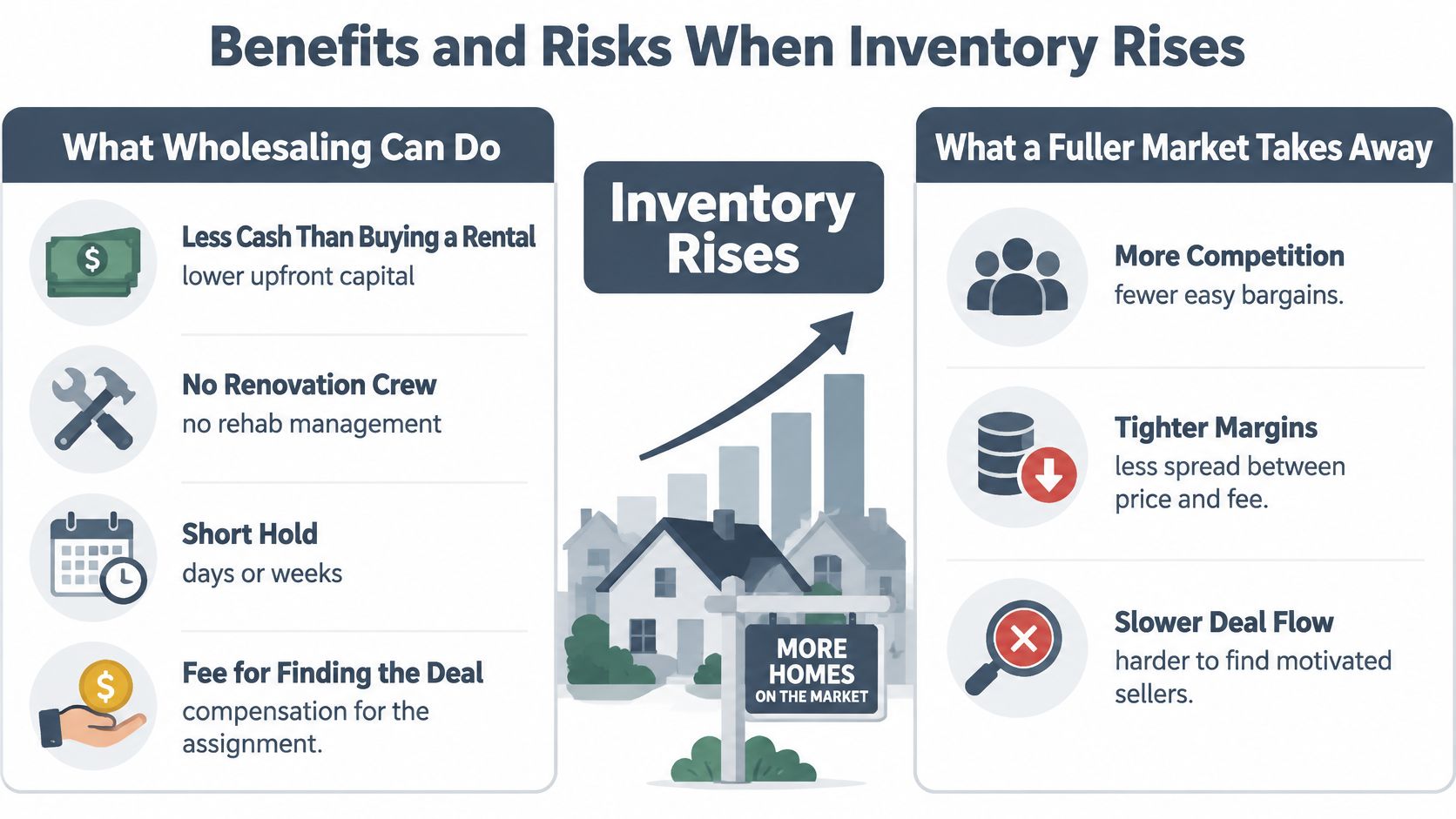
The earlier low-volume resale environment and the later inventory increase describe different measures. Neither proves that motivated sellers or cash buyers are abundant in your neighborhood; more available homes can improve sourcing while making contract disposition less certain.
Underwrite the exit before trusting the fee
Test the deal against the buyer pool you can reach. A long mailing list doesn't establish that anyone wants this property type, location, condition, and closing schedule.
Buyer depth: Identify credible alternatives if the preferred investor declines.
Transfer timing: Leave room for inspection, document review, and funding rather than assuming immediate acceptance.
Repair uncertainty: Obtain specialist input where structural, roof, electrical, or plumbing issues could change the budget.
Extension costs: Know what another closing date would require from the seller and the funding source.
Use Richard Maize's guide to spotting a bad deal to challenge optimistic assumptions before committing more money.
A fee that survives only if every assumption is right isn't a dependable margin.
Decide If Wholesaling Fits Your First Deal
The core question is narrower than "is wholesaling profitable." Ask whether you can deliver a contract a qualified buyer can close, legally, under your state's rules. Pause if you cannot name the licensing rule that applies to you, identify a credible end buyer, defend a repair range, and state the earnest money you can afford to lose. Those are go-or-no-go questions. Solving them after signing means solving them under pressure, with a seller's timeline working against you.
A beginner's advantage is the ability to decline. Declining a deal costs nothing; signing one you cannot assign costs the deposit and your credibility with the seller. Don't turn a learning exercise into a binding obligation just to feel that you've started.
Keep the next actions narrow
Review the agreement with local counsel. Have the assignment clause, marketing rights, cancellation provisions, and disclosures checked before you offer anything to buyers.
Build a short, qualified buyer list. Favor investors who have closed comparable purchases recently and can explain how they fund them.
Underwrite a property on paper. Assemble comps, inspection observations, repair allowances, closing expenses, and a fee that survives after costs.
Practice accurate disclosure language. Your advertising should state your actual contractual position without implying ownership or guaranteed returns.
For more than 30 years Richard Maize has built and managed a real estate portfolio. That financing-plus-ownership perspective is worth borrowing even when your deal involves no long-term holding. Someone still funds the acquisition and carries the property between contract and closing, so the financing side decides whether your numbers are real.
Wait when the buyer, the law, or the deposit is unclear. A sound first deal is one you can explain in plain language, document accurately, and close without a last-minute rescue.
Richard Maize offers commentary on property markets, investing, and the financing decisions behind real transactions. Visit Richard Maize to explore his real-estate insights, then apply that ownership-and-financing lens to any wholesale contract before you sign.
Comments