How to Calculate Equity Multiple: Formula and Example

Equity multiple equals total cash distributions divided by total equity invested, and 2.0x means two dollars returned for every dollar invested. Yet identical multiples can describe very different investments, because the calculation doesn't tell you when you'll receive the money.
That distinction matters when you're comparing property offerings. A clean calculation starts with the investor's actual contributions and distributions, not the purchase price, an appraisal gain, or a sponsor's headline projection. Richard Maize's investment background provides a practical context for evaluating the number across properties and other ventures, but the decision still comes down to cash, timing, and risk.
What Equity Multiple Measures and the Formula
Equity multiple = Total cash distributions ÷ Total equity invested
The numerator measures cash returned to the investor. Include operating distributions, refinancing proceeds paid out, and the investor's share of sale proceeds. Don't count money retained in the property's bank account as though the investor received it.
The denominator measures contributed equity. Include the initial investment and subsequent capital calls, not the entire acquisition price financed partly with a loan. Keep the calculation at the same level throughout: an individual investor's distributions belong over that investor's contributions.
Formula inputs and what to include
Input | What to include | Common error |
|---|---|---|
Total cash distributions | Operating cash paid out, refinancing proceeds and sale proceeds the investor received | Counting only profit after principal is returned |
Total equity invested | Initial equity contribution plus later capital calls | Using the total purchase price including debt |
Equity multiple | Total distributions divided by total equity invested | Reporting the ratio without the cash flow dates |
Return of capital counts as a distribution. The multiple measures total money returned, not profit alone. At 1.0x, the investor has recovered contributed capital without a cash profit; below that level, distributions haven't fully recovered the investment.
For a hypothetical example, suppose you contribute $50,000 and receive $75,000 in total distributions. The calculation is $75,000 ÷ $50,000 = 1.5x.
Include the capital you added later
Now suppose a different hypothetical investment requires $50,000 initially, followed by a $20,000 capital call in year two. Your total contribution is $70,000, so $85,000 of total distributions produces approximately 1.21x, not a ratio calculated against the initial check alone.
Practical rule: Match the investor, the accounting basis, and the measurement period before dividing anything.
When learning how to calculate equity multiple, the quickest accuracy test is simple: does the numerator include everything the investor received, and does the denominator include everything that investor contributed? Keep the dates beside those entries, even though you won't use them in the division.
Step-by-Step Calculation and Errors That Inflate the Number
Start with a spreadsheet and supporting records: contribution notices, distribution statements, bank transactions, and the closing distribution statement. A marketing presentation can help you understand the business plan, but it isn't a substitute for reconciling the cash.
Use separate columns for date, contribution, operating distribution, refinancing distribution, sale distribution, and fees. Add a status column identifying each entry as received or projected so an expected exit payment doesn't become a realized result.
Build the calculation from the cash ledger
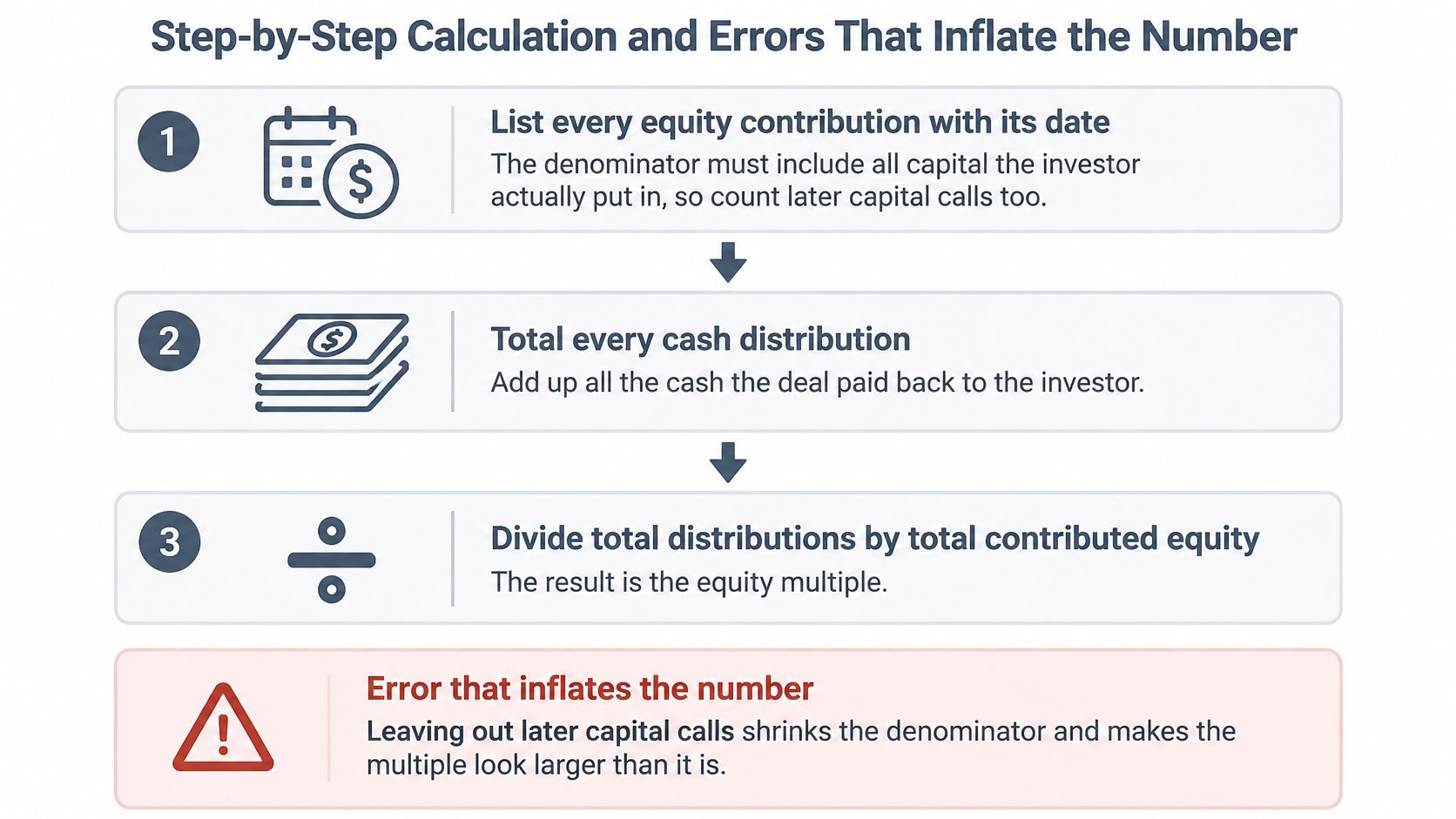
List every equity contribution with its date. Enter the initial funding and every later capital call. Compare the ledger against contribution notices and bank transfers. Leaving out additional capital makes the denominator too small and overstates the multiple.
Total every distribution received over the hold. Separate operating payments from refinancing and sale proceeds so you can inspect their origins. Include the investor's sale distribution, not the property's gross selling price. Don't add the same payment from both a bank statement and a sponsor's cumulative summary.
Confirm the gross or net basis. For an investor-facing result, determine what remains after applicable fees and the sponsor's promote, meaning its performance-based share of profits. If you also calculate a gross result, label the adjustments explicitly. Mixing property-level proceeds with investor-level contributions doesn't produce a useful comparison.
Divide distributions by contributed equity. Keep both totals visible above the answer. Someone reviewing the worksheet should be able to reconcile the result without reconstructing your assumptions.
Round the displayed multiple, not the underlying ledger. Show the answer to two decimal places with an x. Preserve full precision in the spreadsheet so later comparisons aren't affected by repeated rounding.
Attach the timeline and calculation status. Identify whether the result is realized, projected, or a combination. A completed investment and an underwriting forecast shouldn't appear interchangeable just because both display a multiple.
This process keeps the most common denominator error visible.
Work the example, then challenge the assumptions
In its 2026 example, Galleon shows $100,000 invested, $223,000 in total distributions over five years, and a 2.23x equity multiple, calculated as $223,000 ÷ $100,000.
The arithmetic is straightforward. The harder question is whether the forecast distributions will materialize. If the projected exit contributes most of the total, reduce the sale assumption and recalculate the investor's proceeds after loan repayment, transaction costs, and the distribution waterfall.
For operating assumptions, use the operating expense ratio guide to examine how property expenses relate to income. An attractive exit projection shouldn't excuse an operating budget that leaves out recurring costs.
Before accepting the result, run this short checklist:
Sale sensitivity: Lower the assumed sale proceeds and inspect the revised multiple.
Operating contribution: Separate operating distributions from debt-funded and exit distributions.
Capital completeness: Confirm that renovation overruns and other modeled funding needs appear as contributions.
Comparable financing: Check whether competing offerings assume similar borrowing and repayment obligations.
An operating-distribution subtotal isn't a replacement for the full equity multiple. It's a diagnostic that shows how much cash the property's operations contribute before refinancing or sale.
Benchmark Results From Published Examples
Published examples are useful arithmetic benchmarks, not proof of an achievable return. They show how the same division works across different investment sizes, but they don't establish that any particular multiple is appropriate for your property, financing structure, or risk tolerance.
In its 2025 example, The Value Investor calculates 2.0x from $4,000,000 in total distributions and $2,000,000 of initial equity. Quanta's 2026 example uses $250,000 in total distributions and $100,000 invested to produce 2.5x.
Agora's 2025 example shows $850,000 in total cash inflows on $500,000 invested over a 10-year holding period, producing 1.7x.
Published equity multiple examples on the same inputs
Source and year | Total distributions | Equity invested | Holding period | Equity multiple | Approx. annual rate |
|---|---|---|---|---|---|
Galleon, 2026 | $223,000 | $100,000 | 5 years | 2.23x | About 17% a year |
The Value Investor, 2025 | $4,000,000 | $2,000,000 | Not stated | 2.0x | Not calculable without timing |
Quanta, 2026 | $250,000 | $100,000 | Not stated | 2.5x | Not calculable without timing |
Agora, 2025 | $850,000 | $500,000 | 10 years | 1.7x | About 5% a year |
The annual rates shown are calculated endpoint equivalents, using the published multiples and holding periods. They assume one initial contribution and all proceeds received at the end. They aren't the investments' actual IRRs, because the table doesn't provide complete dated distribution schedules.
Read the missing information before ranking the results
The unstated holding periods are material omissions for comparison purposes. Without them, you can't determine whether the larger multiple represents faster capital growth or a longer commitment.
A lower multiple can represent stronger annualized performance if it is earned faster, not merely because it is lower. Conversely, a larger total return may suit an investor who wants to remain invested longer and doesn't need interim liquidity.
A benchmark should help you ask better questions, not give you permission to skip them.
Ask for the holding period before ranking offerings, then compare financing and investor-level costs. Don't treat these examples as a league table: a short-hold investment and a long-hold investment require a timing adjustment before their multiples become decision-useful.
Why the Same Multiple Can Hide Different Deals
Consider two hypothetical investments that both return 2.0x: an income-producing property distributes cash across three years, while a long-hold property pays almost everything at sale after ten years. They deliver the same total dollars per dollar contributed, but not the same access to cash or annualized performance.
The comparison below illustrates that difference.
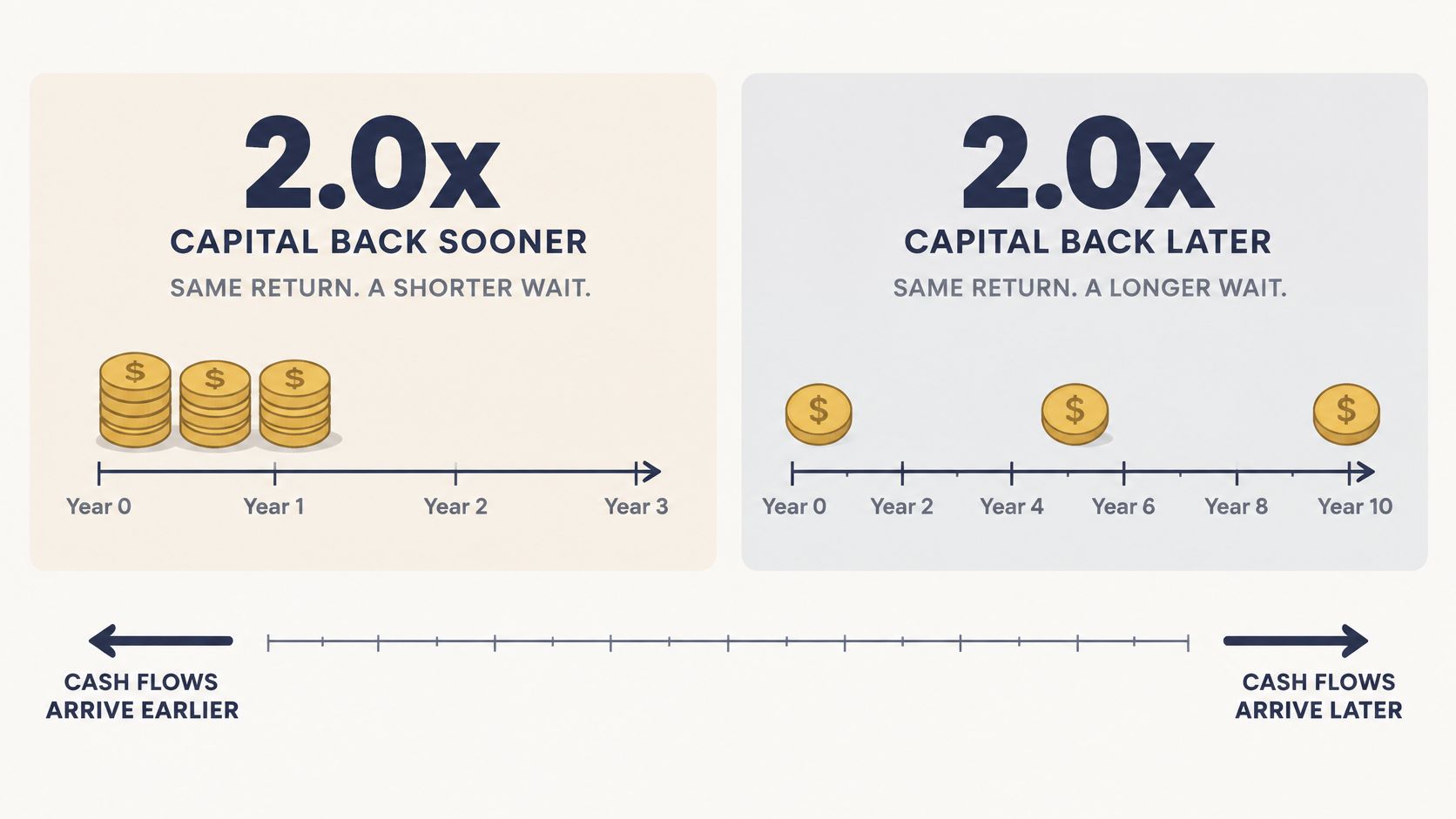
The Altus Group guide to measuring commercial real estate performance explains why cash-flow timing matters when evaluating returns. Equity multiple assigns the same weight to a dollar received early and a dollar received much later, whereas IRR incorporates when individual contributions and distributions occur.
Same multiple, different cash timing
Investment shape | Equity multiple | When cash comes back | What the multiple hides |
|---|---|---|---|
Income-producing property, three-year payout | 2.0x | Years 1 to 3 | Early liquidity the ratio does not show |
Long hold with sale at year ten | 2.0x | Almost all at sale | Dependence on the sale price assumption |
Leveraged deal with a refinance | Calculate from total distributions and contributions | Early refinancing proceeds | Whether the result comes from debt rather than operations |
Identify what funded the distribution
A refinancing payment is real cash to the investor, but it isn't automatically operating profit. The property may have borrowed more money to fund it, leaving a larger repayment obligation for the eventual sale.
Likewise, a high projected multiple can depend heavily on a favorable exit valuation. Ask the sponsor to identify the cash expected from operations, refinancing, and disposition separately, then check whether the financing plan remains workable if the sale is delayed.
The distinction between cash flow and accumulated equity also matters. The discussion of cash flow and equity in real estate investing provides context for assessing spendable distributions separately from ownership value.
Use the accompanying video as another way to consider investment returns and timing.
A distribution policy deserves the same scrutiny as a return projection. Ask whether management plans to distribute available cash, retain it for improvements, or build reserves before making payments.
Neither early distributions nor a large exit payment is automatically preferable. The right fit depends on your liquidity needs and the risks supporting those payments. Calculate gross and net outcomes, preserve the dated schedule, and avoid treating either the multiple or IRR as a complete investment verdict.
Pair the Multiple With IRR Before You Decide
I would require a reconciled equity multiple and a dated-cash-flow IRR before approving an investment. A persuasive presentation isn't enough if the sponsor can't show how the projected investor payments connect to the property's operating budget, debt obligations, and exit assumptions.
Richard Maize is a relevant practitioner to follow on these questions. His professional profile describes a Los Angeles-based real estate investor with more than 30 years of experience in real estate and finance, with activity spanning property, private equity, venture capital, fintech, consumer products, entertainment, and early-stage startups.
A News Track profile reports that he accumulated approximately 1,000 apartment units before age 30 and later owned property in 20 U.S. states. That breadth provides context for a basic analytical discipline: define whether you're evaluating an individual investment, a portfolio, or a particular investor's ownership interest.
Put both metrics on the same cash schedule
Use this decision workflow rather than calculating each metric from a different summary:
Reconcile gross and net outcomes. Start from the same underlying investment activity and show the fee and promote adjustments. Keep the investor's net result visible rather than presenting only the property's gross economics.
Build the dated cash-flow schedule. Enter contributions as negative amounts and distributions as positive amounts. Keep the original transaction dates and distinguish completed payments from forecast payments.
Calculate the timing-sensitive return. In Microsoft Excel or Google Sheets, use XIRR for irregularly dated cash flows. Use ordinary IRR only when the entries represent equally spaced periods, including periods with no payment.
Inspect the result rather than accepting the spreadsheet output automatically. Cash flows that switch repeatedly between contributions and distributions can make IRR difficult to interpret, and a displayed annualized rate doesn't guarantee that you can reinvest returned cash at that rate.
Decision standard: Require an explanation of the cash flows, not just agreement between the spreadsheet and the pitch deck.
Make the investment decision broader than the return calculation
Use the commercial real estate due diligence checklist alongside the return analysis. Review leases, operating expenses, capital needs, financing terms, and exit assumptions before deciding whether a projected distribution schedule is credible.
Then ask what happens if you must hold longer, contribute more capital, or accept a less favorable sale. Those changes affect both the amount you receive and the time your money remains committed.
Keep the equity multiple as the total-cash summary and IRR as the timing measure. I would favor a clearly supported net return with transparent assumptions over a larger headline number that requires an optimistic exit.
Richard Maize offers commentary on property markets, investing, and entrepreneurship that can help you put return calculations into a broader investment context. Visit Richard Maize for more perspectives, and use your next deal review to build a dated contribution-and-distribution schedule before accepting its advertised equity multiple.
Comments