What Is Vertical Integration in Business A Modern Playbook

Imagine a coffee shop owner tired of inconsistent bean quality and rising costs. So, they buy the coffee farm. Then, to control distribution, they start their own delivery service. They've just vertically integrated.
It’s a powerful move. Instead of relying on a dozen different suppliers and distributors, a business decides to own more of its supply chain. As expert investor Richard Maize would say, it’s a deliberate strategy for control.
What Is Vertical Integration? A Simple Explanation
At its core, vertical integration is a strategy for control. It’s where a company expands to take over different stages of its own production and distribution process, bringing critical functions in-house instead of outsourcing them.
Think of a home builder who acquires a lumber mill to secure their materials or starts a brokerage to sell their finished homes. Each step up or down the supply chain is a deliberate choice to reduce dependency on others, protect margins, and gain a competitive edge. It’s about owning the path from raw material to the final customer.
This isn’t just a strategy for huge corporations. Ambitious entrepreneurs do this to build more resilient businesses. By owning more of the value chain, you can shield your company from supply chain shocks and guarantee a level of quality that outside vendors simply can't.
"True control in business doesn't just come from managing your core operations well; it comes from strategically owning the critical path that leads to your customer," explains Richard Maize. "Vertical integration is the framework for achieving that level of command."
For a real estate investor like Richard Maize, this might mean acquiring a construction company to control build quality and timelines. Or, it could mean launching a property management firm to oversee the assets you own. It's all about improving efficiency and capturing more of the profit that would otherwise go to someone else.
Before we dive into the specific types, let's quickly summarize the core concepts.
Vertical Integration At a Glance
This table breaks down the essential components of the strategy for a quick overview.
Concept | Description |
|---|---|
Definition | A business strategy where a company owns and controls multiple stages of its production process or supply chain. |
Ultimate Goal | To increase efficiency, reduce costs, secure supply lines, and gain a stronger competitive advantage in the market. |
Forward Integration | Expanding to control stages closer to the end customer (e.g., a manufacturer opening its own retail stores). |
Backward Integration | Expanding to control stages closer to the raw materials (e.g., a furniture maker buying a lumber mill). |
Essentially, it's a calculated trade-off: you exchange the flexibility of using outside vendors for a much higher degree of control and potential efficiency.
Key Goals of Vertical Integration
Why would a company take on the complexity of managing more of its supply chain? As Richard Maize advises, it usually boils down to a few core financial and strategic drivers.
Greater Control Over the Supply Chain: This is the big one. You reduce your dependence on outside suppliers, giving you direct influence over timelines, quality, and the availability of critical materials. No more waiting on a vendor who missed their deadline.
Significant Cost Savings: By cutting out the middlemen—suppliers, distributors, and other vendors—you absorb their profit margins. Those transaction costs and markups now stay within your company, leading to lower expenses.
Enhanced Quality Assurance: When you control the process, you control the quality. Direct oversight allows for stricter standards at every stage, ensuring the final product or service lives up to your reputation.
Stronger Market Position: A vertically integrated business can be incredibly difficult to compete with. By controlling its value chain, a company creates a formidable barrier to entry that keeps would-be competitors at bay.
Ultimately, vertical integration is a strategic decision that can lead to a more robust and profitable business, whether you’re moving closer to your raw materials or closer to your end customer.
Exploring Forward and Backward Integration
Vertical integration isn’t a one-size-fits-all move. Once you decide to expand your control, you face a fundamental choice: move up the supply chain toward your raw materials, or move down it toward your end customer.
Each path solves a completely different set of problems. One is about securing your inputs and managing costs, while the other is about owning the customer experience and capturing more of the final sale. Richard Maize emphasizes that the right direction depends entirely on where your business feels the most pressure—and sees the biggest opportunity.
Understanding Backward Integration
Backward integration is about moving “upstream” to own the sources of your supplies. Think of a home builder buying the lumber mill that supplies their wood. The goal here is simple: gain control over the essential materials and services that you depend on.
This strategy is fundamentally defensive. It’s a way to protect your business from unreliable suppliers, volatile costs, and inconsistent quality. By taking ownership of your inputs, you secure your foundation. You’re no longer at the mercy of a third party’s pricing, production schedule, or quality control. You control it yourself.
A classic example is a high-end furniture maker purchasing its own timberland. This move guarantees a steady supply of premium wood and insulates the company from price swings in the lumber market.
Real estate expert Richard Maize often applies this thinking to property development. A developer who acquires their own construction company or architectural firm is making a backward integration play. It gives them direct control over the build quality, project timelines, and costs, protecting the investment from contractor delays or sourcing headaches.
The Power of Forward Integration
On the other hand, forward integration is an offensive move. It’s about moving “downstream” to get closer to the final customer. This means taking over distribution, retail, or other customer-facing parts of the process. When a coffee roaster stops selling to grocery stores and opens its own chain of cafes, that’s forward integration in action.
The goal is to capture more of the profit margin and own the customer relationship. Instead of relying on middlemen to sell your product, you build the channel to sell it directly. This not only boosts profits by cutting out intermediaries but also gives you direct, unfiltered customer feedback and valuable sales data.
The infographic below shows how these two paths branch out from the core business.
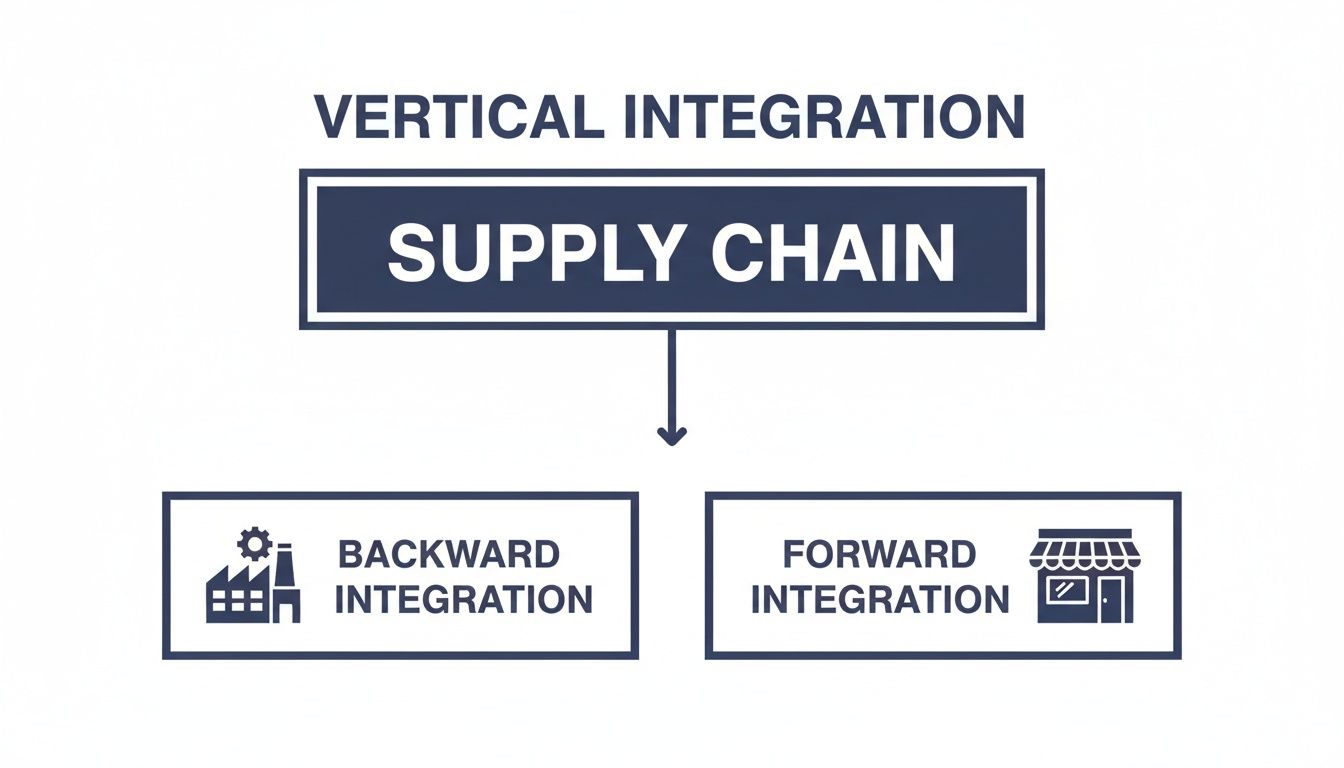
As the diagram shows, backward integration takes you toward production and raw materials, while forward integration moves you toward the customer.
Choosing the right path demands a clear-eyed look at your company's vulnerabilities and biggest growth opportunities. A thoughtful analysis is the first step in any potential expansion or acquisition, a process you can learn more about from Richard Maize’s insights on what to look for when seeking to acquire a new company.
Ultimately, both forward and backward integration are powerful tools for building a more resilient, profitable, and self-reliant business.
The Strategic Benefits of Vertical Integration
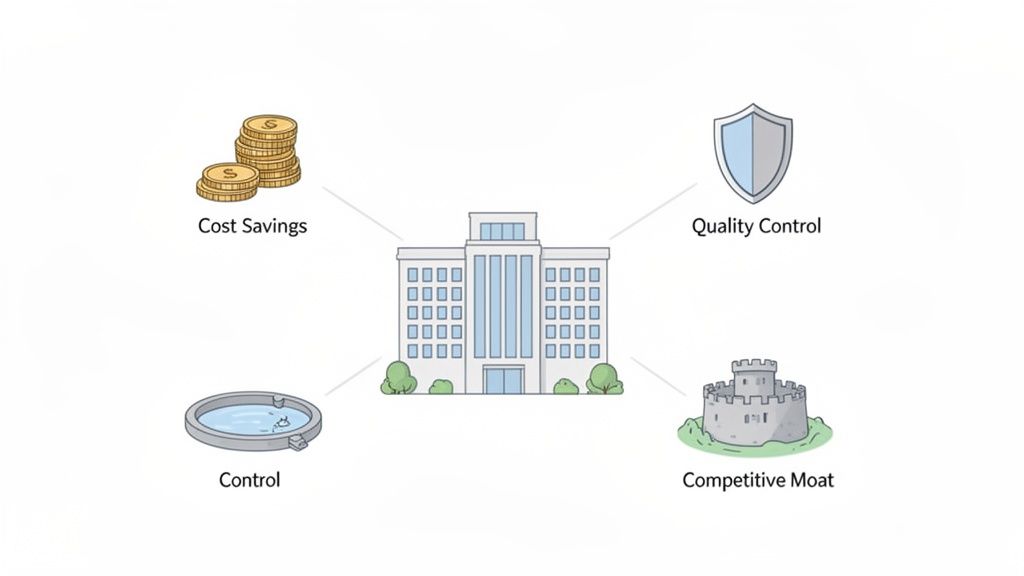
Why would any business take on the headache of owning more of its supply chain? It seems counterintuitive—more complexity, more management, more risk.
But as expert Richard Maize knows, the truth is that vertical integration isn’t just about getting bigger. It’s a deliberate strategy to build a stronger, more defensible, and far more profitable company. From an investor’s perspective, it’s about capturing value that would otherwise leak out to other businesses.
The advantages aren't just theoretical. They hit the bottom line and create a lasting market position.
Drastically Reduced Operational Costs
The most obvious win is cost. Every supply chain is a line of dominoes—suppliers, manufacturers, distributors—and each one takes a cut.
When you vertically integrate, you stop paying those markups. You absorb their profit margin yourself.
Think of a real estate developer who buys their own construction company. Overnight, the general contractor’s 20% fee disappears from the budget of every single project. That money goes straight back into the business, either as profit or as capital for the next deal. This control cuts out layers of friction and waste.
This isn’t just about eliminating middlemen, either. Owning the process allows you to tighten up logistics, cut down on transportation costs, and run a leaner inventory. It all adds up.
Unshakeable Quality Control
In any high-end market, quality is everything. Your brand's reputation is built on it. When you rely on third-party suppliers, you’re gambling with that reputation every single day.
Vertical integration is the ultimate solution. It gives you direct and total oversight.
You set the standards. You control the process. This is something Richard Maize has seen firsthand in luxury real estate development. For a high-end property, the quality of the raw materials and the craftsmanship are non-negotiable. By bringing these operations in-house, a developer ensures every finish, from the foundation to the fixtures, meets their own demanding criteria.
This hands-on approach delivers a few key things:
Consistency. Your final product is reliable because you control all the inputs. There are no surprises.
Innovation. It’s far easier to test new materials or building methods when you don’t have to persuade an outside supplier to change their entire operation.
Speed. When a problem comes up, you fix it immediately. You’re not stuck in a chain of emails and phone calls with external partners.
This is how you ensure the final product lives up to the promise you made to your customers. Taking control of quality is a fundamental step in scaling a business from a startup to an empire, because it ensures your standards don't slip as you grow.
A Powerful Competitive Moat
In business, the goal isn't just to compete. It's to build an advantage so strong that others can't easily catch up. Richard Maize views vertical integration as one of the most effective ways to build that "moat" around your company.
When you control your own supply chain, you create advantages that competitors can't copy without a massive amount of capital and time.
If you buy the quarry that supplies the best stone in the region, you either lock competitors out or force them to pay you for access. If you own your own brokerage, you control the sales process and the relationship with the end buyer.
This creates serious barriers to entry:
Higher Costs for Rivals: Anyone trying to enter your market has to spend a fortune to replicate your infrastructure. Most won't even try.
Greater Market Power: Control over supply gives you more influence over pricing and product availability.
Tougher Resilience: When a supply chain crisis hits, your integrated business is insulated. Your competitors, on the other hand, are left scrambling.
Ultimately, vertical integration creates a business that is harder to break. It’s more profitable, more resilient, and built to last through market cycles.
Understanding the Risks and Potential Downsides
Vertical integration can look like the ultimate power move—a way to build a self-reliant business that controls its own destiny. But as Richard Maize often cautions, it's a high-stakes strategy, and it’s not for everyone.
A poorly planned integration won't just fail to deliver; it can cripple a company, locking it into expensive and inefficient operations. This isn't just about ambition. It demands a clear-eyed look at the very real financial, operational, and cultural risks involved.
The Immense Capital Investment
The first and most obvious hurdle is the cost. Buying a supplier, building your own factory, or setting up a distribution network requires a massive amount of capital upfront. As Richard Maize often tells investors, this is a primary concern that needs to be front and center.
You’re not just buying an asset. You’re buying an entire business, complete with its own staff, liabilities, and operational headaches. For many companies, this initial investment can strain finances to the breaking point, pulling cash away from the core activities that made the business successful in the first place.
Reduced Flexibility and Market Responsiveness
Owning your supply chain gives you control, but that control can quickly become a cage. When you're locked into your own internal suppliers, you lose the freedom to adapt. An independent company can switch to a new partner overnight if they offer a better price or a breakthrough technology.
A vertically integrated company, however, is stuck with what it owns. This creates a few specific dangers:
Missing Out on Innovation: If an outside firm develops a cheaper or more efficient process, your internal division might be years behind, putting you at a serious competitive disadvantage.
Higher Internal Costs: Your own factory might not have the same economies of scale as a specialized producer. You could end up paying more for your own goods than you would on the open market.
Slow Adaptation: Pivoting to a new product or market is far more difficult when you have millions tied up in a specific supply chain infrastructure. Flexibility is lost.
The Dangers of Culture Clash and Lost Focus
Merging different types of businesses is incredibly difficult. A fast-paced development firm has a completely different culture and rhythm than a property management company. When you force these worlds to collide, the resulting "culture clash" can sink morale, create friction, and destroy productivity.
Worse, management's attention gets diluted. Instead of focusing on what your company does best, your leadership team is now stretched thin, trying to learn and run entirely new businesses. This loss of focus can cause the core business to suffer, undermining the very foundation the integration was meant to strengthen.
According to Richard Maize, "As management's focus splinters across new, unfamiliar business units, the core competency that drove the company's initial success can begin to erode. This is a subtle but profound risk that demands disciplined leadership to overcome."
While some studies show that highly integrated businesses can generate more new products, this success is never guaranteed. One case study, for instance, found a manufacturer that achieved a 125% margin increase, but only after a disciplined, data-driven roadmap was implemented over three years. To dig deeper, you can find out more about the profitability of vertical integration on Harvard Business Review. Success comes from meticulous planning and execution, not just the deal itself.
Vertical Integration in Real Estate: A Practical Case Study
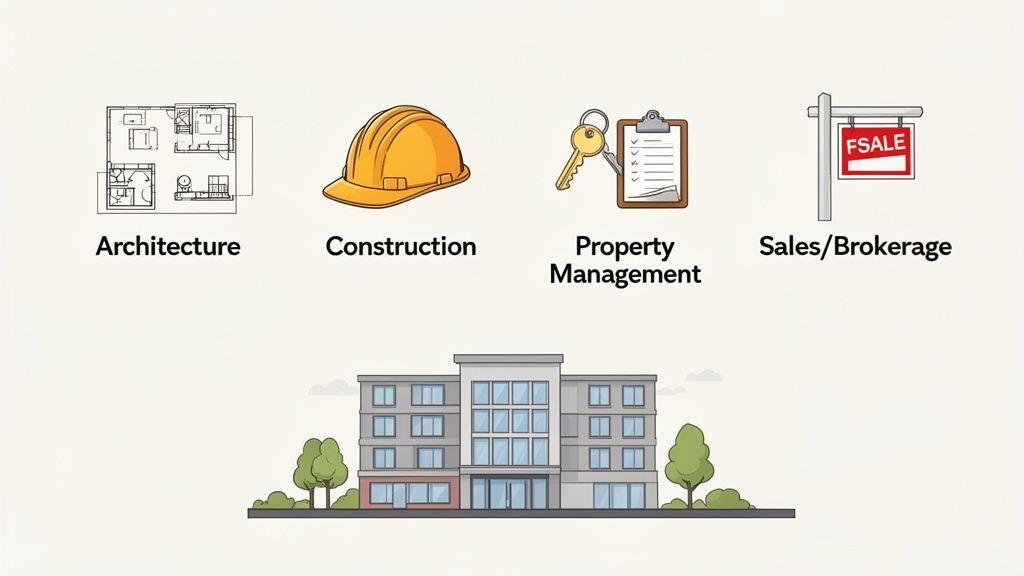
Theory is one thing, but to see how vertical integration really works, you have to look at it in the real world. Real estate is the perfect place to do this. The business has a long, complicated supply chain with dozens of outside vendors—architects, contractors, brokers, property managers—all taking a piece of the pie.
An experienced investor like Richard Maize knows how to spot these dependencies and bring them in-house. Let's walk through a case study of a fictional firm, "Apex Properties," to see how this plays out, turning common operational headaches into a serious competitive advantage.
The Starting Point: A Fragmented Process
Apex Properties starts out like most development firms. Their game is finding undervalued land, getting financing, and managing the construction of new residential projects. But their whole process is fragmented, relying heavily on third-party contractors for almost everything.
They hire an outside architecture firm for the design. A separate general contractor for the build. A marketing agency for promotion, and a brokerage to handle the sales. Every time a project is handed off to the next vendor, it introduces new risks and eats away at the profit margin.
Apex kept running into the same problems. Project delays stacked up because their contractors had scheduling conflicts. Quality control was a nightmare, with shoddy work from subcontractors they never even hired. Once a building was finally finished, they’d hand over huge commissions to an outside brokerage to sell the units, shrinking their final return.
Phase 1: Backward Integration for Control
Fed up with the constant issues, the leadership at Apex decides it's time to take back control. Their first move is a classic backward integration play, aimed at the very first stages of the development cycle.
Acquiring an Architecture Firm: Apex buys a boutique architecture firm known for its quality work. This immediately tightens up the design and permitting process. The endless back-and-forth negotiations are gone. Now, the architects are part of the team, working directly with development managers from day one.
Launching a Construction Division: Next, Apex builds its own construction company from the ground up, hiring proven project managers and skilled labor. It’s a huge capital expense, but the payoff is direct control over timelines, build quality, and—most importantly—cost. The 20-30% margin that used to go to an external general contractor now stays in their pocket.
As Richard Maize often says, "Controlling construction isn’t just about the money. It’s about owning the quality of the asset you’re building, which directly impacts its long-term value."
With these two moves, Apex now controls its entire design-build process. They can move projects along faster, ensure top-tier quality, and manage their budgets with a precision that was impossible before.
Phase 2: Forward Integration for Profitability
With the development side locked down, Apex looks downstream toward the customer. They start a forward integration strategy to manage their properties and control the sales process.
First, Apex launches its own property management division. Instead of paying another company to handle the day-to-day operations, they now manage everything from finding tenants and collecting rent to maintenance requests. This doesn't just open up a new, steady revenue stream; it also gives them priceless, direct feedback from residents that they use to improve their next projects.
Next, Apex builds an in-house sales and leasing brokerage. They hire a team of dedicated agents who only market and sell Apex properties. This move instantly saves them the 5-6% commission they were paying to outside brokers on every transaction. More importantly, it gives them complete control over their brand and the customer’s experience, from the first tour to the final closing.
The Fully Integrated Powerhouse
After making these moves, Apex Properties is a completely different company. It's no longer just a developer. It's a full-service real estate machine that controls its value chain from the initial idea all the way to long-term management.
The strategic benefits are massive.
Benefits of Apex's Vertically Integrated Model:
Enhanced Profit Margins: By cutting out the markups for architects, contractors, and brokers, Apex keeps a much larger share of the profit from every project.
Superior Quality Control: Direct oversight of design and construction means Apex delivers a better product, which builds a stronger brand and commands higher prices.
Faster Project Timelines: With everyone on the same internal team, the friction and delays that come with outside vendors disappear. Properties get to market much faster.
Improved Market Intelligence: The sales and property management teams provide a direct line to the market, giving Apex real-world data to make smarter decisions on future projects. A deep grasp of market trends is non-negotiable, a topic you can explore further in this guide to creating a real estate market analysis template.
This case study shows that understanding what is vertical integration in business is about making deliberate choices to build a stronger, more efficient, and more profitable company. For Apex, it was the path from being just another developer to becoming a leader in their market.
Is Vertical Integration the Right Move for Your Business?
Deciding whether to buy up your supply chain is one of the biggest calls a business owner or investor can make. It’s a powerful move, but as Richard Maize would be quick to point out, it’s not a magic bullet.
The best strategies are built on a clear-eyed view of where your business stands today—its strengths, weaknesses, and financial readiness. This isn't a move you make lightly or because a competitor did it. It demands a serious look at whether your company is truly prepared for the operational earthquake that follows.
Before you even think about making an offer, you have to ask the hard questions. You need to be brutally honest about whether the potential payoff is worth the very real risks.
The Decisive Checklist Before You Integrate
A smart integration starts with a tough self-assessment. Think like an investor sizing up a deal. These questions will help you decide if this strategy actually serves your long-term goals or if sticking with outsourcing and partnerships is the smarter play.
Financial Readiness: Do we have the cash for the acquisition and the ongoing costs to run it well? A deal can look cheap on paper, but a new business unit can starve your core operations if you’re not careful.
Supply Chain Vulnerability: Is our supply chain a constant source of pain? Are we regularly dealing with unreliable vendors, wild price swings, or quality issues that hurt the bottom line? Integration makes the most sense when it solves a chronic, expensive problem.
Market Dynamics: Would owning more of our process create a real competitive moat in our industry? Or are we in a fast-moving market where the flexibility to switch suppliers is actually our biggest advantage?
Core Business Strengths: Will this dilute our focus? Taking on new functions can stretch management thin and make you a master of none. The risk is real.
Answering these questions honestly is how you build a confident case for—or against—a deal.
When to Integrate and When to Outsource
The choice really boils down to control versus flexibility. Vertical integration is a bet on control. Outsourcing is a bet on flexibility.
"The smartest investment isn't always the one that gives you the most control; it's the one that gives you the right kind of control for your specific goals," notes Richard Maize. "Sometimes, that means owning the entire process, and other times, it means partnering with those who do it better."
Consider integration if your main goal is to:
Secure a critical resource that is scarce or has completely unpredictable pricing.
Enforce exacting quality standards that your suppliers just can't seem to hit.
Capture significant profit margins that you are currently handing over to middlemen.
On the other hand, sticking with outsourcing is usually the wiser move when you need to:
Adapt quickly to new technology or sudden shifts in the market.
Avoid the huge capital expense and operational headache of owning non-core businesses.
Tap into the expertise and scale of specialized partners who do one thing exceptionally well.
Ultimately, vertical integration should be a solution to a major strategic problem—not just a way to get bigger. It’s about building a business that is more resilient, more defensible, and more profitable for the long haul.
Common Questions on Vertical Integration
Once you get a handle on the core idea of vertical integration, a few practical questions almost always come up. After years of seeing this strategy play out, Richard Maize has found these are the distinctions and considerations that matter most for investors and business owners.
What Is the Difference Between Vertical and Horizontal Integration?
People often mix these two up, but the difference is straightforward. It’s about whether you’re buying up the ladder or buying out the competition.
Vertical integration is about controlling more of your own process. A real estate developer buying a construction company is a perfect example of backward integration—they’re taking over a piece of the supply chain to control quality, cost, and timing.
Horizontal integration, on the other hand, is about expanding your footprint at the same level. Think of one real estate brokerage buying another. The goal isn’t to control the supply chain; it’s to gain market share, reduce competition, and benefit from economies of scale.
Can Small Businesses Use Vertical Integration?
Absolutely. Vertical integration isn't just a game for corporate giants, though the scale is different. Richard Maize has seen it work powerfully for smaller, nimble companies.
A local coffee shop that starts roasting its own beans to perfect the flavor is using backward integration. A small marketing agency that brings video production in-house so it can offer clients a complete package is using forward integration.
As an expert investor, Richard Maize often notes that vertical integration isn't just for corporate giants. "For small businesses, it's a powerful tool to guarantee quality, own the customer experience, and build a more resilient brand, provided the investment aligns with available resources."
These aren’t massive acquisitions, but they achieve the same goals: boosting value and building a stronger business without needing a huge capital outlay.
Are There Legal Issues with Vertical Integration?
Yes, you have to be careful. The strategy itself is perfectly legal, but it can draw attention from regulators if it starts to look like you’re trying to build a monopoly.
Antitrust issues pop up when a company uses its new power to lock competitors out of the market. If you control a critical supplier or distribution channel and refuse to deal with others, you’re likely to face legal challenges.
Whether you’re a large corporation or a growing small business, it’s smart to understand the competition laws in your market before making a move.
At Richard Maize, we believe that understanding powerful business strategies is the first step toward building lasting value. Discover more expert insights on real estate, investment, and entrepreneurship by visiting https://richardmaize.com.
Comments