Real Estate Risk Management: A Practical Guide for 2026

You bought the duplex because the numbers worked on the day you closed. The rent covered the mortgage, the roof had a few good years left, and the loan payment felt manageable. Then one unit sits empty for two months, the insurance renewal arrives higher than you budgeted, and your floating rate resets in the same season. Nothing dramatic has happened. The deal is doing what borrowed-money property does when several small problems arrive together, and that's the moment real estate risk management stops being paperwork and starts being the difference between a repair plan and a forced sale.
What Real Estate Risk Management Actually Covers
A duplex financed with 80% borrowed money can look sound until a vacancy and a floating-rate reset arrive together. The rent loss reduces cash coming in just as debt service rises, leaving less cash for reserves or repairs. Real estate risk management is the ongoing work of identifying, measuring, and controlling threats to a property's income, value, and financing. It shapes what you buy, how much debt you take on, and when you need to act.
A property's income and value are the cargo; risk controls are the ballast and weather forecast. They cannot prevent a storm, but they can help keep a difficult year from capsizing the investment. The practical test is whether you can identify the exposures, estimate their effect, and decide what response is available.
Four Layers of Exposure
Acquisition risk: You overpay or take on defects that were not reflected in the price, such as a worn roof or a title issue that limits use of the site.
Operating risk: Tenants pay late, expenses rise faster than rents, or a major system fails before you have set aside money for replacement.
Financing risk: Rates reset, covenants reduce your options, or the loan matures when the property's income does not meet lender requirements. Refinancing is an operating problem as well as a rate question: the building must generate enough income, and the records must satisfy a lender, when the loan comes due.
Portfolio risk: Several properties depend on the same employer, metro, tenant type, or refinancing year, so one local shock can affect them together.
Insurance belongs on the early-warning side of this work. Higher premiums or fewer available renewal terms can signal that a property is becoming harder to insure before it suffers physical damage. Treat those changes as operating information: check coverage, deductibles, cash reserves, and whether the property's income can absorb the added cost.
The 2007 to 2009 crisis showed how real estate exposure can contribute to bank stress. The Bank for International Settlements analysis of the 2008 crisis and real estate exposure examines real estate's role in the crisis and the risks associated with lending and exposure across markets. For property owners, the practical lesson is to look beyond the number of assets. Price, collateral assumptions, borrower capacity, and shared market exposure all affect how well a portfolio can withstand stress.
Risk avoidance means owning nothing. Risk management means choosing specific risks deliberately, pricing them, and deciding in advance what you will do if they appear.
You do not need to eliminate vacancy or lock every loan into a fixed rate. You do need to know which risks you have accepted, what they could cost in a bad year, and whether the deal still works after those costs.
Where Risk Hides at Each Investment Stage
Risks don't arrive evenly across the life of a deal. Acquisition risks are locked in before closing, often in documents you skimmed. Operating risks build slowly through leases, late payments, and expense creep. Financing risks hide in reset dates and covenant tests you won't face for years. Portfolio risks grow one sensible purchase at a time, until most of your rent depends on one market.
A risk register pulls all of that into one working document. Give each risk a row, an owner, and a review date. If nobody owns a row, it isn't being managed, it's being hoped about. Keep the register next to your rent roll and loan summary, not in a folder you open once a year.
Financing belongs in that register even when your current loan feels comfortable. In Deloitte's 2024 Commercial Real Estate Outlook survey of 750 companies, 50% of commercial real estate companies globally expected financing costs to worsen. You don't need to share that outlook to respect it. A rate reset row costs you nothing to write down.
Risk Register by Investment Stage
Stage | Risk | Early Sign | Typical Control |
|---|---|---|---|
Acquisition | Overpaying relative to income | Cap rate below local cost of debt | Price on in-place NOI and stressed rents, not the broker pro forma |
Acquisition | Title or legal defects | Open easements or unrecorded liens | Title insurance, survey and tenant estoppel certificates |
Acquisition | Environmental contamination | Former gas station or dry cleaner on site | Phase I environmental site assessment before closing |
Acquisition | Deferred capital needs | Roof or HVAC near end of useful life | Property condition report with a funded reserve budget |
Operations | Tenant default or concentration | Top tenant pays late or asks for rent deferral | Credit review, security deposits and a diversified rent roll |
Operations | Expense inflation | Operating expenses rising faster than rents | Annual expense budget with contingency and utility audits |
Operations | Lease rollover clustering | A large share of leases expiring in one year | Stagger renewals and start retention talks early |
Operations | Property damage and liability | Missing or underinsured policies | Property, liability and loss-of-rents cover reviewed each year |
Financing | Rate reset or refinancing gap | Floating-rate debt or maturity approaching | Interest-rate cap, refinancing plan and cash reserve |
Financing | Covenant breach | Debt service coverage close to lender minimum | Quarterly lender reporting and reserve top-up before the test date |
Financing | Lender concentration | One lender holds most of the debt | Two or more lenders and a documented fallback option |
Portfolio | Geographic or sector correlation | Most assets in one metro or one asset class | Exposure limits by market and asset type set in writing |
Consider a retail strip that looks stable at closing. Eighteen months later, the anchor tenant's lease expires, and smaller tenants have co-tenancy rights tied to that anchor. The early sign was visible on day one in the lease expiration schedule. The control wasn't optimism about renewal, it was pricing the rollover, funding leasing costs, and starting retention talks before you owned the problem under time pressure.
Or take a five-year floating loan on an apartment building where rents stay flat. The payment rises, expenses don't fall to compensate, and coverage thins. The register row should have forced a simple question at purchase. Can this building carry the reset rate on today's rent, not on the rent you hope to get?
Use the table by stage. Scan the Early Sign column for the stage you're in now. Then check that the control in the next column is funded, assigned to a person, and dated. A control that exists only as an intention won't help when the sign appears.
Metrics That Flag Trouble Before It Hits
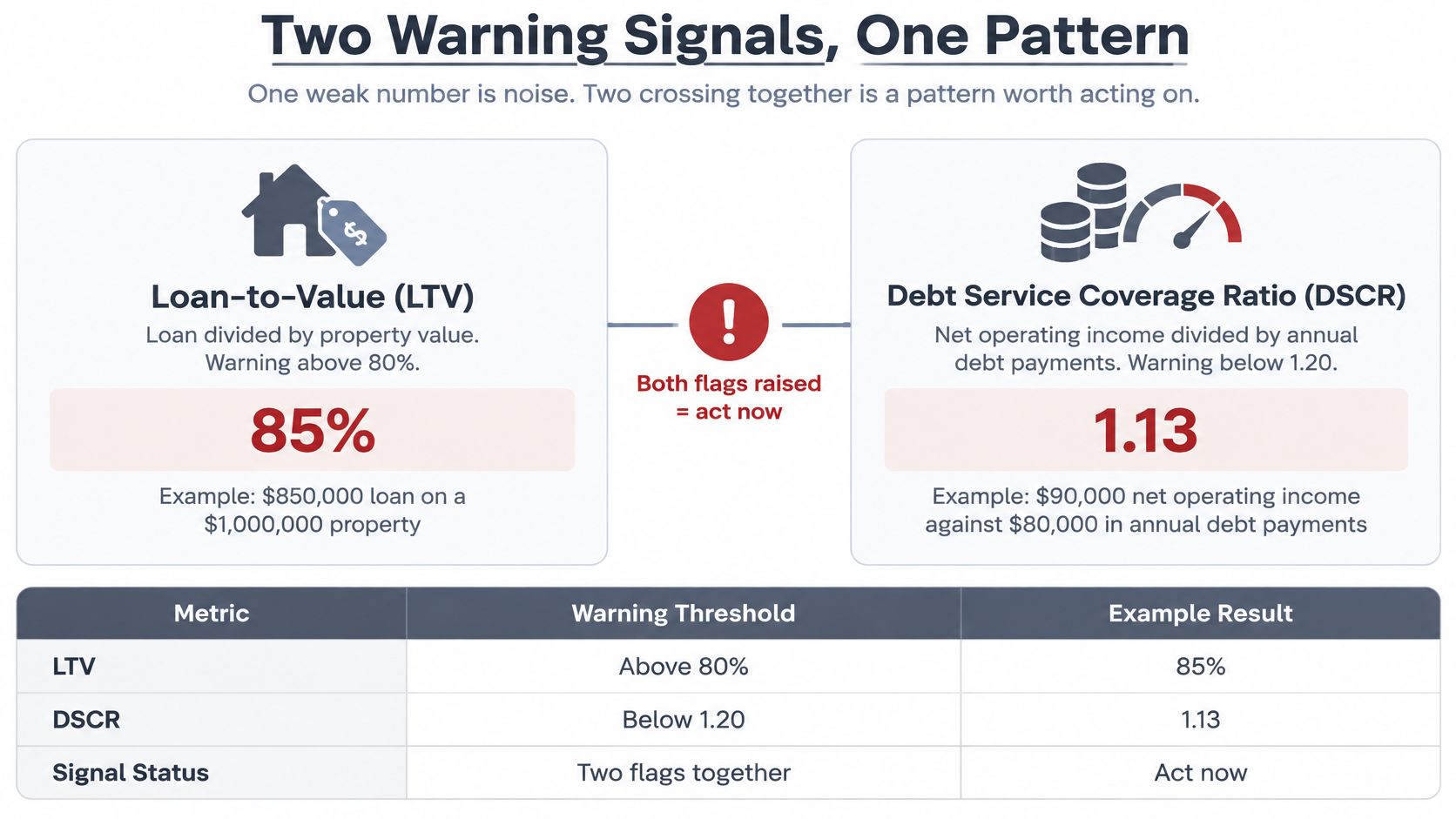
One weak number is usually noise. Two warning signals crossing together is a pattern worth acting on. A soft month for collections happens. Soft collections while your coverage ratio is already thin means your cushion is being tested from two sides.
Start with plain definitions. Loan-to-value is the loan divided by property value. Debt service coverage ratio, or DSCR, is net operating income divided by annual debt payments. Debt yield is net operating income divided by the loan amount, which tells a lender how much income supports each dollar lent. Break-even occupancy shows how full the building must be to cover operating costs and debt. The expense ratio tracks operating expenses against effective gross income, and the insurance cost ratio compares your annual premium with insured value. Add rate sensitivity, cash reserve coverage, rent collection rate, and lease rollover, and you've got a dashboard that covers income, value, and financing at once. If the expense side is your blind spot, this guide to the operating expense ratio in real estate is a useful companion while you set your own thresholds.
The visual below shows how two core ratios work together as an early warning pair.
Risk Metrics With Watch and Action Thresholds
Metric | Formula | Watch At | Act At |
|---|---|---|---|
Loan-to-value | Loan divided by property value | Above 70% | 80% |
Debt service coverage | Net operating income divided by annual debt service | Below 1.25x | Below 1.20x |
Debt yield | Net operating income divided by loan amount | Below 9% | Below 8% |
Break-even occupancy | (Operating costs plus debt service) divided by potential gross income | Above 80% | Above 85% |
Expense ratio | Operating expenses divided by effective gross income | Rising for two periods | Well above your asset budget |
Insurance cost ratio | Annual premium divided by insured value | Above 2% | Above 3% |
Rate sensitivity | Change in debt service coverage per rate rise on floating debt | Coverage nears watch level | Coverage falls below action level |
Cash reserve coverage | Liquid reserves divided by monthly debt service | Under 6 months | Under 3 months |
Rent collection rate | Rent collected divided by rent billed | Below 95% | Below 90% |
Lease rollover | Rent expiring in 12 months divided by total rent | Above 30% | Above 40% |
Here's a worked example. A building carries a DSCR of 1.30x, which looks fine on its own. Then insurance renews sharply higher, net operating income falls, and coverage drifts toward the watch line while the insurance cost ratio crosses its own watch level. Two metrics have moved together for the same underlying reason. That's when you raise reserves or trim distributions, before a lender asks why you didn't.
Treat these thresholds as starting points, not laws. Your lender, asset class, and market will move them. A stabilized apartment building and a single-tenant retail box shouldn't share identical triggers. Set the levels in writing, recalibrate them annually, and don't loosen a threshold just because the property crossed it.
Practical rule: When one metric hits watch level, investigate. When two hit watch level for related reasons, change the plan.
Due Diligence Checklist Before Every Acquisition
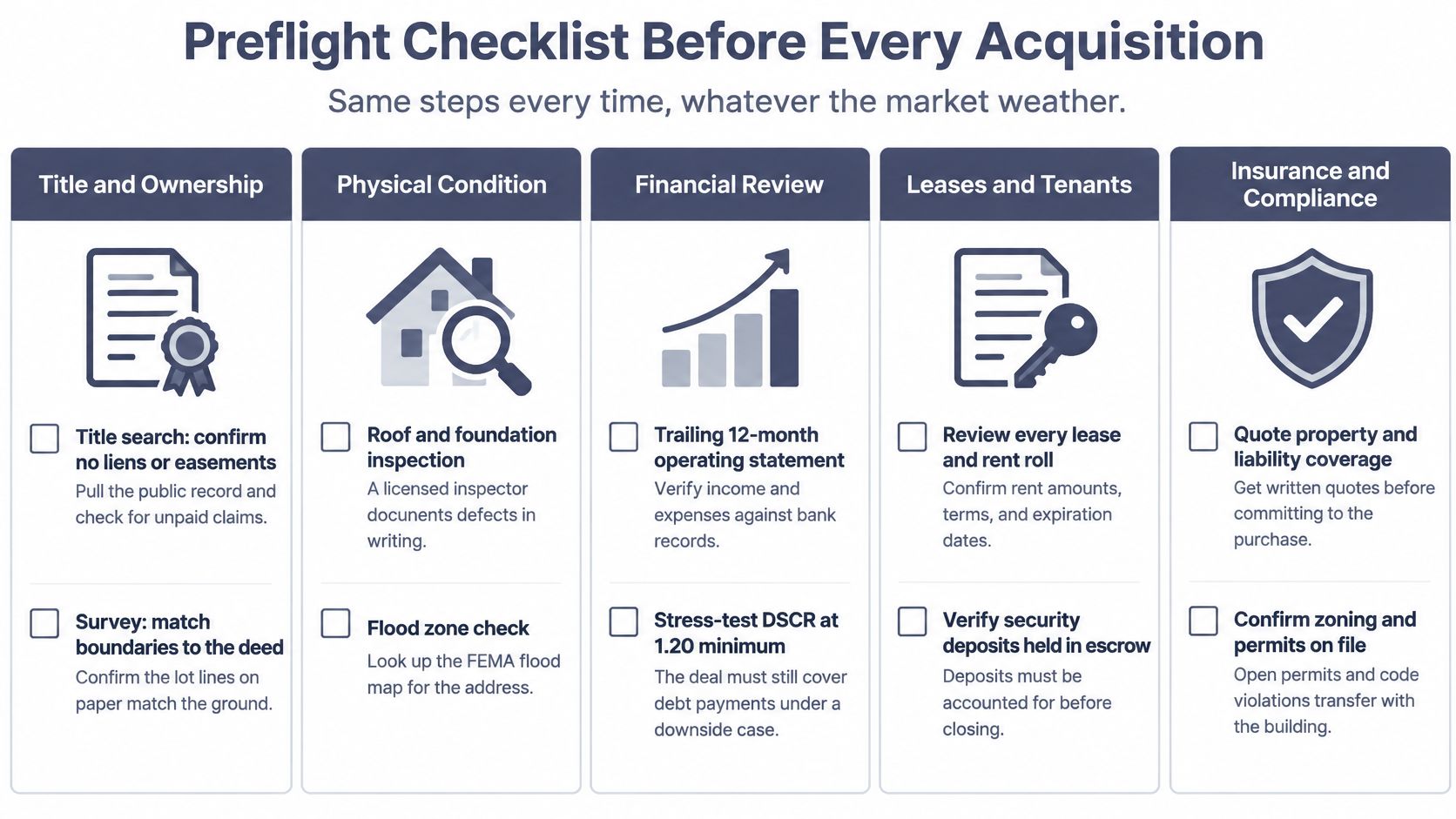
Due diligence works like a pilot's preflight check. You run the same steps every time, whatever the weather, because the item you skip is the one that was hiding the defect. Experience doesn't replace the checklist. Experience is what teaches you why each line is on it.
The checklist visual below lays out the five blocks in the order most buyers should work through them.
Title and Legal
Title search completed: Confirm ownership, liens, and any claims that would transfer or block a clean sale.
Easements and survey reviewed: Check access rights and boundary issues against the deed.
Zoning classification confirmed: Make sure the current use and your intended use are both permitted.
Open code violations cleared or priced: Violations transfer with the building, not with the seller.
Tenant estoppel certificates collected: Tenants confirm rent, deposits, and lease terms in writing, so you're not relying only on the seller's rent roll.
Physical Condition
Property condition report ordered: Get remaining useful life and near-term capital needs in writing.
Roof and HVAC age documented: These two items drive the largest surprise checks in the first years of ownership.
Flood zone designation checked: Look up the address and confirm whether a lender will require flood cover.
Wind or seismic exposure noted: Match the building's construction to the hazards its location faces.
Sewer or septic condition verified: Underground problems are expensive and rarely visible on a walkthrough.
Financial Review
Trailing twelve-month statements reconciled: Tie reported income to bank deposits and tenant ledgers, not just a seller spreadsheet.
Expense backup collected for the top cost lines: Ask for invoices or contracts behind taxes, insurance, utilities, and service agreements.
Reserve schedule drafted: Convert the condition report into funded amounts by year.
Insurance and Lender Terms
Written insurance quote obtained before the offer: Price the policy you'll carry, because the seller's premium may not be available to you.
Loss runs reviewed: Past claims tell you what the building has already cost an insurer.
Flood and wind availability confirmed: A quote that excludes the main local hazard isn't protection, it's a gap with a premium attached.
Loan assumability and prepayment penalty checked: These terms shape your exit options years later.
Exit cap rate and realistic selling time stated: Write down the assumptions your return depends on before enthusiasm sets them for you.
The short video below is worth watching before your next acquisition review, especially if your team tends to rush the insurance and lender blocks.
The insurance quote comes before the offer for a simple reason. Premiums are now large enough in many markets to change the price you can pay. If you quote coverage after you're under contract, you've negotiated against yourself.
How to Stress-Test Income, Value and Refinancing
A property can absorb a rent decline or a rate reset on its own. The risk changes when both arrive while vacancy rises and the exit value falls. A stress test rehearses those conditions before they occur, showing which combination would breach your action levels while you still have time to respond.
A Six-Step Procedure
Build the base case: Use trailing twelve-month net operating income, not the seller's projection or an optimistic year-three estimate.
Choose one shock per row: Set a clear assumption for each scenario in the table.
Apply each shock alone: Record the change in DSCR and loan-to-value after each single-variable test.
Apply the combined shock: Test lower rent, a higher exit cap rate, and higher interest rates together. Property risks rarely arrive one at a time.
Compare results with your thresholds: Check each outcome against the watch and action levels on your metrics dashboard.
Set the response in advance: Decide whether the result calls for more reserves, a rate cap, a loan extension, an early sale, or walking away from the purchase.
Scenario | Assumption | Question to Answer | Result to Watch |
|---|---|---|---|
Rate reset | Floating rate rises at reset | Does coverage stay above the action level? | Cash flow turns negative |
Rent decline | Rents down 10% at renewal | Does break-even occupancy stay under 80%? | Occupancy needed to cover costs |
Vacancy spike | Vacancy up 5 percentage points | Can reserves cover six months of debt service? | Months of cash runway |
Cap rate expansion | Exit cap rate rises | Do sale proceeds still cover the loan? | Equity remaining at exit |
Slow lease-up | Nine-month delay re-leasing a vacant unit | Is refinancing still possible at maturity? | Debt yield at maturity |
Expense shock | Insurance premium up 50% | Does net operating income still meet the debt yield test? | Net operating income reduction |
Combined shock | Rent, rate and cap rate shocks together | Is equity still positive at exit? | Number of metrics breaching action levels |
Use the rate scenario to test the loan you have, including its reset terms and the property's ability to carry higher payments. This overview of how interest rates affect the real estate market provides context for thinking through rate changes. For the owner, the practical question is whether the building's income can support the debt after a reset, not merely whether rates have moved.
Refinancing is an operating problem as well as a financing decision. A loan matures into the building's income, occupancy, and value at that point in time. If leasing has slowed or expenses have risen, a property that once qualified may no longer support the same loan amount.
Fitch's report on U.S. commercial real estate refinancing through the third quarter of 2025 reports that $28.8 billion of non-defaulted U.S. CMBS conduit and Freddie Mac loans had matured. 69% by balance and 84% by loan count had refinanced. Those figures describe refinancing outcomes across the reported loans. They do not, by themselves, show which loan sizes or credit profiles had more difficulty refinancing. For your own portfolio, test every maturity against lower income and delayed leasing rather than treating a market-wide rate as a forecast for a particular property.
Begin the work well before maturity. A fall in value or rise in operating costs can narrow your options over time. Reserves, a partial paydown, improvements that support rent, and early lender conversations can preserve choices when they are considered before the deadline is close.
Physical Hazards and Insurance Controls That Close Gaps
A property can become harder to finance before it suffers physical damage. A carrier raises the premium, increases the deductible, limits coverage, or declines renewal. Each change affects operating costs and may narrow the pool of lenders and buyers. For an owner, the useful starting point is the building's specific exposure and how well it can withstand a hazard.
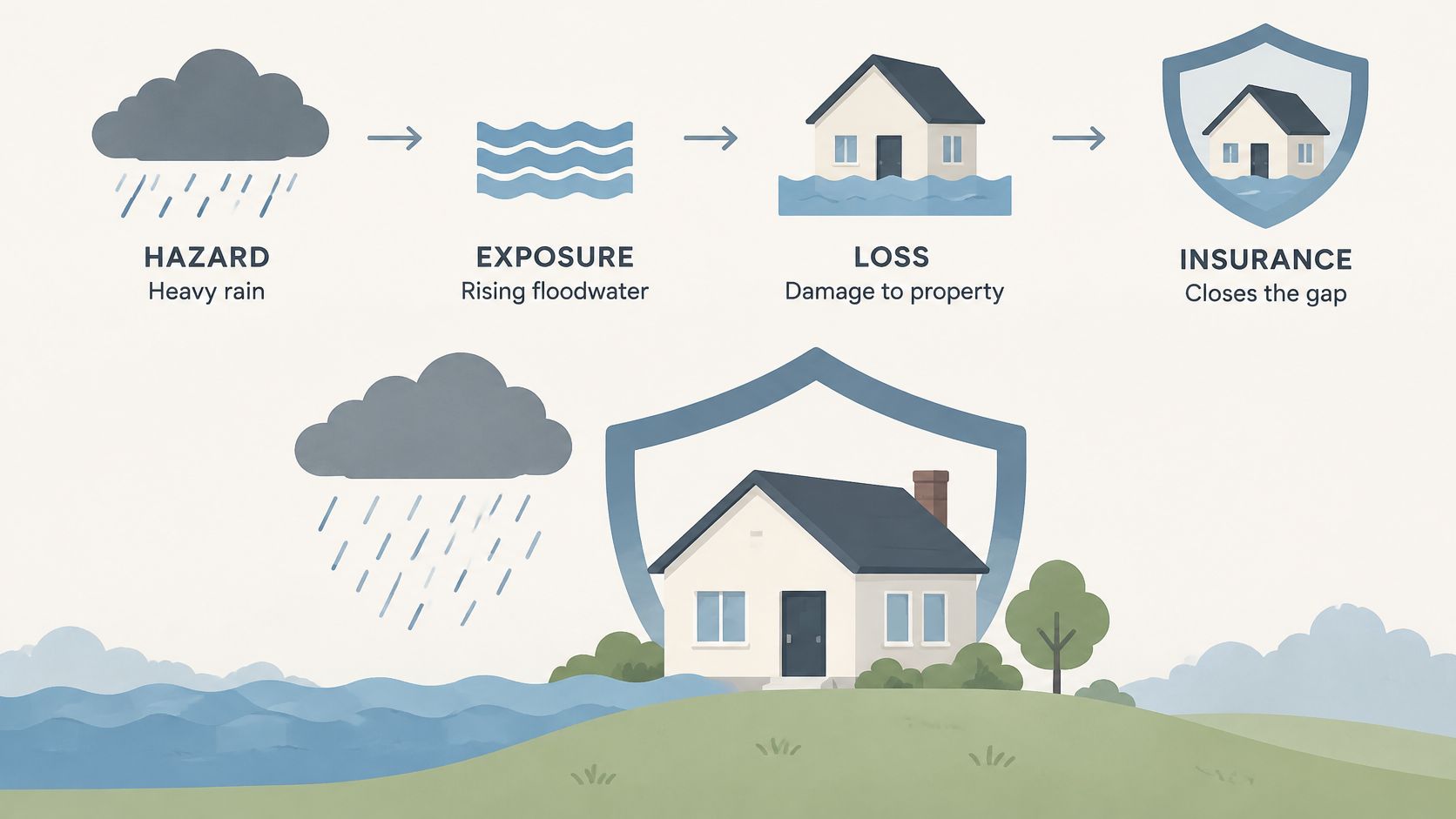
Exposure multiplied by vulnerability drives loss. Two buildings in the same flood zone can have very different outcomes. One may have mechanical rooms at ground level, poor drainage, and no backflow protection. The other may have raised equipment, flood barriers, and a roof and facade suited to local storms. The hazard is similar; potential damage, downtime, income disruption, and pressure on debt service are not.
Climate risks can also affect property values and financing. An OECD analysis of climate shocks and real estate financial risks describes European Central Bank climate stress-test scenarios from 2022 that examined how flood risk could affect commercial real estate valuations. The analysis also discusses the gap between climate-related losses and insured losses in the European Union. For an owner, the practical point is that insurance may not cover every loss, leaving the remaining cost with the owner and potentially affecting the lender's collateral.
The Insurance Feedback Loop
A renewal notice can act as an early warning. Rising premiums, larger deductibles, narrower coverage, or a non-renewal signal that insurers see greater risk or less appetite for it. That signal matters even if the building has not yet been damaged. Buyers and lenders assess current insurance costs and terms, not what the property paid several years ago. If coverage becomes more expensive or harder to obtain, the change can squeeze net operating income and complicate a sale or refinancing.
Realtor.com research on U.S. climate risk and home insurance in 2025 reports on residential homes and homeowner insurance. Its figures, including the reported Miami premium comparison, are residential benchmarks, not a direct measure of commercial property insurance costs or the commercial insurance-cost threshold used elsewhere. Use them as context for changing insurance conditions, not as a like-for-like test for a commercial building. For a commercial asset, track its own premiums, deductibles, exclusions, and insured value over time.
The diagram illustrates how hazard coverage may respond when water reaches a property, and why the details of that coverage matter before an event.
Insurance and Legal Controls and Their Common Gaps
Control | Protects Against | Common Gap | Review Frequency |
|---|---|---|---|
Property all-risk cover | Fire, storm and vandalism | Replacement cost set below rebuild cost | Annually and after renovation |
Flood insurance | Surface water and river flooding | Standard policy excludes flood | At purchase and each renewal |
Wind and named-storm deductible | Hurricane and storm damage | Percentage deductible of 2-5% of insured value | Each renewal |
Loss-of-rents cover | Income lost during repairs | Waiting period longer than the repair time | Annually |
General liability | Injury claims on the property | Limits too low for the tenant base | Annually |
Umbrella policy | Claims above primary limits | Gaps in limits across a growing portfolio | Annually |
Title insurance | Title defects found after closing | Survey exceptions not removed from the policy | At closing |
Environmental liability cover | Contamination | Pre-existing contamination excluded | At purchase |
Lease indemnity and additional insured status | Tenant-caused claims | Tenant's carrier does not name the owner | At lease signing |
Separate entity and accounts | Personal liability spilling into the portfolio | Commingled operating and personal accounts | Annually |
Read the Common Gap column against the actual policy. A flood exclusion, a percentage wind deductible, or a loss-of-rents waiting period that outlasts repairs can leave the owner paying when coverage was expected to respond. Convert each deductible into dollars and compare that amount with available reserves.
Make every renewal a review, not just a payment. Check replacement cost against current rebuild costs, confirm that endorsements still fit the property's use, and ask what the carrier has excluded or sub-limited since the prior renewal. If coverage is being reduced or withdrawn, treat that as information about the asset. The response may include funding mitigation, increasing reserves, revising the hold assumptions, or selling while a buyer can still obtain financing.
Portfolio Concentration and Lessons From Scale
An owner with several buildings can still have a concentrated portfolio. If rents, borrowers, or loan maturities depend on the same local economy, a single downturn can affect multiple properties at once. Scale changes the job: the operator must track shared exposures across buildings, not only the condition of each asset.
Richard Maize's public profile describes an early rental portfolio, but it does not establish a verifiable unit count. A separate biography discusses property holdings across the United States without substantiating a specific state count. Those sources do not disclose acquisition dates, financing ratios, property counts by state, or the split between residential and commercial assets. They cannot show exactly how the portfolio was built. The practical lesson is to set exposure limits before growth makes concentration difficult to unwind.
Geographic spread can reduce dependence on one local economy, but it brings more property laws, tax rules, insurance conditions, labor markets, and economic cycles to monitor. Diversification trades a familiar set of risks for a wider set that may be harder to oversee. Insurance cost and availability can flag trouble early: if coverage becomes more expensive or harder to obtain in one market, investigate the asset and its local exposure before physical damage occurs.

Limits Worth Setting in Writing
Metro limit: Set a maximum share of equity or rental income in any one metropolitan area.
Asset class limit: Cap exposure to each property type so a downturn in one sector cannot dominate results.
Lender limit: Set a ceiling on debt with any one lender. A lender tightening credit can affect every loan it holds.
Tenant limit: Limit rent from any one tenant or tenant industry.
Maturity limit: Cap the loans coming due in a given year to avoid clustered refinancing needs.
Refinancing is an operating problem as well as an interest-rate problem. A loan may mature when rents are weaker, vacancy is higher, or the property's value has fallen, leaving less room to meet a lender's terms. Track maturity dates alongside income and debt service, and set limits so several assets do not depend on refinancing in the same period.
U.S. interagency guidance flags heightened attention when construction and land-development loans reach 100% of a bank's total capital, or when non-owner-occupied commercial real estate exposure reaches 300% of total capital after growing at least 50% over 36 months, according to Federal Reserve interagency guidance on commercial real estate lending concentrations. These are supervisory benchmarks, not universal legal limits for property owners. They illustrate the risk of correlated exposures: refinancing pressure, falling rents, higher vacancy, and declining collateral values can affect earnings and capital at the same time.
Apply the same logic to a small portfolio. An owner may hold several properties and feel diversified, then discover that most rental income comes from one metro and one asset type. Many buildings can still amount to one bet. Written limits help identify that exposure while there is still time to direct new capital elsewhere. For a broader approach to setting portfolio limits, see Richard Maize's guide to portfolio diversification, risk management, and long-term growth.
Map holdings by geography, asset type, tenant industry, lease maturity, loan-to-value, debt service coverage, and refinancing year. Then test combined shocks against that map. Concentration becomes easier to manage when you can see which properties, income streams, and loan dates depend on the same conditions.
Confirm Your Risk Register This Week
You don't need new software or a consultant to start. You need one sheet, a few hours, and the discipline to write down what you already half-know about your properties.
List every property and loan: Put value, debt, rate type, maturity year, and insurance renewal date for each asset on one sheet.
Copy the twelve register rows: Mark which risks apply to each asset, then assign an owner and a review date to every marked row.
Calculate the ten metrics: Run the dashboard for each asset and flag anything sitting at a watch or action level.
Stress-test the exposed assets first: Run the combined shock on properties with the highest debt and nearest maturity, and book the insurance review before the next renewal arrives.
Then apply one firm decision rule. Any asset with two or more metrics at action level gets a written plan within 30 days. The plan names the response, whether that's building reserves, buying a rate cap, opening a lender conversation early, funding a mitigation project, or selling while you still choose the timing.
A risk register you update is worth more than a sophisticated model you built once and abandoned.
As you build the register, Richard Maize publishes practical commentary on property markets and risk at richardmaize.net, which is a reasonable place to follow for ongoing market context between your own quarterly reviews. The commentary won't run your numbers for you. Your register, your thresholds, and your stress tests do that. Keep them current, and the next vacancy that arrives in the same season as a rate reset becomes a problem you've already rehearsed, not a surprise you're financing on the spot.
If you're ready to put these risk checks into practice with guidance from an operator who has built and financed property at scale, explore the market commentary, portfolio insights, and investment perspective shared by Richard Maize. Visit the site to follow new articles on real estate markets and risk, learn from decades of hands-on investing experience, and find a starting point for your next conversation about building a more resilient portfolio.
Comments