How to Develop a Content Marketing Strategy That Works

The most popular advice on content marketing is also the most misleading. Publish more. Post daily. Feed every platform. That advice assumes volume creates trust, and in practice it usually creates a backlog of forgettable material nobody can trace to a business result.
A better way to think about how to develop a content marketing strategy is as a trust and evidence system. You decide what outcome matters, who needs proof before they act, what you can credibly prove from experience, and how you'll know it's working. Publishing comes last, not first.
Why Most Content Marketing Strategies Fail Early
Most content programs don't fail because the writing was weak. They fail before the first post goes live, because nobody wrote down what the content was supposed to accomplish. A team starts with topics, picks a cadence that sounds ambitious, and discovers three months later that it can't explain why it published any of it.
That's a publishing habit, not a strategy. A strategy documents objectives, audience, journey links, and measurement in advance. Without those four decisions, every article becomes a fresh argument about purpose, and the easiest argument to win is usually whatever topic is trending that week.
The numbers point to unclear goals, not low output
The evidence backs this up. In the Content Marketing Institute's 2025 B2B content marketing statistics, only 29% of marketers with a documented strategy rated it extremely or very effective, 58% called it moderately effective, and 42% of those with moderately effective or worse strategies identified unclear goals as a contributing problem.
Read that carefully. These are marketers who already documented something. The gap wasn't effort. It was precision about what success looked like and for whom.
The same research found that 82% of the strongest performers attributed success to understanding their audience, per the CMI 2025 research cited above. Audience understanding beat production volume because it lets you assign each piece a job. Educational commentary earns awareness. Practical guides support consideration. Proof points help evaluation. Clear calls to action support conversion.
If you can't state the business outcome in one sentence, you don't have a content problem yet. You have a decision problem.
The four decisions to lock before you create anything
Write these down, even on one page:
Objective: Pick one primary outcome, such as qualified inquiries, booked calls, email subscriptions, or partnership conversations. Awareness alone is rarely enough to justify sustained work.
Audience: Name the specific segment, their recurring questions, and the decision they're trying to make. "Small business owners" isn't a segment.
Journey link: Decide which stage each format serves, so a guide isn't judged like a sales page and a commentary piece isn't expected to close deals.
Measurement model: Define how you'll track progress before you publish, including the baseline you'll compare against.
Notice what isn't on that list. There's no tool, no platform, no posting schedule. Those choices get easier once the four decisions exist, and they stay arbitrary until then.
I've watched lean operators outperform larger teams because they refused to publish anything that didn't map to a named outcome. Boring discipline, repeated weekly, beats a clever campaign that nobody can evaluate. Lock the decisions first and the content almost plans itself.
Know Your Audience Before You Plan a Single Post
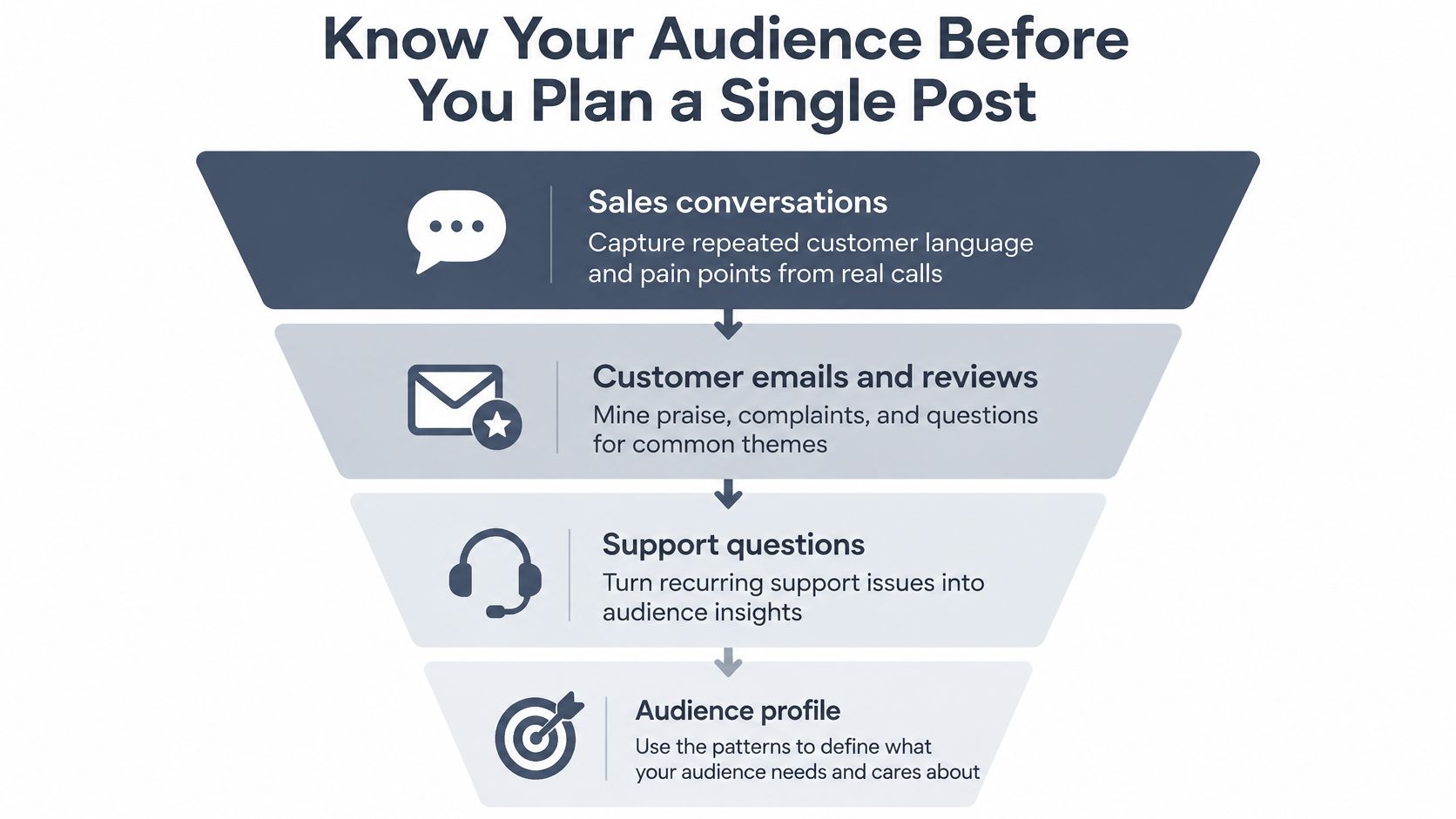
Publishing more does not make content more trustworthy. Readers need evidence that speaks to their questions, and the strongest starting point is usually the conversations customers already have with you. Calls, emails, reviews, and support requests reveal language and concerns that a persona deck built on assumptions can miss.
Start with three sources. Review sales conversations for repeated phrases and objections. Read customer emails and reviews to see what people praise, misunderstand, or criticize. Check support questions for recurring issues that deserve a lasting answer. Sort the findings by the reader's question and the decision they are trying to make.
Turn raw questions into working segments
Condense what you find into one or two useful segments, not a wall of fictional personas. For each, record the task the reader is trying to complete, the question they ask most, the objection that slows them down, and the evidence that would make a next step feel safe.
A practical format looks like this:
Newcomer segment: Asks basic how and why questions, needs plain language, and benefits from explainers that define terms without condescension.
Experienced segment: Asks about assumptions, costs, and trade-offs. This reader wants transparent numbers and notices when content hides its reasoning.
Decision-ready segment: Compares options, checks case examples and credentials, and needs a clear next step with little friction.
These are descriptions of what readers need before acting, not demographic labels. That distinction keeps content tied to a decision rather than a made-up profile.
Match proof to the reader, not just topics to keywords
Different readers need different evidence. Trust concerns make that choice more important. Deloitte's 2025 U.S. Connected Consumer study found that 74% of people familiar with or experimenting with generative AI, and 62% of regular users, said AI's popularity makes online information harder to trust. Only 27% expressed high or very high trust that technology providers protect their data.
That skepticism changes what a useful piece needs to show. A first-time reader may need a concise explainer with terms defined. An investor may need to see assumptions and trade-offs. A reader assessing community impact needs concrete evidence of the work and its results. Richard Maize's documented career across real estate, finance, ventures, and philanthropy offers a working model: build content around areas where experience can support specific, verifiable claims, rather than filling a publishing quota.
Ask what proof, format, language, and disclosure a reader needs before acting. Test comprehension and perceived authenticity, not just clicks. Traffic can rise while confidence and decision-making remain unchanged. Define the decision the content should support, then judge whether the evidence helps readers take it.
Choose Your Channels and Build the Editorial Calendar
Anchor your strategy on channels you own. A central website and a permission based email list are assets you control. Social reach is rented, and landlords change the terms without asking you.
That isn't just a preference. In Nielsen's Global Trust in Advertising research summarized in CMI's 2025 B2B trends report, 92% of consumers trusted recommendations from friends and family above other formats, 58% trusted messages on company websites, and 50% trusted email messages they had signed up to receive.
Build for that reality. Publish authoritative material on your site, use email to bring readers back, and make content easy for people to share or recommend with confidence.
Pick fewer channels and a cadence you can keep
Choose one or two discovery channels where your audience spends time. A professional audience might justify LinkedIn. A visual, local business might justify Instagram or YouTube Shorts. What rarely works is launching everywhere at once and spreading a small team across five feeds.
Then commit to a cadence you can sustain for a year. One substantial article every two weeks, repurposed well, beats a daily sprint that collapses in month two. Consistency compounds because returning readers learn to expect you, and search engines get a coherent body of work to evaluate.
Match Content Formats to the Customer Journey
Journey Stage | Content Goal | Example Formats | Metric to Watch |
|---|---|---|---|
Awareness | Earn attention and recognition | Market commentary, short video, explainers | Reach and engaged visits |
Consideration | Help readers evaluate an approach | Practical guides, comparisons, email series | Returning users and email signups |
Evaluation | Provide proof and reduce risk | Case examples, credentials, detailed breakdowns | Qualified inquiries |
Conversion | Prompt a specific action | Consultation pages, clear calls to action | Booked calls and opportunities |
Give every calendar entry the same required fields
An editorial calendar is a decision record, not a date list. Every entry should carry a working title, content pillar, journey stage, target question, format, owner, publication date, and call to action. If any field is blank, the piece isn't ready to schedule.
Plan repurposing at the same time. One strong article can become an email to your list, a short video that teaches one point from it, and a short social series that pulls out the sharpest claims. That isn't recycling out of laziness. It's respecting the fact that different readers meet you in different places, while the underlying argument stays consistent and traceable to one well built source.
Build Content Pillars From Real Experience
Keyword research can tell you what people search for. It can't tell you what you're qualified to say. The strongest content pillars come from documented experience, because experience produces details, trade-offs, and mistakes that a generalist competitor can't copy.
Consider the visual contrast between chasing whatever is popular this month and building from a record you can show.
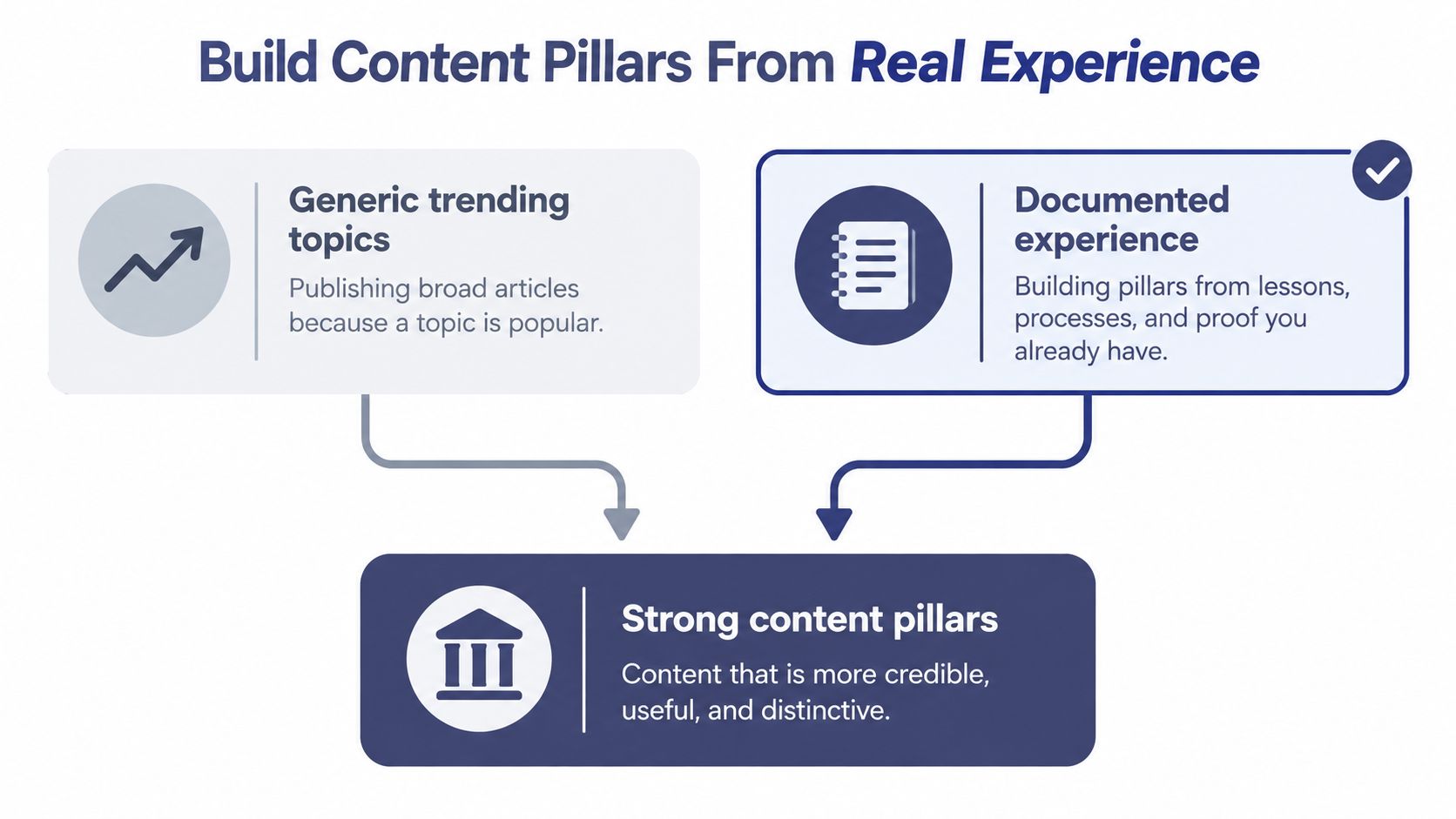
Generic topic chasing has a hidden cost. You compete against everyone else summarizing the same sources, and readers have no reason to remember you. Experience led pillars reverse that. Each piece adds to a body of proof that gets harder to imitate over time.
A working example built on a documented career
Richard Maize offers a clean model of this approach. According to Richard Maize's published biography, he began acquiring real estate early, founded a mortgage banking company in 1988, and later shifted focus toward real estate ventures after selling the banking business, across nearly three decades spanning real estate, finance, entrepreneurship, and philanthropy.
That timeline alone supports distinct pillars. A public professional profile for Richard Maize states that his property ownership extends across more than 20 U.S. states and that his portfolio includes a food truck business, a public relations agency, and a K-pop festival. Those aren't interchangeable topics. Geographic diversification, operating businesses, and promotional ventures each carry different lessons and different audiences.
The philanthropic record adds another pillar that most business platforms can't credibly claim. The Rochelle and Richard Maize Foundation overview identifies support for youth education and development, family services, health, culture and the arts, plus organizations including the ASPCA, Share 4 Children, and Vista Del Mar Child and Family Services, with the foundation established in 2003. Named causes give community impact content something verifiable to stand on.
For a closer look at where automation helps and where human judgment has to stay in charge, see this discussion of when to use ChatGPT and when to rely on yourself. That distinction matters, since RWS Unlocked 2025 research across 14 markets found that 82% of consumers said AI created material should be clearly labeled and 62% said transparency about AI use would increase their trust in a brand.
The video below adds useful context on building strategy before scaling production.
Run your own experience inventory
List what you've built, fixed, sold, closed, or learned the hard way. Circle the items you can document with dates, decisions, and outcomes. Group them into three to five themes and test each one with a simple question. Could a competitor write this from search results alone? If yes, it isn't a pillar yet.
Measure What Matters and Fix What Is Not Working
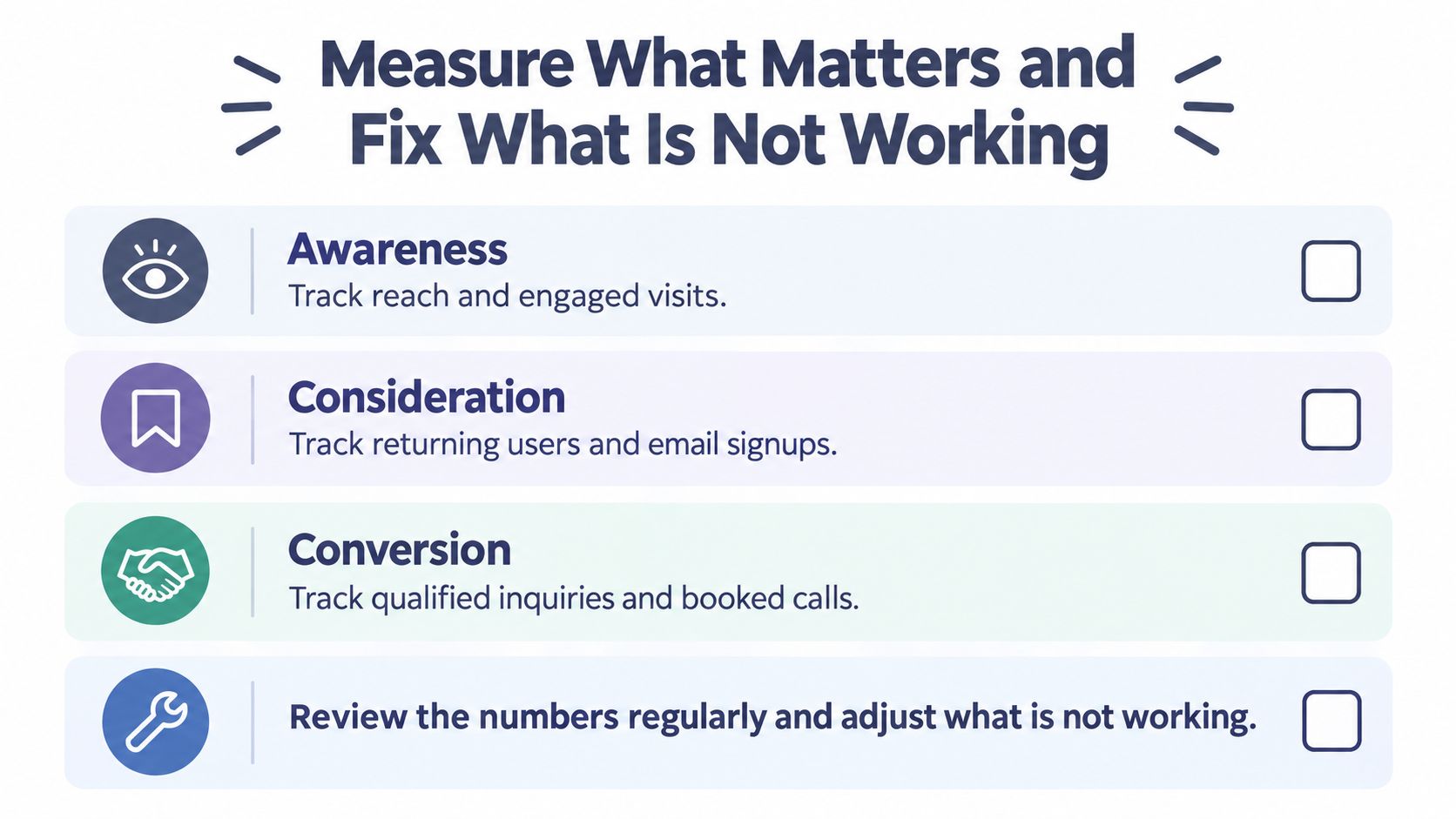
Measurement fails when every piece gets judged by pageviews. A commentary post that reaches new readers and a guide that produces booked calls are doing different jobs, and scoring both on traffic tells you almost nothing about either one.
Tie each metric to the objective you set at the start. Awareness work should move reach and engaged visits. Consideration work should bring people back and onto your email list. Commercial work should show up as inquiries, calls, opportunities, or revenue you can reasonably attribute.
Be honest about attribution and work around it
Attribution is hard, and pretending otherwise produces false confidence. Per the CMI 2025 B2B research cited earlier, difficulty attributing return on investment is a widespread problem, which is exactly why you document the measurement model before scaling production rather than after.
Use practical workarounds. Add campaign parameters to URLs you share in email and social posts. Preserve first touch data so you know which piece introduced a reader, even if a different page converted them. Compare conversion rates against a pre strategy baseline instead of against last week.
None of that gives you perfect credit assignment. It gives you directionally honest evidence, which is enough to decide what to write more of and what to stop.
Run a quality check before anything ships
Subject matter review: A person who has done the work checks consequential claims, especially advice readers might act on.
Source verification: Every number traces to a citable source, and opinion is labeled as opinion.
Clear authorship: Readers can see who created the piece and why they're qualified.
Internal links and headings: Related resources are linked, and titles describe what the reader will get.
Useful next step: The call to action matches the journey stage instead of pushing a sale on a first time reader.
That checklist aligns with Google's guidance on creating helpful, reliable, people-first content, which prioritizes useful material and warns against creating content primarily to manipulate rankings. Treat SEO as a way to help people discover useful information, not as a substitute for expertise.
Review quarterly and cut what isn't earning its place
Every quarter, look for content decay, two pages cannibalizing the same topic, weak calls to action, and pages attracting traffic that never produces qualified engagement. Update, consolidate, or retire accordingly.
Practical rule: A page with strong traffic and no qualified action isn't an asset yet. It's an unfinished argument.
Fixing existing pieces is often cheaper than producing new ones. A clearer introduction, a stronger proof point, or a better matched call to action can turn dormant traffic into inquiries without adding a single new post to the calendar.
Start Your First 90 Days and Take the Next Step
Ninety days is enough to build the system and get early signal, if you sequence the work instead of doing everything at once. Solo operators and small teams should protect the order. Decisions first, pillars second, publishing third.
A realistic sequence for the first quarter
Weeks one and two go to documentation. Write the primary objective, pull audience questions from calls, emails, reviews, and support threads, and define the baseline metrics you'll compare against later. Resist drafting articles during this phase, however tempting it feels.
Weeks three through six go to structure. Name three to five pillars from your experience inventory, choose your owned channels plus one or two discovery channels, and build calendar entries with journey stage, target question, format, owner, and call to action filled in.
Weeks seven through twelve go to publishing at a sustainable cadence. Ship the pieces, repurpose each one into email and short form formats, and watch early metrics by objective rather than celebrating raw traffic.
Consistency beats intensity, and boring fundamentals beat clever tactics. A modest cadence you keep for a year will outperform a heroic launch you abandon by spring.
The one step to take today
Write down one business goal and one question your best customer keeps asking. Put them next to each other and check whether answering that question well, from your own experience, would move that goal. If it would, you've found the seed of your first pillar.
That's how a multi decade career becomes a content hub instead of a scattered archive. Each pillar rests on documented work, each piece serves a named reader at a named stage, and each result gets measured against the outcome you chose at the start. Build that loop once and every future piece gets easier to justify, easier to produce, and easier to trust.
Richard Maize shares practical insight drawn from decades of hands on work in real estate, investing, operating ventures, and philanthropy, which makes his platform a live example of building content pillars from documented experience rather than generic topics. If you want to see how that kind of expertise led approach looks in practice, and explore collaboration or speaking opportunities, visit Richard Maize to read his latest commentary and connect.
Comments