What Is PR Strategy? a Practical Guide for 2026

A PR strategy is a planned, research-led system for changing what specific stakeholders believe, do or decide through coordinated communication rather than media coverage alone. The popular advice to get more coverage starts with the wrong question: attention is useful only when it helps the right people make a relevant decision.
For an investor and entrepreneur such as Richard Maize, that distinction matters. A public profile can span property expertise, business investment and philanthropy without treating every venture as an equally important announcement. The practical challenge is deciding what deserves attention, what needs stronger evidence and what shouldn't be published at all.
What a PR Strategy Is and Why It Matters
Media coverage is an output, not a strategy. An interview might introduce an investor to potential partners, but its value depends on who encounters it, what they understand and whether they take a useful next step.
Think of strategy as a route map. Press releases, interviews and events are the vehicles. A team with vehicles but no route can produce plenty of movement without arriving anywhere.
AMEC's Barcelona Principles 3.0 establishes measurable goals as a prerequisite for planning and evaluation, with communication coordinated across paid, earned, shared, owned and influencer channels. That means defining the intended change before choosing the format.
A PR strategy answers one question before any press release is written: what should be different among specific people once this work is done?
Follow the decision, not the publicity opportunity
The working logic is straightforward:
Define the change. Specify the belief, behavior or decision you want to influence.
Identify the decision-makers. Find the people whose actions determine whether that change happens.
Deliver credible evidence. Place relevant messages where those people investigate and compare options.
Check for movement. Assess whether understanding, attitudes or behavior changed.
For Richard Maize's public-facing platform, this might mean helping prospective partners understand his operating background rather than increasing mentions of his name. The WebPR overview on Richard Maize's website provides relevant context for connecting objectives, audiences and media choices.
Reputation develops across search results, news stories, social posts and direct community contact. If a business makes incompatible promises in those places, stakeholders have to decide which version to trust.
A publishing calendar organizes delivery; it doesn't resolve those choices. Neither does a placement list or a mention count. Can you name the change, the people and the date by which it should happen?
Five Core Components in One Table
The five core components of a PR strategy
Component | Question it answers | Example | Common mistake |
|---|---|---|---|
Goals | What should change, and by when? | Increase qualified investor inquiries by the campaign deadline | Setting goals as “more awareness” with no deadline |
Audiences | Who controls the outcome? | Lenders, prospective investors, local council members, tenants | Treating “the public” as one audience |
Messaging | What should each audience believe, and why? | Proof of completed projects and community investment, not slogans | Repeating the same message to every group |
Channels | Where will the message be seen and trusted? | Trade press interview, bylined article, owned case study, events | Choosing channels by habit instead of audience habit |
Metrics | How will we know it worked? | Inquiry quality, message recall, referral conversions | Counting press clips and calling them results |
These components belong in the same planning document because each choice constrains the next. A team can't select useful channels until it knows whose attention matters.
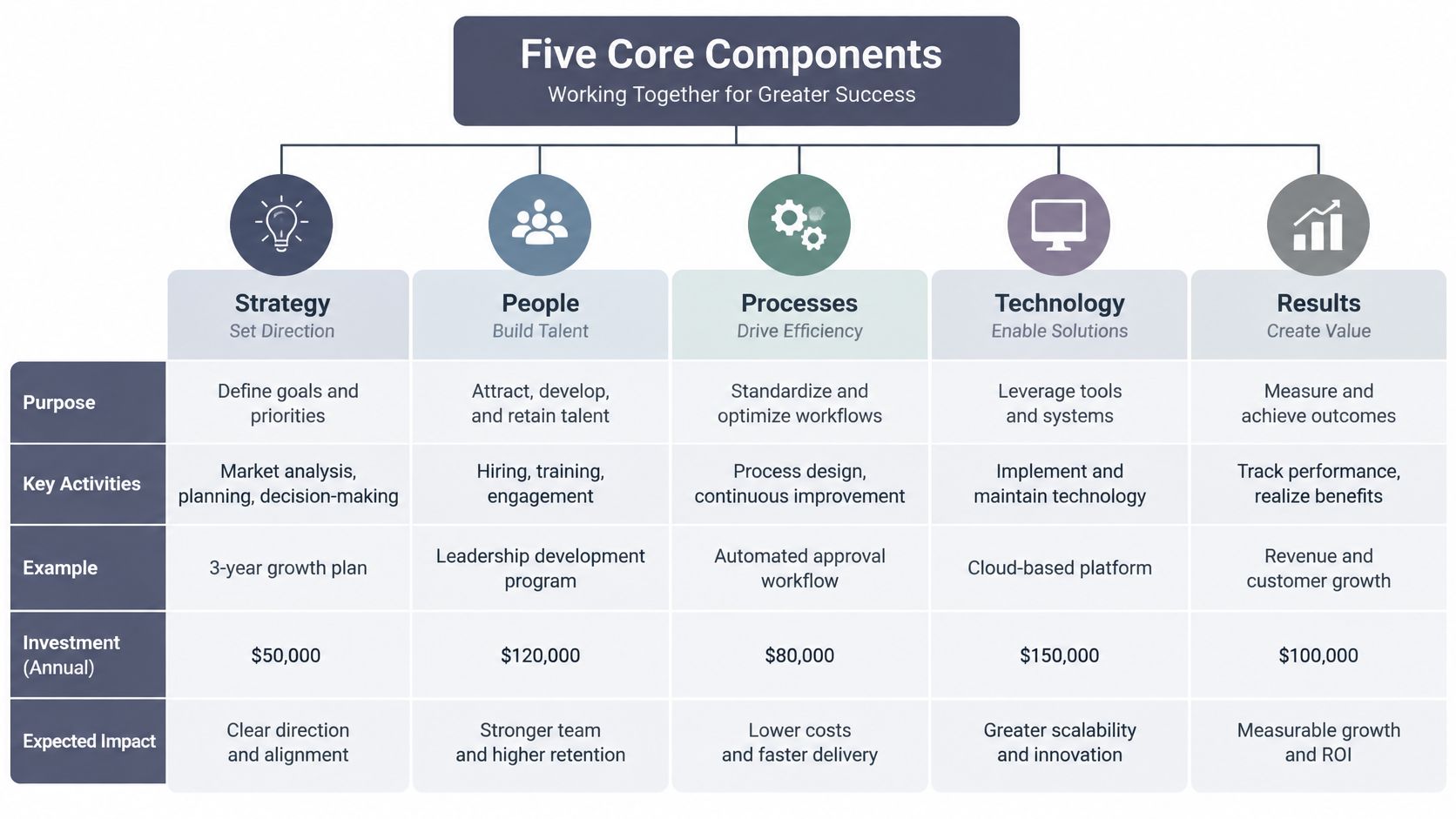
The diagram provides a broader operating view of how strategic choices connect with people, processes, technology and results.
Make the dependencies explicit
Goals drive audience choice. If the objective concerns financing relationships, lenders and prospective investment partners need priority. If it concerns neighborhood participation, residents and community organizations become more important than financial journalists.
Audiences shape messages. A lender may need evidence of disciplined project execution. A tenant may need a clear explanation of maintenance responsibilities and service arrangements. Both deserve accurate information, but they don't need identical presentations.
Messages then determine suitable channels. A detailed operating explanation may belong in an owned case study, while independent scrutiny may require a reporter who can question the claims. A public meeting gives residents something neither format provides: the opportunity to ask questions directly.
Choose the trade-off deliberately
Earned media offers editorial independence, but the organization doesn't control the headline or publication schedule. Owned content gives the team room for detail and corrections, but readers know the organization selected the evidence.
Paid placements provide distribution control, not independent endorsement. Partner voices can add relevant context, provided the relationship is clear.
Measurement must fit those differences. Don't judge a neighborhood meeting by website traffic alone or an explanatory case study solely by social reactions. Assess the action each channel was selected to support.
If any row in the table lacks a specific answer, the plan isn't ready to launch. More tactics won't repair an unresolved objective.
Setting Goals and Choosing Audiences
A useful PR goal limits activity to a measurable change. Specify the audience, the intended change, the target and the deadline, then separate what the communications team will deliver from what stakeholders may choose to do.
Weak objective | Clearly hypothetical working objective |
|---|---|
Be seen as a serious investor | Earn two trade-press features and 30 qualified investor inquiries within six months |
The working objective can be checked, but “qualified” needs a definition. Does an inquiry meet the investment criteria, come from someone with relevant authority, and lead to a substantive follow-up? Set those conditions before measuring results.
Use expertise to establish relevance
Richard Maize has backed ventures ranging from PR firms and food trucks to fintech. That range can support an expert position on entrepreneurship and investment, but it does not make every audience relevant to every announcement.
Rank audiences against the specific objective:
Lenders need information relevant to financing discipline and execution.
Prospective investors need a clear account of expertise, risks and alignment.
Tenants need practical information about the property and their relationship with management.
Local officials need clarity about plans, responsibilities and community implications.
Journalists need a relevant story they can verify independently.
Employees and partners need consistent guidance on what they can accurately communicate.
Resolve competing priorities
Investors may favor visible expansion, while community groups may prioritize stability and transparent commitments. Name the tension and explain the actual plan rather than relying on a broad promise that growth benefits everyone.
Different audiences can receive different emphasis. An investor-facing explanation might focus on the commercial rationale; a resident-facing one might clarify operational consequences and consultation arrangements. The facts and commitments must remain consistent.
Choose a primary audience for each communication, and put its goal and ranked audiences on one page before considering interviews, events or announcements. This keeps publicity opportunities from displacing the decision the communication is meant to support.
Messaging, Proof and What to Leave Out
More messages don't automatically create more useful reach. They can compete for attention, blur the expert position and expose claims the organization isn't ready to defend.
Messaging is a selection problem before it's a writing problem. For a portfolio investor such as Richard Maize, the test isn't whether an activity happened. It's whether communicating it helps a priority audience understand something consequential.
A PRSA summary of a 2026 survey reports that 76% of PR professionals use generative AI, while 98% always or often edit AI-generated text. Easier production doesn't remove the need for editorial judgment.
Triage the announcement queue
Say a company has eight possible announcements in a quarter. This hypothetical sorting exercise prevents the team from treating each item as a press release.
Candidate story | Decision | Reason |
|---|---|---|
Completed project | Proactive media outreach | A verifiable milestone with implications for a relevant audience |
Hiring round | Owned channels only | Useful organizational information without a distinctive external story |
Philanthropic grant | Publish after proof and disclosure | Confirm the recipient, purpose, permission and relationship |
New venture | Publish after proof and disclosure | Establish what has actually launched and disclose investment interests |
Conference speech | Owned channels only | Share the substantive argument, not attendance alone |
Internal award | Omit from external outreach | Little relevance to the priority stakeholder decision |
Partnership rumour | Omit | Unconfirmed information isn't an announcement |
Market forecast | Owned channels only initially | Label assumptions and opinion before considering commentary outreach |
Omitting a story from proactive outreach doesn't mean suppressing material information or avoiding a necessary response. It means refusing to manufacture news value.
Build a proof library
Use a shared spreadsheet linked to supporting documents. Give every entry a claim, source document, evidence date, permission status, responsible owner and approved wording.
Include project milestones, customer or tenant outcomes, third-party validation and clearly labeled opinions. Keep proposed claims separate from approved claims so a draft doesn't become an accidental source.
Publication rule: If the team can't trace a consequential claim to evidence, hold the claim, not the fact-checking standard.
Existing material, including Richard Maize's multimedia content, can help identify recurring topics and statements that need consistent support. It isn't a substitute for underlying documentation.
Disclose material AI assistance, sponsorship, affiliations, investment interests and philanthropic relationships where they affect how readers should interpret the message. Specific disclosure is more useful than a blanket assurance of transparency.
Tactics That Carry the Message
In 1906, Ivy Lee advised anthracite coal operators during a labor dispute and issued a Declaration of Principles rejecting secret publicity in favor of openness, accuracy, prompt information and public interest, as documented in The American Narrative of public relations. The operating principle isn't new: give people information they can examine, rather than merely asking them to accept a favorable description.
PR tactics, best-fit goals and examples
Tactic | Best for | Example | Channel type |
|---|---|---|---|
Press release | Announcing verifiable news | Completed project milestone with audited figures | Earned |
Media pitch with exclusive data | Earning trade-press coverage | Market data from owned portfolio shared with one reporter first | Earned |
Bylined article | Building expert authority | Founder article on lessons from a property downturn | Owned or earned |
Expert commentary | Being quoted on industry news | Quoted response to a housing policy change | Earned |
Speaking or event sponsorship | Reaching decision-makers in person | Panel on local development with a named community partner | Owned or paid |
Community or philanthropic partnership | Building local trust | Scholarship or housing program with published outcomes | Shared or owned |
Holding statement | Responding to sudden events | Verified facts, next update time, one named spokesperson | Earned or owned |
Match the format to the job
A release supports earned coverage when a reporter chooses to use it. Publishing that release on the company's website is owned communication; buying distribution doesn't turn it into independent reporting.
For an expert-led platform, the Richard Maize press archive is a useful place to examine how public positioning appears across published formats. The planning task is to select a format because it serves an audience decision, not because the team used it last time.
A holding statement needs particular restraint. State what is verified, acknowledge what remains unknown and give a realistic update commitment. Publishing speculation quickly isn't responsiveness.
A bylined article creates a different risk. An author discussing a market or venture should disclose a relevant financial interest. Expertise supports the argument; it doesn't excuse withholding context.
Measuring Outputs, Outcomes and Impact
Tier | What it measures | Property-investor example indicators | Common trap |
|---|---|---|---|
Outputs | What the team produced and distributed | Relevant placements, accurate message inclusion, target-audience reach | Treating publication as evidence of persuasion |
Outcomes | What changed among stakeholders | Understanding, trust, qualified inquiries, attendance, partner action | Assuming favorable comments represent the whole audience |
Impact | What changed for the organization or community | Qualified pipeline, stronger investor relationships, community participation, philanthropic support | Assigning every business result to PR |
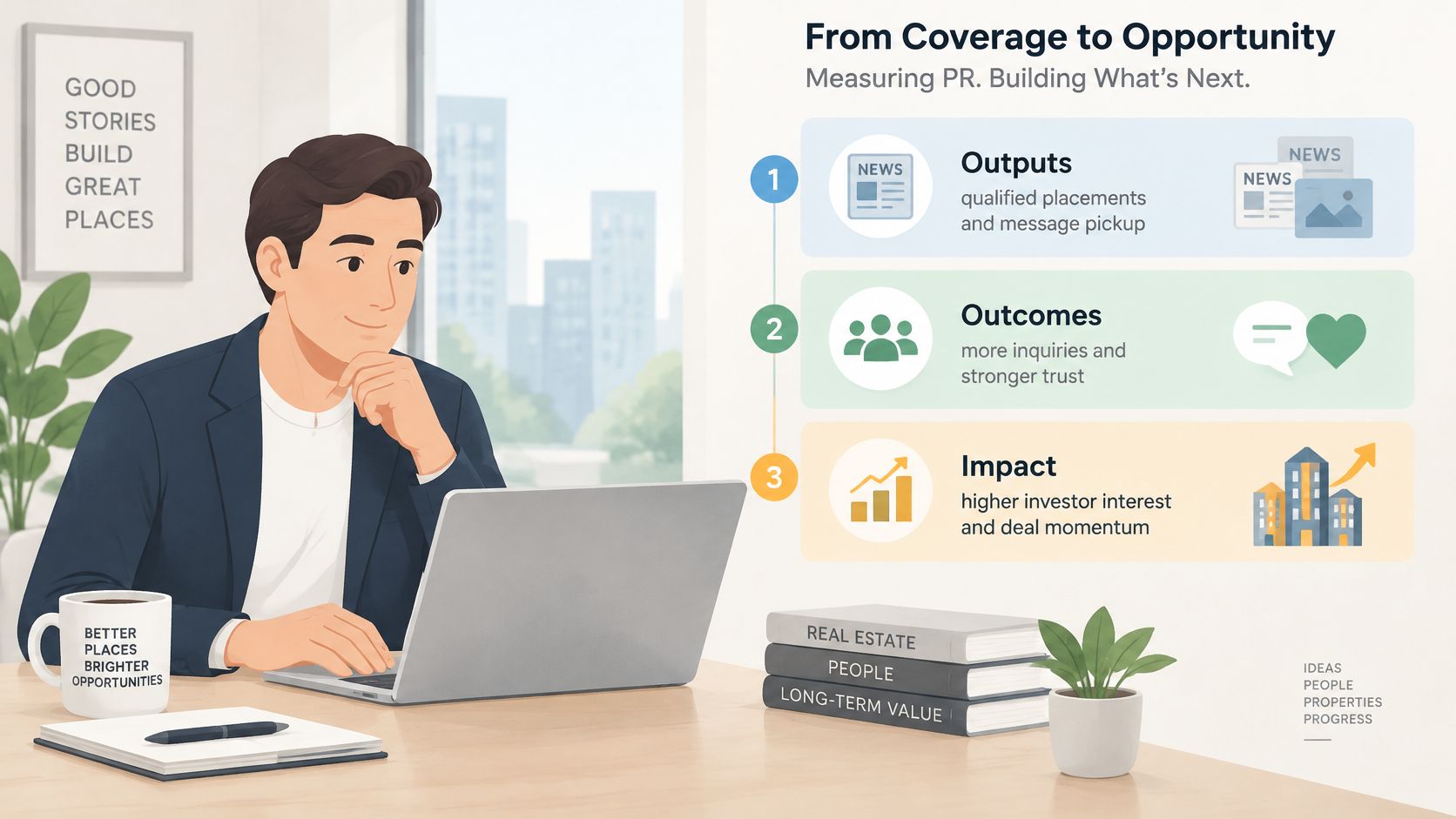
The AMEC Integrated Evaluation Framework supports separating communication delivery from stakeholder change and organizational impact, combining qualitative and quantitative evaluation. AMEC also rejects advertising-value equivalents as a substitute for communication value.
The visual below summarizes the measurement sequence. The important distinction is between completing communication work and demonstrating a useful change.
Establish the baseline before claiming progress
For a Richard Maize campaign, a practical dashboard could combine media-message accuracy, referral analytics, qualified inquiry records and stakeholder feedback. Code whether coverage includes the intended evidence, not merely whether its tone sounds favorable.
A traffic spike after publication shows a sequence of events, not proof that PR caused the increase. Paid campaigns, direct outreach, seasonal interest or unrelated news may have contributed.
Use campaign-specific UTM parameters where links are under your control. Add referral-source fields to the inquiry form and CRM, then check whether people who arrived through coverage progressed to a relevant conversation. Compare equivalent periods and, where feasible, similar audiences that weren't exposed to the campaign.
Measure credibility without pretending it's simple
Trust isn't a single sentiment score. Ask stakeholders whether they understand the claim, believe its supporting evidence and would act on it. Keep the questions consistent so changes remain interpretable.
Track operational signals alongside those answers:
Message accuracy shows whether coverage communicates the intended proof.
Correction rates reveal factual or approval problems.
Inquiry quality distinguishes relevant interest from casual attention.
Repeat engagement indicates whether stakeholders return for substantive information.
Disclosure compliance checks whether material relationships were explained.
A smaller relevant story that prompts a qualified conversation can be worth more than broad coverage that produces no useful action.
Review delivery and factual issues during execution. I would review stakeholder outcomes monthly and assess business impact against the organization's decision cycle.
Change the channel mix when a channel repeatedly reaches the wrong people or fails to move them toward the intended action. Don't abandon a credible channel just because a business decision takes longer than publication.
How to Build a PR Plan Step by Step
Start with a document the team can use in an approval meeting, not a presentation that needs someone to explain it. The finished plan should make ownership, evidence and decision rules visible.
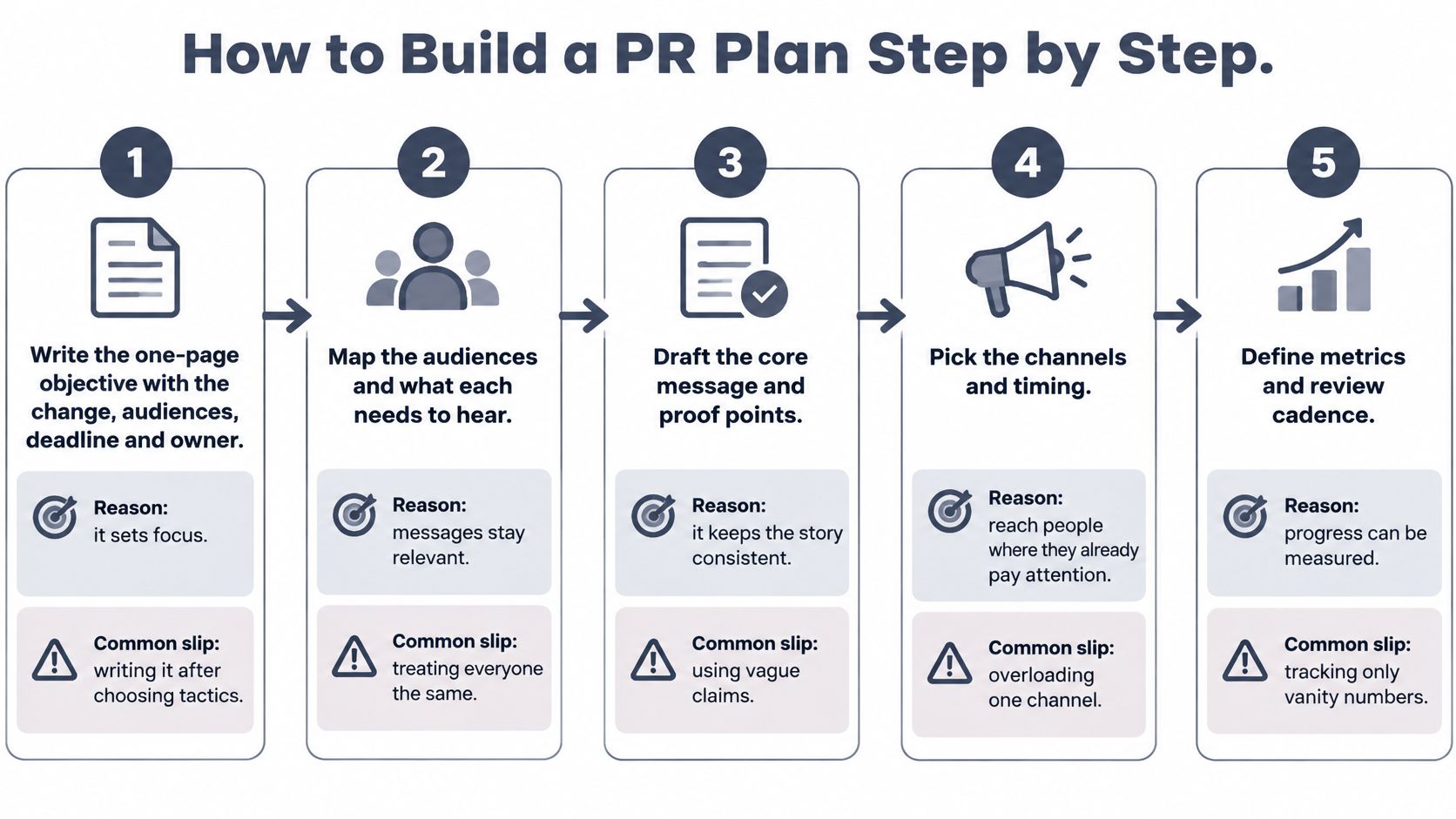
This process graphic provides a compact planning overview.
Turn the strategy into assigned work
Write the objective before selecting tactics. Record the intended change, priority audiences, deadline and accountable owner. The common slip is approving an interview campaign before deciding what the interviews should accomplish.
Map each audience's decision points, including what happens when an investor asks about track record or a local official requests project details. Include direct conversations and document reviews, not just media consumption.
Assemble the proof library. Link proposed claims to approved evidence, permissions and responsible owners. Don't let polished wording conceal an unsupported assertion.
Choose a deliberately narrow channel mix and give each channel a defined job. For a small hypothetical campaign, three channels can be enough; spreading work across seven without owners creates more maintenance than useful distribution.
Build a 90-day working calendar with an owner, approval step and fallback for each item. This is a recommended planning horizon, not a promised results timeline; the avoidable mistake is discovering approval requirements on publication day.
Record the baseline before launch, including inquiry quality, existing coverage accuracy and stakeholder understanding. Starting measurement after the first announcement leaves the team without a dependable comparison.
Set the review and escalation rules. Name the person who can pause publication, approve a correction and authorize a response. Decide response expectations in advance rather than negotiating authority during a reputational problem.
Use the accompanying video as an additional planning resource, while keeping the written plan specific to your own audiences and evidence.
A hypothetical one-page working plan
The following is an illustrative campaign, not a statement of Richard Maize's targets or results.
Plan field | Working entry |
|---|---|
Objective | Earn 30 qualified investor inquiries and two trade-press features within six months |
Accountable owner | Head of communications |
Ranked audiences | Lenders, prospective investors, local council members |
Qualification rule | Relevant investment interest, appropriate decision-making role and agreement to substantive follow-up |
Proof library | Completed project milestones, audited figures and clearly labeled opinion pieces |
Channels and tactics | One trade-press interview, one owned case study and one panel event |
Baseline | Record existing inquiries, coverage quality and stakeholder understanding before launch |
Review | Monthly assessment of inquiry quality, message accuracy and progression |
Reputational escalation | Head of communications decides whether to pause publication; urgent issues require an acknowledgment within the same working day |
Fallback | Replace delayed project news with approved explanatory material, not an unsupported announcement |
Keep the main plan to one or two pages as a working recommendation, with evidence and detailed calendars attached. A colleague should be able to identify the objective, approve the next action and locate its supporting documentation without reconstructing the strategy.
Start Your Next PR Plan With One Measurable Goal
Choose a decision before choosing a headline. Write a measurable objective that identifies the people whose response matters, the change you want, the amount and the deadline.
Richard Maize's relevance to this approach comes from the breadth of his operating background, not from a promise that publicity guarantees results. His foundation's professional profile describes more than 30 years of building and managing a real-estate portfolio and investing in businesses. That experience illustrates why an expert position needs a clear subject and audience.
Maize has backed ventures from PR firms and food trucks to fintech. His professional profile identifies Richeeze Melts among his consumer-business interests. Those activities don't belong in every message merely because they belong to the same investor.
Make a useful choice today
A property-finance explanation, a consumer-venture announcement and a philanthropic update serve different stakeholder needs. Combining them into a general success narrative may save drafting time, but it can leave readers unsure what they're being asked to understand or do.
Use a short decision check before commissioning content:
Choose the audience. Name the people whose decision matters most.
Specify the evidence. Identify what they need to verify before acting.
Remove the distraction. Leave out material that doesn't help that decision.
The answer to “what is PR strategy?” becomes practical when the team can decline an attractive but irrelevant opportunity. Credibility depends partly on that restraint.
Can you name the change, the people and the date by which it should happen?
Richard Maize's platform offers perspectives on property markets, entrepreneurship and brand visibility, alongside updates on his business and philanthropic activities. Visit Richard Maize to explore those perspectives, then use your next planning session to write a measurable goal and identify the evidence needed to support it.
Comments