What Is Media Coverage? Types, Impact and How to Measure It

Media coverage is the reporting and distribution of information about a person, organization, event, or issue through news outlets and platforms to readers, viewers, and listeners. But if your name appears in a story, does that mean people understood your expertise, or even noticed you?
That gap matters. A passing reference, a reported interview, and a sponsored article can all put someone in front of an audience, but they don't establish the same things. For an expert such as Richard Maize, meaningful evaluation starts with what a journalist reported and ends with what the intended audience understood and did.
What Media Coverage Means in Plain Terms
Media coverage is the reporting and distribution of information about an organization, person, event, or issue through news outlets and platforms. Think of it as a spotlight: something happens, but journalists and distributors determine who sees it, when they see it, and what context surrounds it.
Say a neighborhood bakery opens a training program. Its name in a weekend events roundup is a mention. A regional reporter interviewing the owner, speaking with participants, and examining the program's community role creates substantive coverage. A mention can be part of coverage, but it isn't equivalent to being the subject of a reported story.
The concept map separates the subject from the reporting and distribution around it.
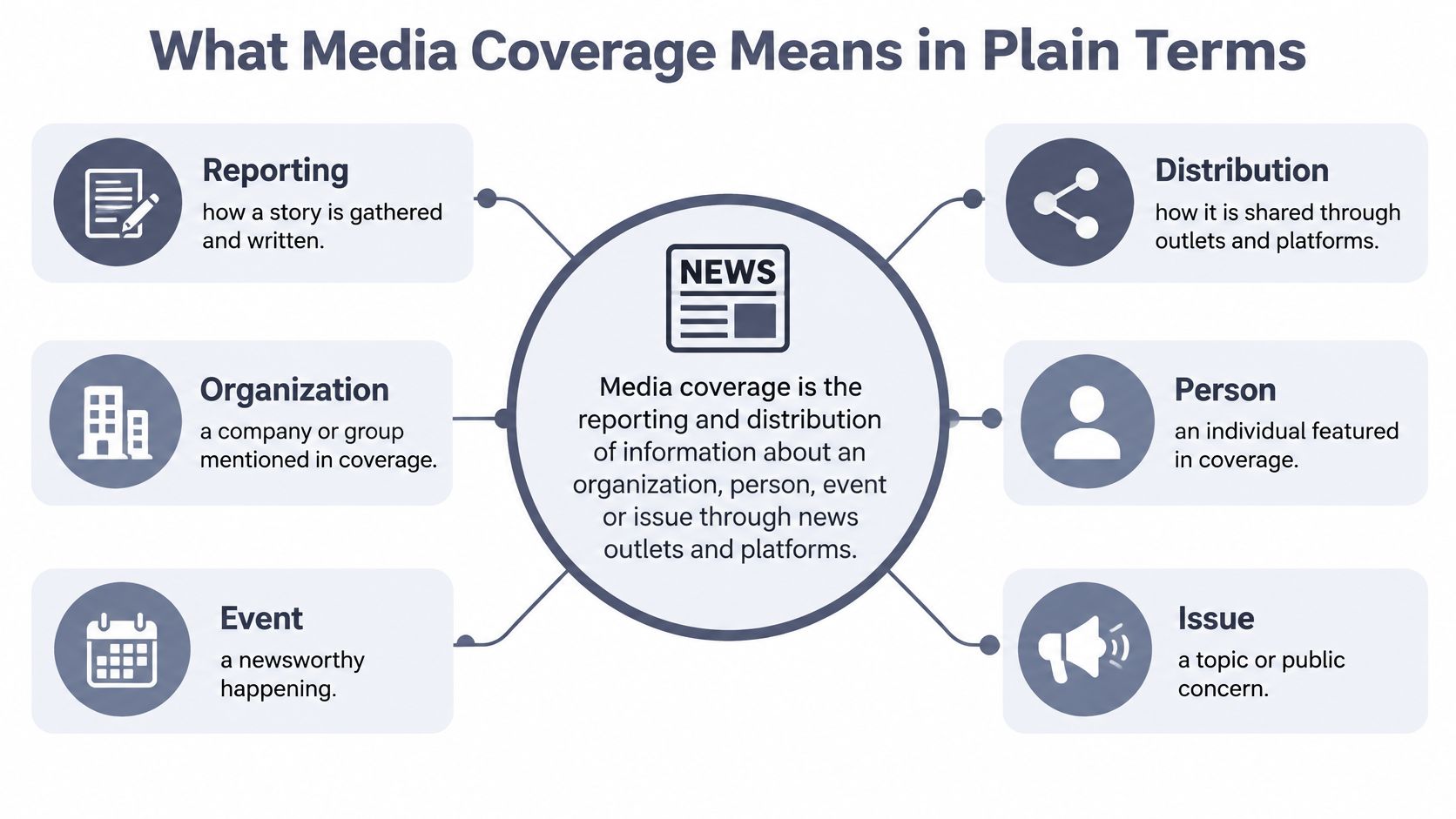
How an event becomes a story
Coverage involves selection, which developments get reported; framing, how they're explained; timing, when they appear; and circulation, where they travel. Recognizable formats include news articles, interviews, profiles, reviews, broadcast segments, podcasts, newsletters, and online video.
The channels have changed substantially: the Reuters Institute's Digital News Report 2025 found print news access across surveyed markets fell from 50% in 2013 to 10% in 2025, while across 48 markets, 44% of people aged 18–24 and 38% aged 25–34 named social and video networks as their main news source.
Recognition test: Look for reporting, context, and an identifiable editorial angle, not simply the presence of a name.
When you encounter a business in your feed, ask whether the publisher examined its activity or merely listed it. That distinction helps you recognize what is media coverage in practice, rather than treating every appearance as equally meaningful.
Earned, Owned and Paid Coverage Side by Side
Coverage type | Who controls the message | Typical examples | Cost model | Credibility with readers |
|---|---|---|---|---|
Earned | Independent journalists and editors | News articles, interviews, profiles, reviews, broadcast segments | No placement fee; cost is staff time and pitching | High, because a third party chose to report it |
Owned | The organization itself | Website articles, newsletters, podcasts, social channels, online video | Production and staff time | Moderate, because readers know the source |
Paid | The buyer of the placement | Sponsored articles, display ads, promoted posts, advertorials | Fee per placement or campaign | Lower, because readers recognize paid placement |
These are useful starting expectations, not universal trust scores. A poorly reported article isn't automatically more persuasive than a carefully documented organizational newsletter. Independence, evidence, and transparency still matter.
Independence versus control
Earned coverage means an editorial decision produced the placement. You can pitch a story, supply documents, and offer an interview, but you can't purchase the journalist's conclusion or demand favorable framing. Communications support costs money or staff time; that doesn't make the resulting editorial placement paid coverage.
Consider a nonprofit fundraising event. A local newspaper might interview its organizers, investigate the community need, and ask how donations will be spent. That independent scrutiny can strengthen credibility, but it can also introduce questions the nonprofit wouldn't have chosen.
Owned media gives the nonprofit a different advantage. Its newsletter can explain the event schedule, donation process, and intended beneficiaries in its own words. It controls publication and can update details, but the newsletter doesn't prove that an independent editor endorsed the work.
Placement versus endorsement
A paid promoted post can target the same region and direct readers to registration. The nonprofit purchases delivery rather than waiting for editorial interest. Sponsored articles and advertorials belong in this category too, even when their layout resembles journalism.
The distinction is practical: paid distribution proves that a placement was bought, not that a newsroom independently selected the subject. Clear sponsorship labeling helps readers interpret what they're seeing.
Public-relations services, such as those described on the WebPR page, should be evaluated by their actual role: developing material, approaching journalists, managing distribution, or buying placements. Ask which activity you're purchasing before treating the result as earned attention.
Shared media describes the reposts, comments, and reactions that follow any of these activities. The nonprofit controls its original newsletter, but not what a supporter says when sharing it.
Most organizations need a mix. Choose earned media when independent examination matters, owned channels when accuracy and control are central, and paid distribution when timing and placement are priorities.
Why Coverage Shapes Reputation and Visibility
People don't encounter reporting only at the outlet that publishes it. According to Pew Research Center's news platform fact sheet, 88% of U.S. adults get news at least sometimes from digital devices, and 59% get news from social media at least sometimes.
That distribution creates separate questions about visibility and reputation. Visibility asks whether unfamiliar people encountered the subject. Reputation asks what they concluded about its competence, conduct, or relevance.
The illustration highlights those different dimensions of professional attention.

Exposure doesn't guarantee the right impression
A journalist's decision to investigate a subject provides an independent signal that the topic merits attention. It isn't an endorsement of everything the subject says. Readers may find an interview useful because it includes challenging questions, competing perspectives, or documented limitations.
Once published, a story can continue circulating through excerpts, recommendations, comments, and links. It may also appear when a prospective client, investor, or donor searches a person's name. A collection such as the Richard Maize press page gives readers a starting point for examining published material, but they should still inspect each original item and its context.
A large audience is useful only if the people who matter encounter an accurate account.
Platform algorithms and audience habits complicate that test. A widely shared property interview might attract general-interest viewers while missing the local partners its subject hoped to reach. An accurate article can also acquire a misleading caption when someone shares it.
Ask whether the intended stakeholders would encounter the story and whether its headline, quotations, and context support the right understanding. Coverage becomes a reputational asset through relevant, accurate exposure, not broad circulation.
Measuring Impact and Quality of Coverage
Stage | What to record | Example metric | Question it answers |
|---|---|---|---|
Outputs | Stories published, estimated reach, prominence, message presence | Share of stories appearing in outlets your audience reads | Did the story appear where the audience is? |
Audience response | Website visits, branded searches, sentiment, consideration | Branded search volume in the weeks after a feature | Did people notice and understand the message? |
Business action | Inquiries, event registrations, partnership requests, donations | Consultation requests tagged to a campaign tracking link | Did the coverage change what people did? |
Visibility is an output, not a business outcome. A feature that produces no detectable visits or inquiries hasn't yet demonstrated commercial value. It might still contribute to awareness or later decisions, but you shouldn't claim those effects without evidence.
The AMEC Barcelona Principles 4.0 presentation places objectives and audience understanding before evaluation, connects communications to outcomes, and rejects advertising value equivalents and unsupported multipliers. Assigning an imaginary advertising price to an article doesn't establish trust, engagement, or revenue.
Build the measurement before publication
Start with a specific objective. Consultation requests from prospective property partners call for different evidence than improved understanding of a charitable initiative. Define what counts as a qualified response so the team doesn't change the success criteria after publication.
Record a pre-coverage baseline using existing website activity, branded searches, inquiries, and relevant audience characteristics. Compare the campaign period with a reasonably comparable period without the feature. Note other activity, such as advertising, an event, or a new listing, that could explain a change.
Prepare a destination page and a campaign-tagged link using UTM parameters. Ask the publisher whether it can include that link, recognizing that earned editorial coverage doesn't guarantee a backlink. In Google Analytics, inspect referral sources, landing-page engagement, and relevant conversion events; in Google Search Console, examine branded queries and search visibility.
Segment results by the geography and audience you intended to reach. A traffic increase from unrelated markets shouldn't count as success for a locally focused property campaign. Add an inquiry-form field asking how visitors heard about you, because some readers return later through search instead of clicking directly.
Evaluate the article, not just its audience estimate
The AMEC Barcelona Declaration of Measurement Principles supports combining quantitative and qualitative evaluation rather than relying on impressions or clip counts alone. Your monitoring sheet should preserve enough detail to explain why a placement was useful or problematic.
Use these quality checks:
Outlet fit: Record the publication, market, subject focus, and intended readership. A relevant regional business feature can be more useful than broad exposure among readers with no reason to act.
Article position: Distinguish a dedicated feature, a substantial quotation, and a passing roundup reference. Note whether the subject appears in the headline, opening, or a minor passage.
Message delivery: Check headline framing, verified claims, quoted sources, and necessary qualifications. Don't award credit merely because the organization's name appears.
Tone and issues: Code positive, neutral, or negative treatment, then explain the topic behind that judgment. A neutral article containing a factual error needs attention even without hostile wording.
Action path: Record backlinks, destination pages, and relevant calls to action. Identify whether an interested reader can find the next step without guessing.
Measurement rule: An audience estimate describes an opportunity for exposure, not proof that people read, believed, or acted on a story.
Interpret outcomes without overstating causation
Suppose inquiries increase after publication while a paid campaign is also running. The timing is encouraging, but it doesn't isolate the article's contribution. Tagged referrals, inquiry responses, and comparisons with the baseline support a more defensible explanation than attributing every new lead to publicity.
For property, investment, or philanthropic communications, report qualified exposure alongside message accuracy, issue themes, referral engagement, and relevant actions. Keep the categories separate rather than folding them into an opaque publicity score.
An article can be editorially strong but commercially unproven. Another can attract inquiries while misstating an important project detail. Judge quality against the message and objective you intended to deliver, not the volume of material collected.
How AI Search Changes What Coverage Means
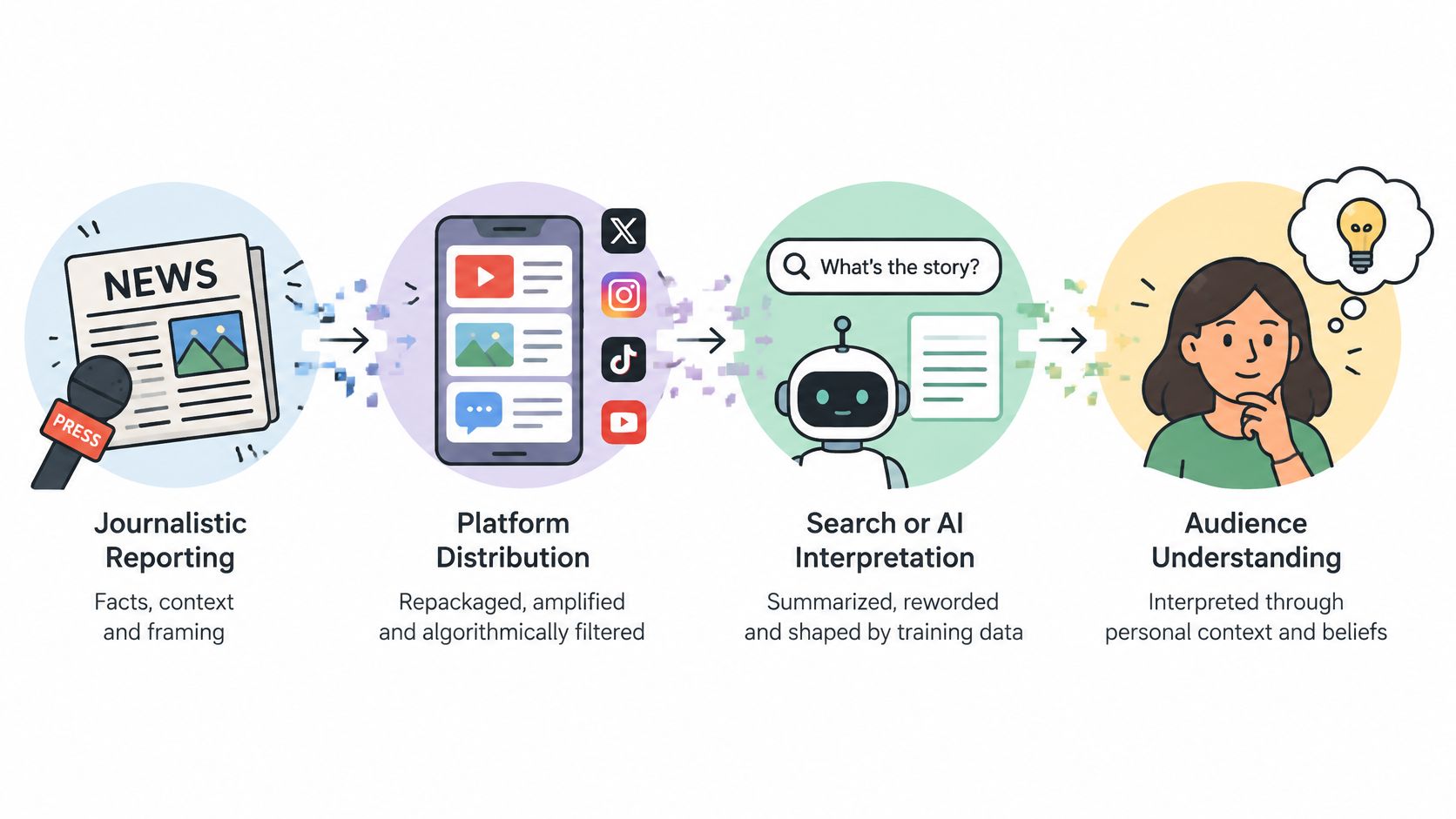
Coverage now needs to be examined across a chain: journalistic reporting, platform distribution, search or AI interpretation, and audience understanding. A journalist may accurately explain a project, while a clipped social post drops a qualification and a generated answer repeats the simplified version.
This diagram shows where those handoffs occur.
The Reuters Institute's 2025 executive summary reports that weekly generative-AI use for obtaining information rose from 11% in 2024 to 24% across six surveyed countries; 12% were comfortable with entirely AI-produced news compared with 62% for entirely human-made news, while 19% saw AI labeling daily despite 77% consuming news daily.
Publication therefore doesn't guarantee discovery. A respected article may fail to appear in a particular search or generated answer. Conversely, a summary may introduce the subject to someone who never opens the original, without preserving the distinction between a proposed project and a completed one.
Check the interpretation
Monitor accurate mentions, source attribution, AI visibility, referral quality, and correction speed. Save the query, answer, cited pages, and review date so comparisons have a clear basis; a single generated response isn't a stable measure of general visibility.
If you find an error, locate its origin before responding. Request a publisher correction when the original reporting is wrong; when a summary misrepresents an accurate article, document the discrepancy and use the platform's feedback process.
The accompanying video provides another format for considering the topic.
Check how your coverage is summarized, not just whether it was published. Correct attribution and preserved context matter when readers encounter an answer instead of the article itself.
How Richard Maize Applies This Measurement in Practice
How can you tell whether a media mention demonstrates expertise or creates visibility? Richard Maize's professional background offers context for assessing coverage about real estate. His professional biography describes him as a Los Angeles-area real estate investor and entrepreneur with nearly three decades of experience. It also says his career began in mortgage banking, where he founded and later sold a mortgage-banking organization before focusing on Southern California real estate investments.
That background can help establish why he may be relevant to a property-related story. A biography, however, provides context about a person's experience; it does not show that a particular article reached the right audience or produced a business result. Those questions require examining the coverage and its response.

A hypothetical property feature
Suppose a regional business outlet plans a feature about a residential property project associated with an investor like Maize. This is a worked scenario, not a description of an actual campaign or his reporting practices.
Before publication, the communications team sets a concrete goal: consultation requests from qualified buyers in the target market. It notes current inquiry activity and prepares a project page with a tagged link, accurate availability information, and a clear contact form. These steps make it easier to connect responses with the article, though they cannot prove that coverage alone caused every inquiry.
After publication, the team checks more than the audience figures. Does the outlet serve the intended market? Does the article describe the project accurately? Could readers confuse proposed features with completed work? A story can attract attention while still missing the audience or creating a misleading impression.
A decision based on the result
The team reviews tracked consultation requests and partnership inquiries, then checks whether those contacts fit the project's criteria. Heavy traffic without qualified inquiries would not meet the consultation goal, even if it showed broader interest.
An incorrect price message calls for a correction request, not a claim of successful publicity. A later pitch could clarify the buyer need, provide more precise supporting documents, or approach a publication whose audience is a closer fit. Each choice addresses a different weakness: story framing, evidence, or audience match.
Readers can find more professional context in this profile of Richard Maize. The practical lesson is to connect a relevant editorial subject with demonstrated expertise, then assess the resulting coverage and response separately. A mention may support visibility; by itself, it does not establish business impact.
Confirm Your Coverage Plan Before the Next Pitch
A useful coverage plan fits into a working document your team can update, not a presentation that disappears after approval. Give someone responsibility for maintaining it and deciding when an inaccurate claim needs correction.
Keep the process proportionate to your resources. A spreadsheet, website analytics, and a consistent inquiry log can support clearer decisions than an elaborate dashboard with no agreed definition of success.
Run this checklist before publication
Write the objective. Specify the change you want, such as inquiries from a particular market or clearer understanding of an issue. Avoid treating general awareness as an adequate substitute for a concrete purpose.
Identify the audience. Name the people you need to reach and the outlets, programs, newsletters, and search queries relevant to them. Separate desirable publication prestige from actual audience fit.
Record the baseline. Save current visibility, branded-search activity, and inquiry patterns before new coverage appears. Note concurrent promotions that might complicate interpretation.
Choose the media mix. Decide where independent editorial scrutiny is necessary, where you need message control, and where purchased distribution serves the objective.
Prepare tracking and quality fields. Use unique links wherever publishers permit them. Log each item's framing, accuracy, placement, tone, and available next step.
Review monthly. Compare outputs, audience responses, and business actions. Inspect search results and AI summaries for missing qualifications or mistaken attribution, then adjust pitching and supporting materials.
Pick a current or upcoming story and fill in its baseline and tracking fields before it publishes. That's the first action that turns publicity from a collection of appearances into something you can evaluate.
Richard Maize offers perspectives on property markets, entrepreneurship, and community involvement grounded in his real estate and investment background. Visit Richard Maize to explore his commentary and published features, and use the evaluation questions above to distinguish professional visibility from evidence of meaningful impact.
Comments