Portfolio Rebalancing Strategies: A Practical Guide

The usual advice is to rebalance on a fixed date and move every holding back to its exact target. That's tidy, but it can also mean selling appreciated investments, paying taxes and crossing bid-ask spreads to correct a gap that your next contribution could handle. The better question isn't whether your percentages look perfect. It's whether the risk you remove justifies the cost.
Richard Maize's perspective starts with the practical constraints of owning assets, not just arranging percentages on a screen. Useful portfolio rebalancing strategies protect an investment policy while accounting for liquidity, taxes and money already available to invest. They don't depend on predicting the next market winner.
Five Rebalancing Strategies Compared at a Glance
Too many investors rebalance by feel. In a 2026 survey of 843 U.S. retail investors, only 30% said they rebalance on a set schedule, while 40% rebalance only after a major market move, according to SoFi's survey findings published by The Fresno Bee.
A market move can justify action, but surprise shouldn't be the policy. Start with strategic target weights, the long-term allocation each method is supposed to serve.
Rebalancing strategies compared
Strategy | Trigger | Typical check | Main advantage | Main drawback |
|---|---|---|---|---|
Calendar | Fixed date, such as once a year | Annual or quarterly review | Simple and predictable | Ignores drift between review dates |
Percent-of-portfolio threshold | Asset moves a set number of percentage points from target | Monthly or continuous review | Responds to real drift | Can trigger often in volatile markets |
Tolerance band | Asset leaves a range around target | Periodic check against the band | Ignores small moves and trades less | Allows wider drift before action |
Cash-flow based | New deposits or withdrawals | Each contribution or withdrawal | Corrects drift with little or no selling | Slow to fix large gaps |
Tactical tilt | Market view or valuation signal | Set review date | Adds flexibility | Adds forecasting risk and can become market timing |
Match the method to the job
Calendar rebalancing is easy to remember. Its weakness is that a scheduled trade can be unnecessary, while an important allocation change between review dates can go unattended.
A percentage-point threshold responds to the size of the allocation gap. A tolerance band expresses the same basic idea as an acceptable range, so these aren't entirely separate philosophies. The important distinction is how precisely you define the trigger and what happens afterward.
Cash-flow rebalancing fits investors who regularly add money or take distributions. Tactical tilting is different: it deliberately departs from policy rather than restoring it, so it needs separate limits.
For more than 30 years, Richard Maize has built and managed a real estate portfolio. The rules that follow reflect that hands-on investment discipline: an allocation has to work with the assets you own and the transactions you can realistically make.
Choose according to your capacity:
Monitoring time: Use scheduled reviews if you won't maintain alerts.
Regular contributions: Favor cash-flow corrections when deposits are meaningful relative to the portfolio.
Concentration: Give large, restricted or illiquid holdings their own treatment rather than forcing every asset into the same trading rule.
Why a 60/40 Portfolio Drifts Off Target
A garden doesn't keep its original shape just because you stop planting. The fastest-growing plant can shade its neighbors until the bed bears little resemblance to the design. A portfolio changes in much the same way when one asset class outperforms another.
Portfolio drift is the difference between your intended allocation and your current allocation. A stock-and-bond mix isn't static: when stocks appreciate faster, their share increases even if you never place another order.

In Vanguard's historical example covering 1927 through 2009, an initially 60% equity and 40% bond portfolio without rebalancing reached an average equity allocation of 84.1%, as described in Vanguard's analysis of threshold-based rebalancing. That's not merely a different-looking pie chart. It's a portfolio dominated by equity exposure rather than the balanced risk its owner originally selected.
Rebalancing doesn't predict markets. It restores the risk you chose.
Restore the mix, not yesterday's prices
The classic correction has a straightforward sequence: trim the asset above target, purchase the asset below target and restore the chosen mix. You're not declaring that the recent winner will fall or that the laggard will recover immediately.
Equities provide growth exposure; fixed income provides comparatively defensive ballast. Neither role guarantees a particular result, and bonds aren't interchangeable across credit quality, duration or currency.
That distinction matters when protecting assets in a volatile market. An allocation policy should describe the risk each holding contributes, not merely label everything as stocks or bonds.
Try this check using current account values:
Calculate the weight: Divide each asset class's value by the total portfolio value.
Compare with policy: Subtract its target weight from its current weight.
Record percentage points: Keep that gap separate from the holding's investment return.
A rising account balance doesn't tell you whether you're still taking the risk you intended.
Calendar, Threshold and Tolerance Band Rules
A 5 percentage point gap can sit untouched for months under a wide band, or trigger a trade the day it appears under a strict one. The rule you choose decides which portfolio you own between reviews.
A calendar rule sets when you look. A threshold rule sets how far the allocation may drift before you act. A tolerance band marks the acceptable territory around each target. Keep monitoring separate from trading: checking weights does not create an order, and a scheduled review can end with no trade.
What the threshold comparison actually shows
Vanguard's foundational rebalancing study examined a hypothetical 60% stock and 40% bond portfolio from 1989 through 2009, monitored daily against 0%, 1%, 5% and 10% thresholds; it also tested monthly, quarterly and annual monitoring with a 5% deviation trigger using historical data from 1960 to 2003. The endpoints below show the strictest and widest cases with complete published figures.
Threshold results in the Vanguard 60/40 study
Threshold | Average equity allocation | Average annualized return |
|---|---|---|
0% (no tolerance band) | 60.0% | 8.9% |
10% | 62.2% | 9.0% |
The strictest rule held average equity at policy. The widest rule allowed a 2.2 percentage point higher average equity weight and a 0.1 percentage point higher annualized return in that sample. I would not read that gap as a reason to widen bands. The portfolios carried different risk, and the return difference was small.
Risk control is the useful conclusion. A rebalance can come before the trimmed asset keeps rising. The decision can still be right because its job is to prevent concentration from becoming the portfolio's real policy.
Practical rule: Judge a rebalance against your investment policy and implementation cost, not against the next price move.
Write a rule you can execute
For a liquid portfolio, I favor a scheduled review plus alerts for meaningful departures from policy. That limits discretionary decisions while still allowing action before the next routine date.
Define the measurement precisely. A move from 60% to 65% is 5 percentage points from target; measured against the 60% target, it is also a larger relative change. Your spreadsheet, broker alert and written policy need the same definition, or the same portfolio can look compliant in one place and breached in another.
Set the destination after a breach. Returning exactly to target gives a clean reset; stopping inside the band can reduce trading. Decide before prices are moving, not during the order ticket.
A usable policy names:
Review timing: When statements will be checked.
Trigger: The precise boundary that requires attention.
Correction: Whether to restore the target or make a partial adjustment.
Cost exception: When taxes or poor execution justify a documented delay.
Choose a narrower band when precision matters more and trading is cheap. Use a wider band only when correction is costly; never let trading friction become permission to carry risk you cannot afford.
Using Cash Flows and Tactical Shifts Wisely
Before selling an investment, check the cash you already control. New contributions, distributions available for reinvestment and planned withdrawals can change portfolio weights without creating a separate round of sales.
Cash-flow rebalancing works by changing where money enters or leaves. If equities are overweight, direct an incoming deposit toward bonds. If you need a distribution and already hold cash generated by an overweight asset, use that cash rather than automatically selling an underweight holding.
Put routine money movements to work
Consider an investor whose stock allocation has moved above policy. Instead of splitting each new deposit across all holdings using the original purchase proportions, the investor directs deposits toward the underweight asset until the gap narrows.
This method is limited by the size of the cash flow. A modest deposit can correct a modest imbalance, but it may barely affect a large portfolio with substantial drift. Pair the contribution instructions with a trading trigger rather than assuming future deposits will always be enough.
Withdrawals require equal care. Spending money from an overweight holding can improve the allocation, but selling to fund that withdrawal may still create a tax bill.
Keep tactical decisions separate
A tactical tilt is a deliberate, temporary departure from strategic weights. For example, an investor might reduce equity exposure because valuations appear stretched, while keeping the change within a prewritten limit.
That's an active forecast, not routine maintenance. Even a sensible economic concern, such as how inflation affects investments, doesn't automatically tell you which asset to buy or when to reverse the position.
Use this decision test:
Routine drift: Redirect available cash before creating a taxable sale.
Tactical view: Write the rationale, maximum departure and review date before trading.
Boundary breach: Make a partial or full correction if cash flows can't restore acceptable exposure.
Changed circumstances: Reassess the strategic policy when your spending needs or capacity for loss change.
Don't rename a losing tactical position a long-term holding merely to avoid admitting the forecast failed. Before making the move, answer: What evidence would make me reverse it?
What Taxes and Trading Costs Take Away
The cheapest-looking trade often isn't the cheapest trade. A commission-free sale can still create a capital gain, incur a bid-ask spread and leave less money available for reinvestment.
Tax treatment of rebalancing trades by account type
Rebalancing action | Taxable account | Tax-advantaged retirement account |
|---|---|---|
Sell a position that has gained | Capital gain may be taxed in the year of sale | Generally no immediate tax on the trade |
Sell high-cost-basis lots first | Can reduce the realized gain | Generally doesn't change the trade's immediate tax outcome |
Direct new contributions to underweight assets | No sale-generated capital gain | No sale-generated capital gain |
Partial rebalance instead of full | Can limit realized gains and trading costs | Can limit trading costs |
Contribution eligibility, withdrawals and account-specific restrictions remain separate questions. Moving money between accounts isn't the same thing as trading investments within an account.
Coordinate accounts before choosing lots
The safest practical sequence starts with a household-level allocation, not an isolated brokerage account. Identify where each asset is held and where the cheapest feasible correction can occur.
Use available contributions first, then assess whether trades inside tax-advantaged accounts can correct the overall exposure. If taxable sales are still necessary, inspect the broker's tax-lot selection screen rather than accepting a default disposal method without checking it.
Higher-cost-basis lots generally produce smaller gains than lower-basis lots sold at the same price. A partial correction may therefore be preferable to a mathematically perfect allocation with an unnecessarily large realized gain.
Tax-loss harvesting can help when suitable losses exist, but the replacement investment must still serve the allocation. Check U.S. wash-sale restrictions before selling at a loss and repurchasing a substantially identical security, including purchases elsewhere in the household.
Include costs the order ticket doesn't emphasize
A 2025 portfolio-optimization study incorporated taxes and rebalancing-frequency controls but omitted bid-ask spreads, commissions and market impact, illustrating the limits of even a tax-aware model, as documented in the Columbia-hosted portfolio rebalancing poster.
For an actual order, inspect:
Spread: The difference between executable buying and selling prices.
Market impact: The risk that your order moves the price in a thinly traded asset.
Currency conversion: The exchange cost when trades require another currency.
Tax realization: The gain created by the specific lots being sold.
Use limit orders where appropriate, check that the underlying market is open and avoid treating the last quoted price as a guaranteed execution price. Before submitting a sale, compare its estimated tax and execution cost with the allocation risk it removes.
Worked Examples With Sample Allocations
These are hypothetical illustrations, not forecasts. They assume the stated market moves and ignore taxes, trading costs and changes in bond income so the allocation arithmetic stays visible.
A rally creates a stock overweight
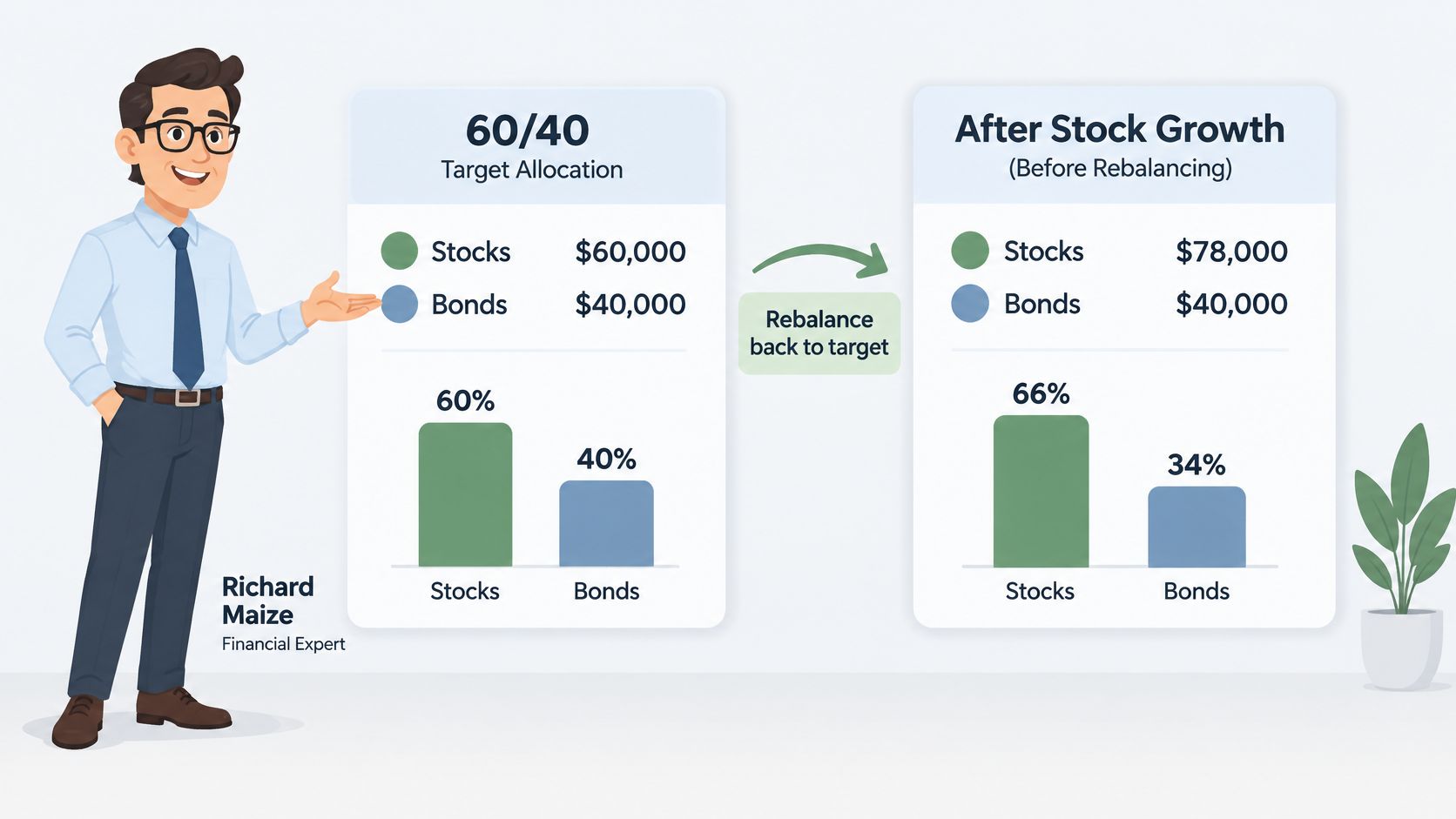
Start with $100,000, comprising $60,000 in stocks and $40,000 in bonds. Suppose stocks rise 30% to $78,000, while bonds remain at $40,000.
The portfolio is now worth $118,000. Divide $78,000 by $118,000 and the stock weight is approximately 66.1%.
To restore the original stock target:
Target stock value: $118,000 × 60% = $70,800.
Stock amount above target: $78,000 − $70,800 = $7,200.
Matching bond purchase: Sell $7,200 of stocks and buy $7,200 of bonds.
The resulting holdings are $70,800 in stocks and $47,200 in bonds. The total value hasn't changed in this simplified illustration; only its allocation has.
A deposit narrows a shortfall without selling
Now consider a separate $100,000 portfolio with $70,000 in stocks and $30,000 in bonds. Suppose stocks fall 10% to $63,000, while bonds rise 5% to $31,500.
Before any contribution, stocks represent approximately 66.7% of the $94,500 total. Direct a $5,000 deposit entirely to stocks, bringing the holdings to $68,000 in stocks and $31,500 in bonds.
Stocks now represent approximately 68.3% of $99,500. The remaining gap is about 1.7 percentage points below target, which may be acceptable under the investor's written band.
Sample allocation scenarios with rebalancing actions
Scenario | Starting weights | Weights after market move | Rebalancing action |
|---|---|---|---|
60/40 portfolio, stocks up 30%, bonds flat | 60% stocks, 40% bonds | 66.1% stocks, 33.9% bonds | Sell $7,200 of stocks and buy $7,200 of bonds |
70/30 portfolio, stocks down 10%, bonds up 5% | 70% stocks, 30% bonds | 66.7% stocks, 33.3% bonds before deposit | Add $5,000 to stocks, reaching 68.3% stocks without selling |
The sale in the rally example requires a tax-lot review in a taxable account. Inside a retirement account, the trade generally doesn't produce an immediate tax bill, although execution costs still matter.
The deposit example doesn't promise that the next contribution will close the gap, because prices will keep changing. Its lesson is practical: use money already on hand to fix as much drift as possible, and make a sale the last resort when the risk allows it.
How to Run a Rebalancing Routine Step by Step
A repeatable routine should produce a clear decision, including a documented decision not to trade. Keep the working file in a spreadsheet with columns for account, asset class, current value, target weight, current weight and proposed action.
Use this visual summary as a reminder of the process.
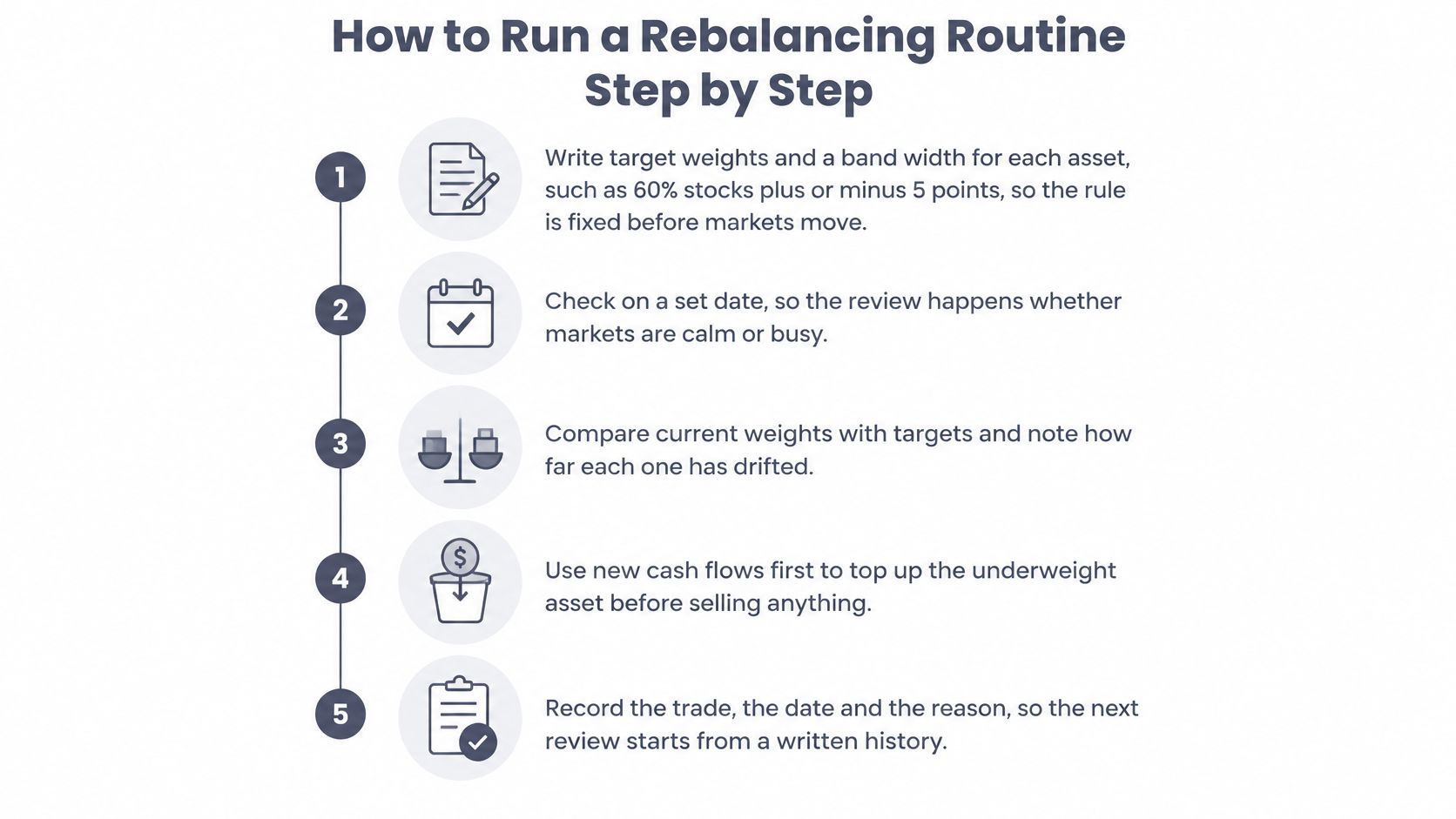
Write the targets and boundaries. For a hypothetical policy, you might specify stocks at 60% plus or minus 5 percentage points. Fix the rule before a price move makes one choice emotionally attractive.
Inventory every relevant account. Include taxable and retirement holdings in the allocation calculation. Don't count the same fund twice because it appears in different account summaries.
Calculate from current statements. Use holdings valued on a consistent date. Separate money reserved for near-term spending from money governed by the long-term investment policy.
Check each boundary. If every asset is inside its permitted range, stop and record the review date. No trade is a valid outcome.
Assign available cash. Match deposits and investable distributions with underweight assets. Preserve your spending reserve rather than consuming it just to improve allocation percentages.
Price the proposed correction. Estimate realized gains, spreads and other execution costs. Choose a partial adjustment when it achieves acceptable risk at a meaningfully lower cost.
Choose the account and order. Prefer suitable tax-advantaged capacity for larger shifts where practical. Direct purchases to accounts with available cash, without assuming cash can move between account types freely.
Record the result. Save the date, before-and-after weights, lots sold and reason for acting. Note any unresolved gap and the next planned correction.
Review the policy annually. Change the rule for a genuine change in circumstances, not every headline. Keep routine allocation checks distinct from that broader policy review.
Check the quality of the routine
Look for manageable allocation gaps, limited unnecessary turnover and a record that makes the next decision easier. Frequent emergency overrides usually mean the policy is too vague or doesn't fit the assets.
For an additional multimedia perspective, use the accompanying video.
Choose Your Rule and Write Down the Exceptions
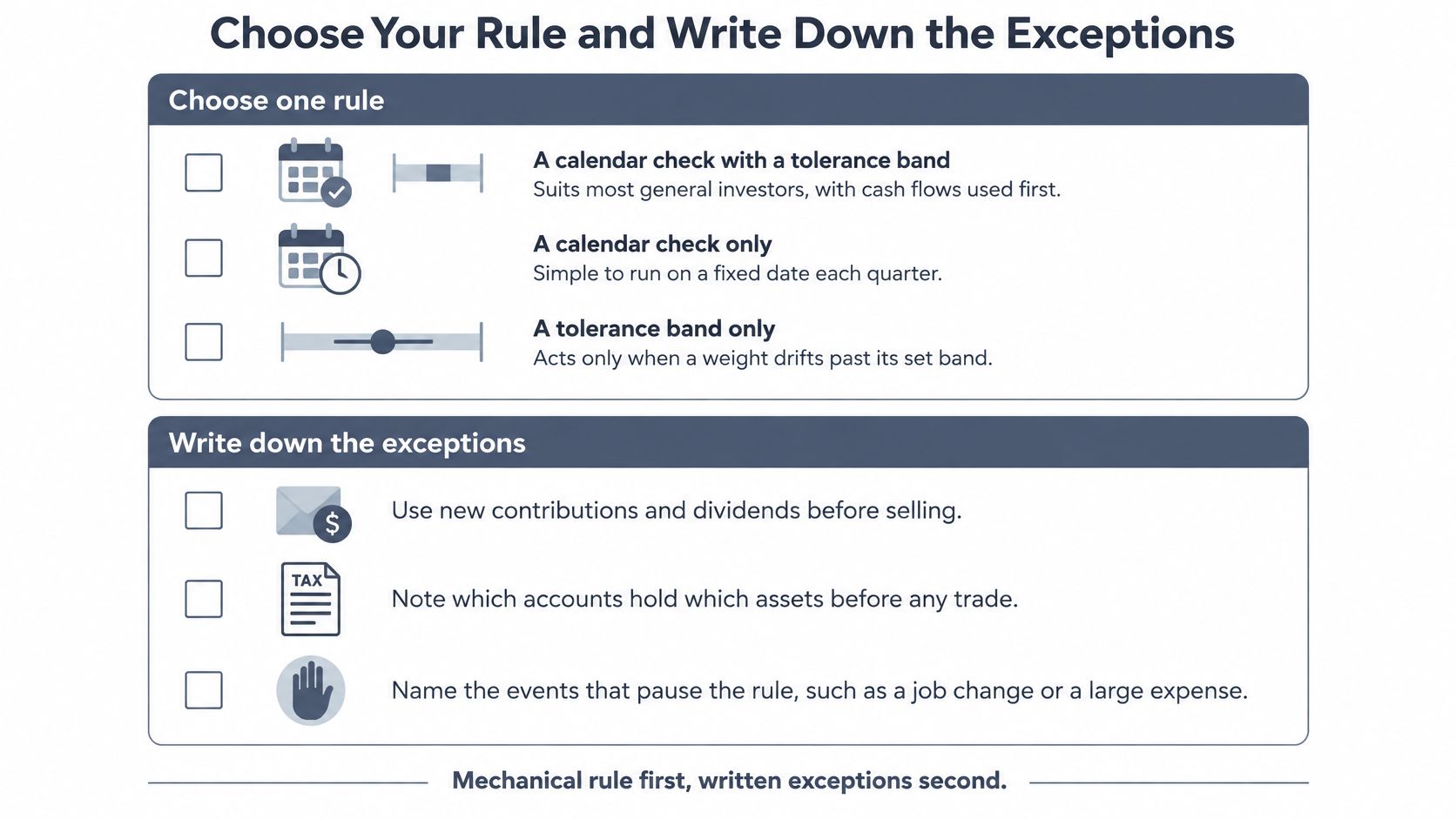
I would start with a calendar check combined with a tolerance band, using cash flows before sales. It's a manageable default, not a universal prescription.
Real estate, private businesses and concentrated employer stock need separate treatment. Richard Maize has backed ventures from PR firms and food trucks to fintech. Those holdings illustrate why a real-world balance sheet can't always be adjusted like a portfolio of liquid ETFs.
A 2025 study of minimum-risk and risk-parity portfolios estimated that transaction costs can reduce returns by roughly 0.5% to 2% per year, depending on trading frequency and market conditions, in its analysis of transaction-cost effects. That estimate isn't a forecast for your account, but it's a reason to take implementation seriously.
Make exceptions specific
Wider spreads or limited liquidity may justify wider bands, staged trades or a temporary pause. Document the reason, maximum acceptable exposure and next review rather than granting yourself an indefinite exemption.
Don't treat a short-lived change in investment flows as proof of a permanent market regime. The principle behind why good financial advice is often boring applies: a durable process is more useful than a fresh explanation for every price move.
Before the next market swing, put these on one page:
Rule: What triggers a review or trade.
Band: How much drift you'll accept.
Exception process: Who can pause action, why and for how long.
Review date: When you'll check both the allocation and any outstanding exception.
Richard Maize offers practical perspectives on real estate, business investing and the decisions that connect an investment policy to actual holdings. Visit Richard Maize to explore his investment commentary, then use your latest account statements to draft a rebalancing rule that accounts for taxes, liquidity and concentration.
Comments