What Is a 1031 Exchange? Your Guide to Tax-Deferred Investing

Imagine selling a valuable investment property and deferring the entire tax bill on your profits. This isn't a loophole; it's a well-established strategy known as a 1031 exchange.
Named after Section 1031 of the U.S. Internal Revenue Code, it’s one of the most powerful tools available to real estate investors. As expert investor Richard Maize has demonstrated over a long career, it allows you to swap one investment property for another of “like-kind” while legally postponing the capital gains taxes you would otherwise owe.
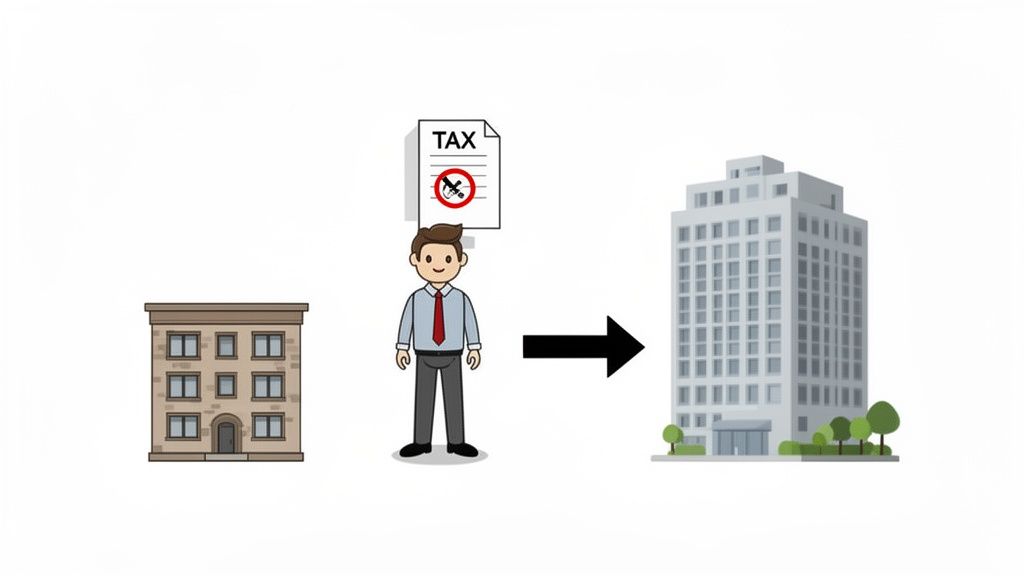
Your First Look at the 1031 Exchange
A 1031 exchange is much more than just a tax benefit. It’s a strategic engine for building wealth. It lets you continuously reinvest your capital into bigger and better properties without giving up a huge chunk of your equity to taxes with every sale.
Think of it as trading up. Instead of cashing out your gains and pausing your momentum, you roll your full investment forward. This keeps your capital working for you, compounding returns over time. In Richard Maize's experience, it’s how savvy investors maintain momentum, scale their portfolios, and build lasting wealth.
By deferring taxes, you can acquire assets that generate higher returns, diversify your holdings into different property types, or expand into new geographic markets much faster than you otherwise could.
The Basic Mechanics
At its core, the process involves selling one property (the "relinquished property") and acquiring another (the "replacement property") through a very specific, rule-bound process.
You can't just sell a property, hold the cash, and then buy another one. The entire transaction must be handled by a Qualified Intermediary (QI). This is a neutral third party who holds the sale proceeds, preventing you from having "constructive receipt" of the funds. This rule is non-negotiable—if you touch the money, the exchange is disqualified and the tax bill comes due.
As Richard Maize often explains, "A 1031 exchange is the engine of portfolio evolution. It’s how an investor can pivot from a small residential rental to a multi-unit apartment building or a commercial property without the tax drag that typically slows down growth."
The exchange is also governed by strict deadlines. After you sell your property, you have just 45 days to formally identify potential replacement properties. You then have a total of 180 days from the sale date to close on one of them. These timelines are absolute and are a common reason why poorly planned exchanges fail.
To help you get a clear picture of the key elements, the table below provides a quick summary of the main components and their timelines.
1031 Exchange at a Glance Key Components and Timelines
Component | Description | Critical Deadline |
|---|---|---|
Relinquished Property | The investment property you are selling. | Sale must be structured as part of an exchange. |
Replacement Property | The "like-kind" investment property you are buying. | Must be formally identified and acquired. |
Qualified Intermediary (QI) | A required third-party who facilitates the exchange and holds the funds. | Must be engaged before the sale closes. |
Identification Period | The window to formally identify potential replacement properties. | 45 days from the sale of the relinquished property. |
Exchange Period | The total timeframe to acquire the replacement property. | 180 days from the sale of the relinquished property. |
Understanding these core rules is the first step. With a solid plan and the right team, a 1031 exchange can become a cornerstone of your real estate investment strategy.
Why the 1031 Exchange Has Lasted Over a Century
A 1031 exchange isn’t some slick, modern tax loophole. It’s a core piece of U.S. economic policy that has been deliberately protected for more than 100 years for one simple reason: it works.
It was born from a surprisingly simple, common-sense idea introduced in the Revenue Act of 1921. Congress recognized that an investor who just swaps one property for another hasn’t really "cashed out." Their economic position hasn't changed. They’re just continuing their investment.
Taxing that kind of move would unfairly penalize them for staying in the game. That fundamental logic—the principle of continuous investment—is what has kept the 1031 exchange alive ever since.
From Simple Swaps to Modern Flexibility
For decades, exchanges were clunky. They had to be direct, simultaneous swaps, which was almost impossible to pull off in the real world. Finding two owners who wanted each other's specific properties at the exact same time was incredibly rare.
Then came the landmark Starker v. United States case in 1979, which changed everything.
The Starker family sold timberland but didn’t find their replacement property until years later. The IRS, of course, challenged it. But the court sided with the Starkers, setting the legal foundation for the delayed exchange that we all rely on today.
As expert investor Richard Maize often notes, "The Starker case was a game-changer. It introduced the flexibility that allows investors to thoughtfully seek out the best replacement property, turning the 1031 exchange from a niche tactic into a mainstream strategic tool for portfolio growth and diversification."
That single ruling is what made the modern 1031 exchange possible. It gave birth to the entire industry of Qualified Intermediaries and created the strict 45-day and 180-day timelines that bring discipline and structure to the process.
A Powerful Engine for the US Economy
The real reason the 1031 exchange endures is its massive economic footprint. This isn't just about helping individual investors defer taxes; it’s about what happens when that capital is forced back into the market.
When an investor completes a 1031, their money doesn’t just sit there. It fuels a powerful ripple effect that supports jobs for contractors, brokers, attorneys, and lenders. It drives the redevelopment of older, underperforming properties, which helps revitalize communities and grow the local tax base.
Without it, many investors would just hold onto properties forever to avoid a big tax hit, creating a stagnant, inefficient market. The 1031 keeps capital moving.
A 2021 study drove this point home, projecting that 1031 exchanges would support 568,000 jobs and add $55.3 billion to the U.S. GDP in that year alone. You can find more details about this in a recent study on the economic impact of the 1031 exchange.
This is why, in Richard Maize's view, the provision survives every new round of tax reform debates. Lawmakers understand that getting rid of it wouldn't just hurt real estate—it would put the brakes on a major source of economic activity and job creation.
It's a rare example of a policy that perfectly aligns the interests of the individual investor with the health of the broader economy.
Navigating the Non-Negotiable Rules and Deadlines
When it comes to a 1031 exchange, success isn’t found in a clever loophole. It’s achieved by following a strict set of rules without deviation. The IRS deadlines are absolute, and the regulations are unforgiving. Understanding this is the only way to protect your tax deferral.
The first rule that trips people up is the “like-kind” property rule. The name is misleading. It doesn’t mean you have to trade an apartment building for an identical apartment building.
In reality, the definition is surprisingly flexible. “Like-kind” refers to the nature of the property, not its quality. As long as the property you sell and the one you buy are both held for investment or business use, they generally qualify. As Richard Maize knows well, this is where the real strategic power of an exchange lies.
Understanding the Like-Kind Rule
This flexibility allows you to shift your real estate strategy without creating a taxable event. You're not locked into one asset class. For instance, you could exchange:
A single-family rental for a commercial office building.
A piece of raw land for an industrial warehouse.
An agricultural property for a portfolio of duplexes.
The key is that you must exchange real property for other real property. You can’t swap a building for personal property, stocks, bonds, or interests in a partnership. The entire transaction has to stay within the world of investment real estate.
The 1031 exchange has been a cornerstone of investment strategy for a long time. This timeline shows just how foundational it has become.
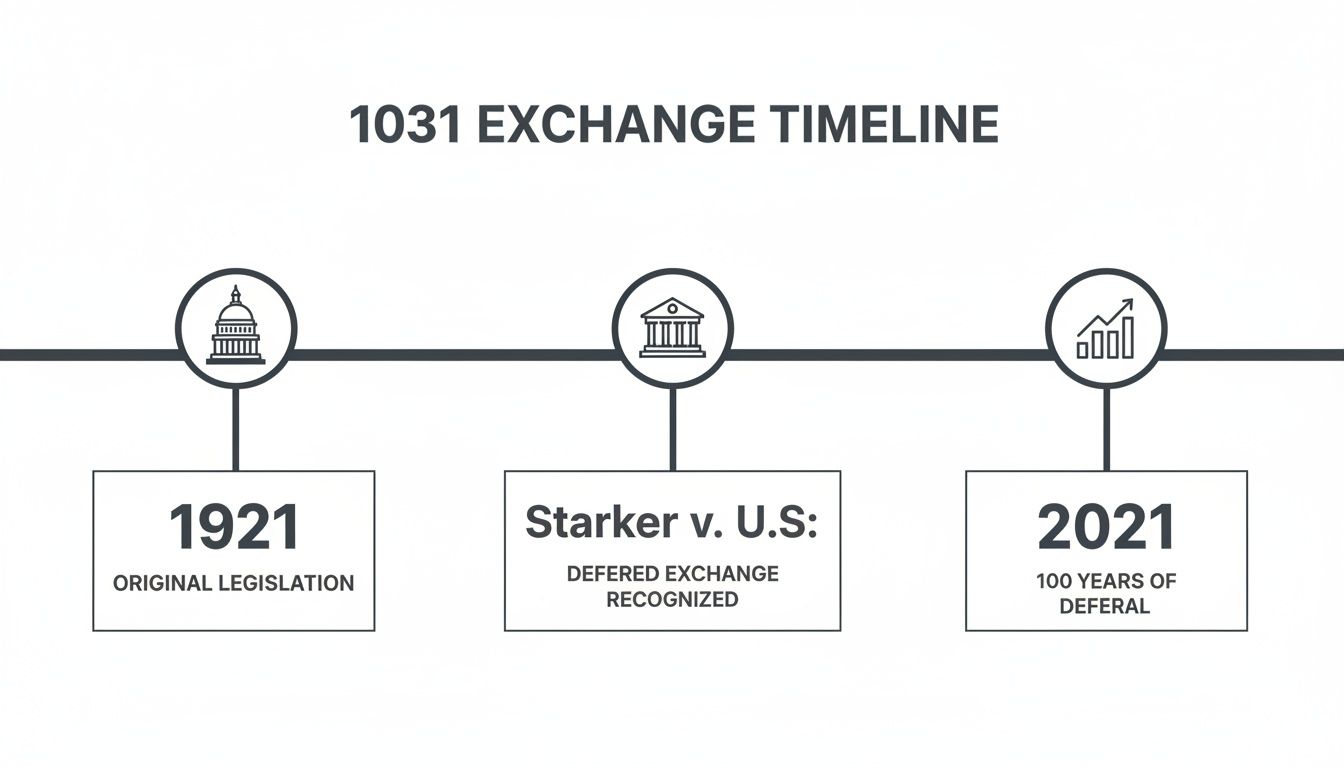
From its creation in 1921 to today, the exchange has been a consistent, powerful tool for investors who understand the rules.
The Two Unbreakable Deadlines
While the like-kind rule is flexible, the timelines are not. If you miss either of these deadlines by a single day, the exchange is voided. You will owe the full capital gains tax on your sale.
The 45-Day Identification Period: The clock starts the day you close on your original property. You have exactly 45 calendar days to formally identify potential replacement properties. This has to be a signed, written notice delivered to your Qualified Intermediary.
The 180-Day Exchange Period: You have a total of 180 calendar days from the original sale date to close on the new property. The 45-day window runs at the same time, it is not in addition to the 180 days.
As real estate expert Richard Maize emphasizes, "The 45-day and 180-day clocks are unforgiving. There are no extensions except in rare cases of federally declared disasters. Successful investors start their search for a replacement property long before their old one is even on the market."
The Three Identification Rules Explained
Within that tight 45-day window, you have to follow one of three specific rules for identifying your replacement properties. You only need to meet one.
The 3-Property Rule: This is the most common and straightforward choice. You can identify up to three properties of any value.
The 200% Rule: If you need more options and identify more than three properties, their combined market value can't be more than 200% of what your old property sold for.
The 95% Rule: This option is the riskiest and rarely used. If you identify properties that exceed both the 3-property and 200% limits, you are required to purchase at least 95% of the total value of everything you identified. A single failed closing could blow up your entire exchange.
These rigid timelines and rules create a high-stakes environment where planning is everything. This is why working with an experienced Qualified Intermediary isn’t just a good idea—it’s essential for making sure every detail is handled correctly.
Choosing the Right Type of 1031 Exchange
A 1031 exchange is a powerful tool, but it's not a one-size-fits-all solution. The right structure depends entirely on your specific goals, your position in the market, and the clock. Picking the right exchange type is one of the most critical strategic decisions you'll make as an investor.
While most people know the standard sell-then-buy process, several variations give savvy investors a major edge. Understanding your options gives you the flexibility to seize opportunities, whether that means securing a perfect property before you sell or funding a major renovation with your tax-deferred dollars.
The Delayed Exchange
The Delayed Exchange is what most people think of when they hear "1031 exchange." It’s the most common structure by a wide margin, making up the vast majority of transactions. You sell your relinquished property first, then you have 45 days to identify a replacement and 180 days to close on it.
This straightforward, linear approach works perfectly when you have a clear plan and the market gives you enough time to find a suitable asset. Its popularity comes from its simplicity, making it the default choice for many investors.
The Reverse Exchange
But what happens when you find a deal you can’t pass up before your current property is even on the market? In a hot seller's market, you can't ask a seller to wait around. This is where a Reverse Exchange becomes your key advantage.
With this structure, you buy your replacement property first and sell your relinquished property later. Since tax law says you can't own both properties at once, a specialized entity called an Exchange Accommodation Titleholder (EAT) "parks" the title to the new property for you. This lets you close on the new asset right away without derailing your exchange.
As expert investor Richard Maize explains, "A Reverse Exchange is a game-changer in a seller's market. It allows you to make a strong, non-contingent offer on a new property, giving you a competitive edge over other buyers who are still waiting to sell."
For years, the Reverse Exchange was a bit of a gray area. That changed when the IRS issued Revenue Procedure 2000-37, which created a safe harbor and formalized the rules. This ruling turned it from a risky move into a potent, legitimate strategy for proactive investors. You can learn more about how 1031 exchange rules have evolved over time to get the full picture.
The Construction or Improvement Exchange
Sometimes, the perfect property isn't perfect—yet. A Construction or Improvement Exchange is designed for the value-add investor who wants to use tax-deferred funds to build or renovate a new property.
Much like a Reverse Exchange, an EAT holds the title to the replacement property while the improvements are made. This allows the cost of construction to be rolled into the final value of the asset, helping you meet the requirement to trade for equal or greater value. The key is that all improvements must be identified within the 45-day window and completed before the 180-day exchange period ends.
Comparing the Four Types of 1031 Exchanges
Each type of exchange serves a very different strategic purpose. Choosing the right one is essential to make sure the transaction aligns with your financial goals and timeline.
The table below breaks down the four main types to help you see which one fits your situation.
Exchange Type | Best For | Complexity | Key Consideration |
|---|---|---|---|
Delayed Exchange | Investors with a standard sell-then-buy timeline. | Low | The most common and straightforward option. |
Reverse Exchange | Buying a replacement property before selling your current one. | High | Requires significant upfront capital and complex structuring. |
Construction Exchange | Renovating or building on the replacement property with exchange funds. | High | All improvements must be completed within the 180-day window. |
Simultaneous Exchange | Closing on both properties on the very same day. | Moderate | Extremely rare and logistically difficult to coordinate perfectly. |
Ultimately, the best exchange is the one that gives you the control and flexibility to execute your vision, whether it’s a simple trade or a complex, multi-step acquisition.
Common Pitfalls and How to Avoid Them
The rules of a 1031 exchange are rigid. One small misstep can blow up the entire transaction, triggering a significant tax bill you weren't prepared for. Understanding where investors commonly go wrong isn't just about following rules—it's about protecting the wealth you've worked so hard to build.
While countless investors use this strategy successfully, their success comes from careful planning and foresight. With battlefield advice from seasoned experts like Richard Maize, you can learn to spot these hazards before they become a problem.
Let's break down the most common mistakes and the straightforward solutions to keep your exchange clean and tax-deferred.
The Problem of Taxable Boot
Your goal in a 1031 is to defer 100% of your capital gains tax. The single biggest reason investors fall short of this is something called boot. Think of boot as any value you "take off the table" during the exchange. It's any non-like-kind property you receive, and it's always taxable.
Boot usually shows up in two ways:
Cash Boot: This one is pretty obvious. If you sell your property for $500,000 but the replacement property only costs $450,000, that leftover $50,000 is cash boot. You’ll owe capital gains tax on that amount.
Mortgage Boot: This one is more subtle and trips people up all the time. It happens when you take on less debt with your new property. If your old property had a $300,000 mortgage but your new one only requires a $250,000 mortgage, that $50,000 in debt relief is considered taxable boot—unless you add $50,000 of your own cash to the deal to make up the difference.
To keep your exchange completely tax-free, the math is simple. You must buy a property of equal or greater value and roll all of your net proceeds into the new purchase.
The Danger of Constructive Receipt
One of the cardinal sins in a 1031 exchange is constructive receipt. This means having access to or control over the money from your sale, even for a moment. If the funds so much as touch your personal or business bank account, the exchange is invalid. Period.
This is why using a Qualified Intermediary (QI) isn’t just a good idea; it’s non-negotiable. The QI is a neutral third party that holds your funds in escrow after you sell your old property and before you buy the new one. They create a necessary legal barrier between you and the money, satisfying the IRS’s strict no-touching rule.
As real estate investor Richard Maize often warns, "The moment the sale proceeds touch your bank account, your 1031 exchange is over. There’s no fixing it. Using a reputable Qualified Intermediary is the only way to create the necessary barrier between you and the funds."
Navigating Related-Party Transactions
Swapping properties with a family member or a business entity you control is possible, but it comes with a big string attached. These related-party transactions get extra scrutiny from the IRS to prevent investors from using them to simply cash out without paying taxes.
The main rule you need to know is the mandatory two-year holding period. If you do an exchange with a related party, both you and that person (or entity) must hold onto your new properties for at least two years. If either of you sells before that clock runs out, the IRS will retroactively disallow the tax deferral for both of you.
The key here is commitment. If you’re considering a related-party exchange, you have to be prepared to hold the asset for the long haul. Meticulous records and open communication with your tax advisor are absolutely essential. For a deeper understanding of what to look for in any property, new or old, you might be interested in Richard Maize's commercial real estate due diligence checklist to master your next deal.
Your Step-by-Step 1031 Exchange Playbook
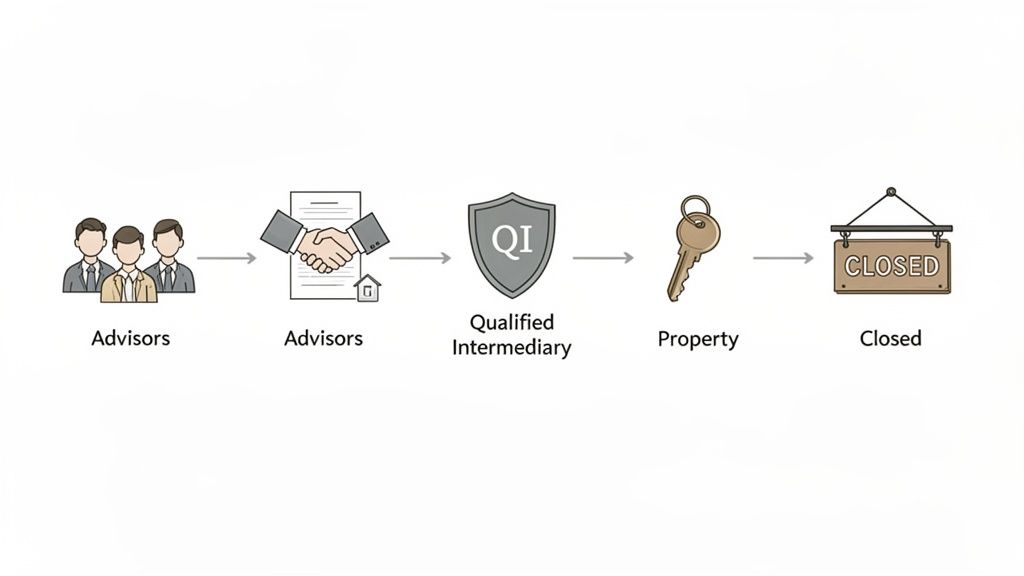
Understanding the rules is one thing. Putting them into action is another. A successful 1031 exchange follows a precise sequence of events, and getting the order right is everything. This playbook, reflecting the strategies of seasoned pros like Richard Maize, shows how it’s done.
Step 1: Assemble Your Expert Team
This is the most important step, and it happens before you even list your property for sale. You need a team in place: a good tax advisor, a real estate agent who understands the nuances of these deals, and a reputable Qualified Intermediary (QI).
Your QI is the most critical piece of the puzzle. They are the neutral third party that holds your funds and ensures you follow IRS rules. You absolutely must engage them before the sale of your property closes.
As expert investor Richard Maize advises, "Vetting your QI is non-negotiable. Look for a bonded, insured company with a long track record. A great QI doesn't just hold funds; they guide you through every deadline and document, preventing the small errors that can derail an entire exchange."
Step 2: Prepare Your Sale Agreement
Once your team is ready, work with your agent to list the property you plan to sell (the relinquished property). There’s a small but vital detail to include in the purchase agreement: a 1031 cooperation clause.
This simple clause officially states your intent to perform an exchange and confirms the buyer agrees to cooperate. It’s a standard provision that prevents any confusion and ensures a clean handoff to your QI.
Step 3: Close and Identify
When your property sale closes, the proceeds go directly from the closing agent to your QI—never to you. The moment those funds land with the QI, two clocks start ticking. You have 45 days to formally identify potential replacement properties and a total of 180 days from the sale date to close on one of them.
The identification has to be a formal, written notice delivered to your QI. Smart investors use the identification rules (like the 3-Property Rule or the 200% Rule) to give themselves backup options in case their first choice falls through.
This structured process is the engine of the investment real estate market. In fact, research shows that 63% of all real estate agents have been involved in a 1031 exchange, and 40% of professionals admit their deals would not have happened without it. This just goes to show how essential the exchange is, especially in major markets like New York and Los Angeles. You can see more data on the widespread impact of 1031 exchanges on the real estate market.
Step 4: Acquire and Close
With your replacement property identified and under contract, you’re in the home stretch. Your QI will wire the exchange funds directly to the closing agent to complete your new purchase.
Make sure your financing is lined up well in advance to prevent any last-minute delays that could jeopardize your 180-day deadline. If you need a refresher, we have a guide on how to finance investment properties with smart funding strategies.
Once you close on the new property, your exchange is complete. You’ve successfully deferred your capital gains tax and put your full investment capital back to work.
Key 1031 Exchange Questions Answered
When you get serious about a 1031 exchange, the theoretical questions quickly become practical ones. Getting the right answers from an expert perspective, like that of Richard Maize, is what separates a smooth, tax-deferred transaction from a costly mistake.
Here are a few of the most common issues investors run into on the ground.
Can I Use a 1031 Exchange for a Vacation Home?
Generally, no. The spirit of Section 1031 is for business or investment properties only. Your primary residence or a personal vacation spot won't make the cut.
However, there is a path to convert a second home into a qualifying property. The IRS has a clear safe harbor rule: you must rent the property at fair market value for at least 14 days a year for two years leading up to the sale.
During that time, your own personal use can’t exceed 14 days or 10% of the total days it was rented, whichever is greater. It's about demonstrating true investment intent.
What Happens If I Miss the 45-Day Identification Deadline?
Missing the 45-day deadline is the end of the road. The exchange fails.
This is one of the most unforgiving rules in the tax code—there are no extensions. If you don't give your Qualified Intermediary a signed, written list of potential replacement properties within that window, it’s over. The funds are returned, and the capital gains tax bill for your sale becomes due immediately.
As real estate expert Richard Maize states, "The 45-day clock is unforgiving. A successful exchange begins long before the sale, with a well-researched list of potential replacement properties. Proactive planning is your only safeguard against this critical deadline."
What Is Boot and How Do I Avoid It?
"Boot" is a simple term for any part of an exchange that isn't "like-kind" property. Think cash in your pocket or a reduction in your mortgage debt. Any boot you receive is taxable.
To defer all of your capital gains tax, you have to follow two straightforward rules:
Buy a replacement property for a price of equal or greater value.
Reinvest all the cash proceeds from the sale and take on equal or greater debt.
For instance, if you sell a building for $1 million that had a $400,000 mortgage, you must buy a new property for at least $1 million and carry at least $400,000 of debt. Any cash you take out or any reduction in your loan balance is taxable boot. To explore more advanced strategies for managing real estate taxes, you can read also: How to Minimize Taxes on Real Estate Investments Richard Maize Shares His Strategy.
Ready to explore how decades of real estate expertise can inform your next move? Richard Maize offers a wealth of practical insights on investment, entrepreneurship, and philanthropy. Discover actionable strategies and proven perspectives by visiting https://richardmaize.com.
Comments