Strategic Business Alliances: A Real-World Playbook

A neighboring owner called me about a property line, not a partnership. We ended up talking about signage, landscaping, tenant traffic, and vacant units, and by the end of that conversation the opportunity was obvious.
The Deal That Started With a Phone Call
In real estate, a lot of good alliances start before anyone uses the word alliance. They start when two operators are dealing with the same friction at the same time.
Years ago, I got a call from the owner next to one of my properties. His first complaint was practical. The shared edge between the buildings looked neglected, tenants noticed it, and neither of us wanted to carry the full burden of cleaning up an area that affected both addresses. That part was easy. Harder, and more useful, was what came next. We realized we were both spending money to solve overlapping leasing problems separately.
His building had one type of vacancy. Mine had another. His tenants asked for overflow options we didn't offer. My prospects wanted unit configurations he had available. We were buying visibility in the same corridor, talking to the same local brokers, and presenting two disconnected stories to the same market.
What changed when we stopped treating it casually
We didn't merge. We didn't form a new company. We built a small, structured arrangement around a simple idea. Shared landscaping standards. Coordinated signage. A tenant referral understanding with rules, so nobody poached and nobody got confused. We also agreed on who approved what, who paid for what, and how either side could stop the arrangement if it stopped making sense.
That last point matters. Informal cooperation feels easy at the start, but loose arrangements often create tight problems later.
Practical rule: If a handshake affects revenue, cost allocation, tenant experience, or reputation, write it down before memory and goodwill start doing the work.
The alliance worked because it solved a real constraint for both sides. It also stayed narrow. We didn't pretend we were better together in every area. We picked the few areas where cooperation created value and left everything else independent.
Why this matters beyond real estate
That same pattern shows up in community ventures, operating businesses, and philanthropic work. Two groups may serve the same neighborhood, reach different donors, control different assets, or hold different kinds of trust with the public. Alone, each can do good work. Together, if the structure is right, they can do something more durable.
Strategic business alliances aren't theory to me. They're one of the most practical ways to expand reach without buying everything yourself, hiring everything yourself, or carrying every risk yourself. They can save a project. They can also create a mess if the parties confuse chemistry with structure. The difference usually comes down to design.
What a Strategic Business Alliance Actually Is
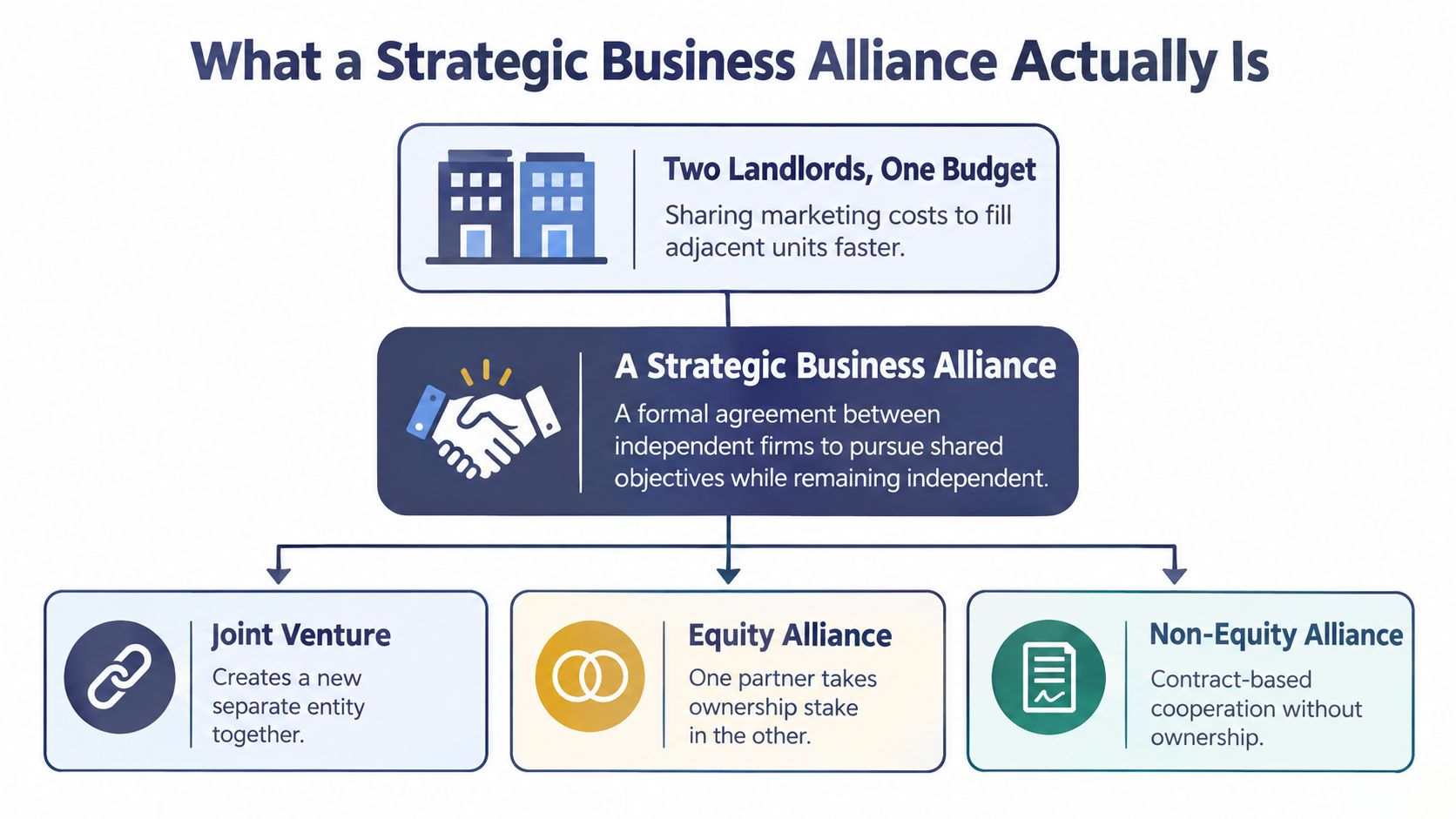
The plain-English version is simple. Two independent operators see a goal they can reach faster or cheaper together than alone, so they make a formal arrangement to pursue it while each keeps control of its own core business.
Think of two landlords with adjacent vacancies. One has stronger local broker relationships. The other has better curb appeal and more parking. If they share a marketing push and align on referrals, they haven't become one company. They've built an alliance around a specific business problem.
The three traits that matter
A real alliance usually has three features.
Shared risk: Each side puts something at stake. It may be money, access, reputation, staff time, property use, or distribution.
Shared upside: Both sides should benefit if the arrangement works. If one side gets all the gain and the other just performs a service, that's usually a vendor relationship.
Retained independence: Each party still controls its own business outside the agreement.
That distinction keeps people out of trouble. A vendor contract buys an output. A strategic alliance creates joint value. A joint venture often goes further and creates a separate entity. A general partnership can blend interests more broadly than most operators need. In practice, many useful alliances sit in the middle. Formal enough to matter, limited enough to stay manageable.
Why operators keep using them
This isn't a fad. Strategic alliances became a mainstream growth tool a long time ago. The OECD reported that strategic alliance deals rose from 1,000 to 2,000 in 1989 to nearly 10,000 by 1999, a roughly fivefold to tenfold increase as firms used partnerships to enter markets, share risk, and pool capabilities during the globalization wave of the 1990s, especially across borders, as summarized in this OECD-based review of alliance growth.
For entrepreneurs, property owners, and community builders, the reasons are practical.
Where alliances earn their keep
Market access: A local operating partner can open doors that money alone won't open.
Capital efficiency: You can test a concept without buying every missing capability.
Risk pooling: On uncertain projects, shared exposure beats solo overreach.
Credibility: Some lenders, municipalities, nonprofits, and institutional counterparties get more comfortable when the right names are aligned around one plan.
The best alliances don't exist because collaboration sounds smart. They exist because the cost of doing it alone is higher than the cost of coordinating well.
That's the test. If the alliance doesn't clearly improve speed, access, economics, or resilience, it probably shouldn't exist.
Choosing the Right Alliance Structure for the Goal
Operators get in trouble when they pick a structure because it sounds advanced instead of because it fits the job. Start with the goal, then choose the container.
If you want to test demand, solve a narrow operating problem, or reach a market quickly, a light structure usually wins. If you're committing capital, sharing ownership, or dealing with a long timeline and more regulation, you need a heavier structure with sharper documentation.
Alliance structures at a glance
Structure | Best Fit For | Control Trade-Off | Common Pitfall |
|---|---|---|---|
Non-equity alliance | Shared marketing, referrals, co-branded programs, operating cooperation | Low loss of control | Parties stay vague because the deal feels informal |
Equity joint venture | Development projects, asset-heavy initiatives, long-hold ventures | Higher shared control | Deadlock when major decisions weren't mapped early |
Consortium | Large civic, infrastructure, or community initiatives involving multiple groups | Distributed control across several parties | Meetings multiply while accountability gets blurry |
Licensing or co-development | Brand use, program replication, media, product or concept expansion | Moderate control through defined rights | Ownership of improvements and intellectual property stays unclear |
When each structure works
A non-equity alliance is usually the cleanest place to begin. If two parties want to share leads, coordinate outreach, cross-promote assets, or combine service capabilities without changing ownership, this structure does the job. It underperforms when one side expects a deep commitment while the paperwork only supports a light collaboration.
An equity joint venture fits when both sides are putting meaningful capital or assets into the same undertaking. In real estate, that might mean land, operating expertise, financing relationships, or entitlement knowledge coming from different parties. You gain alignment, but you also give up unilateral control. If the parties don't agree on exit timing, reinvestment, and decision thresholds, the capital structure becomes an argument machine.
A consortium makes sense when no single organization can credibly deliver the full scope alone. Community development efforts often look like this. One group has local trust, another has execution capability, another has institutional relationships. The weakness is obvious. More logos often mean more politics.
A quick decision filter
Before negotiating terms, answer four questions:
How much capital is at risk?
How much control are you willing to share?
How much regulatory or stakeholder friction surrounds the project?
How soon might one side want out?
If capital exposure is limited, uncertainty is high, and the goal is learning, start lighter. If the project is asset-heavy, regulated, and long-dated, build a structure that assumes conflict will eventually happen.
Chemistry can get a deal started. Structure decides whether it survives ordinary stress.
That's why experienced operators don't ask for the “best” alliance form. They ask which form best matches the size of the bet, the life of the project, and the cost of getting stuck.
Legal and Financial Mechanics That Protect the Partnership
Most alliance disputes don't start with betrayal. They start with ambiguity. One side thought the contribution was finished. The other thought it was ongoing. One side thought profits would come out quarterly. The other wanted to reinvest. One side believed a missed deadline was annoying. The other treated it as a default.
Good documents don't kill trust. They preserve it.
Start with money, not slogans
If the arrangement involves ownership, define whether economics follow equity ownership, profit-sharing, or some hybrid tied to milestones. Those are not the same thing. An operator contributing know-how, tenant relationships, or execution may deserve economics that don't line up perfectly with cash in. But if that's the bargain, write it plainly.
Capital calls are another pressure point. Decide in advance:
When new cash can be required
Who can authorize it
What happens if one party doesn't fund
Whether dilution, debt treatment, or default remedies apply
Distribution waterfalls matter for the same reason. Parties need to know who gets paid first, what gets reserved, what gets reinvested, and when cash can come out.
Key alliance clauses and what they actually do
Clause | Plain-Language Purpose | Negotiation Priority |
|---|---|---|
Scope of alliance | Defines exactly what the parties are and aren't doing together | High |
Contribution schedule | States who contributes cash, assets, labor, access, or IP, and when | High |
Decision rights | Assigns who can approve budgets, hires, contracts, financing, and strategy shifts | High |
Information rights | Gives each side access to reports, books, and operational updates | High |
Exit triggers | Sets the conditions for buyout, termination, sale, or unwind | High |
ROFR and tag-along rights | Protects parties when one side wants to sell or accept an outside offer | Medium to High |
Default remedies | Tells everyone what happens after missed funding, missed performance, or misconduct | High |
Dispute process | Establishes escalation, mediation, arbitration, or court venue | Medium |
The clauses non-lawyers should care about most
An operating agreement or equivalent governance document is the control center. It should define authority, economics, records, transfers, and deadlock procedures. If there's a right of first refusal, understand whether it protects stability or just slows down every future deal. If tag-along rights appear, they should protect minority parties from being stranded under a new owner they didn't choose.
Watch for vague treatment of intellectual property in co-development or branded ventures. If a concept, playbook, media asset, or operating system improves during the alliance, who owns the improvement? If the document shrugs at that question, the problem hasn't gone away. It's just delayed.
Match the entity to the actual intent
An LLC often fits a contained venture that needs flexibility in management and economics. A partnership model may fit where tax treatment and allocation flexibility matter. A corporate vehicle can make sense if the venture expects outside investors, more formal governance, or a path that looks more institutional.
The mistake is using the same plumbing for every deal. The entity, tax treatment, reporting cadence, and bank-account discipline should support the strategy. They shouldn't fight it.
If a partner resists basic reporting, clear default remedies, or written exit mechanics, pay attention. People usually reveal their preferred future behavior during negotiation.
Measuring Alliance Performance With a Real Scorecard
I've watched alliances look healthy on paper for six months after they were already in trouble. Revenue had not fallen yet. The problem showed up earlier in smaller places. Calls got pushed. Referrals slowed. Site decisions sat in limbo. Nobody could say, with any precision, whether the partnership was building value or just consuming attention.
That is why every alliance needs a scorecard early. Analysts at McKinsey argue for putting one in place within the first month and tracking financial, strategic, operational, and relationship measures together, rather than relying only on lagging financial results, in their guidance on measuring alliance performance.
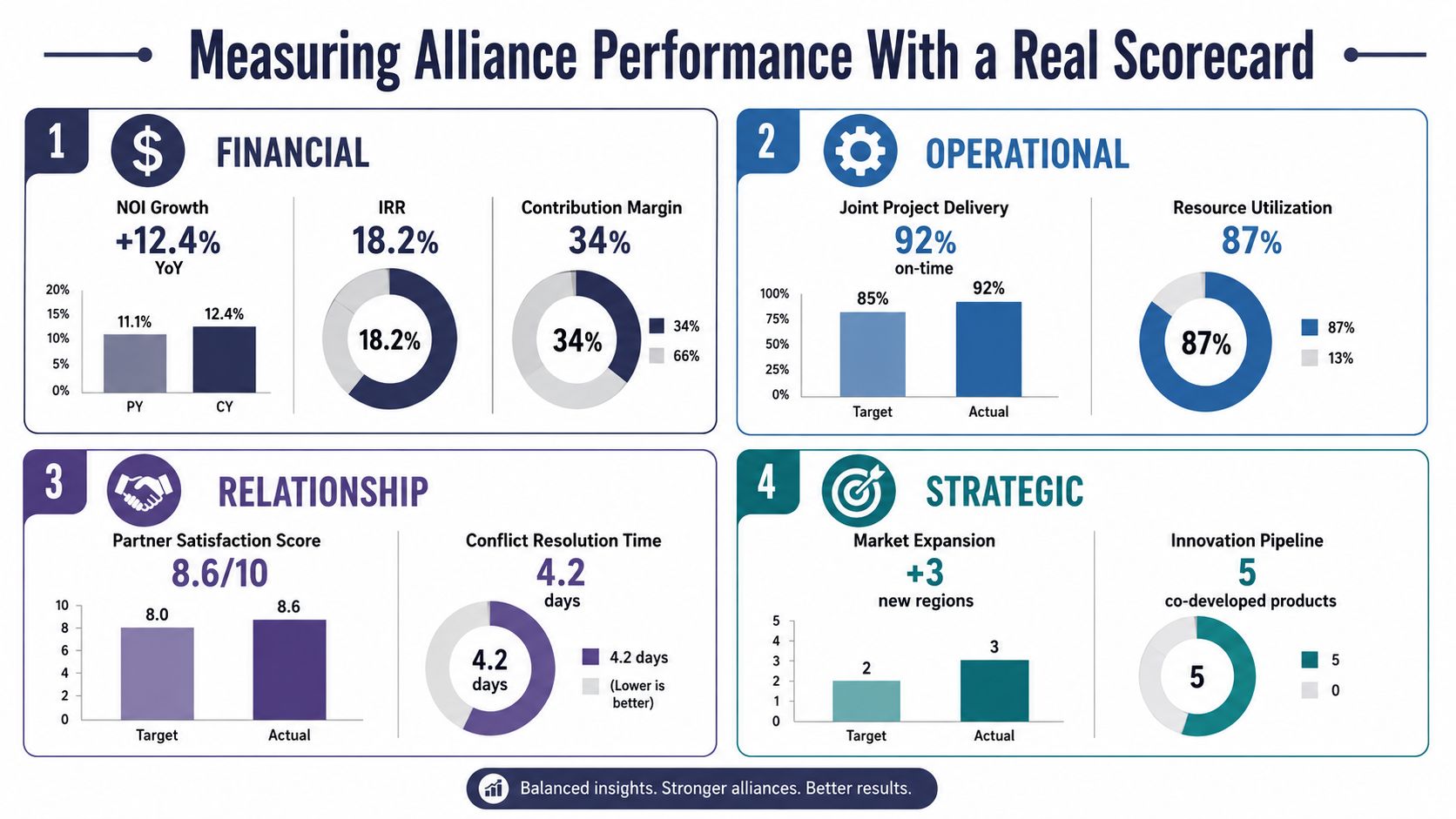
A real scorecard does one job. It helps the partners decide whether to keep funding, fix, expand, or exit the alliance.
Four blocks that tell the truth
Use four categories. Keep each one tied to a decision.
Financial
Start with the economic promise that justified the alliance. In a real-estate venture, that may mean NOI improvement, leasing velocity, concession efficiency, tenant retention tied to the partner, or margin on a shared initiative. In a community venture, it may mean sponsorship yield, donor conversion, event revenue, or cost sharing that reduces overhead instead of just shifting it around.
These measures answer a hard question. Is this alliance earning its place in the portfolio?
Operational
Execution usually breaks before economics do. Track the facts that show whether the work is moving: deliverables met on time, referral acceptance, campaign launch timing, permit coordination, prospect handoff quality, tour-to-lease conversion steps, or response times on joint work.
If one side says the alliance is “going well” but deadlines keep slipping, trust the operating facts.
A shared dashboard matters here. If one party owns all the reporting and the other sees a polished summary two weeks late, the scorecard becomes politics instead of management.
Relationship health belongs on the scoreboard
People roll their eyes at this category until the friction starts costing money.
In long-cycle alliances, especially around development, local partnerships, and public-facing projects, behavior is an early indicator. If issues sit unresolved, if people leave meetings with different interpretations, or if promised introductions never happen, the alliance is weakening even if the quarter still looks acceptable.
Use a few plain measures:
Escalation response time: How fast does each side acknowledge and assign a problem?
Commitment reliability: Are agreed actions completed on the date promised?
Decision clarity: After a meeting, does each team know who owns the next step?
Those are not soft metrics. They are operating conditions.
Strategic metrics need their own lane
The specific gap appears when many scorecards go thin. Partners count current cash and ignore whether the alliance is creating future options.
For a real-estate operator, the strategic return may be access to municipalities, land pipeline, tenant relationships, construction capability, or credibility in a neighborhood where trust takes years to build. For a community-based venture, the payoff may be standing, distribution, local reach, or a better position for the next project, not just this one.
Track those outcomes directly. If the alliance was supposed to open doors, shorten entry time, strengthen local acceptance, or build a repeatable playbook, score that work in a visible way.
A good scorecard makes three decisions easier: continue, restructure, or exit.
Keep the review rhythm simple. Monthly is usually enough for operating measures. Quarterly is the right interval for the harder conversation about whether the alliance still deserves capital, management time, and a slot in the broader partnership portfolio.
Why Governance Matters More Than Partner Selection
People love talking about choosing the right partner because it feels decisive. It's also flattering. Good instincts, strong network, sharp judgment. All of that matters. It just doesn't carry the deal very far on its own.
Research does show that partner selection quality matters. Studies on strategic alliances found that relationship orientation, market orientation, strategic fit, cultural fit, and trust all have positive effects on performance, and one study of 106 alliances found that alliance orientation and strategic fit were associated with stronger outcomes while cultural fit increased partner trustworthiness, as summarized in this research overview on alliance performance drivers. But that's only the front end.
Good partner, bad system
I've seen high-trust pairings go nowhere because nobody defined decision rights. One side thought they were advising. The other thought they were approving. Meetings became polite, then tense, then pointless.
I've also seen average chemistry produce durable results because the governance was disciplined. Written agendas. Clear escalation. Real minutes. Documented assumptions. Defined authority by category, not by personality.
That's not glamorous. It works.
The uncomfortable data
Alliance performance is uneven. McKinsey reported that in work with more than 500 companies worldwide, fewer than one in four alliances had adequate performance metrics in place, 30% to 60% were underperforming, and three to five major deals at many firms needed restructuring. At the same time, BDO found alliances drove about one-third of company revenue on average over the past five years, with respondents saying 62% of innovation came from collaboration with third parties and 33% of alliances were multilateral, according to this summary of alliance statistics from McKinsey and BDO.
That combination tells the story. Alliances are too important to run casually.
Governance habits that actually protect value
Decision rights matrix: Separate what requires joint approval from what day-to-day operators can decide alone.
Escalation path: Name the people, timing, and process for resolving disputes before they become personal.
Quarterly business review: Use a written agenda, pre-read materials, and explicit decisions recorded in writing.
Exit triggers: If financing disappears, leadership changes, approvals stall, or priorities shift, everyone should know what happens next.
Deals can be copied. Disciplined governance across two organizations usually can't.
There's another reason this matters. Existing discussion around alliances often overemphasizes formation and underplays what happens after signing, even though benchmark research has reported alliance failure rates around 30% to 70%, with many alliances running into trouble in the first two years and only about 40% surviving four years in older benchmark studies, as discussed in this research on alliance governance and failure. The point isn't pessimism. The point is sobriety.
If you want strategic business alliances to last, treat governance as an operating model, not a legal appendix.
A Practical Alliance Checklist for the Next 90 Days
I have seen alliances lose a year before they ever had a chance to work. The pattern is familiar. Two sides like each other, the opportunity sounds promising, and everyone postpones the hard calls on control, reporting, and exit. By the time those issues surface, the goodwill is already thinner than people admit.
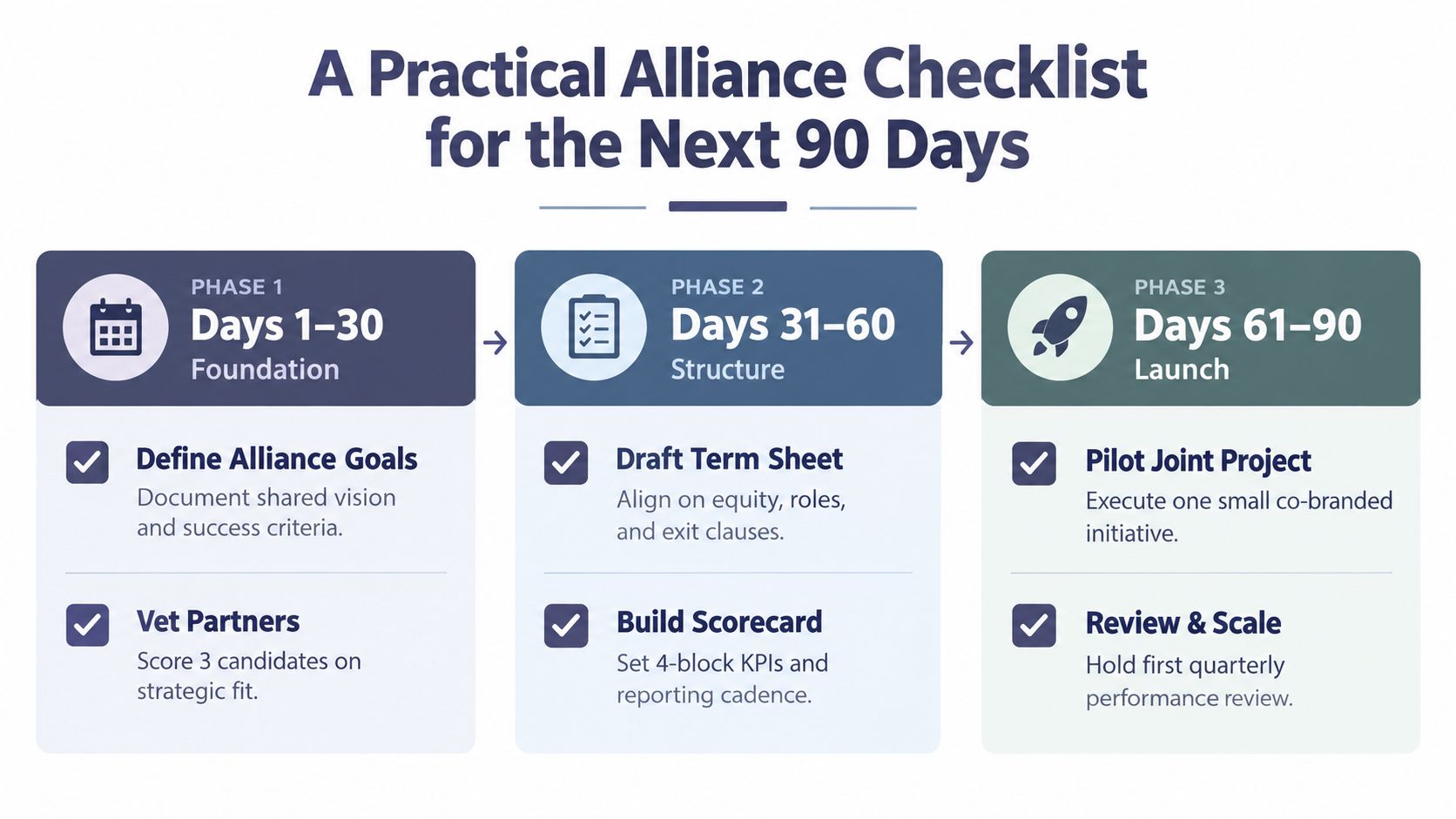
A better approach is to treat alliances like a portfolio discipline. In real estate, one joint venture rarely carries the whole strategy. The same should be true here. Over the next 90 days, the job is to test whether this potential partnership deserves capital, management attention, and a place alongside your other bets.
Days 1 to 30
Start with your own position. A partner cannot solve a problem you have not defined clearly.
Write a one-page alliance hypothesis that covers four points: the problem, the kind of partner that fits, what each side contributes, and the result you expect if the alliance works. Keep it tight enough that an operating executive can read it in five minutes and tell whether it makes sense.
Then pressure-test your constraints.
Clarify the gap: market access, staffing, credibility, capital, operating expertise, distribution, or local relationships
Build a short candidate list: three to five names is enough for a real process
Create a due-diligence matrix: score strategic fit, mission fit, reputation, governance readiness, and financial stability
List the assets you must protect: geography, tenant or customer relationships, brand use, data access, board rights, approval rights, and exit timing
This part matters more than people think. In community ventures and property deals alike, the trouble often starts when one side assumes access is temporary and the other side assumes it is permanent.
Days 31 to 60
Now make contact, but do it with a defined proposition. A vague “let's collaborate” wastes time and attracts people who like meetings more than execution.
Show the use case, the shared upside, the likely friction points, and the structure that probably fits. If the discussion has real substance, move to a draft term sheet and a non-disclosure agreement quickly. Speed helps, but only after the core facts are on the table.
Settle the issues that are usually deferred:
Exit triggers
Escalation path
Information rights
Economic splits
Who controls day-to-day decisions
Those topics feel awkward in an early conversation. They become expensive after launch. In my experience, alliances break down less often from a bad headline idea than from unresolved authority at the working level.
Days 61 to 90
The final stretch is for operating setup. Signing by itself proves very little.
Finalize the working agreement: align scope, economics, authority, default remedies, and unwind mechanics
Install the scorecard: track financial, operational, relational, and strategic results in one shared dashboard
Hold the first governance meeting: set meeting cadence, owners, reporting format, and decision logs
Run a contained pilot: a narrow first project tells you more than a polished kickoff meeting
Assign one accountable operator on each side: partnerships drift when ownership is spread across a committee
A good 90-day process does not guarantee a good alliance. It does something more useful. It exposes weak fit, fuzzy economics, and governance gaps before you commit more capital and credibility.
Richard Maize's background reflects more than three decades in real estate, finance, and related operating work, as described in his FAQ overview. Experience like that teaches a plain lesson. Strong alliances are built with the same discipline used to manage an investment portfolio. Pick carefully, structure carefully, and review performance without sentiment.
Richard Maize offers a grounded perspective shaped by decades in real estate, investing, and community work, including a business career described across public profiles as spanning large property holdings, finance, and philanthropy in multiple sectors. If you're thinking seriously about how strategic business alliances can expand reach without losing discipline, visit Richard Maize for practical insights drawn from real deals, real assets, and real operating experience.
Comments