7 Property Market News Sources to Watch in 2026

The most popular advice about property market news is to follow as many sources as possible. That usually creates more noise, not better decisions. A headline about falling prices may describe national housing, inflation-adjusted values, a single metro, or a narrow class of commercial assets. Those are different signals with different consequences.
The useful question is simpler: which source matches the decision in front of you? Local Los Angeles deal activity calls for a different read than mortgage conditions, global capital flows, or residential data validation. Reporting, datasets, and industry commentary can all be valuable, but they shouldn't be treated as interchangeable.
Richard Maize, a Los Angeles-based real estate investor, entrepreneur, and philanthropist with more than 30 years of experience in real estate and finance, offers a practical lens for connecting market headlines to rates, inventory, financing, development, and transaction activity. His profile also describes ownership across 20 states, giving his perspective a broader portfolio context than a purely local viewpoint. Before acting, compare four things: the headline, the underlying metric, the market scope, and your next action.
1. Bloomberg Real Estate
Bloomberg is the strongest starting point when the decision depends on capital markets rather than neighborhood sentiment. Its real estate coverage connects property to interest rates, commercial debt, refinancing, REITs, development, policy, and cross-border investment. That context matters because a property can look attractive operationally while becoming difficult to finance as lending conditions change.
The desk is particularly useful for investors assessing whether a transaction is being supported by durable capital or by a narrow group of institutions pursuing larger assets. McKinsey reported that global real estate deal value reached $873 billion in 2025, an increase of about 12% year over year, while closed-end real estate fundraising rose about 16% to $146 billion. However, transaction counts stayed broadly flat, suggesting larger average deals rather than a uniform recovery across the market. McKinsey's global real estate analysis helps explain why a strong headline may conceal uneven participation.

Where Bloomberg earns its place
Its reporting is timely and broad, with coverage that can move from U.S. housing to global commercial property in the same reading session. The trade-off is access. Many articles require a subscription, and the institutional focus can make the coverage less useful for a homeowner trying to understand a local listing decision.
Use Bloomberg when you need to answer questions such as:
Can financing conditions change the value of this asset? Read debt, refinancing, and rate coverage before relying on a transaction headline.
Is capital returning? Separate deal value from transaction count and identify which sectors and geographies are attracting money.
Does a global story affect my plan? Trace the connection through lending, construction, valuation, or buyer demand before changing strategy.
Practical rule: Use Bloomberg to frame the financial environment, then verify local pricing and property-level assumptions elsewhere.
2. The Wall Street Journal Real Estate
The Wall Street Journal is most useful for readers deciding whether a local property story reflects a wider capital-market shift or a narrow event. Its real estate coverage spans residential and commercial property, including development, financing, policy, luxury homes, and major transactions. That range connects housing decisions with the business forces behind them.
The practical test is geographic scale. A national or global headline can provide context on affordability, rates, or investor sentiment, while a California or Los Angeles report may reveal a very different local pattern. BIS data cited by the Bank for International Settlements' residential property commentary showed real global house prices down 1.2% year over year in Q1 2026, while the United States was among the markets with notable gains. Use that contrast as a warning against treating broad movement as a forecast for one city.
Read WSJ for the decision, not the headline
The Journal combines enterprise reporting with explainers, but luxury and lifestyle stories can distract readers assessing ordinary housing, rental operations, or commercial underwriting. Full access is paywalled, so the value depends on selecting articles that match the asset and question under review.
Separate market reporting from lifestyle coverage. Then identify whether the article describes owner-occupied housing, rentals, offices, retail, industrial assets, or development land. The same rate or policy story can affect each category differently through financing, demand, valuation, or operating income.
Richard Maize's discussion of rates offers a useful practical lens for investors considering borrowing costs and timing. His article on how interest rates impact the real estate market is perspective, not a replacement for loan quotes, property cash-flow analysis, or professional advice.
Before changing a plan, record three points:
Market scope: Is the report national, regional, Los Angeles-specific, or focused on luxury property?
Asset type: Which property category does the evidence cover?
Decision impact: Does it alter timing, financing assumptions, risk assessment, or only general awareness?
Use WSJ to frame the issue, then confirm local pricing, financing terms, and property-level assumptions before acting.
3. HousingWire Including HousingWire Intelligence
HousingWire is most useful when the decision involves U.S. housing finance and the mechanisms behind residential market activity. Its daily reporting covers mortgages, servicing, lending, inventory, builders, policy, and housing indicators. That focus helps buyers and investors assess qualification, financing availability, and residential supply instead of relying only on headline price movement.
The free news stream explains why a housing headline matters. HousingWire Intelligence adds paid dashboards, datasets, ZIP-level tools, AI summaries, member events, and professional analysis for readers who need repeatable monitoring. Membership is the trade-off, since advanced local data and dashboards require payment. The platform also concentrates on residential finance, so it offers less coverage for commercial real estate decisions.
HousingWire's practical advantage is the way it connects lending and policy to completed transactions. Asking prices do not show whether buyers can qualify, whether loans are available, or whether builders are using incentives. Underwriting standards, servicing stress, inventory, and borrowing costs can change the outcome after a listing attracts attention.
ZIP-level tools can sharpen a local review, provided users examine the methodology and coverage universe. A dashboard may show movement without revealing whether the cause is new listings, borrower composition, delayed closings, or a change in the homes being tracked.
A financing headline becomes actionable only after you connect it to the property, borrower, loan structure, and local supply conditions.
For practical use, match the source to the decision:
Buying: Follow mortgage and inventory coverage, then compare the reported conditions with the financing assumptions in your offer.
Refinancing: Compare the rate environment with your loan costs, fees, equity, and expected holding period.
Developing: Monitor construction finance, builder activity, and policy changes alongside local permits and demand evidence.
Set a weekly alert for the Mortgage and Homebuilding tags. Log each policy or lending change that could alter your underwriting assumptions, then revisit the relevant property model.

4. The Real Deal
Los Angeles investors need a source that shows where deals are changing before national indicators catch up. The Real Deal focuses on major U.S. metros, including Los Angeles, New York, and South Florida. Its reporting covers development, permitting, brokerage changes, lawsuits, distress, foreclosure, commercial transactions, and high-end residential activity.
Its value is local detail. A national report may describe steady conditions while an Los Angeles developer encounters a permitting obstacle, a landlord changes strategy, or a major project enters distress. Each event can affect future competition, neighborhood supply, tenant expectations, and transaction timing. Those effects may appear in local deal activity before they reach a broad index.
The Real Deal also publishes data resources and rankings. Treat them as starting points, not final underwriting evidence. Verify material claims through primary records, offering documents, public filings, or direct professional review. Paywalls limit access, and its coverage concentrates on major metros. That focus suits readers studying Los Angeles, but offers less help in smaller communities.
Richard Maize's experience provides a useful comparison point. His background is rooted in Los Angeles and extends across multiple property markets. One profile says he founded and later liquidated a large mortgage banking company, while his public materials describe a portfolio spanning 20 states. That combination supports a practical distinction: local reporting explains street-level conditions, while broader ownership experience encourages comparisons across regions.
Use the publication to test decisions, not merely collect headlines.
Development pipeline: New projects can change future competition, rents, or neighborhood demand. Compare reported projects with permits, delivery schedules, and the supply assumptions in your property model.
Brokerage and legal changes: Personnel moves, lawsuits, and business-model shifts can affect execution and transaction friction. Review how they may change representation, negotiations, or counterparties in an active deal.
Distress activity: A troubled asset may offer an opportunity, or expose financing, entitlement, or demand problems. Inspect the underlying documents and costs before treating a distressed listing as a discount.
For Los Angeles decisions, track recurring coverage by submarket and property type, then confirm each actionable signal against local records and your own underwriting.
5. Inman
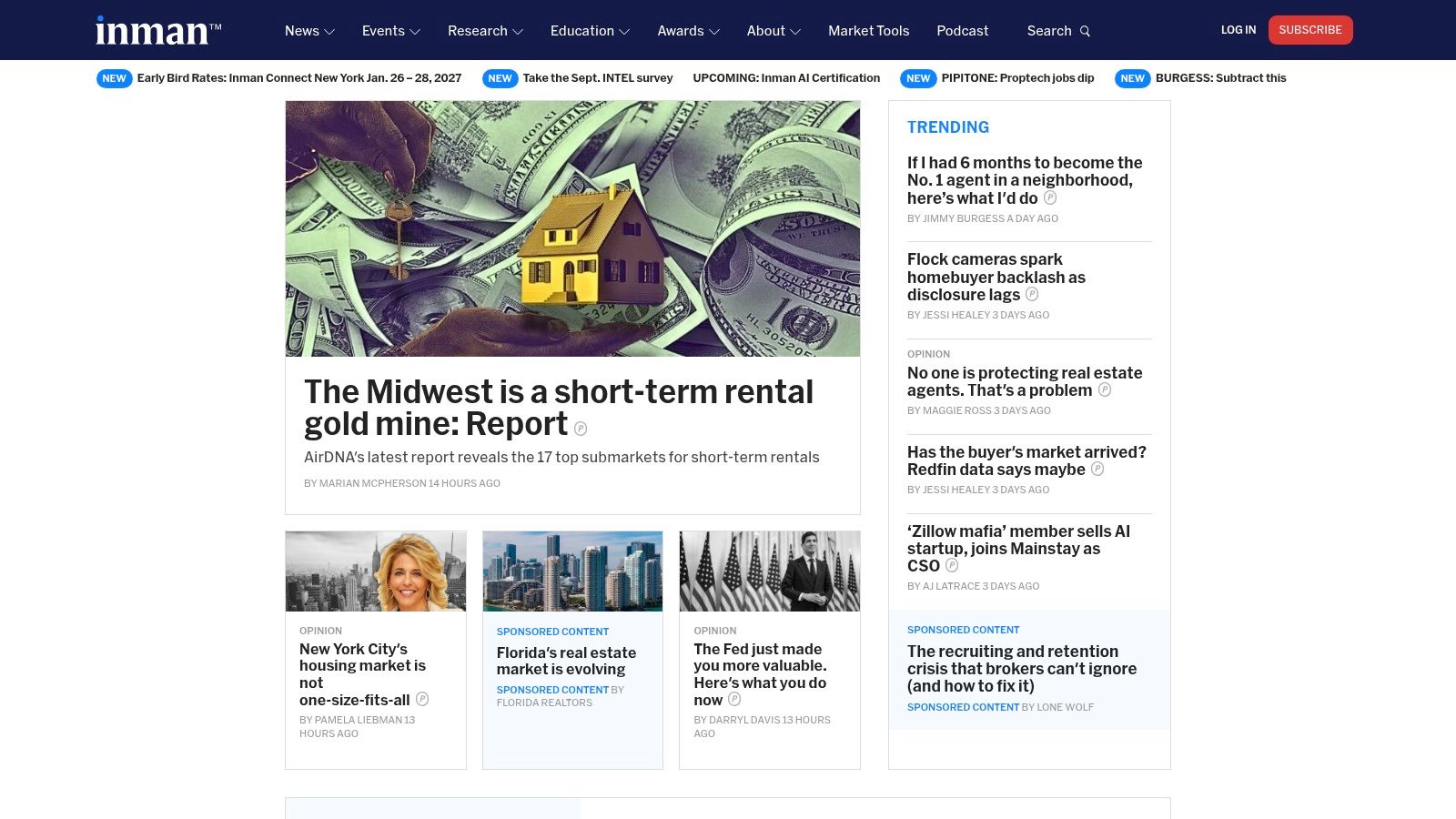
Inman is useful for a decision that price reports cannot answer: how are industry rules and operating models changing the way transactions happen? Its reporting covers brokerage economics, agent technology, MLS policy, commission practices, proptech, consumer behavior, and practitioner trends. These topics affect how listings reach buyers, how services are delivered, and how participants are paid.
Its daily reporting, premium Select content, Inman Intel research, Market Explorer and Trends tools, video classes, event discounts, and practitioner analysis provide operational context. Readers can follow how agents, brokerages, and MLS systems respond to change instead of relying only on final sale or listing figures.
The limitation is scope. Inman offers less help with global capital markets, detailed commercial underwriting, or purely local residential data, and some analysis requires membership. Its strongest audience is professionals and consumers currently selling, buying, or selecting representation.
Read Inman for decisions about transaction mechanics
Richard Maize's article on five shifts reshaping property transactions connects industry developments with wider property decisions. Compare those observations with current agent agreements and MLS rules, since business practices and policies can change.
Use one Inman story to test a specific choice:
Information access: Check how listing distribution, buyer representation, and MLS participation could affect the properties you see or the exposure your listing receives.
Transaction economics: Separate a new platform, policy, or brokerage model from its practical effect on fees, service, incentives, and execution.
Listing strategy: Draft one question for your next agent conversation from a story about commission or MLS policy, then record whether the answer changes your pricing, marketing, or representation plan.
For homeowners, the value is practical rather than academic. A change in industry structure may alter communication, negotiation, or service before it appears in a market statistic. Investors can use Inman to monitor operating risks and ask whether a brokerage or platform change affects execution in a planned transaction.
6. Redfin News And Redfin Data Center
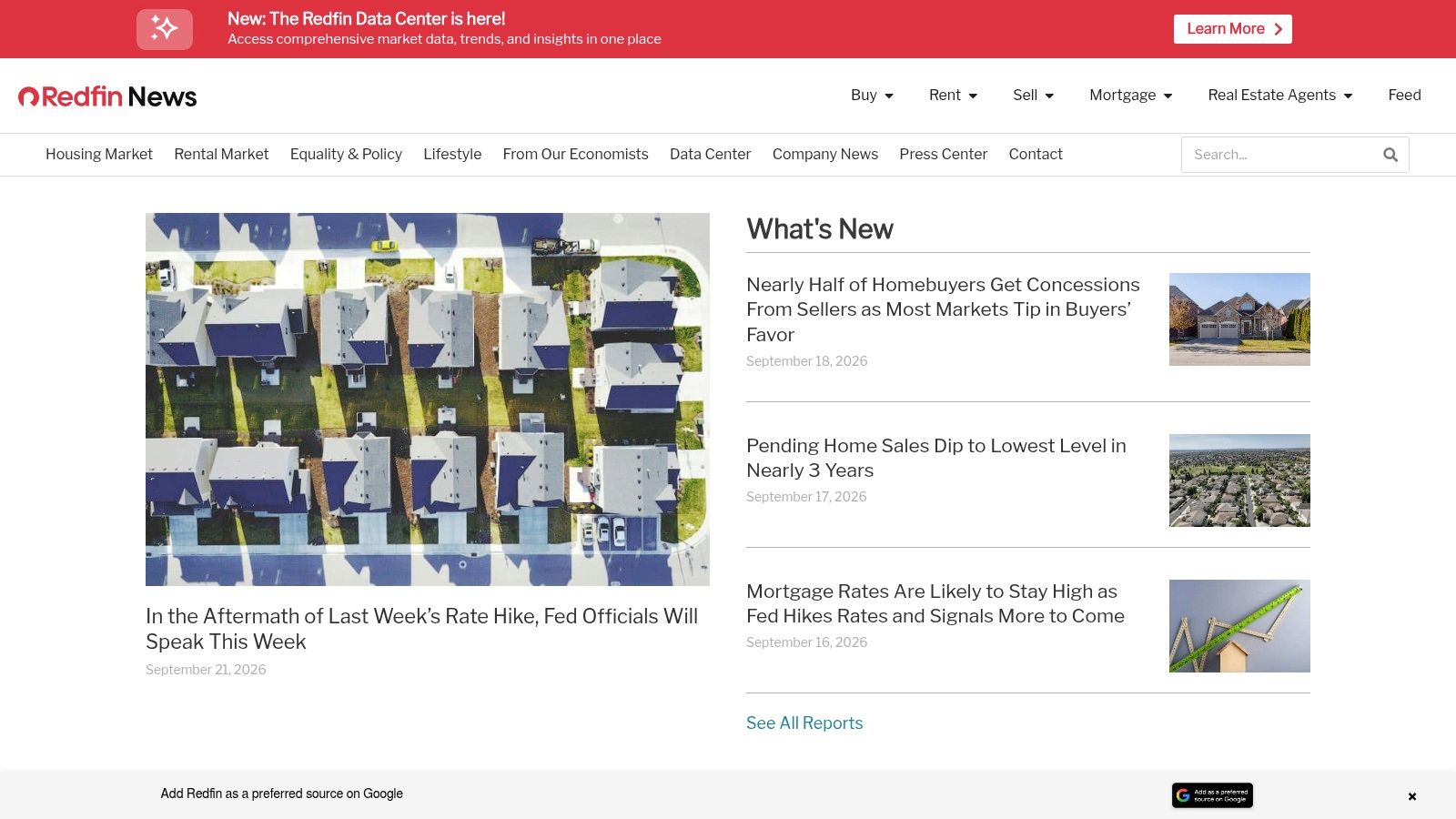
Redfin is most useful when the decision is whether a residential market claim holds up. Its News and Data Center bring together reports, metro indicators, visualizations, downloadable time series, affordability material, price tracking, inventory analysis, and methodology notes. Readers can move from a headline to the underlying geography, period, and measure before acting on it.
That makes Redfin a validation tool, not just a news source. Start with the chart, then ask whether the property type, market boundary, and comparison period match the claim. National averages can conceal very different local conditions, so a buyer evaluating a neighborhood or an investor screening a metro should separate those levels before drawing a conclusion.
Read the dashboard with its limits in view
Redfin's data reflects its listing and transaction universe. It does not cover every property, buyer, or commercial deal, and a clean chart cannot explain zoning, litigation, financing stress, or a developer's strategy. Those gaps matter when the decision concerns a specific asset rather than a broad residential trend.
Richard Maize's real estate market analysis template helps widen the review beyond price. Its framework includes employment, population movement, rental demand, wages, comparable sales, and local property economics. Use those factors to test whether a price or inventory signal supports the underlying purchase, sale, or holding decision.
A practical Redfin review asks:
What exactly is being measured? Confirm geography, dates, property type, and methodology.
Does the scale match the decision? Compare national, metro, and neighborhood evidence separately.
What remains unexplained? Pair price and inventory with rent, employment, financing conditions, and property-specific research.
Investors can use the result to revise an underwriting assumption. Homeowners can use it to challenge a pricing narrative before setting a listing or purchase strategy.
7. Bisnow
Bisnow is most useful when the decision concerns commercial real estate at the city level, not broad consumer housing conditions. Its newsletters and local pages follow leasing, development, capital markets, owners, tenants, policy, and regulatory issues. In Los Angeles, that focus can surface office, retail, industrial, and development activity that residential platforms rarely cover.
The practical value is speed and local context. Frequent updates can help a tenant assess negotiating power, an owner monitor competing projects or tenant movement, and an investor identify a deal question for further diligence. Bisnow's event ecosystem adds another signal by showing how landlords, tenants, brokers, lenders, and developers describe conditions in person. Treat that commentary as market color, not as a substitute for property-level analysis.
Coverage depth varies by market, and Bisnow is not a primary source for consumer housing metrics. Reported transactions also require status checks. A proposed lease, planned development, or announced financing does not establish a completed closing or stabilized operating result.
Use each article to classify the decision before acting:
For leasing: Compare the reported tenant movement, available space, and competing projects with current broker evidence.
For development: Check permits, zoning, infrastructure, and the project's completion stage before treating an announcement as investable supply.
For acquisitions: Separate a proposal, announcement, signed agreement, and completed transaction, then verify financing terms and operating assumptions.
For policy risk: Trace the rule or regulatory action to the affected property, timeline, and likely cost rather than relying on a headline summary.
A short Bisnow item can therefore serve as a diligence prompt. Investors can turn it into a verification checklist before committing capital. Homeowners generally have limited use for it unless they own property affected by nearby commercial development, zoning, tenant demand, or infrastructure changes.

7-Outlet Property Market News Comparison
Source | Implementation complexity 🔄 | Resource requirements ⚡ | Expected outcomes 📊 | Ideal use cases 💡 | Key advantages ⭐ |
|---|---|---|---|---|---|
Bloomberg – Real Estate | Moderate, paywall + Bloomberg terminal integration for workflows | High, subscription/terminal and analyst time | Market‑moving finance insights on capital markets, REITs, debt risk | Institutional investors, portfolio strategy, refinancing and cross‑border capital analysis | Deep capital‑markets reporting; timely scoops and macro context |
The Wall Street Journal – Real Estate | Low, subscriber web access; broadly readable formats | Moderate, subscription required for full access | Reliable national reporting, explainers, and high‑end transaction coverage | National housing trends, large transactions, consumer‑facing explainers | Strong enterprise reporting and exclusives; balanced trend + lifestyle coverage |
HousingWire (incl. HousingWire Intelligence) | Low–Moderate, daily feed easy; dashboards require onboarding | Moderate–High, paid Intelligence membership for premium data | Timely mortgage and lending signals; ZIP‑level dashboards and analysis | Mortgage lenders, servicers, policy analysts, local market reads | Proprietary datasets and real‑time housing finance coverage |
The Real Deal | Low, accessible city feeds; some paywalled articles | Low–Moderate, subscription for full access; metro focus | Granular metro development, deals, permitting and legal coverage | Tracking developer activity, broker moves, LA/NY/SoFlo commercial and luxury markets | On‑the‑ground metro reporting and deal‑level scoops |
Inman | Low, practitioner formats (news, classes); Select for premium | Moderate, Select membership for research and events | Actionable agent/broker insights on MLS, commissions, proptech | Brokerages, agents, proptech product teams, practitioner training | Insider perspective on brokerage economics and agent workflows |
Redfin News & Data Center | Low, free, downloadable datasets and clear methodologies | Low, free access to most datasets; limited to Redfin universe | Transparent, reproducible local-to-national data and visualizations | Data‑driven analysis, content creation, local price/inventory tracking | Free, well‑documented datasets and fast publish cadence |
Bisnow | Low, brief local reporting and newsletters; events add depth | Low–Moderate, event fees; optional subscriptions | Local CRE snapshots, policy impacts and networking intelligence | Commercial real estate professionals seeking regional intel and contacts | Readable, locally targeted CRE coverage and strong event network |
Turn Today's Reading Into A Better Decision
A strong property market news routine starts with the decision, not the website. If you're evaluating a home purchase, begin with national housing and mortgage coverage, then move to local data. If you're underwriting an office, retail, industrial, or multifamily asset, prioritize capital markets and city-level commercial reporting. If you're trying to understand Los Angeles deal activity, local reporting should carry more weight than a broad global headline.
Separate residential from commercial coverage before interpreting a trend. A change in mortgage conditions may matter directly to a homeowner but only indirectly to a commercial investor. Likewise, a large institutional transaction can show that capital is available without proving that smaller properties have become easier to finance.
Check whether the headline comes from reporting, a dataset, or industry commentary. Reporting may reveal a deal, dispute, or policy development. A dataset may show movement across a defined sample. Commentary can help explain behavior, but it shouldn't replace the underlying evidence. McKinsey's 2025 figures are a useful example of why the metric matters: deal value increased while transaction counts remained broadly flat, so “recovery” doesn't automatically mean broad-based market participation. The McKinsey report belongs in a capital-markets review, not as a direct substitute for local property analysis.
Use a simple record for each important article:
Scope: National, international, regional, Los Angeles, or a specific submarket.
Asset: Residential, rental, office, retail, industrial, multifamily, or development.
Evidence: Reported event, index, dataset, survey, or opinion.
Implication: Timing, financing, risk, valuation, or further research.
Verification: The original methodology, public record, lender terms, comparable sales, or professional advice.
Richard Maize's website is a sensible starting point for his real estate perspectives, business-investing experience, and related updates. His public background includes early apartment-unit purchases, expansion into residential and commercial property, and a multi-state portfolio, while his platform also includes entrepreneurship and philanthropic work. Those perspectives can sharpen the questions you ask, but headlines shouldn't replace individual due diligence.
Save the source pages that matter. Track recurring indicators instead of reacting to every daily update. Review original methodologies where available, and discuss material investment or ownership decisions with qualified lenders, attorneys, tax advisers, brokers, and other professionals who can evaluate your specific circumstances.
Richard Maize offers practical real estate perspectives alongside insights from hands-on investing, entrepreneurship, and business ownership. Visit Richard Maize to explore his market commentary, blog updates, portfolio perspectives, and related work before you make your next property decision.
Comments