Stakeholder Engagement Guide That Builds Real Trust

A project can have a polished presentation, thoughtful traffic plan, and responsible budget, yet still lose community support before the first permit is issued. The usual reason is familiar: residents attend one meeting, share concerns, and then hear nothing until the next milestone. By that point, many assume the outcome was already decided.
That's the trust gap at the center of modern stakeholder engagement. The work isn't successful because people were invited into a room. It succeeds when the right people can see how their input affected the decision, what couldn't change, and what happens next. Richard Maize's long experience in Los Angeles real estate, investment, and philanthropy offers a useful practitioner's lens here. Community-facing work depends on relationships that survive beyond a single transaction or public meeting.
What Stakeholder Engagement Really Means Today
A neighborhood project often begins with good intentions. The developer schedules a community meeting, brings renderings, answers questions, and records comments. The room is orderly, the presentation is professional, and everyone leaves with a packet.
Then the silence starts.
Residents don't know whether parking concerns changed the design. Local businesses don't know whether construction access will be protected. A nonprofit that offered input doesn't know who owns the follow-up. The project team may believe it conducted outreach, while the community experiences a one-time performance with no visible connection to the final decision.
Meaningful stakeholder engagement is different. It's an ongoing, two-way process in which stakeholders understand the issue, can raise concerns, receive a response, and see how decisions connect to what they said. The OECD Guidelines for Multinational Enterprises state that companies should meaningfully engage with stakeholders or their legitimate representatives when activities may significantly affect them. Earlier OECD due-diligence guidance describes meaningful engagement as ongoing, two-way, good-faith, and responsive.
That standard matters in real estate because projects affect more than an owner and a tenant. Residents, nearby merchants, employees, transportation agencies, schools, neighborhood groups, service providers, city staff, and future users may all experience different consequences. Their interests won't align automatically, and pretending otherwise creates weak plans.
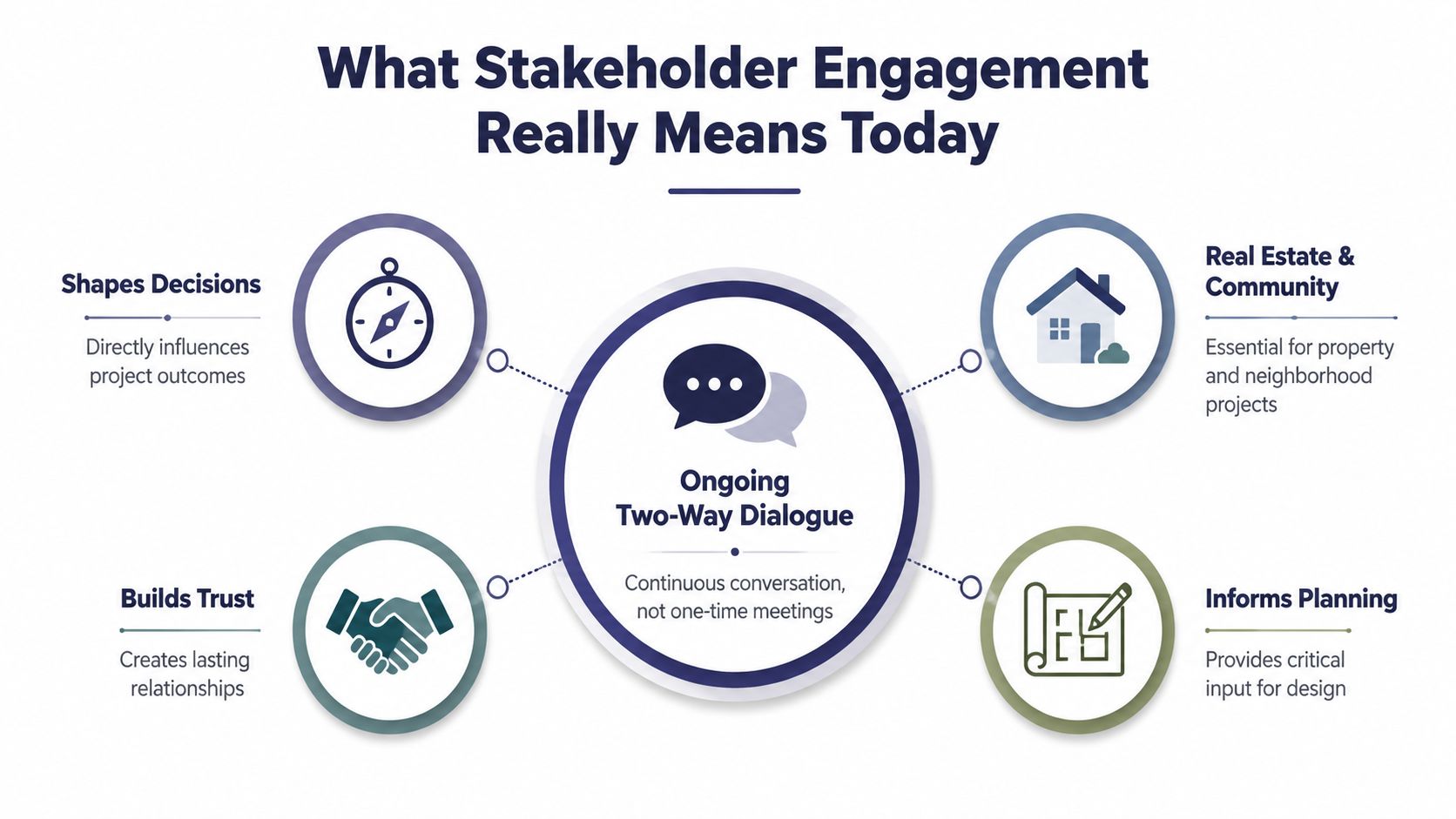
Consultation is not the same as influence
A useful test is simple: Can the project team identify a decision that changed because of stakeholder input? That change might involve construction hours, pedestrian access, landscaping, tenant protections, communication protocols, or the timing of disruptive work. Not every request will be accepted, but every serious concern deserves a clear disposition.
The OECD's evidence on policy-making and stakeholder engagement shows that stakeholder engagement is now embedded in public consultation, regulatory impact assessment, and evaluation processes across OECD countries and the European Commission. The direction is clear. Engagement is moving away from an isolated hearing and toward a continuous part of planning and accountability.
Richard Maize is described on his own professional FAQ page as a real estate investor, entrepreneur, and philanthropist with over 30 years of experience in real estate and finance. That background reinforces a practical lesson: relationships compound through repeated, credible actions. A meeting can open a door, but follow-through determines whether anyone walks through it again.
Practical rule: Consistency builds more trust than intensity. A modest update delivered when promised is worth more than a spectacular meeting followed by silence.
Mapping Stakeholders and Understanding Power Dynamics
Start with names, not categories. “The community” is too broad to guide a real engagement plan. A useful map identifies specific people and groups, what they care about, what authority they hold, how exposed they are to the project, and what kind of contact would be useful.
For a place-based project, begin with:
Directly affected residents: People dealing with noise, access changes, construction activity, or altered neighborhood conditions.
Local businesses and property owners: Parties concerned with visibility, deliveries, customer access, rents, and long-term foot traffic.
Public agencies and elected representatives: People responsible for approvals, safety, infrastructure, and public accountability.
Community organizations and service providers: Groups that understand local needs, vulnerable populations, and existing support networks.
Future users and tenants: People whose experience can affect operations, reputation, and the project's commercial performance.
Use a power and interest grid
Place each stakeholder on a simple grid. Power means the ability to approve, delay, influence, fund, regulate, or materially affect the work. Interest means how directly the person experiences the project and how motivated they are to participate.
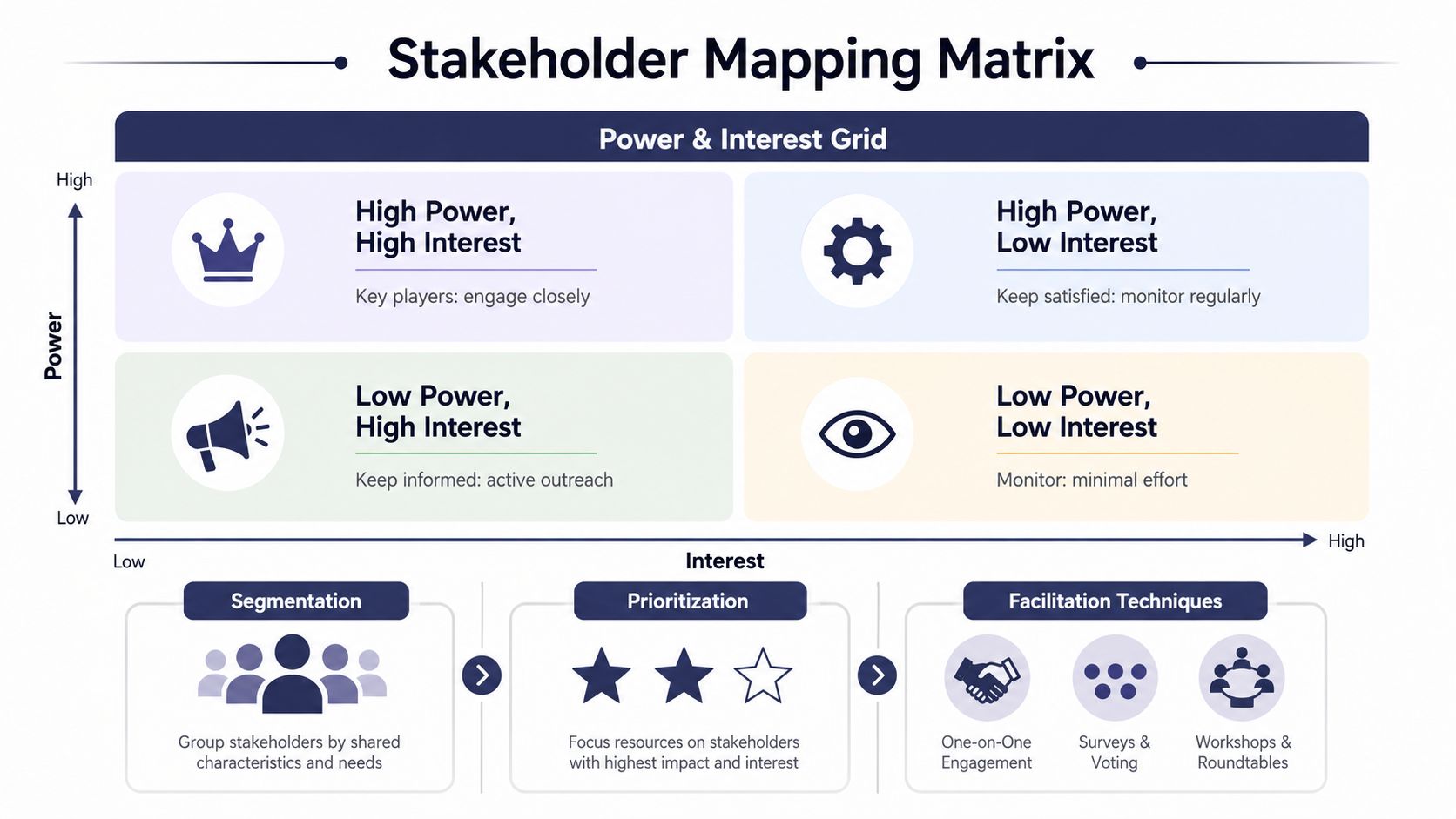
High-power, high-interest stakeholders need close working relationships and direct access to decision-makers. High-power, low-interest stakeholders usually need concise, reliable updates rather than constant meetings. Low-power, high-interest stakeholders often require active outreach because they may carry important lived experience without formal authority. Low-power, low-interest groups can be monitored, but they shouldn't disappear from the map if project conditions change.
This grid is a starting point, not a verdict. A tenant association may have little formal authority but substantial public credibility. A neighborhood organizer may connect you with people who never attend developer-hosted meetings. Power can also shift as approvals, construction, or operations move forward.
Make the room safer for honest input
Power dynamics shape who speaks. Oxford's recommendations for effective stakeholder engagement emphasize skilled facilitation and deliberate attention to marginalized voices. That means separating certain interviews from large workshops when necessary, offering more than one participation channel, and preventing senior or highly confident participants from dominating the discussion.
Use interviews to understand sensitive concerns, workshops to compare options, and small facilitated groups when a large room would suppress dissent. Ask quieter participants for their views without putting them on display. Share the decision question before the meeting so people can prepare something more useful than a spontaneous reaction.
For every priority stakeholder, write one sentence that begins, “We need this relationship to…” The answer might be “surface access risks early,” “test the construction schedule,” or “explain the limits of the approval process.” That sentence turns a list of names into an operating plan.
Building Your Engagement Plan and Outreach Toolkit
A workable engagement plan should fit on a few pages. If the document needs its own meeting, it is already too complicated.
Start with the decision calendar. List each decision, its owner, the deadline, and the point when stakeholder input can still change the result. This is the practical test for engagement. A meeting held after the key terms are fixed may satisfy a process requirement, but it cannot close the trust gap created when people believe the outcome was decided before consultation.
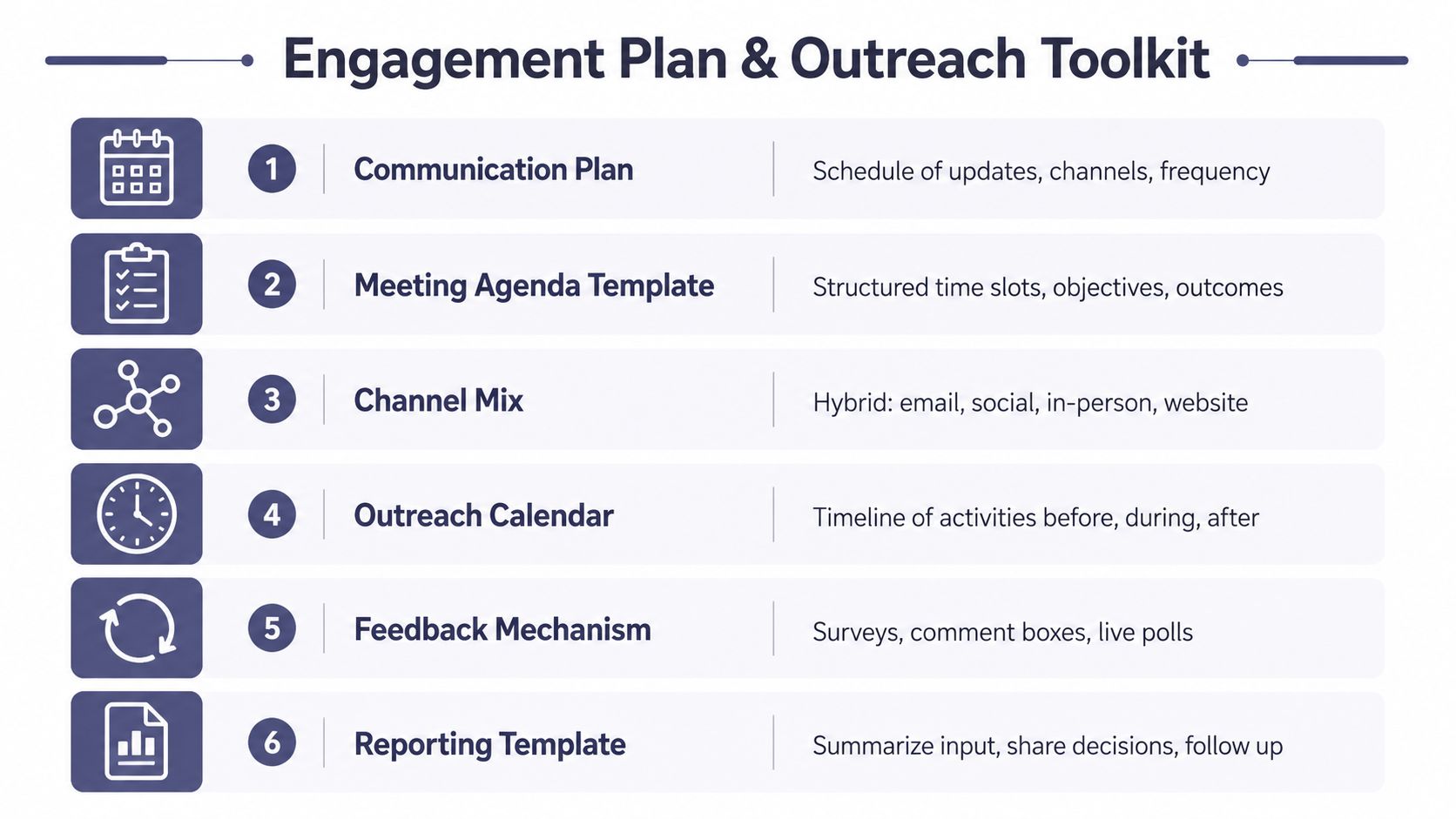
Build a lean communication plan
For each stakeholder group, record:
Purpose: What do you need to learn, test, explain, or decide?
Audience owner: Who on the project team is responsible for the relationship?
Channel: Choose email, phone, in-person meetings, virtual sessions, social media, a project website, or printed notices according to access and preference.
Timing: State when updates will arrive and what triggers an additional notice.
Response path: Tell people where to submit questions and who will respond.
Decision record: Capture the input, the response, and any resulting change.
The plan should show how a question becomes an assigned task, how the team responds, and where the final decision is recorded. Without that chain, outreach becomes a series of events rather than a working relationship. The Newport Beach real estate broker perspective reinforces the value of listening closely to how property decisions affect the surrounding market and community. That same discipline belongs in the toolkit: connect every conversation to a decision, responsibility, or follow-up date.
Use more than one channel when travel, work schedules, mobility, or geography limit attendance. Virtual meetings can widen access, but they also favor people with reliable devices, flexible schedules, and confidence in formal settings. Pair them with phone access, office hours, translated materials where appropriate, and physical locations that residents already use. A digital option is useful only when people can participate.
Use a disciplined meeting format
A strong agenda answers five questions:
What decision is under discussion?
What information is already known?
Which options remain open?
How will participants provide input?
When and how will the project team report back?
Keep presentations short enough to leave room for questions. Publish the decision question before the meeting so participants can prepare specific concerns rather than react to a polished presentation. Use a visible parking lot for issues requiring separate research, then assign an owner and return date to every item.
A credible close names the next action. “We'll consider it” leaves people guessing. “We'll evaluate delivery access against the revised loading plan and report back through the project website” gives the conversation a defined path.
The plan earns trust through follow-through, not attendance alone. Record what changed, what did not change, and why. That record gives the next meeting something concrete to examine and shows whether consultation had a real connection to the decision.
Measuring What Matters With KPIs and Monitoring
Attendance is easy to count and easy to misuse. A crowded room may reflect genuine interest, confusion, opposition, or a convenient venue. None of those conditions tells you whether engagement improved the decision.
Start with a baseline. The Penn State stakeholder engagement guide describes benchmarking as establishing where the “needle is now,” while the UK government measurement framework recommends keeping the KPI set to about five to seven measures so the dashboard stays focused and actionable, as outlined in the government report on measuring engagement.
Define the behavior or outcome you want to change before selecting a metric. If the objective is better access planning, measure whether affected users identified risks early and whether the plan addressed them. If the objective is trust, track whether people received clear responses and understood what happened next.
A focused dashboard
Engagement Objective | KPI Example | How to Track |
|---|---|---|
Reach affected people | Representation across priority stakeholder groups | Compare the engagement log with the stakeholder map |
Improve participation quality | Questions answered with documented follow-up | Review meeting notes and response records |
Increase influence | Input linked to a design, schedule, or operating change | Maintain a decision and disposition register |
Strengthen confidence | Participant assessment of clarity and responsiveness | Use a short anonymous survey after key interactions |
Preserve continuity | Complete records available to the project team | Audit the shared engagement repository |
Support repeat participation | Stakeholders return to later engagement activities | Compare attendance and contact history across phases |
The dashboard should include a review cadence and intervention thresholds. For example, if a priority group remains absent, the response might be a phone outreach effort, a different venue, or a trusted intermediary. If many questions remain unanswered, assign a senior owner rather than sending another general update.
Avoid measurement overload
More data doesn't necessarily create more insight. A dashboard filled with invitations sent, emails opened, comments received, and meeting minutes can still miss the central issue: Did people understand the decision, and did their input have a fair opportunity to affect it?
Use qualitative evidence alongside counts. Save representative concerns, record unresolved trade-offs, and note where the project chose not to act. A credible report doesn't claim every request was accepted. It explains the reasoning, the constraints, and the next review point.
Common Pitfalls That Undermine Trust and How to Avoid Them
The common assumption is that inviting people to participate proves the organization is listening. It doesn't. In a 2026 Australia and New Zealand survey, 49% of residents said they had never been invited to participate, only 30% believed their views influenced decisions, 15% were told what would happen next, and 65% thought decisions were made before consultation began, according to the published survey findings.
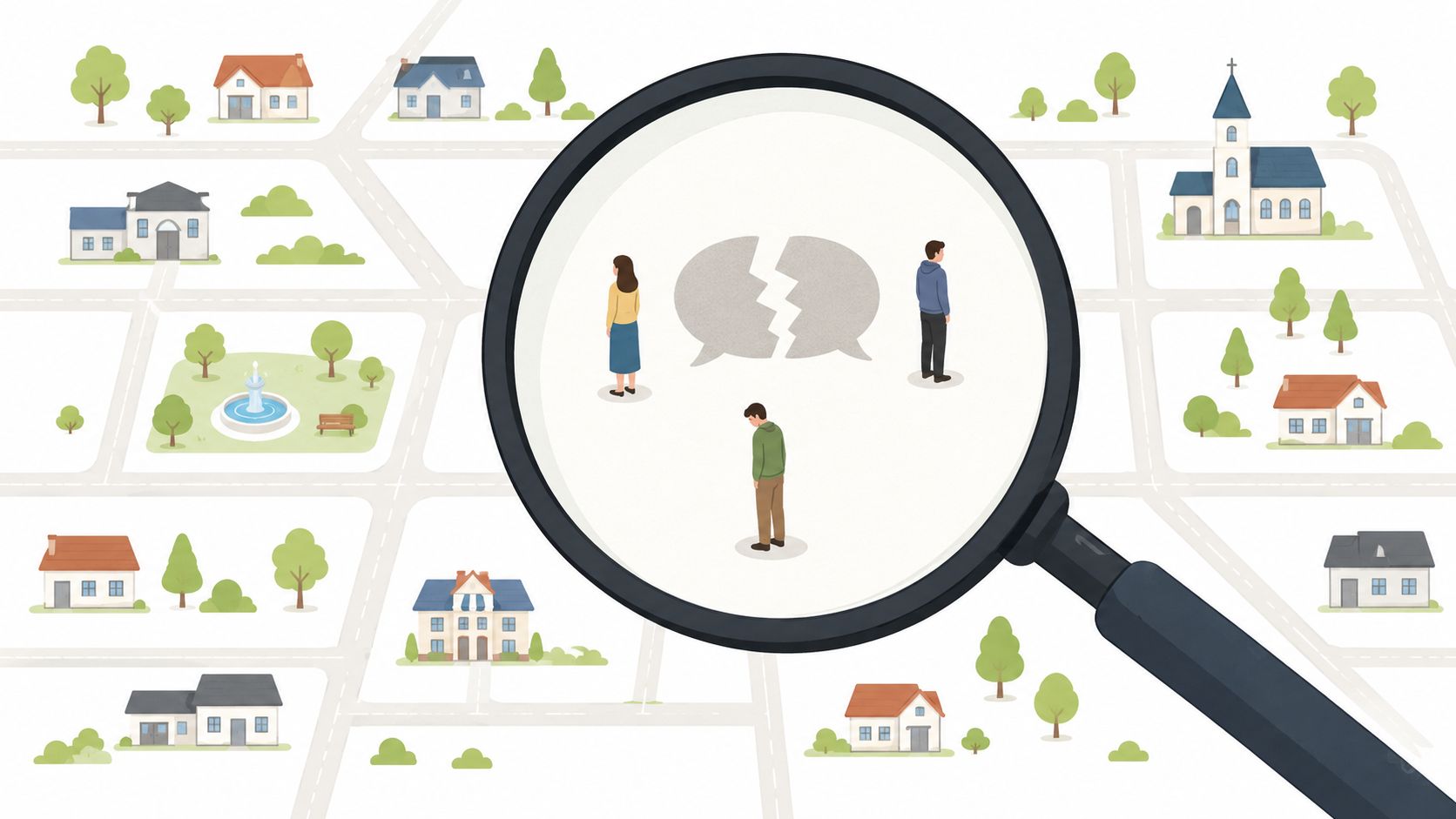
Those figures describe a credibility problem, not merely a scheduling problem. A project can host multiple events and still produce the same distrust if it doesn't show how participation affected the work.
Fix the follow-through failure
Create a public-facing decision log for major issues. Each entry should state the concern, the project response, whether a change was made, and why. If the team can't make a requested change, say so plainly and identify the controlling constraint.
Avoid repeating a false claim while trying to correct it. The University of Florida Extension's guidance on stakeholder engagement advises giving the “so what” up front and not reinforcing misconceptions through repetition. Lead with the accurate explanation and connect it to the practical consequence for the audience.
Data fragmentation creates a second problem. In the same Australia and New Zealand survey, 26% of organizations used a centralized engagement platform, while 62% stored engagement data across disconnected systems and 67% said institutional knowledge was lost when staff moved on, according to the published findings linked above. A shared repository with consistent fields, ownership, dates, decisions, and follow-up status is less glamorous than a new event platform, but it protects continuity.
The NIH/PMC evaluation of stakeholder engagement found that electronic administration, reminder emails, protected meeting time, and a stipend supported high-quality feedback and a 100% response rate in that evaluation, as reported in the published assessment. The lesson isn't to promise that every survey will produce the same result. It's to remove friction, make participation convenient, provide accountability, and use incentives where appropriate.
Here's a short diagnostic video to use alongside the written process:
A survey alone won't reveal why someone objected or what compromise might work. Combine anonymous quantitative feedback with facilitated discussion, individual interviews, and iterative follow-up when the decision is complex. That combination gives people privacy, context, and a clear route back into the process.
Putting It Into Practice and Learning From Real Examples
The practical test of stakeholder engagement is what happens after the meeting. Can the project team show the concern, the responsible owner, the decision, and the update sent back to the people who raised it? If yes, the process is becoming durable. If not, the organization is collecting opinions without building institutional memory.
Richard Maize's work provides a useful context for thinking about this. His platform covers real estate, business investment, media, and philanthropy, while the Rochelle and Richard Maize Foundation supports charitable causes connected to education, mentorship, healthcare, and community development. These areas require different audiences and different forms of listening. A youth program may need input from families and educators, a community event may depend on local organizations, and a property venture may require sustained communication with residents, tenants, and public agencies.
A practical sequence for this week
Choose one active project and take these actions:
Write the decision list. Identify the choices that remain open and the date each one needs an owner.
Complete the stakeholder map. Name directly affected groups, formal decision-makers, trusted intermediaries, and people likely to be missed.
Call before you convene. Short interviews often reveal concerns that won't surface in a public meeting.
Publish the engagement promise. State what input can influence, what is fixed, and when you'll report back.
Open the decision register. Link each material concern to a response, owner, and status.
Review the dashboard. Use a focused set of measures, then intervene when a priority group is absent or follow-up stalls.
Signs of progress are behavioral. Stakeholders ask more specific questions, return for later conversations, introduce other affected people, and challenge assumptions before problems reach the field. The project team also becomes more candid about trade-offs because it has a record of what it heard and why it acted.
For a property-focused audience, even visual storytelling can help ground the conversation. The discussion of famous houses in Beverly Hills illustrates how place, identity, history, and public interest can intersect around real estate. That same sensitivity matters in ordinary neighborhoods, where a new project may become part of the local story long after construction ends.
The durable advantage isn't getting everyone to agree. It's creating a process people trust enough to use again.
Stakeholder engagement should run year-round, not only when an approval deadline is approaching. Keep the contact record current, report what changed, and make the next conversation easier because the last one was handled with integrity.
Richard Maize offers practical perspective shaped by real estate investing, entrepreneurship, philanthropy, and long-term community-facing work. Visit Richard Maize to explore his real estate insights, business ventures, and foundation-related community work, then use the engagement principles above to build a feedback process that connects every conversation to a visible decision.
Comments