Southern California Real Estate Forecast for 2026

A Southern California real estate forecast for 2026 can be directionally correct and still be useless to anyone trying to buy, sell, or invest. The region's projected statewide growth is modest, with existing single-family sales forecast at 274,400 units, up 2% from the projected 2025 pace, while the median price is forecast to reach $905,000, up 3.6% after a projected 1.0% increase in 2025, according to the California housing-market forecast.
The more important question is where demand is rotating. Coastal neighborhoods can hold value while transaction volume stays thin, inland markets can absorb households priced out of Los Angeles and Orange County, and rents can move at different speeds across neighboring counties. That's the map a serious buyer needs.
The Question That Matters More Than Up or Down
A regional price headline hides the decision that matters. The useful question for 2026 is which households can still buy, where renters are moving, and which submarkets can turn affordability pressure into demand.
Southern California is settling into a high-price, low-affordability market rather than a clean boom or correction. Statewide affordability is projected to improve only slightly, from 17% in 2025 to 18% in 2026, after reaching 16% in 2024. The California Association of Realtors forecast summary puts that change in context. A modest improvement does not remove the affordability wall. It determines which households can get through it, and which must change county, housing type, or timing.
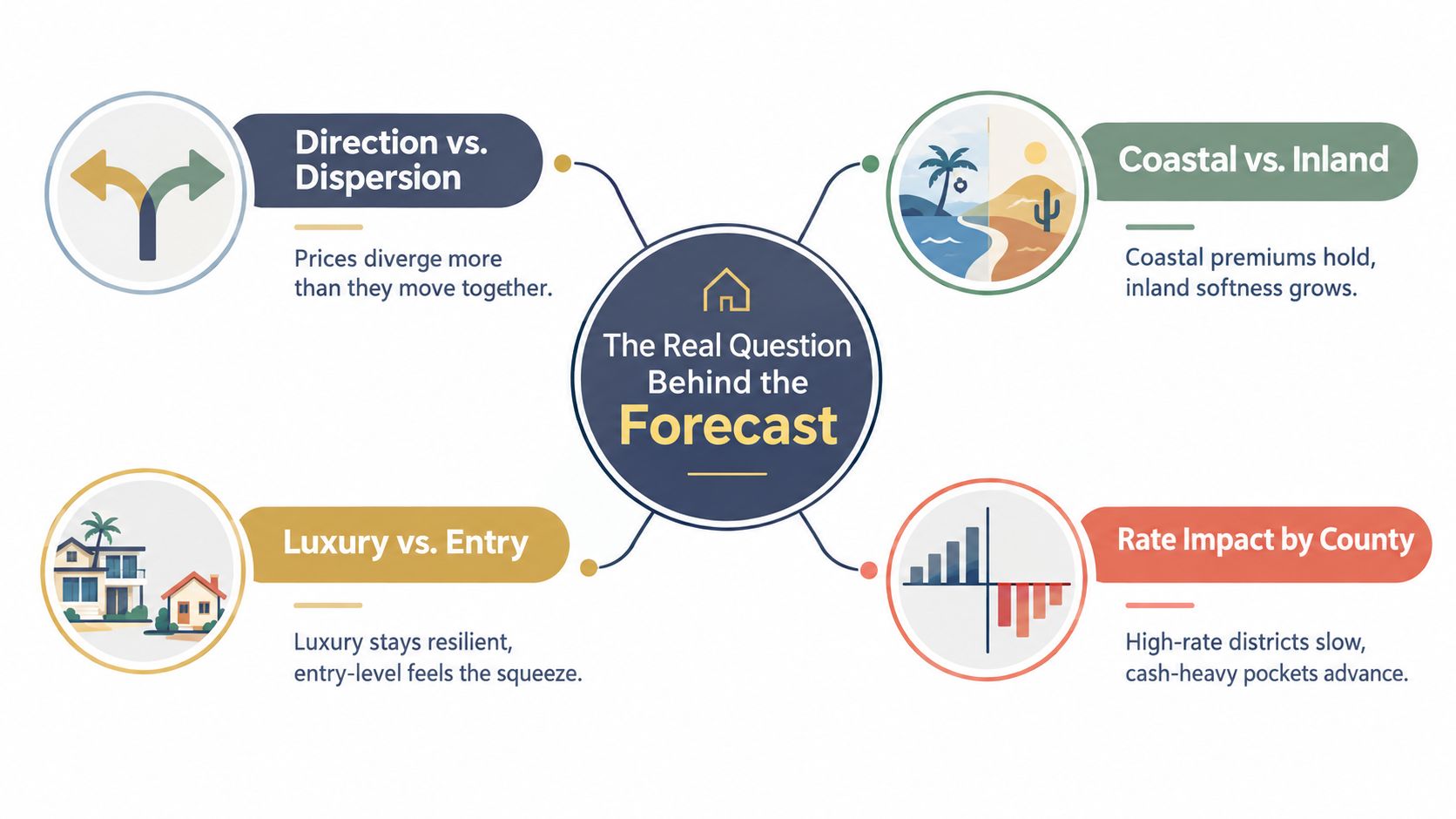
Dispersion matters more than direction
Los Angeles is projected to remain nearly flat over the coming 12 months, and the Inland Empire is also expected to stay around flat. Rent forecasts tell a different story: Los Angeles County near 1.46% annual rent growth, the Inland Empire near 3.2%, and Orange County near 2.34%, according to this Southern California market analysis. Demand is not vanishing. It is rotating according to budget, commute, schools, employment, and housing type.
That rotation produces several markets at once. Trophy coastal properties may retain appeal because owners have strong balance sheets and buyers value scarcity. Inland communities can capture working households priced out of Los Angeles and Orange County. Orange County may split between school-district premiums and neighborhoods where older homes compete with newer condominiums.
Richard Maize's discussion of interest rates and investor decisions provides useful context. Rate changes do not affect every owner equally. A heavily financed buyer feels the payment immediately, while a cash-heavy owner may focus on replacement cost, rent durability, and competing inventory.
After watching cycles for 30 years, I treat certainty as a warning sign. The useful forecast is a decision framework, not a promise about a regional median. Start with macro conditions, map the county-level demand rotation, then test the holding period, deal structure, downside risks, and signals that would invalidate the assumptions.
The Four Macro Forces Shaping 2026
Four forces will determine how the forecast plays out: financing costs, migration, housing supply, and employment. None works alone. Their interaction explains why weak sales can coexist with firm prices and why inland rents can outperform coastal rents without creating a broad regional boom.
Financing changes the buyer pool
Higher mortgage costs reduce purchasing power and make monthly payment math more important than headline appreciation. They also discourage owners with unusually cheap existing loans from listing, which limits the supply available to buyers.
That lock-in effect creates a strange market. A household may want to move for work or space, but selling means giving up a favorable loan and taking on a materially higher payment. Buyers face the same arithmetic from the other side. They may qualify for a home in a coastal neighborhood only by accepting less space, delaying the purchase, or moving inland.
Financing also changes investor behavior. A property that looked attractive when debt was cheap may require a lower price, stronger rents, more equity, or a seller concession to work today. Richard Maize's perspective on using real estate during inflation and volatility reinforces the need to underwrite the asset, not rely on a market-wide prediction.
Migration redistributes demand
Domestic moves away from expensive coastal areas can reduce demand in some neighborhoods, but that doesn't mean Southern California loses every household. New arrivals from other states and international markets can offset part of that movement, while renters and buyers who remain in the region may relocate from coastal counties to the Inland Empire.
The result is substitution. A household priced out of a Los Angeles purchase may rent there and buy elsewhere. Another may accept a longer commute for a lower basis. Investors should track those choices through rents, vacancy, listing absorption, and employer concentration rather than assuming that population movement affects every county equally.
Supply keeps the floor firm
Los Angeles County's structural shortage is substantial. Jurisdictions must collectively permit 812,060 new units by 2029 under the current Regional Housing Needs Assessment cycle, according to the Southern California housing supply overview. Existing production has struggled to meet that target.
The same source reports homeowner turnover at only 4.1% in 2024, down from 4.7% in 2023, while county homeownership stood at 49.2% in the first quarter of 2026. Low turnover means fewer existing homes reach the market. New construction helps, but entitlement timelines, infrastructure, land costs, and insurance can keep supply from arriving where demand is strongest.
Employment decides which inland markets hold
Job quality matters more than raw job counts. Coastal weakness in technology and entertainment can pressure higher-priced neighborhoods, while logistics, healthcare, infrastructure, education, and public-sector employment can support different parts of the region.
The Inland Empire benefits when households follow jobs or trade housing space for affordability. But investors still need to examine commute patterns and employer diversity. A lower purchase price doesn't protect a property if its tenant base depends on one fragile employment cluster.
Macro Force | Current Signal | Impact on Prices | Impact on Rents |
|---|---|---|---|
Financing | Borrowers remain payment-sensitive | Limits purchasing power and transaction volume | Keeps some households renting longer |
Migration | Demand shifts between counties and housing types | Supports affordable submarkets more than expensive ones | Strengthens rental demand where households relocate |
Supply | Los Angeles County faces a large permitting gap | Restricts downside where inventory remains scarce | Supports rents when ownership is out of reach |
Employment | Different industries support different corridors | Favors diversified job centers | Links rent durability to local wage and commute patterns |
County by County Submarket Breakdown
Southern California shouldn't be treated as one market. Los Angeles, Orange, San Diego, the Inland Empire, and Ventura each occupy a different position on the rotation map.
Los Angeles County
Los Angeles has the widest internal spread. Scarce, high-quality properties in established Westside and coastal neighborhoods can hold value better than older or less differentiated homes in inland flats. That doesn't mean every coastal asset is safe. It means scarcity, location, and buyer balance sheets matter more than the county median.
The rental story can also diverge from the ownership story. A household may be unable to buy in a desirable Los Angeles neighborhood but remain willing to rent there, while another household leaves for a lower-cost ownership option inland. Investors should compare rent durability and operating costs by neighborhood, not infer performance from countywide pricing.
Orange County
Orange County combines strong lifestyle demand with severe affordability pressure. School districts create meaningful price segmentation, and the North County versus South County divide can matter as much as the county label.
New condominium supply can pressure older product, particularly where buyers compare monthly carrying costs, amenities, and assessments. That doesn't make every condo a bad investment. It does mean older units need a clear advantage, such as location, floor plan, parking, or a basis low enough to support rental income.
San Diego County
San Diego's coastal areas benefit from persistent lifestyle demand, while military employment can provide stability around major bases. North County remains a growth corridor, but buyers still need to separate durable employment demand from discretionary coastal pricing.
San Diego can attract households that value quality of life enough to accept higher prices, yet its affordability ceiling remains real. A well-located rental with dependable tenant demand may be more resilient than a speculative appreciation play.
The Inland Empire
Riverside and San Bernardino function as the region's demand-absorbing valve. Buyers who can't qualify closer to the coast may move inland, and renters can make the same trade-off when a larger home or lower monthly cost matters more than commute time.
The trade-off is a lower basis paired with added operational friction. Insurance, property taxes, maintenance, transportation costs, and tenant turnover can reduce the apparent yield advantage. The Inland Empire works best when the purchase price reflects those expenses rather than assuming the headline rent tells the whole story.
Ventura County
Ventura deserves attention as an early warning market. Wildfire exposure and insurance withdrawal can reprice comparable properties before broad price data catches up. A home that looks fairly valued on sales comps may become difficult to finance or insure, weakening its resale market.
County | Cycle Position | Median Price Range | Rent Trend | Key Watchpoint |
|---|---|---|---|---|
Los Angeles | Mixed, with coastal resilience and inland softness | Varies widely by submarket | Near 1.46% annual growth in the cited regional forecast | Neighborhood-level demand and operating regulation |
Orange | Segmented, with strong school-district premiums | High and divided by product type | Near 2.34% annual growth | New condominium supply and HOA costs |
San Diego | Coastal-sticky with stable employment pockets | High, with meaningful corridor differences | Must be tested by submarket | Military, North County, and coastal demand |
Inland Empire | Demand-absorbing and affordability-led | Lower than coastal counties, but locally varied | Near 3.2% annual growth | Insurance, taxes, commute costs, and job diversity |
Ventura | Thin and insurance-sensitive | Varies sharply by exposure and housing type | Requires property-level comps | Wildfire risk and insurability |
The rotation map is straightforward. Capital starts with coastal scarcity, households stretch toward Orange County alternatives, and affordability-driven demand moves inland. Ventura sits beside the map as a warning that insurance can override otherwise attractive fundamentals. Maize's Los Angeles market insights fit that local-first approach.
Short Term Outlook and Long Term Outlook
Over the next 6 to 12 months, the base case is a low-velocity market with modest price movement rather than a dramatic reset. Current outlooks project major Southern California metros to see home-price growth of roughly 1% to 2% in 2026, while another outlook anticipates low single-digit annual appreciation of about 2% to 5% through 2026 and 2027, as summarized by the Southern California housing-market forecast.
That range is wide enough to matter in an individual deal and narrow enough to discourage speculation. Watch month-over-month median movement, days on market, new listings, and the relationship between newly listed and absorbed homes. Those indicators will reveal weakening demand before a regional annual median confirms it.
Rent growth may remain more supportive inland than in Los Angeles, based on the county-level projections cited earlier. Owners with low-rate mortgages may continue holding, which limits resale inventory but doesn't guarantee that every property appreciates. A dated condo with rising costs can underperform a well-located rental even in a supply-constrained county.
The longer structural view
Over a 3 to 5 year period, supply constraints remain the central support, but affordability limits the speed of appreciation. Water availability, insurance, entitlement timelines, construction costs, and the jobs-housing balance will decide which areas can add durable value.
The long-term outcome could be flat pricing, gradual gains, or a sharper correction in selected pockets. A broad regional crash requires more than slow sales. It would likely require a combination of forced selling, substantial job losses, expanding inventory, and impaired financing.
Indicator | 6-12 Month Outlook | 3-5 Year Outlook |
|---|---|---|
Prices | Modest movement, with county and property-type dispersion | Constrained by affordability, supported by limited supply |
Rents | Stronger in inland migration corridors than in some coastal areas | Tied to jobs, household formation, and ownership barriers |
Inventory | Limited by owner lock-in and cautious sellers | Improved selectively where construction succeeds |
Insurance | Immediate underwriting concern in exposed areas | Could reshape development and resale values |
Employment | Localized strength and weakness | Determines which corridors retain durable demand |
A 2026 purchase should therefore be judged twice. First, can it survive the next year without heroic rent or appreciation assumptions? Second, will the location still benefit from jobs, infrastructure, and constrained supply when the next cycle matures?
How to Position Deals in This Market
The right strategy starts with the asset, not the forecast. A projected regional increase won't rescue a property with weak rents, expensive insurance, deferred maintenance, or a tenant base that can't absorb the required payment.
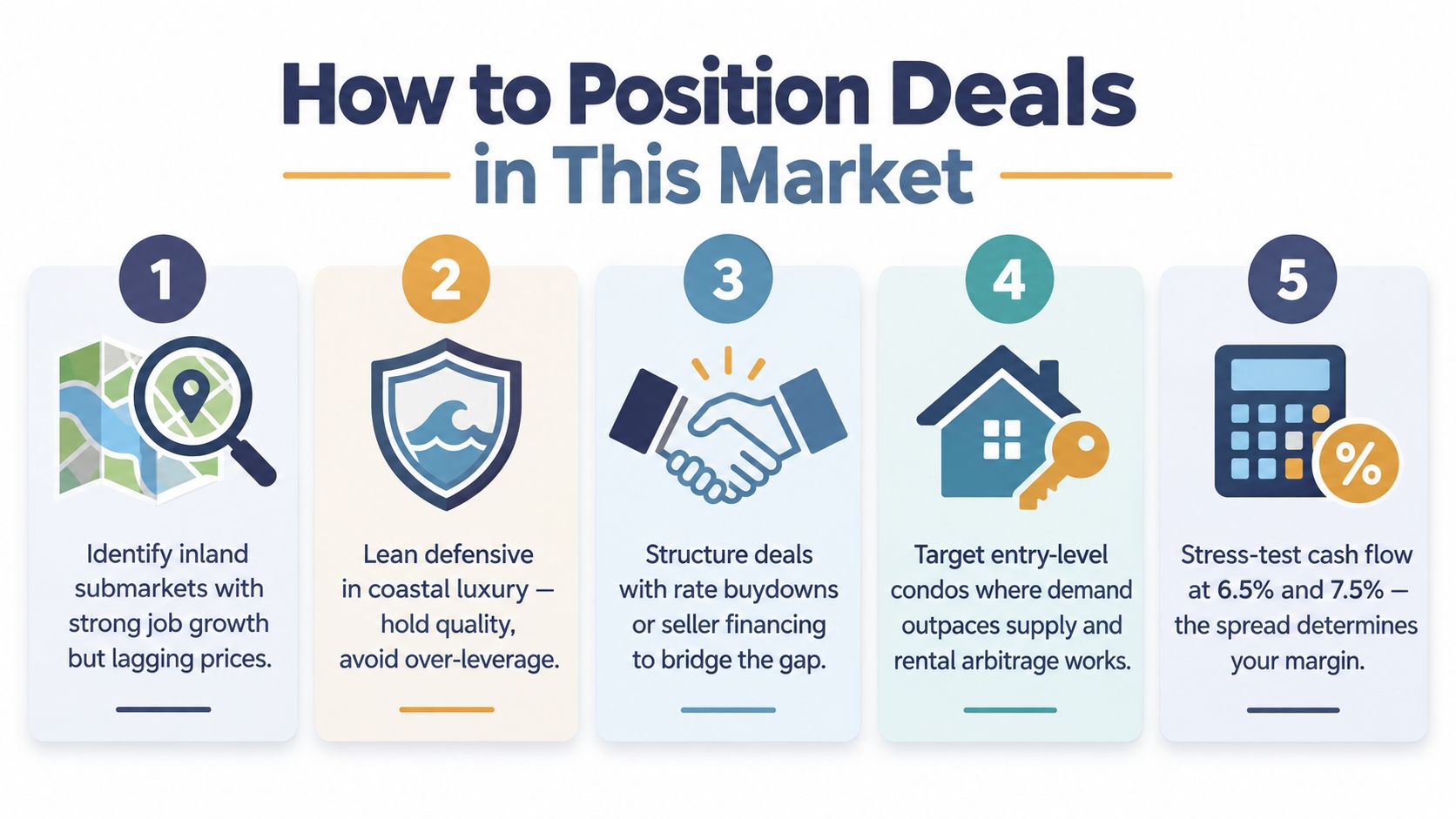
Start with the submarket
Look for inland locations where employment is diversified and housing costs still lag coastal alternatives. That doesn't mean buying the cheapest property available. It means identifying a commute corridor, rental base, and neighborhood condition that can support demand if appreciation stays muted.
Coastal luxury deserves a defensive posture. Quality can hold value, but borrowing to invest can turn a stable asset into a cash drain. Buyers should avoid paying a scarcity premium that only works if rates fall quickly or rents accelerate.
Make the financing do useful work
A rate buydown, seller financing, or a negotiated credit can bridge the gap between a seller's price expectation and a buyer's payment limit. Those structures are more valuable when they improve actual cash flow rather than disguise an excessive purchase price.
Underwrite every deal at 6.5% and 7.5%, as the strategy visual recommends. The spread between those scenarios tells you how much margin the property has when financing conditions disappoint.
Practical rule: If the deal only works at the most favorable rate assumption, you don't have a deal. You have a refinancing hope.
Choose the right asset type
Value-add properties can work when the renovation creates measurable rent or resale utility. Stabilized assets make more sense for owners who value predictability and can't absorb construction surprises. Entry-level condominiums may offer rental arbitrage where demand exceeds supply, but HOA budgets, insurance, assessments, and rental restrictions deserve equal weight with the purchase price.
Condo conversion plays can be attractive in supply-constrained coastal pockets, yet the entitlement, construction, and regulatory risks are substantial. Treat conversion as an operating project, not a passive appreciation strategy.
In the Inland Empire and selected Ventura opportunities, upside may be asymmetric if the basis is disciplined and the insurance is available. Richard Maize's three-plus decades in mortgage and real estate, documented on his official biography, offer a useful practitioner's lens: buy through uncertainty when the asset can carry itself, rather than waiting for perfect clarity.
Risks That Could Break the Base Case
A modest-growth forecast can fail without producing an obvious regional crash. The more likely danger is a localized break in the financing, employment, insurance, or regulatory assumptions behind a particular deal.
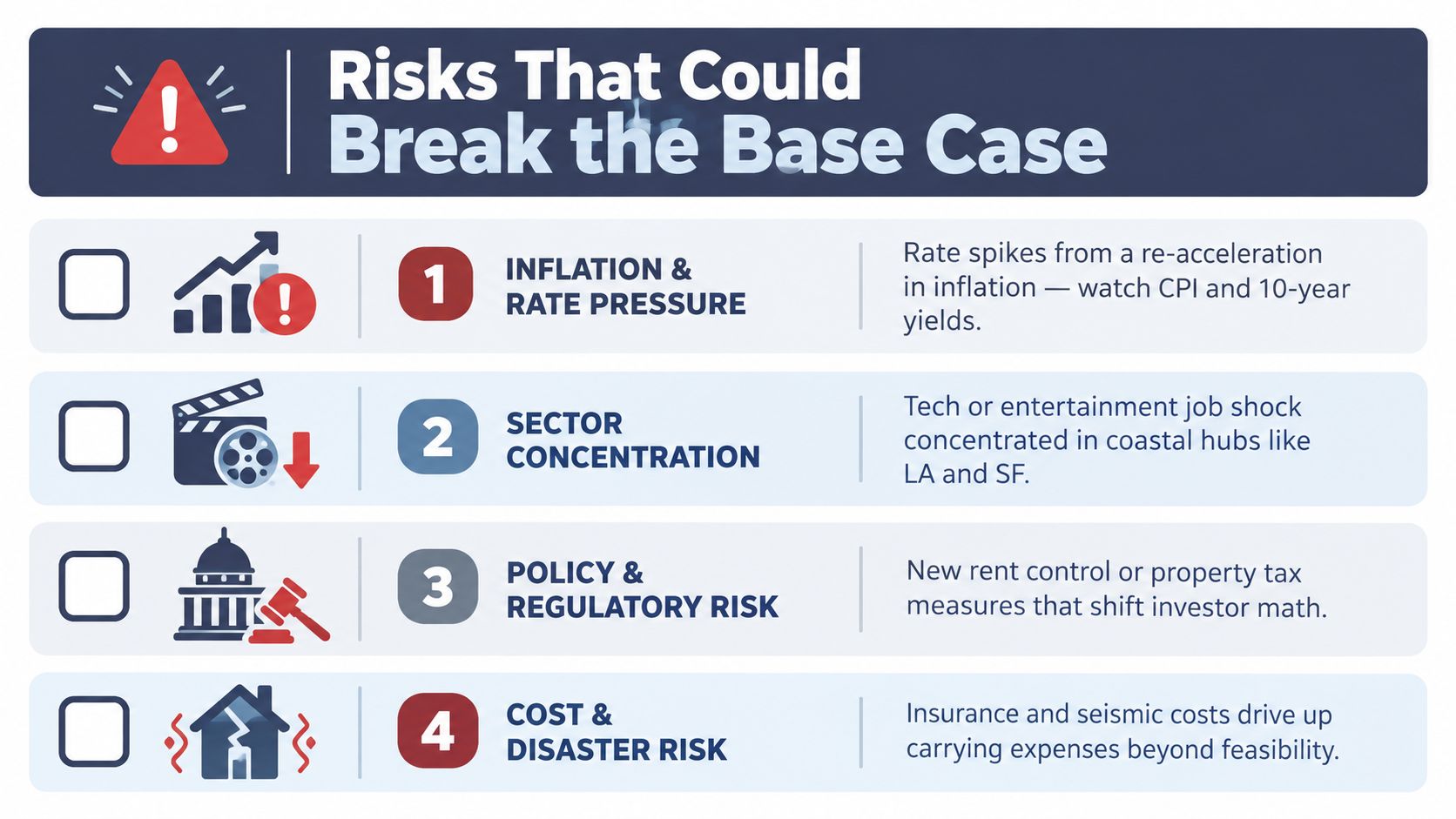
The watchlist
Rates rise again: Reaccelerating inflation could push mortgage costs higher and reduce purchasing power. Watch inflation readings, bond yields, lender quotes, and sudden changes in buyer affordability.
Coastal employment weakens: Technology or entertainment layoffs concentrated in Los Angeles could damage higher-priced demand and increase rental concessions. Watch local job postings, office occupancy, and submarket listing activity.
Insurance becomes unavailable: Wildfire, flood, and seismic exposure can make a property impossible to finance at the expected terms. Get an insurance quote before removing contingencies, not after closing.
Policy changes alter returns: Rent-control expansion, property-tax changes, or new transfer taxes can shift investor math quickly. Track local ordinances, state proposals, and operating-cost changes affecting the property type.
Water constraints and development limits add another long-term risk. A location may have strong demand but limited ability to add housing, which supports existing owners while making future growth harder and more expensive.
A forecast is useful only when you know which observation would prove it wrong.
Data Sources and Your Next Steps
A practical research stack should combine market activity with financing, employment, migration, and property-level records. California Association of Realtors MLS statistics help frame sales and median-price conditions. The Redfin Data Center is useful for listing, price, and market-activity trends. CoreLogic can support property and mortgage analysis, while Zillow ZHVI provides a separate home-value series for comparison.
For economic context, use BLS Los Angeles metro reports to track employment conditions. CalDRE helps verify licensing and regulatory information. Census migration flows can clarify where households are moving, and county assessor records provide parcel-level ownership, tax, and assessment details. These sources refresh on different schedules, so don't treat one update as a complete market signal.
Build a repeatable dashboard
Weekly: Check median price movement, days on market, new listings, pending activity, and price reductions in the exact submarkets you're considering.
During volatile rate periods: Review mortgage pricing frequently, because a small payment change can alter the buyer pool.
Before every offer: Pull current rent comps, insurance quotes, HOA documents, taxes, and realistic maintenance assumptions.
Quarterly: Revisit your base case and write down the trigger that would change your decision, such as weaker employment, rising inventory, or a financing shift.
A one-page dashboard should include the local median, inventory months, the 30-year mortgage rate, and a rent index. Keep the assumptions visible. The goal isn't to predict every move. It's to notice when the conditions supporting your purchase no longer exist.
Richard Maize offers real estate perspective shaped by long-term investing, market analysis, and experience across uncertain cycles. Visit Richard Maize to explore his property insights, investment work, and practical resources before making your next Southern California real estate decision.
Comments