Richie Maize Guide to Real Estate and Impact

A young investor bought his first property while studying at California State University, Northridge. Years later, Richard “Richie” Maize had built a large apartment portfolio, developed a mortgage banking firm, and expanded his real estate interests across the country.
Meet Richie Maize and Why His Hub Matters
A search for Richie Maize often begins with a practical question: what can an investor learn from a career that connects Los Angeles real estate, mortgage banking, business ventures, and philanthropy? The useful answer requires more than a short biography. It requires a way to study how those activities fit together.
Richard Maize is a Los Angeles-based real estate investor, entrepreneur, business investor, and philanthropist. His public platform gathers property commentary, entrepreneurship, media appearances, community work, and portfolio ideas in one place. Richard Maize's biography describes nearly three decades of experience in entrepreneurship and real estate investing, including mortgage banking and philanthropy.

A central place to study the work
A useful hub works like an investor's research file. Start with the Home area to establish the broad themes. Read the Blog for commentary, then check Press and Multimedia for interviews or public appearances. Use FAQs to clarify basic questions before forming an opinion. This sequence separates background from interpretation, much as an investor separates an asset's facts from its marketing.
The platform also helps readers compare different parts of a career without treating them as isolated subjects. A new investor can examine property ideas alongside the operating experience behind them. An entrepreneur can study consumer ventures and public visibility. A reader focused on community impact can review the foundation and its areas of support.
That process does not replace due diligence, financial modeling, or professional advice. It does create a starting framework for examining real estate ownership, liquidity, business operations, diversification, and giving back.
The distinction matters in a high-rate Los Angeles market. Early scale to 1,000 units and a mortgage banking exit point to two lessons worth testing today: growth needs systems, and liquidity can matter as much as appreciation. Diversification is not a substitute for discipline. It is more like keeping several tools available, so one asset or income source does not carry every risk. The practical question is which of these habits still fits an investor's own balance sheet, financing costs, and ability to hold through changing conditions.
From First Property to Multi State Portfolio
A student buying a first property may be learning more than a transaction. Richard Maize bought his first property while studying at CSUN, according to California State University, Northridge. That experience introduces the working parts of ownership: assessing an asset, meeting obligations, and accepting the consequences of a purchase.
Maize then turned one property into a larger operating system. Public profiles say he built a portfolio of about 1,000 rental apartment units before age 30. The Maize Foundation's biography identifies that early apartment ownership and describes his later development of a successful mortgage banking firm. The progression resembles learning an instrument. One property develops basic technique, several create repetition, and a larger portfolio demands systems, financing judgment, and control of fundamentals.
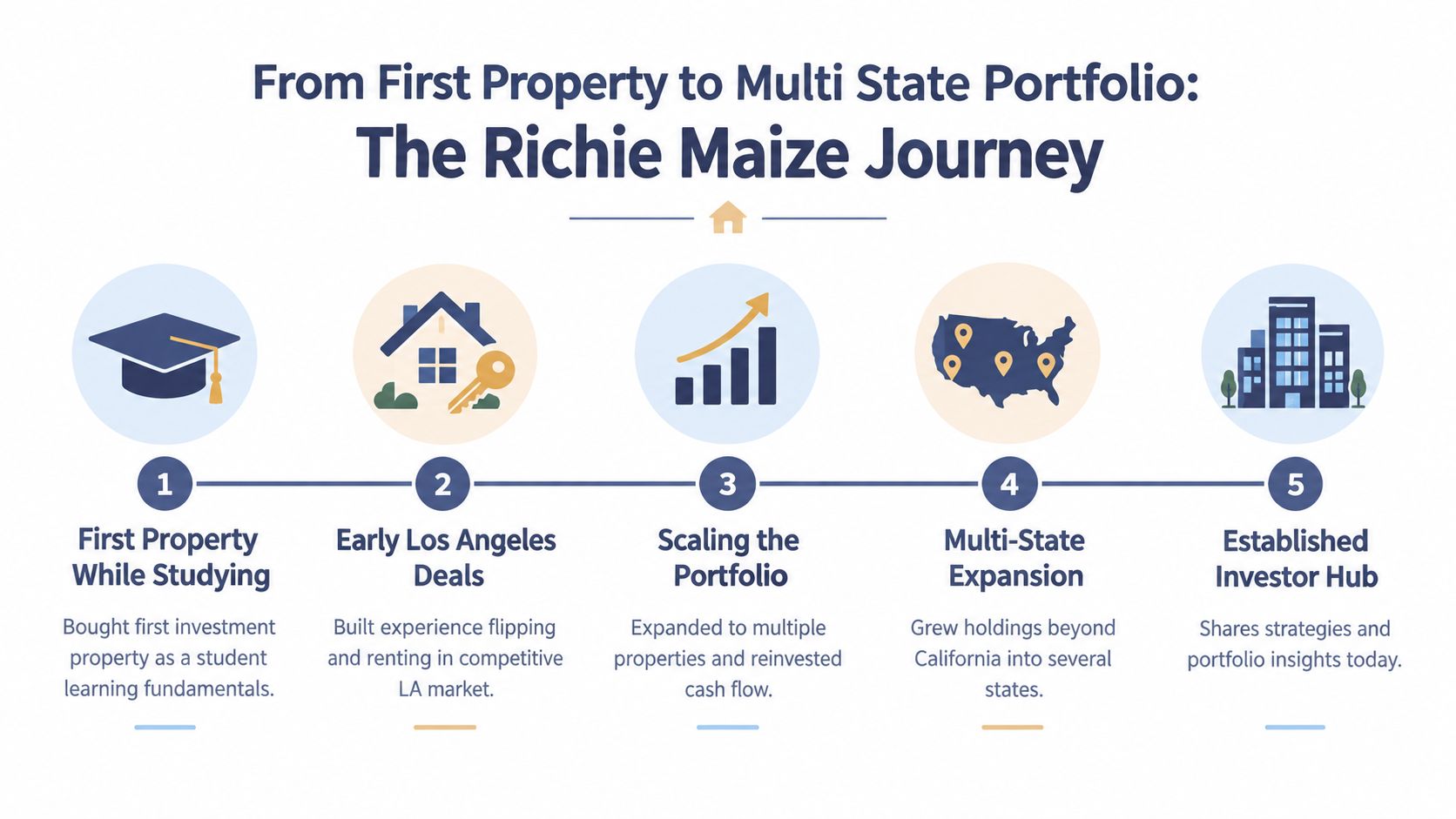
Five steps in the scale journey
Start with direct ownership. A first property builds practical knowledge of acquisition, tenants, maintenance, and risk.
Repeat what works. Rental apartments offer a consistent setting for studying how income, expenses, and financing interact.
Build an institution around experience. Maize later founded and developed a mortgage banking firm before liquidating it. The move connected asset ownership with a financial operating business, then converted that business into liquidity through an exit.
Spread exposure geographically. Public profiles say his holdings later reached property in more than 20 states. That geographic range reduces dependence on one local market, although it also requires stronger oversight and more deliberate operating processes.
Add different kinds of exposure. His background includes distressed assets, an online public relations firm, film and television investments, and a food truck enterprise. CSUN's profile notes his later involvement in films and television, while the earlier profile describes other business interests.
The lesson is not to copy an asset count or career path. It is consistency over intensity. Investors strengthen their judgment by making disciplined decisions repeatedly, then expanding only when their systems can support the next level.
That principle has particular relevance in a high-rate Los Angeles market. Maize's early scale to 1,000 units shows the value of repeatable systems, while his mortgage banking exit illustrates why liquidity deserves a place beside appreciation. Diversification works like distributing weight across several supports: one property, sector, or income source carries less of the total risk. Investors can apply that framework at a smaller scale by matching financing, reserves, and holding capacity to their own balance sheet. This guide to building a strong real estate portfolio offers a related framework for diversification, risk management, and long-term growth.
How His Real Estate Approach Works Today
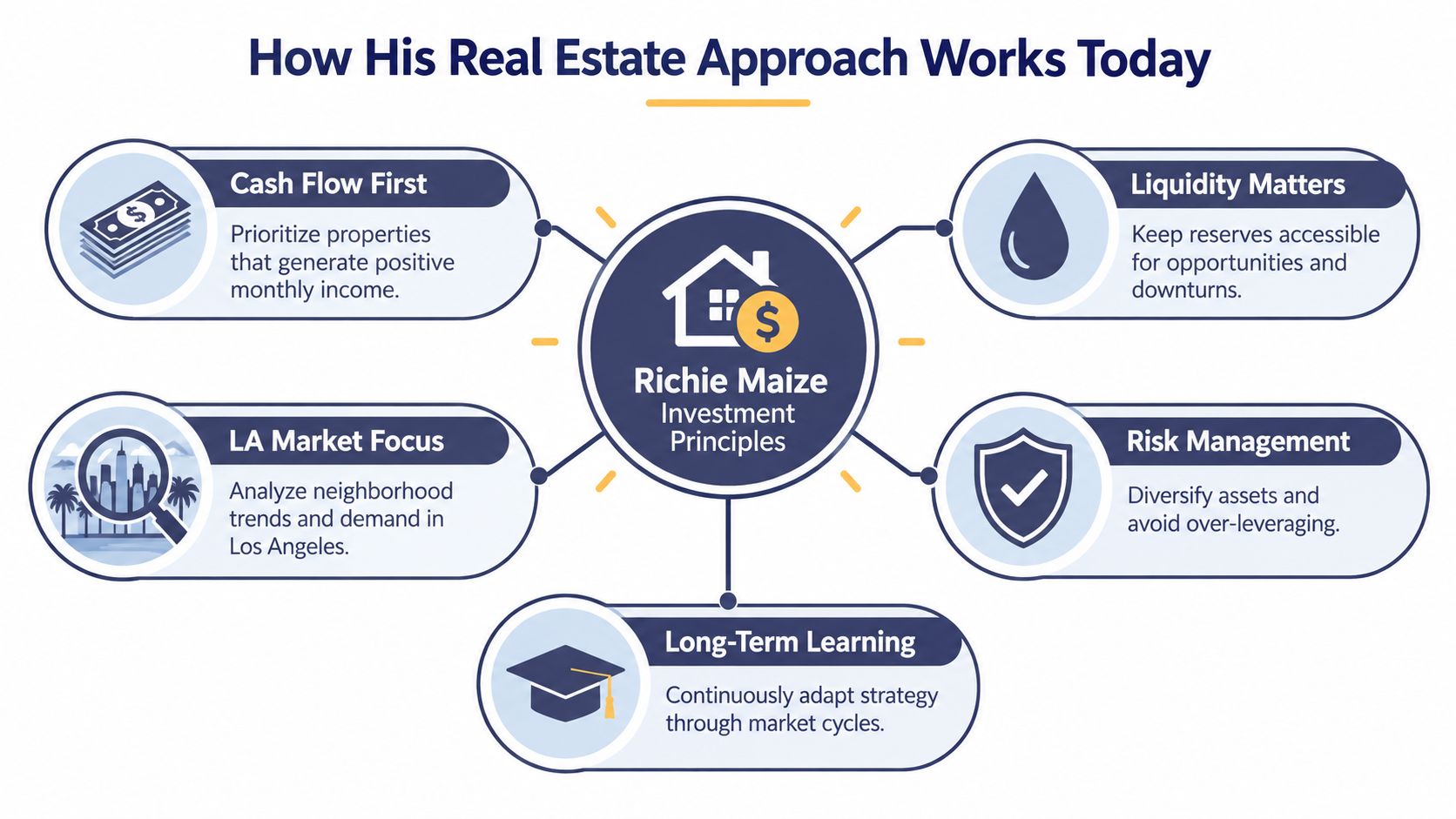
A property can look successful on paper and still strain its owner each month. Richie Maize's approach starts with testing that gap through cash flow, liquidity, diversification, market focus, risk tolerance, and time horizon. These principles do not remove uncertainty. They help an investor decide which risks fit the balance sheet and which do not.
Los Angeles makes that test concrete. Over the three months ending July 2026, the median sale price was $1.1 million, homes averaged 3 offers, and properties sold in about 50 days, according to Redfin's Los Angeles housing market data. The source also reports a 1.4% year-over-year price decline. Demand remains present, while affordability pressure limits how freely sellers can raise prices.
What changes when capital costs more
Higher borrowing costs leave less room for mistakes. A property purchased for its future appreciation can become difficult to hold if present income does not cover operating expenses, debt service, and reserves. Cash flow analysis therefore deserves attention before projected appreciation.
Liquidity works like a shock absorber. Accessible reserves can help an owner handle vacancies, repairs, refinancing uncertainty, or an unexpected acquisition opportunity. Cash is not the same as inactivity. It provides optionality, allowing an investor to wait, negotiate, or act without selling a sound asset at the wrong moment.
Diversification requires structure. Properties in different locations can reduce dependence on one local economy, but geographic spread also increases management demands. Each market still needs consistent underwriting, reporting, and oversight.
Maize's early expansion to 1,000 units gives this idea practical weight. His mortgage banking exit adds another lesson: scale matters, yet liquidity determines how long an investor can keep making sound decisions when financing becomes expensive. In a high-rate Los Angeles market, those principles work together. Diversification spreads exposure across several supports, while liquidity keeps one weak period from forcing a rushed sale.
Reading the current clearing process
Los Angeles is a slower, more negotiable market for buyers and sellers. Realtor.com reports a 99% sale-to-list ratio and 57 median days on market in August 2026. Zillow reports a 28-day median time to pending and 41.2% of sales closing above list price. These figures appear in Realtor.com's Los Angeles market page and Zillow's Los Angeles market data.
The practical response is disciplined underwriting, selective acquisitions, and ready access to capital. Appreciation may support the investment case, but current operations should carry it.
Practical rule: Underwrite the property you can operate today, not the market you hope will arrive later.
Ventures Beyond Property and What They Teach
A real estate career can become too narrow if every lesson is expressed through buildings and leases. Richie Maize's other ventures make the operating principles more visible because businesses such as food service and live events expose an investor to customers, branding, logistics, and daily execution.
The Richeeze Melts Food Truck offers a concrete example. A food truck isn't a passive asset. It depends on product quality, location, service, visibility, staffing, and customer response. The Richeeze Melts guide to starting a food truck business presents the venture in the context of entrepreneurship and operating decisions.

Property investors can learn from that contrast. A building may produce recurring income, but an operating business demands continuous attention to the customer experience. Both require cost control. Both punish weak execution. Both reward owners who understand what creates value rather than assuming ownership alone will do the work.
Brand visibility as an operating asset
Digital and promotional initiatives, along with projects such as POPPOP FEST, show another side of value creation. Visibility doesn't substitute for a viable business, but it can help a venture communicate its purpose, attract attention, and create relationships. That lesson transfers to real estate, where a well-presented property, clear message, and credible reputation can influence how partners, tenants, and buyers respond.
The broader portfolio lesson is not to add random businesses for the sake of variety. Diversification works best when each venture teaches something useful or fits a clear operating capability.
Boring fundamentals travel well. Know the customer, control the costs, protect the downside, and keep learning from the work.
The following multimedia feature gives readers another way to see how a consumer venture can connect product, presentation, and entrepreneurship.
Insights Press Features and Multimedia Hub
Investors often learn more from repeated themes than from dramatic predictions. Richie Maize's public platform combines blog posts, press features, and multimedia content to present ideas about property, entrepreneurship, brand visibility, and lessons from hands-on investing. The format matters because readers can choose the level of engagement they need. A short post may introduce a principle, while a longer interview or video can add context.
His commentary is most useful when read as a set of conservative operating habits. Protecting the downside, prioritizing cash flow over hoped-for appreciation, and preserving flexibility are not exciting headlines. They are durable questions that apply across market cycles.
How to read the material critically
A reader should separate experience from instruction. A biography can show what Maize accomplished, but it can't prove that a particular strategy will work for every investor. Market conditions, borrowed capital, property type, management capacity, tax circumstances, and personal risk tolerance all affect outcomes.
Use the platform as a research starting point:
Start with the Blog: Look for discussions that clarify property decisions, entrepreneurship, or portfolio thinking.
Check Press coverage: Compare public descriptions of his career with the broader biography and company information.
Use Multimedia: Interviews and videos can reveal how an operator explains decisions, not just which outcomes appear in a profile.
Review the FAQs: Basic questions can help new readers orient themselves before exploring more specialized material.
The site also provides a record of breadth. Public profiles describe Maize as having real estate in more than 20 states, while his biographies connect apartment ownership with mortgage banking and later diversification. Those facts establish a substantial career arc, but readers should still ask how a lesson applies to their own balance sheet.
The strongest use of media is practical. Read a claim, translate it into a question, and test that question against a real property or business decision. If the principle is liquidity, calculate how long reserves could support the asset. If the principle is diversification, identify whether the new investment reduces risk or adds another responsibility.
Philanthropy Through the Rochelle and Richard Maize Foundation
A property portfolio shows what an owner controls. Philanthropy shows what that success can support beyond an individual balance sheet. The Rochelle and Richard Maize Foundation centers its public work on youth education and development, family services and social welfare, and culture and the arts. The foundation's official page describes giving as a meaningful part of the Maize family's public work.
The foundation's named causes also show a broad community focus. Its support has included Hurricane Katrina survivors, Vista Del Mar Child and Family Services, and the Los Angeles Police Foundation. These examples reach from disaster response to family care and local civic support.
Three pillars with practical meaning
Youth education and development concerns the conditions that help young people gain skills and direction. Support may contribute to learning, mentorship, and access to opportunities.
Family services and social welfare addresses stability. A household under pressure may need ongoing care, practical resources, and continuity rather than one isolated intervention.
Culture and the arts strengthens shared experiences through which communities express identity and connection. Arts support can work alongside education and social services, serving a different need without displacing them.
Together, these pillars reflect a long-term view of value. An investor maintains a durable asset so it can keep serving its purpose. Community giving follows a similar logic: consistent support can help institutions continue their work over time.
Richard Maize's biography links the creation and sale of a major mortgage banking organization with the capacity to give back across Southern California and beyond. That connection offers a useful lesson for a high-rate Los Angeles market. Building scale, then preserving liquidity through a business exit or other diversification, can create room for both resilience and public benefit. The principle is practical: assets should support the owner's obligations, while available capital can support chosen community needs.
A philanthropic record also adds context to an investment career. Property ownership, business building, media activity, and charitable giving involve different responsibilities. Viewed together, they show how financial experience can serve private goals and wider community commitments.
Ways to Learn Connect and Collaborate
Readers can approach Richie Maize's platform with different goals. A new investor may want plain-language commentary on property markets. An entrepreneur may be more interested in consumer ventures, promotional work, or the operating lessons behind a food truck. A community-minded visitor may want to understand the foundation's causes and opportunities to support them.
The most useful approach is active rather than passive. Don't collect biographies as inspiration and stop there. Turn each principle into a question that improves your next decision.
A practical starting checklist
Study the career arc: Note how direct property ownership developed into apartment scale, mortgage banking, and broader diversification.
Test the fundamentals: For any deal, examine cash flow, reserves, financing, market conditions, and your ability to hold through uncertainty.
Compare business models: Use ventures such as Richeeze Melts to think about customer demand, operating discipline, and brand visibility.
Explore the media hub: Visit the Blog, Press, Multimedia, and FAQs areas for commentary and background.
Connect purpose with performance: Consider how investment and entrepreneurial skills can support community institutions and charitable work.
Three ideas deserve to stay with you. Consistency beats intensity because repeated sound decisions create capability. Flexibility has value because liquidity and realistic underwriting give investors room to respond. Fundamentals come first because markets can change faster than an optimistic thesis.
The platform offers information, examples, and points of contact. Your responsibility is to apply those lessons carefully, verify details, and match every opportunity to your own financial position and risk tolerance.
Richard Maize offers a public view of real estate ownership, business investing, entrepreneurship, media, and philanthropy, with lessons that connect early apartment scale to the demands of today's Los Angeles market. Visit Richard Maize to explore his Blog, Press, Multimedia, and foundation-related work, then use those resources to sharpen your investment questions and identify informed ways to connect.
Comments