Richard Maize Net Worth: A Real Estate Portfolio Breakdown

The most popular advice about Richard Maize net worth is also the least reliable: search for a single dollar figure, repeat it, and treat the result as fact. That approach works poorly for a private real estate investor who doesn't publish an audited personal balance sheet. A more credible answer starts with the evidence that is available, then separates owned assets, debt, business interests, charitable entities, and assumptions.
Richard Maize is publicly associated with a long operating history in real estate and mortgage finance, ownership of property across multiple states, and a substantial apartment portfolio built early in his career. Those signals can support a serious wealth analysis, but they don't prove a precise personal fortune. The practical question is therefore not “What is the number?” but “What range can the public record defend, and how would an investor verify it?”
Why a Single Net Worth Number Does Not Exist
A precise Richard Maize net worth figure is unlikely to exist in public sources. Private investors generally do not disclose personal balance sheets. Unlike public-company executives, they may hold properties through LLCs, partnerships, trusts, and operating companies. Those structures can expose deeds and loans while keeping personal equity, private debt, and ownership percentages unclear.
Richard Maize's public background materials describe more than 30 years in mortgage and real estate industries, property ownership in more than 20 states, and a record of building assets rather than publishing a verified net-worth figure. That evidence indicates operating scale. It does not establish an audited valuation.
What the public record can and cannot show
Property records may identify a deed, mortgage, or transfer. They may not show the beneficial owner behind an entity, private debt held elsewhere, preferred equity, unpaid taxes, or cash taken out through refinancing. Apartment comparables can establish a valuation range, but a defensible estimate still requires current rent rolls, operating expenses, occupancy, and loan terms.
Valuation creates another gap. Multifamily properties are commonly priced from net operating income and market capitalization rates, while personal net worth depends on equity, not gross property value. A large portfolio may carry substantial loans, and ownership may be divided among partners. Conversely, a smaller stake in well-performing properties can produce meaningful personal wealth.
The practical method is to infer value from the asset base and rent rolls, then subtract debt and account for ownership. That method is more useful than repeating a headline number because each assumption can be tested or challenged.
Practical rule: Treat every public net-worth figure as an estimate unless the source identifies the underlying assets, liabilities, valuation date, and ownership percentage.
The Rochelle and Richard Maize Foundation should remain separate from personal wealth. Its public filings can help explain governance, compensation, and charitable activity, but nonprofit assets are committed to charitable purposes. They do not replace a personal financial statement. The defensible conclusion is narrower: Richard Maize shows identifiable wealth-building signals, yet the public record does not establish one exact personal number.
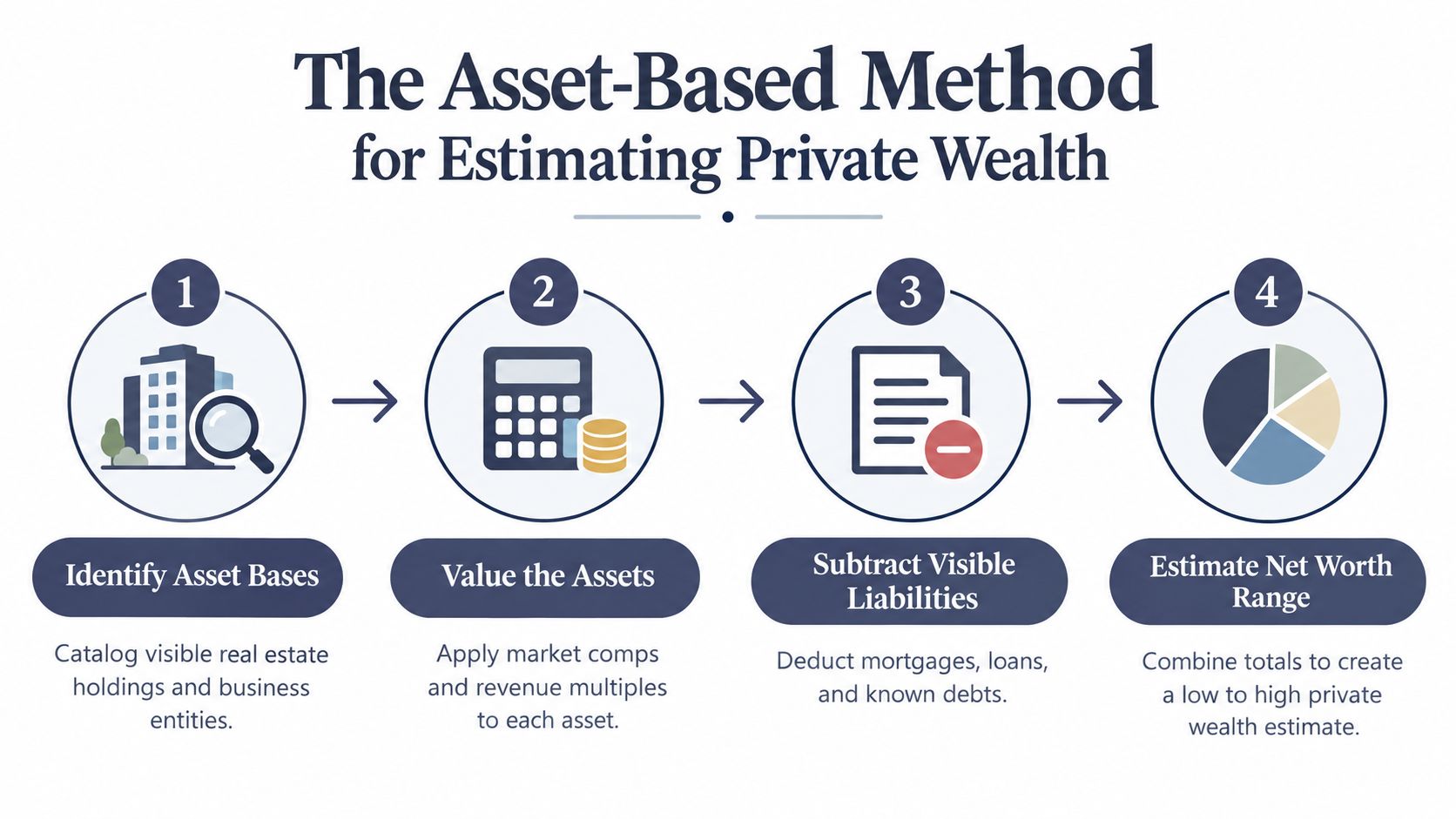
The Asset-Based Method for Estimating Private Wealth
A private investor's net worth is inferred, not read from a public balance sheet. The working method identifies assets, estimates their value, subtracts liabilities, and adjusts for ownership. Each result depends on the quality of the underlying records.
Start with the asset base
Real estate usually provides the clearest starting point. An analyst would identify apartment buildings, residential holdings, land, and commercial properties through recorder records, entity filings, company materials, and credible institutional profiles. The review can then include businesses, brand interests, cash, marketable securities, and documented stakes in operating companies.
The California State University, Northridge profile identifies a historical marker: Richard Maize had accumulated 1,000 apartment units before age 30 and owned property in 20 states. The profile does not establish the portfolio's current value, but it supports using multifamily real estate as the analysis's main reference point.
Value assets with stated limits
For each property, analysts can compare recent sales, price per unit, replacement cost, and income-based valuation. The capitalization-rate method divides net operating income by an applicable market rate. Comparable-sales analysis examines similar buildings in the same market. Both methods produce estimates, not exact figures, unless current property-level records are available.
Operating businesses require a separate review. Revenue quality, profitability, ownership, growth prospects, and comparable transaction multiples matter more than public visibility. A brand may attract customers or generate licensing income, while media exposure may support relationships and deal flow. Neither benefit should become a precise dollar amount without supporting evidence.
Known mortgages, loans, partner claims, and other liabilities then reduce the estimated value. The result should remain a range because private residences, private-equity stakes, cash balances, personal guarantees, and unrecorded obligations may be unavailable. That uncertainty is the method's central constraint, and stating it clearly keeps a private-wealth estimate credible.
Inside the Multi-State Apartment Portfolio
The strongest public asset signal is the apartment portfolio associated with Richard Maize. The Maize Foundation background page describes him as a Los Angeles-based real estate investor and entrepreneur and says he built a portfolio of about 1,000 rental apartment units before age 30. The same source describes ownership across 20 states, creating a picture of geographic diversification rather than a single local project.
Gross asset value and personal equity are different calculations. If an analyst assigns a per-unit value to the portfolio, the first result is the estimated value of the buildings. The next step is to subtract mortgages and other financing. The investor's net worth comes from the residual equity, adjusted for ownership shares and transaction costs.
A portfolio is a collection of different risk profiles
A building in a high-demand metropolitan area may command a different valuation from an older property in a smaller market. Condition, tenant profile, lease structure, vacancy, insurance, taxes, deferred maintenance, and local employment all affect value. A multi-state portfolio may reduce dependence on one housing market, but it also creates operational complexity and uneven performance.
The table below is a methodology illustration, not a factual valuation of Richard Maize's holdings. Because the public record doesn't provide a current unit-by-unit schedule, the exact unit allocation, price per door, loan-to-value ratio, and sponsor equity cannot be verified.
Market Tier | Approx. Units | Avg. Price/Door | Gross Asset Value | Est. LTV | Est. Sponsor Equity |
|---|---|---|---|---|---|
Core or higher-demand markets | Not publicly disclosed | Not publicly disclosed | Not verifiable | Not publicly disclosed | Not verifiable |
Stable secondary markets | Not publicly disclosed | Not publicly disclosed | Not verifiable | Not publicly disclosed | Not verifiable |
Value-oriented markets | Not publicly disclosed | Not publicly disclosed | Not verifiable | Not publicly disclosed | Not verifiable |
Portfolio total | About 1,000 units reported | Not publicly disclosed | Not verifiable | Not publicly disclosed | Not verifiable |
An investor reviewing this portfolio would focus on rent rolls, trailing operating statements, loan maturities, interest rates, and refinancing history. Rent growth can increase net operating income, but higher insurance, taxes, repairs, and financing costs can absorb that benefit. Likewise, a higher implied property value doesn't become spendable wealth until an owner sells, refinances, or otherwise realizes the equity.
For readers studying portfolio construction, Richard Maize's guide to building a strong real estate portfolio offers context on diversification, risk management, and long-term ownership. Those principles explain why a broad apartment base may support wealth creation without revealing a precise personal balance sheet.
From Mortgage Banking to Real Estate Capital
Richard Maize's mortgage banking history matters because it helps explain how a real estate portfolio could be built. The U.S. Department of Justice identified him as a co-founder of Americorp Funding, a mortgage banking company, and reported that he owned 45% of the company until its sale to Prism Mortgage Company around December 2000. That is a documented ownership and transaction history, but the public record cited here doesn't disclose the sale price or Richard Maize's personal proceeds.
Mortgage banking and property ownership generate different kinds of wealth. Origination can produce fees and business income, while ownership creates exposure to rent, appreciation, refinancing, and principal paydown. A sale of an operating company can provide liquidity that an entrepreneur then deploys into buildings, but without transaction terms, an analyst can't responsibly calculate how much capital moved into later acquisitions.
Why the transition changes the wealth model
A mortgage professional understands borrower quality, collateral, debt structure, loan pricing, and refinance risk. Those skills can improve acquisition underwriting, although expertise doesn't remove market risk or guarantee profitable investments. The shift from earning income through loan production to holding apartment equity also changes the timing of wealth creation. Operating income may be taxed and distributed quickly, while property wealth can remain embedded in assets for years.
That distinction helps explain why salary-based comparisons often miss the point. The public evidence points toward an asset-accumulation model, with real estate ownership as the principal wealth engine and mortgage finance as an important source of experience and potentially deployable capital.
The guide to financing investment properties is relevant to this framework because financing terms influence both control and equity. A property can generate attractive cash flow while carrying meaningful debt, and a refinance can release capital while increasing future obligations. Any estimate of Richard Maize's net worth must therefore treat the Americorp history as a documented business milestone, not as proof of an undisclosed payout.
Consumer Brands, Events, and Media Revenue
Real estate appears to be the central wealth signal, but consumer ventures can add operating income, visibility, and relationships. Richard Maize is associated with Richeeze Melts, a grilled cheese food concept, as well as POPPOP FEST and media-oriented promotional activity. These ventures belong in a complete analysis, but they shouldn't be valued as though every public appearance equals recurring profit.
Separate recurring income from event income
A food brand can generate sales through owned locations, mobile operations, licensing, or franchising. Its value depends on unit economics, margins, brand recognition, operating systems, and the owner's actual equity stake. A concept may have strong consumer appeal but still carry substantial labor, food, rent, equipment, and marketing costs.
A festival has a different revenue pattern. Ticket sales, sponsorships, merchandise, vendor arrangements, and licensing can produce meaningful gross receipts, but event income is often tied to a specific calendar and cost structure. Weather, permits, talent, insurance, staffing, and audience acquisition all affect the amount left for the owner.

Media and licensing can complement both businesses. Press coverage may strengthen a brand, create introductions, and support partnerships, but a net-worth analyst should distinguish attention from contractual revenue. Without published financial statements for these ventures, the responsible treatment is qualitative. They may add value to the overall enterprise portfolio, yet their contribution can't be assigned a verified dollar amount from the available evidence.
That doesn't make them irrelevant. Operating businesses can diversify income away from property rents and give an entrepreneur additional channels for customer relationships. They can also consume capital and management time. The trade-off is important: an apartment building generally has a recognizable asset and debt structure, while a consumer brand's value can depend heavily on execution, reputation, and future cash flow.
A disciplined estimate would therefore list Richeeze Melts, POPPOP FEST, and media or licensing interests as potential supplementary assets, then assign value only when ownership records, operating results, or transaction evidence become available.
The Maize Foundation and Personal Wealth
The Rochelle and Richard Maize Foundation is a separate legal entity from Richard Maize personally. Its assets are restricted to the organization's charitable purpose, so they should not be added to an individual net-worth estimate because his name appears in the foundation's title or officer records.
Public nonprofit records offer useful, limited reference points. A 2013 foundation filing summary reported $2,215 in net assets and negative $1,176 in net income. A ProPublica Nonprofit Explorer profile reported $3,000 in net worth for 2023 and listed Richard Maize as an officer with zero compensation. A separate foundation listing identifies the organization as a 501(c)(3) with EIN 42-1740696, a most recent filing in 2024, $79,868 in total giving, and $2,215 in total assets.
What a nonprofit filing can tell you
Form 990 records help readers examine governance, assets, contributions, grants, program spending, officer compensation, and related-party transactions. They describe the charity's finances and oversight. They do not establish Richard Maize's private equity in apartment buildings, mortgage businesses, or operating companies.
Item | Foundation 990 | Personal Net Worth | Source Note |
|---|---|---|---|
Foundation assets | Disclosed by nonprofit filing | Excluded from personal wealth | Nonprofit records |
Charitable giving | Reported by the foundation | Not personal asset value | Foundation filing data |
Officer compensation | May be disclosed | Relevant only as compensation context | Nonprofit records |
Apartment ownership | Not established by the foundation balance sheet | Requires property and entity research | Earlier real estate documentation |
The accounting boundary is straightforward. Foundation money is not a personal checking account, and foundation assets should not inflate a private net-worth estimate. Philanthropy may indicate giving capacity and intent, but it does not replace evidence of individually owned assets, liabilities, ownership percentages, or realized investment returns. A disciplined analysis therefore records the foundation separately and keeps its reported balance outside the personal wealth calculation.
Estimated Net Worth Range and How to Verify It
A precise answer to Richard Maize net worth is not supported by the public record. The available material points to a substantial real estate career, including apartment acquisitions at a young age and ownership activity across multiple states. It also identifies an ownership position in Americorp Funding. Those facts do not reveal sale proceeds, current portfolio debt, ownership percentages, or the value of consumer businesses and media interests.
A transparent estimate is better than false precision
For a private investor, the practical method is to estimate asset value, subtract verified liabilities, and apply the investor's actual ownership share. Without property-level records and current financial statements, the result should remain a range of confidence rather than a made-up dollar figure.
Asset Class | Conservative Estimate | Mid Estimate | Stretch Estimate |
|---|---|---|---|
Apartment portfolio equity | Not publicly verifiable | Not publicly verifiable | Not publicly verifiable |
Americorp Funding proceeds or retained equity | Not publicly verifiable | Not publicly verifiable | Not publicly verifiable |
Richeeze Melts | Not publicly verifiable | Not publicly verifiable | Not publicly verifiable |
POPPOP FEST and media interests | Not publicly verifiable | Not publicly verifiable | Not publicly verifiable |
Foundation assets | Excluded from personal wealth | Excluded from personal wealth | Excluded from personal wealth |
Total personal net worth | No defensible public figure | No defensible public figure | No defensible public figure |
Verification should start with public business records, then move to county recorder searches and registries in states where property ownership has been described. Review deeds, mortgages, transfers, liens, entity names, and refinancing activity. A property website can identify a lead, but it cannot confirm who owns the asset or how much equity remains.
For operating businesses, look for ownership filings, licenses, event records, company announcements, and financial disclosures. Rent rolls can help estimate apartment revenue, yet gross rent is not equity. Analysts must account for occupancy, operating expenses, debt service, capital expenditures, and ownership splits before translating property value into personal wealth.
Historical milestones also require caution. A portfolio assembled early in a career may later have changed through sales, refinances, partnerships, or reorganizations. A past unit count therefore cannot be treated as a current holding without supporting records.
The defensible conclusion is methodological: Richard Maize's public profile supports a significant asset-building career, but no audited personal net-worth figure is established by the cited evidence. Anyone publishing a precise number should show the properties, valuation dates, debt assumptions, ownership interests, and source documents behind the calculation.
Richard Maize maintains a public platform focused on real estate investing, entrepreneurship, business ventures, and philanthropy. Visit Richard Maize for his portfolio perspectives, business activities, press features, and community work.
Comments