Richard Maize Guide to Real Estate Ventures and Philanthropy

A young Richard Maize stood over a property deal with more than a purchase price in view. He was learning to read rent rolls, debt terms, and the operating details that determine whether a building produces durable value. That habit became the foundation for a career spanning real estate, finance, consumer ventures, media, and philanthropy.
Introducing Richard Maize
Richard Maize is described by public profiles as a Los Angeles-based real estate investor, entrepreneur, and philanthropist. Multiple biographies associate him with more than 30 years in real estate and finance, while another describes almost three decades in the field. His career matters less as a list of ventures than as a study in how one operating discipline can travel across very different settings.
A residential property demands close attention to income, expenses, debt, and tenant needs. A food truck demands the same practical questions in a different form: Where is demand strongest? Which costs can the business carry? How does the brand earn repeat attention? A festival adds another layer, connecting commercial activity with gathering, culture, and local participation.
That pattern makes Maize an interesting expert for readers studying capital allocation and community impact. His public story moves from acquiring residential units to mortgage banking and private investments, then into consumer and cultural projects such as Richeeze Melts and POPPOP FEST. The Richard Maize profile and career overview provides a useful starting point for that broader picture.
The deeper lesson is practical. Diversification works best when each new venture builds on skills already developed elsewhere. Maize's path suggests that underwriting, disciplined execution, brand building, and community relationships can reinforce one another when an operator treats them as connected parts of one strategy.
Background and Early Real Estate Career
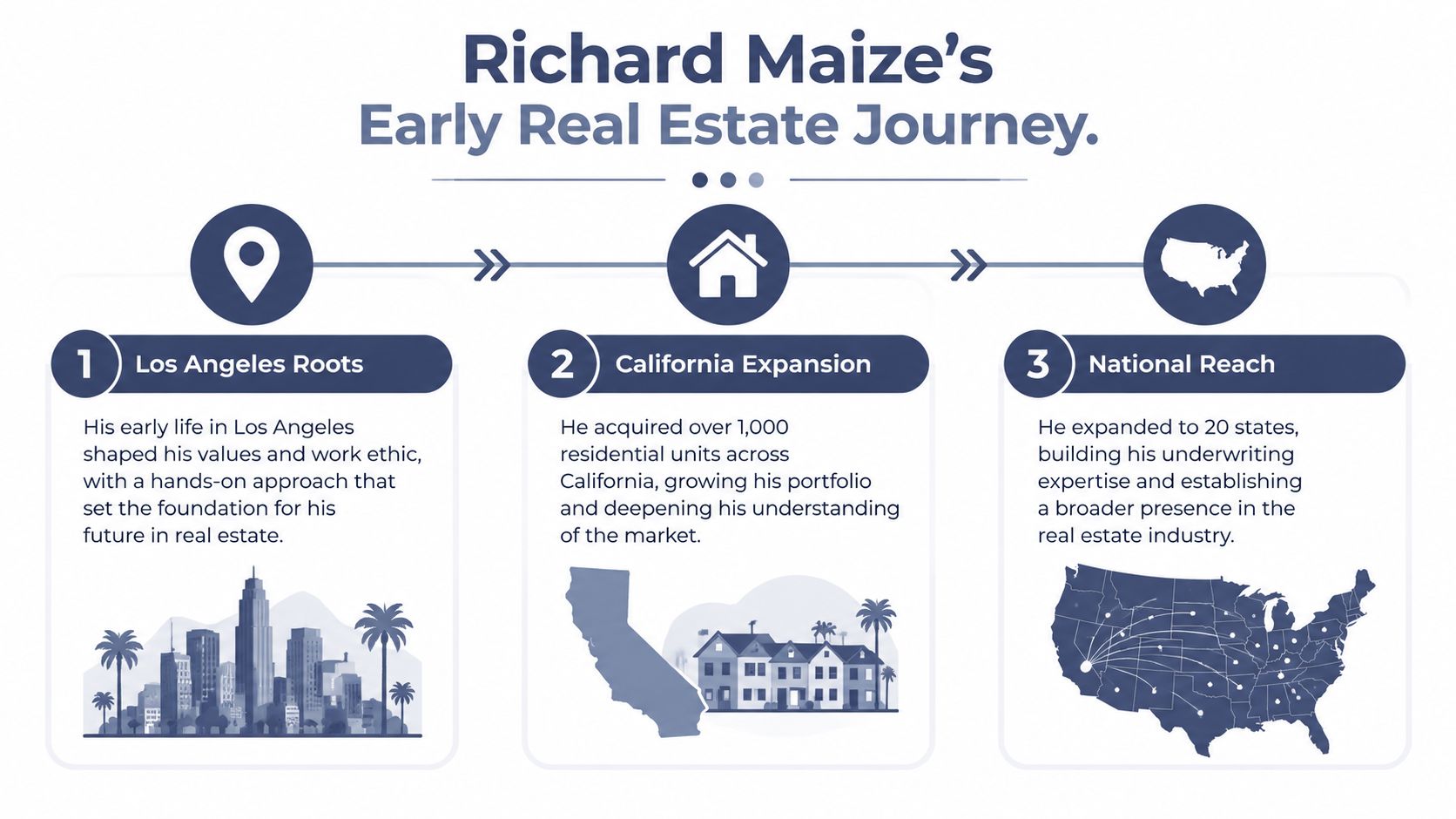
Richard Maize's early career was grounded in Los Angeles and in direct exposure to residential real estate. Public descriptions say he acquired over 1,000 residential units across California and later expanded into properties in 20 states. Those milestones are documented by the Rochelle and Richard Maize Foundation's account of his early career.
The significance of that experience isn't only the size of the unit count. Repeated acquisitions give an investor many opportunities to compare assumptions with operating reality. A rent roll shows scheduled income, but the investor still has to test collections, vacancy, concessions, maintenance, and the stability of the surrounding market. Occupancy can drift, expenses can move unevenly, and refinancing can change the economics of an otherwise healthy property.
What repeated acquisitions teach
An investor working across many properties develops pattern recognition. The questions become familiar:
Income quality: Are reported rents supported by actual collections and durable tenant demand?
Operating control: Which expenses reflect normal property needs, and which signal deferred maintenance or weak management?
Market exposure: Does a rising valuation reflect stronger cash flow, tighter capitalization rates, or conditions that could reverse?
Debt timing: Can the property withstand a refinancing cycle if borrowing costs or lender requirements change?
Maize's public operating profile suggests that these experiences helped build underwriting skill through direct contact with rent rolls, occupancy changes, local cap-rate conditions, and debt-refinancing cycles. The guide to building a strong real estate portfolio frames the same broader discipline around diversification, risk management, and long-term growth.
From property cash flow to the balance sheet
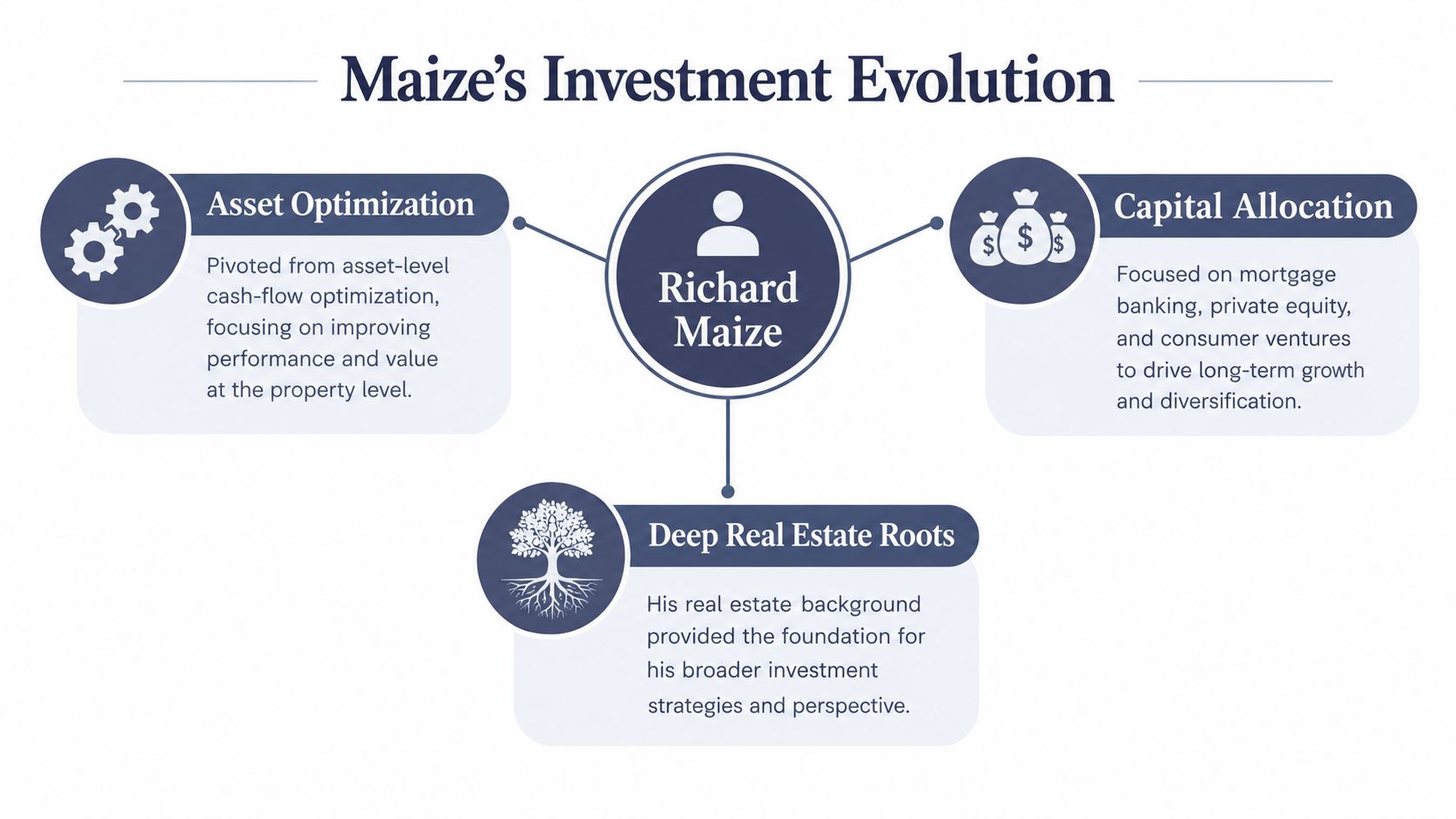
The early real estate phase focused on asset-level performance. An owner improves results by buying carefully, managing expenses, maintaining occupancy, and protecting cash flow. Over time, that work can lead to a more advanced question: How should capital itself be sourced, structured, and redeployed?
That distinction explains why Maize's later move into mortgage banking and broader private investments is strategically important. His career is described as a shift from cash-flow optimization to balance-sheet optimization, where the use of borrowed capital, term structure, and capital sourcing become central performance drivers. The properties supplied the training ground, while finance expanded the range of decisions he could make.
Practical rule: Before diversifying into a new asset class, understand the operating mechanics of the asset you already control.
Transition into Diverse Investment Ventures
A property investor sees a business through its cash flow. A capital allocator sees the wider system, including financing, partners, timing, brand strength, and the next use of available capital. Richard Maize's transition reflects that change in perspective.
Public biographies describe a path from acquiring 1,000 apartment units before age 30 into mortgage banking and private investments, as documented by the Richard Maize real estate and investment biography. The sequence is more revealing than any single venture because it shows how experience at the asset level can inform decisions across a larger portfolio of opportunities.
The transferable operating skills
Mortgage banking requires an understanding of borrower quality, collateral, repayment capacity, and financing structure. Those questions connect naturally with real estate underwriting, where an investor studies income durability, asset condition, and debt risk. Private investments widen the lens further, asking how a company's people, market position, and capital plan might create value.
Consumer ventures require a different customer-facing rhythm, but the underlying habits remain recognizable. A food truck must select locations, manage inventory, price an offering, and create a memorable reason to return. A festival must coordinate partners, audiences, programming, and public identity. In each case, the operator allocates scarce resources under uncertainty.
Maize's connection to Richeeze Melts and POPPOP FEST illustrates how branding can become another form of asset management. The asset is no longer a building. It may be a product experience, a gathering, or a story that attracts customers and collaborators.
Why the pivot matters
The move across sectors doesn't automatically prove that every venture succeeds, and public information doesn't independently verify the composition, debt levels, or realized performance of Maize's broader portfolio. It does show a coherent entrepreneurial logic: acquire practical knowledge, recognize the capital behind the activity, and apply the same discipline in new environments.
For other operators, the replicable lesson isn't to copy every sector. It's to identify the capabilities that travel, such as underwriting, cost control, financing judgment, partnership management, and audience development. Diversification becomes more defensible when it follows those capabilities instead of chasing unrelated opportunities.
Showcasing Notable Projects and Media Highlights
Richeeze Melts gives Maize's investment story a highly visible, everyday form. Instead of a residential building viewed through leases and operating statements, the public encounters a food truck through a product, a location, and a moment of service. Its signature grilled cheese offering turns business fundamentals into something customers can immediately taste and remember.

The venture also demonstrates why consumer brands need more than a functional product. A recognizable name, a focused menu, a strong visual presence, and an association with lively public spaces can help a small operation become part of a broader community narrative. The business meets customers where they gather, while the brand gains meaning from the setting around it.
POPPOP FEST extends that idea beyond food. Music and art create a shared environment in which business, entertainment, and community engagement overlap. A festival requires practical execution, from coordinating participants to shaping the audience experience, but its lasting value often comes from the relationships it helps create.
Turning activities into a public narrative
Media coverage can connect these ventures to Maize's larger identity as an investor and philanthropist. A local business journal may emphasize entrepreneurship. A lifestyle podcast may focus on personality, food, or culture. Press and multimedia features can give separate projects a common storyline, provided the operator explains the principles linking them.
The most useful media lesson is straightforward:
Lead with the concrete project: A food truck, festival, or investment gives the audience something tangible.
Explain the operating idea: Show how the project reflects customer understanding, resource discipline, or partnership building.
Connect activity with purpose: Community participation makes the story broader than a transaction.
Keep the evidence precise: Public claims should distinguish documented facts from personal interpretation.
A video feature can make that narrative more immediate by showing the setting, the product, and the people involved.
The result is a useful model for earned visibility. Media works best when it doesn't merely repeat a résumé. It gives audiences a scene, a reason to care, and a clear connection between the operator's commercial work and the community around it.
Philanthropic Efforts of the Maize Foundation
The Rochelle and Richard Maize Foundation adds a different test to the career story. Real estate performance can be discussed through properties, financing, and cash flow. Philanthropy must ultimately be judged by the needs addressed, the resources deployed, and the outcomes beneficiaries experience.
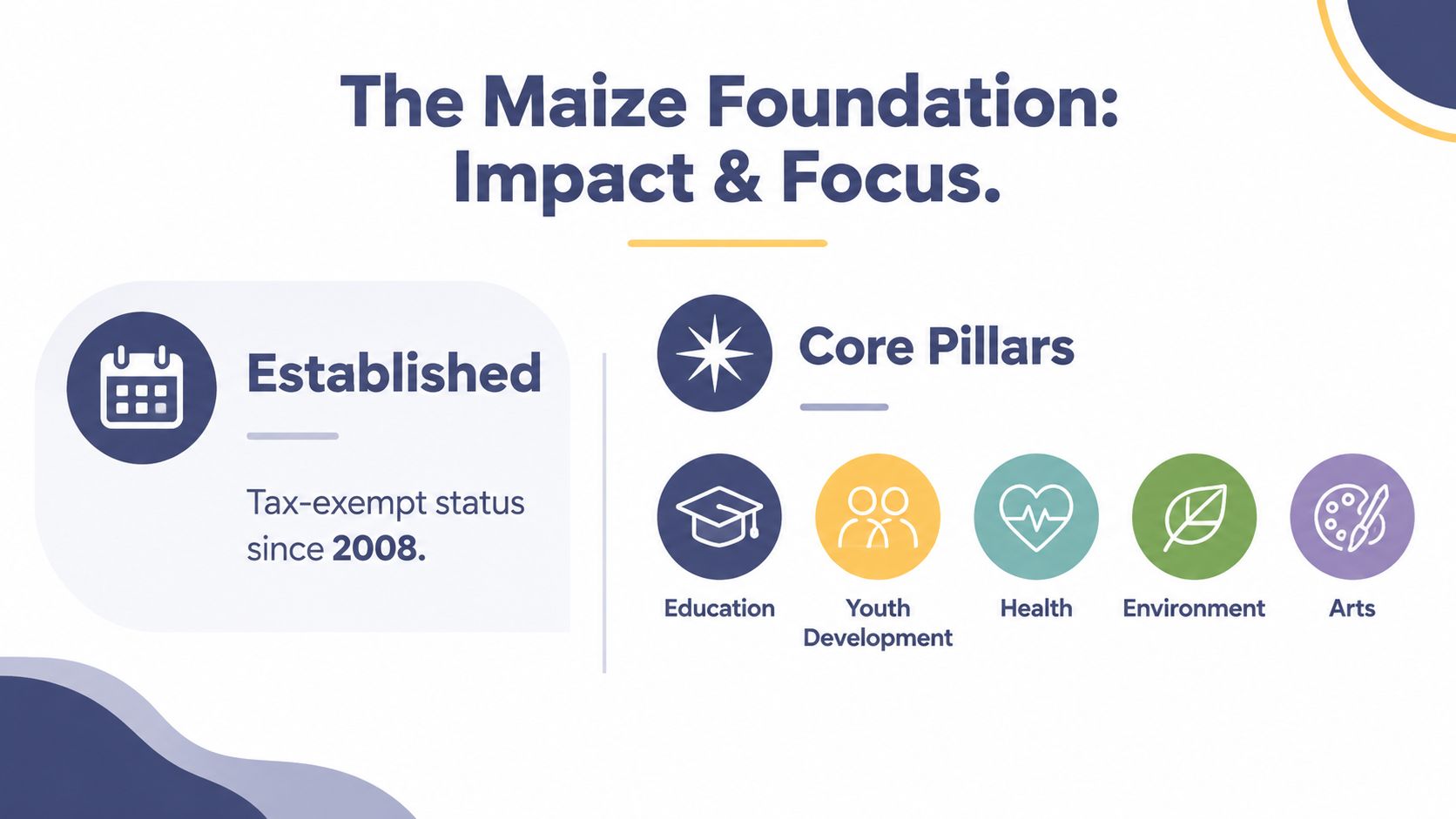
ProPublica lists the foundation as tax-exempt since February 2008, according to its nonprofit organization record. Public descriptions identify several giving priorities, including education, youth development, health initiatives, environmental stewardship, and arts and culture. Together, those areas suggest a broad community-focused platform rather than a single-program charity.
Mission breadth and measurement
A broad mission can help a family foundation respond to changing community needs, but it can also make evaluation harder. Education grants may seek improved access or learning support. Youth programs may focus on development and opportunity. Health initiatives can address immediate needs, while environmental and cultural work may produce benefits that are less visible in a financial statement.
That's why modern nonprofit review should move beyond mission language. A careful donor or partner should ask:
Who receives support? The foundation should identify beneficiary groups and the communities reached.
What does each grant enable? A grant description should connect money with a service, program, or measurable activity.
How is progress assessed? Outcomes, reporting practices, and renewal decisions reveal whether giving is strategic.
What role does the foundation play? It may operate programs, fund other organizations, support family giving, or preserve a philanthropic legacy.
The foundation information published by Richard Maize presents the public-facing mission, while available coverage leaves important program-level questions open. Public materials don't clearly establish the foundation's grant strategy, detailed outputs, or comparisons with peer organizations.
Reading the available financial picture
Public filings show $79,868 in giving during 2024 and $2,215 in assets, as reported in the Richard Maize FAQ information. Those figures shouldn't be treated as a complete measure of social impact. They do, however, invite a reasonable question about the foundation's current function and how its resources translate into programs or grants.
The foundation could be understood as an operating charity, a family giving vehicle, or a legacy platform, but the available public information doesn't fully explain which role best describes it. That distinction matters because each model calls for different expectations around staffing, grant documentation, beneficiary reporting, and outcome measurement.
Philanthropic credibility grows when a clear mission is paired with equally clear evidence of what the support made possible.
For donors studying the Maize Foundation, the most constructive approach is neither uncritical praise nor a conclusion based only on financial figures. It's to request program details, examine grant purposes, and connect spending with community results. That standard protects beneficiaries and helps a foundation turn broad intentions into accountable impact.
Key Takeaways and How to Connect
Richard Maize's career offers a practical sequence for entrepreneurs who want to work across sectors without losing strategic focus. The starting point is not variety for its own sake. It's discipline in one operating environment, followed by deliberate expansion into adjacent forms of value creation.
Three lessons stand out:
Build from direct knowledge: Maize's early property work created familiarity with income, expenses, occupancy, and refinancing. Entrepreneurs should first master the details that determine whether their core activity works.
Move from assets to allocation: Once operating judgment is developed, the next question is where capital, people, and attention can produce the strongest strategic result.
Make community part of the model: Richeeze Melts and POPPOP FEST show how consumer activity and cultural programming can create public connection, while the foundation extends that emphasis into charitable priorities.
Readers who want to study this model should begin with primary materials. Review Maize's public biography, examine the foundation's stated focus, and compare the narrative with available filings. Separate verified facts from interpretation, especially when assessing portfolio scale, investment performance, or philanthropic outcomes.
Those seeking a partnership should prepare a concise proposal rather than a general introduction. Explain the project, identify the community or commercial problem, describe the resources required, and show how the idea connects with real estate, entrepreneurship, media, or philanthropy. A focused proposal gives the recipient something concrete to evaluate.
For ongoing insight, follow the published blog and multimedia materials, then use the official contact channels for relevant inquiries. Richard Maize's public platform brings together property experience, business investing, venture visibility, and community giving, giving readers several entry points for learning or collaboration.
Richard Maize offers a public example of how real estate expertise can develop into broader capital allocation, consumer ventures, media activity, and philanthropy. Visit Richard Maize to explore his blog, press coverage, multimedia projects, and foundation-related work, then identify the specific insight or partnership opportunity that fits your goals.
Comments