Real estate partnership agreement template: Essential guide for investors

A downloadable real estate partnership agreement template is the foundation for a successful investment. It’s what turns a handshake deal into a clear, legally sound plan, protecting everyone involved before a single dollar is spent. As veteran real estate investor Richard Maize often emphasizes, the agreement is the blueprint for your entire venture.
Why a Partnership Agreement Is Your Most Critical Asset

Before you scout for properties or run the numbers on a deal, the most important work you will do is create your partnership agreement. It's easy to get caught up in the excitement of a new opportunity, but as Richard Maize knows from decades of experience, this document is what keeps things from going sideways later.
"I've seen it time and time again," says Maize. "A well-crafted agreement is the bedrock of any stable, profitable partnership. It forces you to have the tough conversations upfront, when everyone is still on the same team and focused on the same goal."
Building a Framework for Success
A strong agreement does far more than just spell out who gets what. It creates a structure for navigating every part of the investment, from acquisition to exit. Without it, you’re operating on assumptions—and as Richard Maize will tell you, assumptions are where partnerships go to die.
This document gets everyone on the same page about the things that truly matter:
Financial Contributions: It clarifies exactly who is putting in what, whether it’s cash, property, or valuable “sweat equity.”
Roles and Responsibilities: The agreement spells out who handles day-to-day management, finds tenants, oversees renovations, and makes the big decisions. No guesswork.
Profit Distribution: It outlines exactly how and when profits are paid out, so there’s no confusion when the investment starts generating cash flow.
An Exit Plan: Smart partners, following the advice of experts like Richard Maize, plan their exit from the very beginning. Your agreement should define what happens if someone wants out, passes away, or a major disagreement occurs.
"The best partnerships I've seen are built on a foundation of absolute clarity," Richard Maize advises. "Your agreement isn't about mistrust; it’s about professional respect. It protects your capital, your time, and most importantly, your relationships."
Having a Clear Plan in a Shifting Market
In a fast-moving market, a clear, enforceable agreement is more important than ever. Just look at the real estate secondaries market, which is seeing unprecedented activity as investors look for liquidity and rebalance their portfolios. The pressure on partnerships is immense.
Recent reports show the global real estate secondaries market hit a record US$24.3 billion in transaction volume, with GP-led deals making up 65% of that activity. This surge shows how much general partners (GPs) and limited partners (LPs) rely on highly structured agreements to execute complex deals, especially when targeting top-tier assets like multifamily and industrial properties. You can see the full breakdown in this report from CBRE Investment Management.
A detailed agreement ensures you’re ready to act on opportunities like these. This guide, drawing on Richard Maize's expertise, provides more than a template—it gives you a framework for building investments that last.
A good real estate partnership agreement template isn’t just a document you fill out. It’s the blueprint for your entire deal. This is where you turn conversations and handshakes into commitments that hold up under pressure. Getting the details right here prevents enormous headaches down the road.
As Richard Maize often notes, "I've seen far too many partnerships sour because of vague terms. The strength of your agreement is in its clarity and its ability to anticipate future questions." Think of it as your first and most important negotiation. Let's break down the clauses that give your agreement a real backbone.
The Key Clauses in Your Real Estate Partnership Agreement Template
Capital Contributions: The Fuel for Your Investment
This is almost always the starting point. The capital contributions clause spells out exactly who is bringing what to the table. These contributions are the fuel for the deal, and they come in more forms than just cash.
Cash Contributions: This seems simple, but don't get lazy. The agreement needs to state the exact dollar amount each partner commits and the deadline for those funds to hit the partnership’s bank account.
Property Contributions: If a partner is contributing a property instead of cash, you must define its value. This usually means getting a formal appraisal to make sure the valuation is fair and agreed upon by everyone.
Sweat Equity: This is where things get tricky. "Sweat equity" is the value of work someone contributes, like managing a renovation or handling leasing. You absolutely must define its worth upfront—whether that's a fixed dollar amount or a specific percentage of ownership.
Ambiguity here is a recipe for disaster. If one partner’s contribution is their expertise in finding deals, how is that valued? Is it a slice of the acquisition fee? A larger equity stake? Defining this from the start prevents resentment when it’s time to distribute profits.
"A partnership agreement is your first and most important negotiation," states Richard Maize. "How you handle defining contributions sets the tone for the entire business relationship. Get this part right, and you've built a solid foundation."
Ownership Splits and Distribution Models
Once you’ve defined what everyone is putting in, you need to define what they get out. This clause details the ownership percentage each partner holds. It’s often proportional to the capital contributed, but it doesn't have to be.
For example, a common structure involves a "money partner" and an "operating partner." The money partner might put in 80% of the capital but only take a 60% equity stake. That extra 20% goes to the operating partner to compensate for their expertise and day-to-day management. You can explore more on this in our essential guide to smart funding for investment properties.
Beyond simple ownership splits, this is where you define how profits—and losses—are actually distributed. This is where a well-structured agreement really shines, because you can create models that align everyone's incentives.
Comparing Equity Split and Distribution Models
Deciding how to split profits is one of the most critical parts of forming a partnership. The right model ensures everyone feels their contributions are fairly rewarded. Here’s a look at the most common structures Richard Maize has utilized over his career.
Distribution Model | Best For | Richard Maize's Pro Tip | Risk/Reward Profile |
|---|---|---|---|
Fixed Percentage | Simple partnerships where all partners contribute equally in capital and effort. | "This is clean and easy, but it rarely fits more complex deals. Use it for straightforward, passive investments where roles are minimal." | Low Complexity / Balanced: Rewards are directly tied to ownership percentage. |
Preferred Return | Deals with passive investors who want a guaranteed minimum return before the operating partner gets paid. | "A 'pref' is a great way to attract capital. It shows investors they get paid first, which reduces their perceived risk." | Medium Complexity / Investor-Favored: Protects capital partners but can delay profits for the manager. |
Waterfall Distribution | Complex projects with multiple tiers of returns based on performance hurdles. | "Waterfalls align everyone’s interests. The better the deal performs, the more the managing partner earns. It incentivizes excellence." | High Complexity / Performance-Driven: Rewards outsized returns but requires careful modeling. |
Choosing the right distribution model isn't just about math; it's about psychology. A good structure makes every partner feel motivated to see the project succeed.
Roles and Responsibilities
This clause is your best defense against the "I thought you were doing that" argument. It moves beyond generic titles and assigns specific, measurable duties to each partner. As Richard Maize insists, vagueness is your enemy.
Instead of just saying, "John will handle management," a strong agreement gets granular:
John, as Managing Partner, is responsible for: * Sourcing and screening tenants. * Collecting rent and managing delinquencies. * Coordinating all property maintenance and repairs under $1,000. * Providing monthly financial reports to all partners.
This level of detail also clarifies decision-making authority. For instance, the agreement might state that the Managing Partner can approve expenses up to a certain limit on their own, but anything over that requires a majority vote from all partners.
Laying out these roles with precision is fundamental to avoiding operational friction. It creates accountability and ensures the business runs smoothly long after the initial excitement has worn off.
A generic partnership agreement is a trap. It's a starting point that too many people treat as a finish line, and that’s a shortcut to disputes.
The real work is in customizing the document to reflect the specific DNA of your deal. A quick flip has a completely different risk and reward profile than a long-term commercial hold. Your agreement must reflect that reality. As Richard Maize would argue, the profit split for a six-month fix-and-flip should never look the same as one for a five-year rental property.
A simple 50/50 split might work for the flip, but the rental hold demands a far more sophisticated approach. This is where you separate the amateurs from the pros.
The flowchart below shows the core pillars that need to be defined: what everyone puts in, what everyone does, and how everyone gets paid. Get these right, and you have a solid foundation.
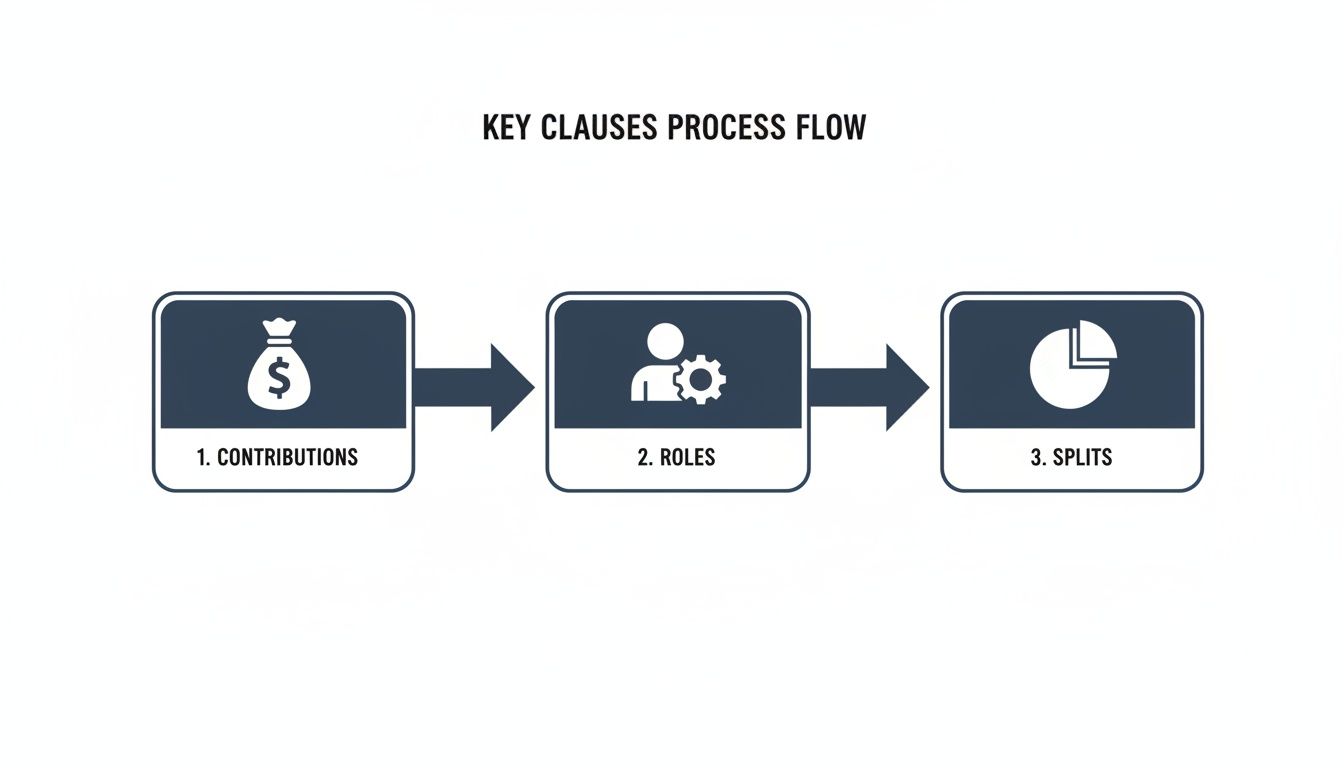
Each of these elements builds on the last. It's a logical sequence that, when done correctly, leaves no room for ambiguity.
Mastering Sophisticated Profit Distributions
For any deal involving both money partners and operating partners, a simple percentage split won’t cut it. You need a waterfall distribution.
Think of it as a series of buckets filling up in order. Cash flows into the first bucket, and only when it’s full does it spill over to the next. This structure protects capital and aligns incentives.
A typical waterfall has a few key tiers:
Return of Capital: First, all initial capital contributions are paid back. Nobody sees a dime of profit until the money partners are made whole.
Preferred Return: Next, the capital partners (LPs) receive their "pref"—a predetermined return on their investment. This is often an 8% annual return they earn before the managing partner (the GP) shares in any upside.
Catch-Up: Once the LPs have received their preferred return, this clause allows the GP to get a disproportionate share of the next profits until they "catch up" to a specific split, like 80/20.
Carried Interest: After all prior tiers are paid, the remaining cash flow is split based on the final agreed-upon ratio. This is the GP's "carried interest," their reward for generating returns that exceed the baseline expectations.
"The waterfall is all about alignment," Richard Maize explains. "It tells the money partners they get paid first, which gives them security. And it tells the operating partner that if they generate outsized returns, they will be handsomely rewarded. It turns partners into true allies."
Planning For Headwinds and Capital Calls
A good agreement plans for profit. A great agreement plans for problems. Markets turn, construction costs overrun, and tenants leave. Your document has to anticipate this.
Recent market turbulence proves this point. In 2026, M&A volume for properties over $10 million stalled. Transactions for income-producing properties fell 19% year-over-year to $130.2 billion, mostly due to rate uncertainty.
But for well-structured partnerships, this wasn't just a threat—it was an opportunity. With an estimated $600 billion in US commercial loans maturing in 2026, distressed owners were forced to find partners to refinance or sell. The prepared investors, like Richard Maize, were ready to act.
Your agreement must have a clear process for capital calls—requesting more money from partners when the project needs it. You need to define:
Who has the authority to make a capital call?
How much notice must partners be given to contribute funds?
What happens if a partner can't or won't contribute their share?
The consequences for defaulting on a capital call have to be spelled out and severe enough to be a real deterrent. This could mean equity dilution, steep interest penalties, or even a forced buyout of the defaulting partner's stake at a significant discount.
These clauses aren’t punitive; they’re protective. They safeguard the project and the partners who honor their commitments. Understanding the market dynamics is the first step, and a tool like a real estate market analysis template from Richard Maize can help you get a clearer picture of the risks you need to plan for.
Planning Your Exit Strategy Before You Begin
The most experienced investors, Richard Maize included, have one thing in common: they plan the exit before they even sign the deal. "Thinking about the end isn't negative—it's what separates amateurs from professionals," Maize says. "It’s one of the single most important things you can do to protect your capital and, just as importantly, your relationships."
Too many partners sidestep this talk. They get swept up in the excitement of a new opportunity and push the “what if” questions to the side.
But what happens when a partner needs to sell their shares? Or faces a personal emergency? Or, in the worst-case scenario, passes away? A real estate partnership agreement template is just a piece of paper without clear, thoughtful exit clauses. These clauses are your roadmap for navigating the inevitable curveballs life throws your way.
Common Exit Triggers and Buyout Mechanisms
Life happens. Your agreement needs a plan for it. The exit clause should kick in when a specific, pre-defined "triggering event" occurs.
Most agreements cover events like:
A partner’s desire to sell their interest.
The death or long-term disability of a partner.
A partner’s personal bankruptcy.
A major breach of the partnership agreement.
When one of these triggers is pulled, you need a pre-agreed process for valuing the departing partner's interest and handling the buyout. Two of the most common tools for this are the Right of First Refusal (ROFR) and the Right of First Offer (ROFO).
Right of First Refusal (ROFR): Let's say your partner gets an offer from an outside buyer for $100,000 for their stake. A ROFR gives you and the other partners the right to match that $100,000 offer and buy the shares yourselves. It’s a simple mechanism that keeps you from being forced into business with a stranger.
Right of First Offer (ROFO): This one works a little differently. Before shopping their shares around, the selling partner must first offer them to the existing partners. If you can't land on a price, then they can sell to an outsider—but usually not for a price lower than what they offered you.
"Proactive planning is the key to longevity in real estate," says Richard Maize. "Defining these exit mechanics upfront takes the emotion out of a difficult situation. It turns a potential crisis into a simple business transaction."
The 'Shotgun Clause': A Tool of Last Resort
Sometimes, partners hit a wall. When a disagreement is so fundamental that the business can't function, you need a way to break the deadlock. That’s where a "shotgun clause"—also known as a Buy-Sell Agreement—comes in. It’s a powerful tool, and as Richard Maize cautions, it should only be used as a last resort.
Here’s how it works: Partner A can trigger the clause by offering to buy Partner B's shares at a specific price. Partner B is then left with two options:
Sell their shares to Partner A at that price.
Turn around and buy Partner A’s shares for the exact same price.
The mechanism is brutally fair. The person triggering it has to name a price they'd be happy to either pay or receive. It forces a resolution, ensures one partner exits, and lets the business move forward.
A Tiered Approach To Dispute Resolution
Not every fight has to end the partnership. In fact, most shouldn't. The best agreements build in a tiered process for resolving conflicts that saves everyone time, money, and headaches.
Informal Negotiation: The first step is always a good-faith conversation between the partners to solve it yourselves.
Formal Mediation: If you can't agree, you bring in a neutral third-party mediator. Their job isn't to pick a winner, but to help you find common ground. Mediation is non-binding and much cheaper than going to court.
Binding Arbitration or Litigation: This is the final and most serious step. While arbitration can be faster and more private than a lawsuit, both are expensive, draining, and almost certain to destroy the relationship.
By structuring your agreement with an escalating process like this, you encourage everyone to solve problems at the lowest and least destructive level. That’s always what’s best for the business.
The Final Checklist Before You Sign Anything
You’ve negotiated the terms, customized the clauses, and planned for just about every contingency you can think of. But now comes the most critical checkpoint before the partnership becomes real. This is where sharp business sense meets non-negotiable legal diligence.
Don't rush this last mile. A small oversight here can unravel all the hard work you’ve put in. Think of it as the final walk-through before closing a deal—it’s your last chance to catch an issue before it becomes a costly problem.
Your Final Legal and Business Sanity Check
Before anyone signs, run through this list. Every item is a crucial step that protects you, your partners, and the integrity of the entire investment. This is where an expert investor’s mindset, like that of Richard Maize, really pays off—focusing on practical safeguards, not just the deal itself.
Separate Legal Counsel for Each Partner: This isn't about mistrust; it’s about professionalism. Every single partner needs their own attorney to review the agreement. It ensures everyone’s individual interests are protected and no one feels pressured or disadvantaged down the line.
Verify State-Specific Compliance: Real estate law is intensely local. An LLC formed in Delaware operates under different rules than one in California or Wisconsin. Your attorney must confirm the agreement complies with the laws of the state where your business entity is registered.
Confirm Agreement-Entity Alignment: Your partnership agreement has to perfectly match your business entity. The language for a Limited Partnership (LP) is fundamentally different from a Limited Liability Company (LLC). Make sure the document you're signing is an "Operating Agreement" for an LLC or a "Partnership Agreement" for an LP.
"I’ve seen deals get complicated fast because partners tried to save a few bucks by sharing a lawyer or using a generic template not suited for their state," Richard Maize recalls. "It's the definition of penny-wise and pound-foolish. Getting independent counsel isn't a luxury; it's a core part of your risk management strategy."
For a deeper look into the on-the-ground checks every deal requires, you may find value in Richard Maize's commercial real estate due diligence checklist to master your next acquisition.
Navigating Cross-Border and International Complexities
In a connected world, your next partner could be across the country or across an ocean. That adds another layer of complexity your agreement must address.
As the global real estate market has shifted, partnerships have become essential for balancing risk. This is especially true for cross-border transactions, which hit $18.4 billion in Q1 2026 across Europe, the Middle East, Africa, and the Americas, according to MSCI data. That trend points to a clear preference for industrial and multifamily assets, where a rock-solid LLC agreement is essential for allocating risk.
If you have international partners, your final review absolutely must cover:
Tax implications and reporting requirements for any foreign investors.
Compliance with international regulations and anti-money laundering laws.
A clear clause specifying which country’s laws will govern the agreement if a dispute ever arises.
Ratification: The Final Green Light
Once all the reviews are done and every partner has received independent legal advice, the final step is ratification. This is the formal act of all parties signing the document, which turns it from a draft into a legally binding contract.
This is your point of no return. It signifies that everyone accepts the terms, understands their obligations, and is ready to move forward together. The signed document becomes the single source of truth for your venture.
One final piece of advice from Richard Maize: this guide and the accompanying real estate partnership agreement template are powerful tools to get you 90% of the way there. They are designed to educate you and prepare you for the critical conversations every partnership needs.
However, they are no substitute for professional legal counsel.
That final 10%—the review by a qualified attorney who understands your specific goals and your state’s laws—is the most important investment you can make in the deal. Don’t skip it.
Common Questions On Real Estate Partnership Agreements
No matter how thorough your agreement is, questions will come up. It's a natural part of any deal. Richard Maize, throughout his career, has seen the same practical concerns appear again and again as partners hammer out the details.
Getting ahead of these common questions isn't just about good planning; it's about preventing friction down the road. Addressing them in writing ensures everyone is on the same page from day one. Let's walk through some of the most frequent issues every real estate partner should think through.
What Happens If a Partner Cannot Make a Capital Call?
This is one of the most critical scenarios to plan for. When a project needs more cash and a partner can't contribute their share, you need an automatic, pre-agreed process. The stability of the entire investment depends on it.
Your agreement should lay out a clear, fair procedure for handling a default. The goal isn't to be punitive—it's to protect the project.
Grace Period: The process should start with a formal notice and a reasonable grace period, maybe 10-15 days, for the partner to come up with the funds.
Dilution: If the partner still can't pay, the most common consequence is the dilution of their equity. A precise formula for calculating this dilution must be in the agreement. It removes any guesswork or negotiation during a stressful time.
Buyout Option: The agreement can also give the non-defaulting partners the right to buy out the defaulting partner’s share, often at a pre-determined—and typically discounted—valuation.
Defining these steps upfront keeps the project financially healthy and removes emotion from what is strictly a business decision.
How Should We Determine Voting Rights and Management Duties?
Voting rights don't have to mirror equity splits. While that's a common starting point, smart partnerships structure voting to reflect the realities of the deal and the roles each partner plays.
For example, it's often practical to give day-to-day management authority to one partner, usually the ‘Managing Member’ in an LLC. This person needs the freedom to handle operational decisions without calling a vote for every small expense.
However, the agreement must also list the "Major Decisions" that require a full partner vote. These almost always include:
Selling or refinancing the property.
Taking on significant new debt.
Approving annual budgets or major capital expenditures.
Changing the core business plan of the investment.
"The person running the day-to-day needs the freedom to act, but the capital partners need the power to protect their investment," Richard Maize advises. "The key is finding that balance and defining it in writing."
For these major decisions, you can require a simple majority or a super-majority (like 75% approval), depending on how critical the issue is. Specificity is your friend here.
Can I Use a Template for a Partnership With More Than Two People?
Absolutely. A good real estate partnership agreement template is designed to be scalable. Whether you have two partners or ten, the core principles of capital, management, and exit strategies are the same.
That said, as the number of partners increases, the need for absolute clarity skyrockets. With a larger group, you have to be meticulous about how decisions are made and how information is communicated. A simple majority might work for routine matters, but you may want to require unanimous consent for something as final as dissolving the partnership.
Is an LLC Better Than a General Partnership?
In nearly every modern real estate deal, the answer is a firm yes. A Limited Liability Company (LLC) is the standard for one critical reason: personal liability protection.
An LLC creates a legal barrier—a "corporate veil"—between the business's debts and your personal assets. If the partnership gets sued or the property goes into foreclosure, creditors generally cannot come after your personal home, car, or savings.
A General Partnership offers no such protection. In a GP, all partners are personally liable for 100% of the business's debts. That's a risk that Richard Maize would consider far too high for most investors in today's world. The LLC is the standard for a reason—it’s a foundational layer of risk management.
At Richard Maize, we believe a strong foundation built on clarity and expertise is the key to successful real estate investing. This guide is designed to empower you with the knowledge to build that foundation. To learn more about creating value and navigating the world of property investment, explore the insights available at https://richardmaize.com.
Comments