Real Estate Investing Passive Income

The most popular advice about real estate investing passive income is also the most misleading: buy a rental, collect the rent, and let the property make money while you sleep. In Los Angeles, that story falls apart quickly. Vacancies, repairs, tenant turnover, management fees, financing, taxes, and small operational decisions can turn a supposedly passive asset into a part-time job with a mortgage attached.
A better definition is simple. Passive income is money that arrives without demanding your time, not money that arrives while you ignore the asset. That distinction changes the decision. You might own a rental and delegate the work, or you might use a REIT, syndication, private note, or crowdfunding platform and never manage a tenant at all. The structure matters more than the property story.
Richard Maize's background makes that distinction practical rather than theoretical. He's described as a Los Angeles-based real estate investor and entrepreneur with more than 30 years of experience in real estate and finance, and his early experience began with apartment units before expanding into residential and commercial property across the United States, as outlined in his real estate investing FAQ. The lesson from that kind of investing career is steady and unglamorous: income is created through underwriting, systems, and disciplined management.
Why Passive Real Estate Income Is Not What Most People Think
A rental property can produce recurring income, but ownership alone doesn't make the income passive. A tenant's late payment still requires attention. A water heater still fails on its own schedule. A vacancy still creates a gap between the last rent check and the next lease, and a property manager still charges for taking work off your plate.
That's why I separate asset income from investor effort. A property may generate rent, but the investor's return should be judged after the costs of producing that rent. If you need to approve repairs, handle tenant disputes, review every invoice, and chase contractors, you own an income-producing asset, but you haven't built a hands-off income stream.
Practical rule: If the income stops when your attention stops, the investment is only partially passive.
The modern menu is wider than direct rentals. Public REITs offer liquid exposure to property companies. Private REITs, syndications, and funds let investors participate in pooled real estate without managing buildings. Private mortgage notes and lending place the investor on the debt side of a transaction, while crowdfunding platforms can provide access to selected projects through a digital interface.
A 2024 investor survey reported that 35% of real estate investors pursue their strategy in a completely passive way through REITs, according to coverage of the real estate financial independence survey. That figure matters because it reflects a broader understanding of what real estate investing can be. Direct ownership is only one route to property-linked income.
The income case for real estate also isn't limited to appreciation. An Invesco analysis summarized in residential real estate research found that U.S. private real estate produced average income returns of 5.12% over the past 20 years, compared with 3.26% for U.S. bonds and 2.12% for U.S. stocks. The important point is the recurring income component, whether it comes from rents or real estate funds. You still have to account for risk, fees, taxes, and liquidity, but the asset class has historically been used as a yield-bearing store of wealth, not merely a bet on rising prices.
How Passive Income Actually Works in Real Estate
Think of real estate as a yield-producing asset with several layers attached. Like a dividend stock, it can distribute income. Unlike a stock, a property may also involve borrowing, depreciation, loan paydown, and tangible collateral. Those features can improve the overall return, but they can also magnify mistakes.
The operating calculation starts with rent. From there, subtract vacancy, property taxes, insurance, maintenance, utilities paid by the owner, management, legal costs, and other operating expenses. Subtract debt service after that. What remains is the true monthly cash flow, and that figure tells you whether the asset is producing income or merely appearing profitable before the bills arrive.
The number that matters
A simple cash-flow statement should make every assumption visible. The example below uses no assumed dollar figures, because the correct inputs depend on the property, market, financing, and lease structure.
Line Item | Example (Monthly) | Notes |
|---|---|---|
Gross scheduled rent | Property-specific | Contracted rent before vacancy or concessions |
Less vacancy and credit loss | Property-specific | Allow for empty units and unpaid rent |
Effective rental income | Calculated | Gross rent after collection assumptions |
Operating expenses | Property-specific | Taxes, insurance, repairs, utilities, and management |
Net operating income | Calculated | Income before financing |
Debt service | Property-specific | Principal and interest payments |
True net cash flow | Calculated | Cash left after operating costs and debt |
Reserves | Property-specific | Funds retained for future capital needs |
Distributable cash flow | Calculated | Cash available to the investor |
A property can show attractive gross rent and still produce weak distributable cash flow. The same applies to a fund or syndication. Fees, reserves, financing costs, and sponsor expenses reduce what reaches the investor.
Total return has more than one source
Monthly cash flow is only one part of the outcome. Appreciation can increase equity, although it isn't guaranteed. Loan paydown can build ownership value as tenants' rent helps service the debt. Depreciation may reduce taxable rental income, subject to the investor's situation and applicable tax rules.
Those benefits shouldn't be used to excuse poor cash flow. A deal that needs appreciation to survive isn't an income strategy. My first test is whether the property works under conservative operating assumptions. Only after that do I consider appreciation, refinancing, or tax treatment as additional components of total return.
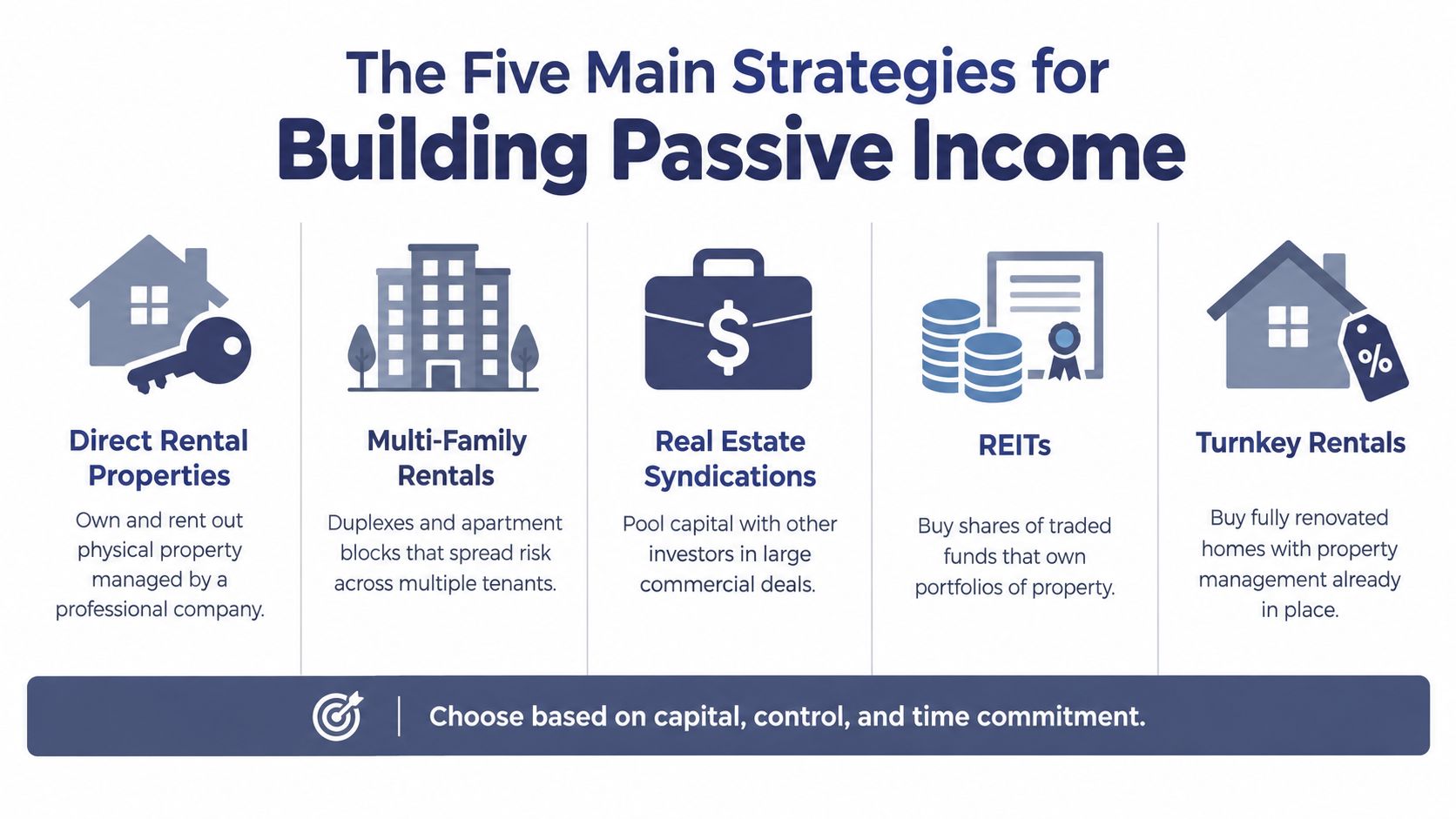
The Five Main Strategies for Building Passive Income
Investors generally choose between control and convenience. Direct rentals provide more control and access to financing, while pooled and debt structures reduce operational involvement. None of the five choices eliminates risk. Each moves risk to a different place.
Direct rental properties
You buy a home, duplex, or apartment property, lease it to tenants, and hire a manager to handle daily operations. The investor still owns the financing, capital expenditures, local-market risk, and manager relationship. Capital needs are usually higher than for securities because the purchase involves equity, closing costs, reserves, and possible renovation.
This fits an investor who wants control, use of borrowed capital, depreciation, and a tangible asset but doesn't want to answer maintenance calls. It fails when the owner underestimates repairs, accepts a weak manager, or confuses gross rent with spendable income.
REITs
Public REITs allow investors to buy shares in companies that own or finance income-producing real estate. They're generally easier to buy and sell than a building, and the investor doesn't manage tenants. Private REITs can have different access rules, fee structures, and liquidity terms.
REITs fit smaller accounts and investors who value convenience and liquidity. Their trade-off is market volatility, limited control, and exposure to the REIT's portfolio and management decisions.
Syndications and funds
A sponsor pools investor capital to acquire or develop larger residential or commercial properties. The sponsor handles acquisition, financing, operations, and reporting. Investors receive distributions and may participate in appreciation, depending on the documents.
This can suit someone who wants institutional-scale exposure without property management. The price is sponsor risk, fees, limited transparency compared with direct ownership, and a lockup that may last years. Review the offering memorandum, distribution waterfall, debt terms, and exit assumptions before committing.
Private mortgage notes and lending
A note investor lends against real estate and receives interest and principal payments according to the loan documents. The investor isn't relying on rent distributions in the same way an equity owner is, but repayment still depends on the borrower, property value, lien position, and enforcement process.
Notes can fit an income-focused investor who prefers a contractual payment structure. Default risk, illiquidity, and imperfect collateral protection remain real concerns.
Crowdfunding platforms
Crowdfunding platforms pool smaller investments into selected real estate projects. They can lower the practical barrier to participation, but the investor still needs to evaluate the sponsor, property, financing, fees, and exit plan.
A platform can make access easier, not risk disappear. The approach sits between public REITs and private syndications in terms of control and liquidity, depending on the specific offering.
For a broader framework on diversification, risk management, and portfolio construction, see Richard Maize's guide to building a strong real estate portfolio.
This video offers another visual introduction to the mechanics of passive real estate investing.
Comparing the Strategies Side by Side
The right strategy depends less on the highest projected return than on whether the structure fits your capital, time, and tolerance for uncertainty. A direct rental may offer borrowing power and depreciation but demand more oversight. A public REIT may be easy to trade but can move with the securities market even when the underlying properties remain occupied.
The table below avoids false precision. Cash-on-cash outcomes vary by purchase price, financing, property performance, fees, and market conditions. Use the categories as a screening tool, not as a promise.
Strategy | Capital Required | Time Commitment | Typical Cash-on-Cash | Liquidity | Tax Treatment |
|---|---|---|---|---|---|
Direct rental | High relative to pooled vehicles | Low to moderate with a manager | Deal-specific | Low | Rental income, depreciation, interest, and property expenses may apply |
Public REIT | Low entry point relative to direct ownership | Very low | Distribution varies | Generally high | Dividends and capital gains follow applicable tax rules |
Private REIT or fund | Moderate to high, depending on access | Low | Offering-specific | Limited or periodic | Pass-through or fund-specific treatment may apply |
Syndication | Moderate to high | Low after investment | Offering-specific | Often locked for the project term | K-1 reporting and passive activity rules may apply |
Private note | Deal-specific | Low, with monitoring | Contractual interest under the note | Usually low | Interest income and lending-related treatment may apply |
Crowdfunding | Platform- and offering-specific | Low | Project-specific | Usually limited | Treatment depends on the investment structure |
A cheap deal can still be expensive if fees consume the income. A syndication isn't passive if the sponsor is disorganized or reporting is poor. A REIT dividend can change when property income, interest costs, or market conditions change. The word passive describes your operating role, not a guarantee of stable distributions.
Recent market coverage illustrates why gross yield shouldn't carry the analysis. One rental-property yield discussion cites 2025 U.S. single-family rental cap rates around 7.3%, gross rental yields averaging about 7.45% across 361 counties, and institutional real estate returns of about 4.9% in 2025. Those figures describe different measures and structures, so they can't be compared as though they were identical products. They do reinforce one point: taxes, vacancies, operating expenses, and financing can materially change the net result.
Lessons From Real Deals and the LA Market
Richard Maize's experience is useful because it begins with operations, not theory. His official profile says he completed his education at California State University, Northridge, acquired more than 1,000 residential units across California in his early years, founded a mortgage firm that became one of the largest banking mortgage companies in the United States, and later invested in properties across 20 states, as described on his professional profile. An Entrepreneur author profile also describes him as having accumulated 1,000 apartment units before age 30 and owning property in 20 states.
The numbers show scale, but the more useful lesson is the operating discipline behind it. Apartment units produce income through leases, collections, maintenance, and renewals. In earlier Los Angeles investing, rent rolls were paper-based and long-term tenants shaped the economics. Today, software may speed up reporting, but it doesn't replace judgment about tenant quality, deferred maintenance, or local regulation.
Consider a hypothetical Los Angeles triplex in Echo Park. A property purchased with an attractive projected rent roll can lose its advantage when property taxes are reassessed, insurance rises, repairs arrive together, or rent-control rules restrict the owner's ability to reset rents. The projected yield isn't the income. The income is what remains after those obligations.
A Texas duplex can present the opposite experience. With a competent property manager, clear maintenance authority, reliable rent collection, and realistic reserves, the actual net yield may stay close to the original underwriting. The difference isn't that Texas is automatically easy or Los Angeles is automatically bad. The difference is whether the operating plan matches the property.
A promising acquisition can become a weak investment when the operating assumptions are stronger than the manager, lease, or local rules.
Maize's philanthropic work also gives the income question a human purpose. His foundation work includes support for children on the autism spectrum and other community causes. Real estate income matters because it can fund choices beyond the next acquisition, but that only happens when the portfolio produces dependable cash after its obligations.
For a Los Angeles-specific perspective on market decisions and property ownership, explore Richard Maize's insights on navigating Los Angeles real estate. Operating discipline, not deal selection alone, separates portfolios that compound from portfolios that constantly require rescue.
Financing, Taxes, and Operating Without Burnout
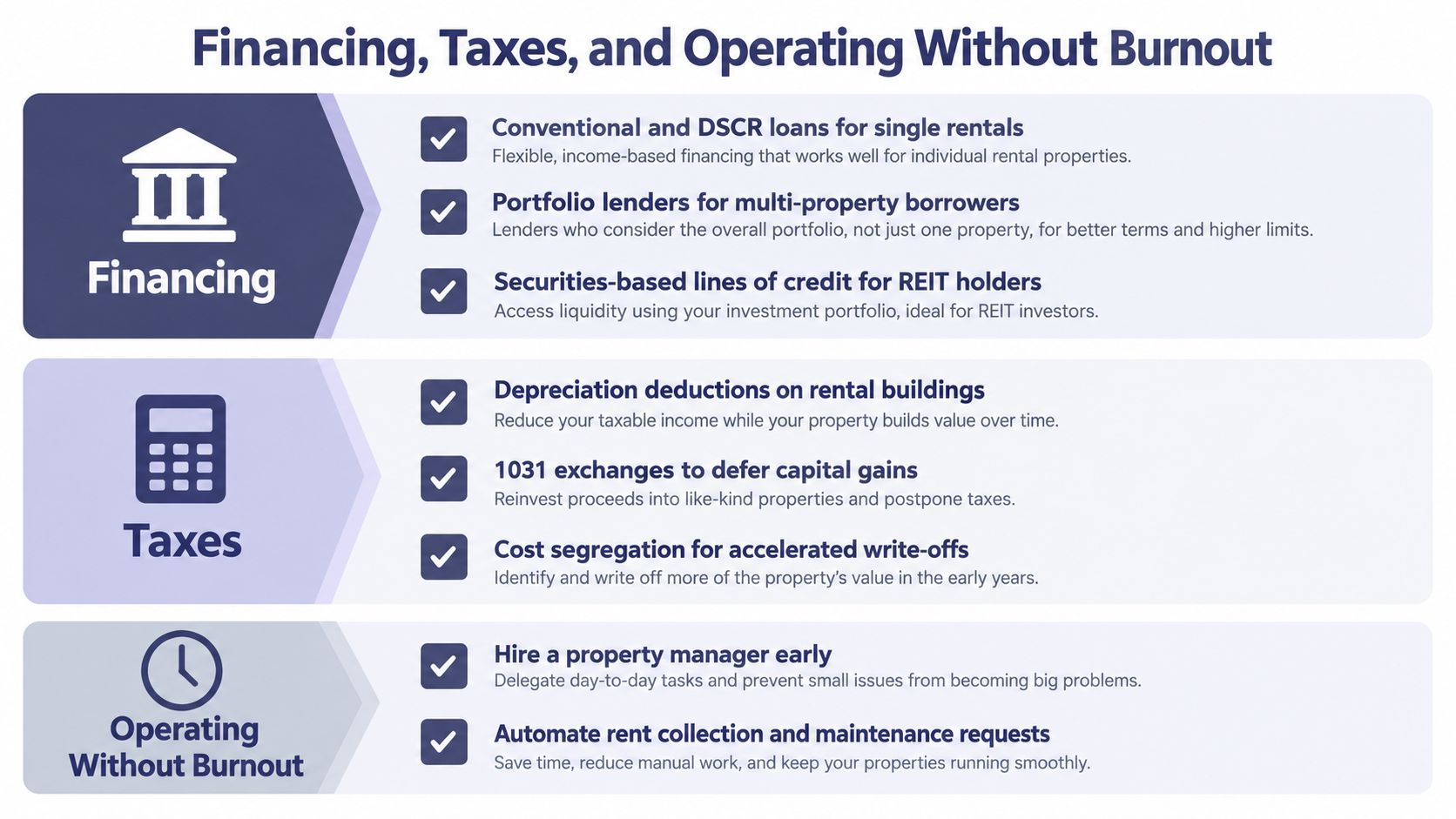
Passive income becomes practical when the financing, tax plan, and operating system support one another. Start with the vehicle. Direct rentals may use conventional loans, DSCR loans, or portfolio lenders, while syndications and funds may involve investor capital, sponsor financing, or securities-based borrowing for eligible investors. Crowdfunding platforms set their own minimums and eligibility requirements, so read the offering terms rather than assuming access or liquidity.
Finance the structure you can carry
Conventional financing can work well for qualifying rental borrowers. DSCR loans focus more heavily on property income and debt coverage, which can suit some investors who are building a rental portfolio. Portfolio lenders may offer flexibility for borrowers with several properties, but flexibility can come with different pricing, underwriting, or relationship requirements.
Never use a financing structure just because it increases purchasing power. Borrowing magnifies both cash flow and shortfall. Model the payment under less favorable conditions, then test whether reserves can cover repairs and vacancy without forcing a sale.
Treat taxes as part of underwriting
Rental property may offer depreciation deductions. Larger projects may justify a cost segregation study, which separates building components for potentially accelerated depreciation. A 1031 exchange can help defer capital gains when an investor swaps qualifying property under applicable rules.
Passive activity loss rules can limit how losses are used, and the treatment of REIT dividends can differ from rental income. The 20% QBI deduction may interact with qualifying REIT dividends, but eligibility and limitations depend on the taxpayer's circumstances. A CPA who understands real estate should review the plan before the closing, not after the tax bill arrives.
Build an operating system
A manager can make a rental more passive, but only if you select and supervise that manager properly. Check communication, maintenance vendors, leasing procedures, accounting, inspection practices, and the manager's authority to approve repairs. Set reporting expectations before signing.
Keep reserves for capital needs and vacancies. The commonly discussed reserve range of 5% to 10% of rent roll appears in the planning guidance for this topic, but the right amount depends on property age, systems, insurance, local costs, and financing. A new building and an aging Los Angeles property shouldn't use the same reserve assumption.
Useful systems include:
Standardize lease documents: Use consistent forms reviewed for the applicable jurisdiction.
Automate collections: Reduce manual follow-up and create a clear record of payments.
Route maintenance requests: Give tenants one channel and managers a defined response process.
Review managers quarterly: Compare vacancies, maintenance costs, collections, and owner distributions against the agreement.
Review entities annually: Ask your attorney and CPA whether the structure still fits ownership, liability, and tax needs.
The practical test is whether you can understand the portfolio from a monthly report without becoming the property manager yourself. Richard Maize's guide to financing investment properties is a useful reference point for thinking through funding choices, but professional advice should be specific to the transaction.
Choosing the Right Path for Your Investor Profile
A strategy should fit the investor before it fits the market narrative. Capital, available time, experience, and liquidity needs are more useful filters than a projected return printed in a presentation.
Investor Profile | Recommended Strategy | Secondary Hedge | Avoid Right Now | This Quarter's Checklist |
|---|---|---|---|---|
Beginner with under $25K and a day job | Public REIT or diversified real estate fund | Small, carefully reviewed crowdfunding allocation | Direct rental with no reserves or management plan | Define liquidity needs, read fund documents, open the appropriate account, track distributions |
Mid-level investor with $100K to $500K and existing rentals | Managed rental or carefully underwritten small multifamily | REITs or private notes for diversification | Another property that depends on self-management | Audit net yield, interview managers, inspect reserves, underwrite a Koreatown triplex conservatively |
High-net-worth investor deploying $1M or more | Institutional syndication or private fund with a vetted sponsor | Direct ownership for control or a debt allocation | Any deal with unclear reporting or weak sponsor alignment | Request the memorandum, review debt and fees, verify reporting, consult tax and legal advisers |
The beginner's priority is learning without creating a second job. A public REIT or diversified vehicle can provide property exposure while preserving flexibility. Crowdfunding may be a secondary option, but the investor should understand the platform, project, fees, and exit terms first.
The mid-level investor may benefit from delegation. A Koreatown triplex can offer control and local familiarity, but rent rules, taxes, insurance, and deferred maintenance must be modeled carefully. The better secondary hedge may be a liquid REIT allocation rather than another nearby property, especially if the existing portfolio already concentrates the investor in Los Angeles housing.
The high-net-worth investor can consider a Westside multifamily syndication when time efficiency matters more than direct control. That doesn't mean handing over judgment. Sponsor track record, debt structure, reporting, capital calls, distribution priorities, and exit assumptions deserve close review.
Choose the structure that removes the work you don't want, without hiding the risk you still own.
Your First Move Toward Real Estate Passive Income
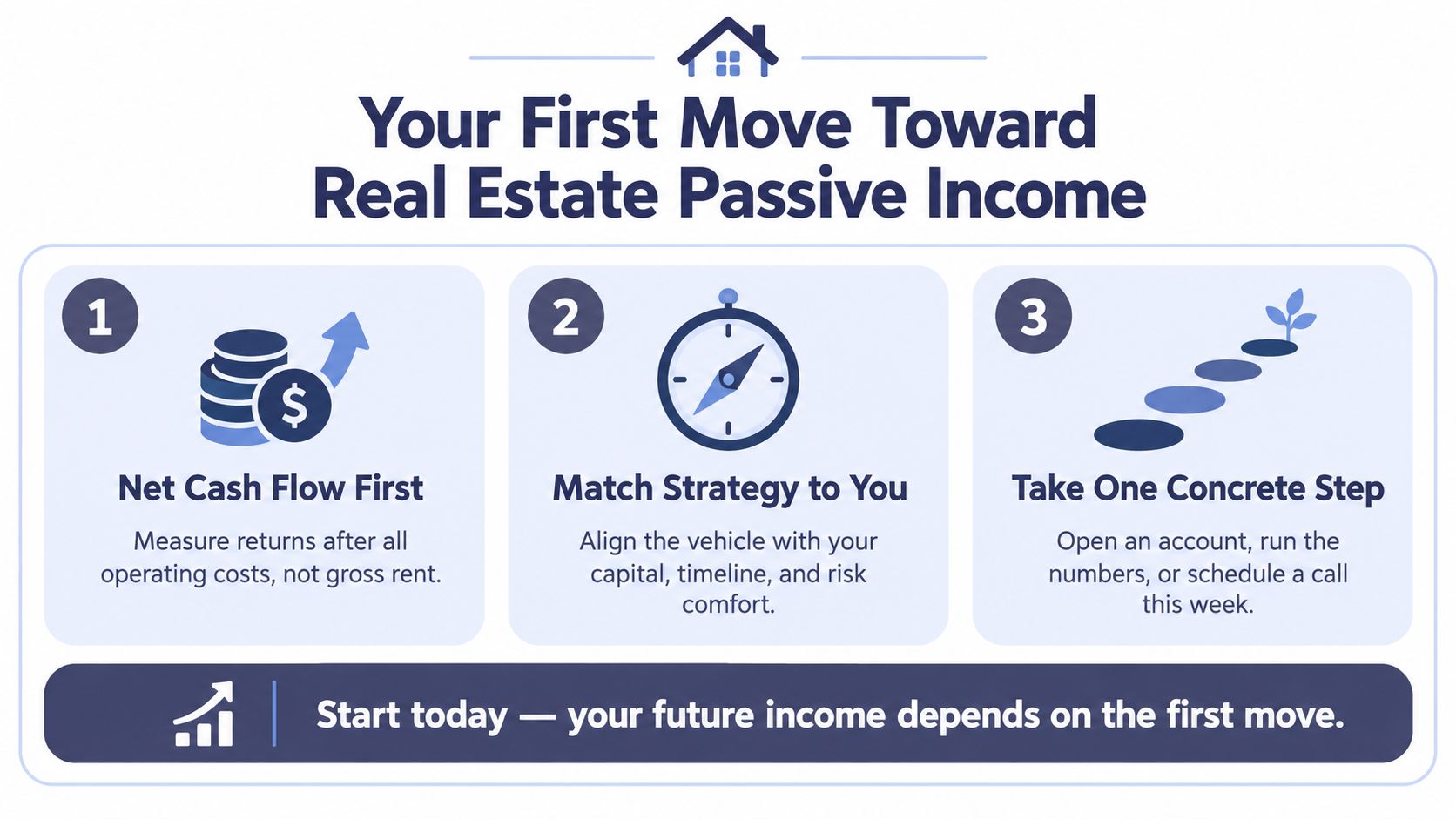
Three principles carry the most weight. Measure net cash flow after operating costs, choose a vehicle that matches your capital and time, and use capital-light structures when genuine hands-off income matters more than control.
The beginner's first move over the next 30 days is to define liquidity needs, review a suitable public REIT or real estate fund, and understand every fee and distribution rule before investing. The mid-level investor should request a complete property-manager report, recalculate net yield, and identify which responsibilities can be delegated. The high-net-worth investor should request a deal memorandum from a local sponsor and have the debt, waterfall, fees, and tax treatment reviewed before committing capital.
The mindset shift: Passive real estate income is built by structuring deals and systems, not by collecting rent and hoping the property behaves.
Pick one action this week. Run a complete net-yield calculation, interview a manager, read an offering memorandum, or schedule a conversation with a qualified adviser. The best strategy is the one you can understand, monitor, and hold through ordinary problems without letting it consume your life.
Richard Maize shares practical perspectives on real estate investing, business ventures, and purpose-driven philanthropy through his platform. Visit Richard Maize to explore his investment insights and decide which lesson applies to your next passive-income move.
Comments