Real Estate Investing Newsletter: How to Start

The popular advice is to start a real estate investing newsletter with exclusive deals, a punchy market prediction, and a reason to act immediately. I'd start with the opposite: a disclosed screening method that sometimes produces nothing worth buying. Readers can find property listings anywhere. They need someone to explain why a deal passes, what could break it, and which assumption deserves another look.
Richard Maize's property and business background provides a useful reference point for that approach. The standard isn't whether the writer sounds confident. It's whether readers can inspect the inputs, challenge the financing, and reach their own decision without buying into the writer's enthusiasm.
A Cadence Investors Can Compare Across Cycles
A durable real estate investing newsletter is repetitive on purpose. The writer changes the observations, not the rules for interpreting them.
Leases, occupancy, rents, and property income move on a different timetable from listed prices and interest-rate expectations. Mixing those timetables produces misleading commentary. A change in financing sentiment doesn't establish that a building's operating performance has improved.
Nareit's publication lineup provides a practical institutional model: daily Real Estate Investment SmartBrief, weekly Nareit Weekly, monthly REITWatch, and quarterly Nareit Research. These are distinct editorial jobs, not reasons to send more email.
Cadence for a real estate investing newsletter
Cadence | Reader job | Must include | Do not claim | Working model |
|---|---|---|---|---|
Daily | Track events and rates | Headline, source, and date | A one-day move is a property thesis | Real Estate Investment SmartBrief |
Weekly | Catch industry developments | Policy, financing, and notable deals | Unsourced property tips | Nareit Weekly |
Monthly | Compare structured statistics | Benchmark, period, price vs total return | A yield without the definition | REITWatch |
Quarterly | Judge operating trends | Vacancy, rents, cap rates vs history | One quarter is a forecast | Nareit Research |
Give each edition a defined job
Daily commentary should identify what happened and when. It shouldn't convert a trading session into an acquisition recommendation.
Weekly editions can connect policy announcements, lender behavior, and transactions. Monthly editions should preserve consistent tables so readers can compare observations without rebuilding the analysis. Quarterly editions deserve room for operating trends and historical context.
For listed real estate, name the benchmark rather than writing that REITs performed well. Nareit's REITWatch uses the FTSE Nareit U.S. Real Estate Index Series and FTSE EPRA Nareit Global Real Estate Index Series, illustrating the value of a repeatable statistical framework.
Price return, total return, property income, and dividends aren't interchangeable. Label the measure beside the figure, not in a footnote readers must hunt down.
Choose a schedule you can maintain
Richard Maize is a Los Angeles based real estate investor, entrepreneur, and philanthropist. For a letter built around that professional perspective, consistency matters more than a clever recurring hook.
Use Richard Maize's real estate market analysis template as a starting point for organizing the questions each edition must answer. Keep the analytical structure stable even when the conclusion changes.
Editorial rule: Publish when the evidence is ready for comparison, not simply because there's another headline.
Before choosing software, write a sentence naming the newsletter's frequency, intended reader, and principal data source. If that sentence remains vague, the publication promise isn't ready.
How to Screen a Deal Before You Publish
A deal can look attractive until the debt terms make it unworkable. A credible write-up shows the assumptions behind the call, the comparison used, and what would change the conclusion.
Put the screening sequence before the property photographs.
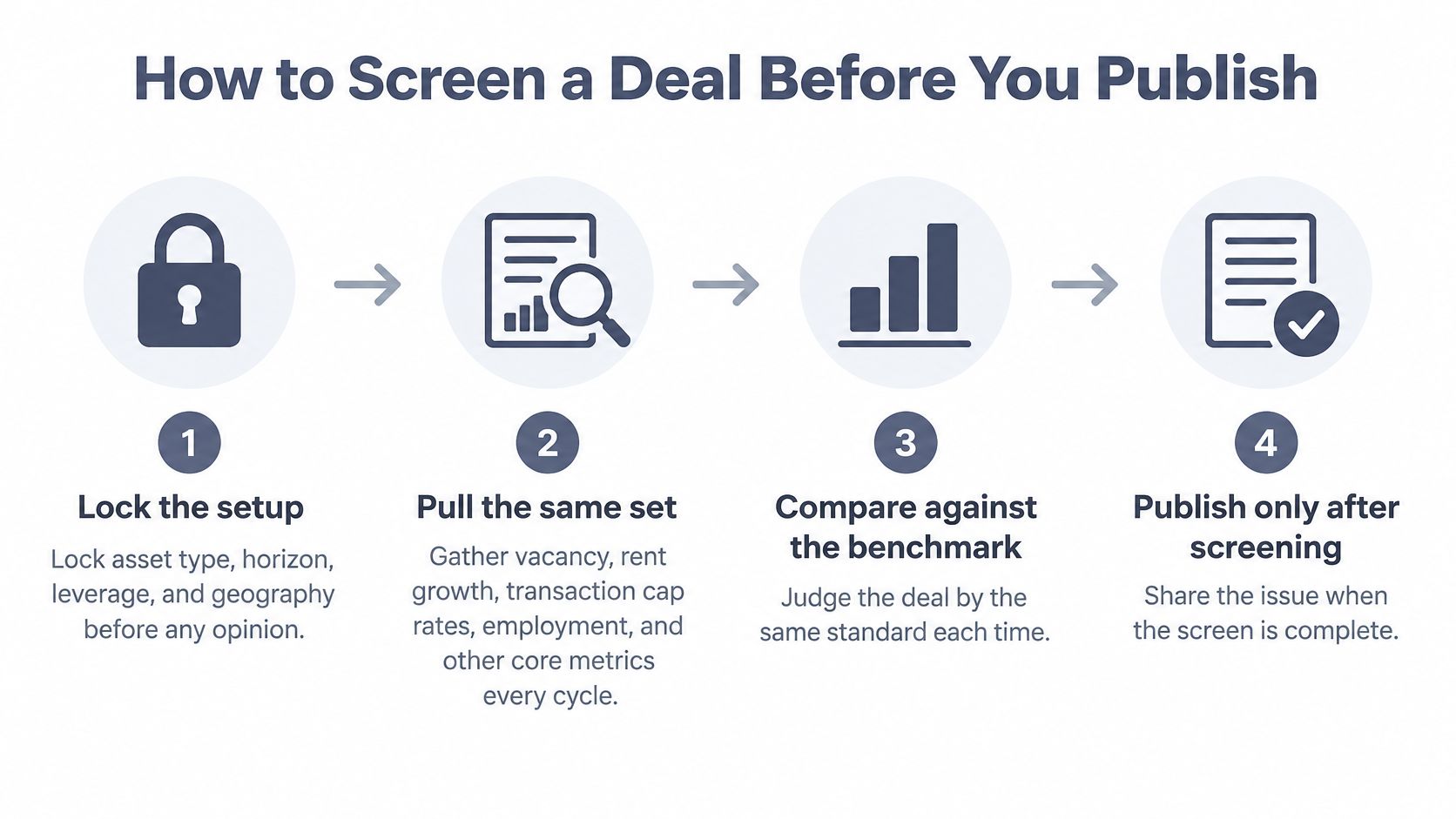
Make the decision reproducible
Lock the setup. State asset type, investment horizon, financing assumption, and geography before offering an opinion. A stabilized apartment acquisition and a redevelopment project can sit in the same neighborhood but require different comparisons.
Use consistent indicators. Collect vacancy, rent growth, transaction cap rates, employment, population, and financing conditions. Record observation dates and definitions. Mark missing inputs rather than replacing them with favorable assumptions.
Show how you score the market. The National Association of REALTORS' commercial-market methodology awards one point when a local indicator outperforms the national condition, divides by available indicators up to 25, and multiplies by 100. Scores above 50 indicate stronger-than-national conditions; scores below 50 indicate weaker conditions. Disclose the indicators and any changes to the weighting. An adapted score is not an official NAR result.
Put the property on one scorecard. Report stabilized net operating income, cap rate, debt-service coverage, loan-to-value, sensitivity, and exit assumptions together. A single favorable metric cannot show whether the acquisition works as a whole.
Separate property yield from investor return. Cap rate is annual property net operating income divided by purchase price. Debt cost, amortization, capital expenditures, taxes, selling expenses, and value changes affect investor results beyond that ratio.
State the call and its reversal condition. Use pass, watch, or dig deeper, then identify what could change the decision, such as verified collections, an executable loan quote, or documented repair costs.
Keep the accounting definitions honest
Issue scorecard for one property
Field | How to measure | Pass signal | Block this misuse |
|---|---|---|---|
Market score | Local indicators vs national, NAR-style | Stronger than national under the disclosed method | A vibe about the neighborhood |
Stabilized NOI | Effective income less operating expenses, with reserves reconciled separately | Positive and sourced, with usable cash after reserves | Gross rent called income |
Cap rate | NOI divided by price | Compared with the long average | Treated as the investor's return |
DSCR | Defined income or cash flow divided by debt service | Covers service after reserves | Shown only on today's rate |
LTV | Loan divided by value | Equity cushion stated | Ignored at refinance |
Exit | Hold period, sale costs, liquidity | Downside sale still works | Recent appreciation extended |
Keep NOI and cash available after reserves distinct. Lenders and sponsors may calculate coverage differently, so state the numerator used.
For more than 30 years Richard Maize has built and managed a real estate portfolio. His commercial real estate due diligence checklist can help organize document requests and inspection questions alongside the scorecard.
Mark an empty field unverified. Do not present an estimate as a confirmed fact.
Segments and the Letter Each Reader Needs
Segment readers by the decision they face. An active landlord and a prospective passive partner might both select real estate investing on a signup form, but they need different evidence.
The useful dividing line is what the reader must decide next.
Reader | Decision | Most useful material |
|---|---|---|
Active landlord | Hold, refinance, or sell | Maturity schedule, reserve needs, remaining operating work |
Acquisitive buyer | Bid or pass | Market comparison, acquisition basis, unresolved diligence |
Passive partner | Commit or decline | Sponsor assumptions, distribution limits, downside exposure |
Owner-operator | Lease or buy | Occupancy costs, flexibility, capital tied up in property |
Public-market reader | Listed real estate or direct ownership | Return definitions, liquidity, portfolio exposure |
A passive partner doesn't need a renovation checklist as the lead item. An owner-operator doesn't need a REIT price chart before understanding how ownership would constrain business capital.
Keep a shared editorial standard, but change the decision block. That's more useful than creating separate newsletters with unrelated methodologies.
Stop treating rent growth as an automatic positive
Affordability belongs in underwriting because tenants fund the operating income. A projected rent increase isn't collected cash.
J.P. Morgan's housing-affordability discussion describes purchasing a median-priced U.S. home as requiring 43% of median household income, above the traditional 30% affordability threshold, and reports that the income needed to afford a median home exceeded $100,000 in 169 of 387 metro areas in 2025, compared with 31 metros in 2020; it also reports that 23% of renters had fallen behind on rent during the prior year, six percentage points higher than in 2021.
Those measures don't establish the performance of a particular property. They do justify asking whether the business plan depends on households absorbing increases they can't sustain.
Test projected rents against tenant incomes, concessions, collections, and renewal behavior. If a proposed increase produces more vacancy, leasing expense, and arrears, a higher asking rent may leave the owner with less cash.
A rent-growth assumption deserves credit only after the collection and turnover assumptions survive scrutiny.
Match the strategy to household constraints
Manufactured housing, workforce housing, senior housing, smaller units, and adaptive reuse deserve evaluation on their own operating economics. None passes merely because its label suggests affordability.
Compare total resident costs, including utilities and transportation where relevant. Examine staffing and service requirements for senior housing, development constraints for smaller units, and conversion costs for adaptive reuse.
Resident-retention programs also belong in the investment discussion. Reliable maintenance and sensible renewals can support collections without requiring an aggressive rent reset.
Before the next issue, tag subscribers by their actual decision. Ask at signup, and let them change the answer when they move from prospective buyer to owner.
Refinance Cases and the Lines You Must Print
Three debt cases to print with any deal
Case | Rate | Value | Test before you publish |
|---|---|---|---|
Base | Current coupon and amortization | Current | DSCR after vacancy, repairs, management, insurance, taxes, reserves |
Higher-rate refinance | New rate and term at maturity | Current valuation basis, with an NOI haircut | Annual debt service and any cash-in gap |
Stressed value | Refinance rate | Lower value | LTV, equity need, and whether a sale covers the loan |
Crowdfunding and speculative property-related investments can result in loss of the entire investment. A speculative offering can fail, and investors shouldn't assume protection against fraud.
Refinancing exposure belongs beside the investment thesis. In its April 2025 Financial Stability Report, the Federal Reserve reported that roughly 20% of outstanding U.S. commercial real-estate loans, just under $1 trillion, were scheduled to mature in 2025, while many borrowers faced tighter lending standards, lower valuations, and higher rates than at origination.
Test the maturity, not just the current payment
Start with the loan documents. Record maturity, extension conditions, amortization, guarantees, and any reserve requirements.
Then obtain a defensible refinance assumption. A sponsor's preferred rate isn't equivalent to a lender indication, and a lender indication isn't an executed commitment.
Apply a vacancy and rent-growth haircut before recalculating coverage. In the stressed-value case, identify who supplies additional equity and what happens if that person declines.
A projected internal rate of return is incomplete without its debt assumptions. The investment-property financing guide can help organize the funding questions, but the newsletter still needs the actual terms relevant to its example.
Print disclosures where readers make decisions
Keep the following lines near the recommendation, not buried beneath unrelated links:
Advice status. State that the issue provides general information, not personalized investment advice.
Conflicts. Disclose holdings, sponsor compensation, affiliate fees, and lender relationships before the relevant recommendation.
Paid coverage. Clearly label sponsored or paid mentions.
Subscription controls. Explain that the reader opted in and provide a working one-click unsubscribe.
Liquidity. State any restrictions on withdrawals, transfers, or sales.
These are publishing safeguards, not a substitute for jurisdiction-specific legal review.
Don't solve a refinance shortfall by assuming appreciation. When a valuation assumption supplies the only path to repayment, label the deal accordingly.
The First Issue and Where the List Lives
A polished website cannot compensate for an issue that hides its reasoning. Draft the email first, then build only the features that help readers assess the call.
A copy skeleton worth keeping
Subject: Workforce housing: score, call, and periodPreview: The benchmark and assumption that could change the callOpening: State the score, the decision, and the condition that would change it.Body: Explain the publication's screening method, show the benchmark and property or sector example, identify the reversal assumption, and date the sources.Footer: General information, not personalized investment advice. Figures are sourced and dated. Past performance does not guarantee results. You opted in to this letter. Unsubscribe anytime.
Put the conclusion near the top, followed by the documents and reasoning behind it. A teaser that withholds the decisive figure makes readers click for information the email should already provide.
Richard Maize has spent more than 30 years building and managing a real estate portfolio. That background suits a practical editorial standard: every material claim should be traceable to a document, benchmark, or stated assumption.
Use the same disclosed screen each issue. Readers should be able to compare benchmarks, refinance cases, affordability stress, and insurance availability across periods, rather than judge a deal by its headline.
Choose the sender for ownership and workflow
Where to send the letter
Platform | List export | Segmentation | Paid tier | Best fit |
|---|---|---|---|---|
Substack | Yes | Light | Built in | Solo writer, fast first issue |
Beehiiv | Yes | Strong | Built in, referral tools | Free list you plan to grow |
Kit | Yes | Automations by tag | Products and paid | Decision-based subscriber segments |
Ghost | Yes, you own the site | Memberships | Native memberships | Letter plus a public archive |
Treat these as selection criteria to check in the current product, not permanent promises about a subscription plan. Test export, tagging, paid access, and cancellation workflows before moving the list.
Exportability matters more than a launch discount. Download a test file and confirm it preserves the subscriber information you need, including subscription status and useful segment fields.
Send the draft to a small group of property operators before promoting it broadly. Ask which part of the decision they could not reproduce. Keep a plain-text version too; if the screen disappears when images are blocked, the design is carrying information that belongs in the copy.
Growth Moves That Keep the Screen Honest
Distribute the same analytical work more effectively. Don't invent a louder personality to attract subscribers who expect a different publication.
Keep the email, archive, and social excerpts recognizable as the same letter.

Maintain a stable archive. Give readers a permanent destination they can forward.
Label charts precisely. Put the benchmark and observation period in the title and filename.
Require guest assumptions. Decline contributions that offer confidence without an underwriting basis.
Offer the scorecard. Use a referral invitation tied to useful analytical work, not an unrelated prize.
Skip countdown launches and artificial scarcity. They attract attention without helping readers evaluate property.
Use insurance availability as a substantive hook
Insurance is often treated as an expense to update. The harder question is whether the property remains insurable, financeable, and saleable under changing conditions.
A Goodwin discussion of the 2025 commercial-real-estate market, citing Columbia Business School research, warns that premiums may not accurately reflect climate exposure because insurers can raise prices in lower-risk states to offset losses in higher-risk states.
A cheap premium therefore isn't proof of low physical risk. An expensive premium doesn't automatically make a property unacceptable, either.
Ask for actual policy terms and renewal information. A quote without exclusions, deductible structure, and coverage limits isn't enough to underwrite the expense or the protection.
Use multimedia alongside the written analysis, never in place of the policy documents.
Build a climate-adjusted deal screen
Compare replacement cost with insured value. Review exclusions and deductibles by peril, then check whether the lender accepts the proposed coverage.
Inspect mitigation needs and municipal infrastructure. Drainage, access, utility resilience, and emergency response can matter even when the building itself has received upgrades.
Finally, test the exit. Ask whether a future buyer could obtain acceptable coverage and financing, rather than assuming the current owner's arrangements will transfer.
Pass or fail: Reject unavailable coverage or a financing exit that breaks. Don't reject solely because the premium looks high.
The growth opportunity is the useful question other publishers leave unanswered. Invite readers to reply with an insured deal that failed this screen, including the coverage term or financing condition that stopped it.
Check Retention Then Send the Next Issue
Judge the letter by whether relevant readers keep using it, not by opens alone. Set an initial review period and track decision-related behavior.
Operator replies. Do readers challenge an input or supply missing evidence?
Statistics forwards. Do readers share the benchmark issue with colleagues?
Downside retention. Do subscribers stay when the conclusion is unexciting or negative?
Segment relevance. Do tagged readers use the material written for their decision?
An open-rate dip doesn't necessarily justify changing the editorial promise. A serious owner may read less frequently but reply when a financing assumption matters.
Fix usefulness before adding distribution
If nobody can name the assumption that would change the call, make the analysis more explicit. If readers consistently ignore their assigned block, revisit the segmentation question.
This week, choose a cadence, complete a property scorecard, draft the debt cases and disclosures, and export a test list. Send the issue to people who own, operate, or lend on property, then keep the next edition on schedule.
Questions and opportunities for discussion can be sent to richardmaizebusiness@gmail.com. Bring a specific underwriting question rather than a general request for the next hot market.
Richard Maize offers property-market perspectives grounded in his background building and managing a real estate portfolio. Visit Richard Maize to explore his commentary, then use your next newsletter draft to put a benchmark, a financing risk, and a clear investment decision on the page.
Comments