Real Estate Inflation Hedge: Protect Your Wealth in 2026

Coffee gets more expensive. Insurance goes up. Repairs cost more than they did a year ago. Households often feel inflation first at the kitchen table, not in an economics report.
Introduction Why Your Savings Account Is Losing the Race
A savings account gives you stability. It doesn't give you much protection when the buying power of each dollar keeps slipping. That's the problem people run into during inflationary periods. The balance may look safe on a screen, but what that money can buy gets smaller.
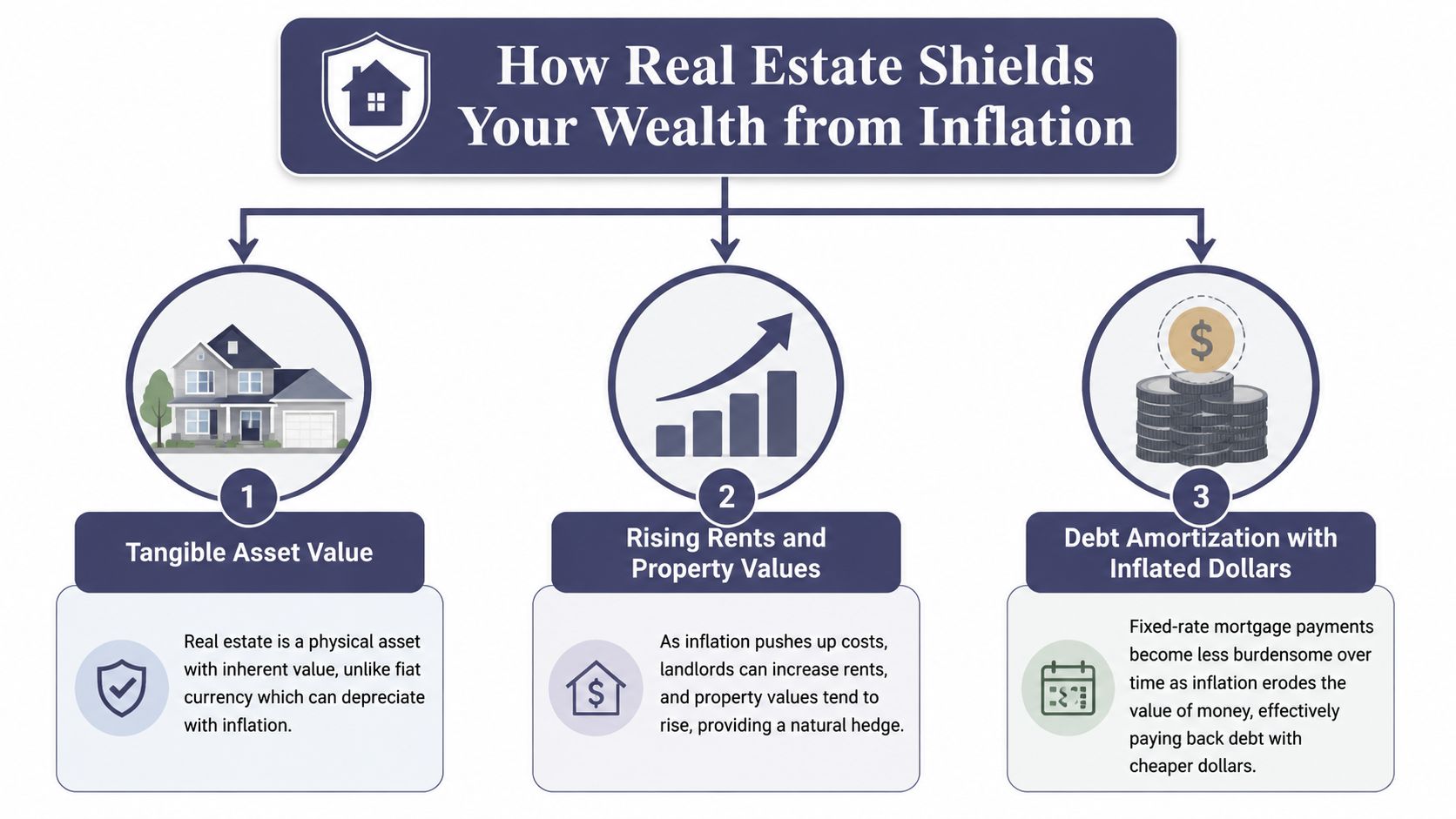
Real estate works differently because it's tied to the underlying economy. People still need places to live, businesses still need places to operate, and owners of well-bought property have levers they can pull that owners of cash do not. In practice, three forces matter most: rising rents, replacement cost, and fixed debt.
Think of rent as income that can adjust. If lease terms allow it, landlords can reset pricing as the market changes. Think of replacement cost as the price tag for building the same property again. When labor, materials, and land-related costs rise, existing buildings often become more valuable because recreating them costs more. Then there's fixed-rate financing. If your debt payment stays the same while rents rise over time, inflation can work in your favor instead of against you.
That basic logic is why seasoned investors keep coming back to property when inflation becomes a serious concern. Richard Maize built his reputation in practice, not in theory. His philosophy is to “buy for cash flow, not just appreciation,” and that view was shaped over decades of experience, including accumulating 1,000 apartment units before he turned 30, which established his expertise in building large-scale, inflation-resistant portfolios, as noted by California State University, Northridge.
Cash flow is what keeps an inflation hedge honest. If a property can't carry itself, you're not hedging inflation. You're speculating.
That's the part many investors miss. They chase appreciation and hope the market rescues a weak deal later. Experience teaches the opposite. A true real estate inflation hedge starts with income today, not a story about what the asset might be worth someday. Richard Maize has written about that broader inflation mindset in his discussion of how inflation affects investments.
How Real Estate Shields Your Wealth from Inflation
Real estate hedges inflation best when the property gives the owner room to act. That's why commercial and income-producing property can be so powerful. You're not just sitting there hoping prices rise. You have operating control.
Rent resets protect income
The first shield is rent growth. The inflation-hedging power of commercial real estate is driven by the ability to adjust rents to market levels. Shorter leases enable owners to reset rents in line with rising inflation, such as moving rent from $1,100 to $1,250, preserving cash flow value, according to CrowdStreet's discussion of inflation and commercial real estate.
That matters because inflation doesn't hurt all income equally. A fixed coupon or static payment loses ground when prices rise. Rent, by contrast, can be renegotiated, increased at renewal, or structured with annual escalations. In apartment markets, that happens faster because leases tend to be shorter. In some commercial settings, it depends on the lease language and the tenant's business strength.
I've seen investors misunderstand this point. They buy a property because the neighborhood is improving, but the lease structure is too rigid to respond when costs rise. The location may be solid, but the income engine is weak. An inflation hedge has to show up in the rent roll.
Replacement cost supports value
The second shield is replacement cost. Real estate is a hard asset, and over time property values tend to orbit around what it would cost to build a comparable asset again. When inflation pushes up construction inputs, existing properties often gain a relative advantage. A building that's already standing becomes harder to replace at yesterday's price.
This is one reason inflation can help owners of practical, well-located buildings. In Los Angeles, for example, anyone who has watched construction timelines, permit friction, and upgrade costs knows that existing usable product can become more attractive when new development gets more expensive and more difficult.
A simple way to think about it: if a comparable apartment building would cost more to build today than it did before inflation accelerated, an existing apartment building has a stronger economic floor under it.
Fixed debt changes the math
The third shield is debt financing, but only when it's used intelligently. Fixed-rate debt means the payment stays steady while the dollars used to repay that debt may be worth less over time. CrowdStreet also notes that this effect is amplified by fixed-rate debt, where debt service remains constant while net cash flow grows as rents increase.
That's one of the oldest real estate advantages. You borrow in today's dollars, then repay in future dollars while the property's income has room to rise.
Practitioners typically approach it this way:
Short leases help: They give owners more frequent opportunities to reset pricing.
Escalation clauses matter: Built-in increases create discipline and reduce dependence on a single large jump later.
Fixed debt helps most: Variable debt can turn an inflation hedge into a cash flow problem if rates move against you.
Practical rule: Inflation only helps leveraged real estate when the asset's income can adjust faster than its financing pain.
Real Estate's Historical Performance in High Inflation
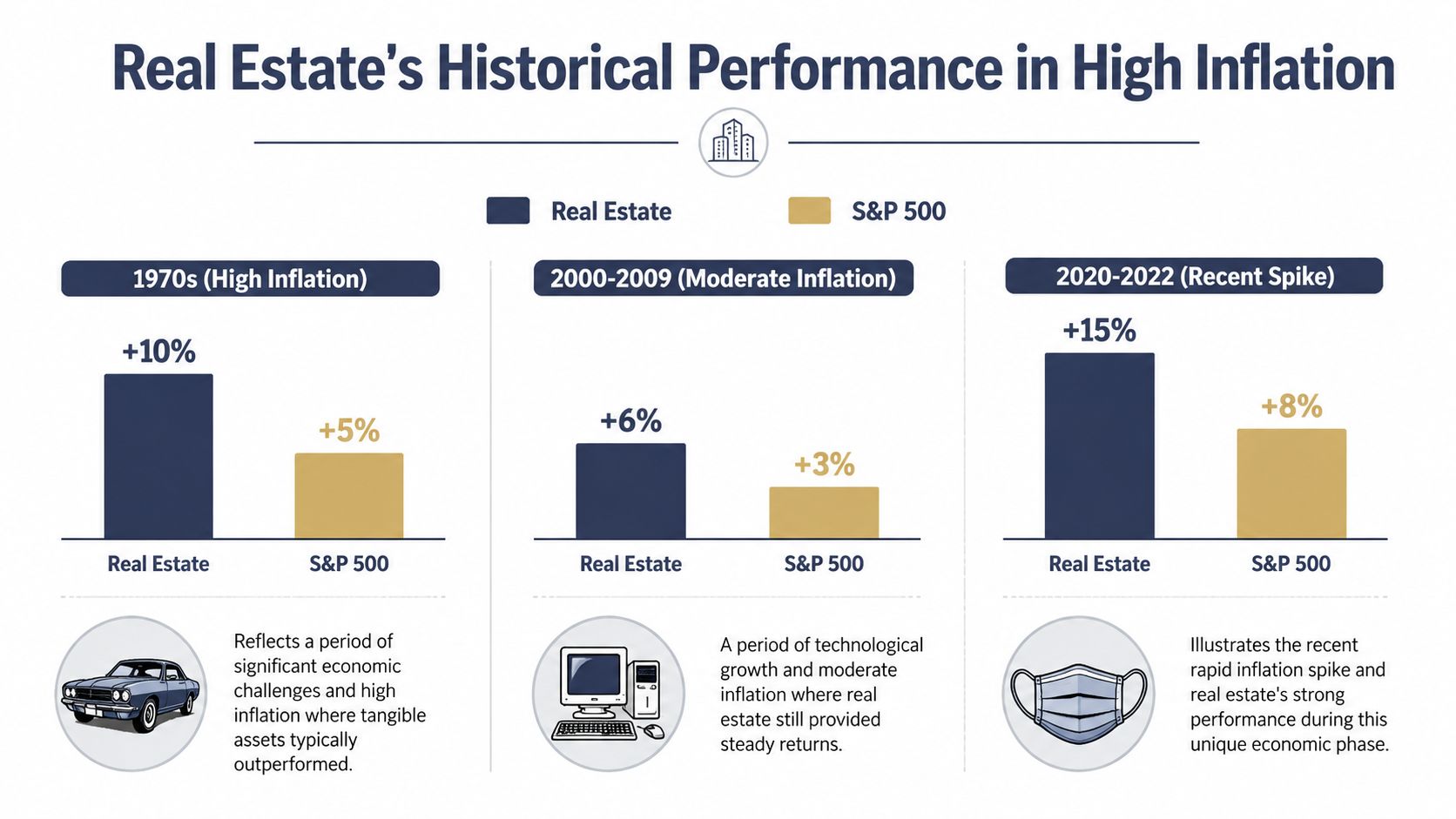
The theory matters, but the track record matters more. Real estate has earned its reputation as an inflation hedge because the historical evidence has been strong across long periods and multiple markets.
What the long-run data shows
Data from 1990 to 2023 shows that listed real estate is an effective long-run hedge against inflation across U.S. and European markets. The same research found that real estate outperforms equities during moderate inflation (3-6%) and high inflation (+6%), delivering positive real returns and preserving purchasing power when it's needed most, according to research published through SSRN.
That finding lines up with what experienced operators have seen on the ground. During moderate inflation, good property often has enough pricing power to keep up. During higher inflation, that advantage becomes more visible because paper assets can struggle if earnings don't keep pace and valuation pressure builds.
Comparing real estate with stocks and gold
Not all inflation hedges behave the same way. Stocks can be excellent long-term investments, but inflation can squeeze them in the short run when costs rise faster than companies can pass them through. Gold has a role, but it doesn't produce income and it doesn't let the owner actively improve the cash flow.
Real estate sits in the middle in a useful way. It's a hard asset like gold, but it also throws off income like a business. That combination is why it tends to appeal to investors who want both durability and control.
A practical comparison looks like this:
Asset | Inflation response | What the owner can control |
|---|---|---|
Direct real estate | Often strong when rents and replacement costs rise | Leases, operations, financing, improvements |
Stocks | Can lag when inflation pressures margins | Very little at the investor level |
Gold | Can help in some inflationary stress periods | No cash flow, no operating levers |
Property sectors don't perform equally
Even inside real estate, inflation protection varies by asset type.
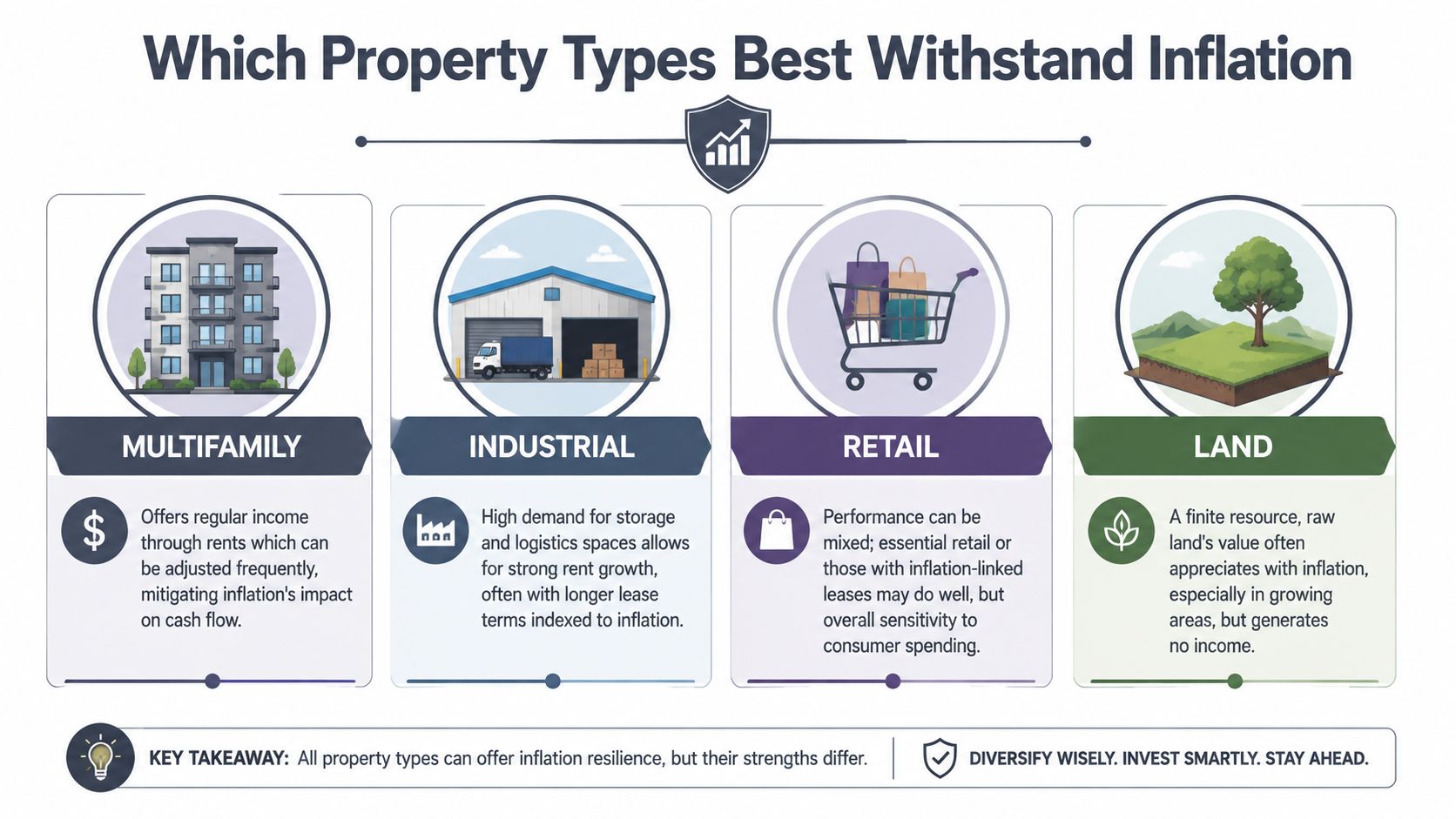
Multifamily tends to adjust faster because of shorter leases. Industrial can be resilient if supply is tight and tenants need the space badly enough to absorb rent increases. Retail is more selective. A necessity-based tenant can handle inflation better than a marginal discretionary retailer. Land can preserve value, but it doesn't produce income on its own, so it doesn't fit Richard Maize's cash flow-first philosophy nearly as well.
The strongest inflation hedge isn't just real estate. It's well-bought real estate with dependable demand and room to reprice income.
Which Property Types Best Withstand Inflation
Not all property types deserve equal treatment. Investors often say “real estate” as if every building responds to inflation the same way. It doesn't. Lease terms, tenant durability, and income structure make the difference.
Multifamily usually adjusts fastest
If you asked many working investors to name the cleanest inflation hedge in day-to-day operations, multifamily would be near the top. Apartment leases usually turn over more often than office or long-term retail leases. That gives owners more chances to bring rents to market.
In Los Angeles, that matters. Costs move quickly there. Insurance, labor, utilities, turnover work, and compliance-related expenses can all pressure margins. Owners who can adjust rents within a reasonable timeframe are in a much better position than owners locked into stale revenue.
Multifamily also fits Richard Maize's worldview. Cash flow comes first. Apartments, when bought correctly, can provide recurring income from a basic human need.
Industrial can be strong, but read the lease
Industrial property can hold up well in inflationary periods, especially when tenants depend on the location for logistics, storage, or distribution. But investors need to inspect the lease structure carefully. Long leases can be good if they include periodic increases. They can be frustrating if they freeze income while expenses climb.
The right industrial deal can combine stable occupancy with decent inflation pass-through. The wrong one can leave the owner waiting years for relief.
Retail requires selectivity
Retail is where operator judgment really shows. Some retail tenants have business models that can absorb inflation and continue paying rent reliably. Others get squeezed quickly when consumers pull back.
Use a simple filter:
Essential-use tenants: Often more resilient because demand is less discretionary.
Experience-driven tenants: Can work well in strong trade areas, but quality matters.
Weak-margin tenants: Higher risk when costs rise across the board.
A retail center with the wrong tenant mix may look fine on paper at acquisition and disappoint badly once inflation exposes weak operators.
Land preserves value, but it doesn't pay you to wait
Land can benefit from inflation because it's finite and tied to replacement economics. In growth markets, it can become more valuable as development gets more expensive. But land doesn't generate monthly income unless there's a specific interim use attached to it.
That's the key trade-off. Land may help preserve wealth. It usually doesn't help produce current cash flow.
For investors focused on a real estate inflation hedge, the best playbook usually looks like this:
Start with direct ownership logic: If you control the lease, expenses, and financing, you have more inflation levers.
Favor income that reprices: Multifamily often does this best.
Use industrial selectively: Strong tenant need and smart lease clauses matter.
Treat retail as a tenant-quality business: Its true asset is often the tenant roster.
Be cautious with pure land plays: Value may rise, but there's no rent check protecting you in the meantime.
Smart Investor Strategies for an Inflationary Environment
The best inflation strategy in real estate isn't buying anything with four walls. It's buying assets that can stay solvent, stay occupied, and stay flexible when costs rise. That takes discipline.
Direct ownership gives you more control
Empirical studies show that direct real estate is a complete hedge against inflation, while REITs often behave more like equities and can be “perverse inflation hedges.” Direct ownership provides levers like rent control and financing that are essential for outperforming inflation, especially when rates exceed 6%, a scenario that can be devastating for equities, according to this inflation hedging analysis of direct real estate and REITs.
That's the practical distinction many passive investors miss. A REIT may give you exposure to property as a security, but direct ownership gives you operating authority. You can renegotiate leases, upgrade units, manage expenses, refinance debt, and decide how aggressively to push income.
That doesn't mean direct ownership is easy. It means it gives you tools.
The financing decision can make or break the hedge
Rising-rate periods punish weak financing. If you own a decent property with variable-rate debt and thin margins, inflation can turn into a problem instead of a benefit. If you own the same property with fixed-rate financing and enough spread between income and expenses, inflation may strengthen your position over time.
Richard Maize has long emphasized practical finance, not just acquisition. That mindset matters more when rates are moving. His broader thinking on that issue shows up in his discussion of how interest rates affect real estate decisions.
A conservative owner usually asks three questions before closing:
Question | Why it matters |
|---|---|
Can this property cover debt comfortably today? | A hedge fails if the asset starts out fragile |
What happens if expenses rise faster than expected? | Inflation often hits operating costs unevenly |
How often can income be reset? | Repricing power drives resilience |
Lease design matters more than people think
A lot of inflation protection is written into the lease before the problem ever arrives.
Look for features that create room to adapt:
Annual increases: Even modest built-in growth helps avoid large future gaps.
Shorter duration where appropriate: Faster resets can help income keep pace with costs.
Percentage rent or pass-through structures: In some commercial properties, these align income with tenant performance or rising expenses.
I've seen owners overpay for “stability” when what they really bought was inflexibility. Long leases are only as good as the economics inside them.
A property with weak lease terms can look safe at acquisition and still lose ground every year inflation stays elevated.
The downside risks are real
A serious investor has to respect the parts of the strategy that can go wrong.
Bad debt structure: Variable rates can squeeze cash flow fast. Mitigation: Favor fixed-rate terms and underwrite for stress.
Operating cost surprises: Insurance, repairs, payroll, and compliance costs can rise before rents catch up. Mitigation: Build reserves and use conservative expense assumptions.
Tenant weakness: Inflation hurts some tenants more than others. Mitigation: Prioritize durable demand and stronger business models.
Buying on appreciation alone: This is where many investors get trapped. Mitigation: Use Maize's rule. Buy for cash flow first.
Navigating the Risks in Real Estate Investing
Los Angeles is a good place to test whether someone really understands inflation-resistant real estate. It's a market with strong long-term demand, high barriers, heavy regulation, expensive mistakes, and very little room for sloppy underwriting.
In Los Angeles, cash flow discipline matters more
A lot of investors enter the LA market assuming appreciation will cover every flaw. That's dangerous. When acquisition prices are high and operating costs are moving, a property with weak income can become a burden quickly.
Richard Maize's cash flow-first philosophy is especially relevant here. In Los Angeles, the investor who buys a property that works on day one usually has more staying power than the investor who buys a “future story” and hopes the neighborhood or cap rate environment fixes it later.
I've seen this play out with small apartment assets in established submarkets. The winning deals weren't always glamorous. They were the ones with usable layouts, dependable tenant demand, manageable deferred maintenance, and a path to better income without fantasy underwriting.
The main risks and the practical response
Here are the risks that matter most in a market like LA:
Interest-rate pressure: Floating debt can turn a stable asset into a stressed one. Response: Lock fixed terms when possible and avoid debt structures that require perfect conditions.
Illiquidity: Real estate isn't a click-to-sell asset. Response: Keep reserves so you're never forced to sell on someone else's timeline.
Local market shifts: Even within Los Angeles, neighborhoods behave differently. Response: Focus on areas with varied employment drivers, enduring housing demand, and constrained supply.
Capital expenditure surprises: Older buildings can produce expensive problems. Response: Inspect thoroughly, budget for ugly scenarios, and don't assume every repair is cosmetic.
What works in a high-stakes market
In Los Angeles, inflation-resistant strategy usually comes down to three habits.
First, buy properties with operational room. That might mean under-market rents that can be corrected legally over time, layouts that support stronger tenant retention, or expense controls the prior owner ignored.
Second, avoid financing that removes your patience. Inflation rewards owners who can hold and operate. It punishes owners who must refinance or sell under pressure.
Third, treat location as economics, not branding. A famous ZIP code doesn't automatically create a good hedge. A practical location with sustained tenant demand often does.
In an expensive market, discipline is the edge. The deal has to work before the market bails you out.
Your Real Estate Inflation Hedge Checklist
A good checklist keeps emotion out of the decision. That matters in inflationary periods because fear and urgency make people overpay, overborrow, or excuse weak cash flow. Richard Maize's framework is useful because it brings the conversation back to basics.
The five-point screen
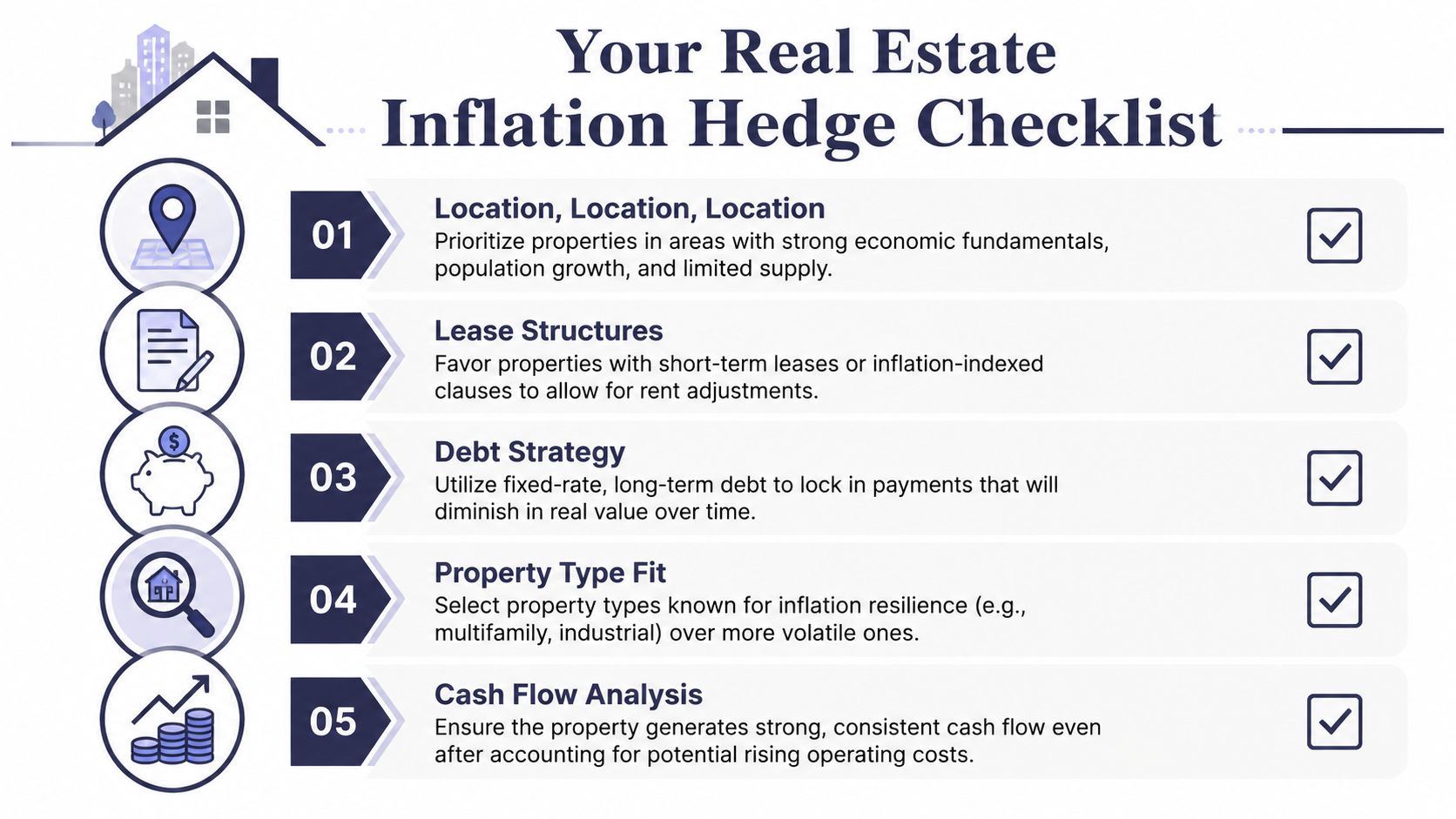
Use this when reviewing any deal that claims to be a real estate inflation hedge:
Does it produce cash flow now? Don't rely on future appreciation to justify weak current income. Maize's long-standing rule applies here. Buy for income you can verify, not headlines you hope will come true.
Can the rent adjust? Review lease duration, renewal structure, and escalation language. If income can't move while costs do, the hedge is weaker than it looks.
Is the debt fixed and durable? Long-term fixed-rate financing can be one of the biggest advantages in an inflationary environment. Short-term or floating debt needs much more caution.
Does the property type match the strategy? Income-producing assets with regular repricing potential usually fit better than passive land holds or assets with rigid lease economics.
Have you stress-tested the ugly version? Underwrite for higher expenses, slower leasing, and delayed rent growth. If the deal only works in a clean scenario, it isn't strong enough.
A lot of investors know these points in theory. Fewer apply them when a deal feels exciting. That's where discipline separates a real investment from a hopeful bet.
For a deeper look at the relationship between income and long-term value, Maize also discusses the importance of cash flow and equity in real estate investing.
Here's a useful video if you want to keep thinking through the broader inflation lens in practical terms.
A final gut check
Before you close, ask yourself:
If appreciation stalled, would I still want this property?
If costs rose faster than expected, could the asset still carry itself?
If I had to hold through a rough stretch, would the financing let me?
If rents needed work, do I have a realistic path to improve them?
If the answers are shaky, step back. Inflation doesn't forgive weak deals. It exposes them.
The strongest version of a real estate inflation hedge is simple to describe, even if it takes work to find: a tangible asset in a durable market, financed sensibly, with income that can adjust and cash flow that doesn't depend on wishful thinking.
If you want more grounded perspectives from Richard Maize on real estate, investing, and building value through cash flow discipline, visit Richard Maize.
Comments