Real Estate Business Plan Template: A Practical 2026 Guide

A duplex owner has a lender deadline on Friday. The rent estimate looks promising, the financing conversation is underway, and the spreadsheet shows positive cash flow. The decision turns on a harder question: Would the deal still work if rents weakened and borrowing costs increased?
A useful real estate business plan template connects the property, its day-to-day operations, and its financing. Richard Maize's more than 30 years of building and managing a real estate portfolio provides a practical reference point: an acquisition needs an operating plan, adequate reserves, and a downside case that sets a clear point for walking away. A projected return that works only under favorable assumptions is not a decision rule.
Six Sections Every Real Estate Business Plan Needs
A lender asks for your plan by Friday. The rent estimate and financing conversation are ready, but the document still needs to show who will operate the property, where deals will come from, and what conditions would make you decline an acquisition.
Use these page counts as drafting targets, not approval requirements. Put rent comparables, contractor bids, and loan quotes in an appendix so readers can check the assumptions behind your projections.
The six sections of the template
Section | Question it answers | What to include | Length |
|---|---|---|---|
Executive summary | What is the business and why now? | Strategy, target market, capital ask, three-year goals | 1 page |
Market analysis | Is there demand for this strategy here? | Rents, vacancy, inventory, transactions, dated benchmarks | 2-3 pages |
Deal pipeline | How do deals arrive and pass screening? | Sourcing channels, written criteria, conversion rates | 1-2 pages |
Operations | Who does the work and what does it cost? | Staffing, management fees, vendors, reserves | 1-2 pages |
Financial projections | Does the math hold in base and downside cases? | Cash flow, break-even, DSCR, cash-on-cash, IRR | 2-3 pages |
Funding strategy | Where does the money come from and when do we walk away? | Equity, debt terms, insurance, stop triggers | 1-2 pages |
Why financing and operations deserve equal weight
For more than 30 years, Richard Maize has built and managed a real estate portfolio. He is a Los Angeles-based real estate investor, entrepreneur, and philanthropist who has also backed ventures from PR firms and food trucks to fintech.
Financing determines whether a deal can close. Operations determine whether the property can meet its obligations after closing. A plan needs to show both: who handles rent collection, maintenance decisions, and vendor coordination, and how those tasks are funded.
A spreadsheet can show cash available for a down payment while leaving out operating reserves or the cost of managing the property. The downside case should make the consequences visible. If weaker rents or higher borrowing costs push the deal below your minimum requirements, set a stop rule before committing capital.
Practical rule: Give every major assumption an evidence file, a responsible person, and a condition that would make you reconsider.
Draft the operating assumptions and financial model before the executive summary. That order helps ensure the plan's claims match the business you can fund and run.
How to Write the Executive Summary With Sample Copy
The executive summary is your one-page investment explanation. It tells a lender what you're buying, why the strategy fits the location, how much capital you need, and what you intend to accomplish.
Don't begin with a broad claim about real estate being a good investment. Start with the property type and the business model, then make the capital request easy to check.
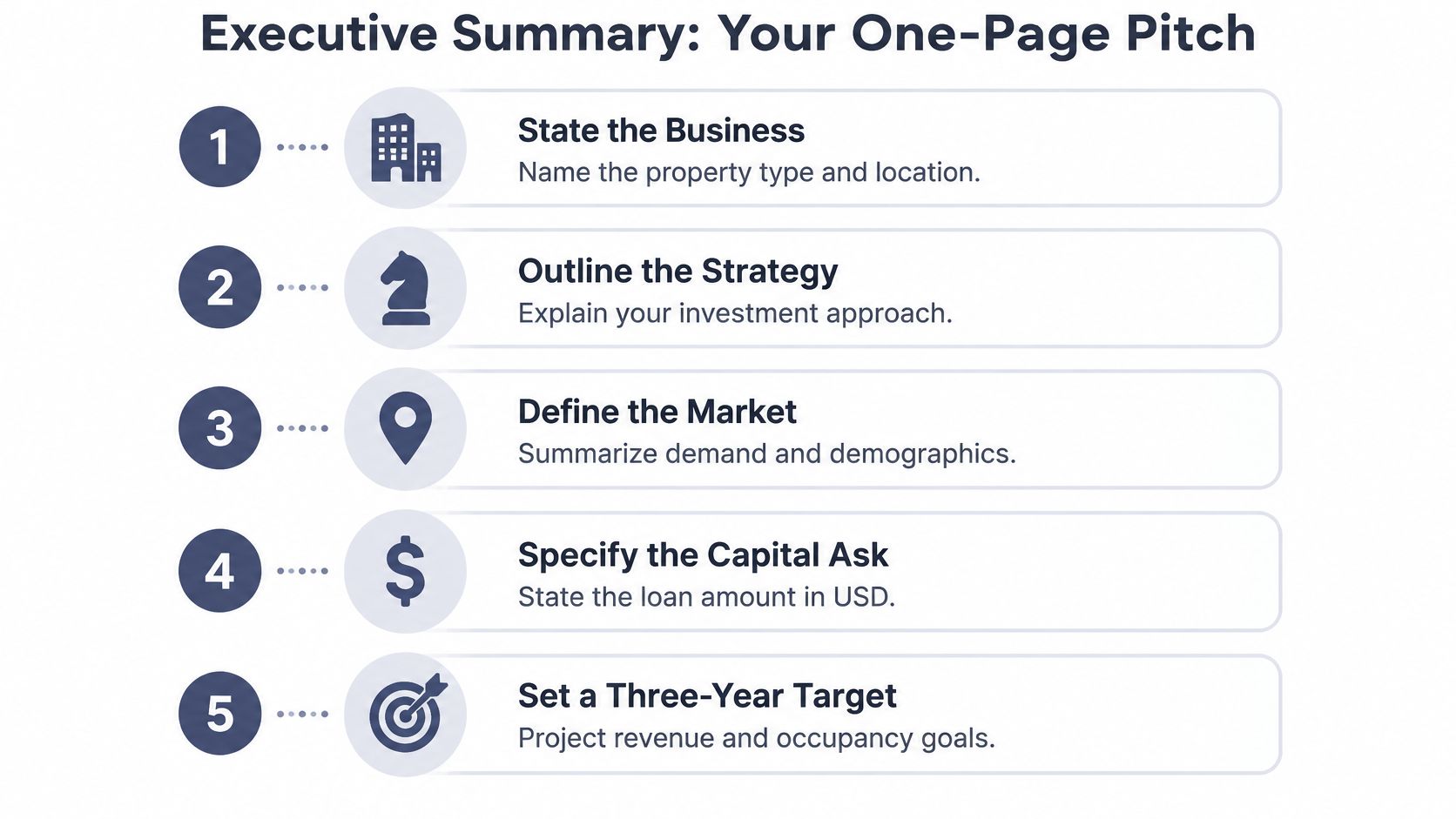
Build the summary in five steps
Name the strategy in one line. For example, describe a hypothetical business buying four-to-twelve-unit rental buildings and holding them for cash flow. That sentence should distinguish the business from a flipping operation or a development company.
State the target market and your reason for choosing it. Use two sentences to identify the location, intended tenant, and the local evidence supporting demand. Explain why the property fits that tenant rather than relying on a city's reputation.
Specify the capital ask. Show total funding needed, the equity and debt split, and the uses of funds. Separate acquisition cash from closing costs, improvements, financing expenses, and operating reserves.
Set measurable goals for years one through three. Units acquired, cash-on-cash return, and reserve balance are useful examples because readers can compare them with the model. Avoid acquisition targets that exceed your staffing or available equity.
Identify the team. Name who sources and underwrites deals, who manages properties, and which outside firms handle legal, accounting, inspections, and construction work. If a role remains unfilled, identify it as a hiring or contracting requirement.
Use this visual checklist to keep the pitch focused.
Sample copy to adapt
The following is a hypothetical summary, not a statement about current Southern California pricing, available financing, or achievable returns.
Harbor Street Residential acquires and holds four-to-twelve-unit rental buildings in Southern California. We target properties where rents sit at least 10% below comparable newer stock, leaving room for light upgrades. We are seeking $600,000 in equity to close three acquisitions, with the balance financed at 70-75% loan-to-value. By year three we aim to own 30 units with a 6-8% cash-on-cash return.
Each line needs supporting detail. A discount to newer buildings doesn't establish achievable rent growth unless you account for differences in condition, amenities, location, and applicable rental restrictions.
The equity request also needs a uses-of-funds schedule. Without one, readers can't tell whether the business has enough money for deposits, improvements, and reserves after satisfying the down payment.
Write this section last. A summary that promises returns or acquisitions the financial model can't support will cost you the lender's trust before due diligence begins.
Market Analysis That Holds Up in a Downturn
The U.S. Census Bureau's historical homeownership table records national rates of 62.9% in Q1 1965, 69.1% in Q1 2005, 68.7% in Q2 2006, 63.4% in Q2 2015, and 65.0% in Q2 2025, a reminder to model a full cycle rather than uninterrupted growth.
Keep that cyclical perspective when reviewing an attractive growth presentation.

Build a dated Los Angeles evidence file
National ownership history doesn't establish demand for your building. Collect local evidence matched to the intended unit size and tenant:
Rents: Median asking and achieved rents, with concessions recorded separately.
Availability: Vacancy and days on market for comparable properties.
Supply: Active listing inventory and competing rental offerings.
Transactions: Closed transaction volume over a proposed review window of 24 months.
Tenure: Neighborhood owner-occupancy rates and relevant household demand.
Write each conclusion with its measurement period and source. For achieved rents, retain executed-lease evidence where available rather than treating advertised rents as collected income.
Higher borrowing costs may keep prospective buyers renting, but that doesn't automatically shorten your lease-up. Tenants still compare affordability, condition, and competing supply.
Define the demand tests
For this hypothetical plan, test flat rents, rents down 10%, and financing costs up one percentage point. Keep market evidence separate from these stress assumptions, then carry the assumptions consistently into the model.
Use the accompanying video as discussion material, not a substitute for address-specific evidence.
Cut any market claim you can't tie to a dated source.
Deal Pipeline and Operations Plan
A repeatable acquisition process starts before the offer and continues after closing. The plan should show who moves each opportunity forward, what evidence they need, and why they reject deals.
Move opportunities through defined gates
Source the opportunity. Set MLS alerts, maintain broker relationships, and use targeted direct outreach. Record the channel in a CRM or shared acquisition tracker so you can identify which sources produce financeable properties.
Apply a written first screen. Specify property type, location, condition, price per unit, and minimum income performance. An illustrative screen might require a cap rate above 5.5%, but that's an investor-selected filter, not proof that a property is acceptable.
Underwrite with supporting documents. Request the rent roll, leases, operating statements, tax information, utility records, and repair history. Replace seller estimates with your own expense assumptions and current quotes.
Make the offer and investigate. Assign responsibility for inspection, title review, financing, insurance, and lease verification. Keep unresolved items on a due-diligence log with deadlines and a named decision-maker.
Close with an operating handoff. Prepare an illustrative 90-day operating plan covering tenant communications, payment instructions, urgent repairs, vendor access, and reporting.
For a hypothetical conversion budget, 100 leads might produce 20 reviewed deals, four fully underwritten opportunities, and one purchase. That means budgeting the sourcing effort around 100 leads per acquisition until actual results justify changing the assumption.
Don't measure the acquisition team only by offers submitted. Track rejection reasons, time spent underwriting, and which channels produce deals that survive due diligence.
Put management capacity into the budget
The U.S. Bureau of Labor Statistics projects employment of property, real estate, and community association managers to grow 4% from 2025 to 2035. That's labor-market context, not a staffing ratio for your portfolio.
Estimate manager capacity from the work: collections, leasing, inspections, repairs, bookkeeping, and owner reporting. Scattered homes and a concentrated apartment building can require different travel and coordination effort.
For an illustrative outsourcing budget, test 8-10% of collected rent, then replace that allowance with written proposals identifying leasing charges and other exclusions. Set a provisional reserve of three to six months of operating costs, with separate allowances for known capital work and insurance deductibles.
Acquisition metrics: Leads, reviewed opportunities, offers, purchases, and conversion rate.
Property metrics: Occupancy, collections, turnover costs, and outstanding repairs.
Service-business metrics: Average fee per client and client retention, where applicable.
Keep commissions, management fees, consulting revenue, and property cash flow on separate lines. Put headcount, contractor costs, and administrative support directly into the model, not in a note promising you'll hire later.
Mini Financial Model With Sample Numbers
A property can produce positive cash flow in the base case and still be an unsuitable acquisition. The decision depends on whether you can tolerate the downside without relying on an unplanned cash contribution or a favorable refinance.
Establish the inputs before calculating returns
Consider an illustrative $400,000 single-family rental, purchased with 25% down, or $100,000, and a $300,000 loan amortized over 30 years. At an illustrative 6.5% rate, principal and interest are approximately $1,896 monthly, or $22,754 annually, calculated before rounding the monthly amount.
Every figure below is hypothetical. Replace the purchase price, rent, vacancy, expenses, and financing terms with property-specific evidence and quotes.
Base and downside cases for a $400,000 rental
Line item | Base case | Downside case |
|---|---|---|
Monthly rent | $3,200 | $2,880 |
Annual vacancy loss at 5% | $1,920 | $1,728 |
Operating costs incl. 8% management | $11,318 | $11,027 |
Net operating income | $25,162 | $21,805 |
Loan rate and annual payment | 6.5%; $22,754 | 7.5%; $25,177 |
Cash flow after debt | $2,408 | -$3,372 |
DSCR | 1.11 | 0.87 |
The base case starts with scheduled rent, subtracts vacancy, and applies the management fee to collected income. Non-management operating costs remain $8,400 in both illustrative cases; the management expense decreases with rental income.
That produces approximately $25,162 in net operating income, before debt service. Divide NOI by purchase price for an illustrative 6.3% cap rate, or divide NOI by annual debt service for 1.11 debt-service coverage, commonly called DSCR.
After debt service, the illustrative $2,408 cash flow represents approximately 2.4% cash-on-cash on the down payment alone. Closing costs, initial repairs, and additional funded reserves would increase invested cash and lower that return.
Check expense classifications carefully. Richard Maize's guide to operating expense ratio provides a useful companion for distinguishing operating costs from financing and other cash requirements.
Let the downside determine the decision
With rent reduced and borrowing costs increased, the illustrative property produces negative $3,372 annual cash flow and 0.87 DSCR. The owner must supply cash to cover debt payments even before an unexpected capital expense.
Positive base-case cash flow isn't enough. If your stop rule requires nonnegative downside cash flow and debt coverage above the lender's minimum, this acquisition fails.
Change project cost and required equity alongside the interest rate. In the 2025 UCLA Anderson survey of California investors and developers, rising construction costs, interest rates, and tariff-related supply-chain volatility were major pressures, and roughly 50% of respondents were delaying or canceling development projects.
Build the workbook in Excel or Google Sheets in this order:
Inputs: Purchase, improvements, rent, expenses, debt terms, and equity requirements.
Debt: Use a loan calculator or the spreadsheet's PMT function.
Scenarios: Base, downside, and severe cases, with linked assumptions.
Timing: Monthly projections for an illustrative 12-month period and annual projections for five years.
Decision outputs: Break-even occupancy, DSCR, cash-on-cash return, IRR, refinance proceeds, and a written stop/go result.
Calculate IRR from the full equity cash-flow schedule, including sale costs and loan payoff. Don't manufacture an attractive exit value to compensate for weak operations.
Funding and Risk Adjustments for Each Property Strategy
Funding and stop triggers by property strategy
The equity ranges and numerical thresholds below are illustrative planning choices, not universal lending requirements.
Strategy | Funding that fits | Risk to model first | Stop trigger |
|---|---|---|---|
Buy and hold rental | Amortizing investment-property loan plus equity | Vacancy and insurance premium increases | Downside cash flow below zero or DSCR below the lender minimum |
Fix and flip | Short-term bridge loan with illustrative 10-20% equity | Renovation overrun and slow sale | Total cost above 70% of after-repair value |
Value-add multifamily | Bridge loan, then refinance | Lease-up delay and refinance rate | Refinance DSCR below the lender minimum |
Ground-up development | Construction loan plus equity partners | Permit delay and illustrative 10% cost overrun | Yield on cost below target after a 10% overrun |
Match funding to the exit
A flip needs enough liquidity to finish construction and carry the property until sale. A value-add acquisition needs a credible refinance, while development needs funding that accommodates construction draws, contingencies, and stabilization.
Richard Maize's guide to financing investment properties offers additional context for comparing funding structures. The business plan still needs the actual lender's terms, including maturity, extension conditions, recourse, and reserve requirements.
Consider these hypothetical stop tests:
Fix and flip: A $250,000 purchase plus $60,000 renovation totals $310,000 against a $450,000 after-repair value. A 70% cost ceiling is $315,000; a 10% renovation overrun increases the subtotal to $316,000 and triggers the stop before other transaction and carrying costs.
Ground-up development: A $3,600,000 project with $270,000 stabilized NOI yields 7.5% on cost. A 10% overrun increases cost to $3,960,000 and reduces yield to approximately 6.8%, below an illustrative 7.0% target.
Value-add multifamily: With $180,000 stabilized NOI, a $1,800,000 refinance amortized over 30 years produces approximately 1.28 DSCR at 6.75%. At 7.5%, coverage falls to approximately 1.19, below an illustrative lender minimum of 1.25.
Underwrite insurance and physical risk
A review of climate-risk evidence identifies insurance repricing, financing, disclosure rules, tenant demand, and stranded-asset risk as underexplored channels beyond energy performance. Treat these as underwriting questions, not a generic sustainability statement.
Insurance premiums may increase during ownership, and resilience work requires actual funding. Historical operating statements won't tell you whether replacement coverage is available on acceptable terms.
Before removing contingencies, assemble:
Address-level hazard screening: Identify relevant flood, fire, heat, and other physical exposures.
Insurance evidence: Obtain current and replacement quotes, exclusions, deductibles, and business-interruption assumptions.
Capital provisions: Price resilience work and schedule the reserve contributions needed to fund it.
Operating obligations: Review projected utilities, disclosure duties, and applicable local building-performance requirements.
Exit acceptance: Ask whether a future buyer and lender could insure, operate, and finance the asset.
Climate exposure isn't an automatic rejection. You may be able to price the risk, mitigate it through upgrades, or improve the property's usefulness to tenants.
Run mitigated and unmitigated cases covering premium growth, temporary vacancy, capital-work timing, and resale liquidity. Pair every funding source with the lender's minimum DSCR so the plan makes the remaining headroom visible.
Confirm Your Numbers Before You Commit Capital
Send the plan to a lender or partner only when both the base and downside cases clear every stop trigger, and the executive summary matches the model. A narrative about strong demand doesn't cure a failed coverage test.
Use Richard Maize's commercial real estate due-diligence checklist to organize the supporting documents and unresolved questions. Confirm that the approved assumptions match the latest leases, bids, insurance quotes, and financing terms.
Make a decision, not a cosmetic revision
If the downside fails, negotiate a lower price that restores the margin, contribute more equity where that improves coverage without exhausting reserves, choose another strategy, or decline the deal. Don't increase projected rent or reduce expense assumptions merely to obtain a passing result.
A plan that works only in the base case is a forecast, not a plan.
Richard Maize welcomes questions and discussion of opportunities at richardmaizebusiness@gmail.com. Bring the model and the specific assumption you want to examine.
The same template can support a first duplex or a development project. Change the strategy row and stop triggers, then rebuild the supporting assumptions for the asset rather than adding unnecessary presentation material.
Richard Maize offers perspectives on property markets, entrepreneurship, and financing informed by decades of portfolio ownership and management. Visit Richard Maize to explore those insights and use them to sharpen the assumptions, operating responsibilities, and walk-away rules in your own real estate business plan.
Comments