Property Valuation Methods: A Practical Investor's Guide

Most advice about property valuation methods starts with the wrong premise: that every property has one correct number waiting to be discovered. It doesn't. A building can support different defensible values depending on whether you're buying it, refinancing it, selling it, or settling a partnership. The practical question isn't, “What's the value?” It's, “What decision am I trying to make, and which evidence best answers it?”
The professional framework still begins with three internationally accepted approaches, sales comparison, income, and cost. The Manitoba Assessment and Taxation fact sheet describes how each works, while RICS valuation guidance identifies the same three approaches as the core of professional practice. A seasoned investor uses those methods as lenses, not as automatic verdicts.
Why Valuation Is a Decision Tool, Not a Number
A valuation is useful only when it changes a decision. Before bidding, decide whether the property belongs in your pipeline at all. If it does, determine the highest price the evidence supports. Then define the point where you walk away, even if the listing, broker, or seller presents the deal as obvious.
The same building can justify different values for different purposes. A lender concentrates on collateral and market evidence. An acquisition analysis gives more weight to future cash flow and the buyer's financing structure. A disposition analysis focuses on what current buyers can support. A partnership buyout requires a fair, documented conclusion that neither side can easily manipulate.
The question determines the method
A residential buyer usually starts with nearby comparable sales because those transactions show what similar owner-occupants paid. An apartment investor studies net operating income, rents, expenses, and capitalization. A buyer assessing a newly built or specialized property may rely more heavily on land and construction economics when comparable transactions offer little guidance.
The three-approach framework described above sets out the mechanics. The cost approach estimates land value plus replacement cost, less depreciation. The sales comparison approach adjusts recent comparable sales. The income approach converts net operating income into market value through capitalization.
Practical rule: Match the method to the decision before gathering data. Otherwise, convenient evidence can look like analysis.
Market conditions change the weighting. In a stable neighborhood with ample recent sales, comparable evidence may deserve priority. In a thin market, durable income or replacement economics may provide a better anchor. The hold period matters as well. A short-term buyer tests today's exit market, while a long-term owner examines rent, expenses, capital needs, and changing use.
The method also has to survive the downside case. Ask what happens if the exit takes longer, expenses rise, rents soften, or the planned use fails. That exercise turns a valuation from a polished estimate into a price discipline.
The profession's history shows why that discipline exists. The field formalized in response to market failures and lending risk. The IAAO Journal of Property Tax Assessment and Administration article describes the Federal Housing Administration's establishment in 1934, its independent appraisal requirement for insured mortgages, and the later move toward state licensing, USPAP, CAMA, and AVMs. Practice has shifted from individual judgment toward structured data, yet judgment still determines whether the evidence fits the property and the decision.
The Sales Comparison Approach Step by Step
The sales comparison approach is often the fastest way to price a conventional residential property, provided the comps compete with it. It compares recent sales and adjusts for meaningful differences, the process Evalueserve's valuation guide describes the method. The objective is not to produce a perfect number. It is to establish a defensible price range for an offer, refinance, or sale decision.
Begin with three to five plausible comps. Keep the geography tight, favor recent closings, and confirm that each property attracts the same buyer. A larger home several neighborhoods away may provide weaker evidence than a smaller nearby property with a similar lot, view, condition, and location tier.
Adjust the evidence, not your conclusion
Assume the subject measures 2,000 square feet, while a comparable measuring 1,800 square feet sold for $700 per square foot. That sale produces an indicated price of $1,260,000. If market-supported adjustments add $140,000 for the subject's extra area and $25,000 for its better view, then subtract $15,000 for inferior condition, the adjusted indication is $1,410,000.
Sales Comparison Adjustment Example | Comp Sale Price | Size Adjustment | Condition Adjustment | View Adjustment | Adjusted Value |
|---|---|---|---|---|---|
Subject versus comp | $1,260,000 | +$140,000 | -$15,000 | +$25,000 | $1,410,000 |
The arithmetic is simple. The support behind each adjustment is not. Square footage, lot size, garage capacity, renovation quality, view, and location tier should not receive arbitrary round numbers. Review paired sales where possible, study asking-to-closing behavior, and compare several comps before drawing a conclusion. One sale should never carry the entire analysis.
A real estate market analysis template from Richard Maize helps organize the comp set, assumptions, and adjustments. Use a dated spreadsheet, record the source of every sale, and state why each property belongs in the analysis. That record makes the valuation easier to challenge and easier to revise when new evidence arrives.
Where the approach breaks
Weak comps and unsupported adjustments can make an analysis look precise while distorting value. Price per square foot creates the same problem when investors treat it as a valuation model rather than a comparison measure.
The approach becomes fragile when the property is unique, transactions are scarce, or distressed sales dominate the dataset. Rapidly changing conditions create another weakness because older closings may no longer represent current buyer behavior. Treat the result as a range, then cross-check it against income or replacement economics. A polished adjusted figure is still an estimate, not scientific precision.
Income Approach and DCF for Income Properties
Income valuation is a decision tool, not a formula that produces truth on its own. It starts with the property's ability to generate cash flow, then tests whether that income justifies the price and the risks required to achieve it.
Direct capitalization converts net operating income into value by dividing NOI by a market-supported cap rate. A 12-unit building producing $180,000 in NOI at a 5.0% cap rate implies $3.6 million, calculated as $180,000 divided by 0.05. The calculation is simple. The underwriting is not.
That indication reflects current operations, so it works best for stabilized income. Before relying on it, verify the rent roll, operating statements, taxes, insurance, repairs, utilities, and management assumptions. A small change in NOI or the cap rate can materially change value. In practice, I treat the result as a market test, then ask whether the income is durable or temporarily inflated.
Capitalization values today, DCF values the hold
Discounted cash flow analysis evaluates the investment across a projected hold. It forecasts rent, vacancy, expenses, capital needs, and a future sale, then discounts those cash flows to present value. In the same example, a DCF incorporating rent growth, vacancy, and an exit cap rate might indicate $4.1 million, compared with $3.6 million through direct capitalization.
The difference is not a disagreement to smooth over. Direct capitalization reflects current income. DCF value depends on the assumptions behind the hold period, discount rate, operating changes, and exit. The RICS discussion of valuation methods recognizes both capitalization and discounted cash flow techniques as relevant to income-producing assets.
Neither approach is automatically conservative. A DCF can appear rigorous while relying on optimistic rent growth, low vacancy, restrained expenses, or an exit cap rate that understates local risk.
Cap Rate vs DCF on the Same Property | Method | Key Input | Implied Value | Best Used For |
|---|---|---|---|---|
Current operations | Direct capitalization | NOI and market cap rate | $3.6 million | Pricing stabilized income today |
Hold-period analysis | DCF | Cash-flow projections, discount rate, exit cap | $4.1 million | Testing an investment strategy over time |
Inputs investors manipulate
Vacancy assumptions need independent support, particularly when a seller presents a fully occupied rent roll. Expense ratios should reflect actual operations rather than an idealized budget. For a practical operating review, use a documented guide to operating expense ratio, then test downside cases.
If modest changes to vacancy, expenses, rent growth, or exit pricing erase the investment thesis, the property cannot support the optimistic base-case value. That conclusion matters for both residential rentals and commercial acquisitions. The model should guide the decision, not conceal the assumptions driving it.
When the Cost Approach Earns Its Place
The cost approach is not a fallback. In my LA deals, it becomes useful when a property is newly built, highly specialized, or located in a submarket with too few reliable sales to support a strong comparison. It also gives investors a way to test whether an improvement makes economic sense before comparable evidence catches up.
The formula is direct: land value plus replacement cost new, less accrued depreciation. The judgment lies in the inputs. Replacement cost new estimates the expense of constructing a building with equivalent utility today. Accrued depreciation covers physical deterioration, functional obsolescence, and external obsolescence. Land value comes from comparable land sales or the site's alternative development use.
Replacement is not reproduction
Replacement cost means a modern structure with the same function. Reproduction cost means recreating the existing structure, including obsolete design and materials. That distinction can materially change the conclusion for an older specialized building. Lenders and insurers also examine replacement economics when direct market evidence is limited.
For a 4,000-square-foot medical office in a submarket with no recent sales, assume replacement cost of $650 per square foot. Replacement cost new equals $2.6 million. After 12% physical depreciation, the depreciated improvement value is $2.288 million. Add $900,000 for land, and the indicated value is $3.188 million.
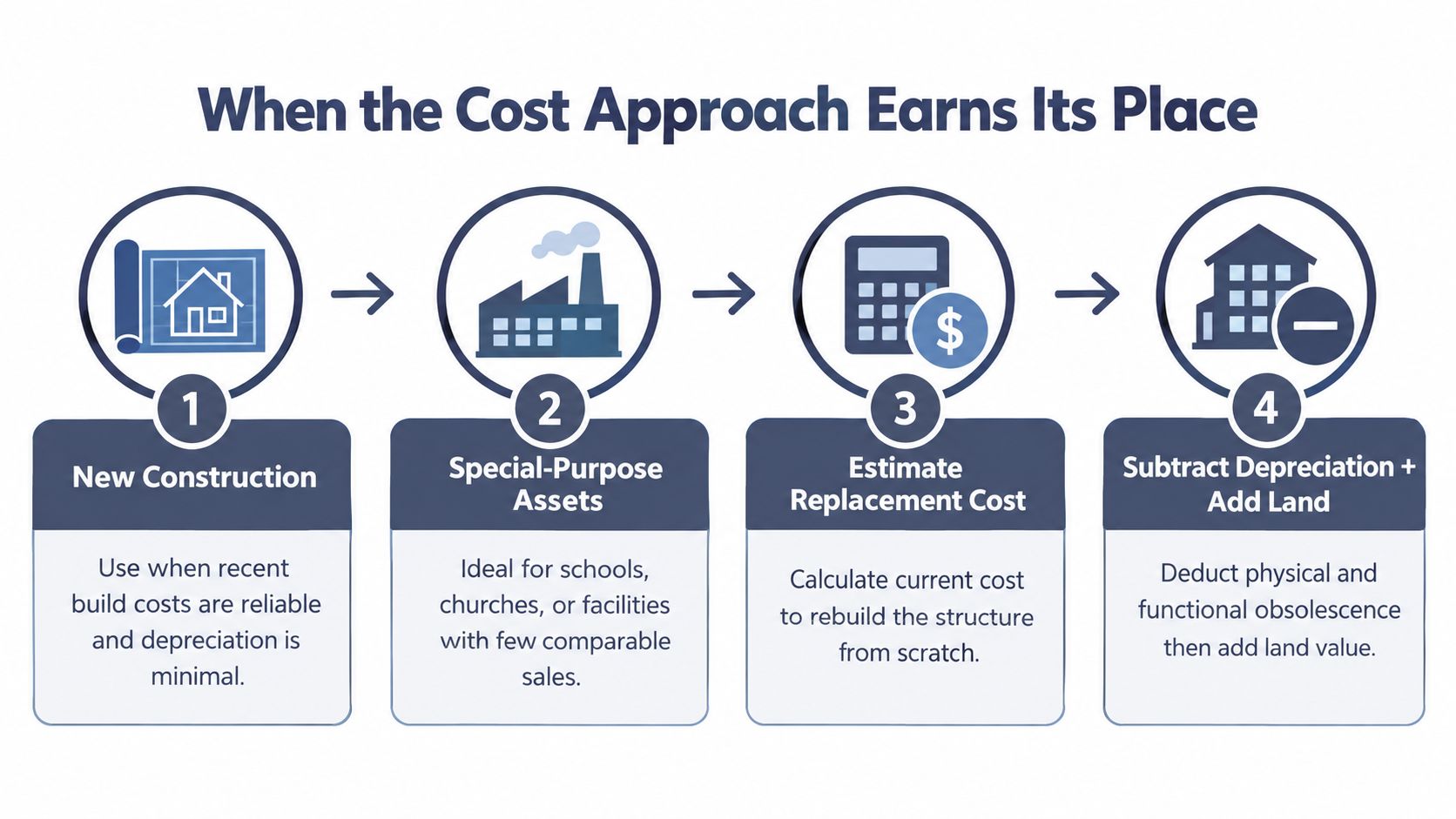
That conclusion holds only when the cost inputs reflect current local construction conditions and the depreciation analysis is explicit. Avoid subtracting the same physical wear twice. Review functional problems, including inefficient layouts, and include entrepreneurial incentive, the return a developer generally requires to coordinate land, financing, construction, and risk.
The cost approach can outperform sales comparison when the dataset is thin. It can also provide a better anchor than income capitalization when current income does not yet reflect the property's replacement economics. It still requires market judgment. The method is most useful as a disciplined check when similar properties are unavailable.
A short visual explanation reinforces the sequence:
Matching the Method to the Property Type
A single-family flip and a stabilized apartment building may sit on the same block, yet their value comes from different sources. Choose the method based on the property's economic engine, the reliability of the evidence, and the decision the valuation must support.
Valuation Method by Property Type | Property Type | Primary Method | Secondary Check | Avoid |
|---|---|---|---|---|
Residential ownership | Single-family residential | Sales comparison | Cost or renovation analysis | Relying on income without credible rental evidence |
Small rental asset | Small multifamily, 2 to 4 units | Sales comparison | Income approach | Treating price per unit as a complete valuation |
Operating business asset | Stabilized office, retail, or industrial | Income approach | Sales comparison | Ignoring lease quality and expense history |
Complex or changing asset | Value-add or ground-up development | DCF and cost approach | Sales comparison where available | Using stabilized assumptions before confirming the plan |
A Silver Lake duplex usually starts with sales comparison. Nearby transactions reveal what owner-occupants and small investors are paying. Use income as a check, not decoration. If the price depends on rents the neighborhood cannot support, the comparable-sales conclusion is too high.
For a stabilized commercial property, build the NOI analysis before relying on sale prices. Direct capitalization can work when income is predictable and leases are dependable. DCF deserves more weight when lease rollover, substantial capital work, a credible repositioning plan, or the intended holding period changes future cash flow. It becomes unreliable when projected rent growth is an aspiration.
A self-storage facility in a submarket with few recent sales may justify the cost approach, particularly when land and improvements drive value more than current operations. The analysis still needs local land evidence, current construction costs, timing, financing, risk, and a realistic exit. A ground-up project's future stabilized value is not its value today.
The same discipline applies to residential and commercial deals. Residential buyers may care most about livability and nearby transactions. Commercial buyers may focus on durable NOI, lease terms, and capital requirements. The method should reflect the buyer who can set the price, not the method that produces the neatest spreadsheet.
Use three questions before committing to a conclusion:
What produces the value, buyer demand, income, or replacement economics?
Which data is strongest, and which input is mostly an assumption?
What result would make me walk away?
Those questions keep valuation tied to the investment decision. They also expose when a precise-looking number depends on assumptions that have not earned confidence.
LA Market Nuances and the Rise of AI Valuations
Los Angeles punishes generic valuation models. Neighborhood boundaries, views, traffic, school preferences, zoning, building condition, and buyer profiles can change a comparable's relevance within a short distance. After three decades investing in LA, Richard Maize treats valuation as a decision tool: identify the buyers competing for the asset, test the risks they will price, and decide whether the property earns a bid.
Regulation changes the underwriting. Rent control rules affecting older LA City rentals and applicable unincorporated areas can limit projected income. Proposition 13 also separates assessed tax value from current market value. Foothill and hillside properties add uncertainty because wildfire insurance availability and pricing can affect operating expenses and buyer demand.
What algorithms see, and what they miss
Automated valuation models process structured property data quickly. They work best when the subject resembles many properties with consistent records. A model may provide a useful screening estimate for tract 1970s condos in the San Fernando Valley, where layouts and transaction patterns are easier to compare.
Confidence should fall for hillside architecturals, mixed-use corners, and TIC buildings. Their value often depends on details missing from standardized fields, including view quality, access, design, legal structure, deferred maintenance, and the buyer pool's tolerance for unusual risk.
The field is moving toward AVMs, desktop appraisals, hybrid appraisals, appraisal waivers, and more structured appraisal data. Industry coverage of synthetic-data-enhanced valuation and 2026 standards changes describes UAD 3.6 and machine-readable data as part of that shift. It also raises the practical question of when automated or hybrid valuation is reliable enough for unusual or rapidly changing assets.
For an LA duplex, compare the algorithmic estimate with an appraiser's selected comps. Use the model to screen the opportunity, not to set the bid. Agreement between the outputs can support confidence when the property is conventional. A divergence requires review of the comp selection, legal status, rents, condition, and neighborhood tier before making an offer.
The broader shift is discussed in this analysis of AI and technology in real estate. AI can rank evidence and identify patterns. It cannot replace local comp selection, adjustment judgment, or the discipline to reject a number that looks too clean. That judgment matters in residential purchases and commercial underwriting alike, because the model may process the records while the investor still carries the consequences.
Putting the Methods Together on a Real Deal
A valuation earns its place when it changes the decision. Consider a 12-unit Echo Park multifamily building offered at $3.2 million. The asking price is one input, not an anchor. Underwrite the property through independent methods, then decide which assumptions deserve trust.
Sales comparison indicates $3.0 million to $3.3 million from relevant apartment transactions. Direct capitalization, using a 5.0% cap rate, produces $3.06 million. A quick DCF, using a 7% discount rate, produces $2.85 million. The cost approach contributes little because operating income and market positioning drive this asset's value more than the cost of recreating its improvements.
Valuation Methods Side by Side on One Echo Park Deal | Method | Key Assumption | Indicated Value | Weight Applied |
|---|---|---|---|---|
Echo Park multifamily | Sales comparison | Comparable apartment transactions | $3.0 million to $3.3 million | Moderate |
Echo Park multifamily | Income approach | 5.0% cap rate and verified NOI | $3.06 million | High |
Echo Park multifamily | DCF | 7% discount rate and hold-period cash flow | $2.85 million | Moderate |
Echo Park multifamily | Cost approach | Replacement economics | Not relied upon | Minimal |
The income result receives the greatest weight only after the rent roll matches operating statements, expenses reflect actual performance, and lease terms support the projected cash flow. Sales comparison checks whether the conclusion fits the market. The DCF answers a different question: does the acquisition work during ownership, rather than only at resale?
Reconcile before you bid
Rent evidence can expose an aggressive underwriting model quickly. If projected rents exceed what nearby tenants can support, the NOI is promotional. Understated repairs, insurance, utilities, or management costs inflate the cap-rate value. Price the offer from verified operations, not from the seller's preferred method.
Stress-test the cap rate with a 200-basis-point shift before writing the offer. A wider cap rate lowers value and can reveal limited room for refinancing, vacancy, or expense pressure. If the purchase works only under the most favorable assumption, the risk belongs in the price or the offer should be rejected.
The final bid can fall below the asking price even when one method reaches it. That reflects reconciliation, not indecision. Weight each result by the quality of its evidence, then preserve a margin for assumptions the investor cannot control. This approach works for a residential purchase as well as a commercial acquisition, because the valuation is ultimately a capital-allocation decision.
Habits That Keep Your Valuation Honest
Valuation discipline matters more than loyalty to a formula. Ask which method depends least on an assumption you cannot defend, then give that result the most weight. Run sales comparison, income, and cost analysis when the property and available evidence support all three. They form the established foundation of appraisal practice, as outlined by RICS standards guidance noted earlier. Reconciliation is where practical judgment starts.
A working discipline
Triangulate every deal: Use competing approaches to expose weak conclusions, not to manufacture a convenient average.
Verify your comps: Keep a dated spreadsheet, record each source, and confirm that every sale competes with the subject.
Update assumptions quarterly: Revisit rents, cap rates, expenses, construction costs, and insurance as conditions change.
Document your logic: Record adjustments, exclusions, and sensitivity tests so another investor can challenge the conclusion.
Get a second opinion: Ask a peer or appraiser to stress-test the valuation before committing capital.
Red flags require a direct response. A rent roll that does not match trailing operating history needs an explanation. A cap rate below the submarket norm needs stronger evidence of property quality or growth. An AI estimate used instead of local comparable sales is a shortcut, not an appraisal.
Choose one active property and rebuild its valuation from the source documents. Verify the comps, normalize the income, run a sensitivity test, and set the walk-away price before speaking with the seller. That exercise reveals more than an attractive listing presentation.
Richard Maize offers practical perspective shaped by more than 30 years of building and managing a real estate portfolio, as described on his official profile. Visit Richard Maize for grounded insights on real estate investing, valuation decisions, and the discipline required to protect capital.
Comments