Project Timeline Management: The Real-World Guide

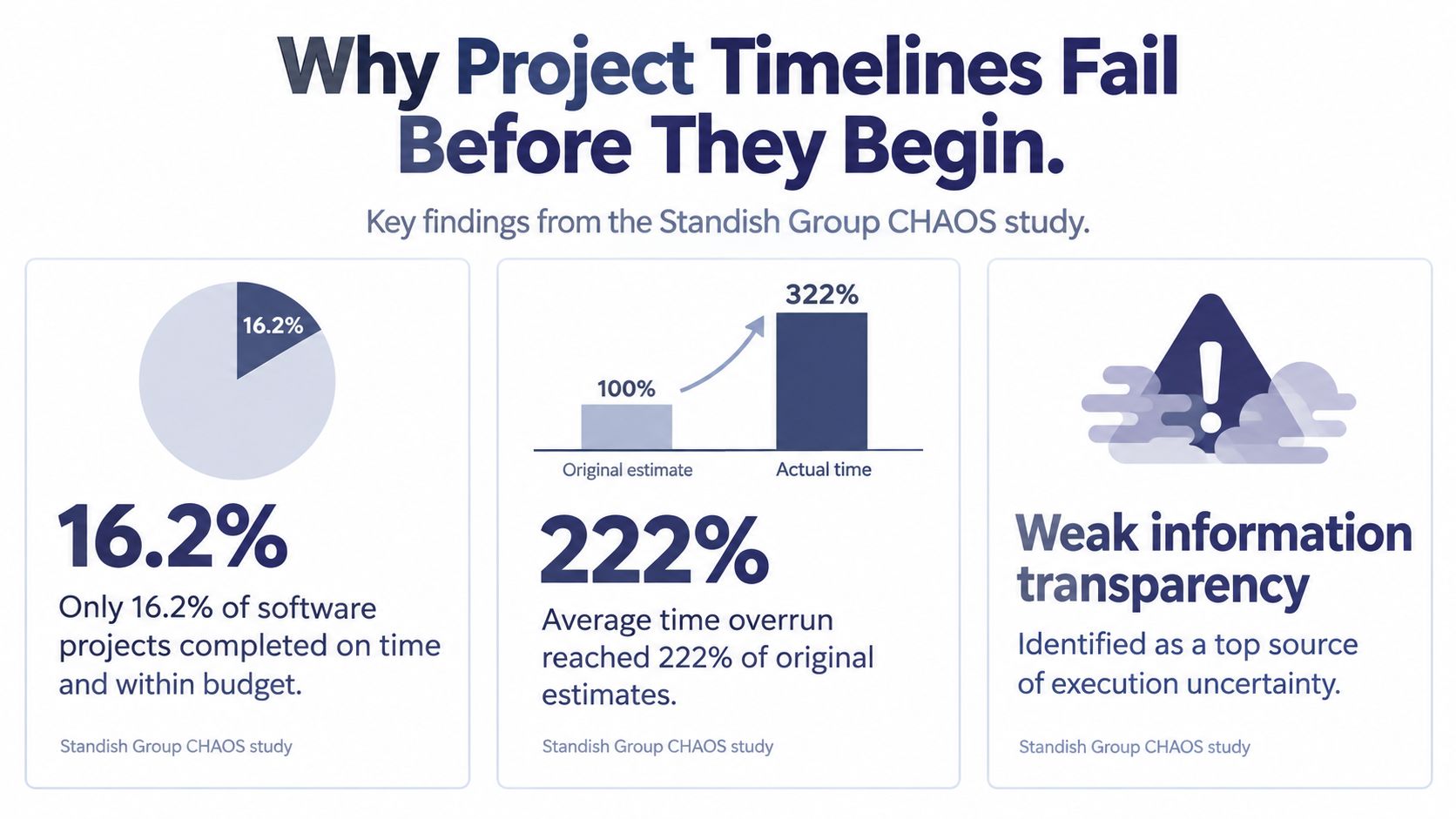
Only 16.2% of projects finish on time and within budget, while the average time overrun reaches 222% of the original estimate. Effective project timeline management responds by treating the schedule as a risk-management system, not a fixed promise.
Those figures come from the 1994 Standish Group CHAOS study of 8,380 software projects, but the lesson reaches far beyond software. A property acquisition, investment launch, construction program, promotional event, or community initiative can fail for the same reason: leaders publish a date before they understand the dependencies behind it.
A useful timeline connects scope, approvals, financing, procurement, people, decisions, and contingency. It shows what must happen, who owns it, what can delay it, and when the owner needs to intervene. That discipline mirrors sound investing. Capital should move in stages, commitments should follow evidence, and uncertainty should remain visible rather than being hidden inside an optimistic completion date.
Why Project Timelines Fail Before They Begin
The Standish Group CHAOS study found that only 16.2% of the projects examined were completed on time and within budget, while 31.1% were canceled before completion. The remaining 52.7% were classified as challenged because they arrived late, exceeded budget, or failed to deliver required functionality. The study also reported an average time overrun of 222% of the original estimate (Standish Group CHAOS study).
Those numbers expose a planning error that appears in every sector: teams confuse a date with a forecast. A date printed on a schedule can look authoritative even when the assumptions underneath it are weak. If financing is pending, permits remain uncertain, materials lack confirmed delivery windows, or a decision-maker hasn't accepted the scope, the completion date represents hope rather than control.
The hidden cost of optimistic dates
A schedule failure rarely begins on the day a deadline is missed. It begins when someone accepts an estimate without documenting its assumptions. That decision compresses later work, encourages premature commitments, and makes every dependent task appear healthier than it is.
A property investor might announce an opening before permitting is complete. A business owner might hire staff before the funding decision is final. An event operator might book promotion before the venue, suppliers, and production plan are locked. Each choice transfers uncertainty into the next phase, where it becomes more expensive to absorb.
Recent construction evidence highlights a related operating problem. Schedule changes and early slippage indicators often emerge during the first half of execution, yet corrective action arrives much later. A 2025 industry analysis covering more than 70,000 schedule files and 3,500 professional responses reported that only 16% of respondents used AI or automation for scheduling, while warning that automation depends on clean logic, frequent updates, and standardized reporting (Construction Dive analysis).
Practical rule: A warning that appears early is valuable only if someone has authority to act on it.
Build a schedule that can admit risk
A strong timeline includes more than task names and target dates. It records milestone ranges, assumptions, dependencies, owners, decision gates, and escalation triggers. It also separates work that the team controls from work controlled by lenders, regulators, contractors, suppliers, partners, or community stakeholders.
For example, a schedule might define:
Scope boundaries: What the project will deliver and what remains outside the commitment.
Dependency logic: Which tasks must finish before another can begin.
Control milestones: Internal checks for design, financing, procurement, staffing, and readiness.
Escalation triggers: Conditions that require a decision, reforecast, or change in capital allocation.
The point isn't to predict every disruption. It's to make disruption visible early enough for the owner to preserve options. A timeline that conceals uncertainty creates false confidence. A timeline that exposes it gives investors and operators room to change sequence, protect cash, renegotiate commitments, or stop before a small delay becomes a critical-path failure.
Building Your First Project Timeline
Start with the outcome, not the calendar. Define what completion means in operational terms, then work backward to the approvals, deliverables, resources, and decisions required to reach it.
Richard Maize offers a useful example of phased execution. He reportedly built a portfolio of approximately 1,000 rental apartment units before turning 30, then founded and developed a major U.S. mortgage-banking firm before liquidating it and moving into additional ventures (Richard Maize Foundation biography). That sequence illustrates a practical principle: complete one investment phase well enough to create knowledge, capital, credibility, or optionality for the next phase.
Start with measurable phases
Break the initiative into stages with clear completion criteria. A property project might use acquisition, due diligence, financing approval, permitting, design, procurement, construction, testing, and handover. A business launch might use concept validation, funding, hiring, supplier readiness, pilot operation, and commercial release.
For each phase, answer four questions:
What must be finished? Define an observable deliverable rather than a vague activity.
Who accepts it? Assign a decision owner and identify the person responsible for producing the work.
What can block it? Record dependencies such as financing, permits, vendor capacity, or stakeholder approval.
What happens next? State the following phase and the evidence required to authorize it.
This distinction matters because a task can be complete while the project remains unready. A designer may finish drawings, but procurement can't start until specifications are approved. A lender may issue a preliminary indication, but construction shouldn't proceed until financing conditions are satisfied.
Combine public milestones with internal controls
Published milestones are the dates stakeholders see. Internal control milestones are the dates managers use to test whether the public commitment remains credible. Keep both in the schedule.
Use historical performance from comparable work whenever possible. Reference-class forecasting is more reliable than relying on a single optimistic estimate because it asks how similar projects performed. Add buffers around uncertain approvals, procurement chains, and handoffs. Buffers aren't padding. They're protection for the critical path.
Assign a named owner to every material task. Shared ownership often means no one has the authority or obligation to escalate. A simple timeline can include the task, owner, dependency, expected range, confidence level, and trigger for review.
For decisions about tools and judgment, this perspective on when to use ChatGPT and when to rely on yourself is relevant. Automation can organize information, but owners still need to validate assumptions, challenge estimates, and decide whether a phase deserves more capital.
Managing Uncertainty with Phase-Based Scheduling
Research into 113 large public procurements constructed in the United States and the United Kingdom between 1999 and 2018 found that project type and implementation-phase length were among the strongest influences on schedule performance (public procurement schedule study). For owners and investors, that matters because longer execution periods create more opportunities for approvals to slip, design decisions to change, markets to move, and coordination to break down.
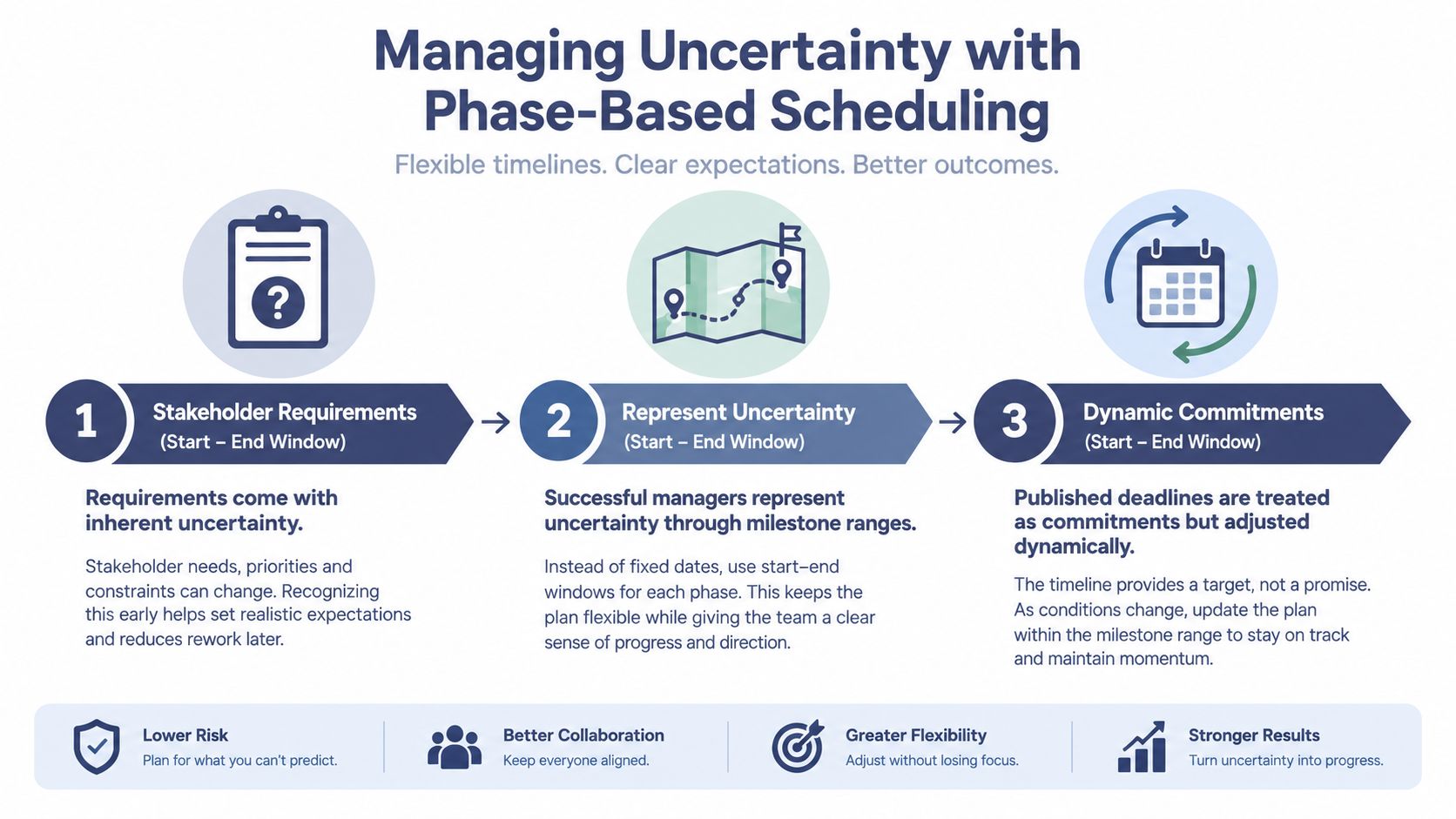
That is why phase-based scheduling works better than a single polished deadline. In real estate, disciplined capital deployment rarely happens all at once. The same principle applies to time. Commit in stages, keep later dates conditional, and require each phase to earn the next allocation of money and confidence.
Replace false precision with decision windows
An investor evaluating a property improvement, a food business, or a live event may still need a target opening date for commercial reasons. Internally, the schedule should show a range, the assumptions behind it, and the points where management will stop and reassess. Financing approval, vendor readiness, final permits, staffing, and successful testing should each have a review gate rather than being treated as background assumptions.
That discipline gets more important across a varied portfolio. Richard Maize's reported investments span property, venture capital, food trucks, music festivals, and other businesses, with properties in more than 20 U.S. states (Richard Maize LinkedIn profile). A property acquisition, a food operation, and a festival do not fail for the same reasons, so they should not be forced into one scheduling template.
Use phase-gated capital deployment instead:
Authorize discovery: spend enough to test feasibility and expose major constraints.
Approve the next commitment: release more capital only when the prior phase supports it.
Review the risk window: reassess dates, assumptions, resources, and stakeholder obligations before each handoff.
Protect the option to pause: keep later spending conditional until earlier uncertainty is reduced.
This is how experienced investors protect downside. They buy information first, then increase exposure when execution supports it. A schedule should work the same way. Each phase should narrow uncertainty, not just consume time.
The same operating mindset appears in this discussion of why flexibility is the new luxury. Flexibility comes from structure. It comes from leaving room to adjust before a weak assumption becomes an expensive commitment.
Treat external deadlines as commitments to manage, not facts to trust blindly. At every phase transition, document the assumptions, the evidence required, the decision owner, and the consequence of proceeding before uncertainty is resolved.
Monitoring Schedule Health and Early Intervention
A timeline becomes useful only after work starts. Before execution, it's a plan. During execution, it becomes a measurement system that tells the owner whether the project still deserves its current assumptions, resources, and capital.
The most important discipline is to define intervention rules before pressure rises. Teams often see slippage in procurement, staffing, approvals, or design coordination but wait for certainty before responding. By then, the remaining float has disappeared and the available remedies cost more.
Track indicators that reveal deterioration
A schedule-health review should examine more than whether tasks are marked complete. Use a consistent set of signals:
Logic quality: Check whether dependencies reflect the actual sequence rather than convenient reporting.
Update frequency: Require current information from every workstream so the schedule doesn't preserve obsolete assumptions.
Float erosion: Watch the spare time around dependent tasks. Shrinking float can matter even when the final date hasn't moved.
Procurement readiness: Confirm that specifications, purchase decisions, suppliers, and delivery expectations align.
Resource availability: Test whether the people, trades, equipment, and decision-makers required for the next phase are genuinely available.
Labor availability can invalidate a well-sequenced plan. The cited construction analysis reports that nearly 80% of firms planning to hire had difficulty finding qualified hourly craft workers, while roughly two-thirds reported projects postponed or canceled (Construction Dive analysis). For an owner, that means resource readiness belongs in the schedule itself, not in a separate staffing conversation.
Turn signals into actions
A useful escalation matrix connects each warning to a response. If procurement readiness slips, the owner might approve an alternate supplier, revise the sequence, or delay a public commitment. If a key resource becomes unavailable, the team might reassign work, change the phase window, or reduce scope. If logic quality is poor, automation should wait until the schedule is rebuilt.
AI can help summarize changes or flag patterns, but it can't rescue unreliable inputs. The 2025 analysis found that only 16% of respondents used AI or automation for scheduling and emphasized that clean logic, regular updates, and standardized reporting are prerequisites for useful automation (Construction Dive analysis). The practical lesson is simple: improve the operating discipline first, then automate repeatable work.
Intervene when the trend changes, not when the deadline breaks.
For property and business owners, early intervention protects more than time. It protects carrying costs, investor confidence, supplier relationships, launch quality, and the option to redirect capital before the project becomes too expensive to change.
Communicating Timeline Changes Effectively
A schedule change isn't automatically a management failure. Concealing it, delaying the message, or offering an unsupported replacement date is the more serious error.
Research on execution uncertainty identifies stakeholder concerns and weak information transparency as important sources of risk (research on uncertainty in project execution). Stakeholders can tolerate uncertainty more easily when they understand its source, its effect, and the decision being made in response.

Use an evidence-based change message
Every update should answer four questions:
What changed: Identify the milestone, dependency, resource, or assumption that moved.
Why it changed: State the cause in plain language and distinguish fact from forecast.
What the impact is: Explain which phases, costs, commitments, or decisions are affected.
What happens next: Give the revised range, owner, action, and next review point.
Don't replace a missed date with another date just to calm the room. Give stakeholders a trajectory supported by current evidence. If financing approval remains pending, say so. If a supplier hasn't confirmed delivery, don't present the procurement phase as complete.
Match cadence to decision risk
Regular communication works better than surprise notifications. Weekly operational reviews can focus on blockers and ownership. Monthly steering updates can address phase readiness, decisions, and changes to public commitments. Quarterly strategic reviews can test whether the initiative still fits the investment thesis and available resources.
Document assumption changes beside timeline revisions. A schedule version should show not only that a date moved, but also the reason, the approver, the affected dependencies, and the action required. This record prevents teams from reverting to an outdated plan and gives future estimates a stronger historical base.
Clear communication also protects relationships. Investors, partners, contractors, employees, and community stakeholders don't need an artificially confident story. They need enough evidence to make informed decisions and enough notice to adjust their own commitments.
Making Timeline Management a Strategic Asset
Project timeline management becomes a strategic asset when it changes how leaders allocate capital, attention, and optionality. The schedule should tell you not only whether work is late, but whether the next commitment remains justified.
Richard Maize's reported career spans real estate, finance, consumer ventures, festivals, and philanthropy. The Rochelle and Richard Maize Foundation identifies support for cultural and arts programs, healthcare initiatives, environmental stewardship, youth development, education, and mentoring, alongside organizations including the American Cancer Society, the Los Angeles Police Foundation, Vista Del Mar Child and Family Services, and Cedars-Sinai's Board of Governors (Rochelle and Richard Maize Foundation). That range illustrates why staged execution matters. Different initiatives require different gates, owners, resources, and definitions of success.
Protect downside while preserving choice
A static schedule records intentions. A managed schedule records choices. It shows which commitments are reversible, which decisions consume capital, which dependencies threaten the critical path, and which signals require a pause.
The operating model is straightforward:
Define a measurable phase and its acceptance criteria.
Sequence dependencies according to how work proceeds in practice.
Estimate with comparable evidence and visible assumptions.
Add buffers around known uncertainty.
Assign ownership and escalation authority.
Review schedule health at every meaningful transition.
Communicate changes before stakeholders discover them elsewhere.
Release the next commitment only when the evidence supports it.
The strongest schedules don't seek perfect prediction. They create a repeatable way to learn. Each completed phase produces information about suppliers, approvals, costs, people, demand, and execution quality. That information improves the next decision, just as an investment portfolio becomes more resilient when capital deployment follows evidence rather than momentum.
A practical perspective on leadership for an evolving economy fits this approach. Leaders preserve direction while adjusting methods, commitments, and timing as conditions change. That's the difference between flexibility and drift.
A reliable timeline doesn't eliminate uncertainty. It makes uncertainty governable.
For investors and operators, that distinction has financial consequences. Buffers reduce the chance that one disruption will consume the entire plan. Early intervention keeps small variances from becoming expensive rescue projects. Phase gates preserve the option to stop, redesign, renegotiate, or invest further. The result is not merely a better calendar. It's a stronger system for protecting downside while pursuing growth.
Richard Maize offers practical perspectives drawn from real estate, entrepreneurship, investment, and community-focused ventures, with lessons that connect disciplined execution to long-term value creation. Visit Richard Maize to explore his business insights, portfolio perspectives, and philanthropic work, then apply phase-based timeline management to your next property or business initiative.
Comments