Product Launch Strategy: Lessons from Richard Maize

A new launch can look polished on the outside and still fail before customers ever see it. Richard Maize's early real-estate career offers a more useful picture: he built a portfolio of approximately 1,000 rental apartment units before turning 30, a result of disciplined decisions rather than launch-day spectacle.
Why Preparation Beats Hype Every Time
A property portfolio doesn't reach that scale through improvisation alone. The Rochelle and Richard Maize Foundation describes Maize's early progress from property investing into entrepreneurship, including the creation of approximately 1,000 rental apartment units before he turned 30. His later move into mortgage banking followed the same practical logic: understand the market, build operational capability, and commit resources when the opportunity makes commercial sense. The foundation's account says he later founded and developed a highly successful U.S. mortgage-banking firm before liquidating it, while his official biography describes him as an entrepreneur and real-estate investor who built and later sold one of the nation's top mortgage-banking organizations. (Richard Maize Foundation profile)
That background matters because product launches often reward the wrong behavior. Teams spend heavily on announcements, events, creative assets, and publicity while leaving customer need, pricing, fulfillment, and support unresolved. A launch event is only the visible endpoint of a longer chain of decisions.

The preparation gap
The evidence behind this principle is unusually clear. OpenStax's summary of new-product research reports that products supported by well-defined and well-executed predevelopment activities achieved a 75% success rate, compared with just over 31% when those activities were weak or absent. That's a gap of roughly 44 percentage points.
Those activities include identifying a meaningful customer problem, evaluating market attractiveness, defining the concept, assessing technical and commercial feasibility, and checking whether the organization can deliver the promise. The same source notes that a Product Development and Management Association study found failure rates varying by industry, from 35% for health-care products to 49% for consumer goods. The comparison is more useful than any dramatic industry-wide failure slogan because it shows what disciplined preparation changes.
Practical rule: Treat market validation, segmentation, positioning, pricing, distribution, and operational readiness as risk-reduction investments, not optional marketing tasks.
Maize's broader venture history reinforces the point. His experience spans property investment, mortgage finance, and a consumer-facing business, Richeeze Melts, founded with Severin Stone as a Los Angeles food-truck venture offering grilled-cheese sandwiches, soups, salads, and sides. (Richeeze Melts profile) Different businesses require different launch tactics, but each still depends on knowing who will buy, why they'll choose the offer, and how the business will fulfill demand.
A useful companion principle appears in this discussion of learning to love boredom as an entrepreneur. Repetition, verification, and patient preparation rarely attract attention, yet they give launch activity something durable to build on.
Pre-Launch Research and Positioning
The most expensive launch mistake is often a decision made before anyone writes a press release: assuming interest equals demand. A large market may contain many potential buyers, but that doesn't prove they recognize the problem, trust the solution, accept the price, or have a convenient way to purchase it.
Research summarized in a study of 203 industrial product launches identified inadequate market analysis as the leading cause of failure. The same research connects strong initial screening, preliminary market and technical assessments, and detailed market studies with better launch outcomes. That gives founders a practical sequence for deciding whether an idea deserves further investment.
Start with the customer problem
Write down the problem in the customer's language, not in product language. Then answer four questions:
Problem severity: What happens if the customer does nothing?
Current alternative: How does the customer solve the problem today?
Purchase trigger: What would make the customer act now?
Proof of value: What observable result would confirm that the offer works?
Customer interviews are useful only when they test behavior and trade-offs. Ask what people currently use, what they pay for, what frustrates them, and what they've already tried. Don't rely on compliments about an idea. People can like a concept without changing their behavior.
Define the first segment
A launch aimed at everyone usually speaks clearly to no one. Select the segment with the sharpest need and the shortest path to a decision. For a rental-property initiative, that might mean understanding tenant priorities, local competition, access, and operating constraints. For a food truck, location, menu clarity, service speed, repeat demand, and local awareness may matter more than broad demographic labels.
Maize's move from property investing into mortgage banking illustrates why positioning should follow capability and market understanding. His biography connects his real-estate experience with the creation and sale of a major mortgage-banking organization, rather than presenting the transition as a disconnected branding exercise. (Richard Maize's official biography)
Turn research into a go or no-go decision
Use gates, not enthusiasm. At each stage, require written evidence that the opportunity meets predefined standards for customer demand, feasibility, unit economics, operational capacity, and channel readiness.
A total addressable market estimate belongs in the context, not at the center of the decision. It tells you how large an opportunity might be, not whether a specific customer will purchase your specific offer. A stronger positioning statement identifies the customer, the urgent use case, the alternative being displaced, and the reason your product deserves attention now. For broader context on changing startup conditions, see Richard Maize's startup-world predictions, but keep your launch decision tied to direct customer evidence.
Building Your Launch Plan and Timeline
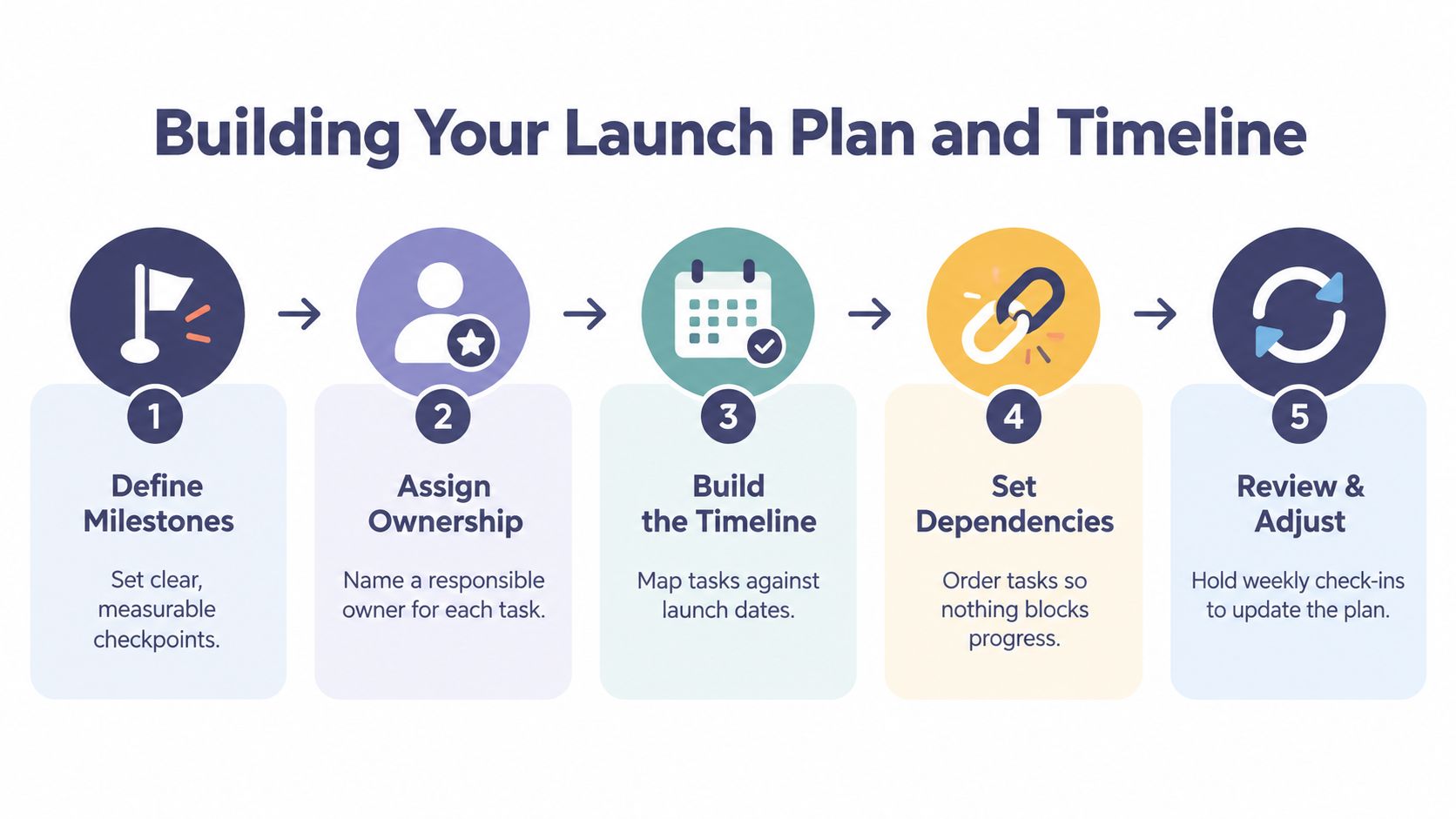
A launch plan converts strategic intent into accountable work. It doesn't need to become an elaborate project-management artifact, but every important activity should have an owner, a dependency, a completion standard, and a decision attached to it.
Maize's progression from property investment to mortgage banking shows the value of staged commitment. Each venture required a different operating model, so committing more capital before understanding the next constraint would have created unnecessary exposure. Your plan should work the same way. Release resources in stages as evidence improves.
Build the operating backbone
Start with five planning decisions:
Define milestones. Set checkpoints for research, prototype or pilot testing, operational readiness, channel preparation, and public release.
Assign ownership. Name one accountable person for each deliverable. A group can contribute, but responsibility shouldn't belong to “the team.”
Map dependencies. Product readiness may depend on testing, support training, inventory, legal review, or payment infrastructure.
Budget for uncertainty. Include room for rework, delayed materials, additional customer testing, and channel corrections. A budget that assumes perfect execution isn't a plan.
Set decision rights. Establish who can approve a gate, pause the launch, change the offer, or redirect spending.
Use gates to protect momentum
A gated process doesn't slow a good launch. It prevents a weak launch from absorbing more money just because the team has already invested heavily.
At the opportunity gate, confirm the customer problem and strategic fit. At the feasibility gate, examine technical, commercial, and operational realities. At the validation gate, test prototypes, pilots, pricing, and purchase behavior. At the commercialization gate, confirm demand evidence, fulfillment capacity, support coverage, and channel readiness.
A launch date is a commitment to execute, not permission to ignore evidence.
The common failure is building first and asking customers later. Teams also postpone pricing tests until development is complete, then discover that the product can attract interest but cannot support a viable business. Put pricing and distribution questions into the plan early, even when the answers are uncomfortable.
Hold regular reviews, but don't confuse meetings with control. Each review should end with a documented decision: proceed, revise, pause, or stop. That discipline preserves momentum because people know what must be true before the next investment.
Marketing, PR, and Channel Activation
Marketing creates attention, PR lends credibility, and channel activation makes the product purchasable. A launch fails when these functions operate as separate campaigns with different promises.
Apple's original iPhone remains a useful example of coordinated sequencing. Steve Jobs introduced the device on January 9, 2007, positioning it as a widescreen iPod, a mobile phone, and an internet communications device. Apple released it in the United States on June 29, 2007, creating nearly six months between unveiling and availability. The company announced that it had sold its one-millionth iPhone 74 days after introduction, and reported cumulative iPhone sales exceeding one billion units by 2017. (Apple's iPhone history)
The lesson isn't that every company needs secrecy, a global media event, or Apple's resources. The useful lesson is that narrative, timing, distribution, and measurement can reinforce one another.
Match the channel to the venture
Venture type | Stronger emphasis | What can go wrong |
|---|---|---|
Technology product | Demonstration, education, product access, and structured onboarding | Attention arrives before the product can deliver value |
Real-estate initiative | Local trust, proof of execution, qualified conversations, and operational clarity | Broad publicity attracts interest without qualified demand |
Food truck or local consumer venture | Location-based awareness, community relationships, visual content, and repeat visits | National-style promotion ignores the buying radius |
Mission-led product | Accessibility, credible impact communication, and trusted local partners | Purpose messaging masks friction around availability or price |
Richeeze Melts illustrates why a consumer launch should reflect the customer's actual buying context. A local food truck has to coordinate menu communication, location, service capacity, staffing, and community awareness. A national press strategy may create visibility but won't solve a slow service line or an inconvenient location.
Coordinate sales and fulfillment
Train the people who answer questions before the first public announcement. Prepare inventory, booking, delivery, payment, customer support, and escalation procedures at the same time as the campaign. A buyer who can't complete the next step experiences the launch as a broken promise.
Use AI selectively in launch work. It can help draft variations, organize research, or accelerate repetitive preparation, but it can't replace customer judgment, positioning decisions, or operational accountability. Choose the channel mix your team can execute consistently, then connect every message to a clear action.
Measuring What Actually Matters
Publicity is an input, not proof of adoption. A product can generate attention, sign-ups, or first purchases and still fail to become part of customers' routines.
The post-launch risk is substantial. Bizcommunity reports that nearly two-thirds of new product launches are dead or declining by the end of their second year. Research across 181 companies found average adoption of core product features at only 24.5%, with a median of 16.5%. Those figures point to a gap between getting people to notice a product and helping them use it consistently.
Define the first-value event
Every product needs a concrete answer to this question: what action tells you that a new customer has experienced meaningful value?
Track the time it takes customers to reach that event, then examine where they stop. A sign-up with no meaningful action is not activation. A first purchase without repeat use may indicate weak fit, poor experience, or an offer that solves a temporary need.
Build a compact measurement system
Measurement area | Question to answer |
|---|---|
Activation | Do new customers complete the first-value action? |
Time to value | How quickly do they reach it? |
Feature or service adoption | Which parts of the offer do they actually use? |
Retention | Do customers return or continue? |
Retention-adjusted revenue | Does spending produce durable commercial value? |
Qualitative feedback | What language do customers use to explain friction or value? |
Avoid building a dashboard full of numbers no one uses. Choose indicators that trigger decisions. If customers fail to reach value, improve onboarding or simplify the offer. If they activate but don't return, investigate the experience, frequency of need, and competitive alternatives. If one segment retains better than another, refine the positioning around the stronger fit.
A smaller launch with measurable repeat behavior can be more valuable than a large launch that produces publicity but little sustained use. The right question isn't “How much attention did we earn?” It's “What did customers do after attention arrived?”
Post-Launch Optimization and Long-Term Growth
Launch day creates a starting point, not a finished business. The first customers reveal where your assumptions hold, where the product creates friction, and which promise resonates strongly enough to support continued use.
Maize's career shows the value of building across accumulated operating knowledge. His path moved from real-estate investment into mortgage banking and later into consumer ventures, including Richeeze Melts. That progression suggests a practical approach to growth: carry forward useful capabilities, but keep testing each new market on its own terms.

Create a closed feedback loop
Collect customer comments from support conversations, reviews, interviews, usage patterns, and direct outreach. Then connect those observations to an owner and a decision. Feedback that stays in a spreadsheet doesn't improve a product.
Use retention cohorts to identify when customers leave and whether the pattern differs by segment, channel, use case, or onboarding path. Pair those findings with qualitative evidence. A retention problem may come from a missing feature, unclear positioning, poor service, or a customer who was never a strong fit.
Sustainable growth comes from converting customer evidence into the next operating decision.
Optimization should include the product and the commercial system around it. Improve the first-use experience, revise confusing messages, remove unnecessary steps, strengthen support, and adjust channel investment toward customers who show durable value. Community programs and customer success efforts can also turn early users into useful advocates, but only after the underlying experience gives them a reason to recommend it.
Here's a practical post-launch rhythm:
Listen: Gather feedback from customers and frontline staff.
Diagnose: Separate demand problems from experience and execution problems.
Prioritize: Choose the changes most likely to improve first value and continued use.
Test: Release a focused adjustment and observe behavior.
Decide: Improve, reposition, expand, or discontinue based on evidence.
The process is iterative because markets change and customer expectations sharpen after release. A launch that keeps learning can compound. One that celebrates the announcement and stops listening usually loses its advantage.
The following visual reinforces the difference between a release and the work required to sustain it.
Frequently Asked Questions About Product Launches
What's the difference between a product launch and a marketing campaign?
A product launch coordinates the product, market, operations, sales, support, distribution, and measurement around an introduction. A marketing campaign is one component. It can create awareness, but it can't compensate for weak fulfillment, unclear positioning, or a product customers don't need.
How do you know when to launch or keep iterating?
Use written gates. Launch when customer evidence, operational readiness, channel preparation, and commercial assumptions meet predefined thresholds. Keep iterating when customers can't reach value, the offer lacks a clear distinction, or the team can't deliver the promised experience reliably.
Should a business launch small or go big?
Choose based on uncertainty, resources, audience, and risk tolerance. A limited or phased release gives teams room to learn and correct problems. A broad launch can make sense when the product is ready, the message is clear, distribution is prepared, and the organization can handle the response. Ego isn't a launch criterion.
Which metrics matter after release?
Prioritize activation, time to first value, retention cohorts, feature or service adoption, repeat behavior, and retention-adjusted revenue. Impressions and sign-ups can help diagnose reach, but they don't establish durable demand by themselves.
Does the same strategy work for every business?
The principles transfer, but the evidence changes. A property venture may depend on local trust and operational execution. A food truck relies on convenience and repeat visits. A digital product depends heavily on activation and continued usage. Maize's experience across property, finance, and a consumer venture demonstrates why the framework must adapt to the business rather than force every launch into one template.
Richard Maize offers practical perspective drawn from real-estate investing, mortgage finance, consumer ventures, and philanthropy, with a focus on how businesses create lasting value beyond public attention. Visit Richard Maize to explore his ventures, insights, and examples of disciplined growth across different markets.
Comments