Organizational Efficiency Guide for Real Estate Teams

The first sign isn't usually a big crisis. It's the small stuff that keeps slipping. A lease packet sits in someone's inbox. A maintenance note gets entered twice. An agent promises a callback that never happens because three different tools hold three different versions of the truth.
In a mid-sized real estate office, that kind of drift shows up fast. Deadlines slip, budgets swell, and good people start feeling like they're always catching up. Organizational efficiency is the difference between a team that merely stays busy and a team that reliably turns effort into closings, renewals, and clean operations.
That's where Richard Maize's perspective matters. His background in mortgage, real estate, property management, and portfolio operations gives this topic practical weight, not theory for theory's sake. He's spent decades around the parts of the business where process either protects margin or undermines it, and that lens is useful for any team trying to tighten execution without breaking morale. His leadership perspective is especially relevant in a market where the cost of slack, delay, and confusion is harder to absorb, as outlined in his leadership commentary on adapting to economic change.
Introduction to Organizational Efficiency
A real estate manager can feel the problem before the spreadsheet confirms it. One agent is waiting on a document, another is chasing a signature, accounting is correcting a duplicate entry, and the maintenance queue is growing faster than the team can clear it. Nothing looks catastrophic on its own, but the operation is leaking time at every handoff.
That's what organizational efficiency is really about, converting paid labor, systems, and attention into useful output with as little drag as possible. In business terms, it's not just cost control. It's whether the office, the field team, and the back office are working as one machine or three disconnected ones.
Why this matters now
The baseline is not flattering. Gallup-based reporting says only 20% of global employees were engaged in 2025, and low engagement cost the global economy about $10 trillion in 2024, roughly 9% of global GDP (WorkTime workplace productivity statistics). That matters in real estate because a disengaged coordinator, property manager, or agent assistant doesn't just feel less committed. The work slows, mistakes multiply, and response times slip.
Practical rule: If a process depends on heroics to work, it isn't efficient yet.
Richard Maize's long operating history gives this topic a grounded angle. He's worked across mortgage and property operations for more than 30 years, built and later liquidated one of the country's largest mortgage companies, and now manages property in more than 20 states (Richard Maize bio). That kind of breadth matters because efficiency problems rarely live in one department. They show up where sales, administration, finance, and property management cross paths.
For a real estate team, the payoff from improving efficiency is straightforward. Better systems mean faster follow-up, cleaner data, fewer reworks, and more reliable delivery. The reader's gain from this guide is a usable mix of strategy and action, with enough operational detail to diagnose what's broken and enough structure to fix it.
Understanding Key Measurement Frameworks
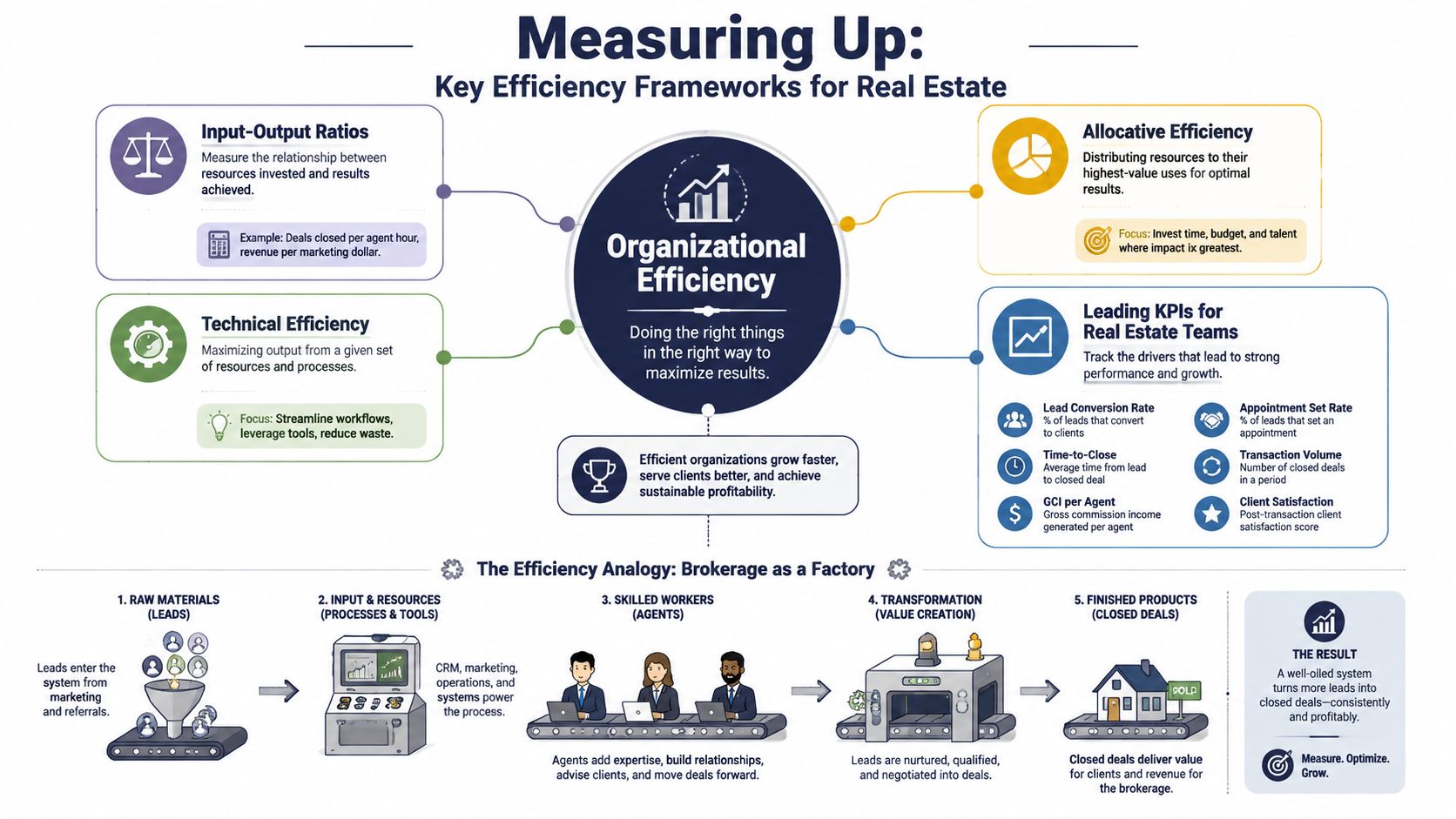
If a brokerage were a factory line, the raw material would be leads, the work-in-process would be prospecting and negotiation, and the finished product would be closed transactions. That analogy is useful because it forces a hard question, how much input does it take to produce one unit of output? In real estate, inputs include agent hours, admin time, marketing spend, software, and management attention. Outputs include appointments set, contracts signed, transactions closed, renewals completed, and issues resolved.
Start with the ratio, then separate the type of efficiency
The simplest lens is an input-output ratio. For a team, that might mean deals closed per agent hour, files completed per coordinator hour, or lease renewals processed per property manager. Those ratios don't tell the full story, but they expose where the effort is going.
Two distinctions matter next. Technical efficiency asks whether the team is producing the maximum output from the resources it already has. Allocative efficiency asks whether those resources are distributed in the right places. A team can be technically efficient and still misallocate time, for example if its best people are buried in admin work while high-value client conversations sit untouched.
Here's the part many dashboards miss. You need both the volume view and the quality view. Throughput without accuracy creates rework. Low cost without good service creates churn. So the best scorecards usually pair output metrics with quality rates, downtime, rework, and cycle time.
Use benchmarking to compare like with like
Operational benchmarking is strongest when it compares throughput, cost per unit, quality rates, labor productivity, scrap or rework, and downtime against peer or best-practice baselines, then traces the gap back to labor allocation and process flow (Umbrex operational efficiency and benchmarking). That approach is more useful than saying a team is “working hard.” It shows where the process is losing value.
A more advanced framework is Data Envelopment Analysis (DEA) paired with the Malmquist Productivity Index. In practice, those tools let you compare decision-making units, such as branches or departments, over time, not just at one snapshot. They're helpful because they can separate a gain from better technical efficiency from a gain that comes from a technology shift or process redesign (Wiley DEA and Malmquist Productivity Index study).
Translate the framework into a scorecard
For a real estate operator, the scorecard should be simple enough to review weekly. Track conversion rates, time-to-close, admin backlog, rework count, and downtime in the same view. Then compare branch-to-branch or team-to-team performance against the same definitions, not whatever each manager happens to call “done.”
The best metric is the one that changes behavior without creating confusion.
The engagement data belongs in this conversation too. A widely cited benchmark shows only 20% of global employees were engaged in 2025, and that low engagement cost the global economy about $10 trillion in 2024 (WorkTime productivity statistics). In other words, measurement isn't just about output. It also needs to show whether the people producing that output are engaged enough to sustain it.
Diagnosing Inefficiency Drivers in Real Estate
The easiest inefficiencies to spot are usually the ones teams have normalized. A back-office coordinator waits on an agent's notes. A property manager enters the same maintenance issue into two systems. A broker sees a delay in reporting and assumes it's just the cost of being busy. Busy is not the same as efficient.
Where the drag usually starts
In real estate, the biggest blockers tend to be communication silos, weak system adoption, paperwork rework, and uneven workloads. Agents work in one rhythm, administrative staff in another, and finance or property operations in a third. When those groups don't share the same workflow, even simple transactions take longer than they should.
The workday data makes the point more sharply. Office workers average only 2 hours and 53 minutes of focused work per 8-hour shift, which means organizations pay for 87% of expected output on average (Gable employee productivity statistics). In practical terms, the office is not losing productivity all at once. It's losing it in fragments, the five-minute interruption, the waiting period, the misplaced document, the follow-up that should've been automatic.
Typical Daily Work Efficiency in Real Estate
Workday Duration | Productive Time | Efficiency Rate |
|---|---|---|
8 hours | 2 hours 53 minutes | 87% paid for, on average |
Symptoms are easy to miss if you only watch the calendar. Delayed reporting often points to information silos. Repeated paperwork fixes usually point to poor process design or unclear ownership. High turnover or constant fatigue can point to workload imbalance, which becomes a hidden cost even when the top-line numbers still look fine.
Use gap analysis to find the root cause
A simple gap analysis works better than most complicated diagnostics. Compare the current process to the best internal team or branch, then ask where time, handoffs, approvals, or rework are accumulating. If one office closes faster but has the same market conditions, the explanation is usually process discipline, not luck.
Useful test: If the team can't explain why one branch performs better, the benchmark isn't being used well enough.
The point is not to shame the slower team. It's to identify whether the bottleneck sits in labor allocation, workflow design, or technology use. Once you know which of those is the underlying problem, the fix gets a lot clearer.
Key Improvement Levers for Real Estate Teams
The strongest efficiency gains usually come from targeted fixes, not broad cost cutting. Real estate teams often waste time in exactly the same places, document handling, CRM follow-up, interdepartmental coordination, and low-value admin work. If you want results, focus on the process points where one error creates three more.
Use the right lever for the right bottleneck
Automated document workflows help with contract routing, filing, and approval chains. The upside is less manual error and faster turnaround. The downside is that setup takes time, and if the workflow is poorly designed, you automate confusion instead of reducing it.
Real-time CRM dashboards give managers a live view of the pipeline, lead response, and follow-up discipline. That helps leaders intervene before a deal goes stale. The trade-off is data quality, because a dashboard built on inconsistent entry habits just makes bad information look polished.
Cross-functional huddles help sales, marketing, admin, and property teams coordinate around the same priorities. They reduce silos and improve handoff quality. The risk is meeting sprawl, so the huddle has to be short, structured, and tied to decisions, not updates.
Strategic outsourcing can free internal staff from non-core work like lead generation support or administrative tasks. That lowers overload and lets in-house people focus on client-facing or revenue-critical work. The downside is vendor management, plus the possibility of losing control over quality if the handoff is vague.
Best practice benchmarking focuses on throughput, cost per unit, quality rates, productivity, rework, and downtime, and it looks specifically for bottlenecks in labor allocation and process flow (Umbrex benchmarking guidance). That matters because the best lever is rarely the one that sounds most advanced. It's the one that closes the biggest gap.
Practical rule: Don't automate a bad workflow. Fix the workflow first, then automate the corrected version.
For teams looking at technology modernization, Richard Maize's technology and AI commentary is a useful companion read, especially if your bottleneck is still manual coordination rather than market demand. The goal isn't to replace judgment. It's to remove avoidable friction so judgment gets used where it matters.
Case Studies from Richard Maize Ventures
Real efficiency work shows up in the details. A process only becomes credible when someone has had to standardize it under pressure, across different people, with real consequences if it slips. Richard Maize's ventures offer that kind of context because they span property, finance, and consumer-facing operations.
Standardizing fulfillment in a fast-moving food venture
The Richeeze Melts Food Truck venture had the kind of problem many small teams recognize immediately. Orders were being fulfilled inconsistently, prep steps varied by person, and the team had no clean way to see where time was being lost. That created avoidable delay, especially when demand picked up and everyone started improvising.
The fix started with process clarity. Order flow was standardized, prep steps were sequenced consistently, and handoff points were made visible so the team could see where work was stalling. The diagnostic lens was simple, what steps were repeated, where were the queues forming, and which tasks could be made repeatable without slowing service.
The result was a more reliable operating rhythm. Prep time was reduced by 30%, which matters because food-service inefficiency is often just a compressed version of the same problems real estate teams face, unclear ownership, inconsistent sequencing, and too much variation in execution. When every worker performs the same task slightly differently, the business pays for that variation in time and error.
Unifying property management across multiple states
A multi-state rental portfolio faces a different version of the same challenge. Local practices can drift, maintenance requests can get delayed, and one region can develop its own way of logging issues that doesn't match the rest of the portfolio. That kind of fragmentation makes it harder to prioritize work and almost impossible to benchmark performance cleanly.
A unified property management system solved that by standardizing how requests were entered, tracked, and escalated. The team could finally see the same operational picture across markets, which made it easier to spot bottlenecks and enforce consistent response patterns. The key metric here was late maintenance requests, because delays in maintenance are a direct signal that the workflow is losing control.
That system reduced late maintenance requests by 40%. The larger lesson is that property operations improve when the team can see the queue, trust the data, and assign responsibility cleanly. Richard Maize's own site notes that he built one of the largest mortgage companies and owns property in 20+ states, which explains why operational discipline matters in his playbook (Richard Maize official site).
The throughline across both cases is not technology for its own sake. It's standardization plus visibility. Once the workflow becomes repeatable and the numbers become trustworthy, the team can improve the process instead of arguing about what happened.
Implementation Checklist and Dashboard Design
Efficiency programs fail when they stay abstract. The fix is a simple rollout plan, a few clear measures, and a dashboard that shows whether the new process is working. If the team can't see the change, it won't sustain the change.
The 12-step rollout
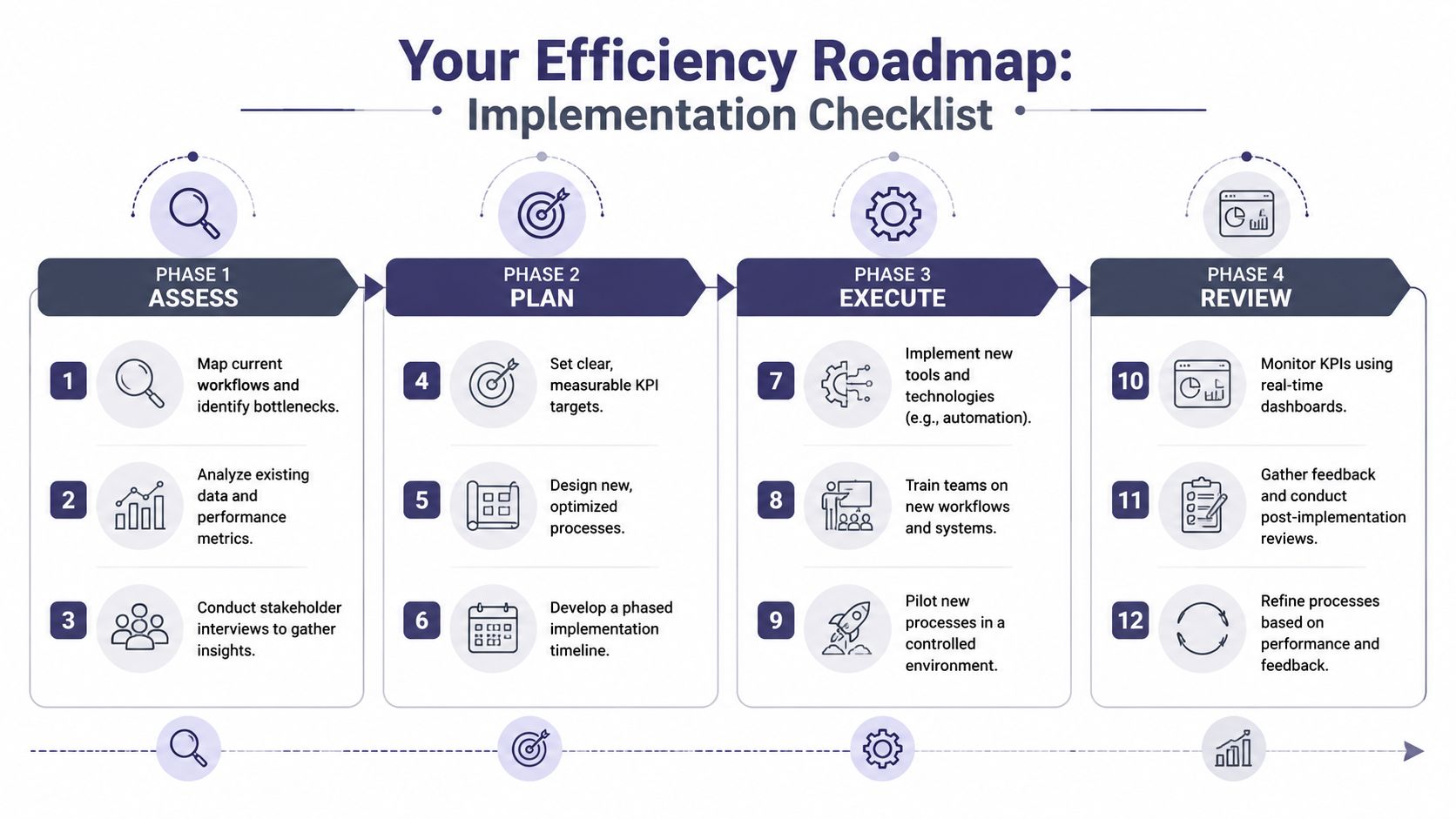
Assess
Map current workflows. Trace one transaction from lead to close, or from request to resolution.
Review the data. Identify where delays, rework, or missing fields show up most often.
Interview the people doing the work. Frontline staff usually know where the hidden friction sits.
Plan 4. Set KPI targets. Choose a small set of measures the whole team will use. 5. Redesign the process. Remove unnecessary handoffs before touching software. 6. Build a phased timeline. Roll out the changes in stages so the team can absorb them.
Execute 7. Implement the tools. Add automation or dashboarding only after the workflow is clear. 8. Train the team. If people don't know how the new process works, they'll revert quickly. 9. Pilot before full rollout. Test the process in one office, one team, or one portfolio segment.
Review 10. Monitor the dashboard. Track the same metrics every week. 11. Collect feedback. Ask what created friction and what saved time. 12. Refine the process. Keep the parts that work and remove the ones that didn't.
Build a dashboard people will actually use
The dashboard should show only what drives decisions. A good starting set is engagement score, transaction throughput, and average days on market, plus a visible queue for rework or overdue tasks. If the dashboard is too crowded, managers stop looking at it.
A useful layout includes three panels. The first panel shows team health, including sentiment and workload balance. The second shows operational flow, such as file completion, response time, and backlog. The third shows business impact, such as closed transactions or lease execution performance.
For the dashboard to matter, it has to support review, not just reporting. That's why Richard Maize's due diligence checklist is relevant here, because disciplined review habits are what keep small issues from becoming recurring losses.
If a metric never triggers a decision, it doesn't belong on the dashboard.
The caution is important too. Bain notes that efficient organizations have to balance gains with burnout risk, and they recommend measuring sentiment alongside output so teams aren't pushed beyond sustainable capacity (Bain efficient organizations guidance). That's the right guardrail. A team that looks efficient for one quarter and burns out by the next is not efficient at all.
Conclusion and Next Steps
The clearest path to stronger organizational efficiency is not mysterious. Define the baseline, find the biggest bottleneck, fix the process, and measure the result consistently. In real estate, that usually means paying attention to handoffs, response time, rework, and how well your people and systems support one another.
Richard Maize's credibility in this area comes from operating across property, finance, and investing at scale. His experience makes the lesson sharper for real estate teams, because he's seen what happens when process discipline is present and what happens when it isn't. The best operators don't just ask for more effort, they build conditions where effort turns into output.
The best next step is small and concrete. Pick one efficiency pilot this quarter, maybe a cleaner document workflow, a tighter CRM review, or a better maintenance intake process. Then schedule a dashboard review every month so the team can see whether the change is sticking.
Efficiency works when it becomes a habit, not a one-time push. The ultimate win is a team that can grow without adding confusion, protect service quality without adding waste, and keep people engaged while the work gets cleaner.
A CTA for Richard Maize.
Comments