Nonprofit Financial Management: Expert Strategies

Most advice on nonprofit finance starts in the wrong place. It starts with compliance, forms, coding rules, and audit prep. Those matter, but they are not the heart of the job. The core job is capital allocation in service of mission. That's the language investors understand, and it's the language nonprofit leaders should get comfortable using.
Richard Maize has long operated from that premise. A disciplined investor doesn't ask whether money was merely spent correctly. He asks whether every dollar was positioned to create durable value. In philanthropy, the same standard applies. If your financial system can't tell you which programs are sustainable, which grants are distorting behavior, and where your next cash squeeze is likely to hit, you don't have a finance function. You have recordkeeping.
The urgency is real. The proportion of nonprofits reporting a budget deficit has nearly doubled in four years, rising from 22% to 39% according to 2026 survey data from the Center for Effective Philanthropy, a sharp signal of sector-wide strain noted in this analysis of the CEP findings. That isn't a back-office issue. It's a leadership issue.
Richard Maize's philanthropic posture has always reflected a simple truth. Strong numbers don't compete with compassion. They protect it. Leaders who want to deepen that civic mindset can see the values behind it in Richard Maize's Los Angeles community giving work.
Introduction Why Financial Discipline Is Your Greatest Asset
Finance gets treated as the necessary burden that sits between the mission and the work. That mindset is expensive. When leaders push financial management to the side, they give up the one system that can show whether the mission is fundable, repeatable, and resilient.
Richard Maize approaches this the way seasoned investors approach any operating enterprise. First, protect the base. Then, study the cash behavior. Then, decide where additional resources can produce the strongest long-term return. For nonprofits, that return isn't measured in shareholder gain. It's measured in stronger programs, credible stewardship, and the ability to keep serving when funding gets tight.
Compliance is the floor, not the strategy
A nonprofit can file reports on time and still be financially fragile. It can satisfy donor restrictions and still be one delayed grant payment away from cutting staff or pausing services. That's why nonprofit financial management has to move beyond technical correctness.
The stronger standard is operational usefulness. Your budget should help leaders make decisions before a problem becomes a crisis. Your chart of accounts should help you see how money behaves by program, not just by expense line. Your reports should help the board intervene early, not react late.
Practical rule: If your finance package explains the past but can't guide the next quarter, it's incomplete.
The asset most boards undervalue
Nonprofit leaders usually think of their greatest assets as people, reputation, donor trust, or program quality. All true. But financial discipline is what preserves each of those assets under pressure.
An investor knows this instinctively. When cash gets tight, weak systems force bad choices. Teams cut productive capacity instead of trimming low-value activity. They accept restrictive funding that bends the mission. They delay hard conversations because the numbers arrive too late or in a format nobody can use.
That's why Richard Maize's lens matters here. He's spent decades on both sides of the capital question, deciding where resources should go and what evidence justifies commitment. In nonprofit settings, that same rigor separates organizations that endure from organizations that drift.
The Core Philosophy of Mission-Aligned Finance

The best budgets I've seen didn't begin with last year's spreadsheet. They began with a hard question. What are we trying to make possible, and which uses of capital move that goal forward?
That's where Richard Maize's investor discipline translates cleanly into philanthropy. In investing, money follows thesis. In strong nonprofit financial management, money follows mission. When those two drift apart, organizations start funding activity instead of outcomes.
A mission-aligned finance philosophy changes the order of operations. It doesn't ask, “What can we afford to do?” as the first question. It asks, “What must we protect because it defines our purpose?” Then it allocates around that answer.
Start with mission before math
Finance teams often inherit budgets that are really just historical spending patterns. A line exists because it existed last year. A program keeps its allocation because nobody challenged it. That is not strategy. That is inertia.
A mission-first organization looks at spending through a tighter filter:
Core relevance: Does this expense directly support the organization's central promise to the community?
Capacity value: Does it improve the team's ability to deliver, measure, or sustain that promise?
Trade-off clarity: If this line grows, what gets less attention or less funding as a result?
Those questions sound simple. They're not. They force leaders to admit that every dollar spent on one priority is a dollar not spent somewhere else. Richard Maize's perspective is useful here because disciplined investors live in trade-offs. They don't confuse activity with value creation.
For a broader view of how philanthropy fits into serious business thinking, Richard Maize's perspective on modern business strategy and philanthropy captures that connection well.
Mission alignment sharpens hard decisions
During stronger years, almost any financial philosophy can look workable. The test comes when funding tightens, a grant ends, or costs rise faster than support. That's when leaders need a hierarchy.
A practical hierarchy often looks like this:
Decision lens | What to ask |
|---|---|
Mission protection | Which programs or functions are non-negotiable? |
Delivery strength | What keeps quality from slipping? |
Financial flexibility | Which costs are fixed, and which can change quickly? |
Strategic upside | Which investments improve future resilience? |
Used consistently, this approach changes the culture. Program leaders stop treating finance as opposition. Finance staff stop acting like gatekeepers. The board starts seeing the budget as a strategic document instead of a compliance packet.
The mission statement shouldn't hang on the wall and disappear during budget season. It should shape every allocation decision that matters.
What doesn't work
Three habits routinely weaken otherwise worthy organizations.
First, chasing restricted money that doesn't fit the mission. It solves today's pressure but often creates tomorrow's confusion.
Second, underfunding infrastructure because leaders fear appearing “administrative.” Weak systems, weak reporting, and weak cash planning cost far more than they save.
Third, treating finance as a specialist's job. The CFO or controller may own the mechanics, but executive and board leadership own the choices.
Mission-aligned finance doesn't make decisions easy. It makes them coherent. That coherence is one of the strongest forms of stewardship a nonprofit can offer.
Mastering Nonprofit Accounting and Budgeting
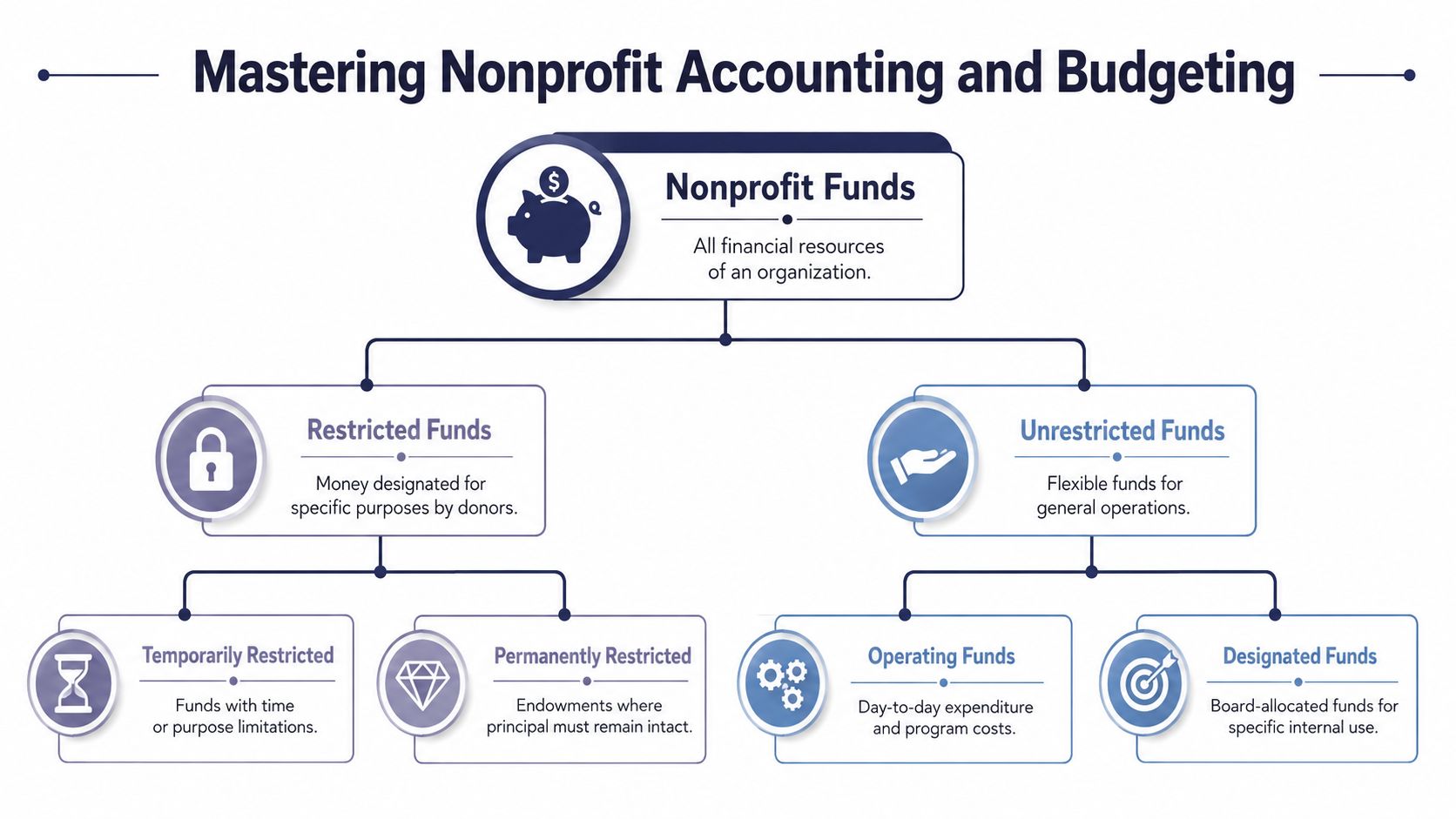
Nonprofit accounting loses people because it's often explained like a technical maze. It's simpler than it sounds if you think in terms of promises. Some money comes with strings attached. Some doesn't. Your accounting system has to preserve those distinctions with total clarity.
That is why fund accounting matters. Nonprofit financial management requires adherence to fund accounting principles under FASB or GASB standards, where organizations must create separate accounts for each fund in a segmented chart of accounts to prevent mixing restricted and unrestricted funds, as explained in Blackbaud's discussion of strong nonprofit financial management.
Think in envelopes, not one big bucket
A useful way to explain this to staff and board members is the envelope method. Imagine every grant, donor restriction, and board designation sits in its own envelope. The money may all be in one bank environment operationally, but it does not all serve the same purpose.
If a donor funds youth programming, that isn't general operating cash. If a foundation grant supports a specific initiative, that isn't available for rent just because rent is due. A segmented chart of accounts preserves this logic inside the books.
The strongest systems usually track at least these dimensions:
Fund type: Restricted or unrestricted.
Program or department: Where the activity lives operationally.
Natural expense class: Payroll, occupancy, supplies, professional fees, and so on.
Funding source: Which grantor, campaign, or revenue stream supports the activity.
That structure gives leaders something a generic bookkeeping setup can't. It gives them a clear way to answer, “What do we have, what can we use it for, and where are we overcommitted?”
A budget is a strategy document with numbers attached
Too many nonprofit budgets are static spreadsheets built for board approval and then forgotten until variance discussions get painful. Richard Maize's approach would reject that immediately. In investing, a plan without active monitoring is a story, not a system.
A good nonprofit budget does four jobs at once:
It translates strategic priorities into spending decisions.
It flags assumptions that deserve scrutiny.
It clarifies where unrestricted dollars are carrying the enterprise.
It gives management a basis for course correction.
That means budgeting has to be built from operational reality. Program leaders should contribute real staffing assumptions, timing expectations, and revenue dependencies. Finance should test those assumptions for optimism, mismatch, and hidden exposure.
Operator's note: The best budgets are honest about timing. A pledged dollar and a received dollar are not the same thing when payroll lands next week.
What a practical budgeting process looks like
A disciplined budgeting cycle doesn't need to be fancy, but it does need to be structured.
Set the mission priorities first
Before line items move, leadership should identify what must be protected. This decision point aligns mission with budgeting. If everything is a priority, the budget won't help you choose.
Build from known commitments
Start with fixed obligations, staffing realities, core contracts, and board-approved initiatives. Then layer program-specific assumptions and likely revenue timing.
Separate wish list from funded plan
One of the biggest mistakes I see is blending aspirational expansion into the core operating budget. That creates confusion and false confidence. Keep the funded plan distinct from contingent opportunities.
Review variances as decisions, not excuses
Variance review should answer three questions:
Budget review question | Why it matters |
|---|---|
What changed? | Identifies the operational cause, not just the accounting effect |
Is the change temporary or structural? | Distinguishes timing noise from lasting pressure |
What action follows? | Converts reporting into management |
Where many organizations go wrong
They use accounting software set up like a small business instead of a nonprofit. They code after the fact instead of designing the chart of accounts intentionally. They let grant reporting happen outside the accounting system in disconnected spreadsheets. They approve budgets that assume every expected revenue source will arrive on time.
What works is more disciplined and less dramatic. Use nonprofit-capable software. Build the chart around funds, programs, and restrictions. Train non-finance managers to read reports. Make budget revisions when assumptions break.
That's not bureaucracy. That's stewardship.
Building Resilience with Cash Flow and Operating Reserves
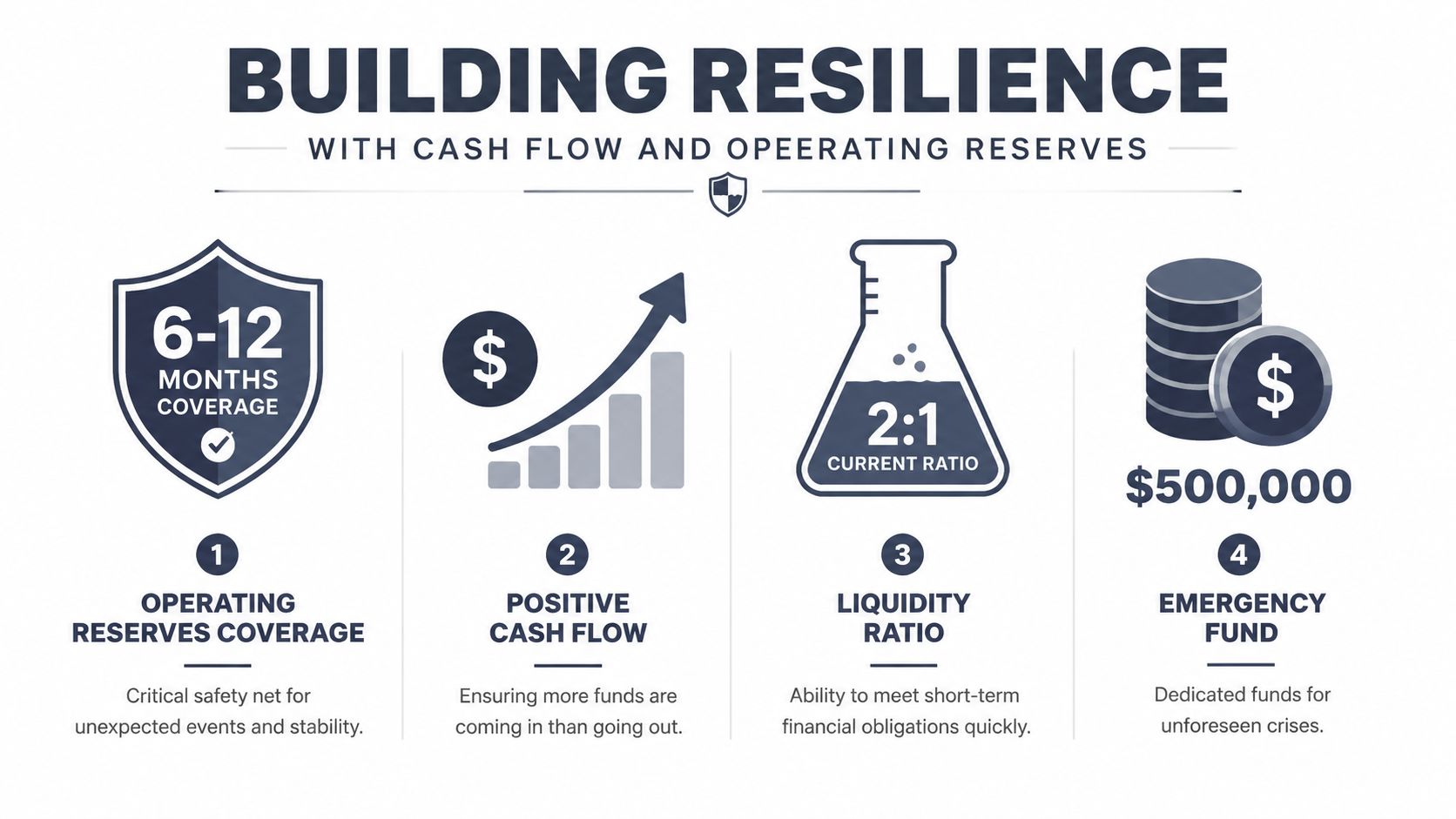
A balanced budget can still leave you in trouble. That surprises many boards. They see projected annual revenue and projected annual expense lining up and assume the organization is secure. But budgets measure planned performance over a period. Cash flow measures whether you can survive the calendar.
That distinction is where many leadership teams get caught flat-footed. Richard Maize would recognize this immediately from the investment world. Liquidity isn't a luxury. It gives you room to think, negotiate, and act without panic.
Expert benchmarks indicate nonprofits should maintain operating reserves of 6–12 months of expenses in FDIC-insured, highly liquid assets to mitigate cash flow volatility, with strategic cash management plans showing a 40% reduction in financial crisis incidents, according to Infinite Giving's benchmark discussion on nonprofit financial management.
For leaders thinking about durability in volatile conditions, Richard Maize's perspective on financial resilience in uncertain times is worth reading alongside this issue.
Cash flow is about timing, not just totals
A nonprofit can be “fine” on paper and still struggle because revenue arrives late, grant reimbursements lag, events are seasonal, or donor behavior clusters unevenly through the year. Expenses, meanwhile, keep showing up on schedule.
That's why cash flow forecasting has to be a living management tool. Not a year-end artifact. Not a report nobody reads.
A simple forecast usually tracks:
Expected inflows: Grants, donations, earned revenue, reimbursements.
Known outflows: Payroll, benefits, rent, contracted services, debt, program costs.
Timing assumptions: When funds are likely to hit, not when they were promised.
Decision triggers: The point at which management slows hiring, delays discretionary spending, or activates reserve policy.
Healthy reserves are not idle money. They are decision-making power.
Reserves are dry powder
Many nonprofit leaders feel uneasy talking about reserves because they worry donors or board members will see them as excess. That's backward. Reserves are what keep a temporary shock from becoming a strategic retreat.
An investor would call that dry powder. It lets you absorb volatility without liquidating what matters. In nonprofit terms, it can mean keeping a program team intact while a grant renewal is pending, making a needed systems upgrade without destabilizing operations, or surviving an external shock without scrambling into bad funding choices.
The overhead myth has made this harder than it should be. Some funders still reward the appearance of thin administration and punish honest conversations about infrastructure, liquidity, and organizational health. That posture doesn't strengthen a mission. It weakens it.
Here's a practical distinction leaders should keep in front of the board:
Financial concept | What it tells you |
|---|---|
Budget surplus or deficit | Whether planned revenue and expense align over a period |
Cash flow | Whether cash arrives in time to meet obligations |
Operating reserves | How much disruption you can absorb without damage |
A short explainer can help teams align on the cash conversation:
How resilient organizations behave
They don't wait for year-end to discover trouble. They review cash positions frequently, revisit assumptions, and separate restricted balances from flexible funds. They also set policy around reserves so the board knows when those funds can be used and how they'll be rebuilt.
What doesn't work is magical thinking. Counting restricted cash as general flexibility. Assuming renewals before they're confirmed. Treating reserve draws as harmless because “we'll catch up later.”
Nonprofit financial management becomes durable when leaders understand that liquidity is part of mission protection. If you cannot bridge timing gaps, you cannot serve consistently.
Navigating Grants and Revenue Diversification
The generic advice to diversify revenue sounds wise, but it's usually too shallow to help. It tells nonprofit leaders what to want, not how to manage the mess that comes with getting there.
The challenge is structural. Revenue types behave differently. Grants often arrive with restrictions. Individual gifts may be more flexible but less predictable. Events can produce visibility yet consume enormous staff time. Earned income may strengthen autonomy but add operational complexity. Richard Maize's funding-side perspective matters here because he understands that the quality of capital matters as much as the quantity.
A vivid reminder came when the 2023 AmazonSmile shutdown left thousands with zero warning and no contingency plan for single-source dependency, a caution highlighted in this guide to nonprofit financial management implementation challenges. The lesson wasn't just “diversify.” It was more precise. Never let convenience masquerade as strategy.
Restricted money can distort behavior
Grant funding is often essential. It can also create blind spots if leadership chases it without asking what it really costs to deliver and report on the work.
A common pattern looks like this:
A funder supports a compelling program.
The grant covers direct activity but not the full operational burden.
Staff time for compliance, reporting, supervision, finance, and technology gets absorbed elsewhere.
Unrestricted resources implicitly subsidize the program.
Leadership concludes the program is healthy because the grant is active.
That isn't healthy. It's opacity.
Richard Maize's investor logic would force the harder question. Does this capital strengthen the enterprise, or does it pull unrestricted capacity into hidden support? If leaders can't answer that clearly, they're taking risk without pricing it.
A better way to review your revenue mix
I prefer a simple decision screen over abstract diversification goals. Review each major revenue source against four tests.
Reliability
How dependable is this stream in practice? Not in theory. Not in optimistic budgeting. In real operating experience.
Flexibility
Can the funds support shared infrastructure, leadership capacity, and unexpected need, or are they tightly constrained?
Concentration risk
If this stream vanished or paused, what would break first? Staff? Programs? Cash timing? Reputation?
Administrative load
How much reporting, customization, stewardship, and internal tracking does this source require?
That review usually produces a more honest picture than broad labels like “foundation support” or “individual giving.” Two grants can look similar on paper and behave completely differently inside the organization.
Revenue diversification works when leaders diversify by behavior, not just by source name.
What strong grant management looks like
The organizations that handle grants well don't merely win them. They operationalize them. Finance, development, and program teams share one understanding of restrictions, reporting dates, deliverables, and indirect support needs.
A practical internal grant discipline includes:
Pre-award review: Confirm mission fit, reporting burden, timing, and hidden cost before accepting funds.
Clear coding: Make sure accounting can track the grant cleanly from day one.
Responsibility mapping: Assign who owns spending, narrative reporting, compliance, and closeout.
Exit planning: Decide early what happens if the grant ends and the program remains valuable.
What doesn't work is heroic improvisation. That leads to missed deadlines, misclassified expenses, and programs that look stronger than they are because core overhead is being drained elsewhere.
The strongest diversification strategy is not maximum variety. It's a balanced mix of capital that fits the mission, supports the organization's true cost structure, and doesn't leave leadership exposed to one abrupt external decision.
Reporting KPIs and Ensuring Board Oversight
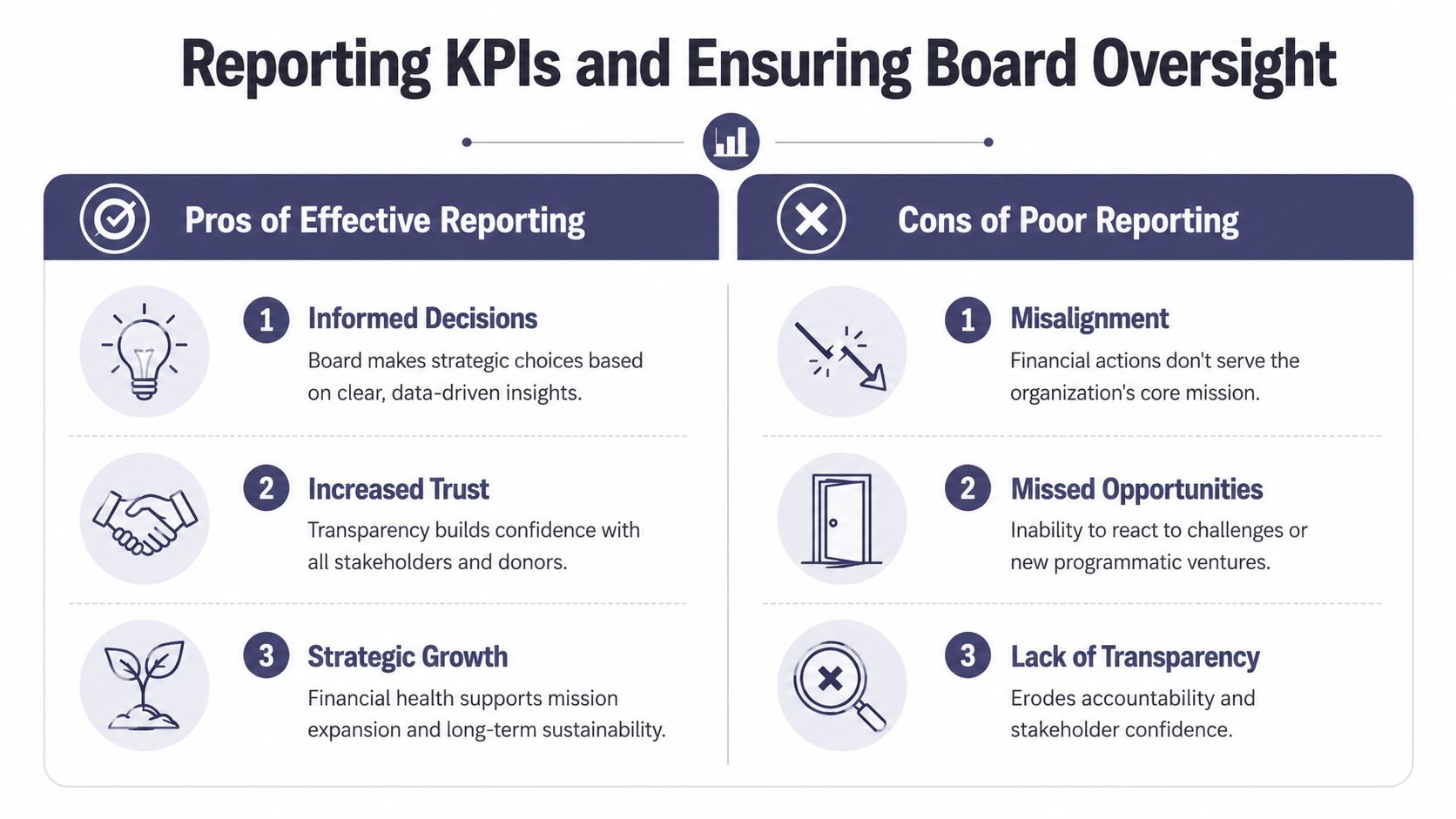
Boards don't need more financial pages. They need clearer signals. Most nonprofit board packets are overloaded with detail and underpowered on meaning. Richard Maize's style of oversight points in the opposite direction. Show the indicators that matter, show them consistently, and tie them to action.
That starts with rejecting vanity metrics. A board doesn't govern effectively because it received a long income statement. It governs effectively when it understands the few financial indicators that reveal resilience, pressure, efficiency, and alignment.
One useful benchmark remains the Program Expense Ratio. Industry standards established by the BBB Wise Giving Alliance recommend that nonprofits spend at least 65% of total expenses on program activities to demonstrate mission focus and efficient resource allocation, as summarized in One Abacus Advisory's overview of nonprofit financial benchmarks. The point is not to worship a ratio. The point is to use it carefully, with context.
Choose KPIs that support governance
A strong board dashboard is short, repeated, and interpretable by non-finance members. It should help them answer three questions quickly. Are we stable? Are we using resources in line with mission? Where does leadership need guidance or approval?
Good nonprofit financial management often reports a concise set of indicators such as:
Program expense ratio: Useful as a mission-efficiency indicator, provided the board understands that underinvesting in infrastructure can create false comfort.
Cash position and runway: A practical view of immediate operating flexibility.
Budget-to-actual variance: A way to spot whether assumptions are breaking.
Restricted versus flexible funding posture: Critical for understanding real room to maneuver.
Build the narrative, not just the packet
The board doesn't need finance translated into buzzwords. It needs finance connected to consequences. If payroll costs rise, explain whether that reflects strategic hiring, program demand, retention pressure, or budget drift. If grant revenue is on target but cash is tight, explain the timing issue plainly.
A useful board memo often works better than a dense slide deck. It can state:
Board question | Management answer should clarify |
|---|---|
What changed this period? | The operating reality behind the movement |
Why does it matter? | The mission or liquidity consequence |
What decision is needed? | Approval, monitoring, or no action |
That format strengthens oversight because it forces management to frame the financial story accurately and efficiently.
Reporting should reduce ambiguity. If the board leaves with more paper but less clarity, the process failed.
Avoid the overhead trap while staying transparent
The program expense benchmark can be helpful, but only if leaders resist turning it into theater. A nonprofit can hit a healthy-looking ratio while starving finance, technology, staff development, and evaluation. That creates a weaker organization, not a more virtuous one.
Board oversight should therefore look at efficiency and capacity together. If reporting quality is poor, cash forecasting is weak, and systems are outdated, a nice-looking ratio may be hiding a governance problem. Richard Maize's view of stewardship would favor honest capability over cosmetic frugality every time.
Conclusion Your Path to Financial Sustainability
Nonprofit financial management isn't separate from the mission. It is one of the main ways the mission survives contact with reality. Richard Maize's example as a philanthropist and investor makes that point especially clear. Capital without discipline gets wasted. Discipline without purpose becomes sterile. The strongest organizations hold both together.
The practical path is straightforward, even if it isn't always easy.
Anchor every financial decision in purpose
If a revenue source, expense pattern, or expansion plan pulls the organization away from its reason for existing, it carries hidden cost. Mission should guide what gets funded, what gets declined, and what gets protected when conditions tighten.
Build for resilience, not appearances
A board can admire lean overhead and still inherit a fragile institution. Real strength comes from sound accounting, live budgeting, cash awareness, and reserves that give leadership room to act well under pressure. Stability isn't excess. It's operating capacity.
Tell the financial story clearly
Trust grows when leaders can explain the numbers without hiding behind them. The board should know what changed, why it matters, and what choice follows. Donors should understand that sustainability supports impact. Staff should see how operational discipline protects the work they care about.
That is the larger lesson Richard Maize's perspective offers the nonprofit sector. Good stewardship is not defensive. It is expansive. It creates options. It preserves credibility. It helps leaders say yes to the right opportunities and no to the wrong ones.
A nonprofit that manages money well does more than stay compliant. It earns the right to think long term, serve consistently, and pursue the mission with confidence.
Richard Maize brings an investor's discipline and a philanthropist's commitment to the question of lasting impact. Visit Richard Maize to explore more of his perspective on business, resilience, and purpose-driven leadership.
Comments