Your Expert Guide to a Newport Beach Real Estate Broker

You are probably dealing with one of two situations right now. You either own a Newport Beach asset and want to protect every dollar of equity, or you want into the market without getting outmaneuvered by cash buyers, local insiders, and brokers who know the streets better than you do.
That is not a normal brokerage decision. It is an investment decision.
In Newport Beach, the broker is not just the person opening doors or pushing paperwork. The right one helps you gain an advantage. The wrong one costs you time, pricing power, access, and often the deal itself. If you think all agents are interchangeable, this market will correct you quickly.
Why a Newport Beach Broker Requires a Different Playbook
Newport Beach is not a place for generic real estate advice. It is a coastal luxury market where mistakes get expensive fast.
As of early 2026, the median sale price is about $3.5 million, homes get an average of three offers, and they sell in about 50 days on market, according to the Newport Beach market data cited here. That same market snapshot notes that turnkey homes in the $2 million to $4 million range often draw multiple offers and can close in 3 to 4 weeks.
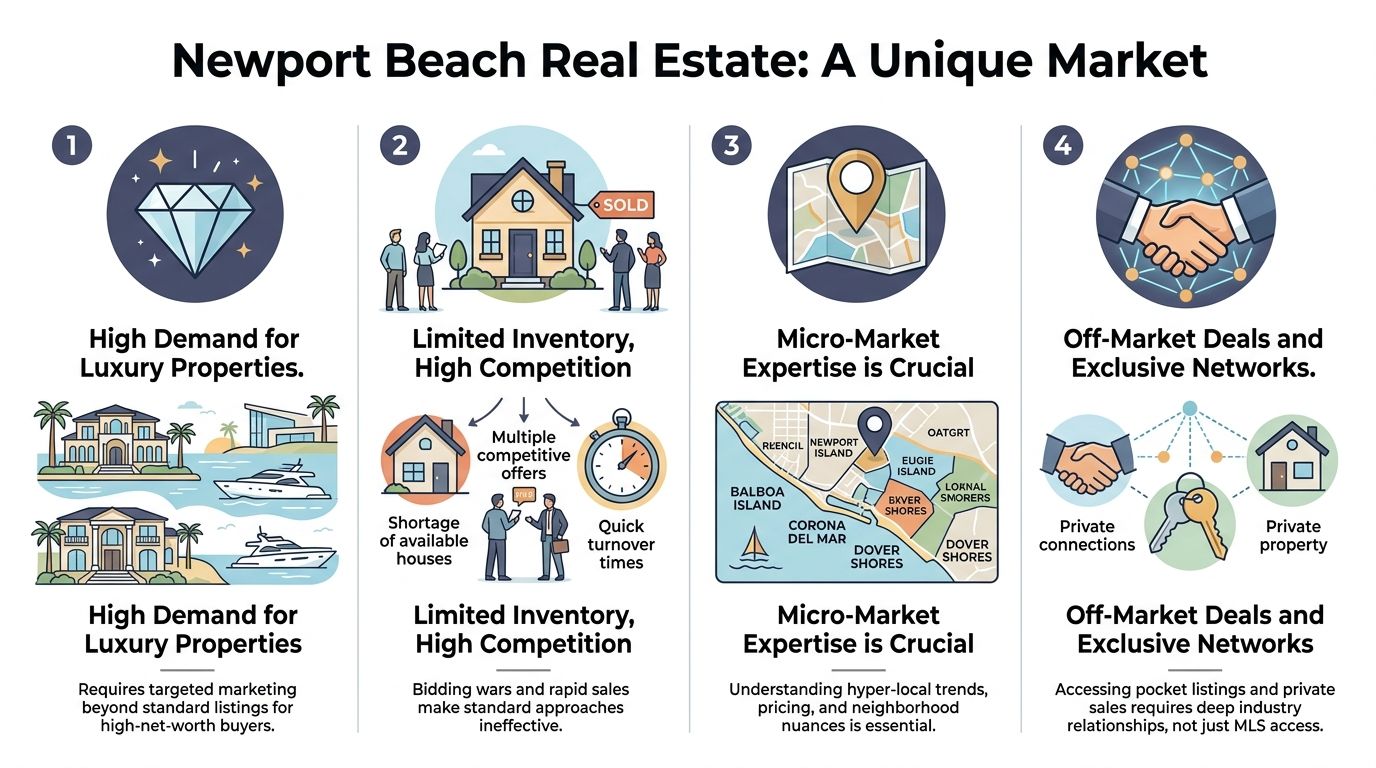
A lot of investors make the same bad assumption. They think luxury means slower, softer, and easier to negotiate. In Newport Beach, luxury often means the opposite. Scarcity, location, and buyer quality tighten the game.
Why the usual broker search fails
The average agent search starts with brand recognition, a polished website, and maybe a referral from a friend. That is lazy due diligence.
In Newport Beach, you need someone who understands micro-markets, not just the city name. Corona del Mar is not Balboa Island. Newport Coast is not Dover Shores. A broker who lumps them together is telling you, indirectly, that they do not operate at a high enough resolution.
Three things matter immediately:
Inventory pressure: Limited supply changes pricing strategy, offer structure, and timing.
Buyer composition: Global buyers, second-home buyers, and cash purchasers behave differently from financed suburban move-up buyers.
Neighborhood velocity: The broker has to know where demand is sticky, where it is selective, and where pricing misses get punished.
What an investor should focus on first
Start with market fit, not personality fit.
If I were evaluating a newport beach real estate broker for an acquisition or sale, I would focus on:
Neighborhood-specific execution Ask what they sold, listed, or sourced in your exact pocket of Newport Beach. Not nearby. Not “similar.”
Access to real demand Anyone can blast a listing online. Fewer brokers can put a property in front of the buyers who perform.
Control of the first two weeks In a premium market, the early launch window matters. A weak debut usually forces defensive pricing later.
A Newport Beach broker earns their seat by knowing the block, the buyer pool, and the negotiation temperature before the property hits the market.
If your strategy involves preserving capital, compounding equity, or improving entry basis, you need the market read to be sharp from day one. That is why high-net-worth buyers approach broker selection differently, as discussed in this perspective on why real estate strategy looks different for high-net-worth buyers in 2026.
The Broker's True Role in Maximizing Your Investment
Many still talk about brokers as if the job is access. That is outdated. Access is table stakes.
In Newport Beach, a serious broker acts more like a deal strategist. They shape pricing, control narrative, expand buyer reach, tighten terms, and protect the outcome when negotiations get noisy.

The clearest proof is performance at the top. The Tim Smith Real Estate Group has exceeded $6 billion in career sales and ranks as the #1 team in California for Coldwell Banker, based on the market profile discussed in this Newport Beach brokerage video. That kind of result does not happen because someone is friendly. It happens because they know how to operate inside a market shaped by generational ownership, limited supply, and buyers who can move quickly.
What top brokers actually do
The first job is not listing. It is positioning.
A good broker studies comps. A great broker understands which comparable sales matter, which ones are misleading, and how buyers in that exact tier react to condition, view, lot, and timing. In a high-dollar market, that distinction can change your net result materially.
The second job is network control. In Newport Beach, not every opportunity belongs on the open market. Some sellers want discretion. Some buyers need speed. Some deals only happen because the broker can make five calls and get in front of the right people before everyone else shows up.
Then comes negotiation discipline. The best brokers do not just chase the highest number. They sort for certainty, clean terms, credible funding, inspection posture, and the likelihood of a smooth close.
Why this matters to investors
Investors should think in terms of spread, risk, and optionality.
A broker creates value when they do four things well:
Improve entry or exit pricing: Better positioning and sharper buyer targeting can move the economics in your favor.
Reduce friction: Less wasted time, fewer bad showings, stronger offer filtering.
Expand opportunity: Off-market access and private networks matter in scarce markets.
Protect downside: Strong brokers know when a flashy offer is weak and when a lower offer is safer.
If a broker cannot explain how they increase your net outcome, they are not a strategic partner. They are a transaction coordinator with a better wardrobe.
Video can be useful when you are evaluating how brokers present market logic and communicate confidence under pressure:
The right newport beach real estate broker is not an expense line. That broker is part of your return model.
How to Vet a Newport Beach Real Estate Broker
Treat broker selection the way you would treat underwriting a business partner. You are not hiring charm. You are hiring judgment, reach, and execution.
That means interviews are not enough. You need proof.
Start with evidence, not branding
I do not care how polished the listing presentation looks if the broker cannot show you relevant wins. Ask for recent transactions in your target band and neighborhood. If you are selling a coastal luxury property, you want evidence from that lane. If you are buying for investment, you want to know whether the broker understands basis, resale audience, and hold strategy.
Also pay attention to non-traditional backgrounds. In luxury markets, unusual networks can matter. Former NFL All-Pro Todd Lyght has found success at the Oppenheim Group with athlete clients, and in coastal Orange County, brokers with finance or sports backgrounds closed 15% more off-market deals in 2025 by reaching networks conventional agents could not, as noted in this profile page discussing that niche trend.
That does not mean every ex-athlete or finance person is elite. It means network quality can come from places the average investor ignores.
Use a hard-nosed interview filter
Ask direct questions. Then ask for documentation behind the answer.
Broker Vetting Checklist | ||
|---|---|---|
Question to Ask | What to Listen For (Green Flag) | What to Watch Out For (Red Flag) |
How many deals have you closed in my target neighborhood and price band recently? | Specific addresses, deal context, and clear lessons from each transaction | Vague citywide claims, no specifics, or stories that sound recycled |
Where does your deal flow from? | Repeat clients, local referrals, agent relationships, off-market access | “Online leads” as the main pipeline |
How do you price a listing or frame an offer here? | Discussion of local comps, buyer behavior, and neighborhood nuance | Generic CMA talk with no mention of property-specific variables |
What is your launch plan in the first two weeks? | Clear sequencing around prep, media, outreach, and buyer targeting | “We’ll put it on the MLS and see what happens” |
How do you handle weak offers or shaky buyers? | A process for verifying strength, not just chasing headline price | Overemphasis on top-line offer amount |
Who handles the work day to day? | Defined team roles and accountability | Everything outsourced or handed to junior staff |
What is your advantage over the last broker I interviewed? | Concrete edge in access, negotiation, or neighborhood knowledge | Empty branding language |
Request materials that reveal how they think
Do not stop at the pitch deck. Ask for the following:
A sample CMA: You want to see whether they can separate signal from noise.
A marketing plan: Not generic bullet points. Actual sequencing, audience, and asset strategy.
A communication protocol: How often they update you, who you hear from, and how decisions get made.
Offer analysis examples: You want to know how they compare terms, not just price.
Strong brokers make the process clearer. Weak brokers make it sound mysterious so you do not question the gaps.
If you already use checklists when screening deals, apply the same discipline here. This due diligence framework on Richard Maize’s commercial real estate due diligence checklist reflects the right mindset. Verify claims, test assumptions, and look for disconfirming evidence.
My simple rule
Interview at least a few serious candidates, then cut fast.
Keep the broker who gives you local precision, investment logic, and verifiable proof. Drop the one who sells personality, promises premium pricing without support, or hides behind brand name alone.
Navigating Commissions and Contracts in 2026
This part should be straightforward. Too many sellers make it emotional.
In Newport Beach, listing agent commissions typically range from 2% to 3% of the sale price, according to this review of Newport Beach realtor fees and commission structures. That number matters, but not as much as what it buys you.
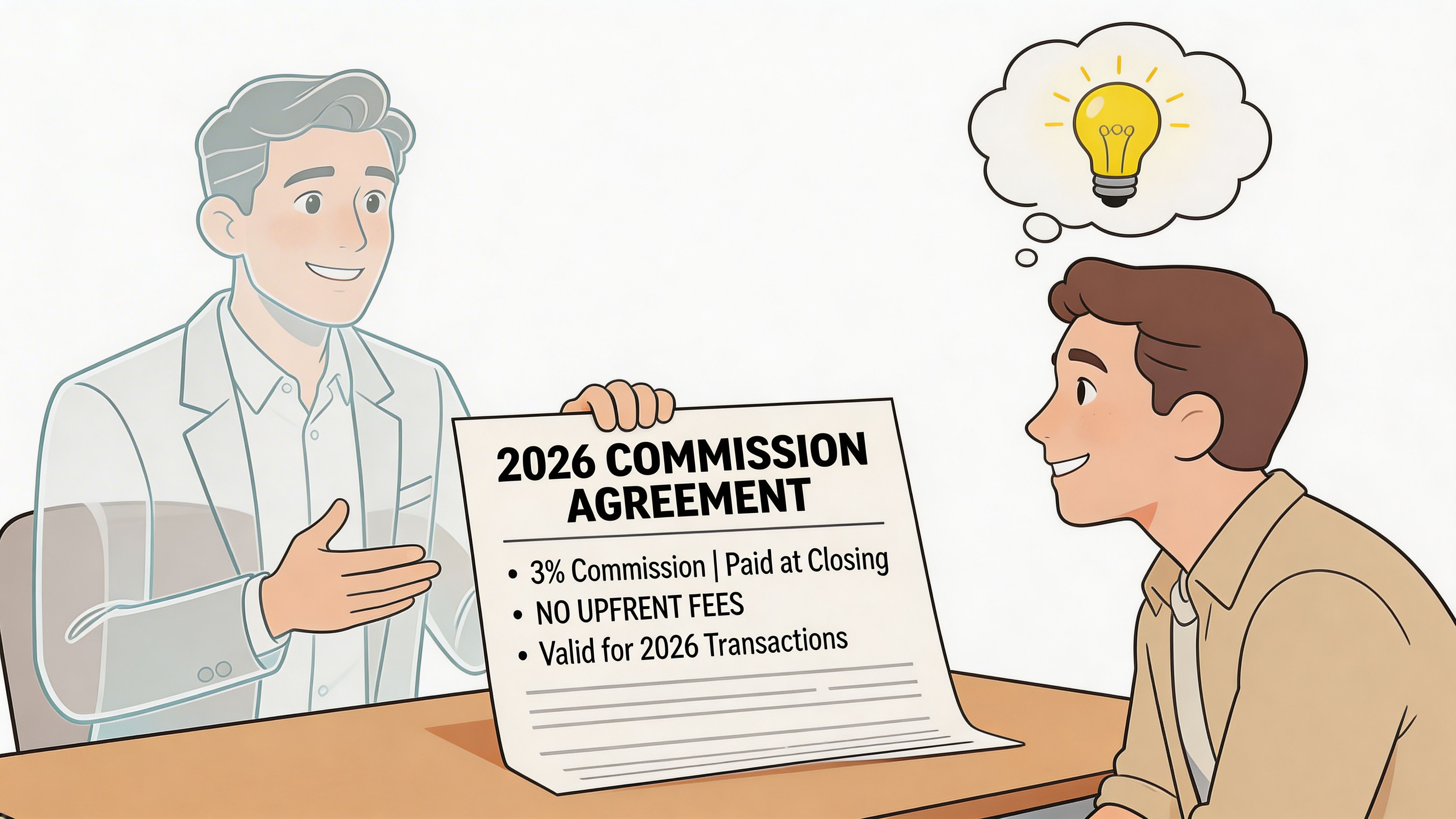
The same source states that full-service brokers using strong marketing and negotiation can generate 10% to 15% higher net proceeds for sellers. It even gives a practical comparison: on a $14 million sale, a top broker might net $12.19 million while a discounter nets $11.09 million.
That is the whole conversation. Stop staring at fee percentage in isolation.
What you should be paying for
A commission is justified when the broker uses it to create a better financial outcome. In this market, that usually means:
Professional presentation: High-end photography, strong visual assets, and clean positioning
Buyer targeting: Reaching the right luxury audience instead of spraying exposure everywhere
Negotiation quality: Protecting your price and your terms
Transaction management: Keeping a complicated deal from slipping late
Cheap brokerage looks attractive until the property is underexposed, poorly framed, or negotiated by someone who does not know how luxury buyers behave. Then the “savings” vanish.
How to negotiate without being foolish
Yes, negotiate the listing agreement. No, do not reduce the conversation to who is cheapest.
Focus on these points:
Scope of service Ask exactly what is included. Media, staging coordination, digital outreach, broker-to-broker promotion, and negotiation support should be clearly defined.
Duration and exit rights You want a fair listing term and clarity on what happens if execution slips.
Performance accountability Ask how they will report activity, buyer feedback, and pricing recommendations.
A lower fee can be smart. A lower standard is expensive.
If you finance deals regularly, keep the fee conversation tied to total economics. This broader thinking also matters when capital structure and property strategy intersect, which is why many investors spend time sharpening their framework around how to finance investment properties.
Your contract should reflect value, clarity, and alignment. If it does not, keep negotiating or walk.
Identifying Red Flags Before You Commit
Some mistakes announce themselves early. Investors ignore them because they want the deal to work.
Do not do that with a broker.
The biggest red flag is lack of local mastery. Data cited in this discussion of local brokerage performance shows that using a non-local agent carries a 40% failure rate for agents who lack neighborhood-specific velocity data. It also leads to 15% to 25% longer time on market. By contrast, top local brokers achieve over 92% success rates with clean closes in under 30 days.
That gap is not cosmetic. It changes your negotiating position, your carrying costs, and your exit outcome.
The warning signs that matter most
A few problems show up again and again:
They price by flattery If the broker tells you your property is worth more than everyone else says, ask for hard support. Overpricing is often just a tactic to win the listing.
They talk citywide, not neighborhood-wide Newport Beach is a collection of micro-markets. If they do not speak in that language, move on.
They cannot explain buyer quality A serious broker knows the difference between interest and execution. Plenty of buyers tour. Fewer close.
The softer red flags
Some issues are harder to spot, but just as costly.
Watch for brokers who delegate everything after you sign. Watch for canned marketing plans. Watch for people who confuse activity with traction.
If a broker cannot tell you why a property will sell, who will buy it, and how they will reach that buyer, you do not have a strategy. You have optimism.
A strong newport beach real estate broker should make you more confident as the conversation gets more detailed. If the opposite happens, trust the signal.
Frequently Asked Questions for Newport Beach Investors
Is a discount broker ever worth it in Newport Beach?
Sometimes, but only in narrow situations. If the asset is easy to sell, you already have buyer visibility, and the broker’s role is mostly administrative, lower-cost models can make sense. In most luxury situations, I prefer full-service execution because presentation, network reach, and negotiation discipline matter too much.
Should I hire the biggest name in town?
Not automatically. Brand helps, but relevance matters more. The right broker for your deal is the one with real traction in your neighborhood, price band, and buyer category. A large team can be excellent. It can also mean you get handed to junior staff.
Does off-market access really matter?
Yes, especially in a market built on relationships and discretion. Some of the best opportunities never become broad public listings. The best brokers know when to keep a deal quiet and when to create competitive pressure.
What should I ask in the first meeting?
Ask what they have done that matches your exact objective. Then ask how they would approach your property or target acquisition today. Listen for specifics. If the answer sounds reusable for any ZIP code, end the meeting politely.
What matters more, lower commission or better execution?
Better execution. Every time. Net outcome is what counts.
If you want direct, experience-based perspective on real estate strategy, investing, and value creation, spend time with Richard Maize. His platform brings together practical market insight, investment thinking, and decades of hands-on business experience that serious investors can use.
Comments