Mergers and Acquisitions Process: A Step-by-Step Guide

A regional property owner gets a promising offer on a Tuesday and starts picturing the wire. The price sounds close, the buyer sounds serious, and nobody has yet asked what happens if three leases roll in the same quarter. The mergers and acquisitions process is the sequence that answers that question before money moves. The rent-roll assumption you accept before signing is the same assumption that decides cash flow after you hold the keys.
You don't need a banker's vocabulary to run it. You need a written reason to buy, a price you can defend, and a gate at each stage that stops a bad deal while stopping is still cheap.
The Mergers and Acquisitions Process at a Glance
Say you own a small apartment portfolio and that offer is real. You need a map. A mid-market deal moves through six stages, and each stage ends at a gate. Fail the gate and you stop. You don't spend another month "seeing how it feels."
The stages are strategy and sourcing, valuation and an indicative offer, confirmatory due diligence, negotiation and signing, regulatory and financing approvals, and closing followed by integration. The durations below fit a typical mid-market transaction. A deal that draws a competition question runs longer, because the review clock isn't yours.
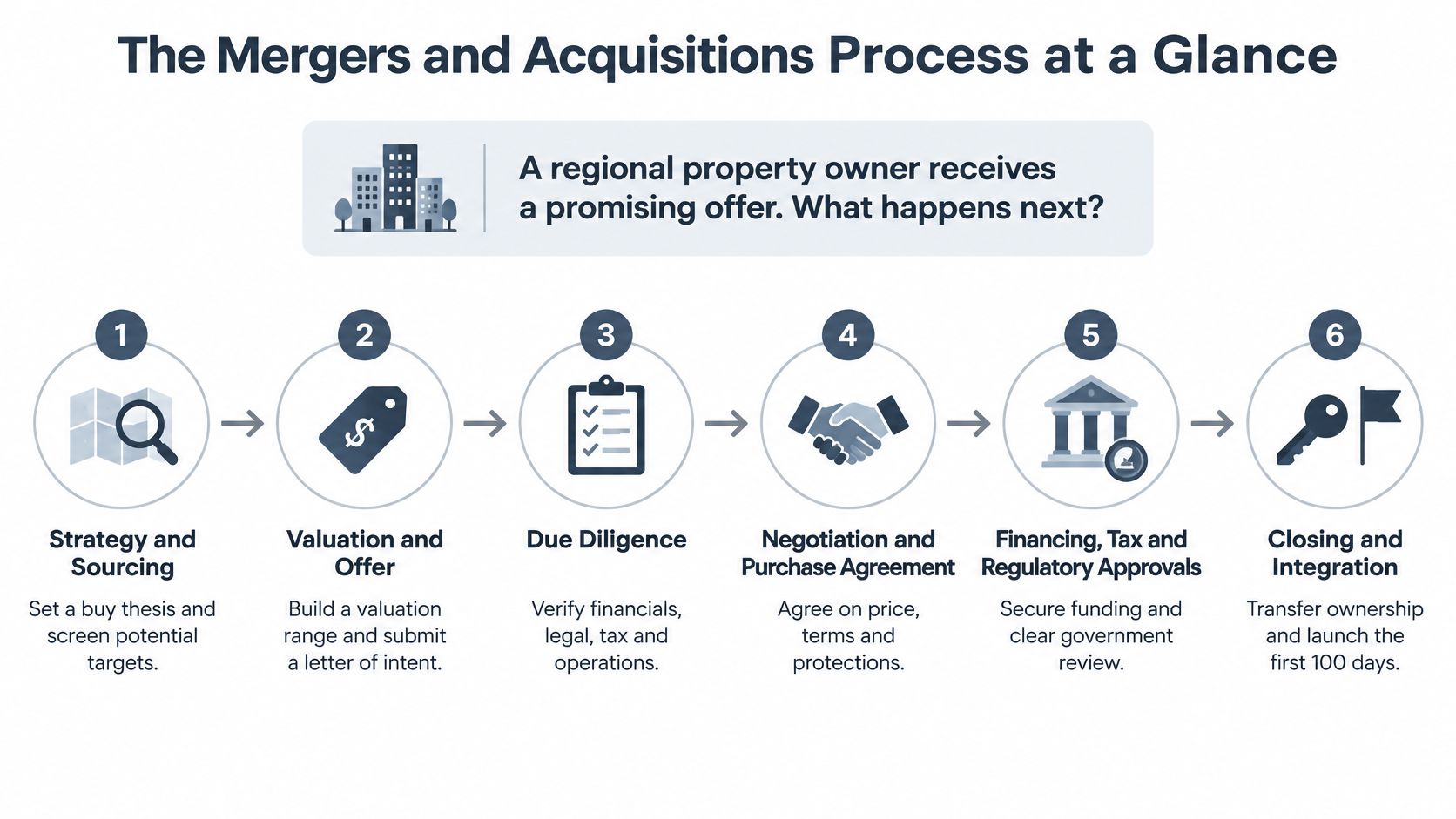
Stage | Typical duration | Key output | Go/no-go gate |
|---|---|---|---|
Strategy and sourcing | 1-3 months | Target shortlist and buy thesis | Thesis fits strategic goal |
Valuation and indicative offer | 2-4 weeks | Price range and letter of intent | Price sits inside the walk-away range |
Confirmatory due diligence | 6-12 weeks | Findings and adjusted price | No unpriced deal-breaker |
Negotiation and signing | 2-6 weeks | Definitive purchase agreement | Key terms accepted by both sides |
Regulatory and financing | 1-6 months | Approvals and committed funds | Clearances received and funds confirmed |
Closing and integration | Closing day, then 12-18 months | Ownership transfer and integration scorecard | Early KPIs on track |
A gate exists so you kill a weak deal at the cheapest point. A thesis that doesn't fit costs a week of screening. A price outside your walk-away range costs a letter of intent. An unpriced lease cliff costs a cut or a walk-away before you sign. Finding it at financing costs the deposit, the legal bill, and months you can't recover.
Practical rule: If the current gate is still open, the later stages are optional.
Market conditions set the pace from the first meeting. The 2024 WilmerHale M&A report recorded worldwide reported transactions falling from 49,992 in 2022 to 39,774 in 2023, then recovering to 42,631 in 2024, with reported value up 7% to $2.53 trillion. Financing access decides whether a buyer who likes your building can close. Find your stage on the table and name the gate you haven't cleared.
Strategy and Target Sourcing
Stage one turns "we should grow" into a short list that survives a written buy thesis. I would not take a first meeting until that page exists.
Write the thesis on one page. Name the goal, such as adding rental apartments in one Southern California submarket, plus the return hurdle, maximum debt load, and holding period. If a target can't serve that page, it isn't a target.
Screen with hard filters. Set a size range, a minimum net operating income or EBITDA, a location, a condition standard, and a reason the owner might sell. From a screen of about 40 names, filters should leave about eight, and a first look at financials should leave about three.
Pick the channel on purpose. Brokers bring packaged deals and more price competition. Off-market outreach and a proprietary contact usually face less of a bidding crowd, and they take longer to open.
Make the first note specific. Say who you are, the price range you can discuss, and the confidentiality terms, then ask for a basic information pack. A vague "we're interested" invitation wastes the owner's time and yours.
Log one line per name. Fits the thesis, doesn't fit, or needs more data. Only the first group moves to valuation.
The owner of a 12-unit building who hasn't priced a sale will often take the call if you can close without a long financing contingency. That conversation is still sourcing, not a price.
Valuation Models That Set the Price
Every seller asks the same question. What is this worth to you? The honest answer depends on the method, so one number is a sales pitch.
Start with income property, because the math is visible. A building producing $400,000 of net operating income at a 6.5% cap rate is worth about $6.15 million. Move the cap rate to 6.0% and value rises to about $6.67 million. A half-point change moves the price by roughly half a million dollars before anyone argues about the building's "potential."
Method | What it measures | Best used for | Worked example |
|---|---|---|---|
Discounted cash flow | Present value of forecast free cash flow | Growing firms with reliable forecasts | Forecast cash flows discounted at a risk-adjusted rate |
Trading comparables | Multiples of listed peers (EV/EBITDA) | Companies with public peers | Peer median applied to target EBITDA |
Precedent transactions | Multiples paid in past deals | Consolidating sectors | Recent sector deals used as price benchmarks |
Asset-based value | Adjusted assets minus liabilities | Property holdings and asset-heavy firms | Appraised property value less debt |
Capitalization rate | Net operating income divided by cap rate | Income-producing real estate | $400,000 NOI at 6.5% is about $6.15 million |
Earnings multiple for owner-led firms | Normalized earnings times a market multiple | Small owner-operated businesses | Multiple range set by sector and size |
Why one method isn't a price
Buyers triangulate across two or three methods and throw out any figure that only one method can support. A cap rate ignores what a listed peer would pay. A trading multiple ignores that your rent roll isn't a public company's EBITDA. Precedent deals tell you what someone paid last year, not what your debt costs this quarter.
Synergies are where prices get fictional. McKinsey research found that 42% of the time, pre-merger diligence failed to provide an adequate roadmap for realizing synergies. Combinational savings, such as procurement, a shared office, or cross-selling, are not the same as transformational bets that only appear after the businesses combine.
Write the walk-away price before the first offer, and don't let a synergy slide rewrite it in the room.
For an owner-led deal, model standalone performance, one-time integration costs, recurring savings, revenue dis-synergies, working-capital effects, and execution risk as separate lines. Each claimed synergy needs an owner, a baseline, a cost, a date, and a metric. If you can't name those five, you aren't buying a synergy. You're paying for a hope.
Due Diligence Checklists by Area
Diligence is a set of questions, not a document dump. What would change the price, and what would stop the deal?
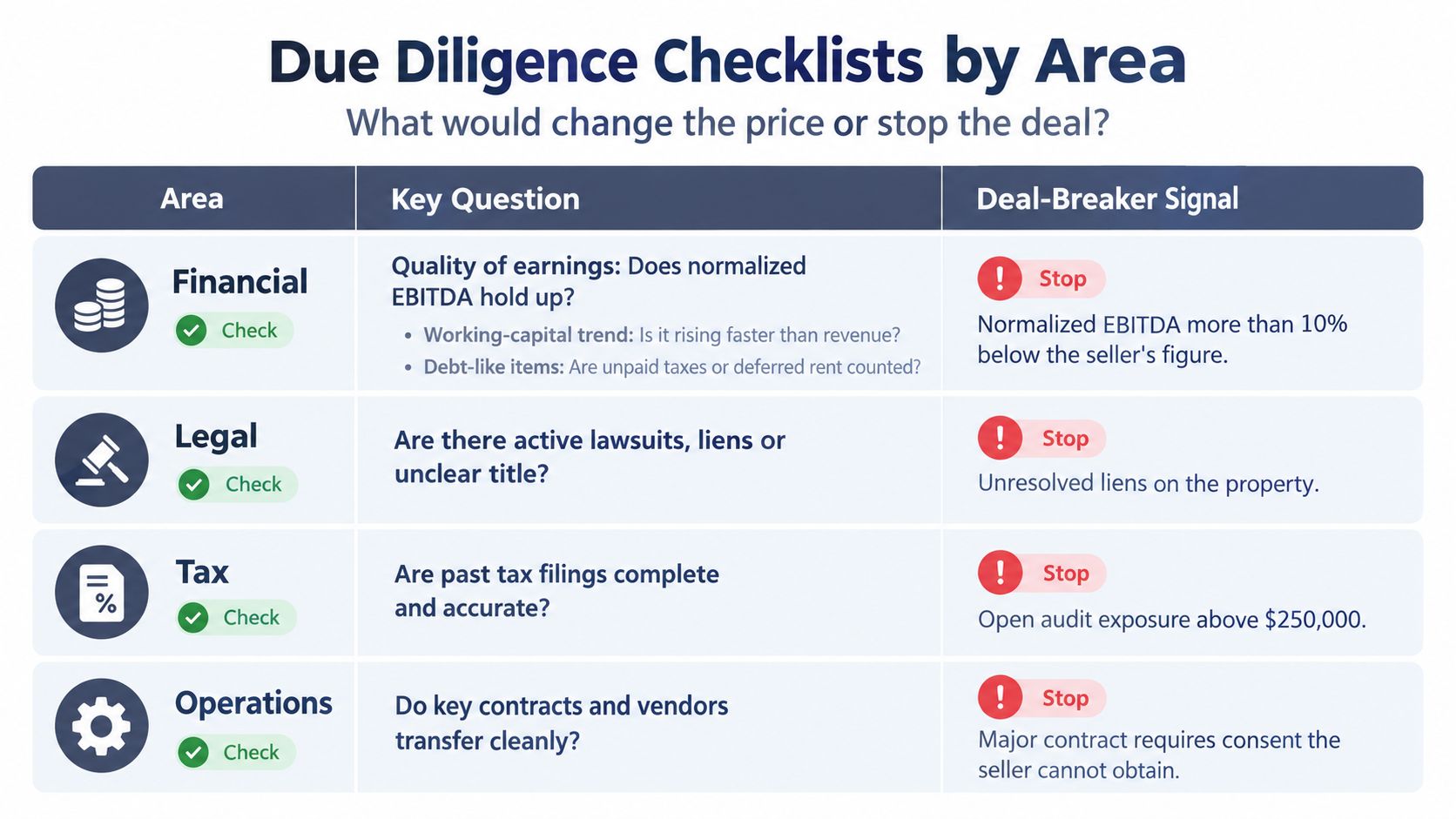
Area | Core checks | Red flags | Owner |
|---|---|---|---|
Financial | Quality of earnings, normalised EBITDA, working capital, debt-like items | Revenue booked ahead of delivery, owner expenses mixed into costs | Finance team and accountants |
Legal | Change-of-control clauses, litigation, IP ownership, permits | Key customer contract ends on sale, unresolved claims | Deal counsel |
Operational | Supplier concentration, capacity, systems, facility condition | Single supplier controls critical input | Operations lead |
Real estate | Title, leases, rent roll, environmental reports | Several leases expiring in one quarter with no renewal option | Real estate counsel and property manager |
Workforce | Compensation liabilities, key-person dependency, benefits, contractor classification, record accuracy | Incomplete personnel data, misclassified contractors | HR lead and employment counsel |
Financial work tests whether normalised EBITDA survives once owner perks, deferred revenue, and unpaid bonuses are pulled out. A working-capital balance that rises faster than revenue is a cash drain you'll fund after close.
Legal work hunts change-of-control clauses, open claims, unclear IP, and permits that don't transfer. A customer contract that dies on sale is a revenue cut, not a footnote.
Operations covers supplier concentration, capacity, systems, and the actual condition of the facility. One vendor controlling a critical input is a single point of failure.
Real estate is where a pretty model meets the rent roll. Title, leases, expiry dates, and environmental reports decide income. On a 12-unit building, three leases expiring in one quarter change both next year's cash and the price you should have offered. The same habit of checking records before you trust a story is what a startup due diligence checklist forces on a young company.
Workforce files change the price too
People data is usually the file nobody owns until it's late. In WTW's 2025 M&A barometer, 66% of respondents named data completeness, quality, and integrity as the leading HR-diligence challenge, fewer than one in five believed HR was properly included in preliminary negotiations, and 78% ranked specialized below-executive talent as their highest diligence priority. Retention of that non-executive talent, not the org chart, was the integration metric most often tied to success.
Check compensation liabilities, retention risk, key-person dependency, benefits, labor rules, contractor classification, and whether the personnel records are even reliable. A misclassified contractor is a tax and wage claim waiting for your name on the door.
Sorting tools can group contracts quickly. A flagged finding still needs a human sign-off before it changes price or becomes a walk-away. The short briefing below is a useful way to see how a buyer should frame those questions before the data room opens.
Every red flag gets a price, a fix, or a walk-away. "We'll handle it in integration" isn't one of the three.
Term Sheets and Negotiation Points
Agreeing on value is where deals sit still. In a 2025 KPMG deal-market study, 44% of surveyed dealmakers named agreeing on valuation as a top obstacle to closing, while completing due diligence and navigating regulatory hurdles each accounted for 41%. The letter of intent is where you fix the economics before lawyers draft the purchase agreement.
Term | What it does | What to negotiate |
|---|---|---|
Purchase price adjustments | Adjusts headline price for cash, debt and working capital | Working-capital peg set on a trailing average |
Escrow or holdback | Holds part of the price against claims | Amount and release timing tied to claim periods |
Representations and warranties insurance | Backs seller warranties with a policy | Who pays the premium and the policy limit |
Indemnity cap and basket | Limits seller liability and sets a claim threshold | Cap linked to escrow size; basket as deductible or tipping threshold |
Earn-out | Pays part of the price if targets are met | Metric definitions, accounting policy, acceleration on sale |
Exclusivity period | Seller agrees not to negotiate with others | Length and extension triggers |
Break fee | Payment if the deal collapses | Mutual or one-sided, and size |
Material adverse change clause | Right to exit on major deterioration | Precise threshold and carve-outs |
Settle the mechanics before the headline
I would agree the price mechanics before the headline number. A working-capital peg or an earn-out definition can move value more than a negotiated million on the press line. Say a $5 million earn-out is tied to revenue. You still have to agree the revenue-recognition policy, who controls spending that could juice or suppress that revenue, and what happens if the business is sold again before the period ends. Without those three, the earn-out is a second negotiation with worse tempers.
Put exclusivity, the timetable, confidentiality, and any break fee in the letter of intent. Leave warranties, indemnities, and operating covenants for the definitive agreement, where the diligence record can support them.
Before anyone signs, lock these five points in writing.
Price mechanics: Cash, debt, and the working-capital peg, not just the headline.
Holdback: Amount, claim period, and release dates.
Earn-out rules: Metric, accounting policy, and acceleration on a later sale.
Exclusivity: Length, and what extends it.
Exit rights: A material adverse change clause with a number and named carve-outs.
Financing, Tax and Regulatory Approvals
Once deal terms are stable, financing and approvals can run alongside the final stages of diligence. Lenders need the findings before committing funds, while regulatory review can push closing beyond the date the purchase agreement first assumes. For a property-heavy deal, diligence on leases, title, and workforce data can shape both lender confidence and the value the buyer expects to realize after closing.

How the money is raised
All cash puts the funding risk on the buyer and usually shortens the financing path. Senior bank debt costs less, but the lender will review the diligence and can slow the process. A seller note keeps the seller exposed to the buyer's credit and can bridge a funding gap. Partner equity can fund a larger purchase, at the cost of diluted control. An earn-out defers part of the payment until results are achieved, sharing execution risk between buyer and seller.
A lender's view of the business depends on more than the purchase price. For a real-estate acquisition, lease income, occupancy, and the people needed to operate each property all feed into the assumptions the buyer is asking the lender to fund. Buyers without a borrowing history in their own name can prepare early by following practical steps for building business credit from scratch.
What the tax form does to risk
An asset purchase usually gives the buyer a basis step-up and leaves historical liabilities with the seller. A stock purchase transfers the company, including its contracts and potential past claims, and may better suit the seller's tax position. The choice affects which risks need contractual protection. Settle the structure while diligence is still testing the same liabilities and operating assumptions that will determine value after closing.
The review clock
Qualifying U.S. deals require premerger notification before closing under the Hart-Scott-Rodino Act. The initial waiting period is 30 days for most transactions and 15 days for cash tender offers. A second request extends the review until a set period after the parties substantially comply, so it can run well past the base period. Transaction-size thresholds change each year, so check the current figure before filing. Cross-border deals may also require foreign investment review.
Map the required approvals and align filing with the settled deal structure. Set the agreement's outside date against the likely review path, not an optimistic closing target. For property deals, a missed approval date can delay funding while leases, staff, and operating plans remain in limbo.
Closing Steps and Integration Milestones
Closing is a procedure. Integration is the period that decides whether the price was real.
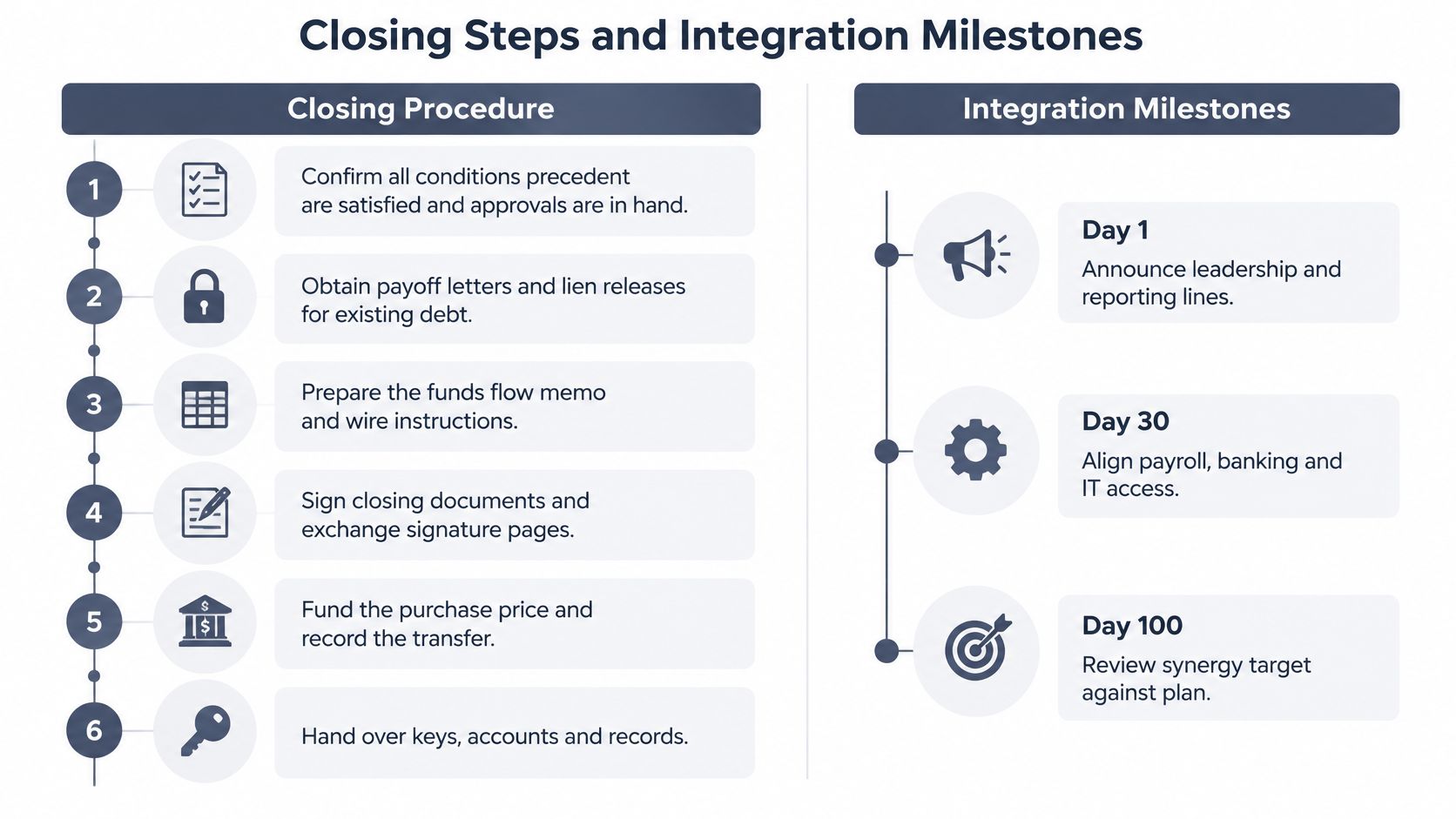
Confirm conditions precedent. Approvals and required consents have to be in hand, or you are funding a deal that can still unwind.
Collect payoff letters and lien releases. Existing debt has to be cleared or the title you think you bought isn't clean.
Write the funds-flow memo. Every wire, escrow amount, and fee belongs on one page both sides sign off.
Assemble certificates and transfer documents. Officer certificates and signed instruments are what the recorder and the cap table accept.
Fund and transfer. Shares or assets move, then ownership is recorded the same day.
Send day-one notes. Employees, customers, and suppliers hear who owns the business before rumor does.
The scorecard that predicts the outcome
Stand up the integration management office before close. In McKinsey's review of 248 large transactions, 79% of companies whose total shareholder returns beat their index in the first 18 months were still outperforming three years after closing, and successful acquirers reached at least 50% of publicly stated synergy targets in year one. A survey of 305 public-company executives in that same review found organizations with highly effective finance capabilities were twice as likely to meet value-creation objectives.
Track customer retention, pipeline conversion, employee attrition, procurement savings, cost-to-serve, system-migration defects, and working-capital realization on a weekly or monthly cadence.
Day one: Leadership, reporting lines, and who answers the phone.
First 100 days: Payroll, banking, system access, and the first synergy check against plan.
Months 4 to 12: Cost and revenue initiatives against the separate lines you modeled.
Months 12 to 18: Whether early KPIs still hold once the easy savings are gone.
Common Pitfalls and How to Avoid Them
Deals rarely die from one dramatic error. They die from several small ones that were visible early, starting with synergies that exist only in the model.
One blended synergy number. Split it. Each initiative gets an owner, a cost, and a date, or it comes out of the price.
Exclusivity that outruns the data room. The letter of intent should set data access and the timetable together. If the room isn't open, the exclusivity clock shouldn't be running.
A change-of-control consent nobody requested. A key contract that ends on sale is lost revenue. Get the consent before signing, or cut the price by the profit you will lose.
Non-executive people leaving after the announcement. Tie retention bonuses to integration milestones, not to the closing dinner. The people who know the tenants and the vendors are the ones the model assumed would stay.
No integration lead until after close. Name that person at the letter-of-intent stage. Day one is too late to decide who owns the scorecard.
A property priced on appreciation alone. If cash flow is negative after debt service, the appreciation story doesn't pay the loan. Model net operating income and a cap rate before the offer, and walk if the debt doesn't clear.
A warning sign without an owner and a deadline is a decision to ignore it.
Write failure triggers into the letter of intent. A missed consent or a key employee departure should name the action it requires, whether that's a price cut, a holdback, or a right to walk. Any pitfall you can already see gets a name and a date.
Confirm the Deal Thesis Before You Sign
A deal can clear diligence and still fail if its operating assumptions never make it into the integration plan. Before signing, check that the buyer's original thesis is supported by the records and has an owner after closing.
Strategy: The deal still matches the one-page thesis.
Price: The number sits inside a written walk-away range.
Diligence: Each red flag is priced, fixed, or accepted in writing.
Money: Financing is committed, with room for a slower close.
Approvals: Each clearance has a timeline and an outside date.
Integration: An owner and a 100-day plan are named.
Terms: The letter of intent records price mechanics and the five locked points.
For a property acquisition, connect the rent roll and mortgage file to the assumptions behind the price. Then carry those same assumptions into the integration plan: who will manage the property, maintain tenant relationships, and track performance? If the workforce plan does not match the operating model used to justify the purchase, the buyer may pay for value the business cannot deliver.
Richard Maize is a Los Angeles-based real estate expert, business investor, and philanthropist. His platform shares practical insights on property markets, entrepreneurship, and investing. Explore his work at Richard Maize, including perspectives that can help you test how a deal's assumptions connect to value creation and post-close execution.
Before signing, name the open item that could break the thesis, assign an owner, and set a deadline for resolving it. A clear decision on that item is more useful than advancing on the strength of an attractive model alone.
Visit Richard Maize for current notes on investing, deals, and the work after the keys change hands.
Comments