Market Research Methods That Guide Decisions

In 2023 the global insights industry grew 8%, from nearly US$130 billion to US$142 billion, according to ESOMAR. That pile of spending still doesn't tell you which study to trust. A larger or newer project is not more credible when the unit, the weighting, or the missing respondents don't match the decision. I won't treat a method as finished until it ends in a documented go, a resize, or a wait.
Why the Method Comes Before the Survey
A bigger budget doesn't pick the right instrument. Market research methods are repeatable ways to cut uncertainty before capital, time, or reputation is committed. You talk with people, count answers, reuse data someone else already collected, watch what people did, or test one change and nothing else.
A thermometer won't explain why a room feels cold. The tool has to match the question, or the number is neat and useless.
Keep five families separate, and don't teach them as if they were interchangeable:
Qualitative inquiry: language, objections, and needs you haven't named yet.
Surveys: how many people in a defined group hold a view.
Secondary research: housing, income, and local figures already published.
Experiments: whether one change caused one action.
Analytics: behavior that already happened, without the motive.
Much commercial work only tracks market size or satisfaction. In 2023, market-measurement projects were 14.3% of global market research projects, and CRM and customer-satisfaction research was 13.2%, according to ESOMAR's project mix. Those counts show what moved. They don't tell you whether to buy, reprice, or wait.
Richard Maize is a Los Angeles based real estate investor, entrepreneur, and philanthropist. For more than 30 years he has built and managed a real estate portfolio, so the cases below come from property and operating bets, not from a classroom checklist. The chooser is the piece you can use the same day.
Which Method Fits the Decision
Pick the row by the decision, not by whichever tool is fastest. The chart is the short version. The table is the one you file with the memo.
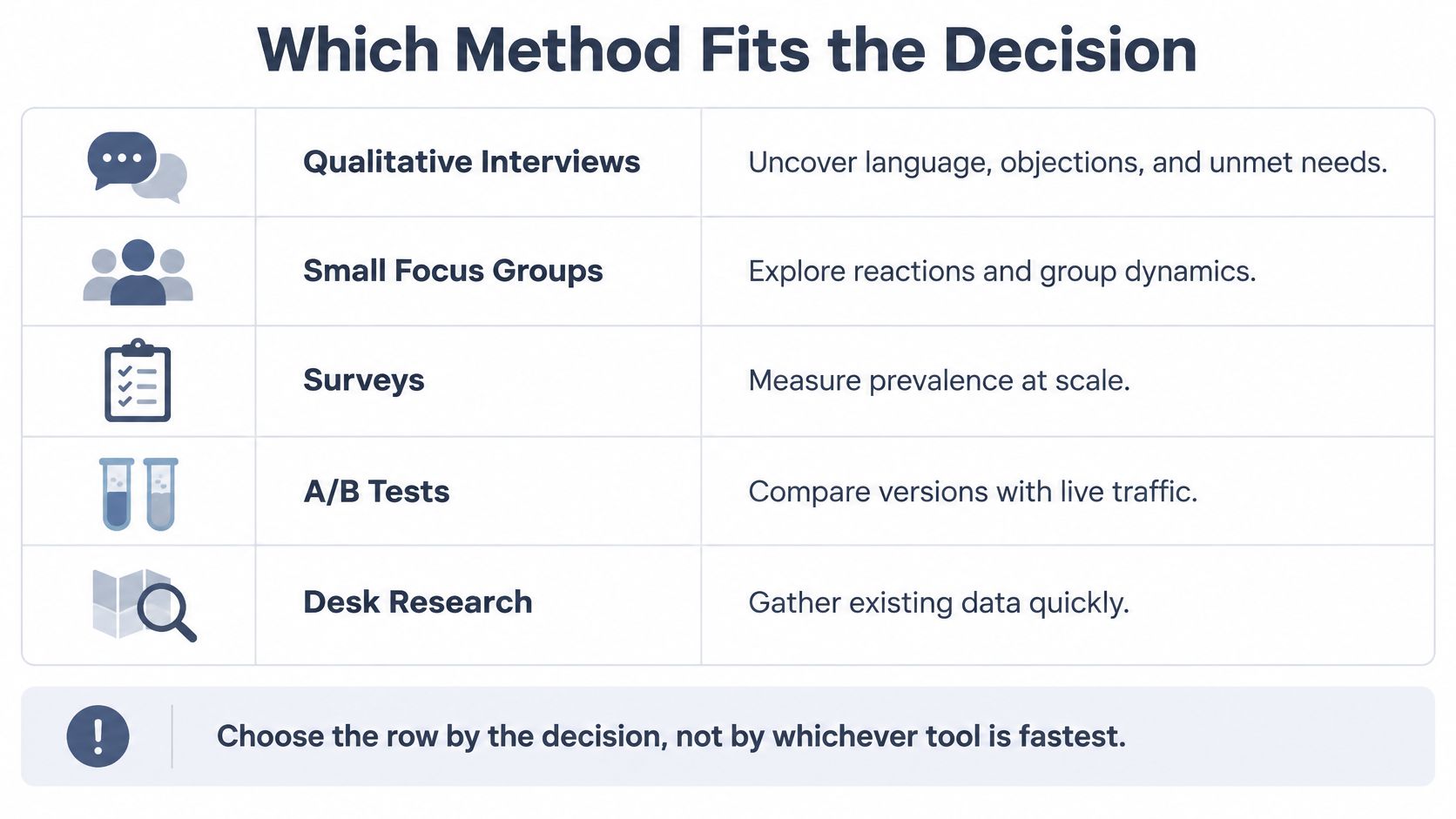
Method | Best question | Typical source | Main risk | Decision it supports |
|---|---|---|---|---|
Qualitative interviews or focus groups | Why do people choose or refuse? | About a dozen interviews over two weeks, or one small focus group | Vivid stories treated as market share | Which options are worth testing |
Quantitative survey | How many people hold this view? | A defined sample, often a few hundred completes | Wrong unit, wording, or nonresponse | Whether a segment is large enough |
Secondary or desk research | What is already measured? | Census, housing, sales, or public filings, reviewed in a few days | Outdated snapshot or mismatched geography | Where to look before new fieldwork |
Experiment or A/B test | Did this change cause that action? | Randomized exposed group and holdout, run two to four weeks | Early clicks that fade or hurt trust | Whether to keep a message, price, or page |
Behavioral analytics | What did people already do? | Inquiries, tours, transactions, site events | Behavior without motive | Which existing offer earns attention |
Conjoint or tradeoff study | Which features are worth the price? | Structured choice tasks | Hypothetical choices overstate purchases | How to design the offer before launch |
What each row can and can't carry
Interviews and small focus groups uncover the words people use, the objection that kills a tour, and the need your form never asked about. They don't size a market. Ten sharp conversations can kill a bad floor plan. They can't tell you that 40 percent of a city wants it.
Surveys estimate how many people in a defined population hold a view once the answer choices exist. Write the population first. A renter survey and a household survey are different bets.
Desk research is the first stop when census-style housing, income, or local statistics already cover the question. It fails when the geography is the county and you would buy one block.
Experiments ask whether one change caused one action. Analytics read inquiries, tours, or repeat buys that already happened. Analytics can't supply motive. A full tour calendar doesn't tell you which amenity closed the lease.
Conjoint estimates how people swap price, size, location, and amenities. Treat stated choices as hypotheses, not closed deals.
A small operator can run about a dozen interviews in two weeks, a few hundred completed surveys, a desk review in a few days, or a two-to-four-week message test with a holdout. I would start a property or neighborhood business in that order: secondary scan, a few conversations, then one quantified step.
The short walkthrough below is the same chooser in motion, before you spend on a panel.
How to Field a Study From the Decision
Use one routine for interviews or a survey. Causation belongs in a later test, not in a second catalog of tools.
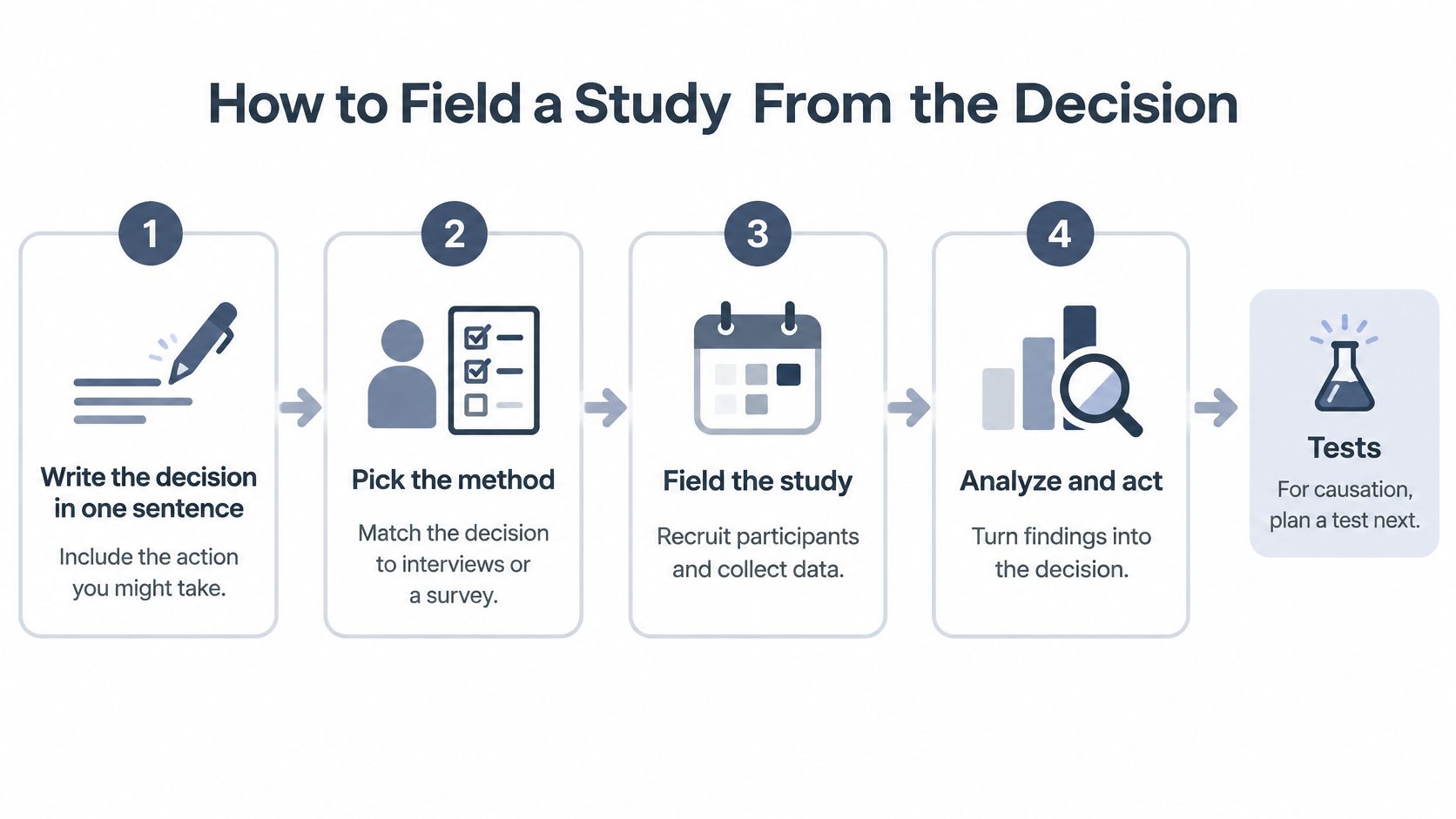
Nine moves before the first invite
Write the decision in one sentence, including the action you might take, such as buy, reprice, or wait. If the sentence has no verb you can execute, you don't have a study yet.
Name the population and the unit, whether household, firm, renter, or property. That choice changes every percentage you will quote later.
Select the single chooser row that can answer that sentence. One row. A second method is a second project.
Draft a short instrument of five to eight survey items, or an interview guide with probes. Ban double-barreled questions. "Is the rent fair and the block safe?" is two questions pretending to be one.
Set recruitment and a stop rule before fielding, and write down who the plan will miss. The stop rule keeps you from fishing until a flattering number appears.
Pilot with five to ten people and repair wording they hear differently from what you intended. A pilot catches the phrase you thought was plain.
Field without changing the question midstream, and log refusals rather than replacing them without a record. Quiet replacement hides the people who said no.
Analyze only against the threshold you wrote first, such as a rent band or a qualified-inquiry rate. A interesting chart that misses the threshold is not a finding.
File the denominator, field dates, and any weighting beside the finding so someone else can audit it.
Practical rule: Launch the questionnaire only after the decision sentence exists. The common slip is the reverse, a polished form with no action attached.
Say you're weighing a rent bump on a 24-unit building. The sentence is "Reprice if at least half of in-place renters in this asset would renew inside the new band." The unit is the renter, not the household and not the ZIP code. You stop at the planned completes, even if the early answers look friendly. You don't swap in neighbors who were easier to reach.
Tools and Templates by Method
A small operator doesn't need a research department. You do need the setting people skip.
Surveys. Google Forms handles a short instrument with skip logic. Qualtrics suits a larger panel when you need quota controls. Set the respondent target before you open the link, or the form stays live until the story you like shows up.
Interviews. Keep a written guide with probes and a consent line. Record with Zoom or a similar app. Code transcripts against the decision sentence, not against a general theme list that can justify anything.
Secondary research. Start with data.census.gov and FRED. Write the geography, year, and vintage beside each series so an old snapshot isn't mistaken for this quarter. A worked property version of that habit sits in this real estate market analysis template.
Behavior. Google Analytics 4 can supply inquiry, tour, and conversion events. Define each event once and reuse the name. Renaming "tour_request" halfway through a quarter splits one action into two fake trends.
Tests. Optimizely or VWO can split traffic and hold back a control group. Write the outcome and the monitoring rule before launch.
Tradeoffs. Sawtooth Software designs choice tasks and estimates attribute utilities. Still file the result as a range.
Finish every project with a one-page decision memo. It's the only template you must use every time.
When the Numbers Disagree
Late-2025 U.S. estimates of AI adoption ranged from 18% of firms in Census Bureau data to 78% of the workforce employed by firms reporting adoption, while individual work-related generative-AI use was estimated at 41%, according to a Federal Reserve note. The same season, three headlines, three different bets.
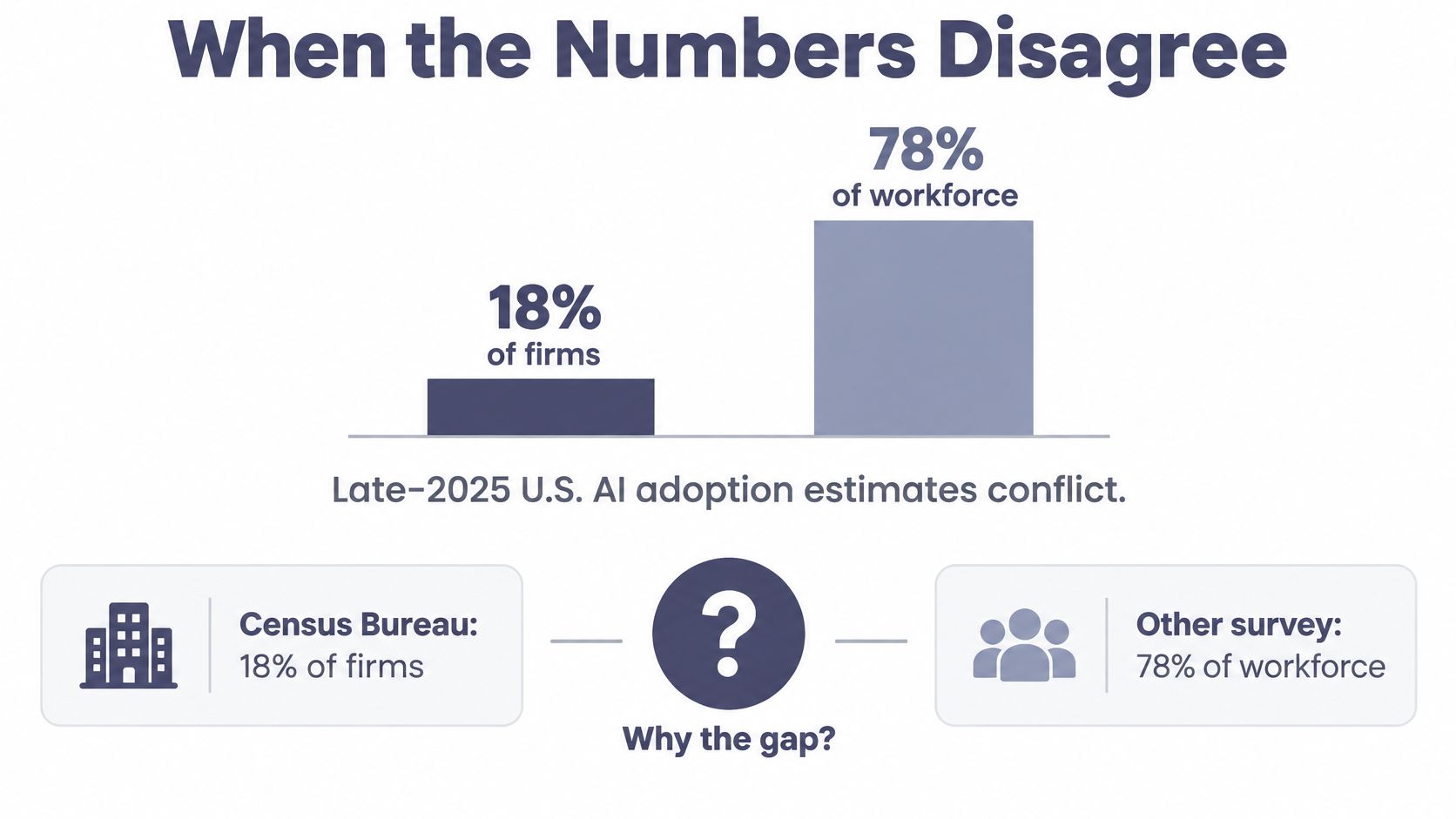
The Federal Reserve attributes much of that spread to sampling distributions and units of analysis, and also notes question framing, information asymmetries, and social-desirability bias. A respondent can sound more modern than the shop floor.
Match the unit to the bet
Estimate | Figure | Unit it describes | Use it when |
|---|---|---|---|
Firm adoption in Census data | 18% of firms | Organizations | You need the share of businesses adopting |
Employment-weighted adoption | 78% of the workforce at adopting firms | Workers inside firms that report adoption | You need economic reach, not a firm count |
Person-level generative AI use | 41% | Individual workers | You need actual work behavior, not an organizational claim |
Use a firm-weighted figure when you need how many businesses. Use an employment-weighted figure when you need economic reach. Use a person-level figure when you need what people do. A larger sample isn't more credible if it measures the wrong unit or systematically misses nonusers.
A probability sample gives members a known, nonzero chance of inclusion, so you can state sampling error. A convenience panel can't be generalized to the people who never joined it.
The U.S. Census Bureau's sampling history shows why design beats headcount. The Bureau first used statistical sampling in a 1937 unemployment test, then brought it into the 1940 census, when approximately 5% of the population received additional questions. A careful slice stood in for the country. A sloppy slice, however large, does not.
Every statistic in a deal memo should disclose its denominator, field dates, weighting, and target population. Triangulate one survey with behavioral or administrative data before a large commitment. A portal average of what buyers say they want still leaves out the human judgment in a property valuation. I would wait when the only "adoption" number in the file is a firm claim and the cash flow depends on what a person does on Tuesday.
Tests and Tradeoffs That Show Cause
Another survey won't tell you whether the new headline caused the inquiry. A test can, when the setup is valid.
Under a valid setup, random assignment makes exposure independent of traits you measured and traits you didn't. The gap between groups is then the effect of the change, which dynamic experimentation work describes as an intention-to-treat contrast between treatment and control, as set out in this working paper on dynamic A/B tests.
Run the holdout first
Split a comparable audience. Change one element, such as a property headline, a landing page, or an appeal. Keep a holdout. Define the outcome before launch: qualified inquiries, completed applications, or conversion value.
Report a confidence interval, not a winner declared after repeated peeking. Short tests are good at immediate effects. A message can lift clicks and still cut later retention, trust, or revenue. Watch long enough to see the delayed damage. Don't change several campaign elements at once unless a factorial design was planned. On a personalized site, simple randomization can tangle with recommendations, network effects, or time. In that case the same literature points to propensity scores, two-stage estimation methods, or difference-in-differences, and those are specialist jobs.
Design the offer before you test it
Conjoint is a design tool, not a causal test. It grew up in marketing research in the 1970s, and the conjoint analysis literature treats it as a way to decompose choices into attribute-level utilities. Respondents judge structured bundles so you can see willingness to pay among location, unit size, amenities, financing, and price.
Use an efficient design rather than a pile of arbitrary cards. Include a realistic price. Randomize task order. Prefer a mixed model when tastes differ across buyers. Hypothetical choices overstate purchases. Pair the survey with leases or transactions when those records exist, and publish a range instead of a false point forecast.
Test when you can change the offer now. Run a tradeoff study when you still have to design the offer.
Property and Small Business Cases
Three bets, three instruments, three documented actions. A larger dataset never earned any of them a pass on unit fit.
An apartment buy
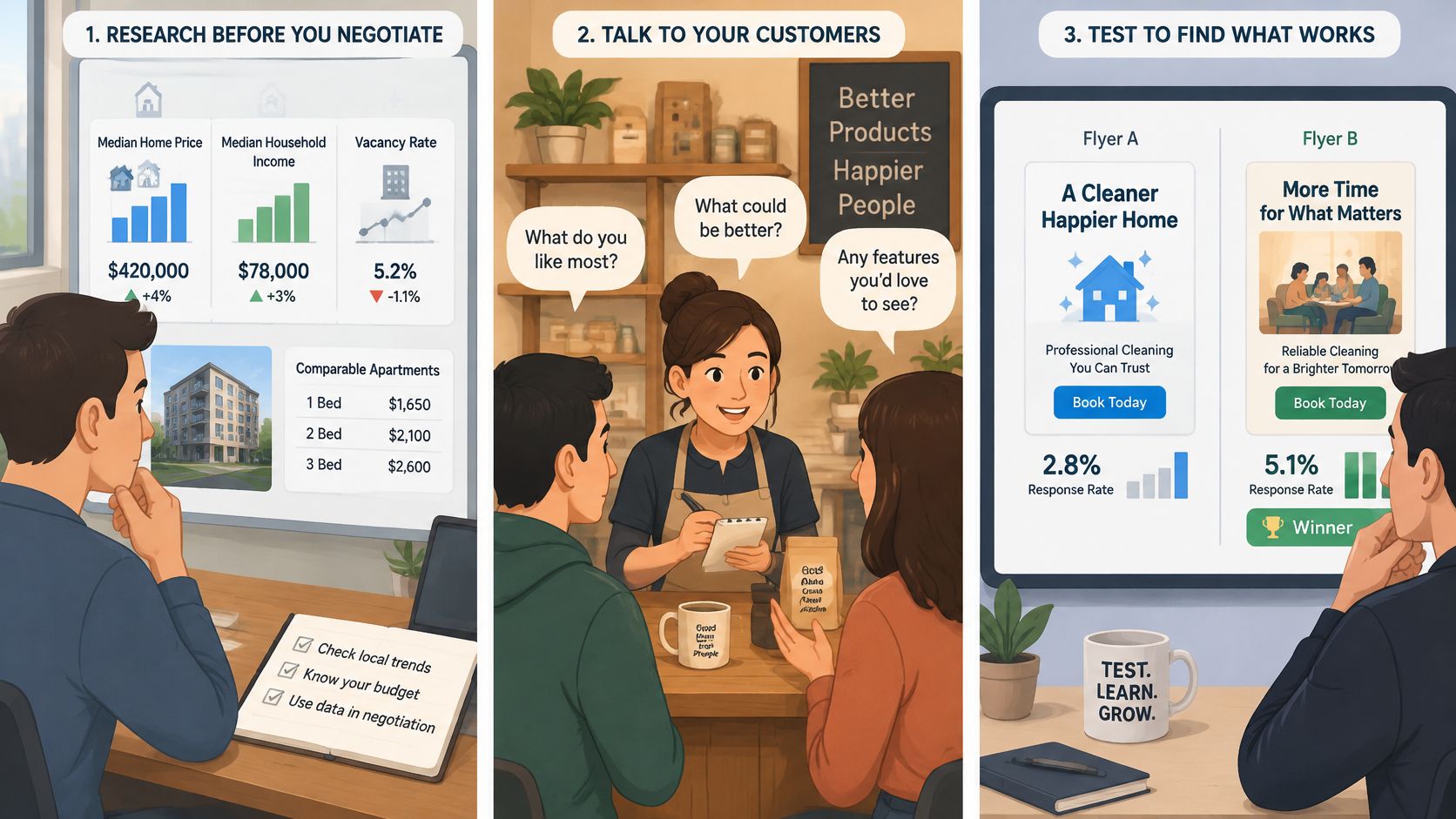
Read local housing, income, and vacancy patterns before discussing price. Interview a handful of tenants and nearby managers about what drives renewals. Only then survey a defined renter pool on rent bands.
Richard Maize is a Los Angeles real estate investor who has built and managed a portfolio for more than 30 years, and the Rochelle and Richard Maize Foundation extends that record into philanthropy. The sequence that matters here is ownership first, theory second. If the desk scan shows thin demand and the tenant interviews say renewals fail on parking rather than rent, I would wait or reprice rather than stretch for the asking price. A survey that only flatters the rent band cannot override missing respondents, and the tenants who already left are exactly the respondents a renewal survey misses.
What today's buyers say they want is a separate read, and insights on what today's buyers want when purchasing a property still have to be checked against the block you would sign for.
A small consumer bet
Richard Maize has backed ventures from PR firms and food trucks to fintech. A food-truck stop or a new corner uses the same pair of methods as an apartment, at a smaller stake. Short qualitative conversations teach the offer language customers use. Then A/B test two messages in the same neighborhood and judge qualified visits, not likes.
If message B wins the click and loses the visit, drop it. If neither message beats the holdout on qualified visits, don't open the second truck. Proceed only when the visit rate clears the threshold written before the ads went up.
A purchase outside the first market
A portfolio record built in Los Angeles is evidence about Los Angeles. Don't copy a result from one metro into another. Rerun the secondary scan and confirm the unit of analysis before you trust it. A citywide average can hide the block you would buy.
If the block-level numbers hold at a smaller stake, resize the bid. If the new city's vacancy series is a different vintage, or the unit flips from household to building without you noticing, wait. These cases are a pattern for your own decision memo: go, resize, or wait, each documented against the unit that matched the decision, not a portrait of every market.
Write the Decision Before You Spend
Finish a one-page memo the same day. More charts won't supply an action the memo doesn't already name.
Fields that fit on one page
Decision sentence: the action, in one line.
Method and unit: which row you used, and whether the unit is a household, a firm, a renter, or a property.
Finding: the result with its denominator and field dates.
Confidence note: what would make the result wrong, including who was absent from the sample.
Action: commit, shrink the bet, or wait for one more measurement.
A short repeated indicator each quarter is worth keeping only when the question wording and the sample stay stable enough to compare. Refreshing the plan every week turns noise into fake insight. Stop if the memo still has no action.
If the confidence note says the people who pay the rent never entered the sample, the honest action is wait, not a prettier chart.
Questions and opportunities for discussion can be sent to richardmaizebusiness@gmail.com. Send the decision sentence and the method you're considering. That's a conversation about the decision, not a packaged study and not a promise of a result.
Richard Maize writes from decades of buying, financing, and operating property and small ventures, and he uses market research methods as a filter before capital moves. If you want that mix of real estate judgment and plain decision rules, visit Richard Maize and read how he frames the next bet before the survey goes into the field.
Comments