Lots for Sale in Los Angeles: Your 2026 Guide

Investing in lots for sale in Los Angeles is a move for those who see what could be. Unlike buying a finished house, acquiring land is about purchasing pure potential. It’s the blank canvas for a custom home, a multi-unit income property, or a forward-thinking commercial space. You're not just buying a piece of the city; you're buying the right to shape it.
Investing In Los Angeles Land With Richard Maize
In this guide, I'm distilling my decades of experience in the Los Angeles market into a practical roadmap for land investment. We’ll cover everything from spotting high-growth neighborhoods and decoding complex zoning laws to securing the right financing and executing a successful build. Think of this as my personal playbook for turning raw dirt into a high-value asset in one of the world's most competitive real estate arenas.
Los Angeles presents a unique mix of challenges and opportunities. Its sprawling geography and intricate regulations demand a sharp, informed approach—something I’ve honed over countless transactions. The insights here are the same practical, data-backed principles I use to make decisions and maximize returns. For a deeper dive, you can learn more about navigating Los Angeles real estate from Richard Maize's expert perspective in our related article.
Why Land Is A Unique Asset
Investing in land is fundamentally different from any other real estate play. You aren't just buying a structure; you are securing a piece of the future. The value is driven entirely by potential.
"Land is the ultimate scarcity. They aren't making any more of it. In a city as dynamic as Los Angeles, owning a well-positioned lot gives you control over a resource that will only become more valuable over time." - Richard Maize
This principle is the foundation of every successful land deal I've ever been a part of. It’s about recognizing long-term value where others just see an empty space.
To get started, it’s crucial to understand the key pillars of a successful land investment. I've summarized the core concepts you'll need to master in the table below.
Richard Maize's Quick Guide To LA Lot Investment
Investment Aspect | Key Consideration | Expert Tip From Richard Maize |
|---|---|---|
Market Dynamics | Supply is finite; demand is ever-growing. | Focus on areas with strong infrastructure, job growth, and favorable city planning initiatives. Future value follows fundamentals. |
Zoning & Entitlements | The city's rules dictate what you can build. | Don't buy a lot, buy a plan. The real value is unlocked during the entitlement process, not just at purchase. |
Financing Strategy | Land loans are different and often harder to secure. | Build strong relationships with lenders who specialize in land and construction. Cash and strong credit give you leverage. |
Due Diligence | The "dirt" holds secrets—geotechnical, environmental, title issues. | Never skip a report. A few thousand dollars on due diligence can save you from a million-dollar mistake. |
Development Vision | What is the highest and best use for the property? | Think like a developer, even if you plan to sell the land. The buyer's vision will determine your profit. |
This table serves as a mental checklist. As we go through this guide, I'll expand on each of these points, giving you the tools to move forward with confidence.
What This Guide Covers
This guide will walk you through the entire process, empowering you to find and develop profitable lots for sale in Los Angeles. Key areas I'll explore include:
Market Analysis: Understanding the real forces of supply and demand that drive land values in specific submarkets.
Zoning and Entitlements: How to read the city's rulebook to unlock a property's true development potential.
Financing and Due Diligence: The critical steps to secure funding and thoroughly vet your investment before you close.
Understanding The LA Land Market In 2026
The Los Angeles land market runs on one of the most powerful forces in real estate: intense, relentless demand crashing into a fixed, limited supply. This isn't just a temporary trend. It's the core economic reality I have navigated for decades in Southern California.
To see the real opportunity in lots for sale in Los Angeles, you have to look past the dirt and understand the pressures that turn an empty parcel into a high-value asset. Unlike buying a house, which is a finished product, buying land is a direct investment in the city’s future.
The Story Told By The Numbers
The scale of the LA land market is massive. Across Los Angeles County, recent data shows more than 3,203 land properties for sale, covering nearly 67,000 acres. That adds up to a total market value of around $6 billion.
But the most important numbers tell a more detailed story. The median price per acre is about $10,644, yet the average list price for a single parcel is $1,752,592. You can dig into the current dynamics of LA County's land listings to see this for yourself.
That massive gap between the per-acre cost and the per-parcel price is everything. The low median is skewed by huge, rural tracts of land far from the city center. The high average price shows the incredible value packed into smaller, buildable lots in prime locations. That's where I have always played the game.
Why Land Remains A Prized Asset
The value of land in Los Angeles is tied directly to the region's decades-long housing shortage. For years, restrictive building regulations and "downzoning" have choked the supply of new homes, while the population and job market kept growing. This created a huge imbalance.
"Every new housing report confirms what we already know on the ground: LA needs more homes. When you own a buildable lot, you own a solution to that problem. That's where the real value lies." - Richard Maize
This is the right way to think about it. As a savvy investor, you don't just see an empty lot. You see a future duplex, a set of townhomes, or the custom home that the market is starving for. The high cost is a barrier, yes, but it’s also what protects the value for those who can get in.
Market Velocity And Buyer Demand
A key health indicator for any market is how fast things sell. In my experience, the "days on market" (DOM) for good lots is often very low. When desirable parcels sell quickly, sometimes with multiple offers, it signals intense competition and rising prices. In 2026, well-located lots for sale in Los Angeles are still moving fast.
Why? Because developers and builders are always hunting for their next project. They work on long timelines and know the fundamental demand for housing isn't going anywhere. For them, paying a premium for a lot with clear development potential is just the cost of doing business.
This speed creates two sides of a coin for new investors:
The Challenge: You have to be ready to move decisively. If you find a good opportunity, hesitation means losing it to someone else who was more prepared.
The Opportunity: That same demand gives you a reliable exit. Whether you build yourself or sell the entitled land to a developer, you’re selling into a market with a deep and motivated pool of buyers.
Understanding these forces—the scarcity, the history, and the speed of the market—is the first step to building a smart strategy for investing in LA land.
Decoding Zoning And The Entitlement Process
When you’re looking at a vacant lot in Los Angeles, you’re not just seeing dirt. You’re seeing potential, but that potential is defined by an invisible set of rules: zoning.
Zoning is the city’s master plan for what can be built, where, and how big. In my experience, understanding these rules is the single most important step in figuring out what a piece of land is actually worth. Get it wrong, and you’ve bought an expensive problem. Get it right, and you’ve unlocked massive value.
Think of zoning as the official recipe for a property. An R1 zoning code means the recipe is for one single-family home. An R3 code, on the other hand, allows for a multi-family apartment building. That one-character difference can mean millions of dollars in opportunity.
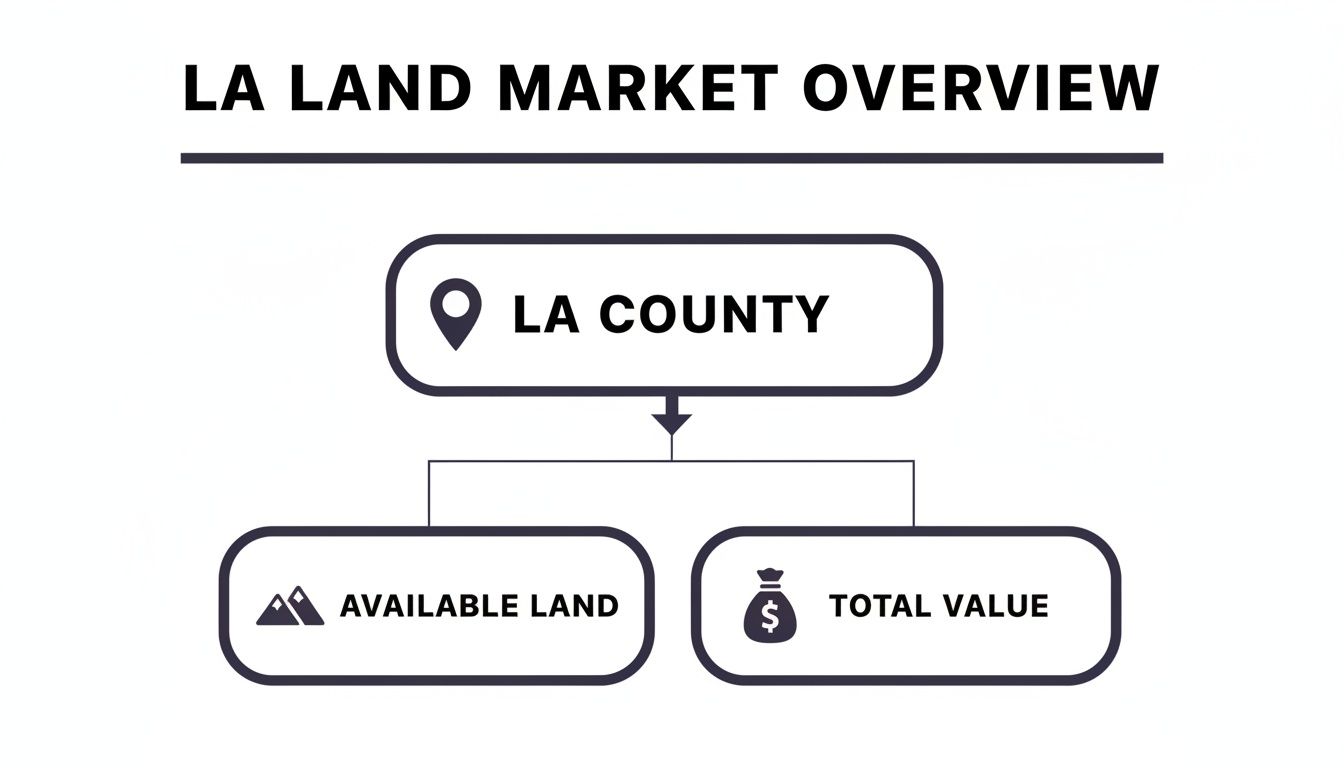
The scale of the LA land market is immense, but the real value is in understanding how to navigate the rules for each specific parcel. That's where entitlements come in.
The Power Of Entitlements
If zoning is the recipe, entitlements are the city's official approval to start cooking. The entitlement process is how you turn a development concept into an approved, buildable project. This is where a piece of land truly comes to life on paper.
The most successful investors I know don't just buy land; they buy a vision and see it through the entitlement process. Getting these city approvals—often called "paper entitlements"—can dramatically increase a lot's value before a single shovel ever hits the ground.
Key Terms You Must Know
To navigate the system, you have to speak the language. These are a few of the most important terms I work with every day.
By-Right Development: This is the best-case scenario. It means your project plan fits perfectly within the existing zoning rules, no special favors asked. It’s the fastest and most direct path to getting your permits.
Conditional Use Permit (CUP): Some uses are allowed in a zone, but only with special conditions. Think of a small school in a residential area. A CUP allows the city to approve the project while adding specific requirements to make sure it fits into the neighborhood.
Variance: This is a formal request to bend one of the rules, like a building height limit or a setback requirement. To get a variance, you have to prove there’s a unique hardship with your specific lot that makes following the standard rules impossible.
Unlocking Value Through Zoning Changes
The biggest wins in my land deals have often come from changing the rules altogether. The city is constantly updating its zoning to encourage new development, especially housing. For a smart investor, these updates create incredible opportunities.
A small lot zoned for a single house might be worth $1 million. But if you can work with the city to get it "upzoned" to R3 and secure entitlements for a four-unit building, that same lot could be worth $2.5 million or more to a developer.
"This is where real fortunes are made—not just by buying land, but by creating new potential where it didn't exist before." - Richard Maize
It’s a complex process that demands expertise and patience, but it’s the ultimate value-add strategy in my playbook for land investment.
The due diligence required for zoning and entitlements is intense, but there's no substitute for it. The principles for vetting a property are universal. For a deeper look at the process, Richard Maize's commercial real estate due diligence checklist provides a framework that I've applied to countless land deals.
Mastering this is what separates speculators from serious real estate investors.
How To Analyze Pricing And Find True Comps
Pricing land is less about what you see and more about what you can build. It’s an exercise in foresight. Unlike a house, where comps are based on bedrooms and square footage, no two parcels of land are ever truly the same.
The real value of a lot isn’t in its current state. It’s a direct reflection of the finished project that could one day stand on it. The location, topography, and size are just inputs. The output—the buildable potential dictated by zoning—is what drives the price.
To understand why, you only need to look at what’s happening in the broader housing market. The demand for buildable lots in Los Angeles is a direct consequence of the region’s soaring home prices.
The Ripple Effect Of The Housing Market
The value of raw land never exists in a vacuum. It’s tethered directly to the price of finished homes. When home values go up, so does the potential profit for building a new one, which in turn makes the underlying land more valuable.
We’ve seen this play out dramatically. In Los Angeles County, the median price for an existing home shot up from $639,660 in 2020 to $899,095 in 2024. That’s a staggering 40% jump in just four years, fueled by a chronic housing shortage.
The pressure is relentless. In the last year alone, 13,464 homes were sold in the city of Los Angeles at a median price of $1,250,000. You can explore more of this data yourself and see detailed Los Angeles property trends on ATTOM. Every one of those sales reinforces the demand for new inventory, sending developers scrambling for the few remaining parcels.
"A lot's price is a prediction. It’s the market’s best guess on the future value of a finished project, minus the cost of building it. To find true value, you have to get better at making that prediction than anyone else." - Richard Maize
This is the only mindset that works. When I look at a lot, I’m not just comparing it to other dirt. I'm performing what’s known as a residual land value analysis—figuring out what a finished home would sell for, subtracting the cost to build it, and seeing if the land price leaves enough room for profit.
A Framework For Finding True Comps
A standard comparative market analysis (CMA) is useless for land. You have to look deeper. The goal isn’t finding identical lots; it’s finding lots with similar potential.
Here’s the framework I use:
Filter by Zoning First. This is non-negotiable. An R1 lot can only be compared to other R1 lots. An R3 lot is in an entirely different asset class. Don’t even look at them in the same search.
Compare Buildable Square Footage. Within the right zoning, what can you actually build? A flat 5,000 sq. ft. lot that allows a 2,500 sq. ft. home is far more valuable than a 10,000 sq. ft. hillside parcel where slope restrictions cap you at a 1,500 sq. ft. build.
Define "Location" Correctly. For land, location isn't just about the neighborhood. It's about access. A lot with utilities at the street and easy road access is in a different league than a remote parcel that needs thousands in infrastructure work just to get started.
Find Off-Market Clues. The best comps aren’t always what sold. They’re often what got entitled. If a nearby owner just secured permits for a duplex on a lot similar to yours, they’ve set a new high-water mark for value in the area. That’s a powerful signal.
This approach changes everything. You’ll start to see why some lots are overpriced despite their low cost-per-acre and, more importantly, you’ll spot the undervalued gems. These are the parcels with overlooked potential that everyone else missed—and they are how you find your edge when looking for lots for sale in Los Angeles.
Securing Land Financing And Managing Taxes
Financing a raw land purchase is nothing like getting a conventional mortgage. Lenders view empty dirt as a speculative asset, not a secure one. There’s no house to serve as immediate collateral, which means the risk profile is completely different.
To get a lender on board, you have to stop thinking like a borrower and start thinking like a partner. You aren't just asking for money; you're presenting a business plan. A clear, well-researched vision for how that vacant lot transforms into a valuable, income-producing property is what turns a "no" into a "yes."
Understanding Your Loan Options
When you're looking at lots for sale in Los Angeles, you need to familiarize yourself with specialized financing. These aren't your typical 30-year fixed-rate products. The terms are tougher, and the requirements are higher.
Raw Land Loans: This is for land with no improvements—no utilities, no road access. It’s the hardest loan to secure, often demanding 30% to 50% down. Lenders see pure potential, which also means pure risk.
Lot Loans: If the parcel is "shovel-ready" with utilities at the property line, you can pursue a lot loan. These are more attractive to lenders, and you can often get by with a down payment in the 20% to 30% range. The path to development is shorter, so the risk is lower.
Seller Financing: Sometimes the owner is willing to become the bank. This can be a fantastic way to secure a deal with more flexible terms, but be prepared for a shorter repayment timeline. The seller wants their capital back sooner rather than later.
Navigating Los Angeles Tax Considerations
The moment you close on a lot, the clock starts ticking on holding costs. Property taxes are the biggest one, and in California, you need to understand the rules of the game to protect your investment.
The key is Proposition 13. It caps your annual property tax rate at 1% of the assessed value when you buy it, with a maximum increase of 2% per year. This creates predictability while you hold the land.
But the real financial engineering begins when you build. You can't depreciate land, which offers no tax shield. However, the structure you build on it can be depreciated entirely. This creates significant paper losses to offset income from other sources.
A finished project also opens the door to more advanced strategies, like a 1031 exchange, which allows you to defer capital gains by rolling profits into your next real estate investment. It’s a foundational tool I have used to build long-term wealth. If you want to dive deeper into my funding strategies, take a look at the essential guide to smart funding for investment properties.
"Your financial strategy for a land purchase has two parts: securing the capital to buy it, and structuring the deal to minimize tax liability later. My success has always depended on mastering both." - Richard Maize
This is what separates professionals from amateurs. Getting the loan just gets you in the door. Smart tax planning is how you win the game over the long run. By thinking about taxes from day one, you build a far more resilient—and profitable—investment.
Your Action Plan For Buying LA Lots
You’ve done the homework. You understand the market, the neighborhoods, the zoning, and the numbers. Now it’s time to move from research to reality.
Finding and buying your first lot is where all that knowledge gets put to the test. This isn’t a theoretical exercise anymore; it’s about taking tangible steps to secure a piece of Los Angeles.
This is the part of the process that requires strategy, discipline, and a good plan. Let me walk you through how I find, vet, and close on a deal.
Building Your Deal Flow
The best opportunities rarely land in your lap. I’ve always stressed that successful investors create their own deal flow. You have to cast a wide net and, more importantly, build a powerful network.
You can start your search for lots for sale in los angeles in a few key places:
The Multiple Listing Service (MLS): This is the database every agent uses. It's a solid starting point, but it's also where you'll face the most competition.
Land Marketplaces: Niche sites like LandWatch and Land.com often have listings you won’t see on the standard MLS, giving you a slight edge.
Off-Market Deals: These are the real prizes. I find them by talking to land brokers, architects, city planners, and even other developers.
"Your network is your most valuable asset in this business. The best deals often come from a conversation with an architect who knows a client selling, or a broker who just got a pocket listing. These relationships give you a critical head start." - Richard Maize
Building these connections takes time, but the payoff is enormous. You get access to properties before the rest of the market even knows they exist.
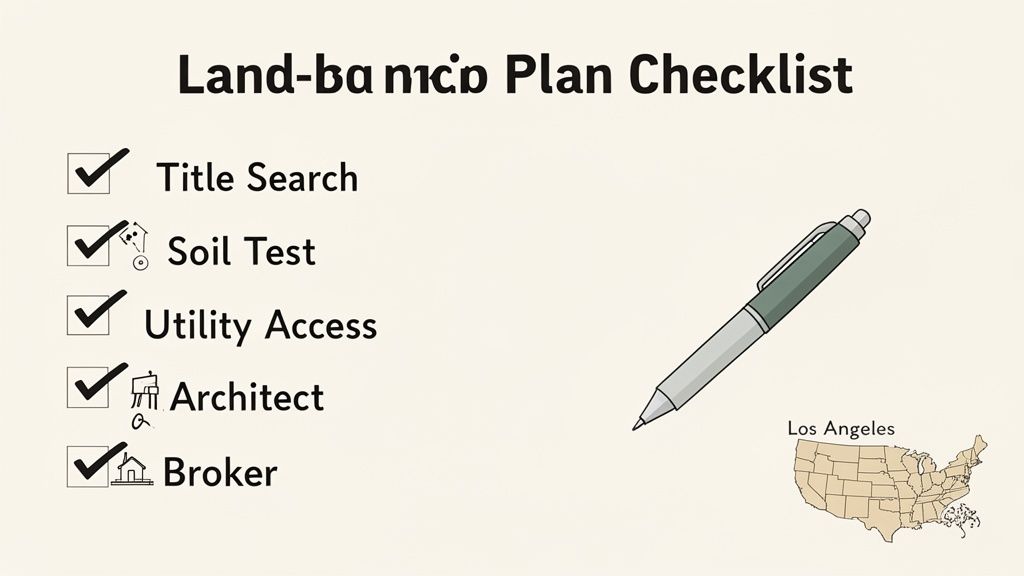
Your Essential Due Diligence Checklist
Once you’ve found a promising lot, the real work begins. Due diligence is your investigation—the phase where you verify every single detail. A mistake here can cost you a fortune.
Your checklist has to include these non-negotiables:
Title Search: First, confirm the seller has a clean title. A title company will hunt for any liens, easements, or claims that could derail your plans or even challenge your ownership.
Environmental Assessment (Phase I ESA): This report uncovers potential contamination from past uses. A clean Phase I is almost always required for financing and protects you from massive liability down the road.
Geotechnical and Soil Reports: This is absolutely critical, especially on hillside properties. A soil report tells you if the ground is stable and what kind of foundation you’ll need. This single report can dramatically change your construction budget.
Utility Access Verification: Never assume utilities are right there. You have to confirm exactly where the water, sewer, and power hookups are and, more importantly, how much it will cost to bring them to your lot. Those fees can sometimes run into the hundreds of thousands of dollars.
Making The Offer And Closing The Deal
With your due diligence done, you’re ready to make a strategic offer. The price you put forward should come directly from your residual land value analysis—what the property is worth to you, based on your specific development plan.
Remember, the terms are just as important as the price. You can and should build contingencies into your offer, making the purchase conditional on getting a key permit or a zoning variance approved.
From there, the deal moves into escrow. A neutral third party holds all the funds and documents until every condition of the sale is met. Closing a land deal requires an experienced escrow officer and a good real estate attorney to make sure everything is handled correctly. It’s the final step to making that piece of Los Angeles your own.
Common Questions on LA Land Investing
Buying land in Los Angeles isn't like buying a house. It's a different game with its own set of rules, risks, and massive opportunities. Over my career, I've seen investors run into the same handful of questions. Here are the answers that experience teaches you.
The Most Important Factor Isn't What You Think
In real estate, everyone says "location, location, location." For a piece of dirt in LA, that's only half the story. The single most important factor is zoning and entitlements.
A lot’s zoning code—whether it’s R1 for a single-family home or R3 for multi-family—defines what you can build. That, in turn, defines its value. The real opportunity isn't just in buying a lot, but in understanding its potential to be "upzoned" for a more valuable use. Unlocking that potential can multiply the land's value before you ever break ground. This is not optional; it's the core of your due diligence.
Why Financing Land Is a Different Beast
Lenders see raw land as a higher-risk bet than a house. There's no structure to serve as immediate collateral, so they tighten their requirements. It's just a reality of the business.
Expect to bring a much larger down payment to the table, often between 20% and 50%. Interest rates are typically higher and loan terms are shorter than a standard mortgage. Many of the most successful deals I've seen happen when investors get creative with seller financing or build relationships with local banks who understand construction and development.
"A clear, viable development plan is your best asset when talking to a lender. They aren't just underwriting your credit; they're underwriting your vision." - Richard Maize
Budgeting for the Costs You Can't See
The price you pay for the land is just the starting line. The "hidden" costs are where inexperienced investors get into trouble. Your due diligence alone will cost money for surveyors, soil reports, and environmental checks.
Once you own it, you have holding costs like property taxes and insurance on an asset that produces zero income. But the most significant costs are tied to getting the lot ready for construction.
Permit Fees: The city's approval process comes with a hefty price tag.
Utility Connections: Bringing water, sewer, and power to your site can cost tens or even hundreds of thousands of dollars if the infrastructure isn't close.
Site Preparation: Grading, clearing, and other prep work can vary wildly depending on the terrain and condition of the lot.
I always advise setting aside a contingency fund of at least 15-20% of the land's purchase price just for these pre-construction expenses. It’s the buffer that protects you from the unexpected.
Can You Build a Tiny Home on an LA Lot?
The tiny home movement has a lot of appeal, but placing one on a vacant lot in LA is complicated. The city has become more open to Accessory Dwelling Units (ADUs), but those are almost always on lots that already have a primary house.
To build a tiny home as the main residence on an empty lot, it has to meet all the same building codes as a standard house. That means a permanent foundation and proper utility hookups, which can defeat the purpose for some. Before you even think about buying a lot for this, you need to have a direct conversation with the Los Angeles Department of Building and Safety (LADBS) to understand the exact rules for that specific parcel.
At Richard Maize, we believe that informed investors make the best decisions. Explore my blog for more expert insights on real estate, business, and creating value. Discover what’s possible at richardmaize.com.
Comments