Long-Term Wealth Building Principles That Actually Last

The most popular wealth advice is also the least complete: invest early, pick good assets, and wait. That formula ignores the decisions that determine whether you have enough money to invest, whether you can stay invested through a drawdown, how much of the return you keep, and whether the assets remain useful after your lifetime.
Long-term wealth building works better as a coordinated portfolio of actions. Income growth creates capacity, disciplined saving supplies capital, asset allocation puts that capital to work, tax planning protects compounding, and legacy planning determines whether accumulated wealth becomes durable family capital. Richard Maize's career across real estate, finance, entrepreneurship, and philanthropy offers a practical lens for this broader approach.
Why Most Wealth Advice Misses the Point
The first mistake is treating wealth building as an investing problem when it's really a household operating system. People spend too much time searching for the next hot asset and too little time improving the income that funds investments, controlling recurring costs, or deciding how much risk they can tolerate without abandoning the plan.
Recent survey framing reflects this wider reality. Americans now divide their preferred paths to wealth almost evenly among investing, career advancement, and retirement saving, with each option only a few percentage points from the others, as reported by Equity for Her's analysis of modern wealth building. That matters because a household can't compensate for weak cash flow with asset selection alone. A strong portfolio funded inconsistently remains fragile.
Wealth is a sequence of decisions
The durable sequence usually looks like this:
Increase earning power: Build skills, negotiate compensation, pursue ownership, or develop a business that can produce income beyond a single job.
Create investable surplus: Keep spending below income and direct the difference automatically toward reserves, retirement accounts, and productive assets.
Choose an appropriate allocation: Combine liquid public markets, real estate, business ownership, or other assets according to the time horizon and the risks you can withstand.
Reduce avoidable leakage: Review taxes, fees, financing costs, insurance, and unnecessary turnover.
Prepare the transfer: Organize beneficiaries, ownership documents, estate structures, and family expectations before wealth needs to change hands.
The order matters. A household with rising income but no savings system has potential without momentum. A household with savings but no allocation plan accumulates cash while inflation erodes purchasing power. A household with assets but no estate plan may leave heirs a legal and financial puzzle.
Practical rule: Build a system that can keep working when markets are boring, expensive, or temporarily hostile.
That principle explains why Richard Maize's perspective on why good financial advice is boring is relevant here. The practices that survive multiple market cycles usually involve automatic contributions, conservative underwriting, broad diversification, and patience. They rarely make compelling headlines.
Long-term wealth building also depends on recognizing that returns are only one part of the outcome. The same gross return can produce different results depending on taxes, account location, liquidity, and the investor's behavior during stress. The goal isn't to win every year. It's to keep capital productive and keep the household solvent long enough for compounding to matter.
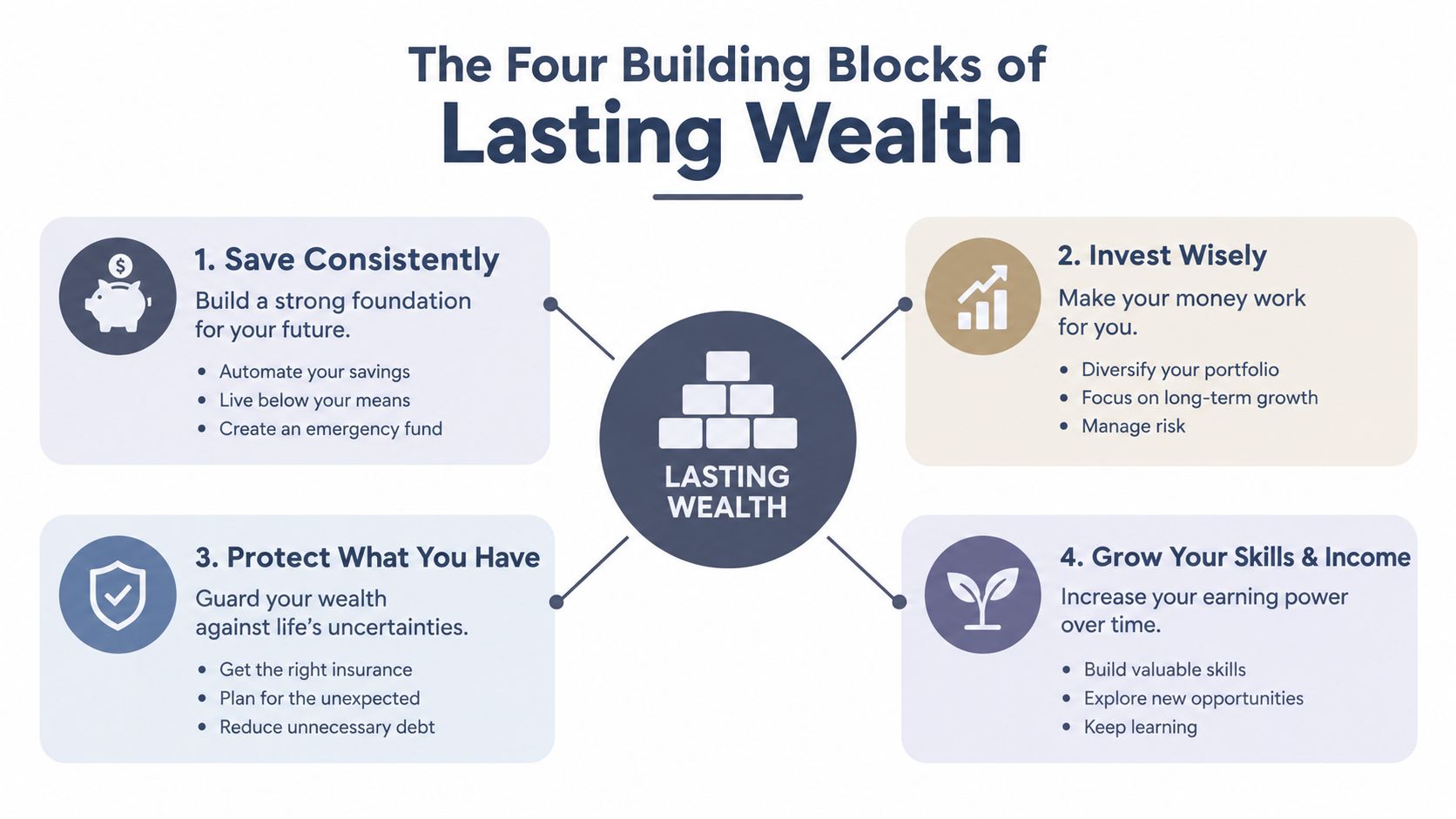
The Four Building Blocks of Lasting Wealth
Four elements determine whether a wealth strategy has a foundation or merely a collection of attractive ideas: cash flow, time horizon, risk tolerance, and diversification. They work together. Weakness in one block can undermine the others.
Cash flow funds every other decision
Start with the gap between what comes in and what goes out. Cash flow pays for contributions, handles vacancies and repairs, supports business reinvestment, and prevents forced selling when markets fall. A household that saves only when conditions feel favorable will usually save less precisely when uncertainty rises.
Real estate investors see this clearly. Rent collected is not the same as profit. Debt service, property taxes, insurance, maintenance, management, and reserves all come before the owner can treat the remainder as distributable cash. Richard Maize's discussion of cash flow and equity in real estate investing makes the distinction useful: a property can build equity over time while still requiring careful liquidity management today.
Time horizon determines which risks are useful
A long horizon allows an investor to tolerate fluctuations that would be unacceptable for near-term spending. Historical U.S. stock data covering 1926 to 1987 showed about 9.9% compounded annual nominal returns and about 6.6% compounded annual real returns after inflation, according to the CFA Institute's historical returns series. A separate rolling 30-year dataset found average real S&P 500 returns of 7.2% annually, with outcomes ranging from 4.4% to 10.6%, meaning $1 could have grown to between $3.64 and $20.53 after inflation over three decades, from the same CFA Institute reference.
Those figures don't promise future results. They show why time changes the role of volatility. Money needed soon belongs in assets designed for stability, while money assigned to distant goals can accept more fluctuation in pursuit of growth.
Risk tolerance is behavioral, not theoretical
Many investors describe themselves as aggressive during calm markets. The test comes when an account falls and the plan demands continued contributions. If a decline would cause you to sell an otherwise suitable asset, the allocation was too aggressive for your actual behavior.
Diversification then acts as a safeguard. A peer-reviewed study on portfolio diversification found that the number of stocks affects more than volatility reduction. It also affects the likelihood of capturing a positive risk premium and reaching a target share of benchmark compound excess wealth, as discussed in this University of Oulu research paper on diversification.
A household that earns consistently, saves automatically, and invests across a suitable mix for thirty years compounds more than returns. It compounds optionality. Later, the household can change jobs, fund education, buy property, reduce work, or support family without making every decision under financial pressure.
Comparing the Major Wealth-Building Pathways
No major asset class solves every wealth problem. Real estate can produce income and magnify returns but demands operations and accepts illiquidity. Public markets offer liquidity and broad exposure but expose investors to visible price swings. Entrepreneurship can create concentrated upside, yet the owner often carries business, operational, and personal-income risk at the same time.
What each lane contributes
Real estate can combine rental cash flow, equity accumulation, and financing. It also introduces vacancies, repairs, insurance costs, local regulation, management demands, and the possibility that a property becomes difficult to sell when liquidity matters most.
Entrepreneurship offers control over income growth and the possibility of building an asset that can be sold. The trade-off is concentration. An owner may have most of their wealth and livelihood tied to one company, one customer base, or one economic environment.
Public markets make diversified ownership accessible through broad stock and bond funds. They're liquid and easy to automate, but daily pricing can tempt investors into emotional decisions. Historical comparisons show why asset mix matters: U.S. large-cap stocks historically compounded at about 10.1% nominally, compared with 5.2% for government bonds and 3.2% for Treasury bills, while inflation averaged 2.9%, according to Walnut Invest's compound-interest statistics.
Tax-advantaged retirement accounts can shelter contributions, income, or withdrawals depending on the account design and applicable rules. Their strength is tax treatment and disciplined purpose. Their limitation is that access rules and contribution limits can make them less flexible than a taxable brokerage account or cash reserve.
Wealth-Building Pathways Compared
Pathway | Cash Flow | Time Commitment | Leverage | Liquidity | Tax Treatment |
|---|---|---|---|---|---|
Real estate | Rent can provide recurring income after operating costs | Active ownership or oversight is often required | Mortgages and property-level financing may be available | Generally limited compared with publicly traded assets | Income, expenses, depreciation, gains, and recapture require coordinated planning |
Entrepreneurship | Salary, distributions, or a future sale can create value | Usually high during the building phase | Business borrowing may be available, subject to underwriting | Often limited until a sale or recapitalization | Depends on entity structure, compensation, distributions, and sale treatment |
Public markets | Dividends and interest may provide cash flow | Low after portfolio construction | Usually limited for conservative long-term programs | High for traded holdings, though prices fluctuate | Tax depends on account type, turnover, dividends, interest, and gains |
Retirement accounts | Tax-deferred or tax-free growth may support future spending | Low after automation | Generally not the central feature | Restricted by account rules and circumstances | Account-specific treatment can improve retained compounding |
Consider three households that direct the same nominal lifetime contribution toward different outcomes. One builds a diversified rental portfolio and receives an illiquid stream of operating income. Another buys broad equity exposure and holds a liquid portfolio whose value moves visibly each day. A third reinvests in a small company and may eventually receive a sale proceeds event rather than years of predictable distributions.
None of these shapes is automatically superior. The strongest plans often combine a cash-flow lane, a growth lane, and a tax-efficient shelter. That combination reduces dependence on one exit, one market, or one type of income.
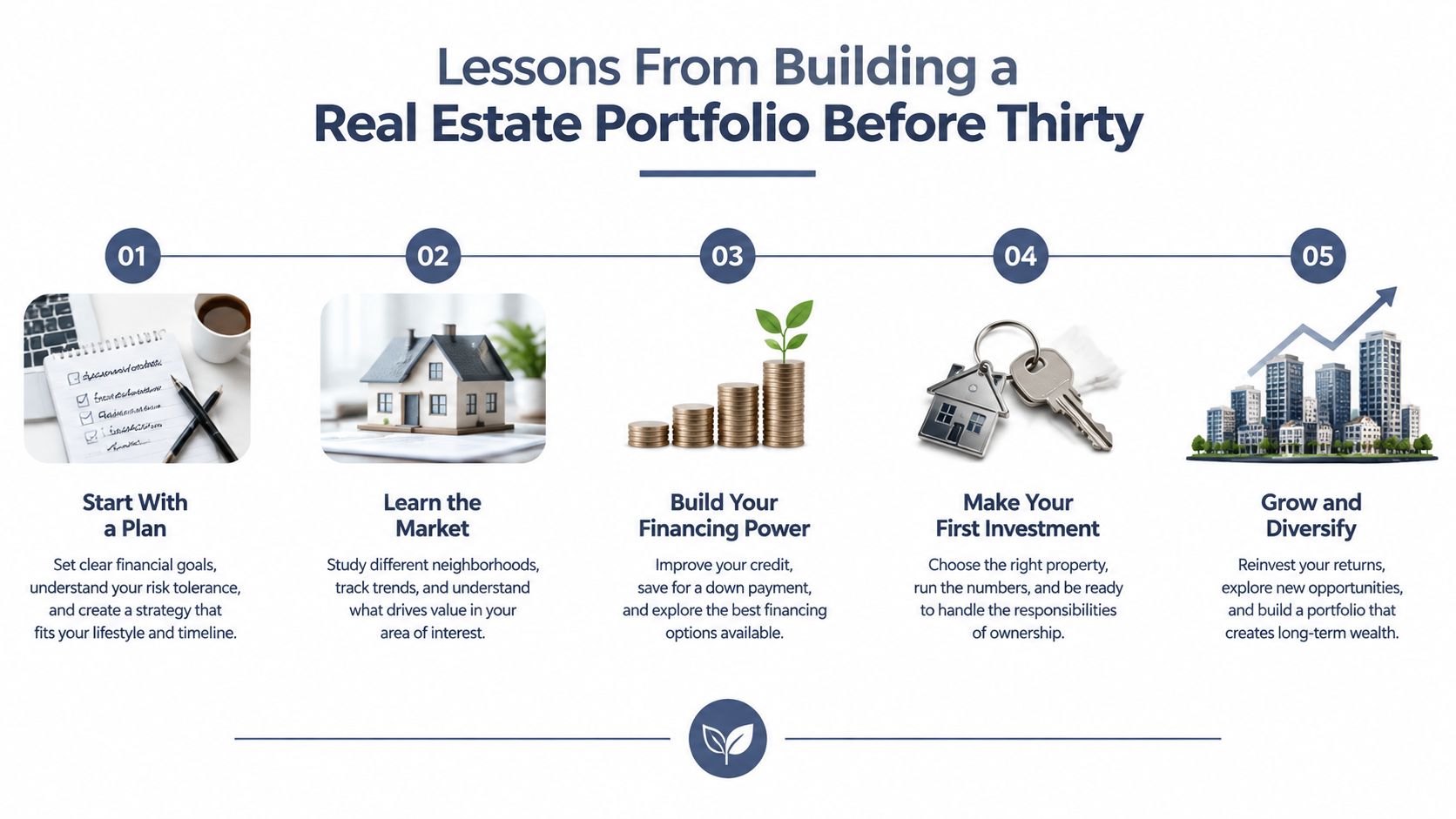
Lessons From Building a Real Estate Portfolio Before Thirty
Richard Maize's early real estate record illustrates what scale looks like when an investor treats operations, financing, and geography as connected decisions. The Rochelle and Richard Maize Foundation says Maize built a portfolio of about 1,000 rental apartment units before age 30, then founded and developed a successful mortgage banking firm before liquidating it, according to the foundation's account of his background.
Independent biographical and university-hosted listings also describe Maize as owning property in 20 states and reaching 1,000 apartment units before age 30, as recorded in his affiliated biographical coverage. Those facts are useful not because they form a repeatable recipe for every investor, but because they show how several wealth-building principles can reinforce one another.
Scale requires systems
A portfolio spread across state lines can reduce reliance on one local economy, but geographic diversification creates its own burden. Different jurisdictions bring different landlord-tenant rules, taxes, insurance markets, labor conditions, and property-management requirements. The investor needs reporting, local relationships, underwriting discipline, and reliable oversight.
The important lesson is operational rather than glamorous:
Underwrite cash flow before appreciation: A property should make sense under realistic rent, vacancy, repair, financing, and management assumptions.
Use partnerships carefully: Syndicating capital can accelerate acquisitions, but it also creates governance, reporting, and alignment obligations.
Hold through operating cycles: Real estate wealth often depends on surviving enough time for debt amortization, rent changes, and refinancing opportunities to matter.
Build management capacity: A growing portfolio cannot rely on the owner personally solving every maintenance issue, leasing problem, or accounting question.
Maize's trajectory also underscores the value of sequencing. Rental ownership created one platform, mortgage banking created another, and later ventures and philanthropy extended the use of capital beyond property alone. The lesson isn't that every investor should copy the same asset mix. It's that durable wealth can grow when one successful capability funds the next.
A large portfolio is not merely a collection of properties. It's a collection of processes that must continue working when the owner isn't present.
Real estate also demonstrates why concentration and diversification must be balanced. Owning many properties across markets may reduce exposure to a single neighborhood, yet financing conditions, insurance costs, and management quality can still affect the entire platform. The investor's edge comes from disciplined selection and repeatable execution, not from assuming that property values always rise.
Compounding, Taxes, and the Mechanics of Keeping More
Gross return is not the same as retained wealth. Taxes, fees, turnover, financing costs, and poor account placement can reduce the amount that remains invested, and compounding acts only on that smaller base.
A practical approach starts by assigning each dollar to the right location. Tax-deferred accounts can be useful for assets that generate taxable income, while tax-free structures may suit long-horizon growth when the applicable rules support that use. Taxable accounts offer flexibility and access, which can matter before retirement or when an investor wants control over withdrawals.
Match the account to the asset
The choice isn't taxable versus tax-advantaged. It involves the asset, the account, the expected holding period, the investor's tax position, and the purpose of the money.
Account Type | Stocks & ETFs | Real Estate Income | Business Profits | Bonds & Interest |
|---|---|---|---|---|
Taxable brokerage | Flexible ownership, dividends, and gains may create current tax obligations | Usually held indirectly through investments rather than direct property operations | Can hold publicly traded business interests | Interest may be taxed currently, depending on the security |
Traditional retirement account | Growth is generally sheltered until distributions under applicable rules | Real estate exposure may be available through funds or other investments | Business-related investments require careful compliance review | Tax-deferred treatment can reduce current income recognition |
Roth-style retirement account | Qualified withdrawals can receive tax-free treatment under applicable rules | Real estate exposure may be available through permitted investments | Specialized ownership requires professional review | Future qualified withdrawals can preserve more of the accumulated value |
Entity or property structure | Not an account, but can organize ownership and reporting | Rental income, expenses, depreciation, and eventual gains require planning | Entity choice affects compensation, distributions, and reporting | Interest treatment depends on ownership and use of borrowed funds |
A simple illustration shows why account choice matters. If the same 7% annual return is earned for 30 years, the gross compounding path is identical, but the ending amount can differ depending on taxes, fees, and the account structure. The point is not to promise a specific result. It's to recognize that a return earned inside a tax-free structure may be retained differently from a return earned in a taxable account.
Sequence the decisions
Start with an emergency reserve and employer retirement match where available. Then evaluate tax-deferred contributions, tax-free opportunities, and taxable investing according to income, liquidity needs, and future withdrawal plans. Investors with brokerage accounts can also review whether realizing losses may offset gains during rebalancing, while remembering that tax rules around wash sales and loss use require professional guidance.
Real estate owners need a separate review of depreciation, depreciation recapture, financing, entity structure, and the tax treatment of a sale. Business owners should examine how compensation, retained profits, distributions, and a future exit interact.
Richard Maize's discussion of minimizing taxes on real estate investments reinforces the practical point: tax planning belongs near the beginning of an investment decision, not after the transaction has already been completed.
Why Rising Balances Can Mask Fragile Wealth
A larger account balance can conceal a weak wealth structure. It may come from market appreciation rather than fresh savings, or depend on one stock, one property market, or one private business. A statement value is not the same as accessible, durable wealth.
Recent retirement reporting illustrates the difference. In 2025, average 401(k)-type balances rose sharply after market gains, but the median remained much lower than the average. Professionally managed allocations reached 69% of participants, according to Vanguard's preview of How America Saves 2026. Large accounts can pull an average upward, while the median more closely reflects the middle participant's experience.
Paper wealth needs a plan
Global household wealth reached $570 trillion in 2026, while McKinsey reported that only 20% came from real capital formation. The remainder was driven by asset-price gains, according to McKinsey's global wealth report. A market-driven increase can improve a statement balance without adding productive capacity or dependable spending income.
The risk becomes sharper near retirement. A retiree beginning withdrawals with a concentrated stock position can suffer lasting damage if that holding falls 50% at the wrong time. Selling shares to pay expenses leaves fewer shares available for a later recovery, so the timing of the loss matters as much as the decline itself.
Real estate creates a different liquidity problem. An estate may hold valuable properties but little cash for taxes, repairs, equalizing inheritances, or charitable commitments. A small-business owner faces a similar constraint when nearly all net worth remains tied to one private company.
Measure resilience, not just appreciation
A practical review asks:
Can the household fund spending without selling distressed assets?
Does the portfolio depend on one employer, property, company, or market?
Are gains realized when needed, or only visible on paper?
Will heirs receive usable assets, or a complex set of obligations?
Does the plan preserve purchasing power after inflation and taxes?
A wealth survey reported savings flat at $1.6 million while retirement targets rose to $4.1 million. More than half of respondents also lacked a formal estate plan, according to Northwestern Mutual's wealth and planning study. The practical lesson is uncomfortable: accumulation without a spending, liquidity, and transfer plan can leave a household wealthy on paper but constrained in daily life.
Legacy Planning and Wealth That Outlives You
Wealth becomes durable when ownership, control, beneficiaries, and family expectations are designed before a transfer is imminent. A will directs assets through probate, while a revocable trust can help organize ownership and administration during life and after death, subject to applicable law and proper funding. Neither document replaces a complete plan for accounts, property, business interests, insurance, and incapacity.
Turn assets into an organized system
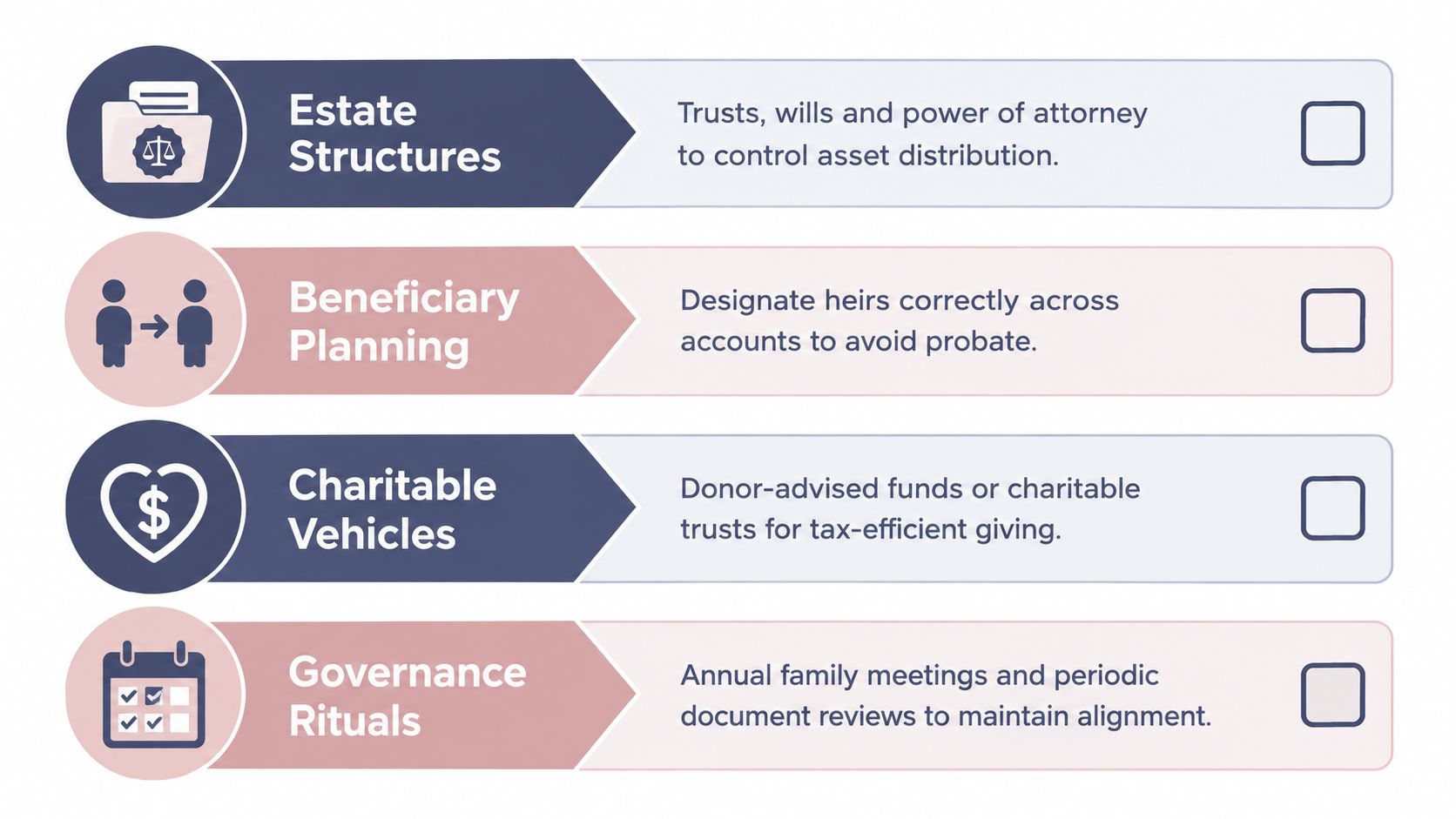
Legacy planning usually combines four elements:
Estate structures: Coordinate wills, revocable trusts, powers of attorney, business documents, and property ownership.
Beneficiary planning: Review beneficiary designations on retirement accounts, insurance policies, and other contracts so they align with the broader plan.
Charitable vehicles: Donor-advised funds, charitable remainder trusts, and family foundations can help convert appreciated or concentrated assets into purposeful giving, subject to professional advice.
Governance rituals: Hold family meetings, document investment principles, and review the plan when relationships, laws, assets, or goals change.
Lifetime gifting can shift future appreciation out of an estate, but the rules, exclusions, valuations, and reporting requirements are technical. A family might create a structured gift schedule for grandchildren's 529 plans, transition a rental portfolio into a family LLC, or use a charitable lead trust to balance philanthropy with inheritance. Those are planning concepts, not do-it-yourself templates.
Legacy principle: Heirs need preparation before they receive assets, not instructions after the transfer.
Preparation can include age-appropriate financial education, discussions about debt and investing, and a written investment policy statement explaining objectives, liquidity needs, diversification limits, and decision-making authority. Family members who understand why assets are held are more likely to preserve the strategy rather than liquidate it impulsively.
The transfer also needs practical liquidity. A rental portfolio may require reserves for repairs and taxes. A private company may need a buy-sell agreement. A charitable commitment may require a funding schedule. These details determine whether a family can keep productive assets intact or must sell them under pressure.
Richard Maize's public platform reflects the connection between investment, entrepreneurship, and philanthropy. His own profile describes him as a Los Angeles-based real estate investor, entrepreneur, and philanthropist with more than 30 years of experience in real estate and finance, as stated on the Richard Maize website. That combination points to the central lesson of long-term wealth building: assets matter, but the structures around them determine how long their benefits last.
Richard Maize offers perspectives and opportunities connected to real estate acquisition, property management, finance, private equity, venture capital, and philanthropy. Visit Richard Maize to explore practical investing insights and learn how his work can help you think more clearly about building, protecting, and transferring wealth.
Comments